
Regulatory barriers for the circular economy Recycling of
Regulatory barriers for the circular economy Recycling of packaging for food and beverages – plastics and polymers thinkstep & Wuppertal Institute, Margarida Gama (thinkstep)
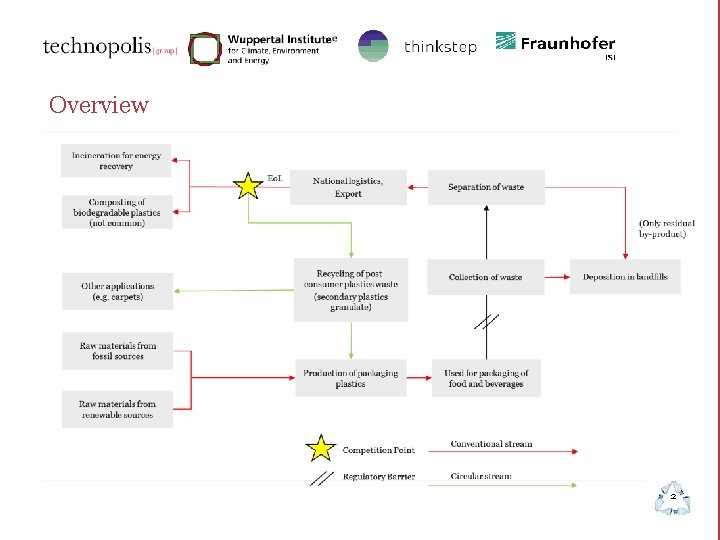
Overview 2

Main regulatory barrier • Lacking implementation of the waste hierarchy (Directive 2008/98/EC on waste - Waste Framework Directive - WFD) PRODUCT (NON-WASTE) WASTE PREVENTION PREPARING FOR RE-USE RECYCLING RECOVERY DISPOSAL 3
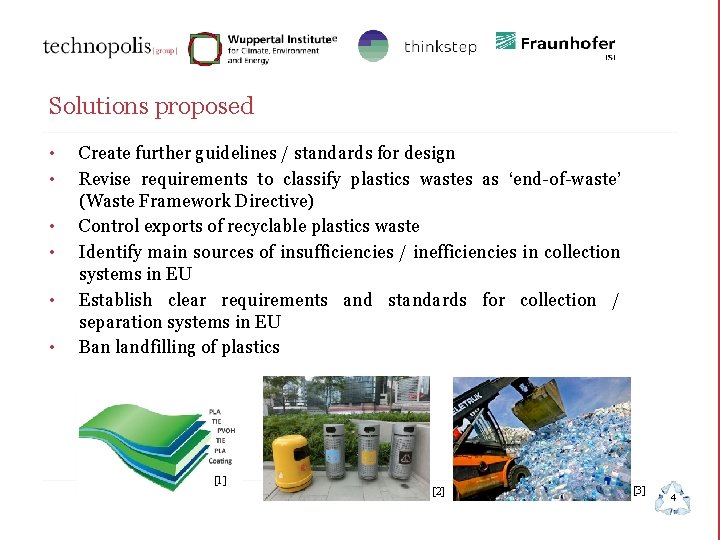
Solutions proposed • • • Create further guidelines / standards for design Revise requirements to classify plastics wastes as ‘end-of-waste’ (Waste Framework Directive) Control exports of recyclable plastics waste Identify main sources of insufficiencies / inefficiencies in collection systems in EU Establish clear requirements and standards for collection / separation systems in EU Ban landfilling of plastics [1] [2] [3] 4
![Effects of regulatory barrier • [4] Economic effects: • Costs and benefits depend on](http://slidetodoc.com/presentation_image_h2/24225faef326e2bc9774ad90dadfd5cf/image-5.jpg "Effects of regulatory barrier • [4] Economic effects: • Costs and benefits depend on")
Effects of regulatory barrier • [4] Economic effects: • Costs and benefits depend on Member-state and industry sector. General advantages of overcoming this barrier: • Producers: cost savings associate with the price of secondary granulates are estimated in app. 10% when compared with primary* • Collectors / separators: contributes to better allocate resources and to define potential funding to support implementation • Plastic recyclers: more stable input of plastics (quality, quantity) builds trust on investments for improving capabilities • Plastic incinerators: more stable input of goods to incinerate allows more precise prediction on the amounts of energy generated and (eventually) higher calorific content of the input * Based on the average prices for primary and secondary PE, PP and PS for 2013 5

Effects of regulatory barrier • Environmental effects: • Typically, recycling is better than incinerating • BUT, a holistic perspective on the whole life cycle of a product is essential (design!) • Considering the full life-cycle, the best option will have associated: Less exploitation of resources Less pollution (reduce littering / plastic debris) Lower emissions 6 [5] [6] [7]

Observations • In order to follow the waste hierarchy in the Waste Framework Directive, further regulation has to be considered • Different stakeholders positions must be heard and supported • All the phases of the life cycle of plastics have to be considered and understood before decision making on regulation and establishing priorities [8] [9] [10] 7
![Thank you! Image Sources [1] http: //www. bio 4 map. eu/imagenes/imagen_about. png [2] https:](http://slidetodoc.com/presentation_image_h2/24225faef326e2bc9774ad90dadfd5cf/image-8.jpg "Thank you! Image Sources [1] http: //www. bio 4 map. eu/imagenes/imagen_about. png [2] https:")
Thank you! Image Sources [1] http: //www. bio 4 map. eu/imagenes/imagen_about. png [2] https: //upload. wikimedia. org/wikipedia/commons/9/91/HK_Admiralty_Tamar_Park_s_Amphitheatre_refuse_waste collection_bins_May-2013. JPG [3] http: //planetsave. com/wp-content/uploads/2014/10/Plastic-bottles-being-landfilled. png [4] http: //www. advancissurgical. com/wp-content/uploads/2013/10/Hemosep_cost-of-platelets_cost-of-blood_postoperative-bleeding. jpg [5] http: //www. vlahovicgroup. com/wp-content/uploads/oil-gas. jpg [6] http: //www. uscnpm. org/wp-content/uploads/2015/09/carbon. jpg [7] http: //www. lifegate. com/app/uploads/busta-nelloceano. jpg [8] http: //www. utsa. edu/today/images/graphics/lawbooks. jpg [9] http: //www. damarque. com/sites/default/files/sites/all/themes/danland/images/upload/blog/Stakeholder-Management-Expert 1. jpg [10] http: //www. trinseo. com/-/media/Trinseo/Images/Sustainability/Sustainable-Operations/p 35 -life-cycle-logo. jpg? la=en 8
- Slides: 8