
Regulations for the Safe Transport of Radioactive Material
- Slides: 42
Regulations for the Safe Transport of Radioactive Material SSR-6 Module 2. 2 School for Drafting Regulations on Radiation Safety Module 2: Main Requirements on Emergency and Medical Exposure, Transport and Waste Safety 23 January 2017 Vienna, Austria Christopher S. Bajwa Transport Safety Unit Regulatory Infrastructure and Transport Safety Section Division of Radiation, Transport and Waste Safety Department of Nuclear Safety and Security International Atomic Energy Agency
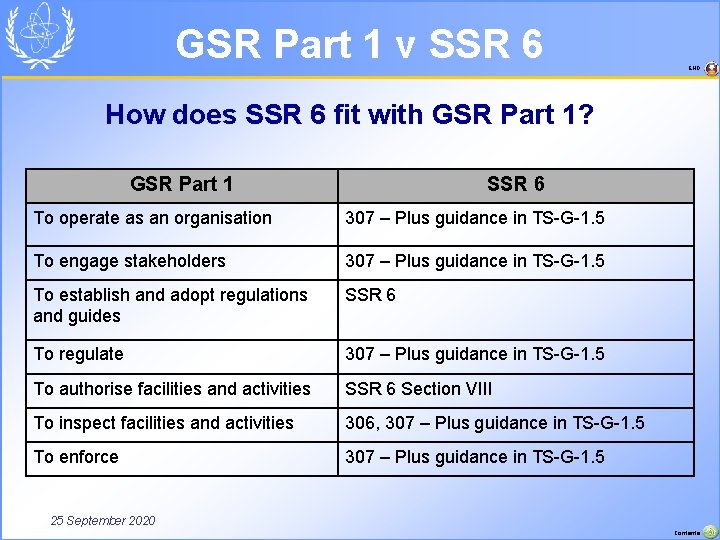
GSR Part 1 v SSR 6 END How does SSR 6 fit with GSR Part 1? GSR Part 1 SSR 6 To operate as an organisation 307 – Plus guidance in TS-G-1. 5 To engage stakeholders 307 – Plus guidance in TS-G-1. 5 To establish and adopt regulations and guides SSR 6 To regulate 307 – Plus guidance in TS-G-1. 5 To authorise facilities and activities SSR 6 Section VIII To inspect facilities and activities 306, 307 – Plus guidance in TS-G-1. 5 To enforce 307 – Plus guidance in TS-G-1. 5 25 September 2020 Contents
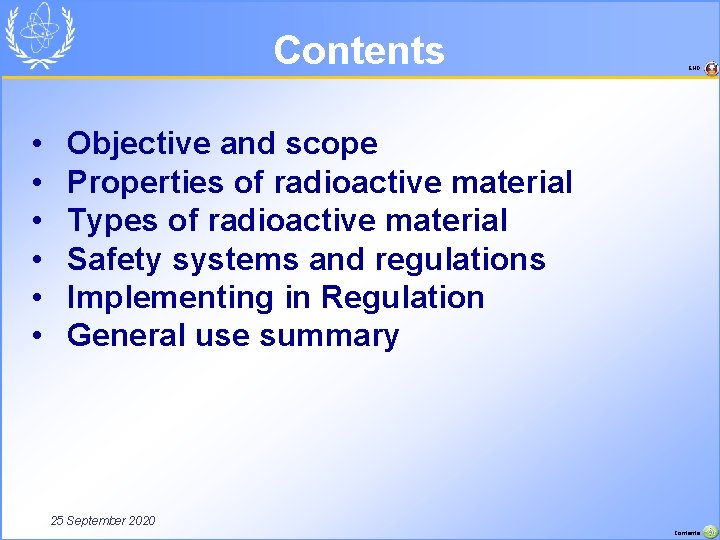
Contents • • • END Objective and scope Properties of radioactive material Types of radioactive material Safety systems and regulations Implementing in Regulation General use summary 25 September 2020 Contents
END Objective and scope 25 September 2020 Contents
Exclusions END • Radioactive material that is an integral part of the means of transport. • Radioactive material moved within an establishment that is subject to appropriate safety regulations in force in the establishment and where the movement does not involve public roads or railways. • Radioactive material implanted or incorporated into a person or live animal for diagnosis or treatment. • Radioactive material in or on a person who is to be transported for medical treatment because the person has been subject to accidental or deliberate intake of radioactive material or to contamination. 25 September 2020 Contents
Exclusions END • Radioactive material in consumer products that have received regulatory approval, following their sale to the end user. • Natural material and ores containing naturally occurring radionuclides, which may have been processed, provided the activity concentration of the material does not exceed 10 times the values specified in Table 2, or. . . • Non-radioactive solid objects with radioactive substances present on any surface in quantities not in excess of the levels defined 25 September 2020 Contents
Objective END The objective of these Regulations is to establish requirements that must be satisfied to ensure safety and to protect persons, property and the environment from the effects of radiation in the transport of radioactive material. 25 September 2020 Contents
Objective END This protection is achieved by requiring: a) Containment of the radioactive contents; b) Control of external radiation levels; c) Prevention of criticality; d) Prevention of damage caused by heat. 25 September 2020 Contents
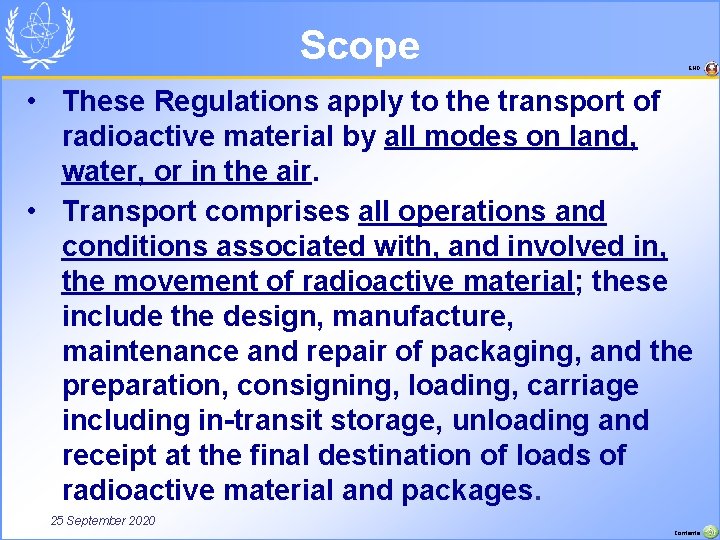
Scope END • These Regulations apply to the transport of radioactive material by all modes on land, water, or in the air. • Transport comprises all operations and conditions associated with, and involved in, the movement of radioactive material; these include the design, manufacture, maintenance and repair of packaging, and the preparation, consigning, loading, carriage including in-transit storage, unloading and receipt at the final destination of loads of radioactive material and packages. 25 September 2020 Contents
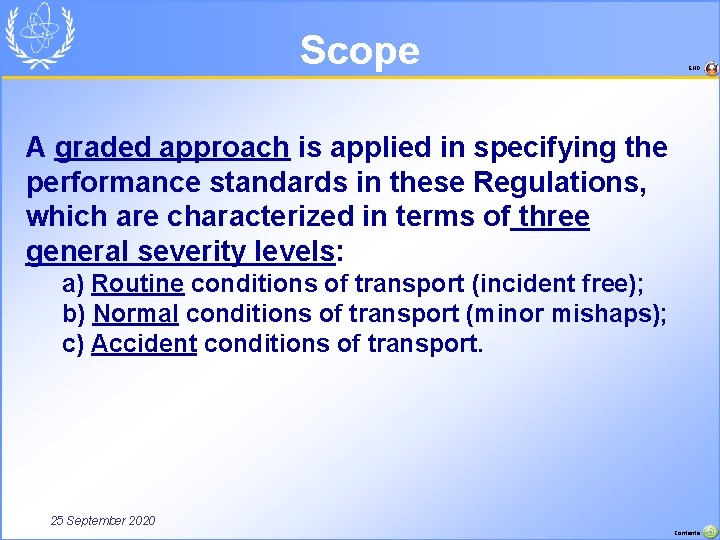
Scope END A graded approach is applied in specifying the performance standards in these Regulations, which are characterized in terms of three general severity levels: a) Routine conditions of transport (incident free); b) Normal conditions of transport (minor mishaps); c) Accident conditions of transport. 25 September 2020 Contents
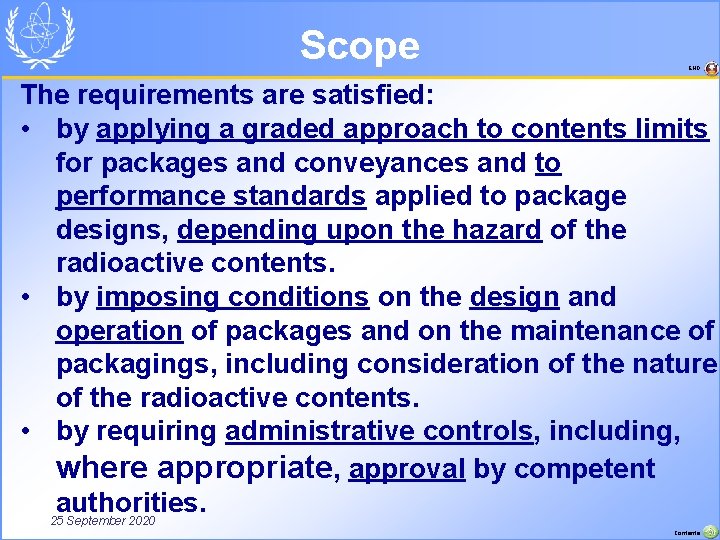
Scope END The requirements are satisfied: • by applying a graded approach to contents limits for packages and conveyances and to performance standards applied to package designs, depending upon the hazard of the radioactive contents. • by imposing conditions on the design and operation of packages and on the maintenance of packagings, including consideration of the nature of the radioactive contents. • by requiring administrative controls, including, where appropriate, approval by competent authorities. 25 September 2020 Contents
END Properties of radioactive material 25 September 2020 Contents
A 1 and A 2 Hazard index END • For direct radiation in transport – A 1 • For radiotoxicity in transport – A 2 • Maximum exposure in any accident for workers and public around 50 m. Sv • Most exposed person expected to have very small increase in risk of death over their lifetime, and • effectively no chance of acute death , even in the most severe accidents (from the radioactive material). 25 September 2020 Contents
Fissile material END • Only applies to nuclear material – Once a “critical” amount of material is in one place a lethal amount of radiation is released – Exceptions for certain amounts and types of material – otherwise strict approval 25 September 2020 Contents
END Types of radioactive material 25 September 2020 Contents
Transport categories of radioactive material END • Low Specific Activity (LSA) • Surface Contaminated Object (SCO) • Special Form (SF) – sometimes SFRM – (consider also LDRM) • Uranium Hexafluoride • Fissile Material • Radioactive Material 25 September 2020 Contents
LSA and SCO END • LSA – Radioactive Material dispersed in nonradioactive material – Low concentration limits hazard – Three categories • SCO – Radioactive Material in low concentrations on the surface of a non-radioactive object – Low surface concentration limits hazard – Two categories 25 September 2020 Contents
Special Form Radioactive Material END • Material in a solid form that is difficult to disperse • Tested and certified against accident conditions (impact and fire) • Usually contained in non-radioactive metal sheath – NOTE – LDRM 25 September 2020 Contents
Uranium Hexafluoride END • Has other hazardous properties – UN Class 6, with 8 and 7 subsidiary • Can produce HF when exposed to water 25 September 2020 Contents
Fissile material END • Has potential for critical mass to be formed – requires control of accumulation • Certain types safe because of low concentration or other reasons (often described as “fissile excepted”) 25 September 2020 Contents
Radioactive Material END • Generally regulated based on quantity • Some exceptions related to very low quantities (empty packages, instruments or articles etc. ) • Special form and fissile material can be a sub-category 25 September 2020 Contents
END Safety systems and regulations 25 September 2020 Contents
UN number END • Classification process depends on: – – – Uranium Hexafluoride? Fissile? Excepted Package? LSA or SCO? Type A Quantity? Package certificate? 25 September 2020 Contents
Safety system based on hazard END • Graded approach, as hazard increases – Higher package standard – More controls during transport – More regulatory control before shipment • Graded approach aims to limit exposure to 50 m. Sv in the event of an accident by: – – Material specification Packaging standards Conveyance limitations Administrative controls • Continuous review to ensure this is achieved 25 September 2020 Contents
Package standard END • Packages graded to limit possible exposure of workers and public – – Unpackaged Excepted Package Industrial Package Type A Package (designed to withstand normal rough handling) – Type B Package (designed to survive severe accident) – Type C Package (designed to survive severe air accident) 25 September 2020 Contents
Package standard END • Maximum exposure in any accident for workers and public around 50 m. Sv – Most exposed person expected to have much less than a 1% increase in risk of death over their lifetime, and effectively no chance of acute death (within 60 days), even in the most severe accidents (from the radioactive material). 25 September 2020 Contents
Controls during transport END • Pre-shipment checks (graded approach) • Normal controls (excepted package has some different controls), examples – Contamination, labels, marks, placards, Transport Index, documentation, segregation etc. • Category I, II or III labels relates to the direct radiation hazard close to the package • Transport Index relates to the direct radiation hazard at a distance from the package • Special control – exclusive use – all aspects of shipment controlled from start to finish by a single consignor or consignee 25 September 2020 Contents
Regulatory oversight END • Certain materials require pre approval • Certain packages require pre approval • Some approvals only needed in country of origin, others in all states of transit • Some shipments require notification of all transit states 25 September 2020 Contents
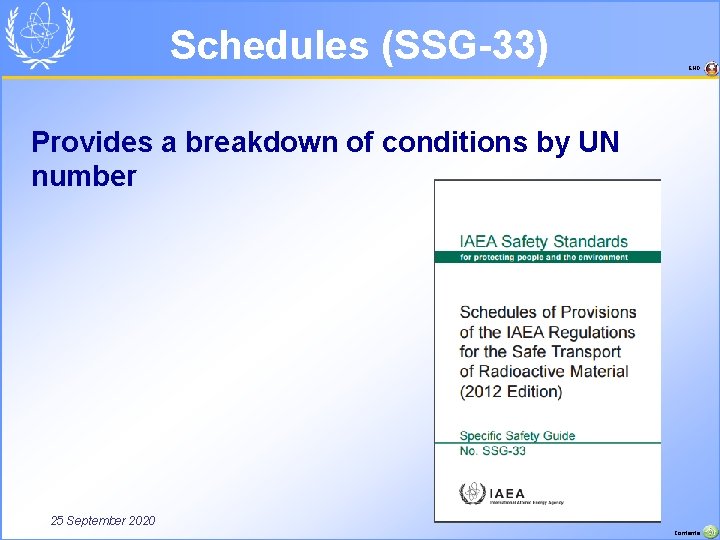
Schedules (SSG-33) END Provides a breakdown of conditions by UN number 25 September 2020 Contents
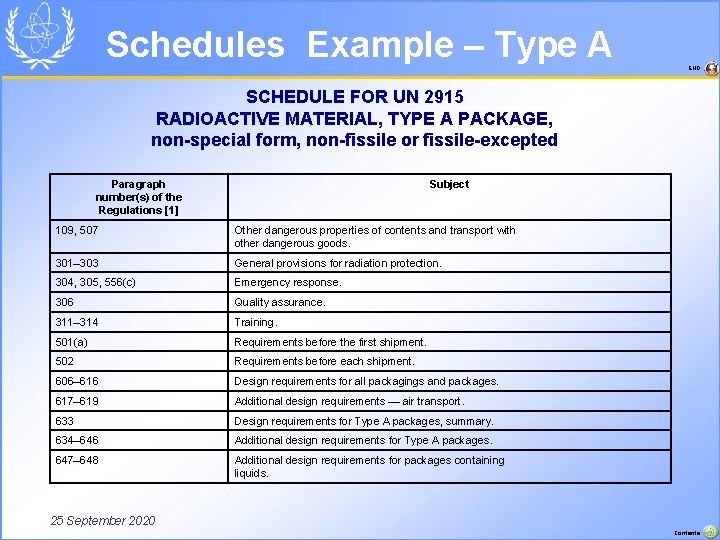
Schedules Example – Type A END SCHEDULE FOR UN 2915 RADIOACTIVE MATERIAL, TYPE A PACKAGE, non-special form, non-fissile or fissile-excepted Paragraph number(s) of the Regulations [1] Subject 109, 507 Other dangerous properties of contents and transport with other dangerous goods. 301– 303 General provisions for radiation protection. 304, 305, 556(c) Emergency response. 306 Quality assurance. 311– 314 Training. 501(a) Requirements before the first shipment. 502 Requirements before each shipment. 606– 616 Design requirements for all packagings and packages. 617– 619 Additional design requirements — air transport. 633 Design requirements for Type A packages, summary. 634– 646 Additional design requirements for Type A packages. 647– 648 Additional design requirements for packages containing liquids. 25 September 2020 Contents
END Implementing in Regulation 25 September 2020 Contents
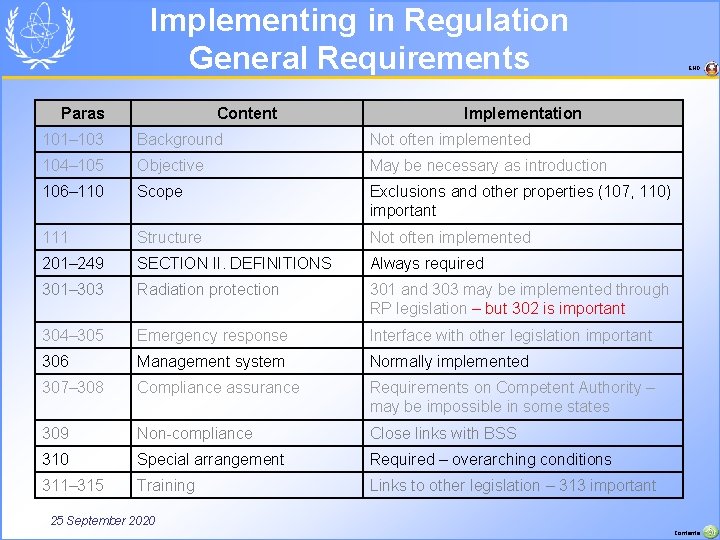
Implementing in Regulation General Requirements Paras Content END Implementation 101– 103 Background Not often implemented 104– 105 Objective May be necessary as introduction 106– 110 Scope Exclusions and other properties (107, 110) important 111 Structure Not often implemented 201– 249 SECTION II. DEFINITIONS Always required 301– 303 Radiation protection 301 and 303 may be implemented through RP legislation – but 302 is important 304– 305 Emergency response Interface with other legislation important 306 Management system Normally implemented 307– 308 Compliance assurance Requirements on Competent Authority – may be impossible in some states 309 Non-compliance Close links with BSS 310 Special arrangement Required – overarching conditions 311– 315 Training Links to other legislation – 313 important 25 September 2020 Contents
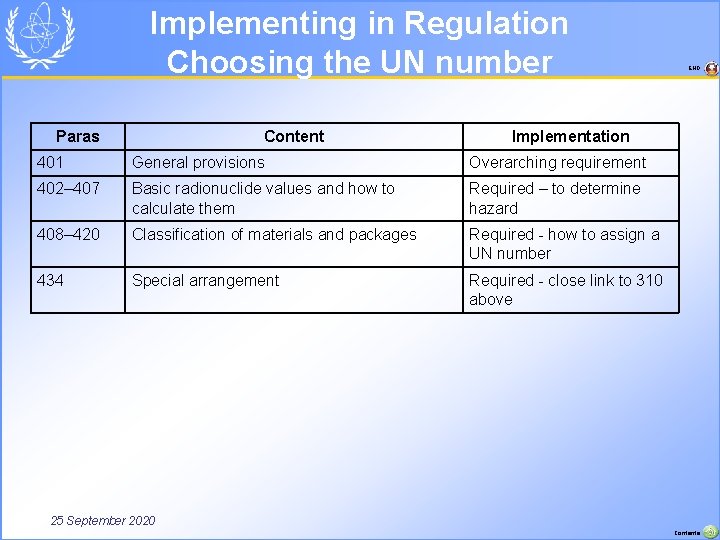
Implementing in Regulation Choosing the UN number Paras Content END Implementation 401 General provisions Overarching requirement 402– 407 Basic radionuclide values and how to calculate them Required – to determine hazard 408– 420 Classification of materials and packages Required - how to assign a UN number 434 Special arrangement Required - close link to 310 above 25 September 2020 Contents
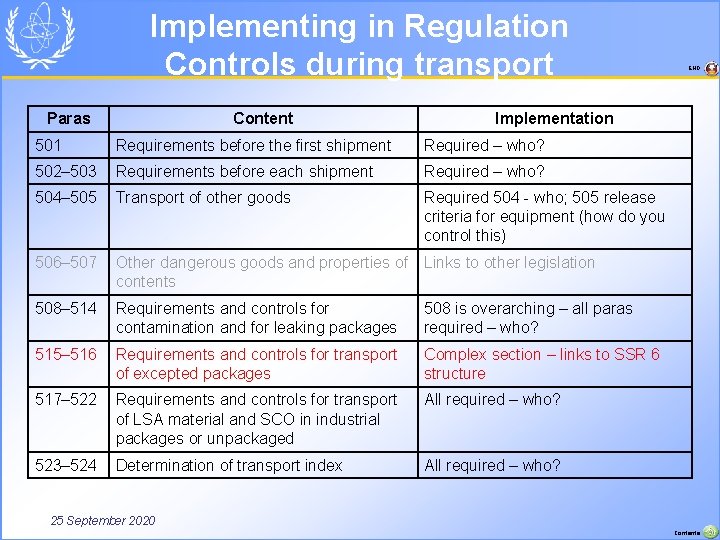
Implementing in Regulation Controls during transport Paras Content END Implementation 501 Requirements before the first shipment Required – who? 502– 503 Requirements before each shipment Required – who? 504– 505 Transport of other goods Required 504 - who; 505 release criteria for equipment (how do you control this) 506– 507 Other dangerous goods and properties of Links to other legislation contents 508– 514 Requirements and controls for contamination and for leaking packages 508 is overarching – all paras required – who? 515– 516 Requirements and controls for transport of excepted packages Complex section – links to SSR 6 structure 517– 522 Requirements and controls for transport of LSA material and SCO in industrial packages or unpackaged All required – who? 523– 524 Determination of transport index All required – who? 25 September 2020 Contents
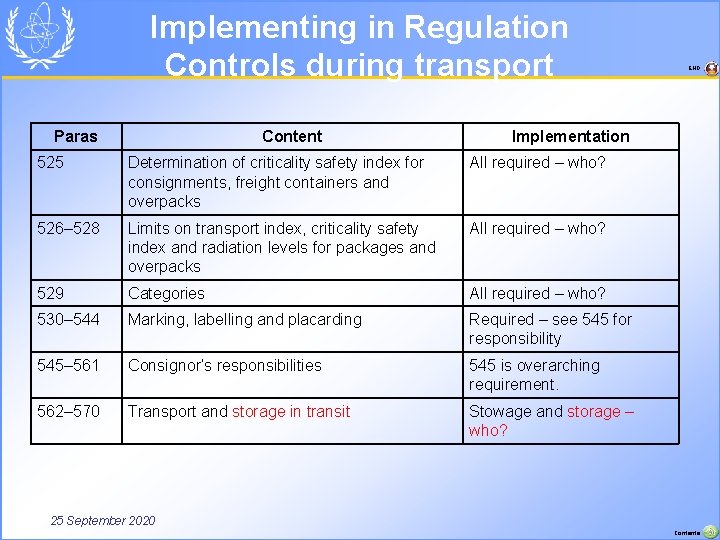
Implementing in Regulation Controls during transport Paras Content END Implementation 525 Determination of criticality safety index for consignments, freight containers and overpacks All required – who? 526– 528 Limits on transport index, criticality safety index and radiation levels for packages and overpacks All required – who? 529 Categories All required – who? 530– 544 Marking, labelling and placarding Required – see 545 for responsibility 545– 561 Consignor’s responsibilities 545 is overarching requirement. 562– 570 Transport and storage in transit Stowage and storage – who? 25 September 2020 Contents
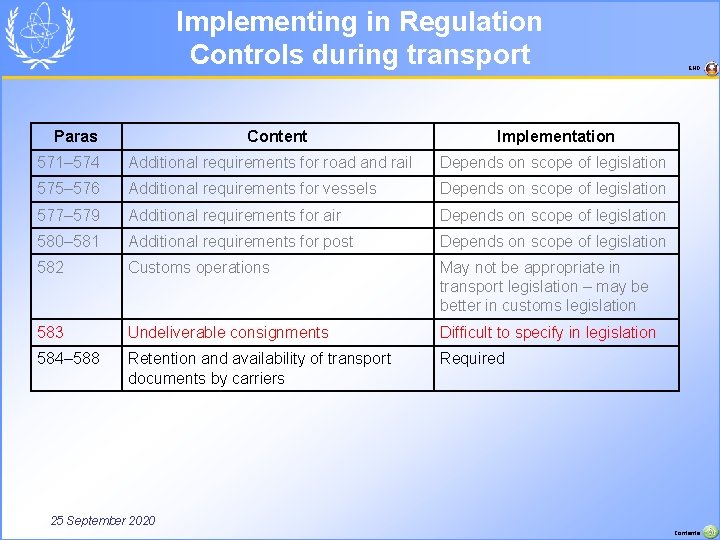
Implementing in Regulation Controls during transport Paras Content END Implementation 571– 574 Additional requirements for road and rail Depends on scope of legislation 575– 576 Additional requirements for vessels Depends on scope of legislation 577– 579 Additional requirements for air Depends on scope of legislation 580– 581 Additional requirements for post Depends on scope of legislation 582 Customs operations May not be appropriate in transport legislation – may be better in customs legislation 583 Undeliverable consignments Difficult to specify in legislation 584– 588 Retention and availability of transport documents by carriers Required 25 September 2020 Contents
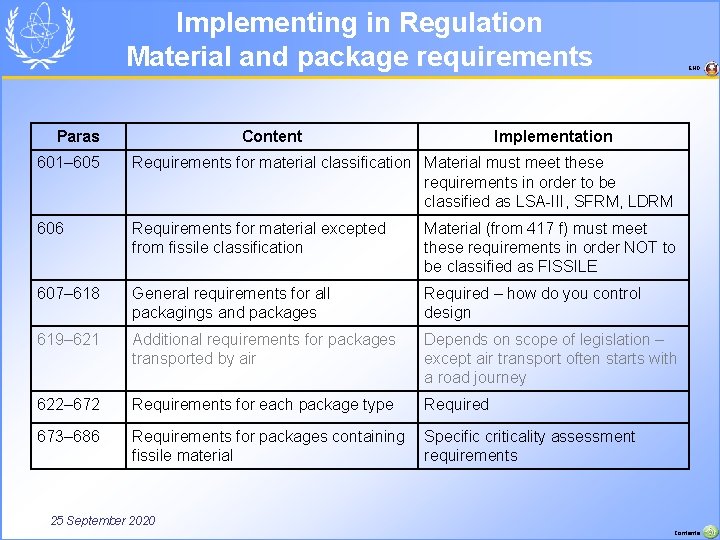
Implementing in Regulation Material and package requirements Paras Content END Implementation 601– 605 Requirements for material classification Material must meet these requirements in order to be classified as LSA-III, SFRM, LDRM 606 Requirements for material excepted from fissile classification Material (from 417 f) must meet these requirements in order NOT to be classified as FISSILE 607– 618 General requirements for all packagings and packages Required – how do you control design 619– 621 Additional requirements for packages transported by air Depends on scope of legislation – except air transport often starts with a road journey 622– 672 Requirements for each package type Required 673– 686 Requirements for packages containing fissile material Specific criticality assessment requirements 25 September 2020 Contents
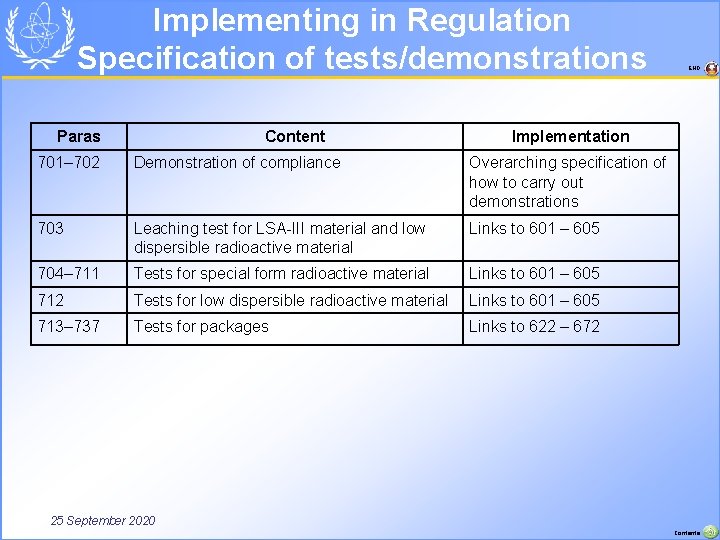
Implementing in Regulation Specification of tests/demonstrations Paras Content END Implementation 701– 702 Demonstration of compliance Overarching specification of how to carry out demonstrations 703 Leaching test for LSA-III material and low dispersible radioactive material Links to 601 – 605 704– 711 Tests for special form radioactive material Links to 601 – 605 712 Tests for low dispersible radioactive material Links to 601 – 605 713– 737 Tests for packages Links to 622 – 672 25 September 2020 Contents
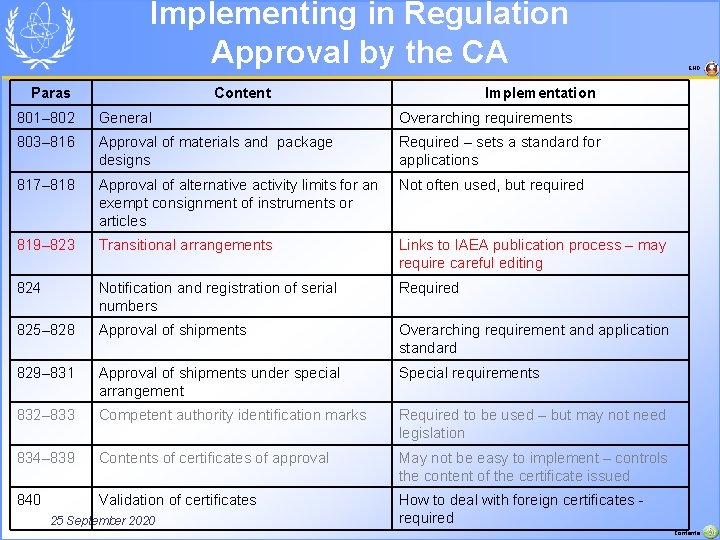
Implementing in Regulation Approval by the CA Paras Content Implementation 801– 802 General Overarching requirements 803– 816 Approval of materials and package designs Required – sets a standard for applications 817– 818 Approval of alternative activity limits for an exempt consignment of instruments or articles Not often used, but required 819– 823 Transitional arrangements Links to IAEA publication process – may require careful editing 824 Notification and registration of serial numbers Required 825– 828 Approval of shipments Overarching requirement and application standard 829– 831 Approval of shipments under special arrangement Special requirements 832– 833 Competent authority identification marks Required to be used – but may not need legislation 834– 839 Contents of certificates of approval May not be easy to implement – controls the content of the certificate issued 840 Validation of certificates How to deal with foreign certificates required 25 September 2020 END Contents
END General use summary 25 September 2020 Contents
Normal transport of radioactive material END • Excepted packages make up most shipments – these are intended to be treated like general cargo packages • Type A packages carry the majority of the rest of the shipments – often medical shipments • It is unusual for normal transport operators to come across fissile material, uranium hexafluoride, special form, LSA or SCO • Industrial packages carry LSA and SCO – these tend to be large volume, heavy weight shipments • Fissile material normally has special security requirements and so normally has special carriers 25 September 2020 Contents
Questions? END Thank you 25 September 2020 50 Contents