
Regulation of Rubisco Introduction Rubisco stand for ribulose
Regulation of Rubisco
Introduction • • • Rubisco stand for ribulose 1, 5 -bisphosphate carboxylase/oxygenase which catalyzes the carboxylation of ribulose-1, 5 -bisphosphate (Ru. BP) or say that it convert CO 2 into glucose (energy rich molecule) by the process of photosynthesis in plants. Rubisco enzyme is the most abundant protein (16%) in plants and on earth and a major sink for plant nitrogen. It has been widely accepted as the ultimate rate limiting step in carbon fixation during photosynthesis. Present in stroma of chloroplast in plants. Turn over number is very low that is 3 and 10 molecules per second. May be significant in Carbon fixation in plants while insignificant as it bind with oxygen during photorespiration.
Rubisco • Ribulose-1, 5 -bisphosphate carboxylase/oxygenase (Rubisco) • It is one the important enzyme which perform the first major step of carbon fixation in C 3 plants. • In this process the atmospheric CO 2 is converted to energy rich molecules such as glucose by plants. • In chemical terms, it catalyzes the carboxylation of ribulose-1, 5 -bisphosphate (Ru. BP).

Function of Rubisco
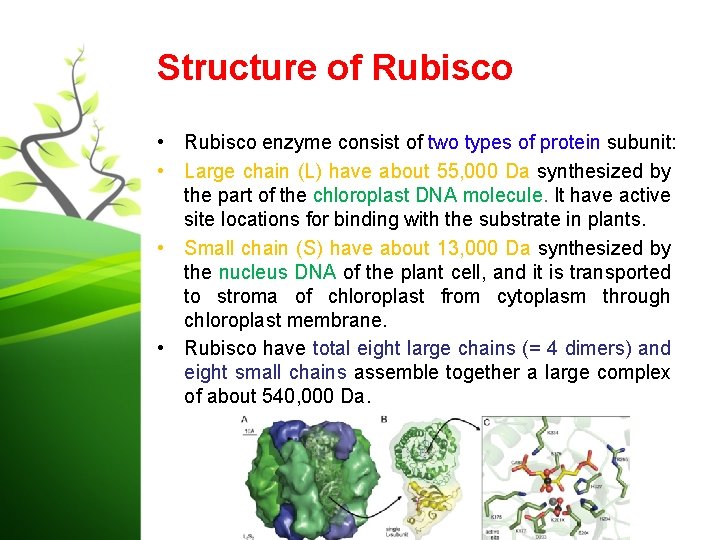
Structure of Rubisco • Rubisco enzyme consist of two types of protein subunit: • Large chain (L) have about 55, 000 Da synthesized by the part of the chloroplast DNA molecule. It have active site locations for binding with the substrate in plants. • Small chain (S) have about 13, 000 Da synthesized by the nucleus DNA of the plant cell, and it is transported to stroma of chloroplast from cytoplasm through chloroplast membrane. • Rubisco have total eight large chains (= 4 dimers) and eight small chains assemble together a large complex of about 540, 000 Da.
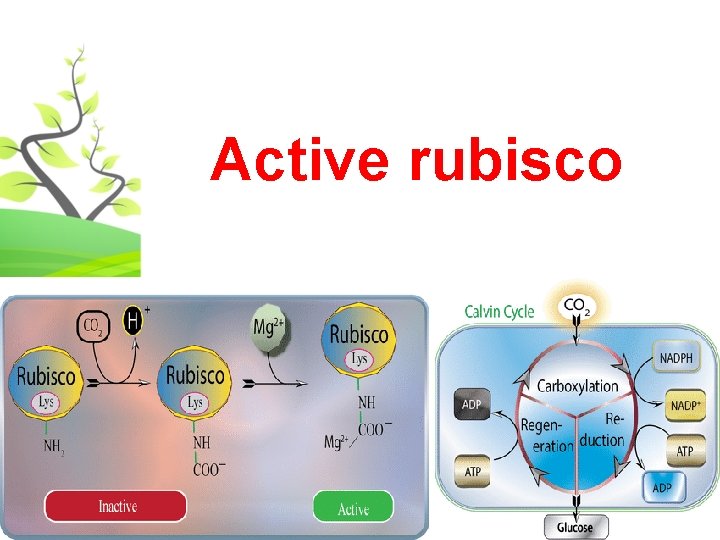
Rubisco activator • Magnesium ions (Mg+2): – The proper position of Mg+2 in active site of the enzyme involves addition of activating carbon dioxide molecule (CO 2) to a basic amino acid lysine in the active site. • CO 2 and O 2: – Rubisco can not perfectly differentiate between CO 2 and O 2 as they have similar shape and chemical properties.
Active rubisco
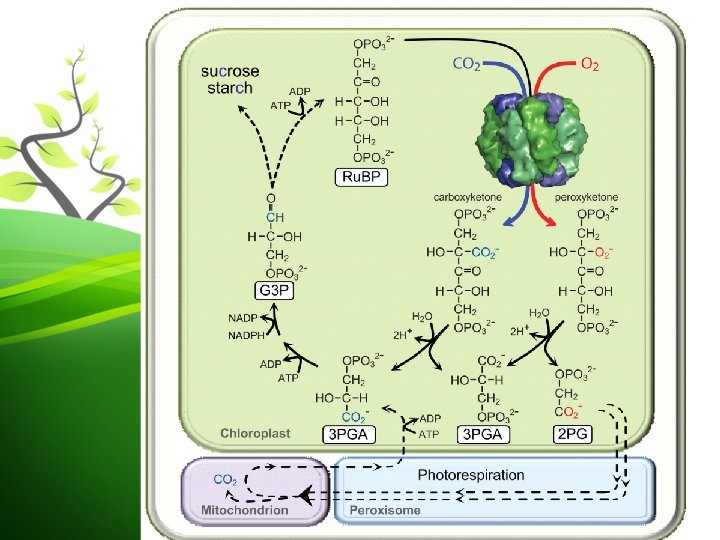
Rubsico function • CO 2 + ribulose-1, 5 -bisphosphate (Ru. BP) Rubisco Mg+2 2 -phosphoglyceric acid (PGA) – PGA a product of carboxylation, enter in Calvin cycle (C 3 cycle). – Rubisco catalyses CO 2 into glucose, as a part of dark reaction of calvin cycle in photosynthesis by using ATP and NADPH of light reaction. – Which further being reduced to glyceraldehyde-3 phosphate (G 3 P) or triose phosphate. – Five molecules out of six G 3 P were used to regenerate Ru. BP. – One molecule of triose phosphate often condense to form phosphates yield sucrose and then starch.
Photorespiration/ oxygenase activity • O 2 have higher binding capacity with Ru. BP Rubisco • O 2 + Ru. BP 3 -phosphoglycerate + Mg+2 2 -phosphoglycolate • Phosphoglycolate can inhibits many enzymes responsible in carbon fixation during photosynthesis. • Phosphoglycolate cannot converted directly into sugars, so an evil of C 3 plants known as photorespiration. • This process is a wastage of energy and reducing power (ATP and NADPH). • It also produce a reactive oxygen species like H 2 O 2 (hydrogen peroxide) while converting glycolate into glyoxylate takes place in peroxisome also utilize ATP and NADPH to bring back the substrate in the cycle.
- Slides: 10