
REGULATION OF PLASMID COPY NUMBER Plasmids must regulate
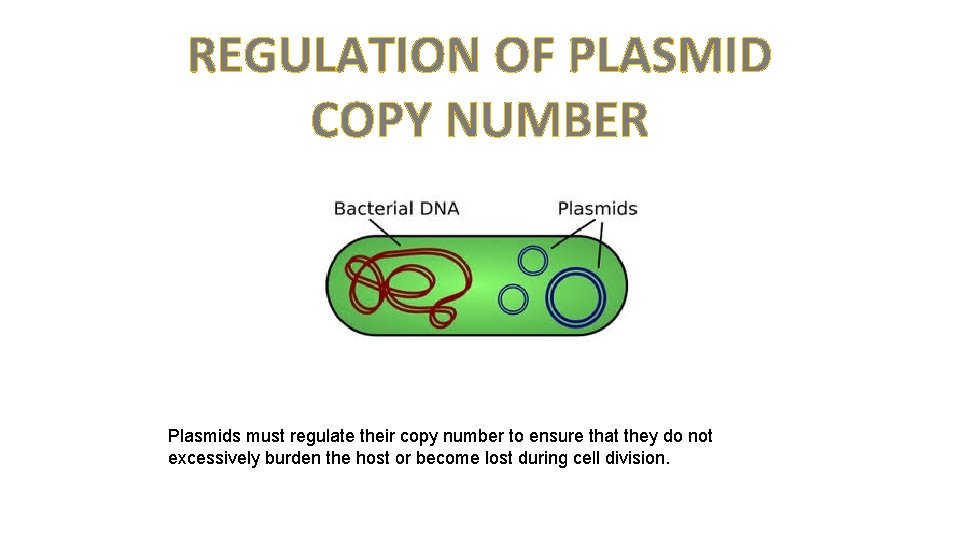
REGULATION OF PLASMID COPY NUMBER Plasmids must regulate their copy number to ensure that they do not excessively burden the host or become lost during cell division.
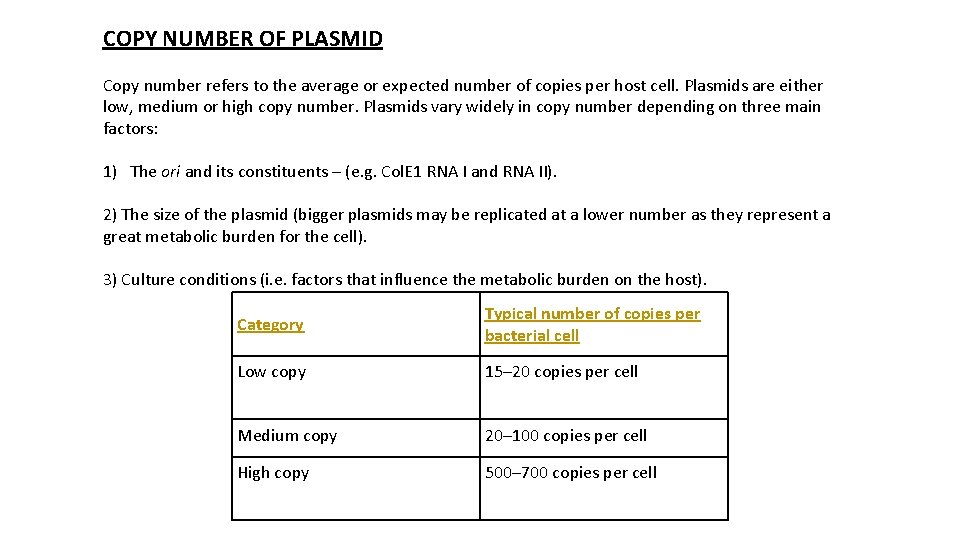
COPY NUMBER OF PLASMID Copy number refers to the average or expected number of copies per host cell. Plasmids are either low, medium or high copy number. Plasmids vary widely in copy number depending on three main factors: 1) The ori and its constituents – (e. g. Col. E 1 RNA I and RNA II). 2) The size of the plasmid (bigger plasmids may be replicated at a lower number as they represent a great metabolic burden for the cell). 3) Culture conditions (i. e. factors that influence the metabolic burden on the host). Category Typical number of copies per bacterial cell Low copy 15– 20 copies per cell Medium copy 20– 100 copies per cell High copy 500– 700 copies per cell
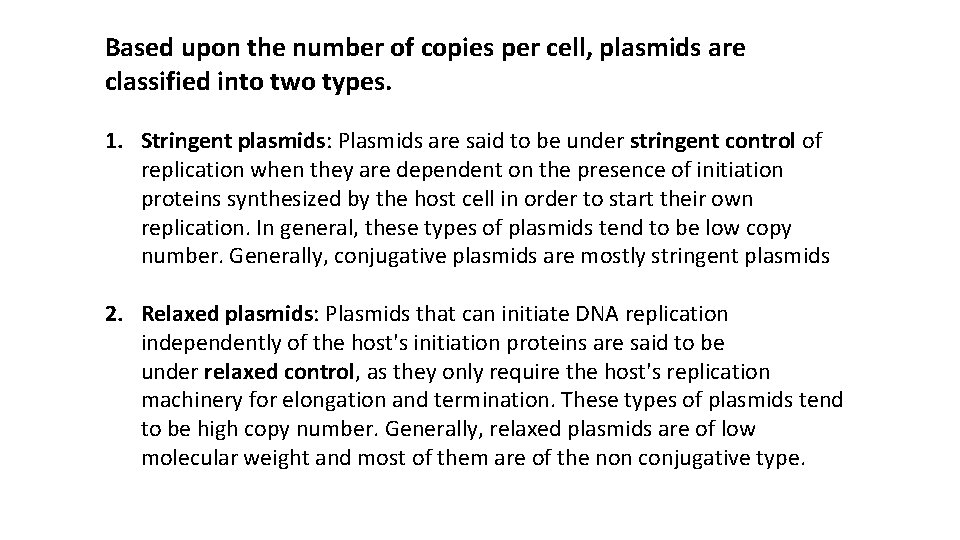
Based upon the number of copies per cell, plasmids are classified into two types. 1. Stringent plasmids: Plasmids are said to be under stringent control of replication when they are dependent on the presence of initiation proteins synthesized by the host cell in order to start their own replication. In general, these types of plasmids tend to be low copy number. Generally, conjugative plasmids are mostly stringent plasmids 2. Relaxed plasmids: Plasmids that can initiate DNA replication independently of the host's initiation proteins are said to be under relaxed control, as they only require the host's replication machinery for elongation and termination. These types of plasmids tend to be high copy number. Generally, relaxed plasmids are of low molecular weight and most of them are of the non conjugative type.
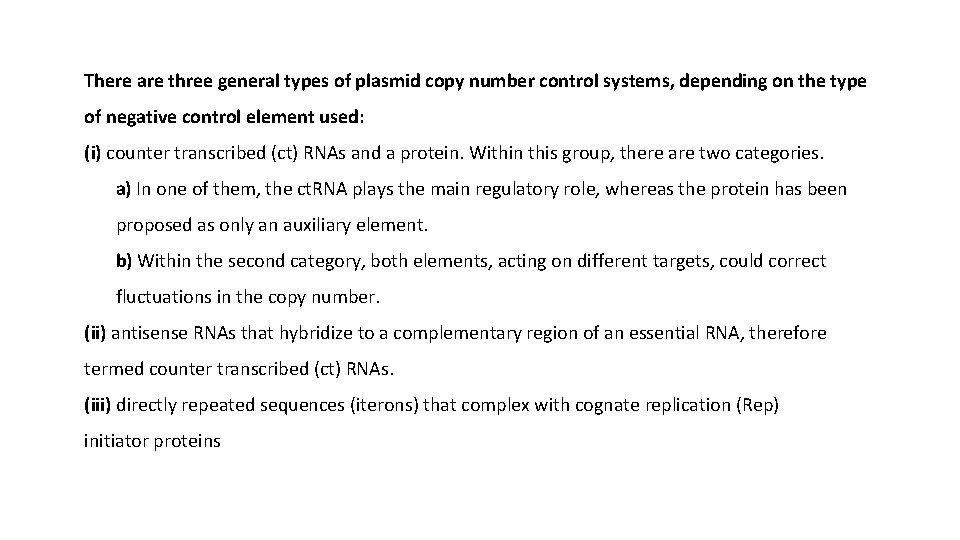
There are three general types of plasmid copy number control systems, depending on the type of negative control element used: (i) counter transcribed (ct) RNAs and a protein. Within this group, there are two categories. a) In one of them, the ct. RNA plays the main regulatory role, whereas the protein has been proposed as only an auxiliary element. b) Within the second category, both elements, acting on different targets, could correct fluctuations in the copy number. (ii) antisense RNAs that hybridize to a complementary region of an essential RNA, therefore termed counter transcribed (ct) RNAs. (iii) directly repeated sequences (iterons) that complex with cognate replication (Rep) initiator proteins
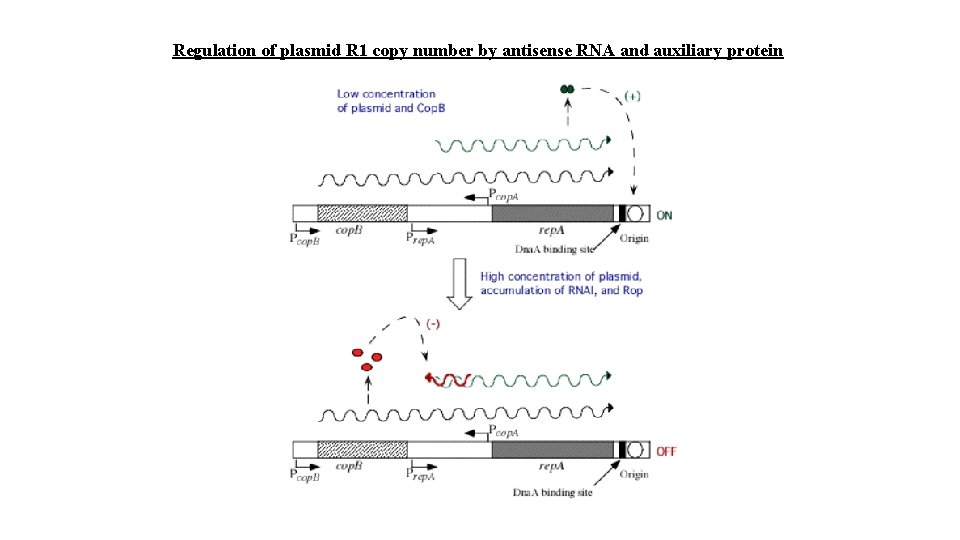
Regulation of plasmid R 1 copy number by antisense RNA and auxiliary protein
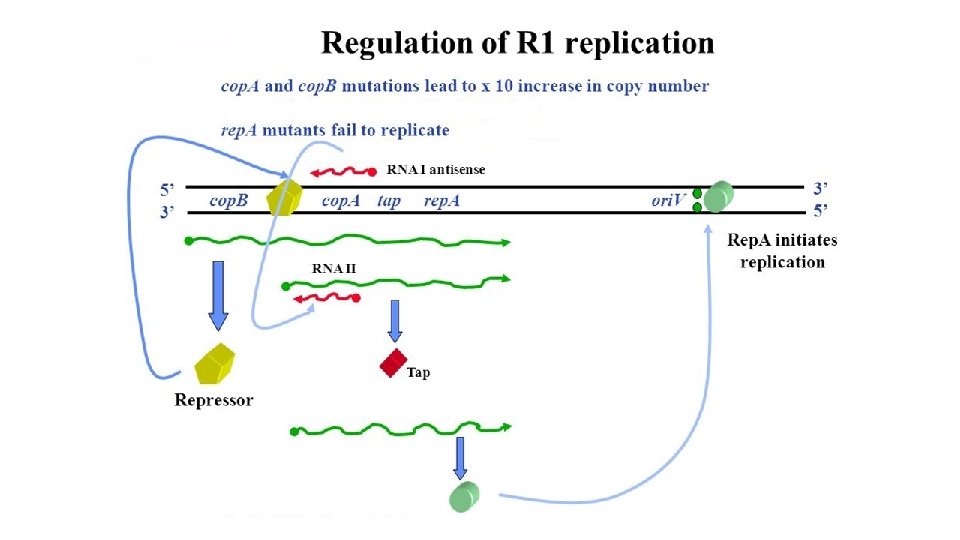
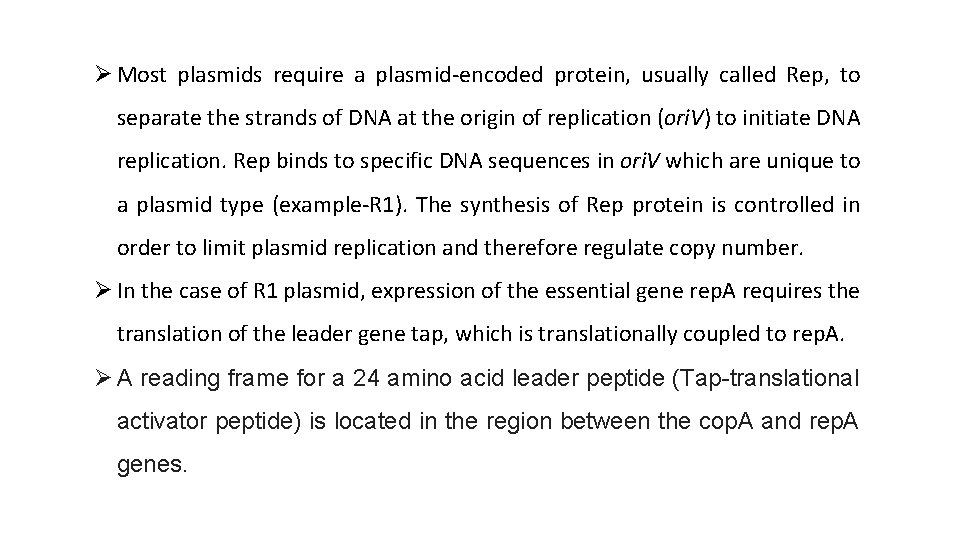
Ø Most plasmids require a plasmid‐encoded protein, usually called Rep, to separate the strands of DNA at the origin of replication (ori. V) to initiate DNA replication. Rep binds to specific DNA sequences in ori. V which are unique to a plasmid type (example‐R 1). The synthesis of Rep protein is controlled in order to limit plasmid replication and therefore regulate copy number. Ø In the case of R 1 plasmid, expression of the essential gene rep. A requires the translation of the leader gene tap, which is translationally coupled to rep. A. Ø A reading frame for a 24 amino acid leader peptide (Tap-translational activator peptide) is located in the region between the cop. A and rep. A genes.
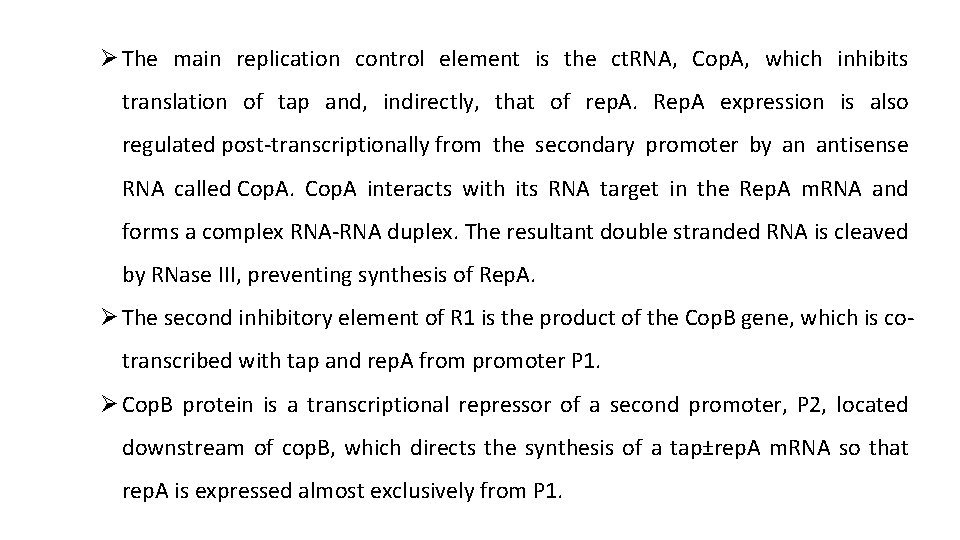
Ø The main replication control element is the ct. RNA, Cop. A, which inhibits translation of tap and, indirectly, that of rep. A. Rep. A expression is also regulated post‐transcriptionally from the secondary promoter by an antisense RNA called Cop. A interacts with its RNA target in the Rep. A m. RNA and forms a complex RNA‐RNA duplex. The resultant double stranded RNA is cleaved by RNase III, preventing synthesis of Rep. A. Ø The second inhibitory element of R 1 is the product of the Cop. B gene, which is co‐ transcribed with tap and rep. A from promoter P 1. Ø Cop. B protein is a transcriptional repressor of a second promoter, P 2, located downstream of cop. B, which directs the synthesis of a tap±rep. A m. RNA so that rep. A is expressed almost exclusively from P 1.
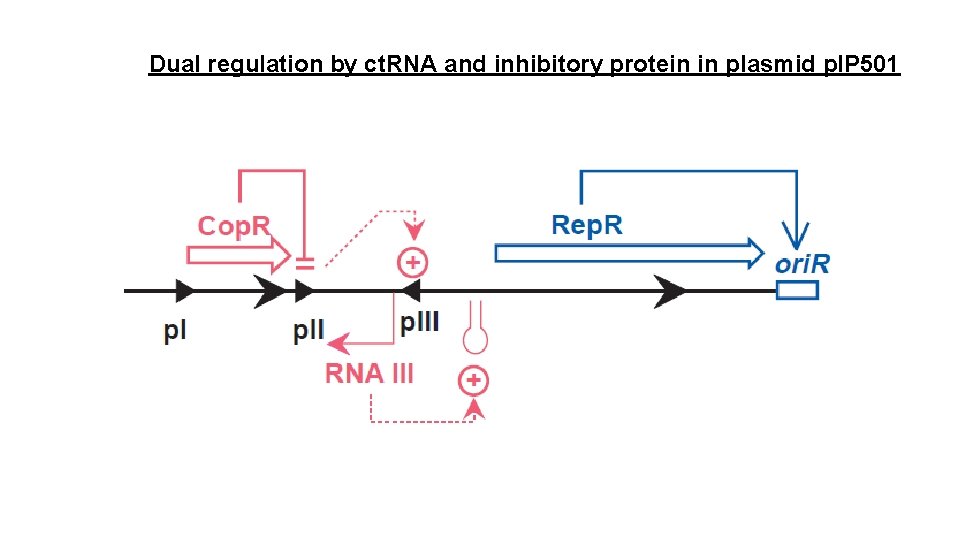
Dual regulation by ct. RNA and inhibitory protein in plasmid p. IP 501
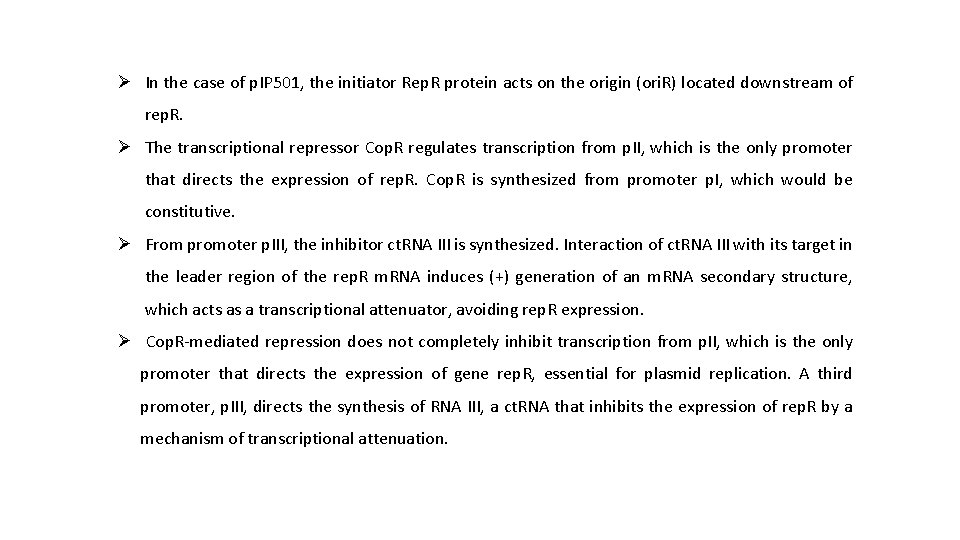
Ø In the case of p. IP 501, the initiator Rep. R protein acts on the origin (ori. R) located downstream of rep. R. Ø The transcriptional repressor Cop. R regulates transcription from p. II, which is the only promoter that directs the expression of rep. R. Cop. R is synthesized from promoter p. I, which would be constitutive. Ø From promoter p. III, the inhibitor ct. RNA III is synthesized. Interaction of ct. RNA III with its target in the leader region of the rep. R m. RNA induces (+) generation of an m. RNA secondary structure, which acts as a transcriptional attenuator, avoiding rep. R expression. Ø Cop. R‐mediated repression does not completely inhibit transcription from p. II, which is the only promoter that directs the expression of gene rep. R, essential for plasmid replication. A third promoter, p. III, directs the synthesis of RNA III, a ct. RNA that inhibits the expression of rep. R by a mechanism of transcriptional attenuation.
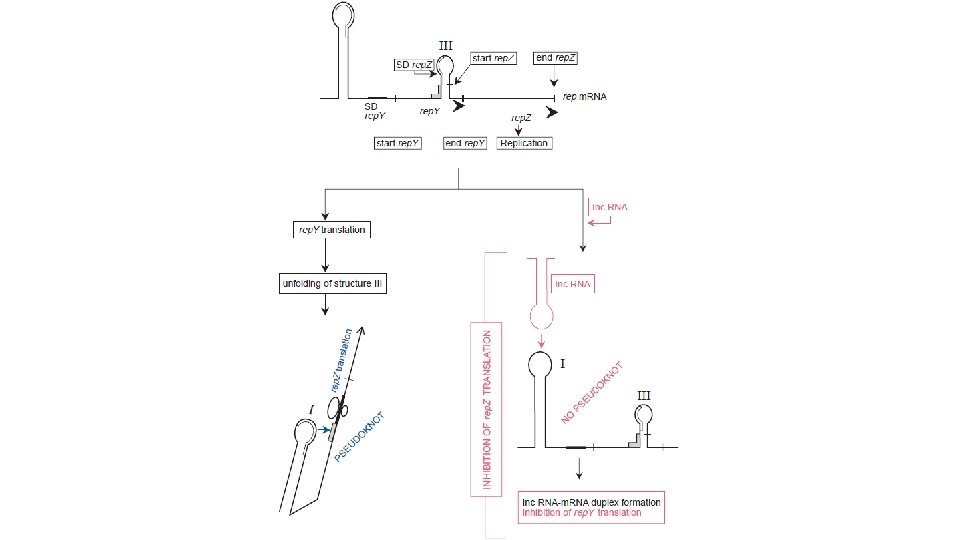
Copy number control by competition between pseudoknot formation and antisense RNA binding at a specific RNA site Ø Control of replication by pseudoknot formation in Col. Ib-P 9. Genes rep. Y (for leader peptide) and rep. Z (for initiator of replication) are translationally coupled. Ø On the m. RNA, the Shine±Dalgarno sequence (SD) of rep. Y is exposed, whereas the SD and the initiation codon of rep. Z can be occluded within structure III. Ø If there is no interaction with Inc RNA (left), rep. Y translation takes place. Stalled ribosomes at the end of rep. Y unfold structure III, allowing the formation of the pseudoknot between the region located on the loop of structure I (double lines) and its complementary region (stippled rectangle). Ø This facilitates binding of the ribosomes (ellipses) to the rep. Z SD sequences, followed by translation of rep. Z. Ø The antisense Inc RNA (right) would hinder pseudoknot formation and translation of rep. Y, leading to inhibition of rep. Z translation.
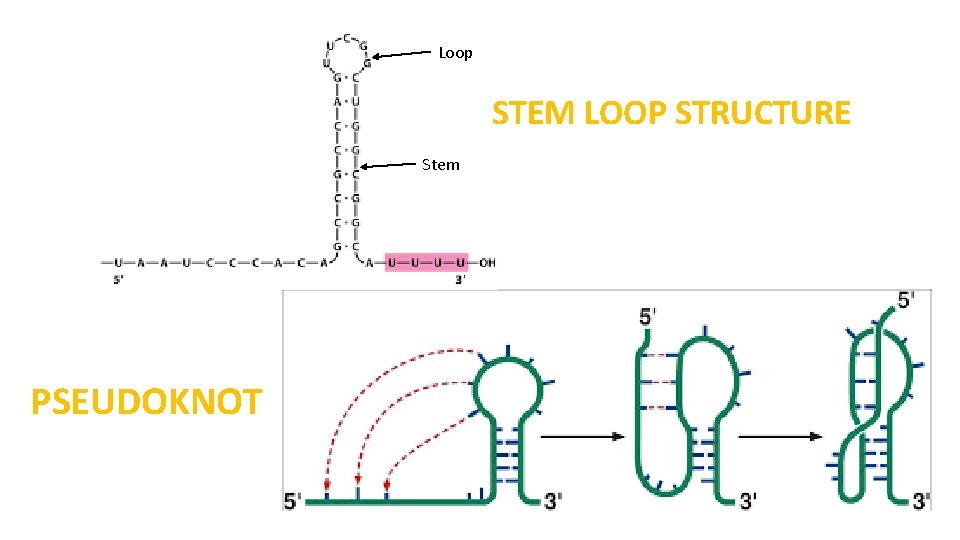
Loop STEM LOOP STRUCTURE Stem PSEUDOKNOT
ITERON MEDIATED COPY NUMBER CONTROL (HANDCUFFING) Iterons Ø Replication origins of a family of bacterial plasmids have multiple sites, called iterons, for binding a plasmid‐specific replication initiator protein. The iteron–initiator interactions are essential for plasmid replication as well as for inhibition of plasmid over‐replication. Ø Iterons are directly repeated DNA sequences present in the origin of replication in some plasmids, which play an important role in regulation of plasmid copy number in bacterial cells. Iterons represent Rep protein‐binding sites to initiate replication. Ø They are quite short sequences varying in no. of base pairs constituting the repeats (15‐ 76 bp) in different plasmids. Ø The iteron number and spacing between iterons also can differ among iteron‐containing plasmids.
![[1] Initiator protein monomers (at low cellular concentrations) activate origin of replication [2] Dimerization](http://slidetodoc.com/presentation_image/3c98c6742e06a0bbfcbecb24d888fecd/image-15.jpg "[1] Initiator protein monomers (at low cellular concentrations) activate origin of replication [2] Dimerization")
[1] Initiator protein monomers (at low cellular concentrations) activate origin of replication [2] Dimerization of protein at higher cellular concentrations [3] Transcriptional autorepression [4] Handcuffing
Limiting Factors of Initiation 1) Transcriptional autorepression that reduces initiator synthesis 2) Initiator dimerization that reduces the concentration of monomers, the form active in initiation 3) The monomeric forms of Rep. A that bind to iterons can subsequently bind through protein–protein interactions with other Rep. A monomer–iteron complexes, even those on sister plasmids. The result, called handcuffing, effectively ties up the plasmids, preventing movement of the replication fork. Ø As the cell volume increases, the Rep. A dimers disassociate and handcuffing decreases.
REFERENCES Ø https: //onlinelibrary. wiley. com/doi/full/10. 1046/j. 1365‐ 2958. 2000. 02005. x Ø https: //onlinelibrary. wiley. com/doi/full/10. 1111/j. 1365‐ 2958. 2006. 05229. x Ø Microbial physiology by Albert G. Moat, John W. Foster and Michael P. Spector
- Slides: 17