
Regulation of Digestion The activities of the digestive
- Slides: 15
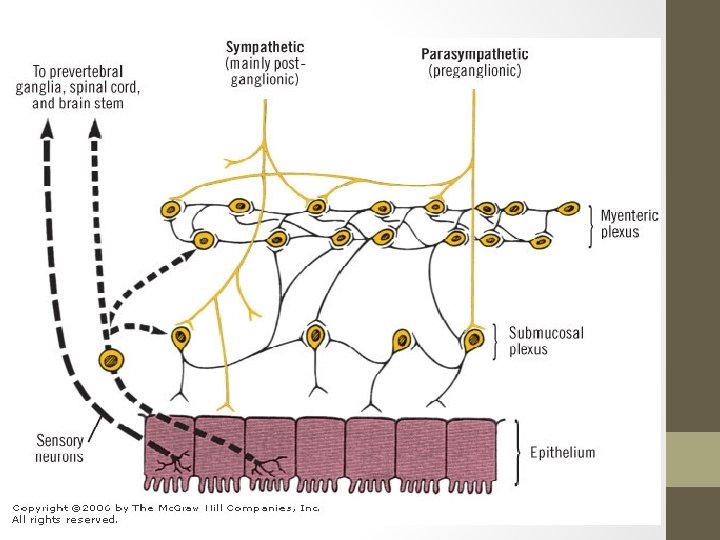
Regulation of Digestion The activities of the digestive system are regulated by both neural reflexes and hormones. Enteric nervous system: The gastrointestinal tract has a nervous system all its own called the enteric nervous system. It lies entirely in the wall of the gut, beginning in the esophagus and extending all the way to the anus. The number of neurons in this enteric system is about 100 million, almost exactly equal to the number in the entire spinal cord. This highly developed enteric nervous system is especially important in controlling gastrointestinal movements and secretion. The enteric nervous system is composed mainly of two plexuses (1) an outer plexus lying between the longitudinal and circular muscle layers, called the myenteric plexus or Auerbach’s plexus,
and (2) an inner plexus, called the submucosal plexus or Meissner’s plexus, that lies in the submucosa. The myenteric plexus controls mainly the gastrointestinal movements, and the submucosal plexus controls mainly gastrointestinal secretion and local blood flow. Although the enteric nervous system can function on its own, independently of these extrinsic nerves, stimulation by the parasympathetic and sympathetic systems can greatly enhance or inhibit gastrointestinal functions
Also there are sensory nerve endings that originate in the gastrointestinal epithelium or gut wall and send afferent fibers to both plexuses of the enteric system, as well as (1) to the prevertebral ganglia of the sympathetic nervous system, (2) to the spinal cord, and (3) in the vagus nerves all the way to the brain stem. These sensory nerves can elicit local reflexes within the gut wall itself and still other reflexes that are relayed to the gut from either the prevertebral ganglia or the basal regions of the brain.
The myenteric plexus should not be considered entirely excitatory because some of its neurons are inhibitory; their fiber endings secrete an inhibitory transmitter, possibly vasoactive intestinal polypeptide or some other inhibitory peptide. The resulting inhibitory signals are especially useful for inhibiting some of the intestinal sphincter muscles that impede movement of food along successive segments of the gastrointestinal tract, such as the pyloric sphincter, which controls emptying of the stomach into the duodenum, and the sphincter of the ileocecal valve, which controls emptying from the small intestine into the cecum.
The submucosal plexus, in contrast to the myenteric plexus, is mainly concerned with controlling function within the inner wall of each minute segment of the intestine. For instance, many sensory signals originate from the gastrointestinal epithelium and are then integrated in the submucosal plexus to help control local intestinal secretion, local absorption, and local contraction of the submucosal muscle that causes various degrees of infolding of the gastrointestinal mucosa.
The second regulatory agent of the digestive system is Hormonal regulation : Four important hormones and their effects on target cells follow: 1 - Gastrin : is produced by enteroendocrine cells(G cells) of the stomach mucosa. Effects include: - Stimulation of gastric juice (especially HCl) secretion by gastric glands. - Stimulation of smooth muscle contraction in the stomach, small intestine, and large intestine, which increases gastric and intestinal motility. - Relaxation of the pyloric sphincter, which promotes gastric emptying into the small intestine.
2 - Secretin: is produced by the enteroendocrine cells of the duodenal mucosa. Effects include: - Stimulation of bicarbonate secretion by the pancreas, which stabilizes the p. H of the chyme when released into the duodenum. - Stimulation of bile production by the liver. - Inhibition of gastric juice secretions and gastric motility, which in turn slows digestion in the stomach and retards gastric emptying.
3 - Cholecystokinin (CCK): is produced by the enteroendocrine cells of the duodenal mucosa. Effects include: - Stimulation of bile release by the gallbladder. - Stimulation of pancreatic juice secretion. - Relaxation of the hepatopancreatic ampulla and opening of the hepatopancreatic sphincter, which allows the flow of bile and pancreatic juices into the duodenum.
4 - Glucose insulinotropic peptide (GIP) is produced and released by the enteroendocrine cells of the duodenal mucosa in response to the presence of the glucose in the small intestine. This hormone - stimulates the pancreas to begin releasing insulin. Some researchers refer to this hormone as glucose‐dependent insulinotropic peptide (still maintaining the abbreviation of GIP; some also use GDIP).
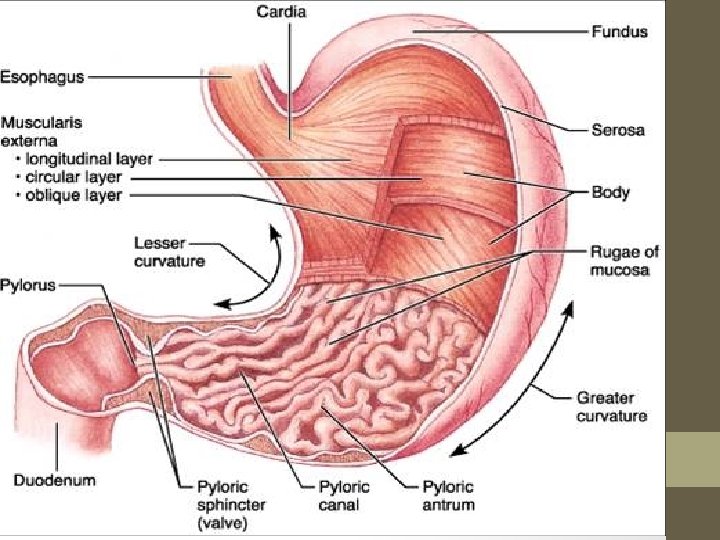
The stomach: • the stomach is a J shaped expanded bag, located just left of the midline between the oesophagus and small intestine. The stomach stores up to 2 liters of food • The functions of the stomach include: • The short-term storage of ingested food. • Mechanical breakdown of food by churning and mixing motions. • Chemical digestion of proteins by acids and enzymes. • Stomach acid kills germs. • Some absorption of substances such as alcohol. • Most of these functions are achieved by the secretion of stomach juices by gastric glands in the body and fundus. Some cells are responsible for secreting acid and others secrete enzymes to break down proteins.
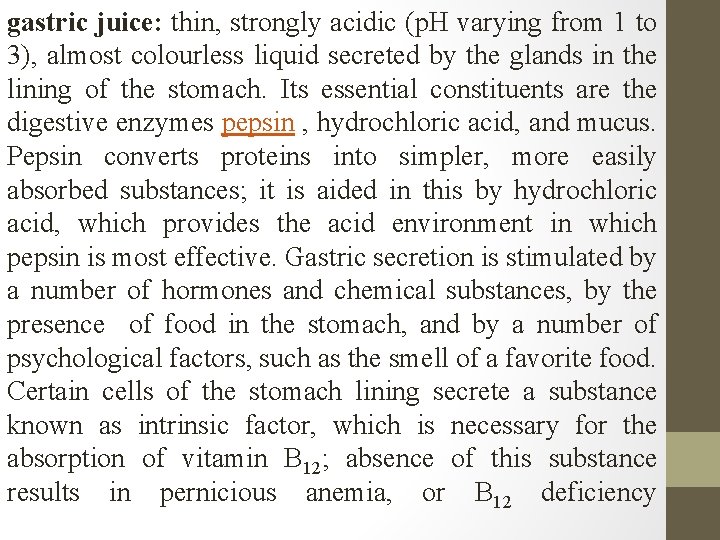
gastric juice: thin, strongly acidic (p. H varying from 1 to 3), almost colourless liquid secreted by the glands in the lining of the stomach. Its essential constituents are the digestive enzymes pepsin , hydrochloric acid, and mucus. Pepsin converts proteins into simpler, more easily absorbed substances; it is aided in this by hydrochloric acid, which provides the acid environment in which pepsin is most effective. Gastric secretion is stimulated by a number of hormones and chemical substances, by the presence of food in the stomach, and by a number of psychological factors, such as the smell of a favorite food. Certain cells of the stomach lining secrete a substance known as intrinsic factor, which is necessary for the absorption of vitamin B 12; absence of this substance results in pernicious anemia, or B 12 deficiency
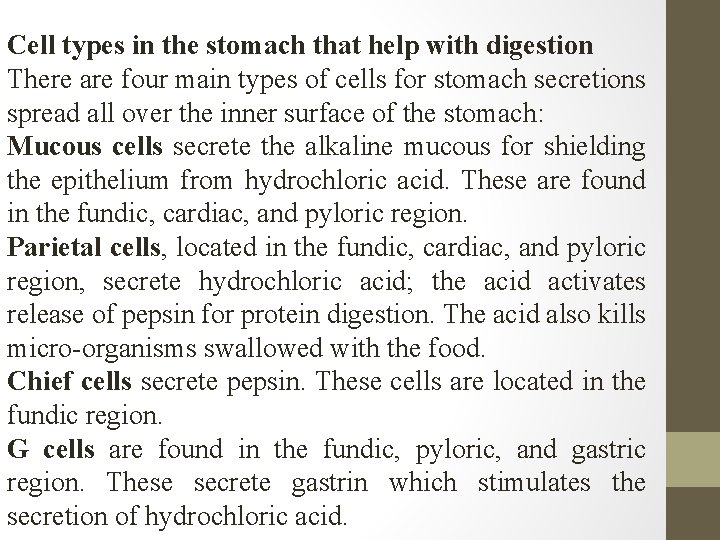
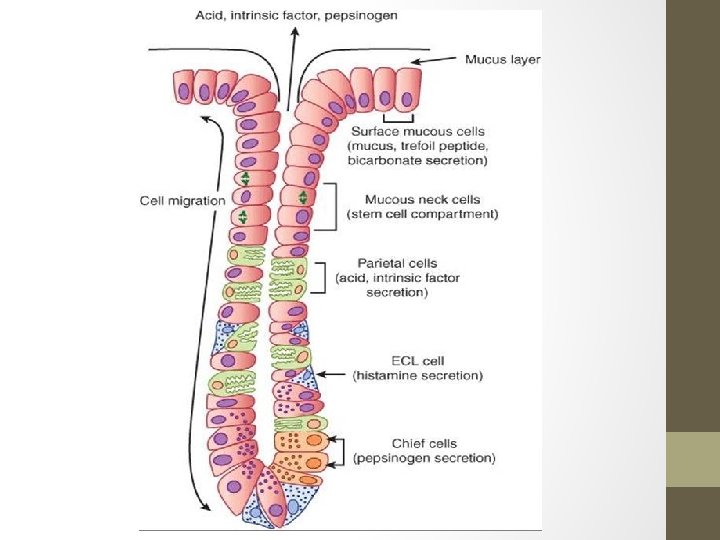
Cell types in the stomach that help with digestion There are four main types of cells for stomach secretions spread all over the inner surface of the stomach: Mucous cells secrete the alkaline mucous for shielding the epithelium from hydrochloric acid. These are found in the fundic, cardiac, and pyloric region. Parietal cells, located in the fundic, cardiac, and pyloric region, secrete hydrochloric acid; the acid activates release of pepsin for protein digestion. The acid also kills micro-organisms swallowed with the food. Chief cells secrete pepsin. These cells are located in the fundic region. G cells are found in the fundic, pyloric, and gastric region. These secrete gastrin which stimulates the secretion of hydrochloric acid.