
Regulation of Cell Division AP Biology 2006 2007
Regulation of Cell Division AP Biology 2006 -2007
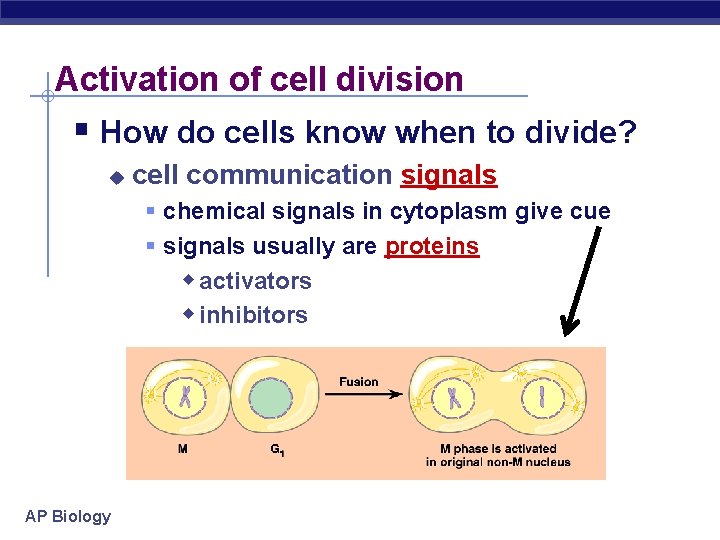
Activation of cell division § How do cells know when to divide? u cell communication signals § chemical signals in cytoplasm give cue § signals usually are proteins w activators w inhibitors AP Biology
Coordination of cell division § A multicellular organism needs to coordinate cell division across different tissues & organs u critical for normal growth, development & maintenance § coordinate timing of cell division § coordinate rates of cell division § not all cells may have the same cell cycle AP Biology
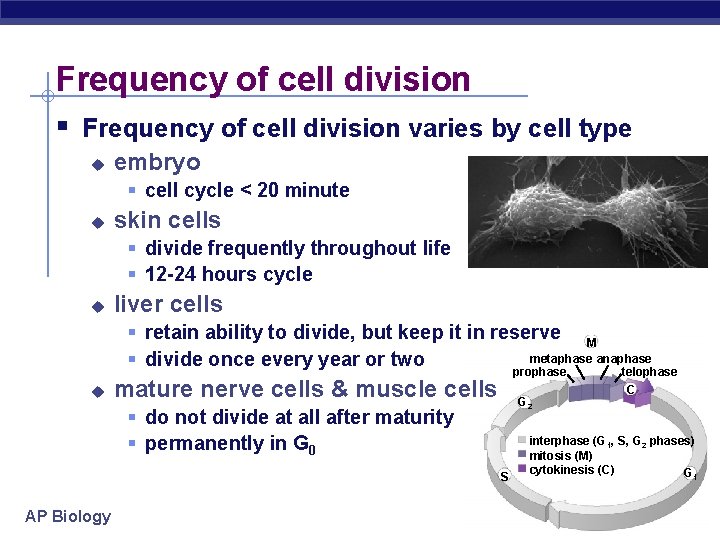
Frequency of cell division § Frequency of cell division varies by cell type u embryo § cell cycle < 20 minute u skin cells § divide frequently throughout life § 12 -24 hours cycle u liver cells § retain ability to divide, but keep it in reserve M metaphase anaphase § divide once every year or two u prophase mature nerve cells & muscle cells G 2 § do not divide at all after maturity § permanently in G 0 S AP Biology telophase C interphase (G 1, S, G 2 phases) mitosis (M) cytokinesis (C) G 1

There’s no turning back, now! Overview of Cell Cycle Control § Two irreversible points in cell cycle replication of genetic material u separation of sister chromatids u § Checkpoints u process is assessed & possibly halted centromere single-stranded AP Biology chromosomes sister chromatids double-stranded chromosomes
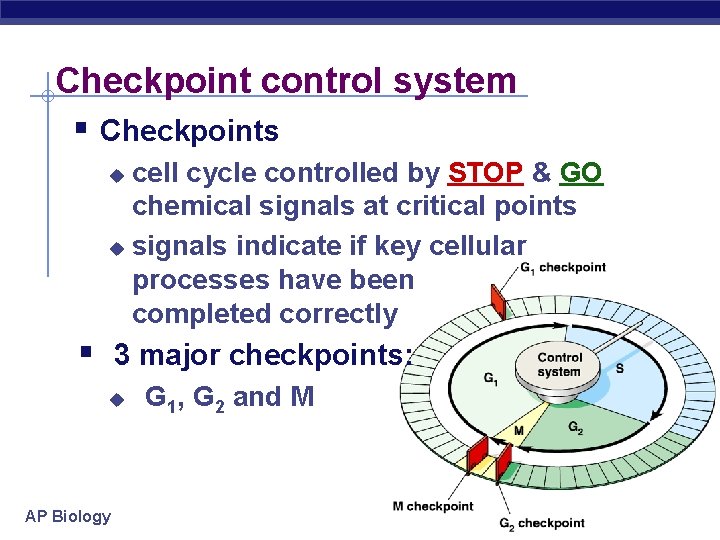
Checkpoint control system § Checkpoints cell cycle controlled by STOP & GO chemical signals at critical points u signals indicate if key cellular processes have been completed correctly u § 3 major checkpoints: u AP Biology G 1, G 2 and M
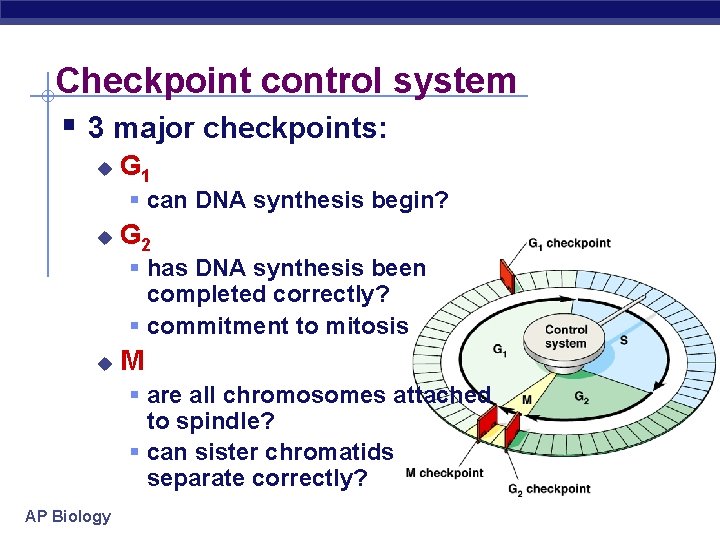
Checkpoint control system § 3 major checkpoints: u G 1 § can DNA synthesis begin? u G 2 § has DNA synthesis been completed correctly? § commitment to mitosis u M § are all chromosomes attached to spindle? § can sister chromatids separate correctly? AP Biology
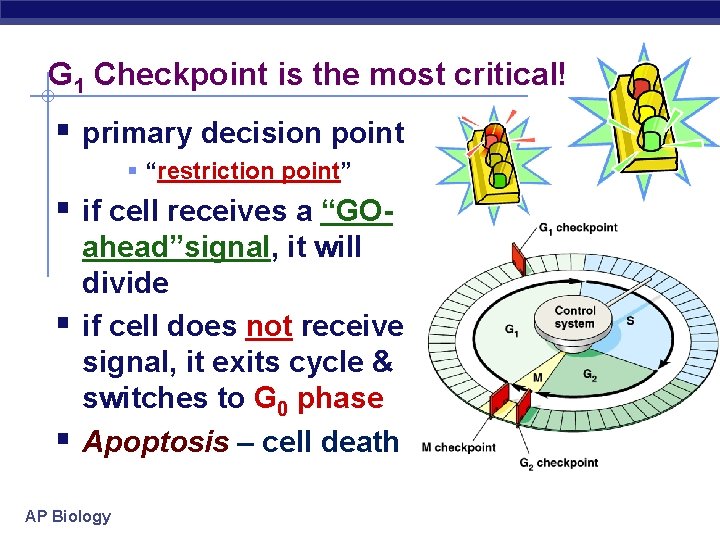
G 1 Checkpoint is the most critical! § primary decision point § “restriction point” § if cell receives a “GO§ § ahead”signal, it will divide if cell does not receive signal, it exits cycle & switches to G 0 phase Apoptosis – cell death AP Biology
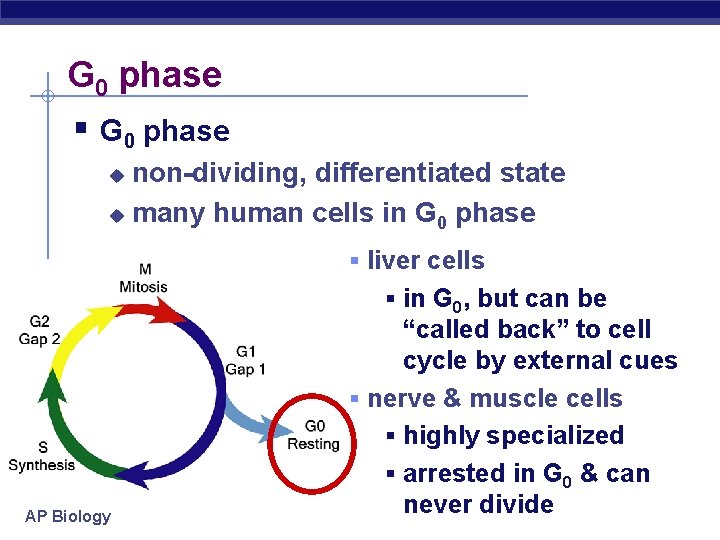
G 0 phase § G 0 phase non-dividing, differentiated state u many human cells in G 0 phase u AP Biology § liver cells § in G 0, but can be “called back” to cell cycle by external cues § nerve & muscle cells § highly specialized § arrested in G 0 & can never divide

“Go-ahead” signals § Protein molecules that promote cell growth & division u internal signals Where is the P attached? § “promoting factors” u external signals § “growth factors” § Primary mechanism of control u phosphorylation § Use of kinase enzymes w Which either activates or inactivates cell signals by adding a phosphate AP Biology
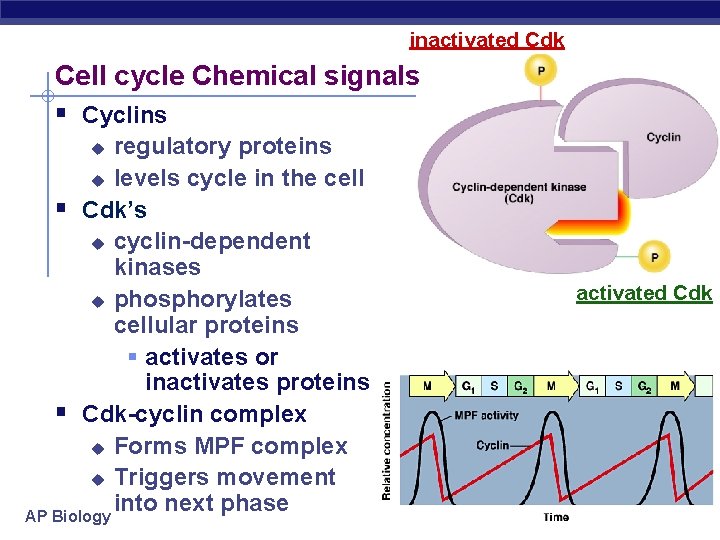
inactivated Cdk Cell cycle Chemical signals § Cyclins regulatory proteins u levels cycle in the cell § Cdk’s u cyclin-dependent kinases u phosphorylates cellular proteins § activates or inactivates proteins § Cdk-cyclin complex u Forms MPF complex u Triggers movement into next phase AP Biology u activated Cdk
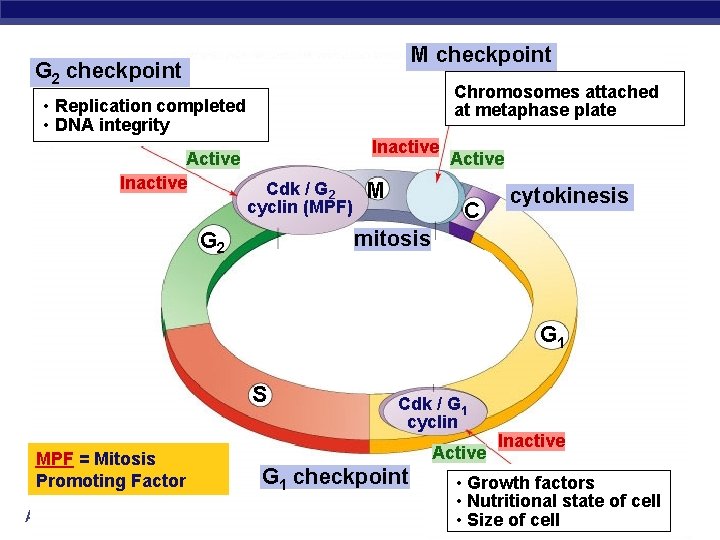
M checkpoint G 2 checkpoint Chromosomes attached at metaphase plate • Replication completed • DNA integrity Active Inactive Cdk / G 2 cyclin (MPF) M Active C cytokinesis mitosis G 2 G 1 S MPF = Mitosis Promoting Factor AP Biology Cdk / G 1 cyclin Active G 1 checkpoint Inactive • Growth factors • Nutritional state of cell • Size of cell
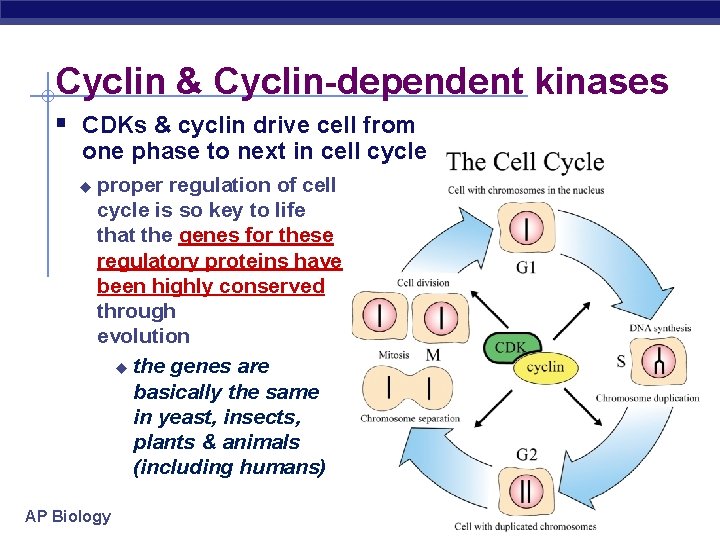
Cyclin & Cyclin-dependent kinases § CDKs & cyclin drive cell from one phase to next in cell cycle u proper regulation of cell cycle is so key to life that the genes for these regulatory proteins have been highly conserved through evolution u the genes are basically the same in yeast, insects, plants & animals (including humans) AP Biology
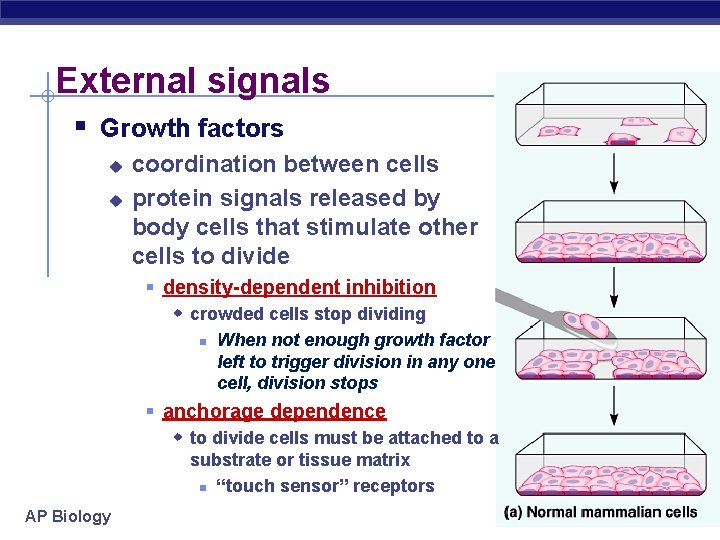
External signals § Growth factors u u coordination between cells protein signals released by body cells that stimulate other cells to divide § density-dependent inhibition w crowded cells stop dividing n When not enough growth factor left to trigger division in any one cell, division stops § anchorage dependence w to divide cells must be attached to a substrate or tissue matrix n “touch sensor” receptors AP Biology
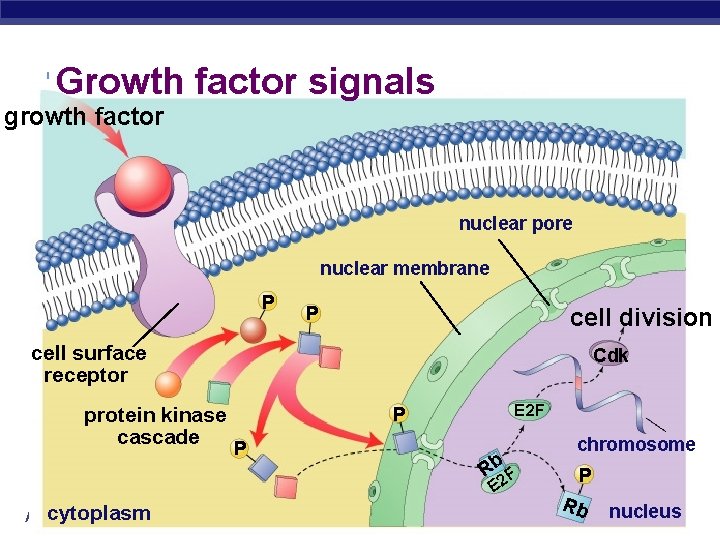
Growth factor signals growth factor nuclear pore nuclear membrane P P cell division cell surface receptor protein kinase cascade Cdk E 2 F P P Rb 2 F E APcytoplasm Biology chromosome P Rb nucleus
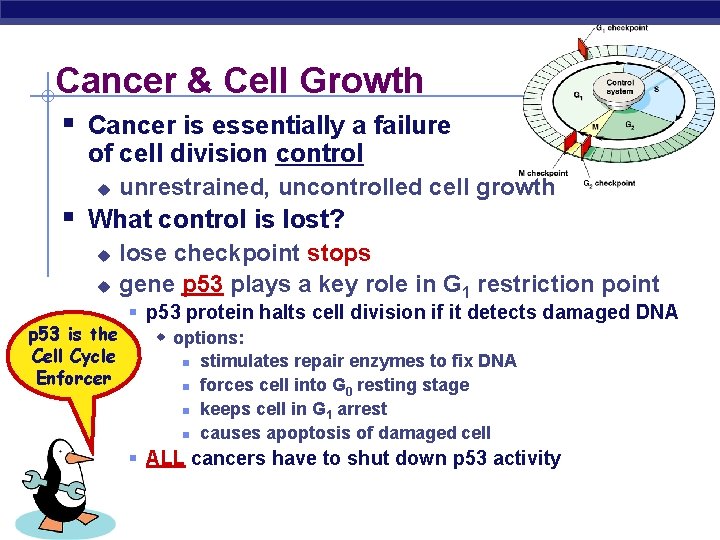
Cancer & Cell Growth § Cancer is essentially a failure of cell division control u unrestrained, uncontrolled cell growth § What control is lost? u u lose checkpoint stops gene p 53 plays a key role in G 1 restriction point § p 53 protein halts cell division if it detects damaged DNA p 53 is the w options: Cell Cycle Enforcer n n stimulates repair enzymes to fix DNA forces cell into G 0 resting stage keeps cell in G 1 arrest causes apoptosis of damaged cell § ALL cancers have to shut down p 53 activity AP Biology
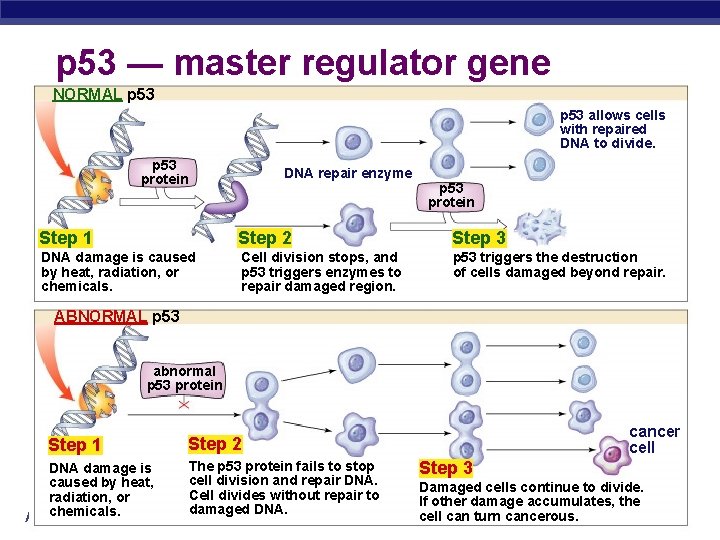
p 53 — master regulator gene NORMAL p 53 allows cells with repaired DNA to divide. p 53 protein DNA repair enzyme p 53 protein Step 1 Step 2 Step 3 DNA damage is caused by heat, radiation, or chemicals. Cell division stops, and p 53 triggers enzymes to repair damaged region. p 53 triggers the destruction of cells damaged beyond repair. ABNORMAL p 53 abnormal p 53 protein Step 1 DNA damage is caused by heat, radiation, or AP chemicals. Biology cancer cell Step 2 The p 53 protein fails to stop cell division and repair DNA. Cell divides without repair to damaged DNA. Step 3 Damaged cells continue to divide. If other damage accumulates, the cell can turn cancerous.
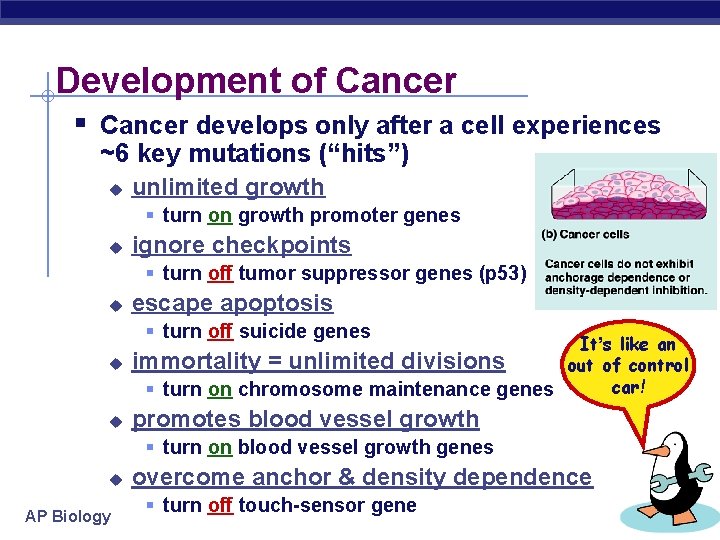
Development of Cancer § Cancer develops only after a cell experiences ~6 key mutations (“hits”) u unlimited growth § turn on growth promoter genes u ignore checkpoints § turn off tumor suppressor genes (p 53) u escape apoptosis § turn off suicide genes It’s like an u immortality = unlimited divisions out of control car! § turn on chromosome maintenance genes u promotes blood vessel growth § turn on blood vessel growth genes u AP Biology overcome anchor & density dependence § turn off touch-sensor gene
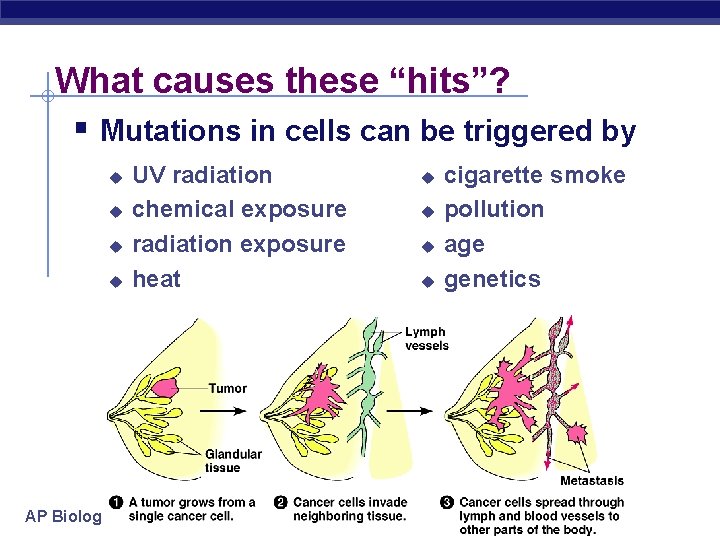
What causes these “hits”? § Mutations in cells can be triggered by u u AP Biology UV radiation chemical exposure radiation exposure heat u u cigarette smoke pollution age genetics
Tumors § Mass of abnormal cells u Benign tumor § abnormal cells remain at original site as a lump w p 53 has halted cell divisions § most do not cause serious problems & can be removed by surgery u Malignant tumors § cells leave original site w lose attachment to nearby cells w carried by blood & lymph system to other tissues w start more tumors = metastasis § impair functions of organs throughout body AP Biology
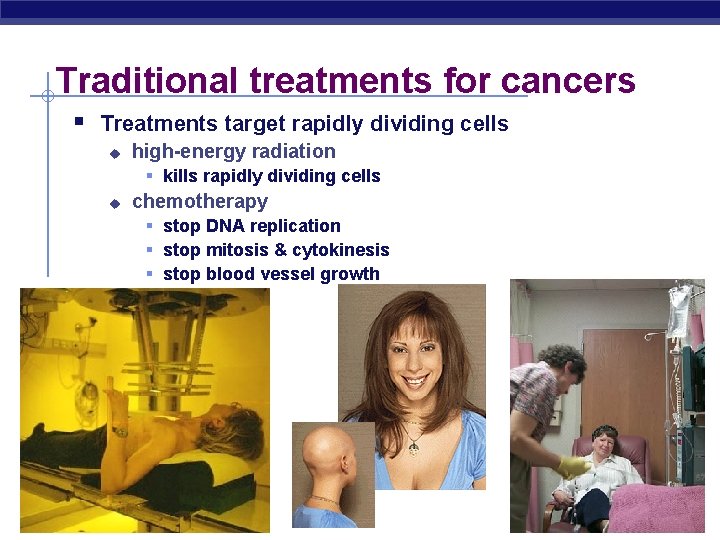
Traditional treatments for cancers § Treatments target rapidly dividing cells u high-energy radiation § kills rapidly dividing cells u chemotherapy § stop DNA replication § stop mitosis & cytokinesis § stop blood vessel growth AP Biology
- Slides: 21