
Regulation of Cell Division and Cancer AP Biology
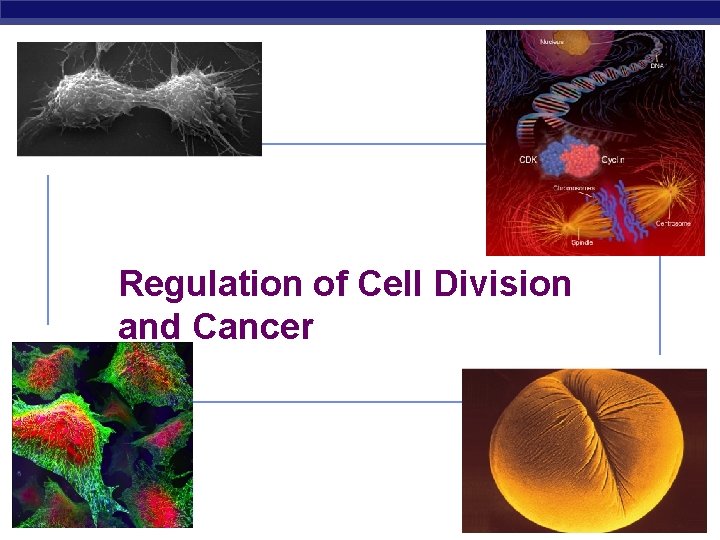
Regulation of Cell Division and Cancer AP Biology 2008 -2009
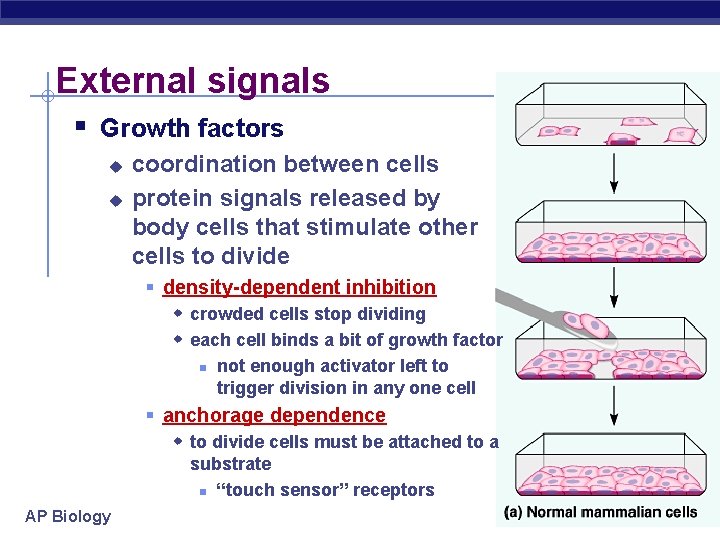
External signals § Growth factors u u coordination between cells protein signals released by body cells that stimulate other cells to divide § density-dependent inhibition w crowded cells stop dividing w each cell binds a bit of growth factor n not enough activator left to trigger division in any one cell § anchorage dependence w to divide cells must be attached to a substrate n “touch sensor” receptors AP Biology

Growth Factors and Cancer § Growth factors can create cancers u proto-oncogenes § normally activates cell division w growth factor genes w become oncogenes (cancer-causing) when mutated § if switched “ON” can cause cancer § example: RAS (activates cyclins) u tumor-suppressor genes § normally inhibits cell division § if switched “OFF” can cause cancer § example: p 53 AP Biology
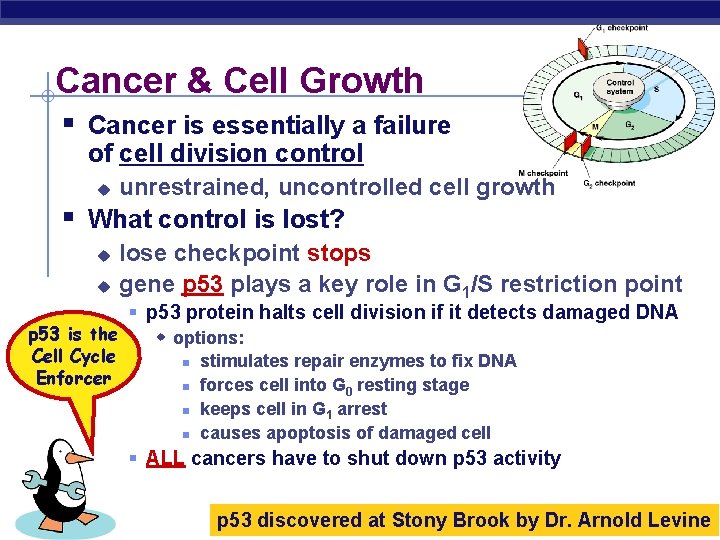
Cancer & Cell Growth § Cancer is essentially a failure of cell division control u unrestrained, uncontrolled cell growth § What control is lost? u u lose checkpoint stops gene p 53 plays a key role in G 1/S restriction point § p 53 protein halts cell division if it detects damaged DNA p 53 is the w options: Cell Cycle Enforcer n n stimulates repair enzymes to fix DNA forces cell into G 0 resting stage keeps cell in G 1 arrest causes apoptosis of damaged cell § ALL cancers have to shut down p 53 activity AP Biology p 53 discovered at Stony Brook by Dr. Arnold Levine
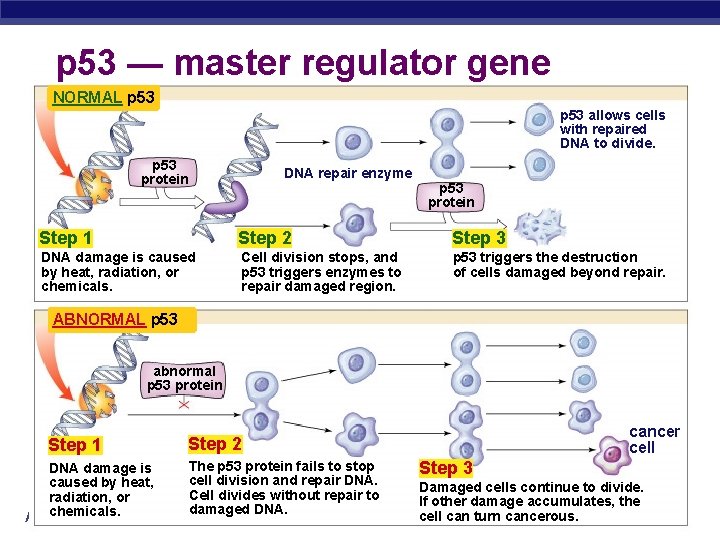
p 53 — master regulator gene NORMAL p 53 allows cells with repaired DNA to divide. p 53 protein DNA repair enzyme p 53 protein Step 1 Step 2 Step 3 DNA damage is caused by heat, radiation, or chemicals. Cell division stops, and p 53 triggers enzymes to repair damaged region. p 53 triggers the destruction of cells damaged beyond repair. ABNORMAL p 53 abnormal p 53 protein Step 1 DNA damage is caused by heat, radiation, or AP chemicals. Biology cancer cell Step 2 The p 53 protein fails to stop cell division and repair DNA. Cell divides without repair to damaged DNA. Step 3 Damaged cells continue to divide. If other damage accumulates, the cell can turn cancerous.
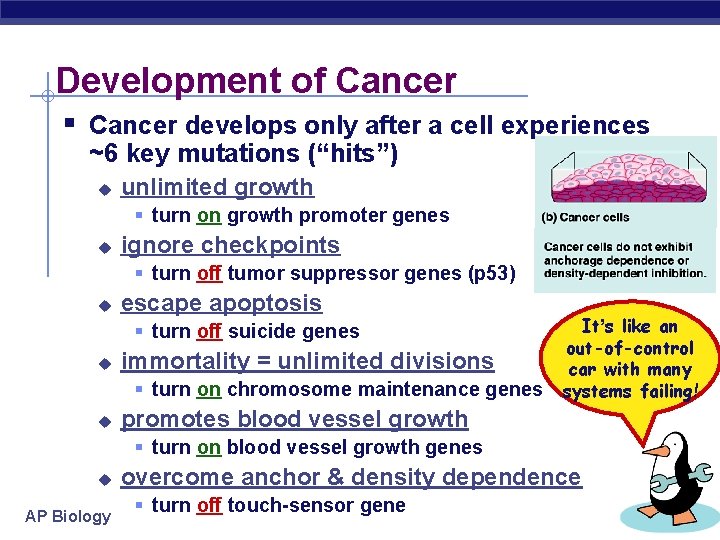
Development of Cancer § Cancer develops only after a cell experiences ~6 key mutations (“hits”) u unlimited growth § turn on growth promoter genes u ignore checkpoints § turn off tumor suppressor genes (p 53) u escape apoptosis § turn off suicide genes u immortality = unlimited divisions § turn on chromosome maintenance genes u It’s like an out-of-control car with many systems failing! promotes blood vessel growth § turn on blood vessel growth genes u AP Biology overcome anchor & density dependence § turn off touch-sensor gene
What causes these “hits”? § Mutations in cells can be triggered by u u AP Biology UV radiation chemical exposure radiation exposure heat u u cigarette smoke pollution age genetics
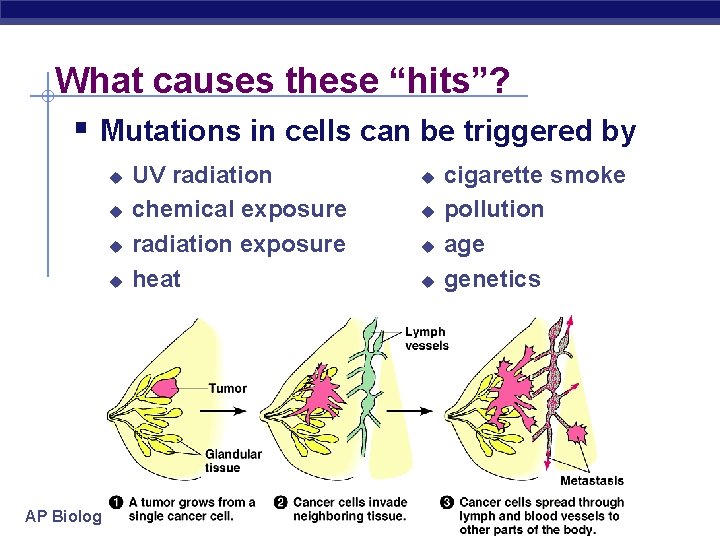
Tumors § Mass of abnormal cells u Benign tumor § abnormal cells remain at original site as a lump w p 53 has halted cell divisions § most do not cause serious problems & can be removed by surgery u Malignant tumor § cells leave original site w lose attachment to nearby cells w carried by blood & lymph system to other tissues w start more tumors = metastasis § impair functions of organs throughout body AP Biology
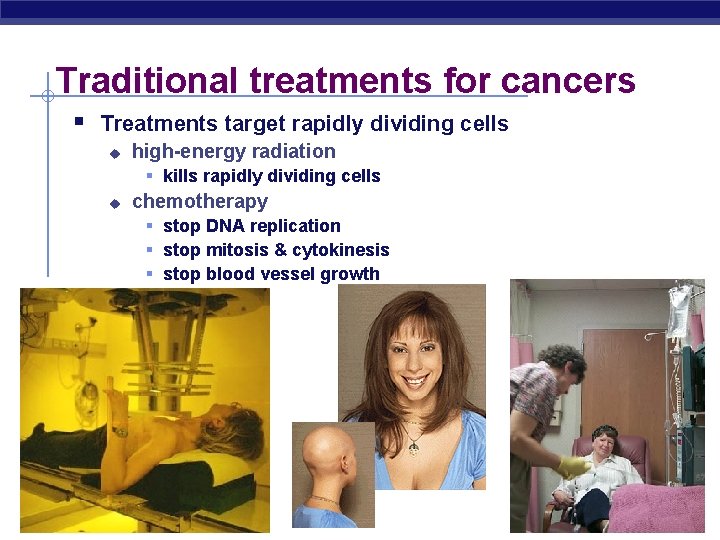
Traditional treatments for cancers § Treatments target rapidly dividing cells u high-energy radiation § kills rapidly dividing cells u chemotherapy § stop DNA replication § stop mitosis & cytokinesis § stop blood vessel growth AP Biology
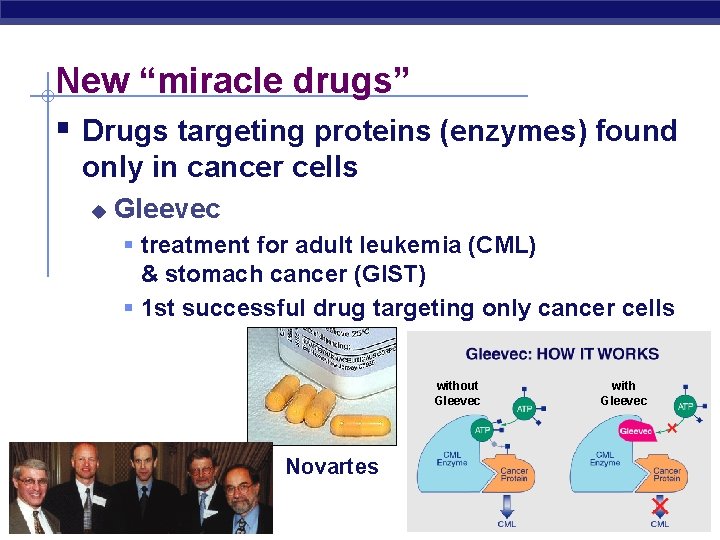
New “miracle drugs” § Drugs targeting proteins (enzymes) found only in cancer cells u Gleevec § treatment for adult leukemia (CML) & stomach cancer (GIST) § 1 st successful drug targeting only cancer cells without Gleevec Novartes AP Biology with Gleevec
- Slides: 10