
Regulating Nitrate Pollution European Approaches Helle Tegner Anker
- Slides: 17
Regulating Nitrate Pollution – European Approaches Helle Tegner Anker Faculty of Life Sciences Copenhagen University
Outline p What’s the problem n n p Environmental problem(s) Regulatory problem(s) EU regulation of nitrate pollution n n Environmental quality perspective Project or activity perspective Implementation in the Member States p Appropriate and coherent regulatory approach? p
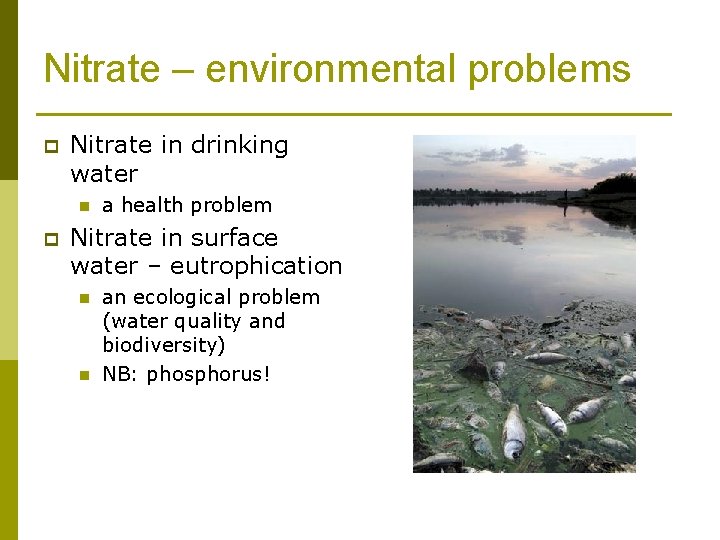
Nitrate – environmental problems p Nitrate in drinking water n p a health problem Nitrate in surface water – eutrophication n n an ecological problem (water quality and biodiversity) NB: phosphorus!
Nitrate – regulatory problems p Regulatory problems n n n p Non-point source (diffuse) pollution regulation Point source pollution regulation Combining non-point source and point source pollution regulation! Agriculture is the main contributor to nitrate pollution of water (50 -70 %) n n Spreading of manure and other fertilizers Leakage from farm installations, storage facilities etc.
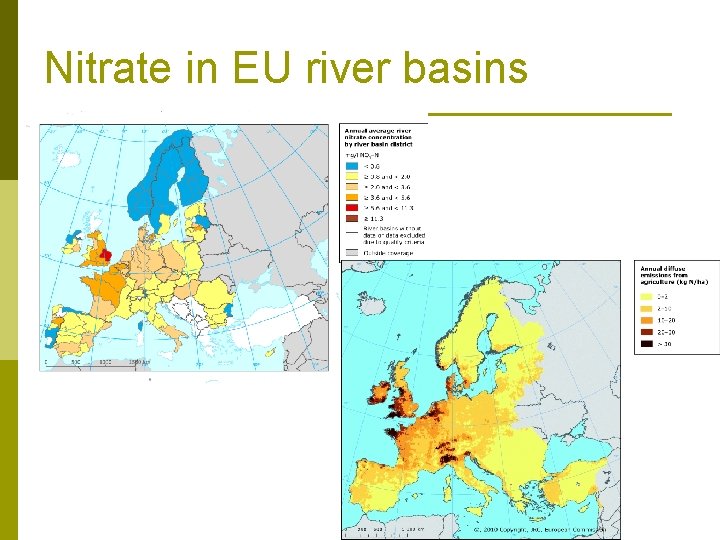
Nitrate in EU river basins
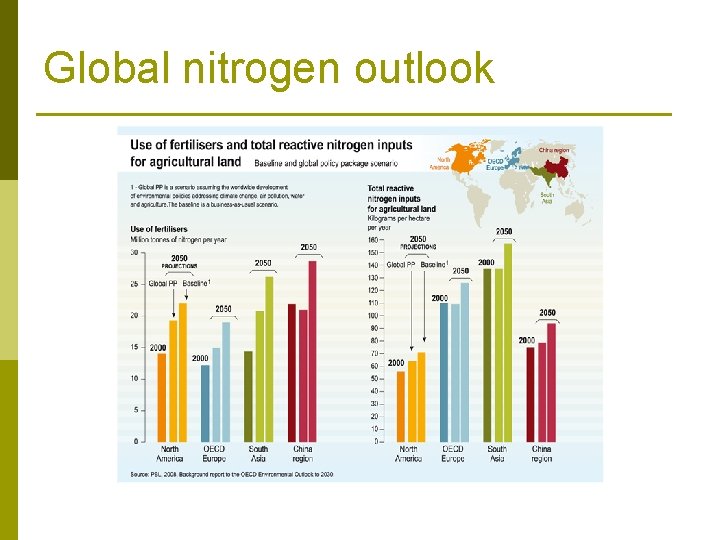
Global nitrogen outlook
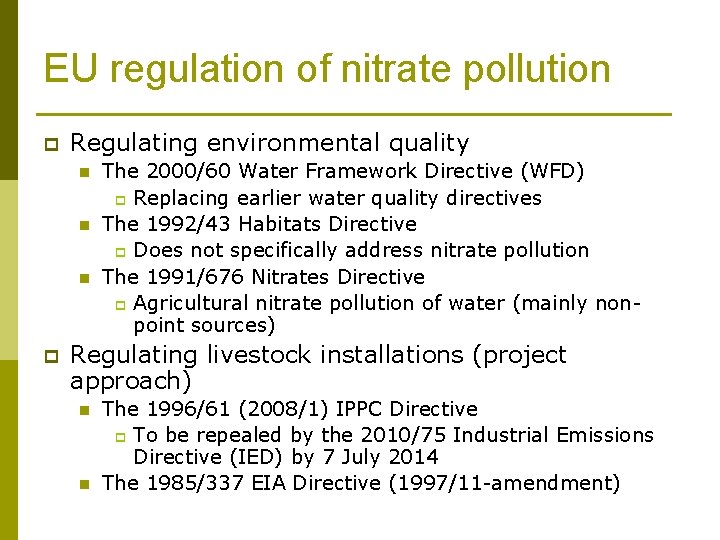
EU regulation of nitrate pollution p Regulating environmental quality n n n p The 2000/60 Water Framework Directive (WFD) p Replacing earlier water quality directives The 1992/43 Habitats Directive p Does not specifically address nitrate pollution The 1991/676 Nitrates Directive p Agricultural nitrate pollution of water (mainly nonpoint sources) Regulating livestock installations (project approach) n n The 1996/61 (2008/1) IPPC Directive p To be repealed by the 2010/75 Industrial Emissions Directive (IED) by 7 July 2014 The 1985/337 EIA Directive (1997/11 -amendment)
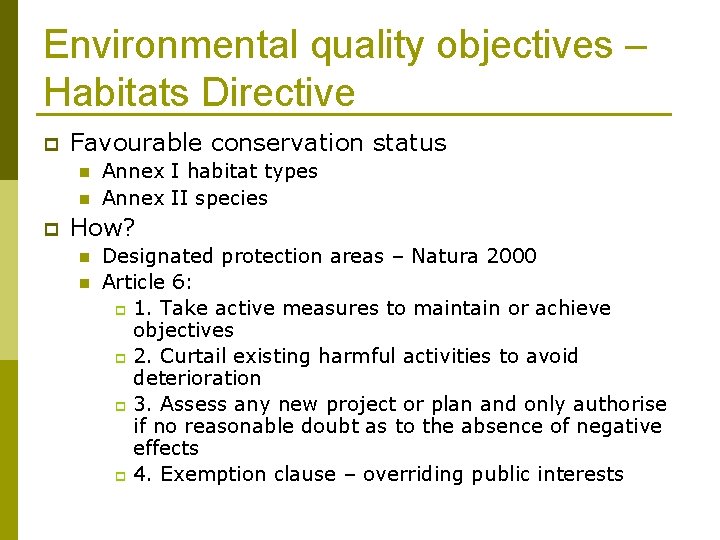
Environmental quality objectives – Habitats Directive p Favourable conservation status n n p Annex I habitat types Annex II species How? n n Designated protection areas – Natura 2000 Article 6: p 1. Take active measures to maintain or achieve objectives p 2. Curtail existing harmful activities to avoid deterioration p 3. Assess any new project or plan and only authorise if no reasonable doubt as to the absence of negative effects p 4. Exemption clause – overriding public interests
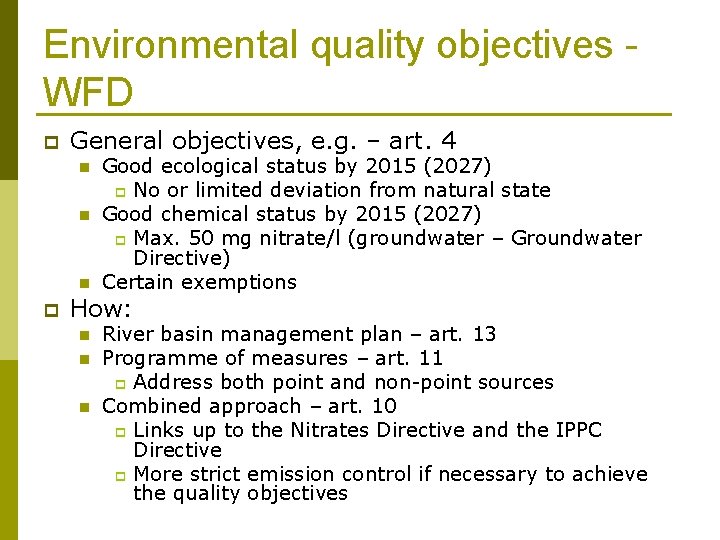
Environmental quality objectives WFD p General objectives, e. g. – art. 4 n n n p Good ecological status by 2015 (2027) p No or limited deviation from natural state Good chemical status by 2015 (2027) p Max. 50 mg nitrate/l (groundwater – Groundwater Directive) Certain exemptions How: n n n River basin management plan – art. 13 Programme of measures – art. 11 p Address both point and non-point sources Combined approach – art. 10 p Links up to the Nitrates Directive and the IPPC Directive p More strict emission control if necessary to achieve the quality objectives
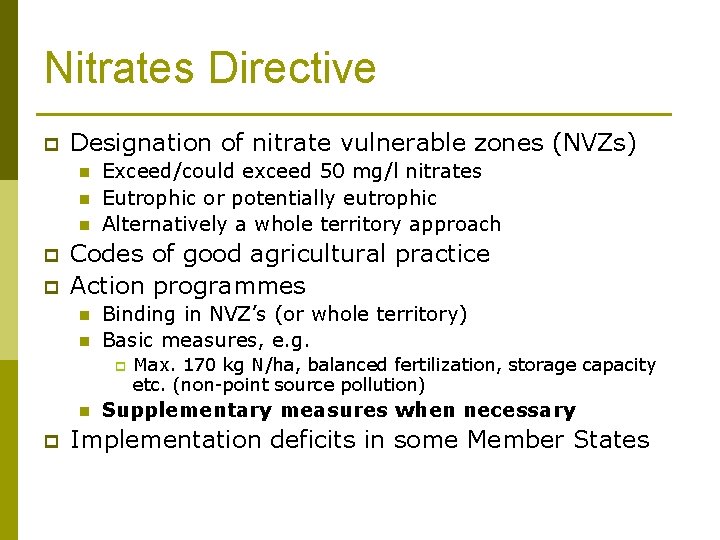
Nitrates Directive p Designation of nitrate vulnerable zones (NVZs) n n n p p Exceed/could exceed 50 mg/l nitrates Eutrophic or potentially eutrophic Alternatively a whole territory approach Codes of good agricultural practice Action programmes n n Binding in NVZ’s (or whole territory) Basic measures, e. g. p n p Max. 170 kg N/ha, balanced fertilization, storage capacity etc. (non-point source pollution) Supplementary measures when necessary Implementation deficits in some Member States
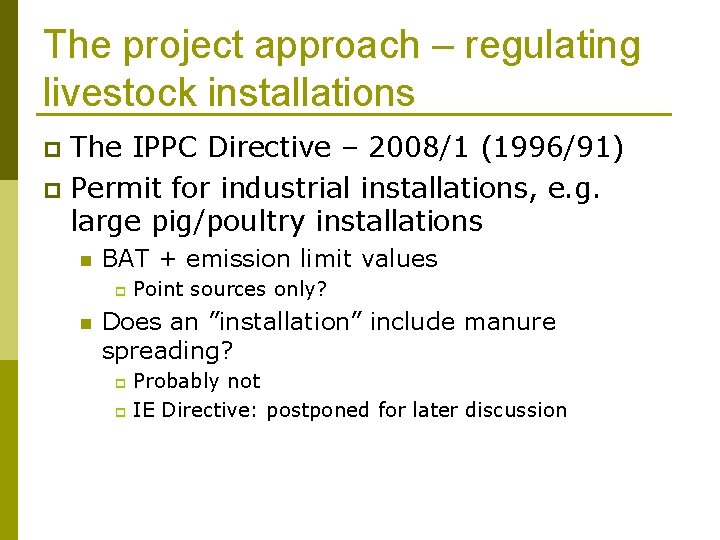
The project approach – regulating livestock installations The IPPC Directive – 2008/1 (1996/91) p Permit for industrial installations, e. g. large pig/poultry installations p n BAT + emission limit values p n Point sources only? Does an ”installation” include manure spreading? Probably not p IE Directive: postponed for later discussion p
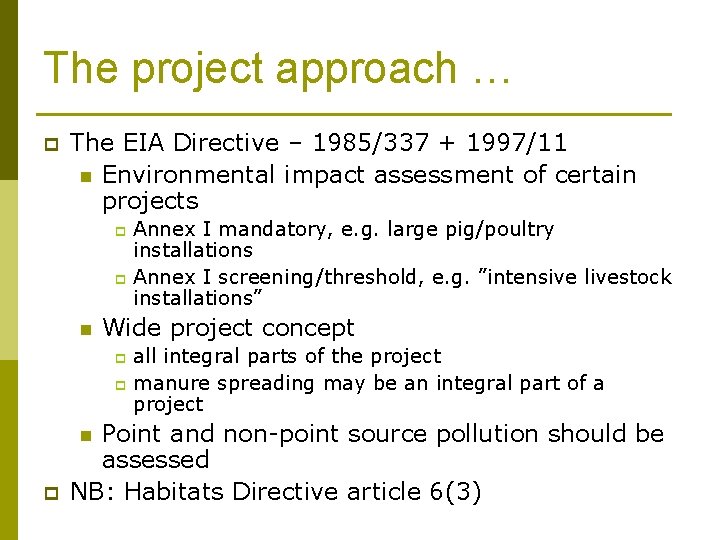
The project approach … p The EIA Directive – 1985/337 + 1997/11 n Environmental impact assessment of certain projects Annex I mandatory, e. g. large pig/poultry installations p Annex I screening/threshold, e. g. ”intensive livestock installations” p n Wide project concept all integral parts of the project p manure spreading may be an integral part of a project p Point and non-point source pollution should be assessed NB: Habitats Directive article 6(3) n p
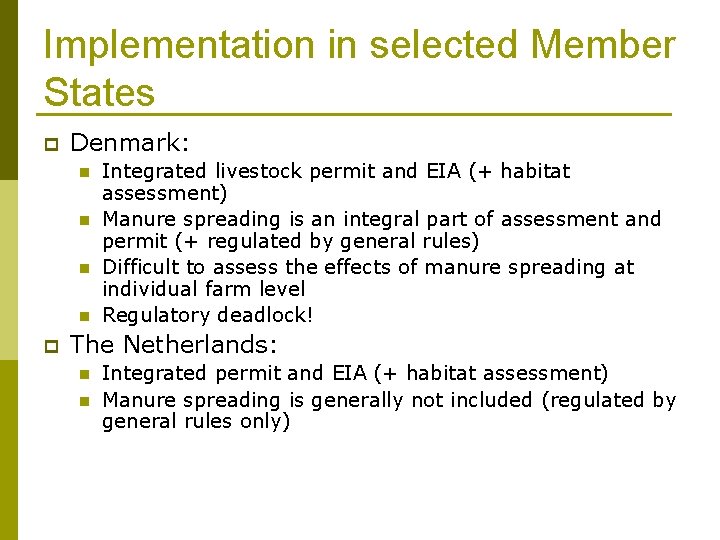
Implementation in selected Member States p Denmark: n n p Integrated livestock permit and EIA (+ habitat assessment) Manure spreading is an integral part of assessment and permit (+ regulated by general rules) Difficult to assess the effects of manure spreading at individual farm level Regulatory deadlock! The Netherlands: n n Integrated permit and EIA (+ habitat assessment) Manure spreading is generally not included (regulated by general rules only)
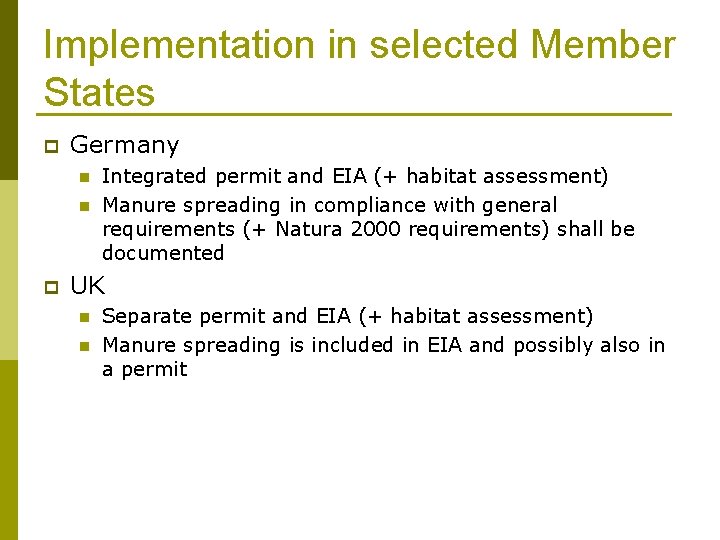
Implementation in selected Member States p Germany n n p Integrated permit and EIA (+ habitat assessment) Manure spreading in compliance with general requirements (+ Natura 2000 requirements) shall be documented UK n n Separate permit and EIA (+ habitat assessment) Manure spreading is included in EIA and possibly also in a permit
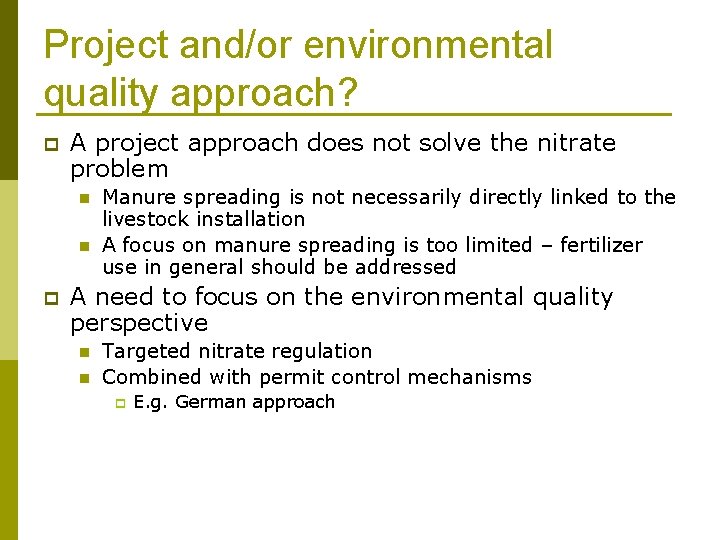
Project and/or environmental quality approach? p A project approach does not solve the nitrate problem n n p Manure spreading is not necessarily directly linked to the livestock installation A focus on manure spreading is too limited – fertilizer use in general should be addressed A need to focus on the environmental quality perspective n n Targeted nitrate regulation Combined with permit control mechanisms p E. g. German approach
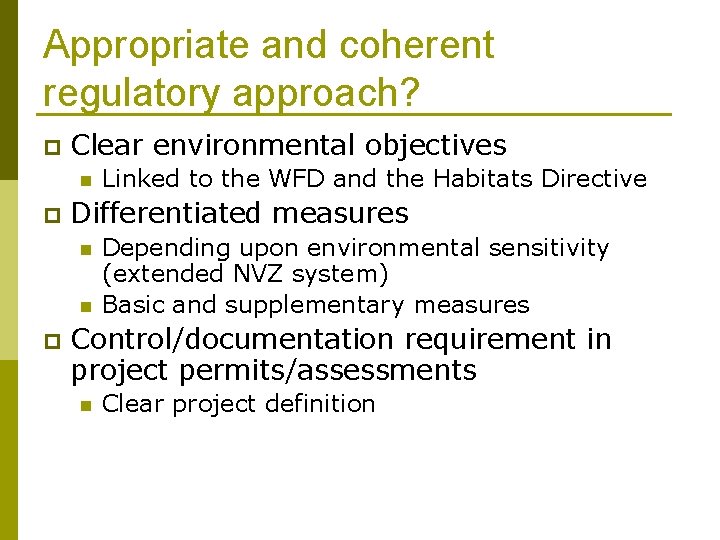
Appropriate and coherent regulatory approach? p Clear environmental objectives n p Differentiated measures n n p Linked to the WFD and the Habitats Directive Depending upon environmental sensitivity (extended NVZ system) Basic and supplementary measures Control/documentation requirement in project permits/assessments n Clear project definition