
Regular Spl Maintenance in LWR including Patrolling Sivakumar
- Slides: 45
Regular & Spl Maintenance in LWR including Patrolling Sivakumar. A Professor Works/IRICEN/PUNE 7420041125 sivakumar@iricen. gov. in
RECAP OF BASICS
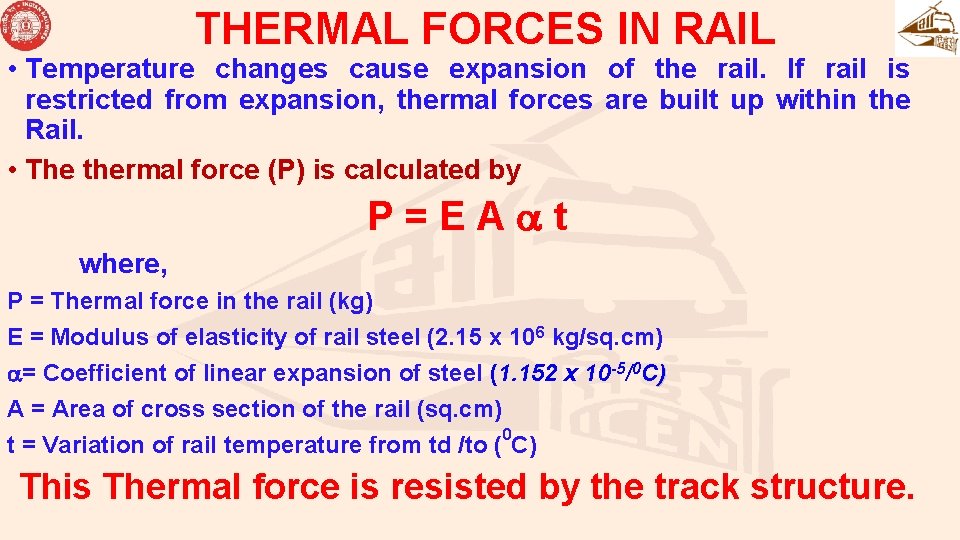
THERMAL FORCES IN RAIL • Temperature changes cause expansion of the rail. If rail is restricted from expansion, thermal forces are built up within the Rail. • The thermal force (P) is calculated by P=EA t where, P = Thermal force in the rail (kg) E = Modulus of elasticity of rail steel (2. 15 x 106 kg/sq. cm) = Coefficient of linear expansion of steel (1. 152 x 10 -5/0 C) A = Area of cross section of the rail (sq. cm) 0 t = Variation of rail temperature from td /to ( C) This Thermal force is resisted by the track structure.
RESISTANCE TO THERMAL FORCE BY TRACK COMPONENTS Resistance by the track (R) is due to • Rails, which are fastened to sleepers with fittings • Sleepers are embedded in Ballast • Ballast is laid on stabilized formation and is well compacted Thus, a track with all its components, acts as a composite structure which offers resistance to the free expansion / contraction of rail on account of thermal forces
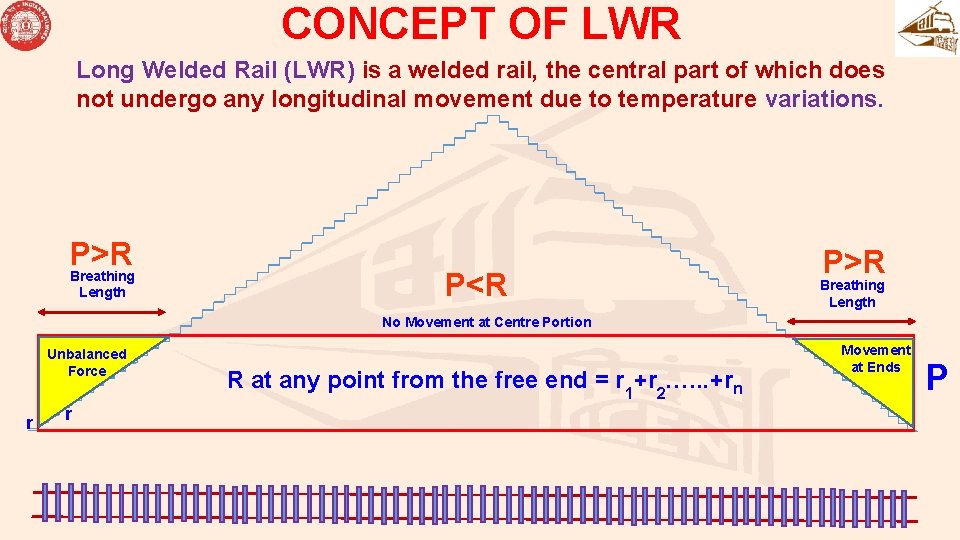
CONCEPT OF LWR Long Welded Rail (LWR) is a welded rail, the central part of which does not undergo any longitudinal movement due to temperature variations. P>R Breathing Length P<R P>R Breathing Length No Movement at Centre Portion Unbalanced Force r r R at any point from the free end = r 1+r 2. …. . +rn Movement at Ends P
LONG WELDED RAIL Understanding the delicate balance between the Thermal force, P and Resistance offered by the track, R, at all times is the key.
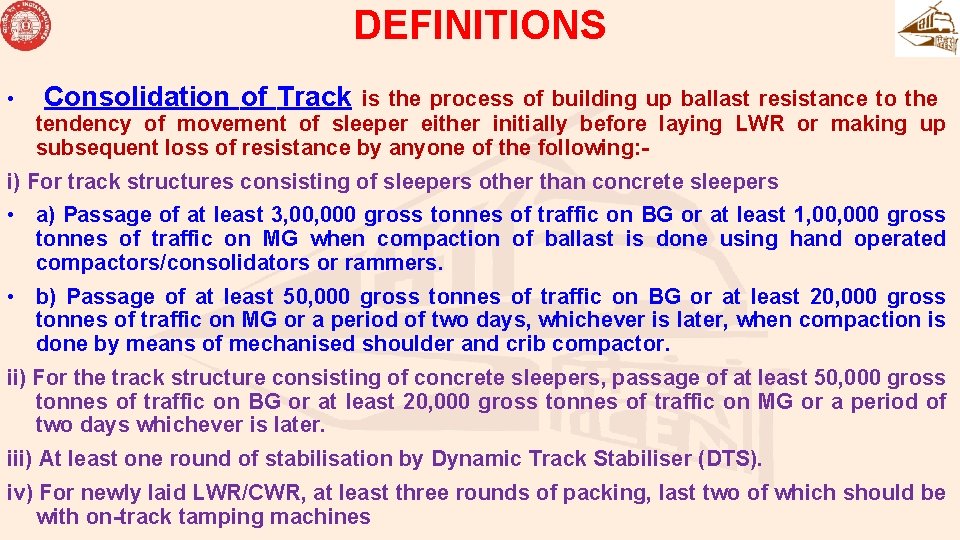
DEFINITIONS • Consolidation of Track is the process of building up ballast resistance to the tendency of movement of sleeper either initially before laying LWR or making up subsequent loss of resistance by anyone of the following: - i) For track structures consisting of sleepers other than concrete sleepers • a) Passage of at least 3, 000 gross tonnes of traffic on BG or at least 1, 000 gross tonnes of traffic on MG when compaction of ballast is done using hand operated compactors/consolidators or rammers. • b) Passage of at least 50, 000 gross tonnes of traffic on BG or at least 20, 000 gross tonnes of traffic on MG or a period of two days, whichever is later, when compaction is done by means of mechanised shoulder and crib compactor. ii) For the track structure consisting of concrete sleepers, passage of at least 50, 000 gross tonnes of traffic on BG or at least 20, 000 gross tonnes of traffic on MG or a period of two days whichever is later. iii) At least one round of stabilisation by Dynamic Track Stabiliser (DTS). iv) For newly laid LWR/CWR, at least three rounds of packing, last two of which should be with on-track tamping machines
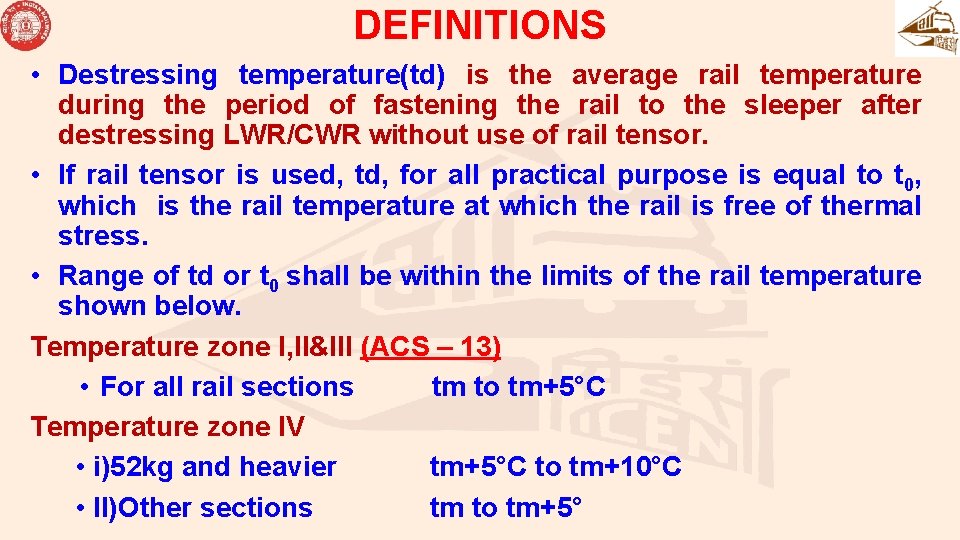
DEFINITIONS • Destressing temperature(td) is the average rail temperature during the period of fastening the rail to the sleeper after destressing LWR/CWR without use of rail tensor. • If rail tensor is used, td, for all practical purpose is equal to t 0, which is the rail temperature at which the rail is free of thermal stress. • Range of td or t 0 shall be within the limits of the rail temperature shown below. Temperature zone I, II&III (ACS – 13) • For all rail sections tm to tm+5°C Temperature zone IV • i)52 kg and heavier tm+5°C to tm+10°C • II)Other sections tm to tm+5°
DEFINITIONS • Hot Weather Patrol is the patrol carried out when the rail temperature exceeds (ACS -12) (i) 1540 per km and above. (ii) td+20°C on PSC sleeper track with sleeper density less than 1540 per km and track other than PSC sleeper. • Cold Weather Patrol is the patrol carried out during cold months of the year in specified sections as per instructions of Chief Engineer.
General (ACS 9) Track structure consisting of other than concrete sleepers in LWR/CWR. …. Track structure consisting of sleepers concrete sleepers • The regular track maintenance in LWR/CWR shall be when rail temperature is between td+10°C and td-30°C and shall be completed well before onset of summer. If rail temperature after the maintenance operation exceeds td+20°C during the period of consolidation, then the speed restriction of 50 km/h on BG and 40 km/h on MG shall be imposed.
MAINTENANCE OPERATIONS IN LWR
MAINTENANCE OF LWR/CWR • An important prerequisite for proper functioning of LWR/CWR is its initial laying to a high standard and its subsequent maintenance by trained personnel possessing valid competency certificates and level of authorisation not lower than what is laid down Regular track maintenance in LWR/CWR includes following operations: i) Tamping/packing ii) Lifting iii) Aligning including minor realignment of curves iv) Shallow screening/shoulder cleaning v) Renewal of fastenings requiring lifting vi) Maintenance of buffer rails
General Ballast section & Cess level - properly maintained, specially on pedestrian & cattle crossings, curves, approaches to LC, bridges. Dwarf walls may be provided. Replenishment of ballast - before onset of summer At isolated places, by the Gangmate by taking out minimum quantity of ballast from the centre of the track Sufficient quantity of ballast shall be collected to provide full ballast section before commencing any maintenance operation, specially lifting. When crow bars are used for slewing, care shall be taken to apply these in a manner so as to avoid lifting of track.
General Special attention shall be paid to maintenance of track at following locations: SEJs/breathing lengths Approaches of level crossings, points & crossings and unballasted deck bridges Horizontal and vertical curves Special attention shall be paid to maintenance of fastenings in LWR/CWR especially on concrete sleepers. All fastenings shall be complete and well secured.
Mechanised Maintenance tamping: • Tamping in LWR/CWR with general lift not exceeding 50 mm in case of concrete sleeper and 25 mm in case of other sleepers • correction of alignment shall be carried out during the period when prevailing rail temperatures in between td +10°C and td-30°C and shall be completed well before onset of summer. • Lifting where needed, in excess of 50 mm in case of concrete sleepers/25 mm in case of other types of sleepers shall be carried out in stages with • adequate time gap in between successive stages such that full consolidation of the previous stage is achieved prior to taking up the subsequent lift.
Cleaning of shoulder ballast • Mechanised cleaning of shoulder ballast shall be undertaken when prevailing rail temperatures are between td +10°C and td-30°C and shall be completed well before onset of summer , together with the precautions mentioned therein. • At no time, not more than 30 sleepers spaces in a continuous stretch shall be opened for manual maintenance or shallow screening with atleast 30 fully boxed sleeper spaces left in between adjacent openings. • Maintenance of in between lengths shall not be undertaken till passage of traffic for atleast 24 hours in case of BG carrying more than 10 GMT or 2 days in case of other BG and MG routes.
Casual renewal of sleepers • Not more than one sleeper in 30 consecutive sleepers shall be replaced at a time. • Should it be necessary to renew two or more consecutive sleepers in the same length, they may be renewed one at a time after packing the sleepers renewed earlier when rail temperature is between td +10°C and td-30°C and shall be completed well before onset of summer duly with precautions mentioned therein
Renewal of fastenings The work of renewal of fastenings shall be carried out when rail temperature is between td +10°C and td-30°C and shall be completed well before onset of summer with following additional precautions: Renewal of fastenings not requiring lifting shall be renewed on not more than one sleeper at a time. In case fastenings of more than one sleepers are required to be renewed at a time, then atleast 15 sleepers in between shall be kept intact. Work shall be done under supervision of Keyman. Fastenings requiring lifting of rails i. e. grooved rubber pads, etc. shall be renewed on not more than one sleeper at a time. In case fastenings of more than one sleepers are required to be renewed at a time, then atleast 30 sleepers in between shall be kept intact. Work shall de done under supervision of Gangmate
Maintenance of SEJs/buffer rails Once in a fortnight SEJs shall be checked, packed and aligned if necessary. Oiling and greasing of tongue and stock rails of SEJ and tightening of fastenings shall be done simultaneously. Movement of SEJs shall be checked and action taken for destressing During his daily patrolling, Keyman shall keep special watch on the SEJs falling in his beat.
SPECIAL TRACK MAINTENANCE Special track maintenance in LWR/CWR includes following operations: i) Through fittings renewal. ii) Deep screening/mechanised cleaning of ballast. iii) Lowering/Lifting of track iv) Major realignment of curves v) Sleeper renewal other than casual renewals vi) Rehabilitation of bridges and formation causing disturbance to track
Through fittings renewal • Whenever it is decided to carry out through renewal of fittings so as to ensure proper functioning of LWR, the LWR shall be destressed alongwith the through fittings renewal
Deep screening/mechanised cleaning of ballast Provisions in IRPWM laid for DS will apply to LWR/CWR with further additional provisions & Wherever mechanised cleaning of ballast is resorted: Ballast Cleaning Machine (BCM), tamping machine and Dynamic Track Stabilizer (DTS) shall, as far as possible, be deployed in one consist. Temperature records - studied for the previous and the current year. The max & min rail temperature attainable during the period of DS and during the period of consolidation shall be estimated. Sequence of operation: a) DS of LWR may be done from one end of LWR to other end. b) After DS and consolidation , destressing of LWR shall be undertaken.
Deep screening/mechanised cleaning of ballast Any of the following three methods may be adopted for carrying out the work of deep screening/mechanised cleaning a) If range of rail temperature falls within td+10°C to td-20°C, deepscreening may be done without cutting or temporay destressing. b) If range of rail temperature falls outside (a) above, temporary destressing shall be carried out 10°C below the maximum rail temperature likely to be attained during the period of work. CWR shall be cut into LWRs of about 1 km length with two temporary buffer rails of 6. 5 metre long clamped as per arrangements c) Wherever rail renewals are being carried out, LWR/CWR may be converted into three rail panels and deep screening done.
Deep screening/mechanised cleaning of ballast(contd) Constant monitoring of rail temperature during the progress of work. Should the temperature rise more than 10°C above td/temporary destressing temperature, adequate precautions shall be taken including another round of temporary destressing. Note : Deep screening shall be undertaken within 15 days of temporary destressing failing which temporary destressing may become due again, if the rail temperature varies appreciably. During the period of deep screening, if there is any possibility of minimum temperature falling 30°C below td /temporary destressing temperature, cold weather patrol should be introduced to detect/ guard against rail fractures
Other special maintenance i) Other types of special track maintenance are lowering of track, major realignment of curves, renewal of large number of sleepers or rehabilitation of formation/ bridges causing disturbance to track. ii) For carrying out such maintenance, the affected length of track may be isolated from LWR/CWR by introducing SEJs as needed. iii) Temperature records of the section shall be studied and action taken. iv) After completion of work, the affected length of track shall be destressed at the required destressing temperature and joined with rest of the LWR/CWR.
DESTRESSING DURING MAINTENANCE Abnormal behavior of LWR/CWR whenever gets manifested in one or more of the following, destressing shall be under taken as per procedure laid down. • When the gap observed at SEJ a) differs beyond limits specified b) exceeds the maximum designed gap of SEJ c) when stock/tongue rail crosses the mean position (ACS 10). ii) After special maintenance operations iii) After restoration of track following an unusual occurence mentioned iv) If number of locations where temporary repairs have been done exceed three per km
DESTRESSING DURING MAINTENANCE (Contd) • Destressing of Long LWR / CWR shall be done by cutting it into LWRs of about 1 km length which shall be joined after destressing in accordance with.
UNUSUAL OCCURRENCES i) Rail fractures or replacement of defective rail/ glued joint. ii) Damage to SEJ/buffer rails iii) Buckling or tendency towards buckling iv) Factors causing disturbance to LWR/CWR such as accidents, breaches etc.
RECTIFICATION OF RAIL FRACTURES If any fracture takes place on LWR/CWR, immediate action shall be taken to suspend the traffic and to protect the line. Report the fracture to Gangmate/Keyman/PWI, who shall arrange emergency repairs to pass the traffic immediately. Repairs shall be carried out in four stages a) Emergency repairs to pass the traffic immediately b) Temporary repairs c) Permanent repairs d) Destressing.
Emergency repairs • The fractured rail to be joined by using appropriate arrangements. • If the gap at fracture does not exceed 30 mm, insertion of any closure rail piece is not necessary. • The traffic may then be resumed at a speed of stop dead and 10 km/h for the first train and 20 km/h for subsequent trains Temporary repairs If a welding party is not readily available, the fracture shall be repaired by using a cut rail (not less than 4 metre long) and clamped/bolted A traffic block shall be taken within the range specified for td Two points on either side of the fracture shall be marked such that the length of closure rail (not less than 4 metre) to be inserted is equal to the total length of the rail pieces removed from the track minus allowances for two welds and saw cut (normally 51 mm).
Temporary repairs (Contd) The rails shall then be cut through at these points, the closure rail shall then be inserted and joined and the traffic shall then be resumed at restricted speed. One of the joints to be provided with closure piece of adequate width and joined by one metre fishplate and clamps Permanent Repairs One joint of the closure rail with correct gap be welded. However, to ensure correct gap during welding of the other joint, tensor shall be used After welding of joints, a length of track equal to breathing length or about 125 metres on either side be unfastened and tapped to ensure equalisation of stress and then refastened
DAMAGE TO SWITCH EXPANSION JOINT • The damaged/broken SEJ shall be replaced. • Traffic may be allowed if necessary at a restricted speed and thereafter restriction relaxed progressively. • If another SEJ is not available, both the damaged SEJ and the undamaged SEJ on the opposite rail at the same location, shall be replaced by a closure rail and connected to LWR/CWR with special clamps and fishplates. • The traffic over the clamped joints may be permitted at a restricted speed. • The restriction may be relaxed only after the new SEJ has been inserted in the correct position and the clamped joint has been replaced with in situ weld.
BUCKLING OF TRACK • Buckling or a tendency towards buckling may occur, among others, in the following circumstances: i) Failure to adhere to the temperature ranges specified for operation on LWR/CWR ii) Inadequate resistance to longitudinal, lateral and vertical movement of track due to deficiencies in ballast section or/and inadequate ballast consolidation. iii) Use of ineffective / missing fastenings resulting in loss of creep resistance and torsional resistance iv) Excessive settlement of formation v) Improper functioning of SEJ.
Buckling and its investigation i) Tendency towards buckling will usually manifest itself through kinks in track during Hot hours of the day. ii) By tapping sleepers for hollowness, it may be possible to notice if there is any tendency towards vertical buckling. iii) As soon as the tendency for buckling is detected, traffic shall be suspended & track protected. iv) track shall then be stabilised by heaping ballast on the shoulders up to the top of the web of the rail obtaining the ballast from inter-sleeper spaces between the rails. v) Each case of buckling shall be investigated by AEN immediately after its occurrence and a detailed report submitted to DEN/Sr. DEN.
Repairs to buckled track i) When the track actually buckles, the traffic shall be suspended and the cause of buckling ascertained. The position of tongue and stock rails of the SEJ shall be checked. The methods for rectification are explained below. ii) The rectification shall be carried out under the supervision of PWI: a) Emergency repairs b) Permanent repairs c) Destressing.
Emergency repairs • Buckled rails shall preferably be gas cut not less than 6. 5 m apart. • Track slewed to correct alignment, cut rails of the required lengths inserted, making due provision for welding of joints on both sides. • Cut rails shall then be connected by use of special fishplates and screw clamps and the line opened to traffic with speed restriction. Permanent repairs As soon as possible the clamped joints shall be welded. Additional pair of cut rails and rail cutting equipment shall also be required to adjust the gaps in case they have been disturbed in the intervening period. The speed restriction shall be removed after welding. The entire panel shall be destressed as soon as possible.
BREACHES, TEMPORARY GIRDERS AND DIVERSIONS • The affected portion shall be isolated by insertion of SEJs preferably within the temperature range specified for td • The track thus isolated shall be replaced by fish plated track which shall be box anchored, if necessary. • In the breached sections where the new banks are constructed, the formation shall be fully consolidated before laying LWR/CWR again. • In case of diversions and insertion of temporary girders, SEJ shall be inserted to isolate the portion where such work is required to be done. • LWR/CWR panels in the affected portion shall be destressed immediately after the LWR/CWR are restored.
PATROLLING
HOT WEATHER PATROLLING • Period for hot weather patrolling shall be laid down by Chief Engineer for each section and patrol charts prepared where accordingly. • Patrolling shall be organised by PWI accordingly. In addition, the PWI and Gangmate shall be vigilant during summer and on hot days. Patrolling will also be introduced, when the rail temperature rises above • (i)td + 25°C on PSC sleeper track with sleeper density 1540 per km and above. • (ii)td+20°C on PSC sleeper track with sleeper density less than 1540 per km and track other than PSC sleeper
HOT WEATHER PATROLLING • Hot weather patrolling will be carried out as follows: • i) On single line or where only one road in a double line section is having LWR/CWR- One patrolman for 2 km. • ii) On double line section when LWR exist on both roads - One patrolman for 1 km length of UP & DN road. The beats of each hot weather patrolman will thus be restricted to 2 km. • The hot weather patrolman should always carry the following equipment: • HS Flags – Red 2 • Staff for Flags 1 • Detonators 10 • Canne-a-boule 1
Duties of hot weather patrolman • walk over his beat slowly over one rail in one direction & on other rail in the return. On double lines, he will repeat this procedure alternately on UP and DN tracks. • be vigilant & look out for kinks, especially during the hottest part of the days. • When a kink is observed, immediately examine at least 100 sleepers ahead & in rear of the kink for any floating condition of track, by meticulously sounding every sleeper by dropping a Canne-a-boule on each end of the sleeper to determine the extent of void under the sleeper. • If the sounding reveals a floating condition for incipient bucking or if actual buckling has been detected, take immediate steps to protect the affected portion by display of hand signals as per rules. • After protecting the track, patrolman will advise his superiors
Duties of hot weather patrolman • Gangmate, on receipt of advice of a buckle, will proceed to site quickly with all available men & ensure protection of site. • He shall inspect the condition of track 100 m on either side of this suspected zone and commence heaping of surplus ballast, if available, on the shoulders and up to the rail head and keep on compacting the ballast with available tools. • No attempt should be made to slew or align the track or disturb the existing ballast section. • The mate should continue to remain at site till the arrival of P. Way Mistry/PWI. • Rail temperature to be noted at site of apprehended/actual buckle. • Efforts to bring down the temperature of the rail by covering ballast up to the level of rail head on the outside, or leaves, water sprinkling etc.
COLD WEATHER PATROLLING • Shall be introduced when rail temperature is less than td - 30°C. • Period & section shall be laid down by the Chief Engineer and patrol charts prepared where necessary, and shall be organised by PWI accordingly. • Following guidelines may be followed for issuing detailed guidelines by the Chief Engineer. • On single line or where only one road in a double section is having LWR/CWR - One patrolman for two kilometre. • On double line section when LWR/CWR rest on both road - One patrolman for one kilometre length of UP and DN road. • Changes in beat length and man power deployment as given above if found necessary, may be decided by the Chief Engineer depending on prevailing local conditions, frequency of train service, weather conditions
COLD WEATHER PATROLLING Equipment: - 2 tri-colour hand signal lamps, 1 match box, 2 red flags and 1 green flag, 1 three-cell electric torch, 1 staff, Number plate Whistle Thunderer, Rail Piece(s). Duties: walk over his beat slowly along one rail in one direction & on the other rail in the return direction. On double line, he will repeat this procedure alternately on UP and DN tracks. He will be vigilant and look out for rail/weld failure. He will also notice the gaps at SEJs if they fall in his beat. In case he notices a rail/weld failure or gap at SEJ becomes more than the designed maximum gap, he will take immediate action to suspend the traffic and protect the line. After protecting the track the patrolman will arrange to report Keyman/ Gangmate/ PWM / PWI, who shall arrange for making emergency repairs to pass the traffic immediately
MOBILE WATCHMAN Mobile watchman shall be posted, till period of consolidation is over, on stretches where after maintenance operation, rail temperature has exceeded td+20°C during the period of consolidation as given in para 1· 18. They would be withdrawn when the period of consolidation is over and the track behaves satisfactorily. Number of Mobile watchman required to be posted would depend upon the length of track attended by manual or by tampers. Normally one Mobile watchman would be sufficient for one kilometre of track. Mobile watchman will be provided with all equipments as per requirements of HOT / Cold weather patrolling specified. Mobile watchman posted on these sites would patrol the section, which has been freshly packed and for which period of consolidation is not over. He shall be vigilant and will look out for incipient buckles and kinks in the rails. He will also observe for rail/weld failures and gaps at SEJs. When a kink is observed, he will take action as specified in Hot Weather patrolling shall be taken. If a rail/weld failure is observed or gaps at SEJs become more than the designed maximum gap of the SEJ, action as specified in Cold Weather Patrolling shall be taken