
Regular Pap smears can save your life Cervical
- Slides: 24
Regular Pap smears can save your life
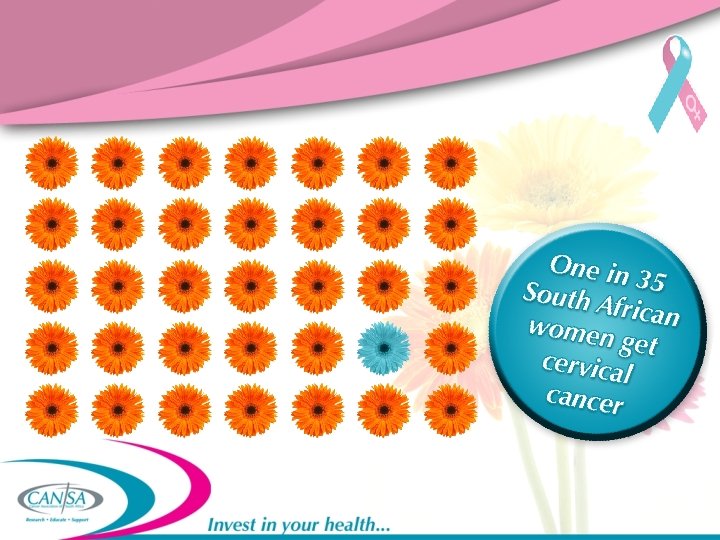
Cervical cancer affects more South African women than any other cancer
What is cervical cancer? The cervix is the lower part or mouth of the uterus (womb) It is one of the most common cancers among South African women Cervical cancer is curable if detected and treated in the early stages! Cervical cancer does not develop suddenly There is a gradual change from normal cervical cells, through various levels of abnormality, to precancer lesions and eventually to cancer This whole process
What is a Pap smear? A pap smear is a procedure that is done to detect early cell changes in the neck of the womb By having pap smears regularly, treatment can be given at an early stage and so prevent the development of advanced cervical cancer The Pap smear is the single most effective cancer screening procedure! Although some women may experience discomfort, a pap smear is usually quick and painless
How is a Pap smear done? To allow for a visual inspection of the vagina and cervix and to enable the easy collection of cervical cells from the entrance of the womb, a medical practitioner inserts an instrument called a speculum into the vaginal canal Cervical cells are then collected from the surface of the cervix with a small wooden spatula or a small cervical brush The cells are put onto a glass slide which is then sent to a laboratory for examination under a microscope If abnormal cells are detected, you will be referred for treatment to prevent development of cancer of the cervix
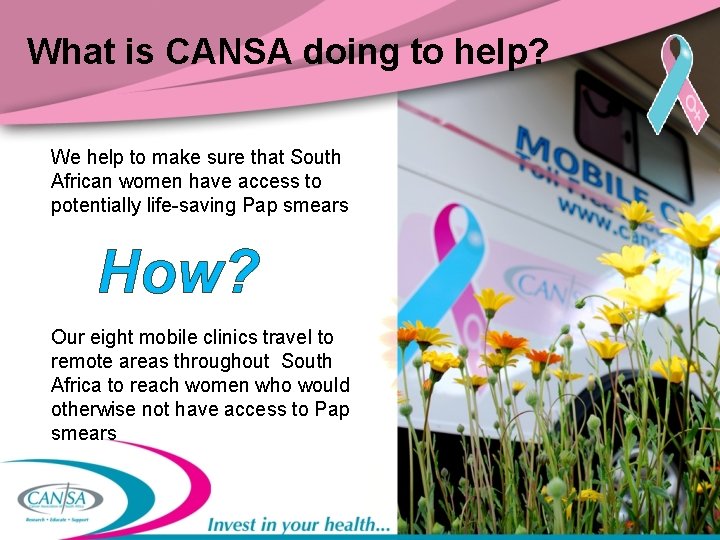
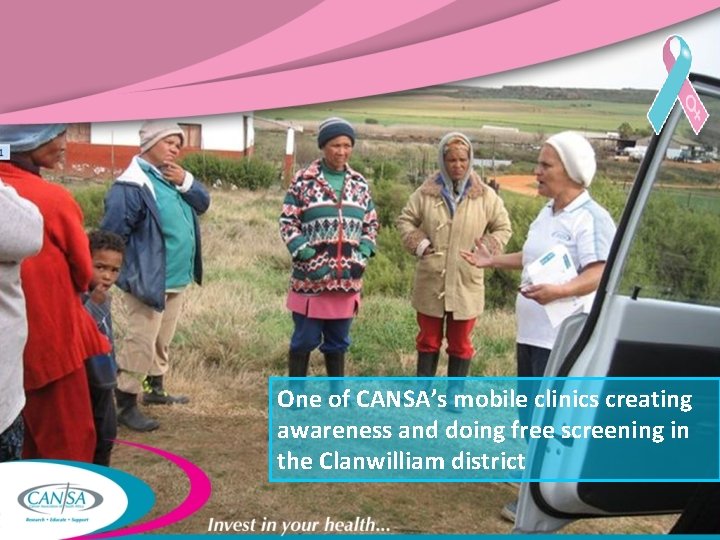
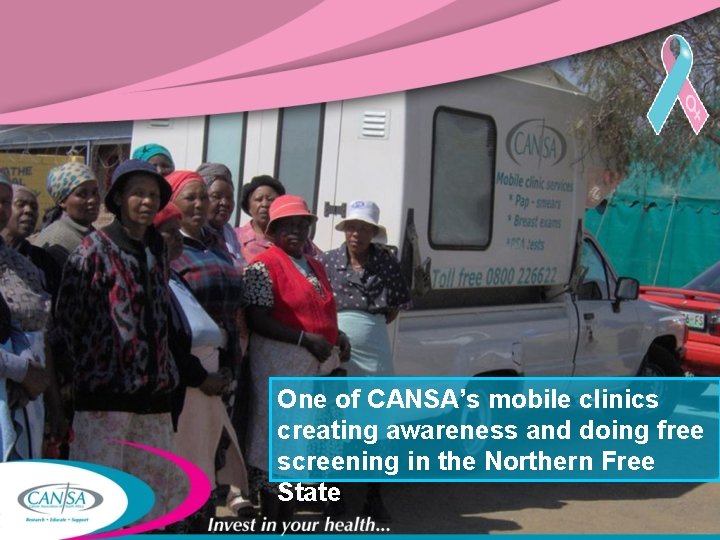
What is CANSA doing to help? We help to make sure that South African women have access to potentially life-saving Pap smears How? Our eight mobile clinics travel to remote areas throughout South Africa to reach women who would otherwise not have access to Pap smears
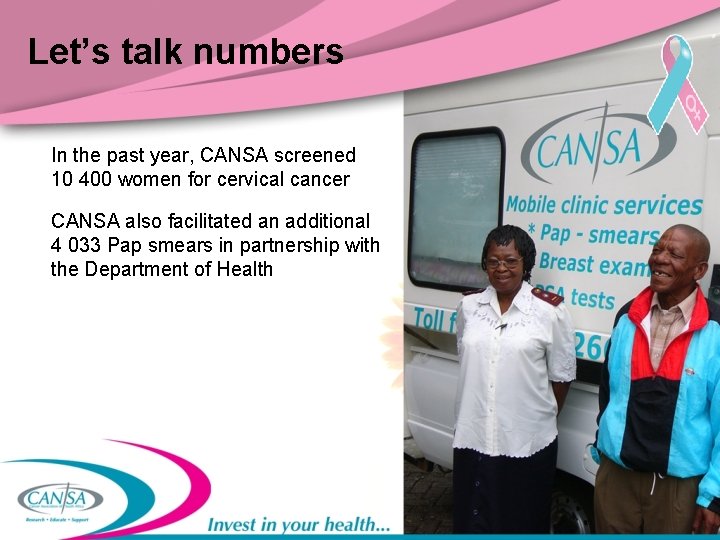
Let’s talk numbers In the past year, CANSA screened 10 400 women for cervical cancer CANSA also facilitated an additional 4 033 Pap smears in partnership with the Department of Health
One of CANSA’s mobile clinics creating awareness and doing free screening in the Clanwilliam district
One of CANSA’s mobile clinics creating awareness and doing free screening in the Northern Free State
Are you at risk for cervical cancer? Let’s find out!
You have an increased risk for cervical cancer if. . . You've had persistent Human Papillomavirus (HPV) infections Why? HPV infection of the cervix is the primary risk factor for cervical cancer and is associated with 70% of all cases
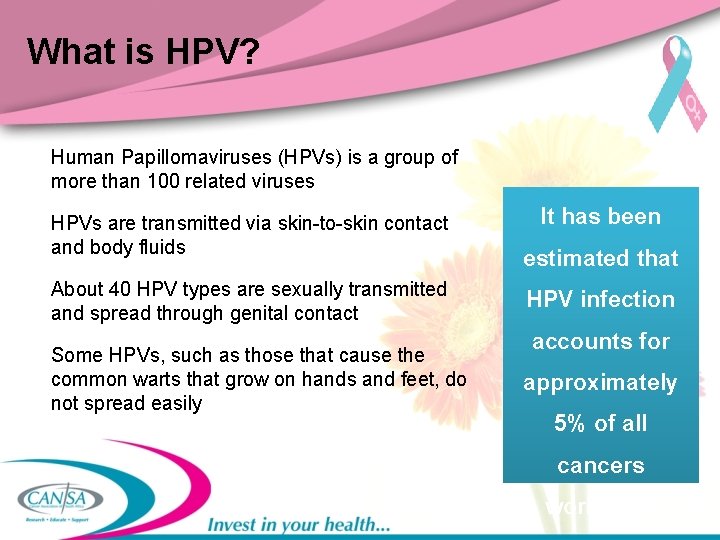
What is HPV? Human Papillomaviruses (HPVs) is a group of more than 100 related viruses HPVs are transmitted via skin-to-skin contact and body fluids About 40 HPV types are sexually transmitted and spread through genital contact Some HPVs, such as those that cause the common warts that grow on hands and feet, do not spread easily It has been estimated that HPV infection accounts for approximately 5% of all cancers worldwide
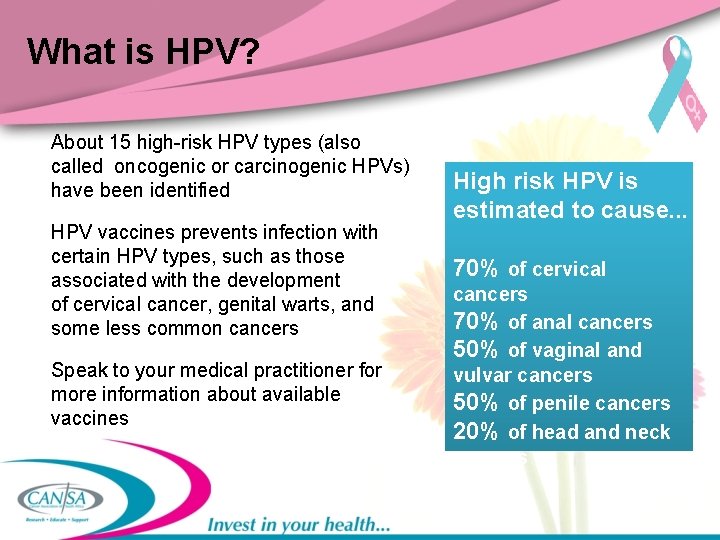
What is HPV? About 15 high-risk HPV types (also called oncogenic or carcinogenic HPVs) have been identified HPV vaccines prevents infection with certain HPV types, such as those associated with the development of cervical cancer, genital warts, and some less common cancers Speak to your medical practitioner for more information about available vaccines High risk HPV is estimated to cause. . . 70% of cervical cancers 70% of anal cancers 50% of vaginal and vulvar cancers 50% of penile cancers 20% of head and neck cancers
You have an increased risk for cervical cancer if. . . You have a weakened immune system Why? Women with weakened immune systems - when diagnosed with Acquired Immune Deficiency Syndrome (AIDS) or when taking immunesuppressing drugs for auto-immune diseases or after organ transplants are more likely to develop cervical cancer
You have an increased risk for cervical cancer if. . . You've had many sexual partners. . . or your partner had (or has) lots of partners Why? Many sexual partners increases your risk of HPV infections Being sexually active from a very young age increases exposure to many partners Women in homosexual relationships should also be screened regularly as HPV is passed through body fluids
You have an increased risk for cervical cancer if. . . You haven't had a Pap smear in the past three or more years Why? Women who have never had a Pap smear, or who have not had one for several years have an increased risk Don’t forget. . . Pap smears to detect cervical cancer is the single most effective cancer screening procedure
You have an increased risk for cervical cancer if. . . You're a smoker Why? Recent research established that smoking increases cervical cancer risk with 50%
You have an increased risk for cervical cancer if. . . You're of child-bearing age (18 -40) Why? Most high risk pre-cancerous lesions are found in women of childbearing age Also, multiple pregnancies increase the risk of cervical cancer when between 5 to 7 full-term pregnancies have been experienced
Just remember. . . It is possible to develop cervical cancer with or without the risk factors we’ve discussed The more risk factors you have, the greater your likelihood of developing cervical cancer If you have a number of risk factors, find out from your health practitioner or CANSA Care Centre what you can do to reduce your risk
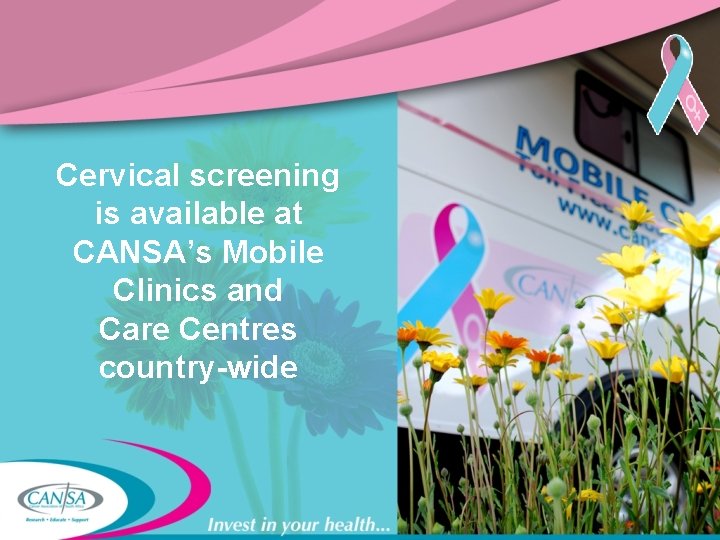
Cervical screening is available at CANSA’s Mobile Clinics and Care Centres country-wide
Join the fight against cervical cancer. . . Get screened Make a donation Become a member Sign up as a volunteer
To assist CANSA expand its cancer screening programmes, please consider making a donation at any of our more than 50 CANSA Care Centres country-wide
Any questions? Toll-Free 0800 22 66 22 www. cansa. org. za