
Regular expressions used for describing string patterns e
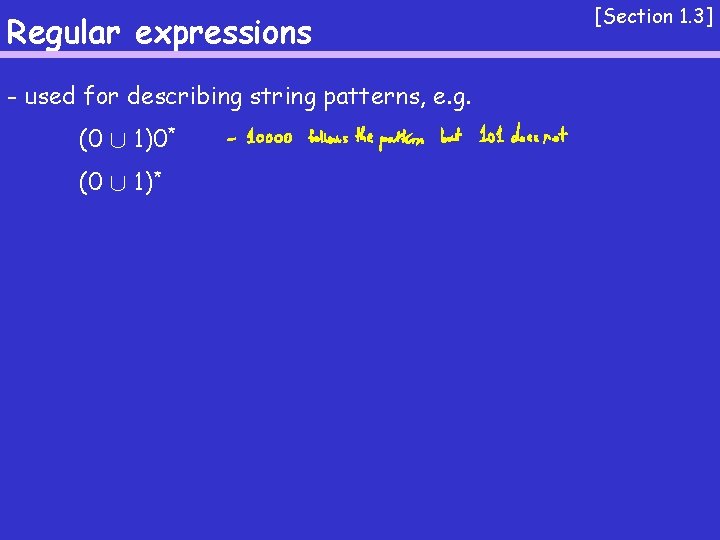
Regular expressions - used for describing string patterns, e. g. (0 [ 1)0* (0 [ 1)* [Section 1. 3]
![Regular expressions [Section 1. 3] Formal definition: R is a regular expression if R](http://slidetodoc.com/presentation_image/5acbf6e9b28d41c746029f2052a9e0e9/image-2.jpg "Regular expressions [Section 1. 3] Formal definition: R is a regular expression if R")
Regular expressions [Section 1. 3] Formal definition: R is a regular expression if R is one of the following: 1. a for some a 2 §, 2. ε 3. ; 4. (R 1 [ R 2), where R 1, R 2 are regular expressions 5. (R 1. R 2), where R 1, R 2 are regular expressions 6. (R 1)*, where R 1 is a regular expression. 7. Note: this type of definition is called a recursive/inductive definition (i. e. the definition is a recursive algorithm).
![Regular expressions [Section 1. 3] For convenience: R+ = RR* Examples: give regular expressions](http://slidetodoc.com/presentation_image/5acbf6e9b28d41c746029f2052a9e0e9/image-3.jpg "Regular expressions [Section 1. 3] For convenience: R+ = RR* Examples: give regular expressions")
Regular expressions [Section 1. 3] For convenience: R+ = RR* Examples: give regular expressions for the following languages: - { w 2 {0, 1}* | w contains the substring 001 } - { w 2 {0, 1}* | w does not contain two consecutive 0’s } - { w 2 {0, 1}* | |w| is divisible by 2 or 3 } - { w 2 {0, 1}* | |w| < 4 }
![Regular expressions [Section 1. 3] Examples: let R be any regular expression - R.](http://slidetodoc.com/presentation_image/5acbf6e9b28d41c746029f2052a9e0e9/image-4.jpg "Regular expressions [Section 1. 3] Examples: let R be any regular expression - R.")
Regular expressions [Section 1. 3] Examples: let R be any regular expression - R. ; =? - R. ε=? - ; * = ? - ε* = ? The language defined by R is denoted L(R). We’ll often abuse notation and use R to denote the language L(R).
![Equivalence of reg. expr. and FA’s [Section 1. 3] Thm 1. 54: A language](http://slidetodoc.com/presentation_image/5acbf6e9b28d41c746029f2052a9e0e9/image-5.jpg "Equivalence of reg. expr. and FA’s [Section 1. 3] Thm 1. 54: A language")
Equivalence of reg. expr. and FA’s [Section 1. 3] Thm 1. 54: A language is regular iff some regular expression describes it. Lemma 1. 55: Given a regular expression R, there exists a FA M such that L(M) = L(R). Lemma 1. 60: Given a FA M, there exists a regular expression R such that L(R) = L(M).
![Equivalence of reg. expr. and FA’s [Section 1. 3] Lemma 1. 55: Given a](http://slidetodoc.com/presentation_image/5acbf6e9b28d41c746029f2052a9e0e9/image-6.jpg "Equivalence of reg. expr. and FA’s [Section 1. 3] Lemma 1. 55: Given a")
Equivalence of reg. expr. and FA’s [Section 1. 3] Lemma 1. 55: Given a regular expression R, there exists a FA M such that L(M) = L(R).
![Equivalence of reg. expr. and FA’s [Section 1. 3] Lemma 1. 60: Given a](http://slidetodoc.com/presentation_image/5acbf6e9b28d41c746029f2052a9e0e9/image-7.jpg "Equivalence of reg. expr. and FA’s [Section 1. 3] Lemma 1. 60: Given a")
Equivalence of reg. expr. and FA’s [Section 1. 3] Lemma 1. 60: Given a FA M, there exists a regular expression R such that L(R) = L(M). Proof idea: Generalized NFA (GNFA) - transitions may be marked by reg. expr. (not just §[{ε}) - single accept state that a) has arrows coming in from every other state, b) does not have any outgoing arrows - start state that a) has arrows to every other state, b) does not have any incoming arrows - all other states have arrows to all other states
![Equivalence of reg. expr. and FA’s [Section 1. 3] Lemma 1. 60: Given a](http://slidetodoc.com/presentation_image/5acbf6e9b28d41c746029f2052a9e0e9/image-8.jpg "Equivalence of reg. expr. and FA’s [Section 1. 3] Lemma 1. 60: Given a")
Equivalence of reg. expr. and FA’s [Section 1. 3] Lemma 1. 60: Given a FA M, there exists a regular expression R such that L(R) = L(M). Proof idea: Idea: start with a GNFA, remove states one by one and redraw arrows as necessary.
![Equivalence of reg. expr. and FA’s [Section 1. 3] Lemma 1. 60: Given a](http://slidetodoc.com/presentation_image/5acbf6e9b28d41c746029f2052a9e0e9/image-9.jpg "Equivalence of reg. expr. and FA’s [Section 1. 3] Lemma 1. 60: Given a")
Equivalence of reg. expr. and FA’s [Section 1. 3] Lemma 1. 60: Given a FA M, there exists a regular expression R such that L(R) = L(M). Proof idea: How to construct an equivalent GNFA with one fewer state?
- Slides: 9