
Regular Expressions Text Normalization Edit Distance Chapter 2

![nitrogen{130} egrep "^[^A-Z]" cars. txt destination - could be ready for sale within a](https://slidetodoc.com/presentation_image_h2/44405b0e24ed1b7cd285473415d5248e/image-9.jpg "nitrogen{130} egrep \"^[^A-Z]\" cars. txt destination - could be ready for sale within a")
![nitrogen{174} egrep '^[^A-Z]+$' cars. txt destination - could be ready for sale within a](https://slidetodoc.com/presentation_image_h2/44405b0e24ed1b7cd285473415d5248e/image-10.jpg "nitrogen{174} egrep '^[^A-Z]+$' cars. txt destination - could be ready for sale within a")

- Slides: 49
Regular Expressions, Text Normalization, Edit Distance Chapter 2
Basic Text Processing Regular Expressions
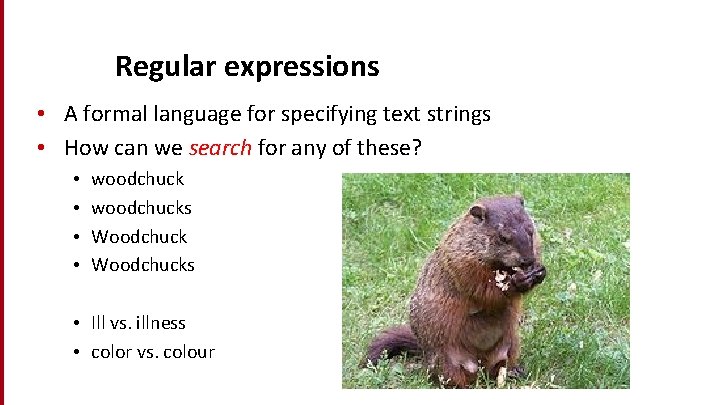
Regular expressions • A formal language for specifying text strings • How can we search for any of these? • • woodchucks Woodchucks • Ill vs. illness • color vs. colour
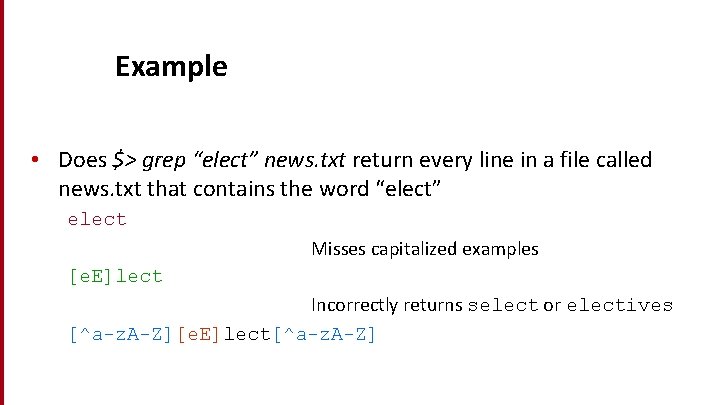
Example • Does $> grep “elect” news. txt return every line in a file called news. txt that contains the word “elect” elect Misses capitalized examples [e. E]lect Incorrectly returns select or electives [^a-z. A-Z][e. E]lect[^a-z. A-Z]
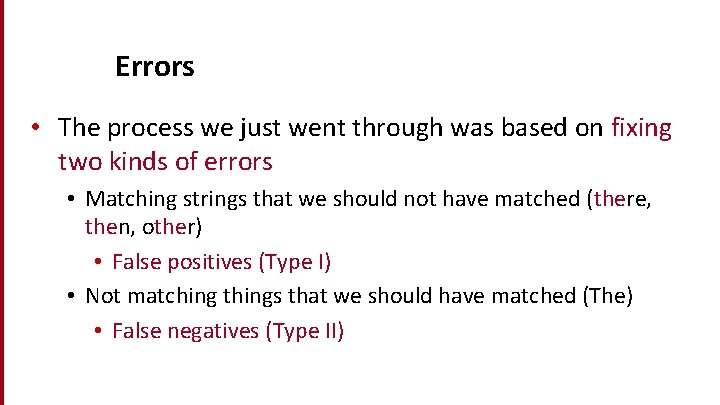
Errors • The process we just went through was based on fixing two kinds of errors • Matching strings that we should not have matched (there, then, other) • False positives (Type I) • Not matching things that we should have matched (The) • False negatives (Type II)
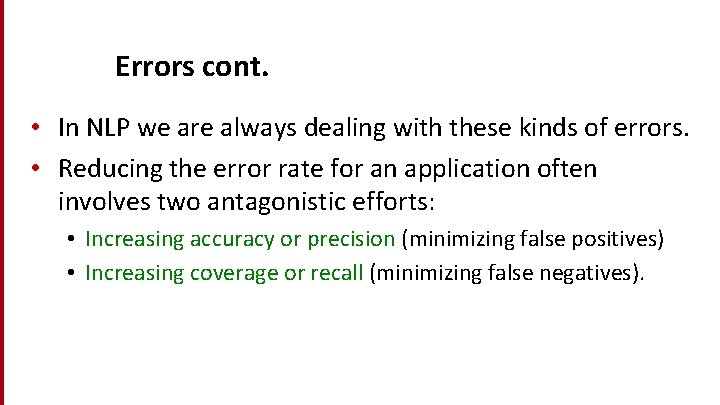
Errors cont. • In NLP we are always dealing with these kinds of errors. • Reducing the error rate for an application often involves two antagonistic efforts: • Increasing accuracy or precision (minimizing false positives) • Increasing coverage or recall (minimizing false negatives).
Summary • Regular expressions play a surprisingly large role • Sophisticated sequences of regular expressions are often the first model for any text processing text • I am assuming you know, or will learn, in a language of your choice • For many hard tasks, we use machine learning classifiers • But regular expressions are used as features in the classifiers • Can be very useful in capturing generalizations 7
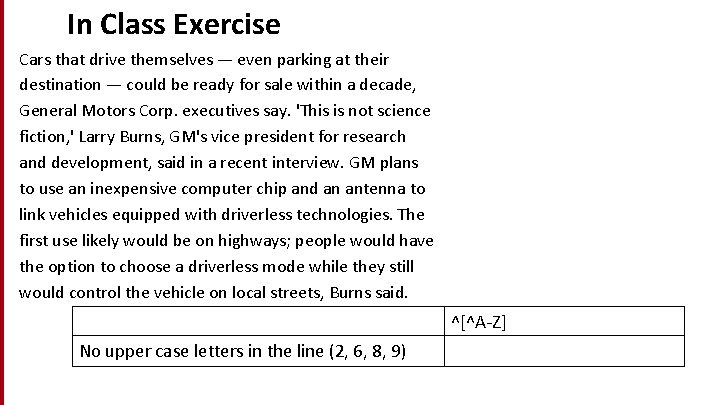
In Class Exercise Cars that drive themselves — even parking at their destination — could be ready for sale within a decade, General Motors Corp. executives say. 'This is not science fiction, ' Larry Burns, GM's vice president for research and development, said in a recent interview. GM plans to use an inexpensive computer chip and an antenna to link vehicles equipped with driverless technologies. The first use likely would be on highways; people would have the option to choose a driverless mode while they still would control the vehicle on local streets, Burns said. ^[^A-Z] No upper case letters in the line (2, 6, 8, 9)
nitrogen{130} egrep "^[^A-Z]" cars. txt destination - could be ready for sale within a decade, fiction, ' Larry Burns, GM's vice president for research and development, said in a recent interview. GM plans to use an inexpensive computer chip and an antenna to link vehicles equipped with driverless technologies. The first use likely would be on highways; people would have the option to choose a driverless mode while they still would control the vehicle on local streets, Burns said. 9
nitrogen{174} egrep '^[^A-Z]+$' cars. txt destination - could be ready for sale within a decade, to use an inexpensive computer chip and an antenna to first use likely would be on highways; people would have the option to choose a driverless mode while they still 10
Basic Text Processing Word tokenization
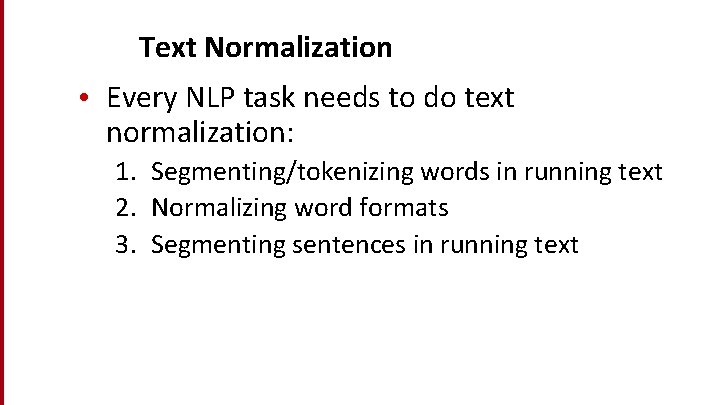
Text Normalization • Every NLP task needs to do text normalization: 1. Segmenting/tokenizing words in running text 2. Normalizing word formats 3. Segmenting sentences in running text
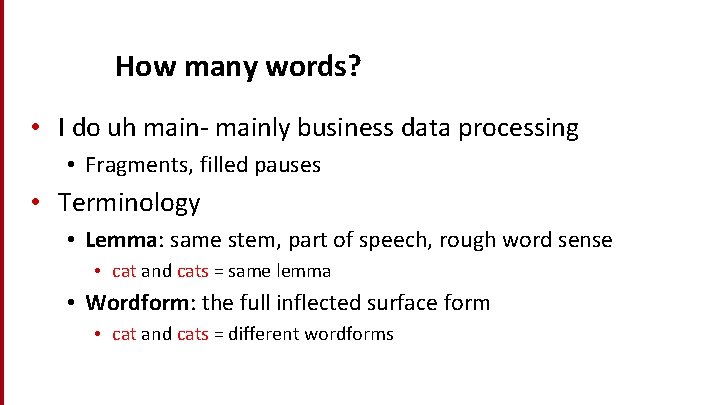
How many words? • I do uh main- mainly business data processing • Fragments, filled pauses • Terminology • Lemma: same stem, part of speech, rough word sense • cat and cats = same lemma • Wordform: the full inflected surface form • cat and cats = different wordforms
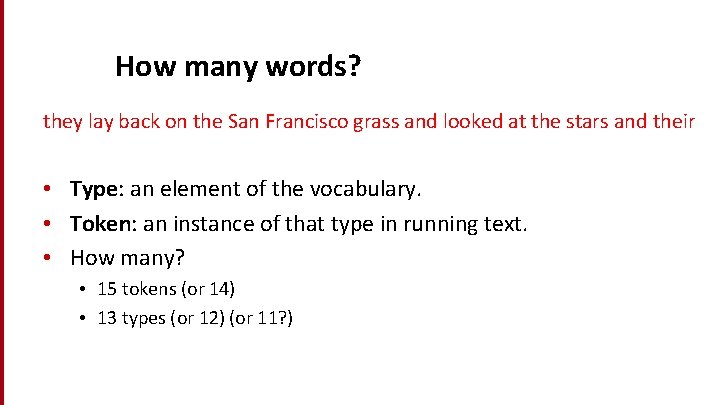
How many words? they lay back on the San Francisco grass and looked at the stars and their • Type: an element of the vocabulary. • Token: an instance of that type in running text. • How many? • 15 tokens (or 14) • 13 types (or 12) (or 11? )
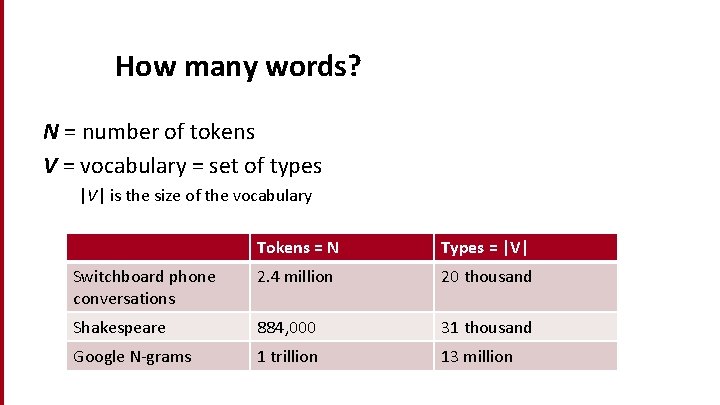
How many words? N = number of tokens V = vocabulary = set of types |V| is the size of the vocabulary Tokens = N Types = |V| Switchboard phone conversations 2. 4 million 20 thousand Shakespeare 884, 000 31 thousand Google N-grams 1 trillion 13 million
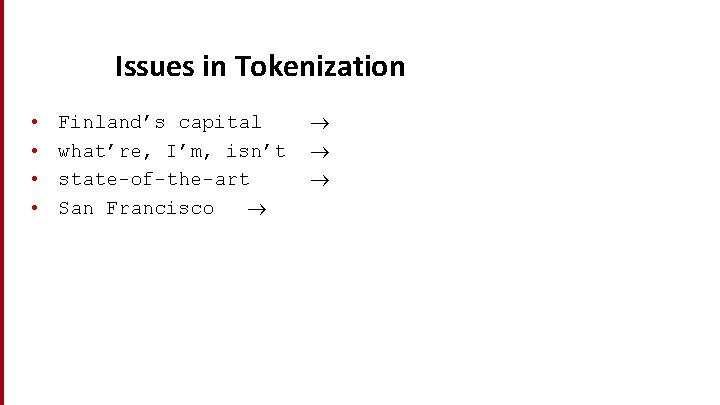
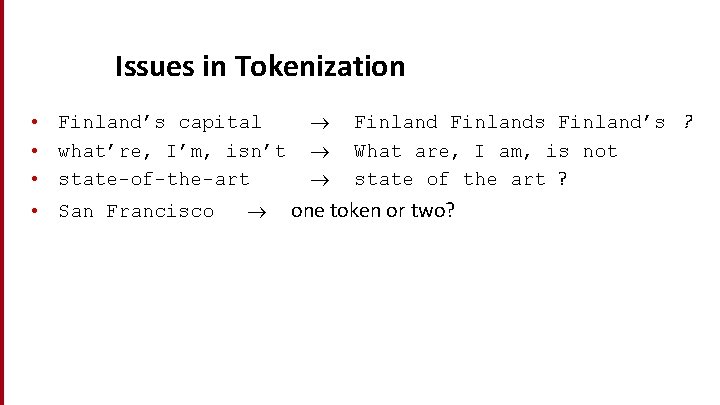
Issues in Tokenization • • Finland’s capital what’re, I’m, isn’t state-of-the-art San Francisco
Issues in Tokenization • Finland’s capital • what’re, I’m, isn’t • state-of-the-art • San Francisco Finlands Finland’s ? What are, I am, is not state of the art ? one token or two?
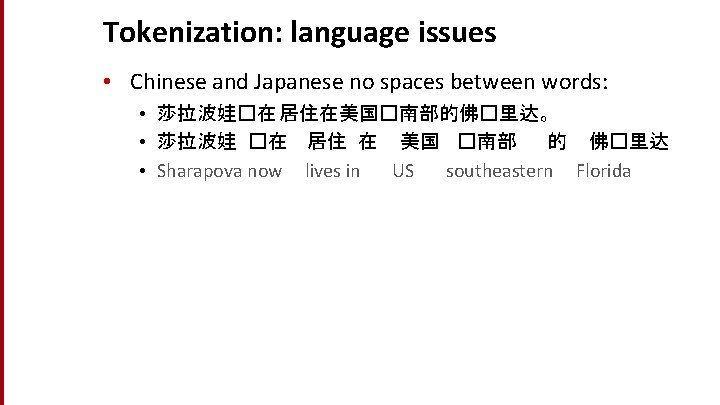
Tokenization: language issues • Chinese and Japanese no spaces between words: • 莎拉波娃�在 居住在美国�南部的佛�里达。 • 莎拉波娃 �在 居住 在 美国 �南部 的 佛�里达 • Sharapova now lives in US southeastern Florida
Basic Text Processing Word Normalization and Stemming
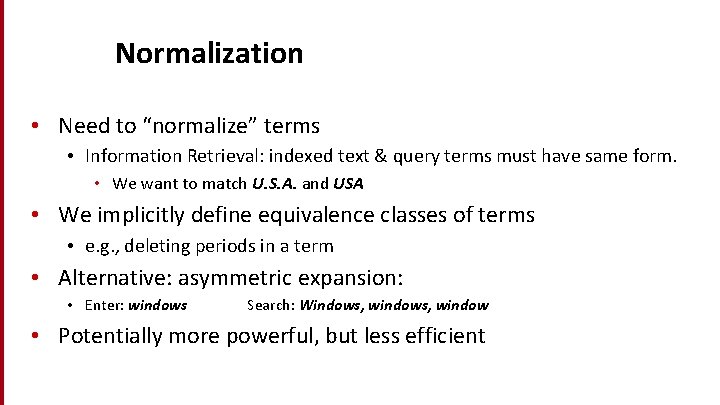
Normalization • Need to “normalize” terms • Information Retrieval: indexed text & query terms must have same form. • We want to match U. S. A. and USA • We implicitly define equivalence classes of terms • e. g. , deleting periods in a term • Alternative: asymmetric expansion: • Enter: windows Search: Windows, window • Potentially more powerful, but less efficient
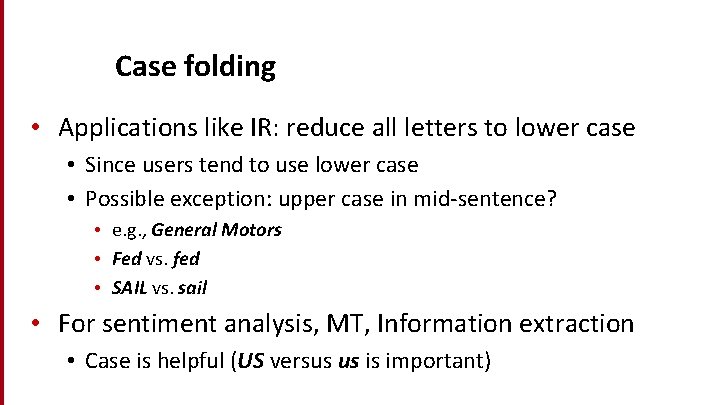
Case folding • Applications like IR: reduce all letters to lower case • Since users tend to use lower case • Possible exception: upper case in mid-sentence? • e. g. , General Motors • Fed vs. fed • SAIL vs. sail • For sentiment analysis, MT, Information extraction • Case is helpful (US versus us is important)
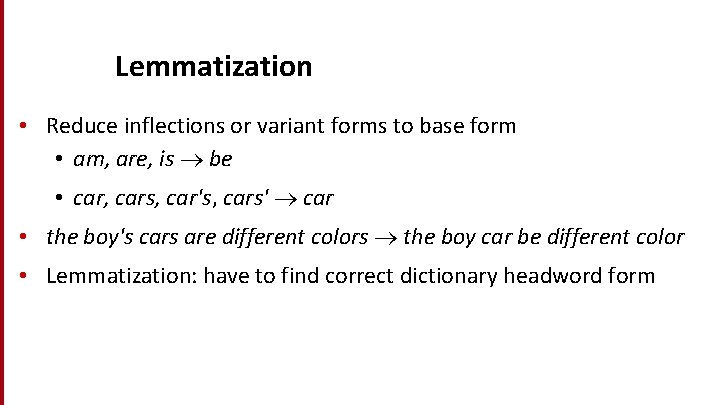
Lemmatization • Reduce inflections or variant forms to base form • am, are, is be • car, cars, car's, cars' car • the boy's cars are different colors the boy car be different color • Lemmatization: have to find correct dictionary headword form
Morphology • Morphemes: • The small meaningful units that make up words • Stems: The core meaning-bearing units • Affixes: Bits and pieces that adhere to stems • Often with grammatical functions
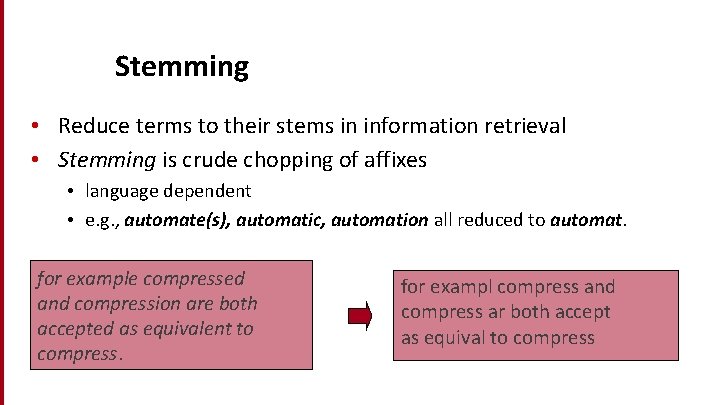
Stemming • Reduce terms to their stems in information retrieval • Stemming is crude chopping of affixes • language dependent • e. g. , automate(s), automatic, automation all reduced to automat. for example compressed and compression are both accepted as equivalent to compress. for exampl compress and compress ar both accept as equival to compress
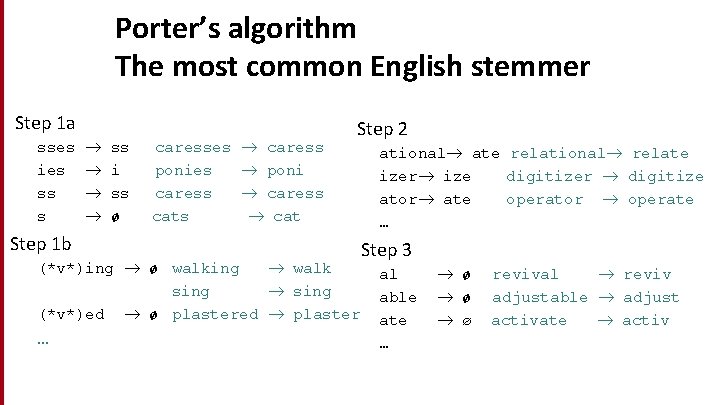
Porter’s algorithm The most common English stemmer Step 1 a sses ies ss s ss i ss ø caresses caress ponies poni caress cats cat Step 2 Step 1 b (*v*)ing ø walking walk sing (*v*)ed ø plastered plaster … ational ate relational relate izer ize digitizer digitize ator ate operator operate … Step 3 al able ate … ø ø ø revival reviv adjustable adjust activate activ
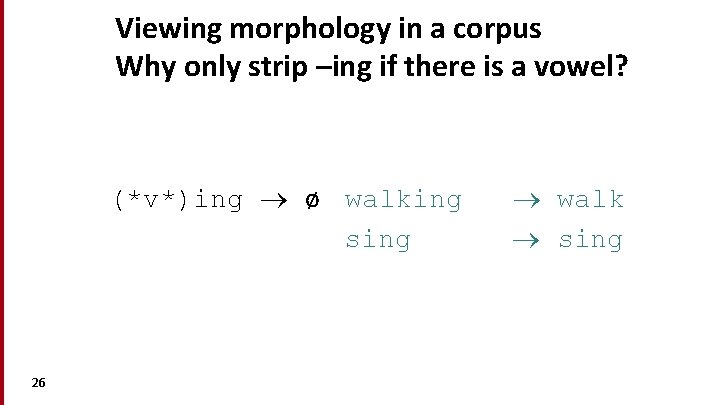
Viewing morphology in a corpus Why only strip –ing if there is a vowel? (*v*)ing ø walking sing 26 walk sing
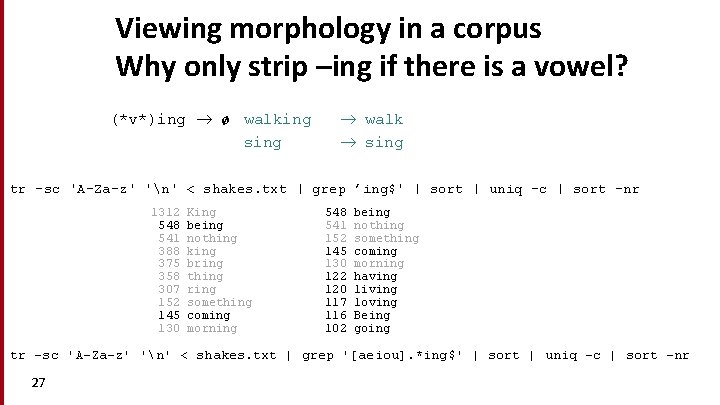
Viewing morphology in a corpus Why only strip –ing if there is a vowel? (*v*)ing ø walking sing walk sing tr -sc 'A-Za-z' 'n' < shakes. txt | grep ’ing$' | sort | uniq -c | sort –nr 1312 548 541 388 375 358 307 152 145 130 King being nothing king bring thing ring something coming morning 548 541 152 145 130 122 120 117 116 102 being nothing something coming morning having living loving Being going tr -sc 'A-Za-z' 'n' < shakes. txt | grep '[aeiou]. *ing$' | sort | uniq -c | sort –nr 27
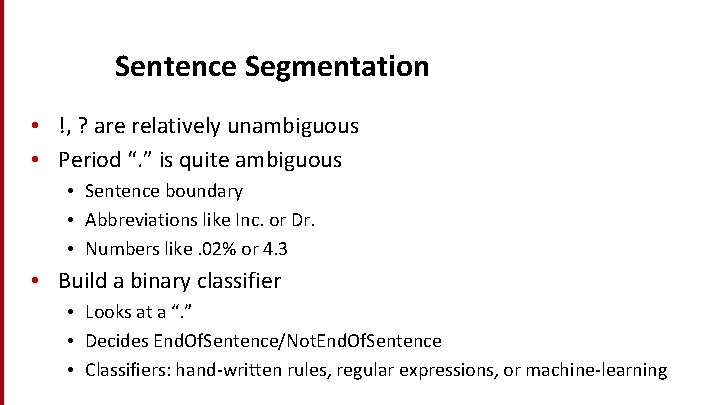
Sentence Segmentation • !, ? are relatively unambiguous • Period “. ” is quite ambiguous • Sentence boundary • Abbreviations like Inc. or Dr. • Numbers like. 02% or 4. 3 • Build a binary classifier • Looks at a “. ” • Decides End. Of. Sentence/Not. End. Of. Sentence • Classifiers: hand-written rules, regular expressions, or machine-learning
Minimum Edit Distance Definition and Computation
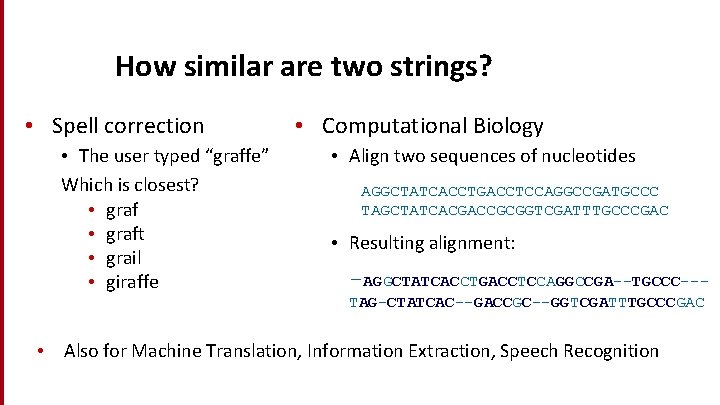
How similar are two strings? • Spell correction • The user typed “graffe” Which is closest? • graft • grail • giraffe • Computational Biology • Align two sequences of nucleotides AGGCTATCACCTGACCTCCAGGCCGATGCCC TAGCTATCACGACCGCGGTCGATTTGCCCGAC • Resulting alignment: -AGGCTATCACCTGACCTCCAGGCCGA--TGCCC--TAG-CTATCAC--GACCGC--GGTCGATTTGCCCGAC • Also for Machine Translation, Information Extraction, Speech Recognition
Edit Distance • The minimum edit distance between two strings • Is the minimum number of editing operations • Insertion • Deletion • Substitution • Needed to transform one into the other
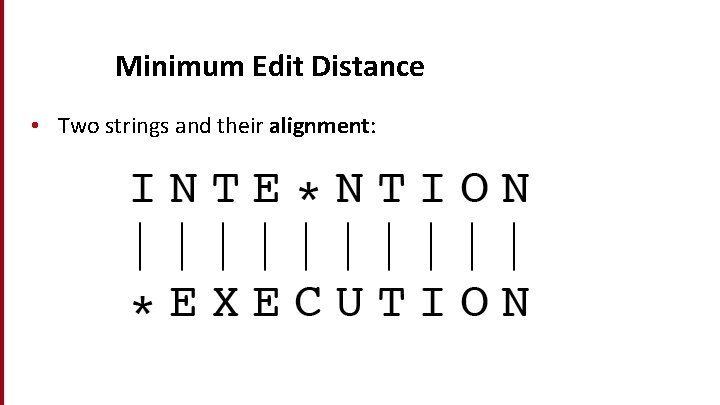
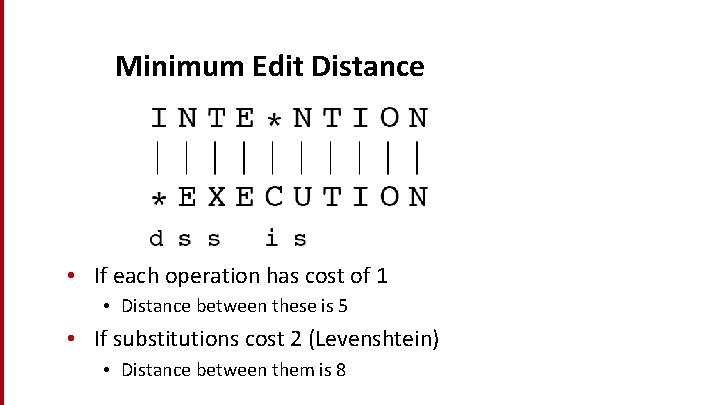
Minimum Edit Distance • Two strings and their alignment:
Minimum Edit Distance • If each operation has cost of 1 • Distance between these is 5 • If substitutions cost 2 (Levenshtein) • Distance between them is 8
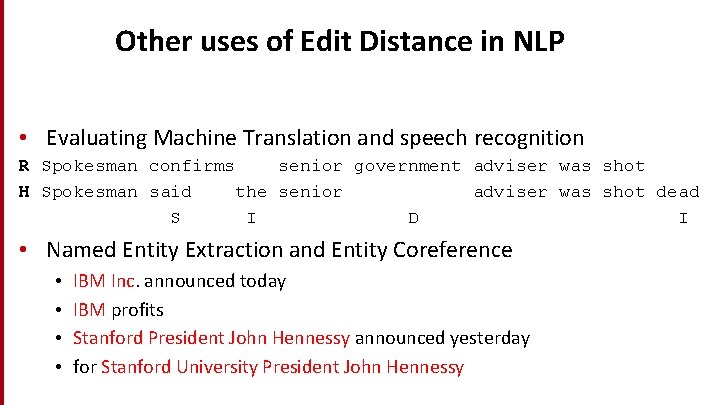
Other uses of Edit Distance in NLP • Evaluating Machine Translation and speech recognition R Spokesman confirms senior government adviser was shot H Spokesman said the senior adviser was shot dead S I D I • Named Entity Extraction and Entity Coreference • • IBM Inc. announced today IBM profits Stanford President John Hennessy announced yesterday for Stanford University President John Hennessy
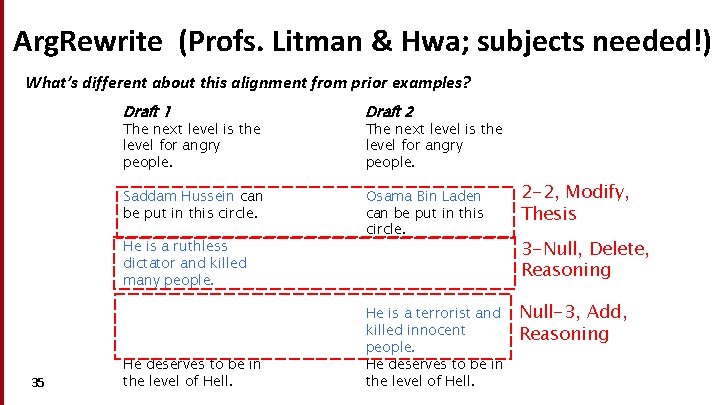
Arg. Rewrite (Profs. Litman & Hwa; subjects needed!) What’s different about this alignment from prior examples? Draft 1 Draft 2 Saddam Hussein can be put in this circle. Osama Bin Laden can be put in this circle. 2 -2, Modify, Thesis He is a terrorist and killed innocent people. He deserves to be in the level of Hell. Null-3, Add, Reasoning The next level is the level for angry people. He is a ruthless dictator and killed many people. 35 He deserves to be in the level of Hell. The next level is the level for angry people. 3 -Null, Delete, Reasoning
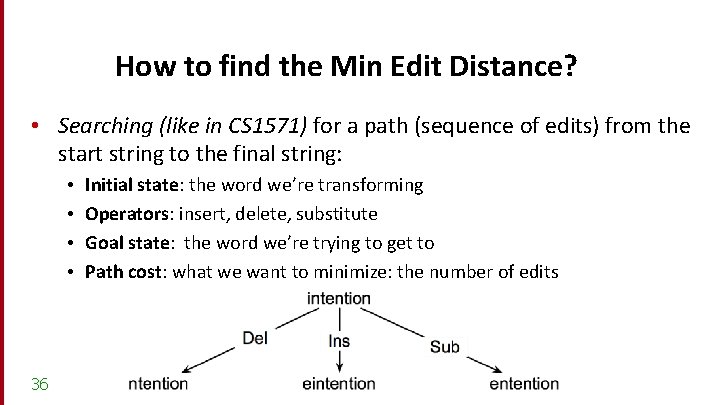
How to find the Min Edit Distance? • Searching (like in CS 1571) for a path (sequence of edits) from the start string to the final string: • • 36 Initial state: the word we’re transforming Operators: insert, delete, substitute Goal state: the word we’re trying to get to Path cost: what we want to minimize: the number of edits
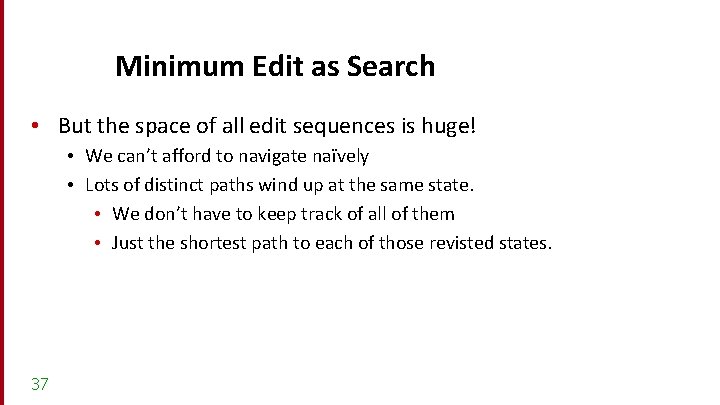
Minimum Edit as Search • But the space of all edit sequences is huge! • We can’t afford to navigate naïvely • Lots of distinct paths wind up at the same state. • We don’t have to keep track of all of them • Just the shortest path to each of those revisted states. 37
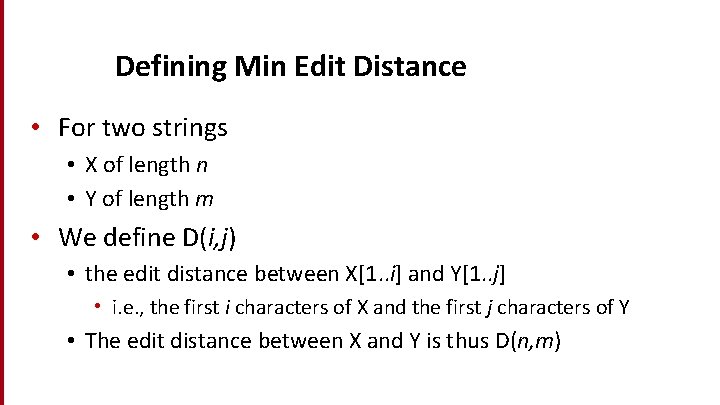
Defining Min Edit Distance • For two strings • X of length n • Y of length m • We define D(i, j) • the edit distance between X[1. . i] and Y[1. . j] • i. e. , the first i characters of X and the first j characters of Y • The edit distance between X and Y is thus D(n, m)
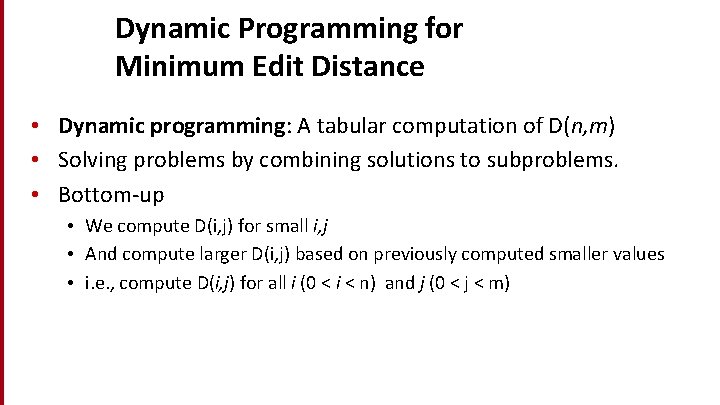
Dynamic Programming for Minimum Edit Distance • Dynamic programming: A tabular computation of D(n, m) • Solving problems by combining solutions to subproblems. • Bottom-up • We compute D(i, j) for small i, j • And compute larger D(i, j) based on previously computed smaller values • i. e. , compute D(i, j) for all i (0 < i < n) and j (0 < j < m)
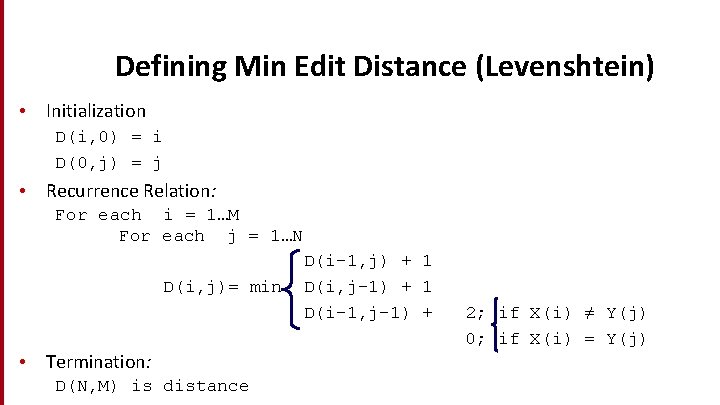
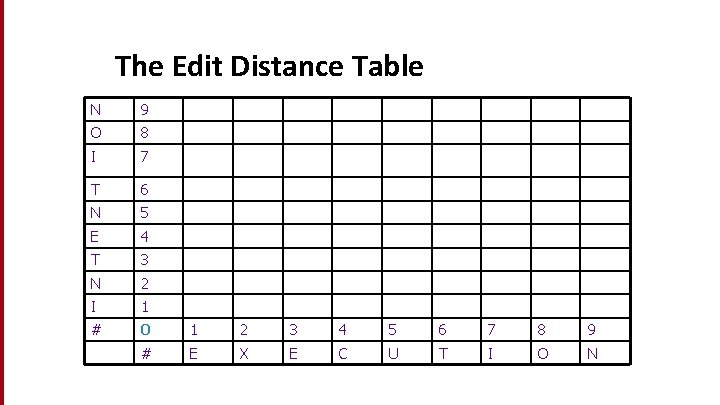
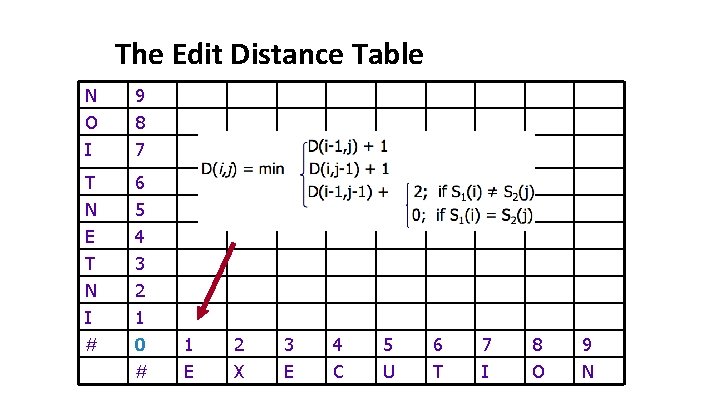
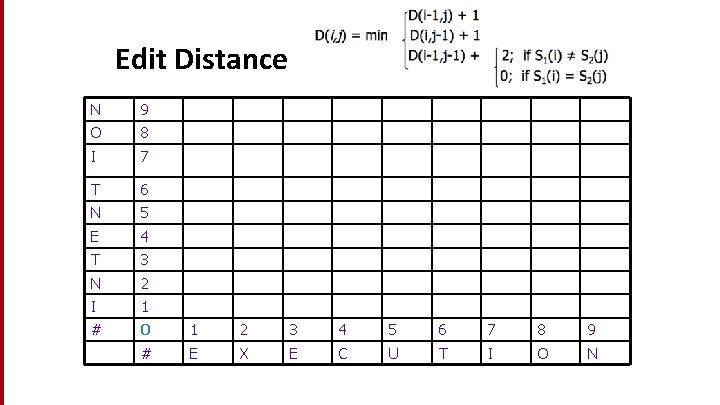
Defining Min Edit Distance (Levenshtein) • Initialization D(i, 0) = i D(0, j) = j • Recurrence Relation: For each i = 1…M For each j = 1…N D(i, j)= min • Termination: D(N, M) is distance D(i-1, j) + 1 D(i, j-1) + 1 D(i-1, j-1) + 2; if X(i) ≠ Y(j) 0; if X(i) = Y(j)
The Edit Distance Table N 9 O 8 I 7 T 6 N 5 E 4 T 3 N 2 I 1 # 0 1 2 3 4 5 6 7 8 9 # E X E C U T I O N
The Edit Distance Table N O I 9 8 7 T N 6 5 E T N I # 4 3 2 1 0 # 1 E 2 X 3 E 4 C 5 U 6 T 7 I 8 O 9 N
Edit Distance N 9 O 8 I 7 T 6 N 5 E 4 T 3 N 2 I 1 # 0 1 2 3 4 5 6 7 8 9 # E X E C U T I O N
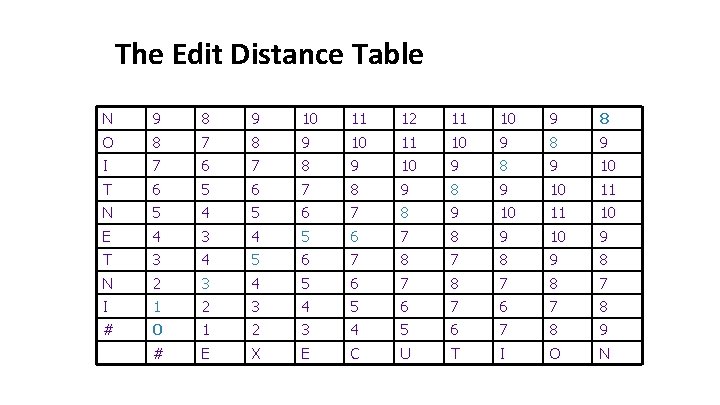
The Edit Distance Table N 9 8 9 10 11 12 11 10 9 8 O 8 7 8 9 10 11 10 9 8 9 I 7 6 7 8 9 10 9 8 9 10 T 6 5 6 7 8 9 10 11 N 5 4 5 6 7 8 9 10 11 10 E 4 3 4 5 6 7 8 9 10 9 T 3 4 5 6 7 8 9 8 N 2 3 4 5 6 7 8 7 I 1 2 3 4 5 6 7 8 # 0 1 2 3 4 5 6 7 8 9 # E X E C U T I O N
Computing alignments • Edit distance isn’t sufficient • We often need to align each character of the two strings to each other • We do this by keeping a “backtrace” • Every time we enter a cell, remember where we came from • When we reach the end, • Trace back the path from the upper right corner to read off the alignment
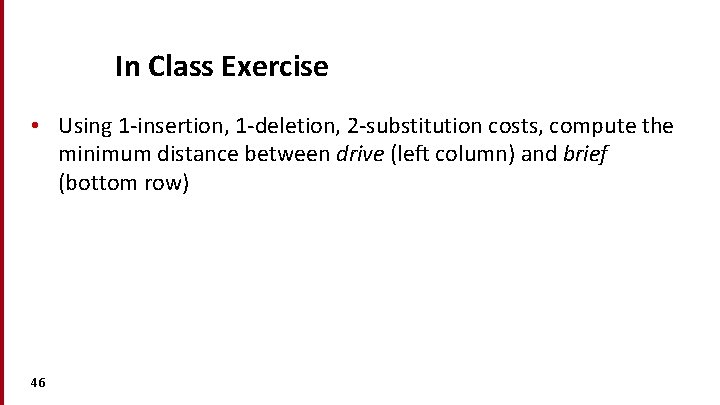
In Class Exercise • Using 1 -insertion, 1 -deletion, 2 -substitution costs, compute the minimum distance between drive (left column) and brief (bottom row) 46
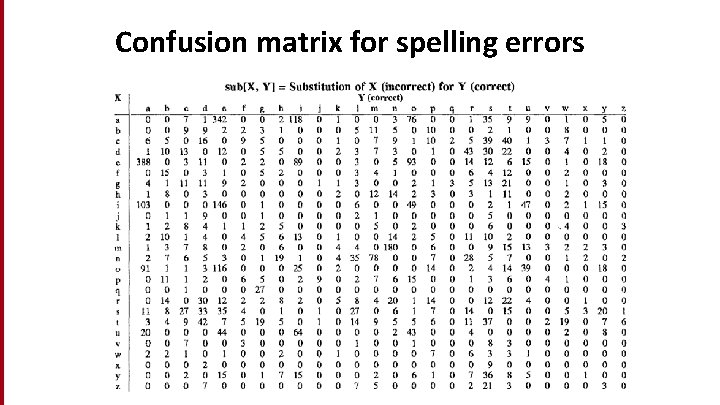
Weighted Edit Distance • Why would we add weights to the computation? • Spell Correction: some letters are more likely to be mistyped than others • Biology: certain kinds of deletions or insertions are more likely than others • Also other variants on basic algorithm (e. g. , global context)
Confusion matrix for spelling errors