
Regular Expressions RE Empty set A RE denotes
- Slides: 33
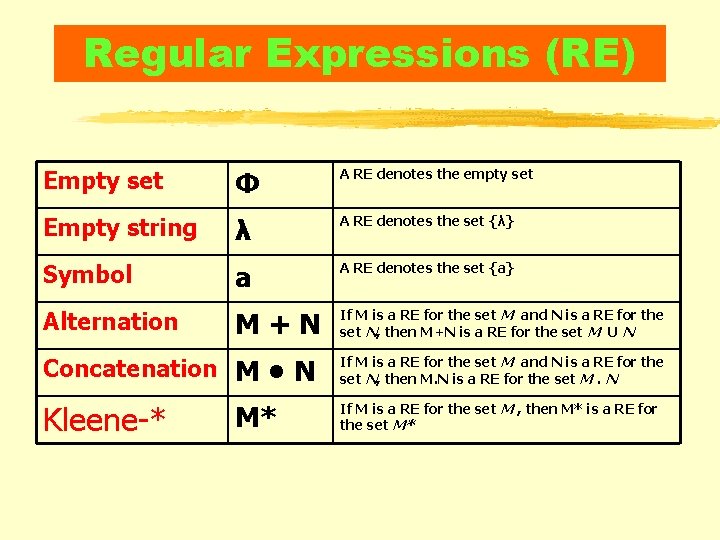
Regular Expressions (RE) Empty set Φ A RE denotes the empty set Empty string λ A RE denotes the set {λ} Symbol a A RE denotes the set {a} M+N If M is a RE for the set M and N is a RE for the set N, then M+N is a RE for the set M U N Alternation Concatenation M • N If M is a RE for the set M and N is a RE for the set N, then M. N is a RE for the set M. N Kleene-* If M is a RE for the set M , then M* is a RE for the set M* M*
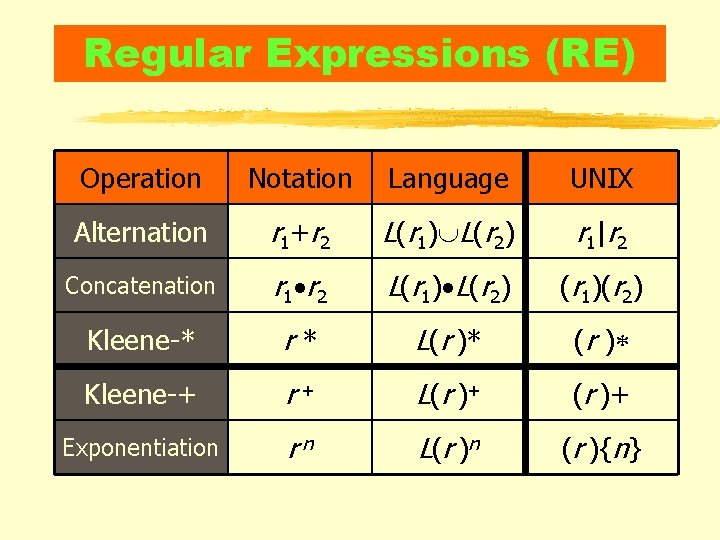
Regular Expressions (RE) Operation Notation Language UNIX Alternation r 1 + r 2 L(r 1) L(r 2) r 1 |r 2 Concatenation r 1 r 2 L(r 1) L(r 2) (r 1)(r 2) Kleene-* r* L(r )* Kleene-+ r+ L( r ) + (r )+ Exponentiation rn L( r ) n (r ){n}
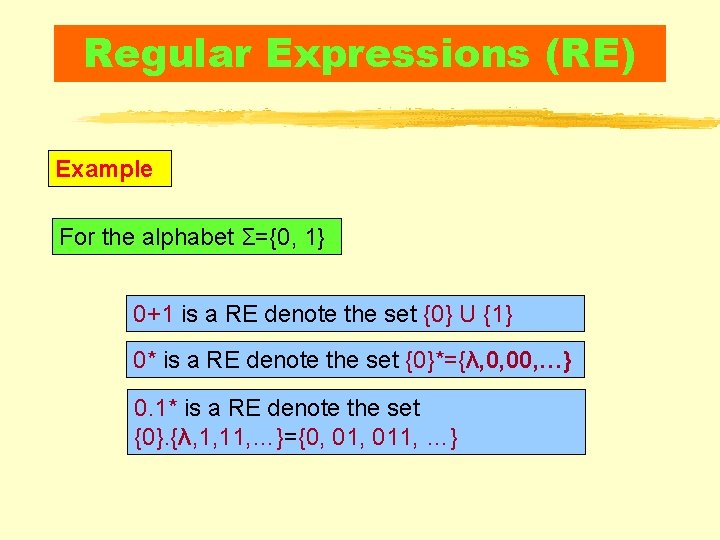
Regular Expressions (RE) Example For the alphabet Σ={0, 1} 0+1 is a RE denote the set {0} U {1} 0* is a RE denote the set {0}*={λ, 0, 00, …} 0. 1* is a RE denote the set {0}. {λ, 1, 11, …}={0, 011, …}
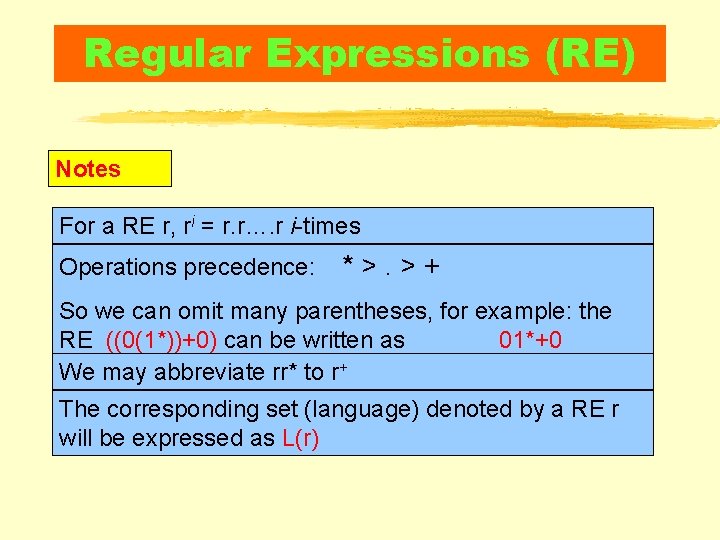
Regular Expressions (RE) Notes For a RE r, ri = r. r…. r i-times Operations precedence: *>. >+ So we can omit many parentheses, for example: the RE ((0(1*))+0) can be written as 01*+0 We may abbreviate rr* to r+ The corresponding set (language) denoted by a RE r will be expressed as L(r)
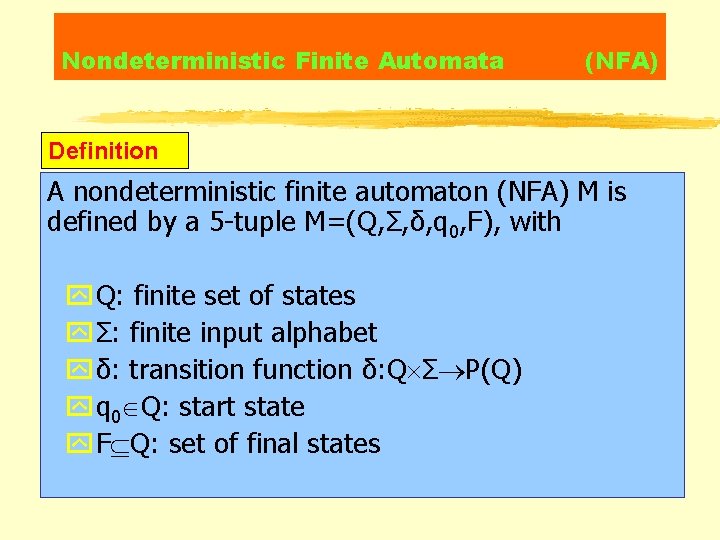
Nondeterministic Finite Automata (NFA) Definition A nondeterministic finite automaton (NFA) M is defined by a 5 -tuple M=(Q, Σ, δ, q 0, F), with y. Q: finite set of states yΣ: finite input alphabet yδ: transition function δ: Q Σ P(Q) yq 0 Q: start state y. F Q: set of final states
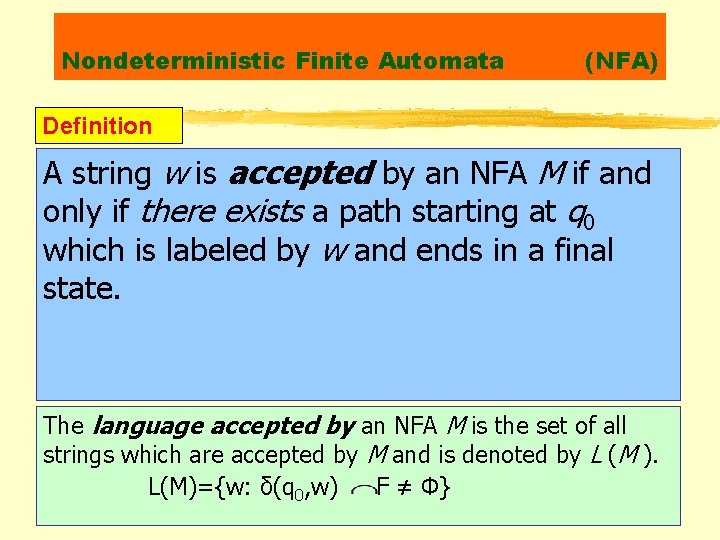
Nondeterministic Finite Automata (NFA) Definition A string w is accepted by an NFA M if and only if there exists a path starting at q 0 which is labeled by w and ends in a final state. The language accepted by an NFA M is the set of all strings which are accepted by M and is denoted by L (M ). L(M)={w: δ(q 0, w) F ≠ Φ}
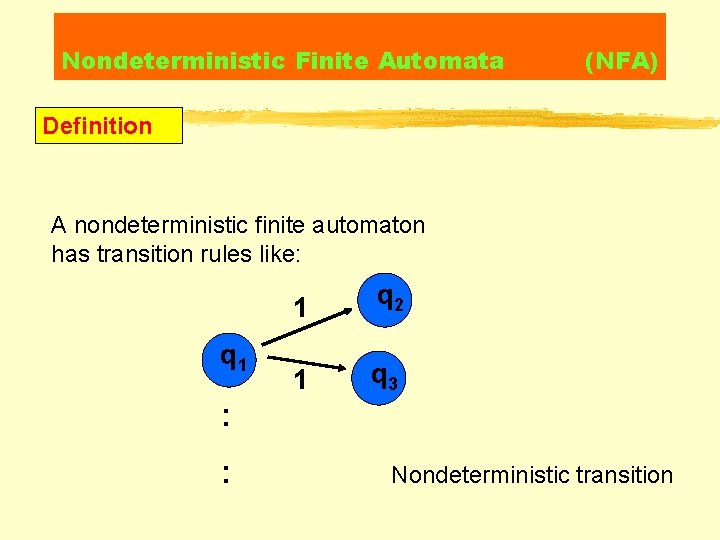
Nondeterministic Finite Automata (NFA) Definition A nondeterministic finite automaton has transition rules like: q 1 1 q 2 1 q 3 : : Nondeterministic transition
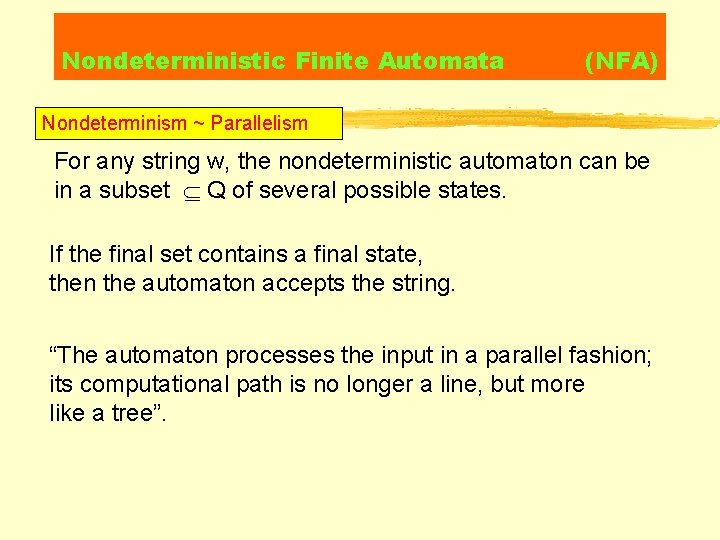
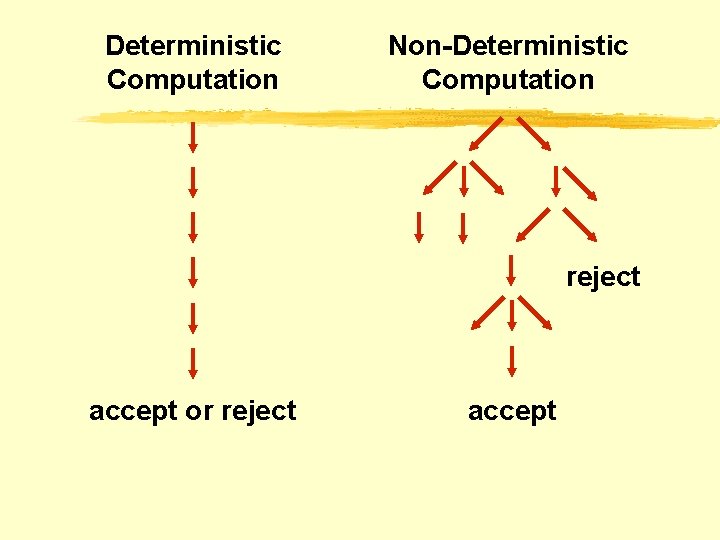
Nondeterministic Finite Automata (NFA) Nondeterminism ~ Parallelism For any string w, the nondeterministic automaton can be in a subset Q of several possible states. If the final set contains a final state, then the automaton accepts the string. “The automaton processes the input in a parallel fashion; its computational path is no longer a line, but more like a tree”.
Deterministic Computation Non-Deterministic Computation reject accept or reject accept
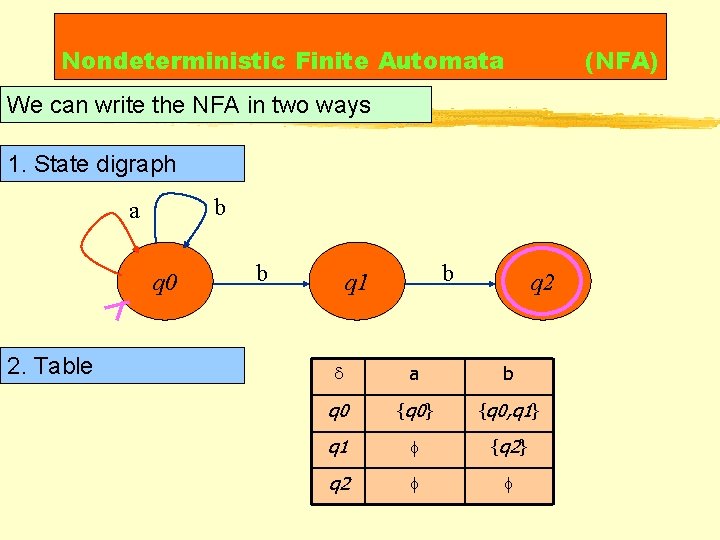
Nondeterministic Finite Automata (NFA) We can write the NFA in two ways 1. State digraph b a q 0 2. Table b b q 1 q 2 d a b q 0 {q 0} {q 0, q 1} q 1 f {q 2} q 2 f f
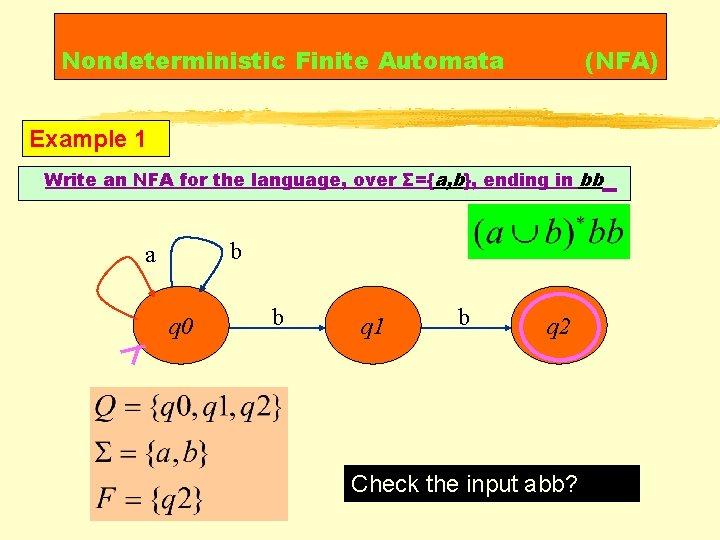
Nondeterministic Finite Automata (NFA) Example 1 Write an NFA for the language, over Σ={a, b}, ending in bb b a q 0 b q 1 b q 2 Check the input abb?
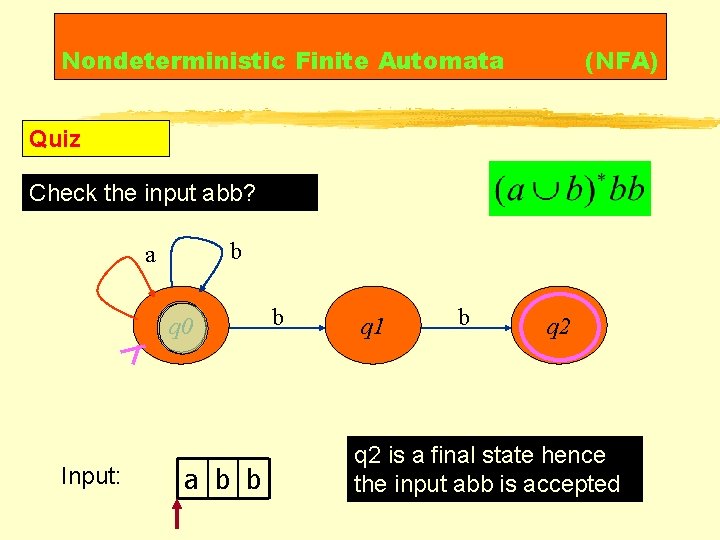
Nondeterministic Finite Automata (NFA) Quiz Check the input abb? b a q 0 Input: a b b b q 1 b q 2 is a final state hence the input abb is accepted
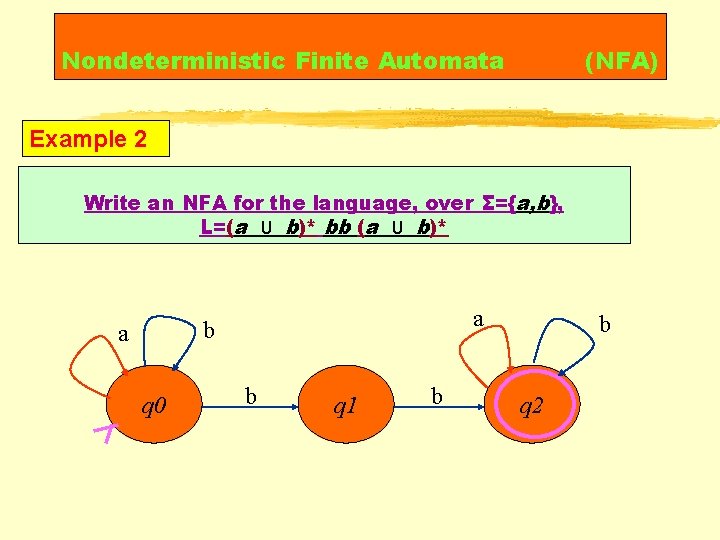
Nondeterministic Finite Automata (NFA) Example 2 Write an NFA for the language, over Σ={a, b}, L=(a U b)* bb (a U b)* a b a q 0 b q 1 b b q 2
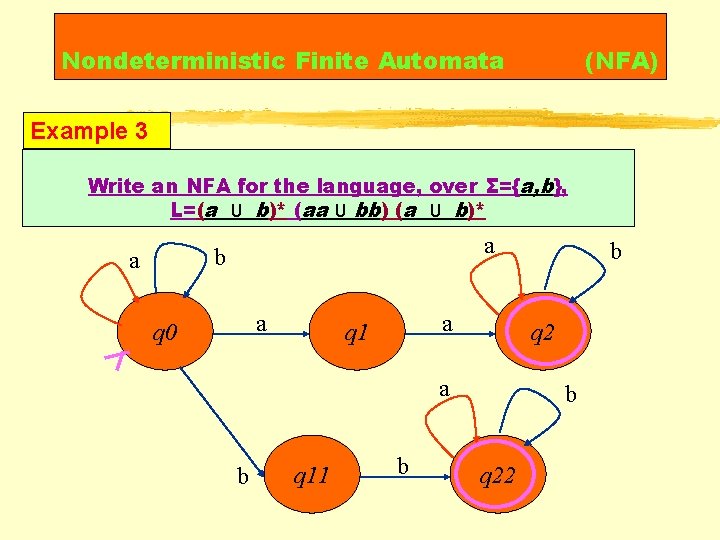
Nondeterministic Finite Automata (NFA) Example 3 Write an NFA for the language, over Σ={a, b}, L=(a U b)* (aa U bb) (a U b)* a b a a q 0 a q 1 q 2 a b q 11 b b b q 22
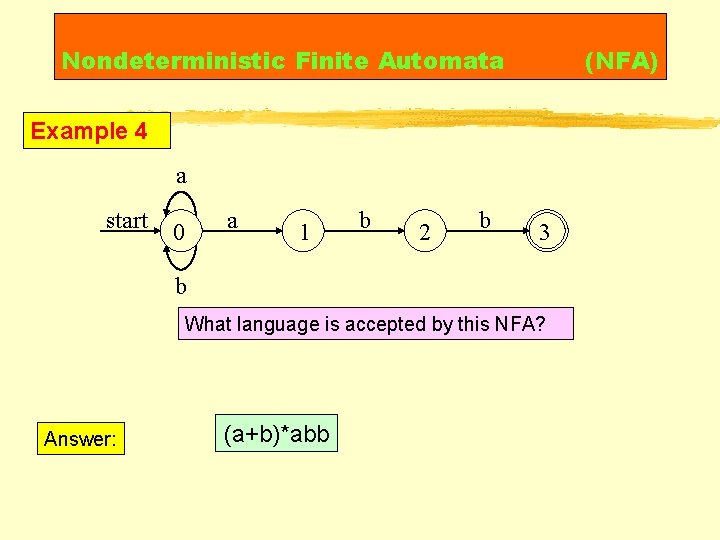
Nondeterministic Finite Automata (NFA) Example 4 a start a 0 1 b 2 b 3 b What language is accepted by this NFA? Answer: (a+b)*abb
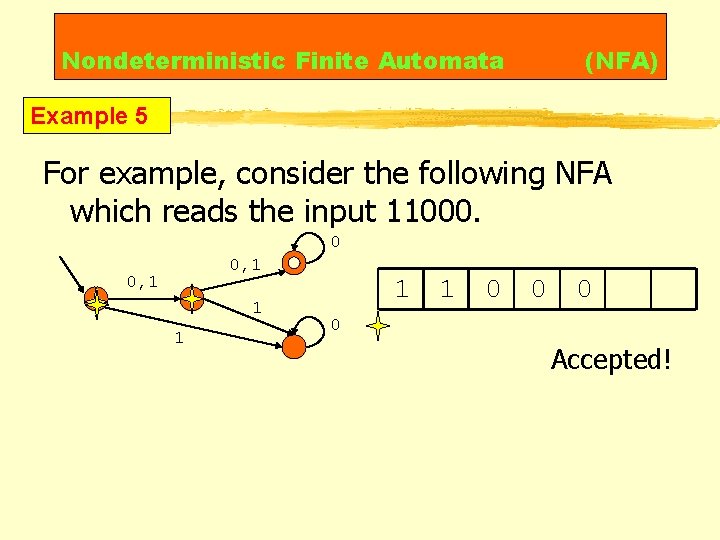
Nondeterministic Finite Automata (NFA) Example 5 For example, consider the following NFA which reads the input 11000. 0 0, 1 1 1 0 0 Accepted!
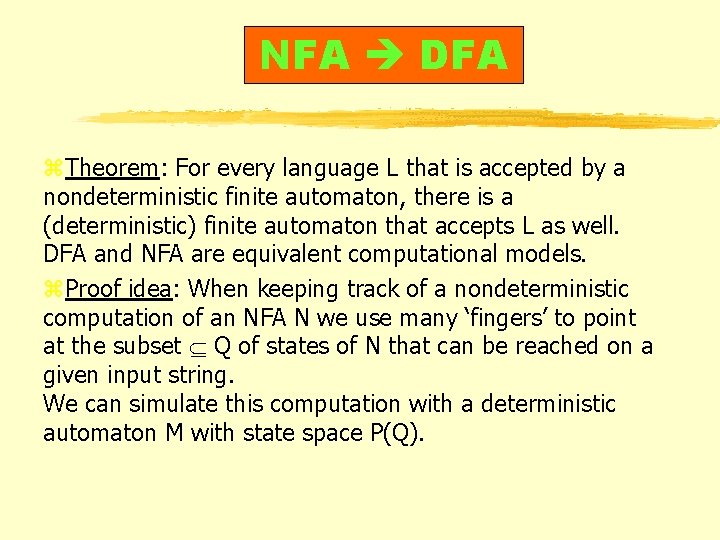
NFA DFA z. Theorem: For every language L that is accepted by a nondeterministic finite automaton, there is a (deterministic) finite automaton that accepts L as well. DFA and NFA are equivalent computational models. z. Proof idea: When keeping track of a nondeterministic computation of an NFA N we use many ‘fingers’ to point at the subset Q of states of N that can be reached on a given input string. We can simulate this computation with a deterministic automaton M with state space P(Q).
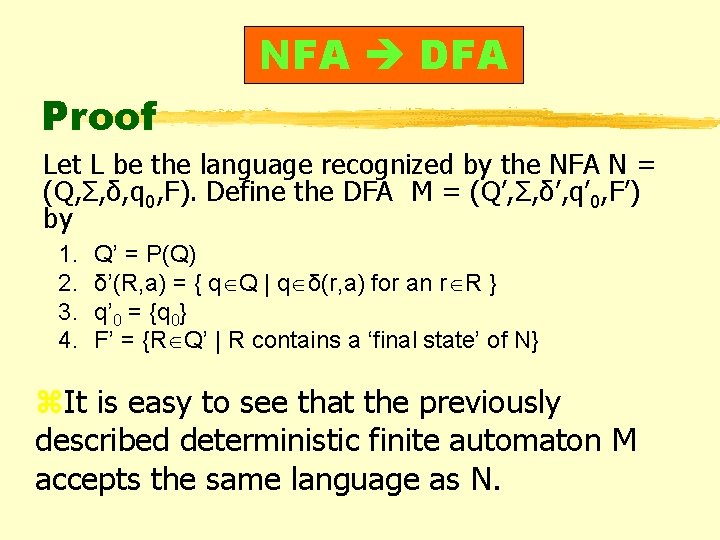
NFA DFA Proof Let L be the language recognized by the NFA N = (Q, Σ, δ, q 0, F). Define the DFA M = (Q’, Σ, δ’, q’ 0, F’) by 1. 2. 3. 4. Q’ = P(Q) δ’(R, a) = { q Q | q δ(r, a) for an r R } q’ 0 = {q 0} F’ = {R Q’ | R contains a ‘final state’ of N} z. It is easy to see that the previously described deterministic finite automaton M accepts the same language as N.
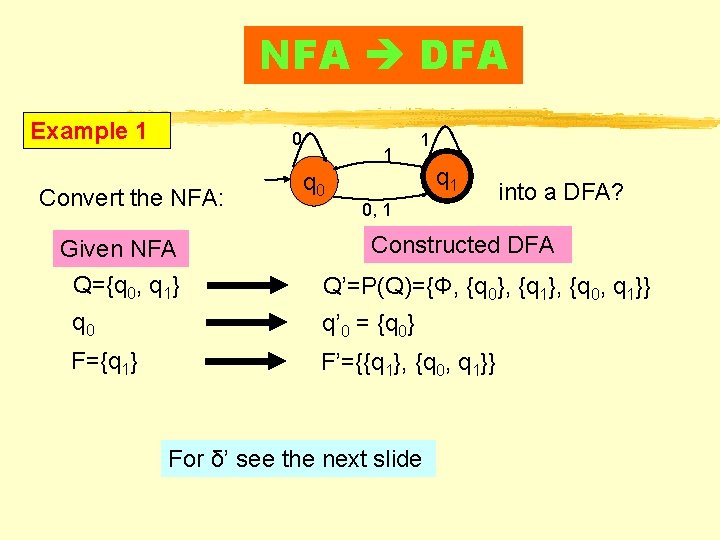
NFA DFA Example 1 0 Convert the NFA: Given NFA Q={q 0, q 1} 1 1 q 0 q 1 0, 1 into a DFA? Constructed DFA Q’=P(Q)={Φ, {q 0}, {q 1}, {q 0, q 1}} q 0 q’ 0 = {q 0} F={q 1} F’={{q 1}, {q 0, q 1}} For δ’ see the next slide
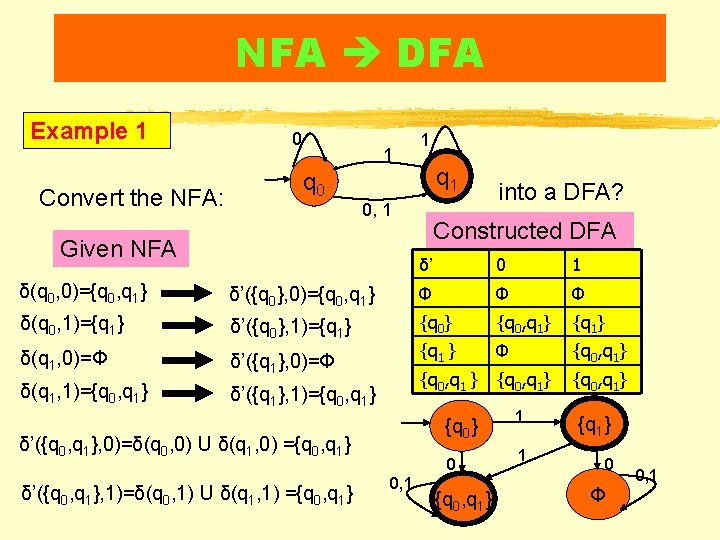
NFA DFA Example 1 Convert the NFA: 0 1 1 q 0 0, 1 Given NFA into a DFA? Constructed DFA δ’ 0 1 δ(q 0, 0)={q 0, q 1} δ’({q 0}, 0)={q 0, q 1} Φ Φ Φ δ(q 0, 1)={q 1} δ’({q 0}, 1)={q 1} {q 0, q 1} {q 1} δ(q 1, 0)=Φ δ’({q 1}, 0)=Φ {q 1 } Φ {q 0, q 1} δ(q 1, 1)={q 0, q 1} δ’({q 1}, 1)={q 0, q 1} {q 0, q 1} {q 0} δ’({q 0, q 1}, 0)=δ(q 0, 0) U δ(q 1, 0) ={q 0, q 1} δ’({q 0, q 1}, 1)=δ(q 0, 1) U δ(q 1, 1) ={q 0, q 1} 0 0, 1 {q 0, q 1} 1 1 {q 0, q 1} {q 1} 0 Φ 0, 1
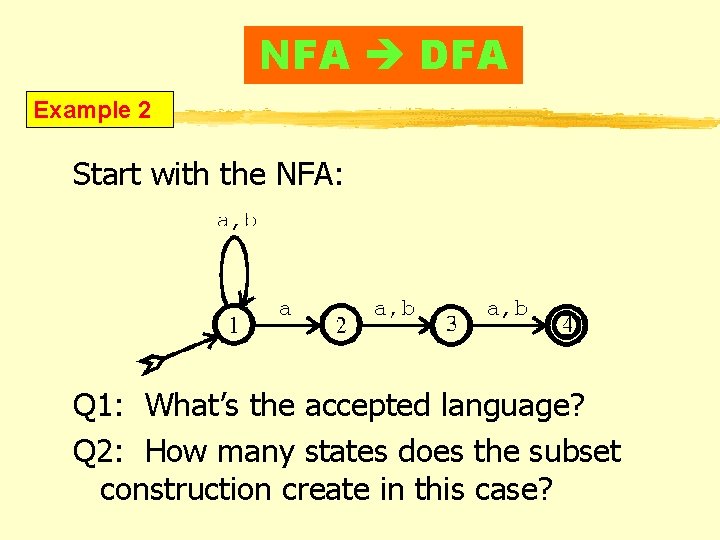
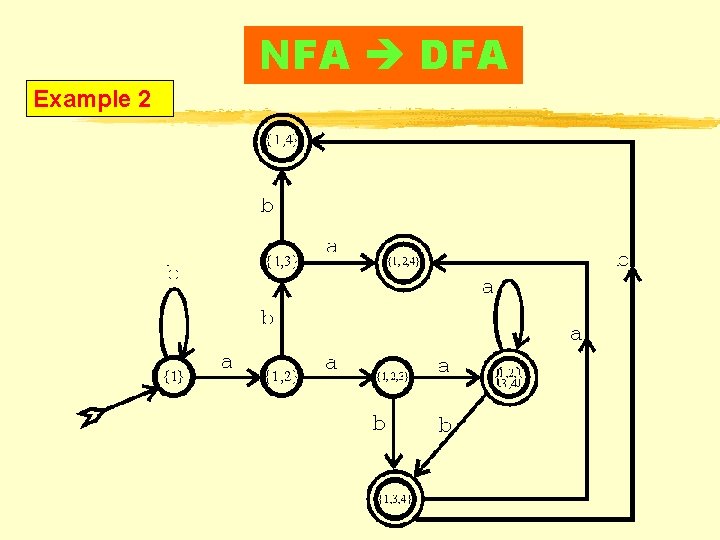
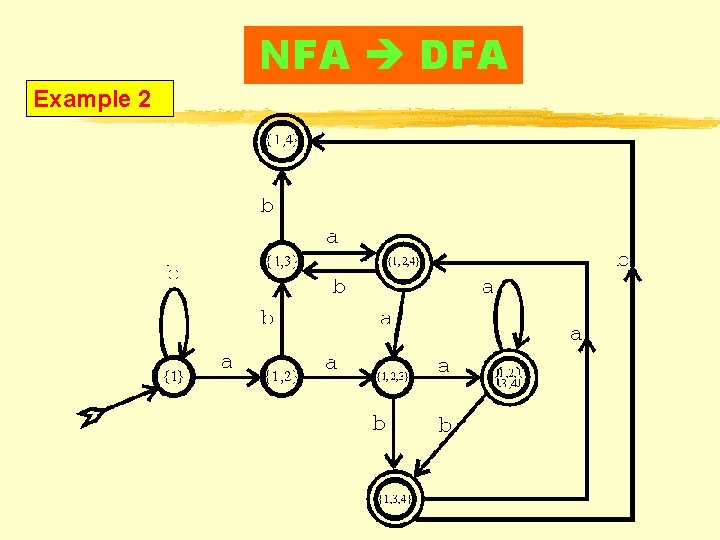
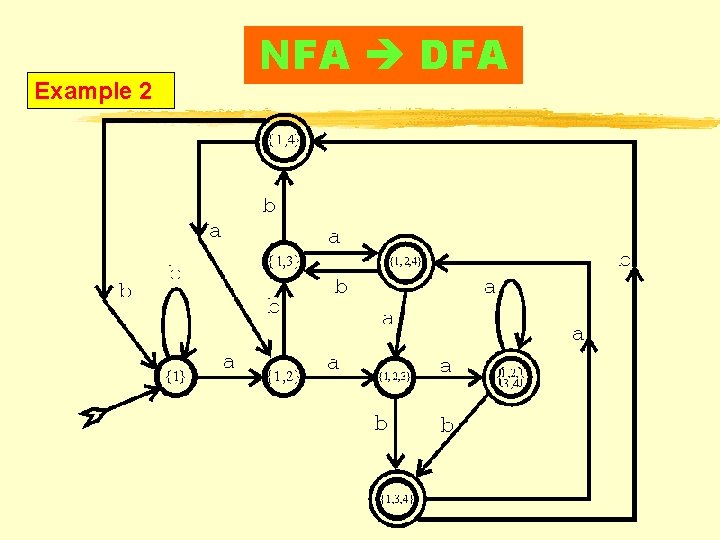
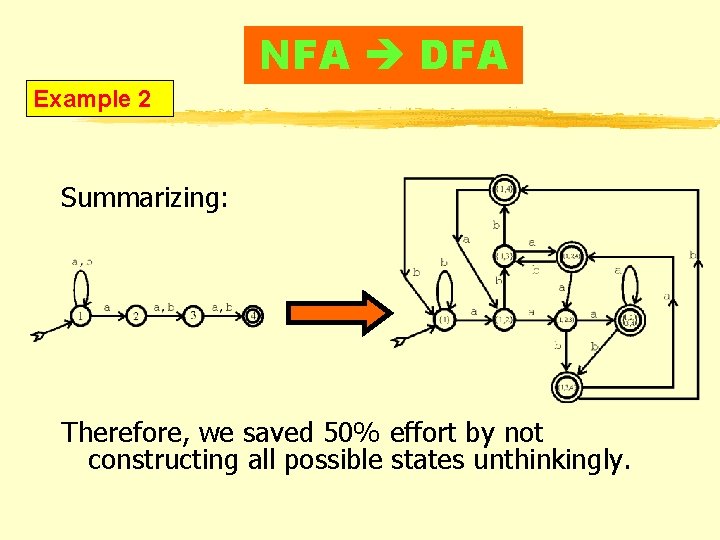
NFA DFA Example 2 Start with the NFA: Q 1: What’s the accepted language? Q 2: How many states does the subset construction create in this case?
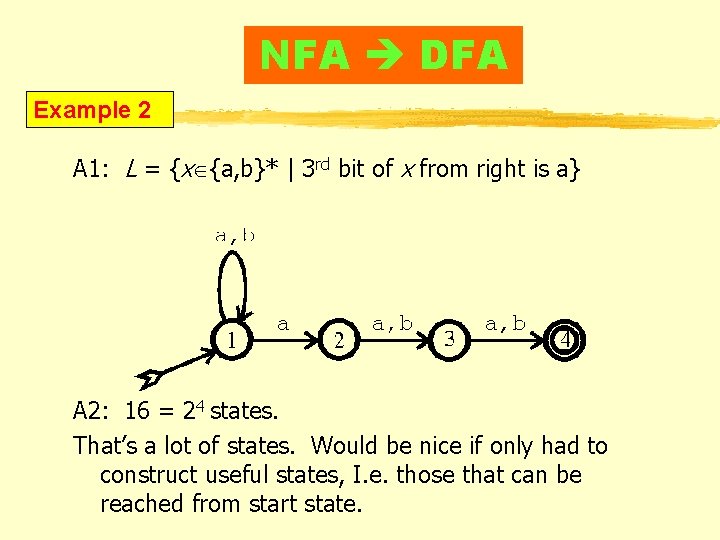
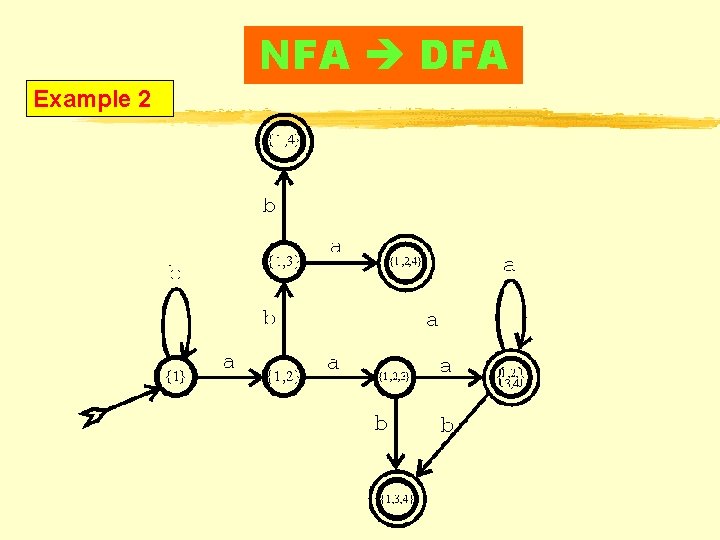
NFA DFA Example 2 A 1: L = {x {a, b}* | 3 rd bit of x from right is a} A 2: 16 = 24 states. That’s a lot of states. Would be nice if only had to construct useful states, I. e. those that can be reached from start state.
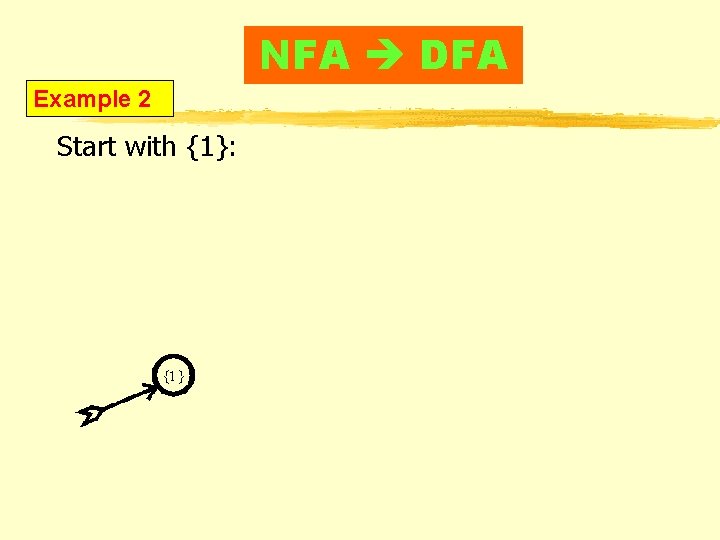
NFA DFA Example 2 Start with {1}:
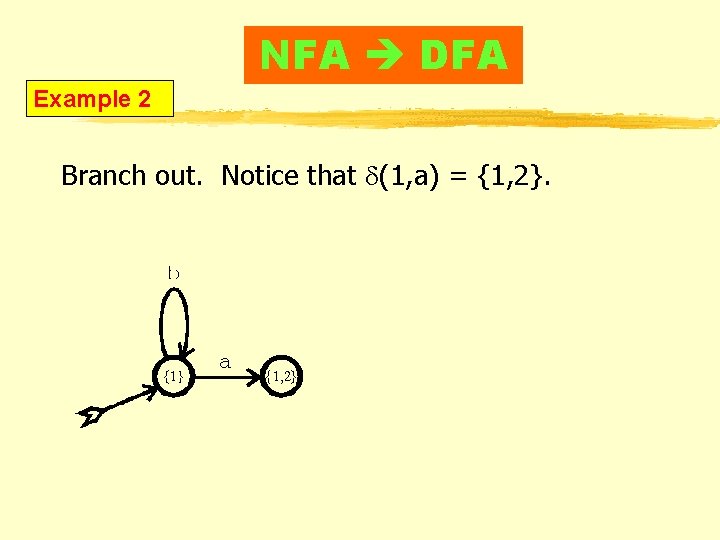
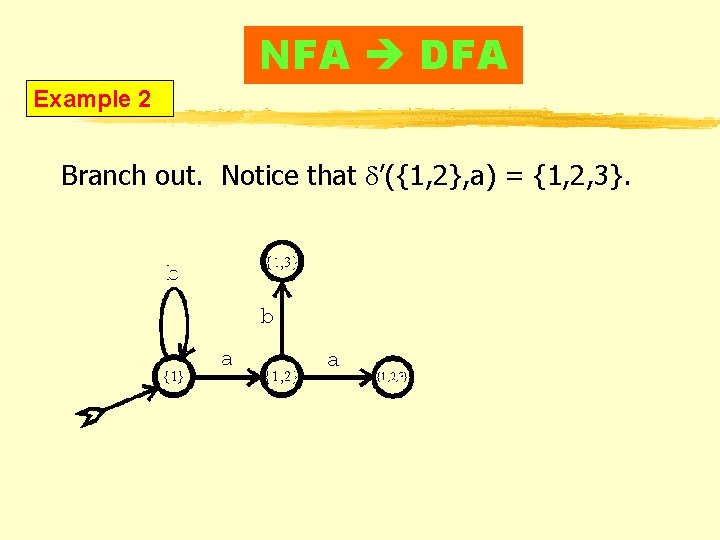
NFA DFA Example 2 Branch out. Notice that d(1, a) = {1, 2}.
NFA DFA Example 2 Branch out. Notice that d’({1, 2}, a) = {1, 2, 3}.
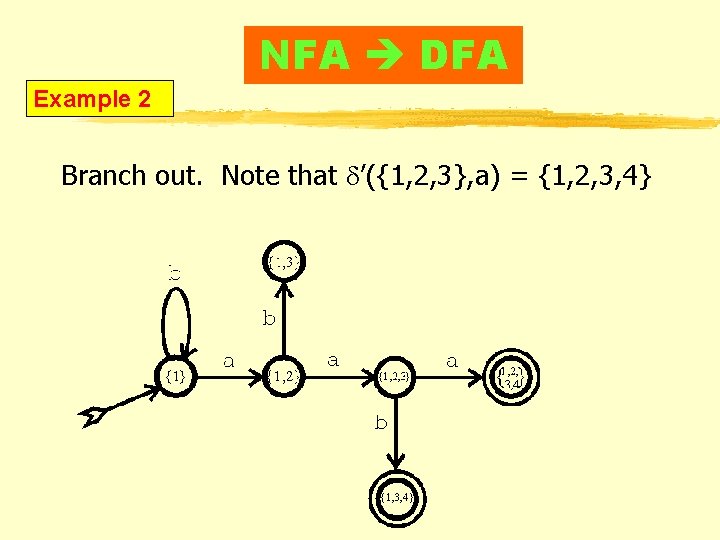
NFA DFA Example 2 Branch out. Note that d’({1, 2, 3}, a) = {1, 2, 3, 4}
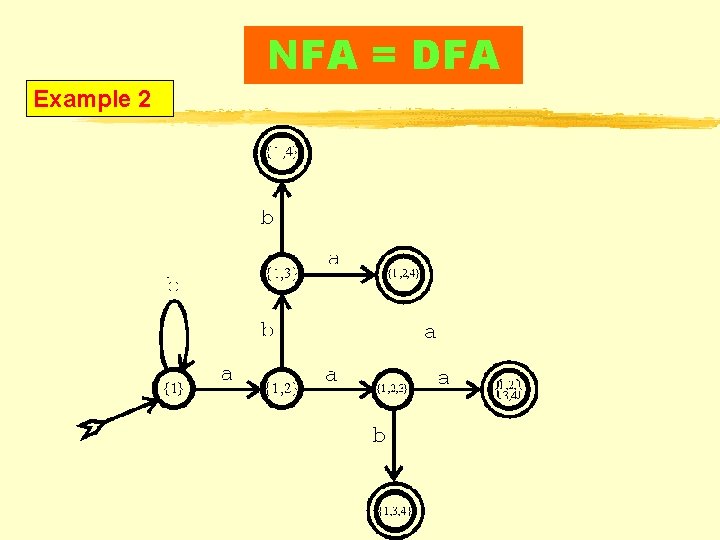
NFA = DFA Example 2
NFA DFA Example 2
NFA DFA Example 2
NFA DFA Example 2
Example 2 NFA DFA
NFA DFA Example 2 Summarizing: Therefore, we saved 50% effort by not constructing all possible states unthinkingly.
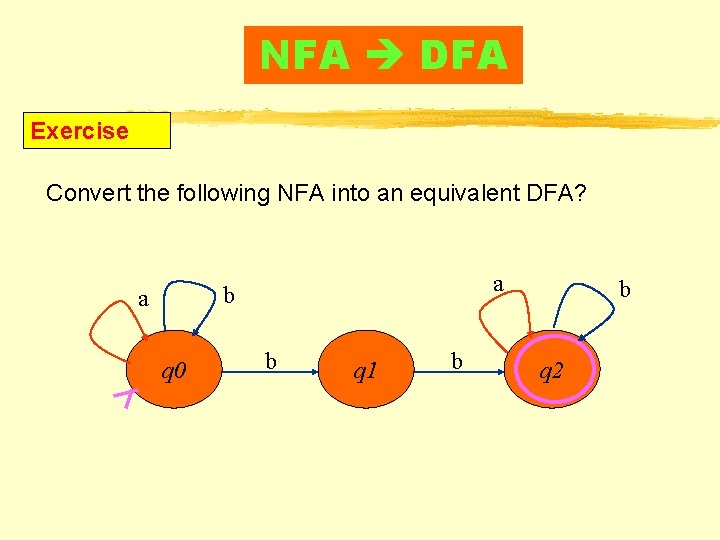
NFA DFA Exercise Convert the following NFA into an equivalent DFA? a b a q 0 b q 1 b b q 2