
Regular Expressions Finite State Automata Part 2 ICS

- Slides: 60
Regular Expressions & Finite State Automata – Part 2 ICS 482: Natural Language Processing Husni Al-Muhtaseb 1/8/2022 1
NLP Credits and Acknowledgment These slides were adapted from presentations of the Authors of the book SPEECH and LANGUAGE PROCESSING: An Introduction to Natural Language Processing, Computational Linguistics, and Speech Recognition and some modifications from presentations found in the WEB by several scholars including the following
NLP Credits and Acknowledgment If your name is missing please contact me muhtaseb At Kfupm. Edu. sa
NLP Credits and Acknowledgment Husni Al-Muhtaseb James Martin Jim Martin Dan Jurafsky Sandiway Fong Song young in Paula Matuszek Mary-Angela Papalaskari Dick Crouch Tracy Kin L. Venkata Subramaniam Martin Volk Bruce R. Maxim Jan Hajič Srinath Srinivasa Simeon Ntafos Paolo Pirjanian Ricardo Vilalta Tom Lenaerts Heshaam Feili Björn Gambäck Christian Korthals Thomas G. Dietterich Devika Subramanian Duminda Wijesekera Lee Mc. Cluskey David J. Kriegman Kathleen Mc. Keown Michael J. Ciaraldi David Finkel Min-Yen Kan Andreas Geyer. Schulz Franz J. Kurfess Tim Finin Nadjet Bouayad Kathy Mc. Coy Hans Uszkoreit Azadeh Maghsoodi Khurshid Ahmad Staffan Larsson Robert Wilensky Feiyu Xu Jakub Piskorski Rohini Srihari Mark Sanderson Andrew Elks Marc Davis Ray Larson Jimmy Lin Marti Hearst Andrew Mc. Callum Nick Kushmerick Mark Craven Chia-Hui Chang Diana Maynard James Allan Martha Palmer julia hirschberg Elaine Rich Christof Monz Bonnie J. Dorr Nizar Habash Massimo Poesio David Goss-Grubbs Thomas K Harris John Hutchins Alexandros Potamianos Mike Rosner Latifa Al-Sulaiti Giorgio Satta Jerry R. Hobbs Christopher Manning Hinrich Schütze Alexander Gelbukh Gina-Anne Levow Guitao Gao Qing Ma Zeynep Altan
Previous Lectures • • • 1 Assignment #1 1 Pre-start online questionnaire 2 Introduction to NLP 2 Phases of an NLP system 2 NLP Applications 3 Chatting with Alice 3 Regular Expressions 3 Finite State Automata 3 Regular languages 3 Assignment #2 1/8/2022 5
Objective of Today’s Lecture • • • Regular Expressions Regular languages Deterministic Finite State Automata Non-deterministic Finite State Automata Accept, Reject, Generate terms 1/8/2022 6
Review • Regular expressions are a textual representation of FSAs • Recognition is the process of determining if a string/ input is in the language defined by some machine – Recognition is straightforward with deterministic machines 1/8/2022 7
Regular Expressions • Matching strings with regular expressions is a matter of – translating the expression into a machine (table) and – passing the table to an interpreter 1/8/2022 8
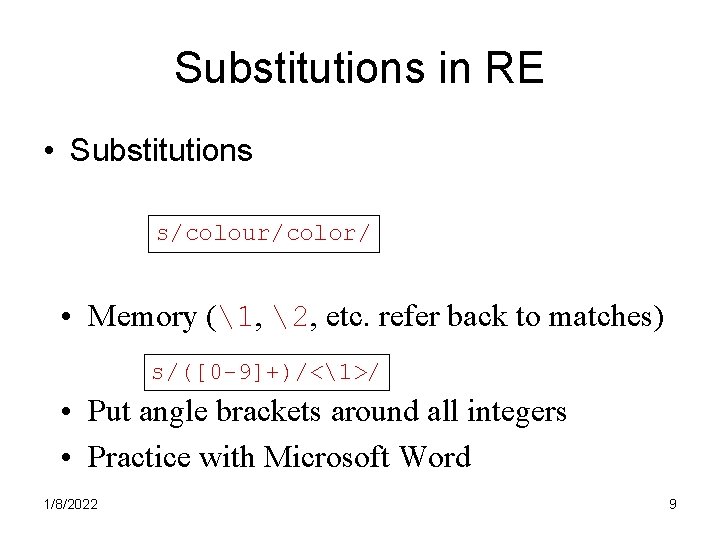
Substitutions in RE • Substitutions s/colour/color/ • Memory (1, 2, etc. refer back to matches) s/([0 -9]+)/<1>/ • Put angle brackets around all integers • Practice with Microsoft Word 1/8/2022 9
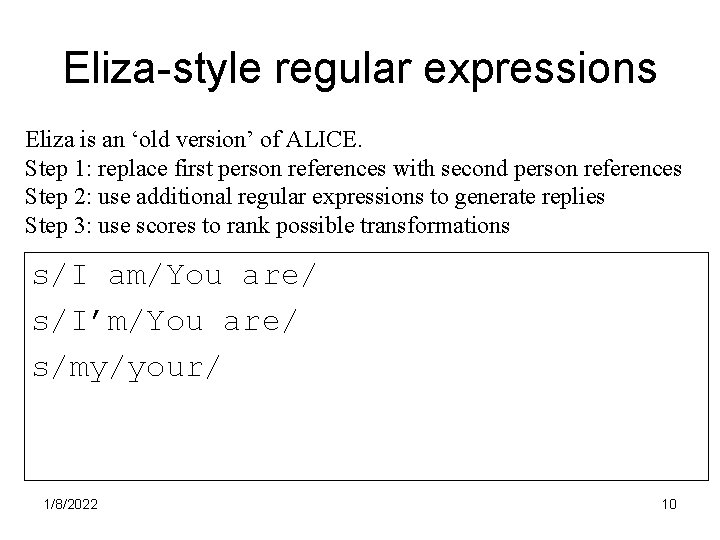
Eliza-style regular expressions Eliza is an ‘old version’ of ALICE. Step 1: replace first person references with second person references Step 2: use additional regular expressions to generate replies Step 3: use scores to rank possible transformations s/I am/You are/ s/I’m/You are/ s/my/your/ 1/8/2022 10
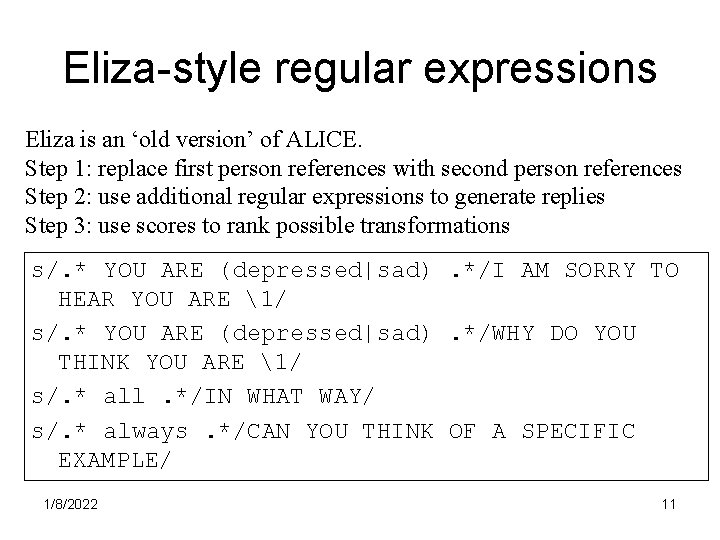
Eliza-style regular expressions Eliza is an ‘old version’ of ALICE. Step 1: replace first person references with second person references Step 2: use additional regular expressions to generate replies Step 3: use scores to rank possible transformations s/. * YOU ARE (depressed|sad). */I AM SORRY TO HEAR YOU ARE 1/ s/. * YOU ARE (depressed|sad). */WHY DO YOU THINK YOU ARE 1/ s/. * all. */IN WHAT WAY/ s/. * always. */CAN YOU THINK OF A SPECIFIC EXAMPLE/ 1/8/2022 11
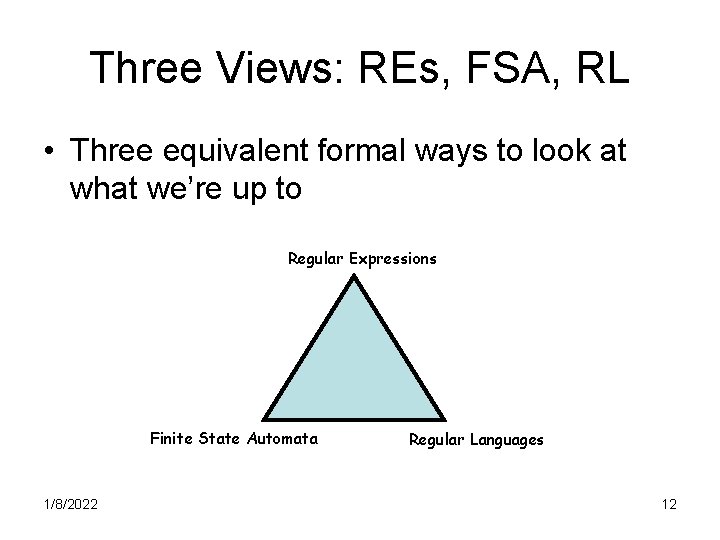
Three Views: REs, FSA, RL • Three equivalent formal ways to look at what we’re up to Regular Expressions Finite State Automata 1/8/2022 Regular Languages 12
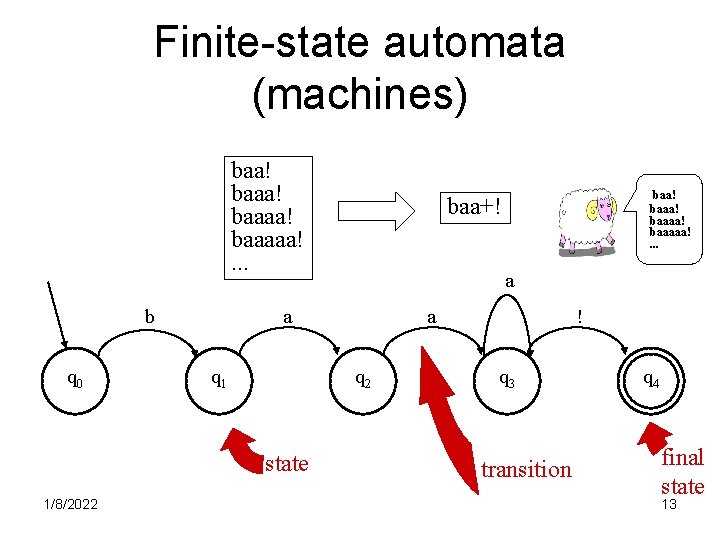
Finite-state automata (machines) baa! baaaa! baaaaa!. . . b q 0 a a q 2 state 1/8/2022 baa+! a q 1 baa! baaaa! baaaaa!. . . ! q 3 transition q 4 final state 13
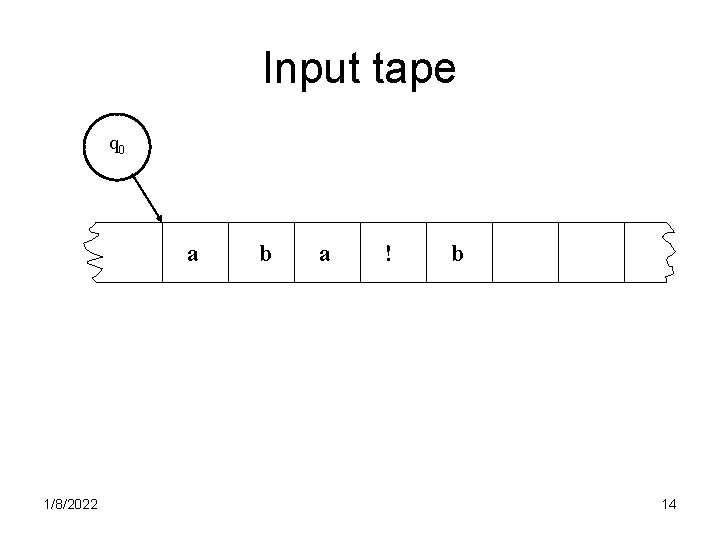
Input tape q 0 a 1/8/2022 b a ! b 14
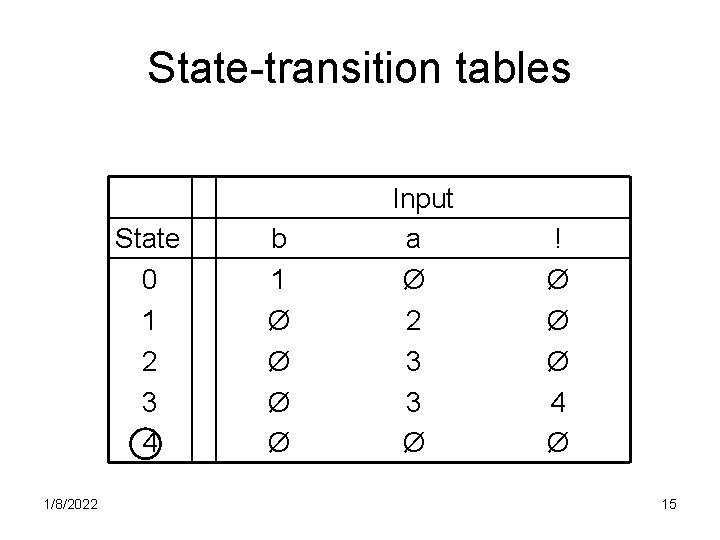
State-transition tables State 0 1 2 3 4 1/8/2022 b 1 Ø Ø Input a Ø 2 3 3 Ø ! Ø Ø Ø 4 Ø 15
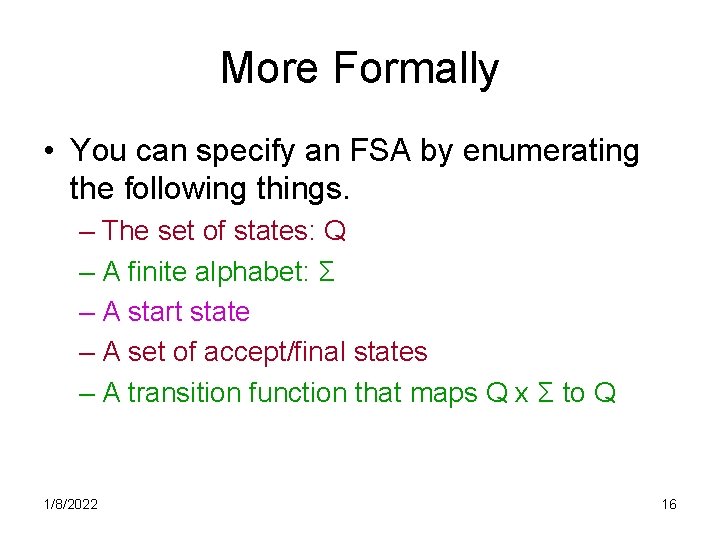
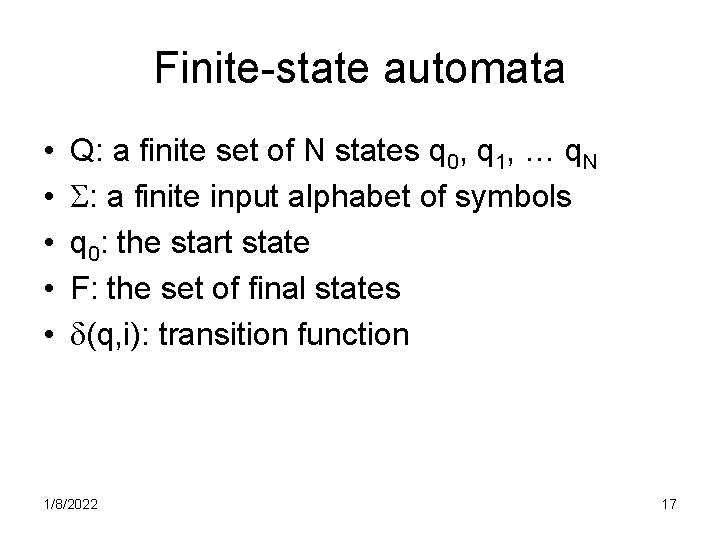
More Formally • You can specify an FSA by enumerating the following things. – The set of states: Q – A finite alphabet: Σ – A start state – A set of accept/final states – A transition function that maps Q x Σ to Q 1/8/2022 16
Finite-state automata • • • Q: a finite set of N states q 0, q 1, … q. N : a finite input alphabet of symbols q 0: the start state F: the set of final states (q, i): transition function 1/8/2022 17
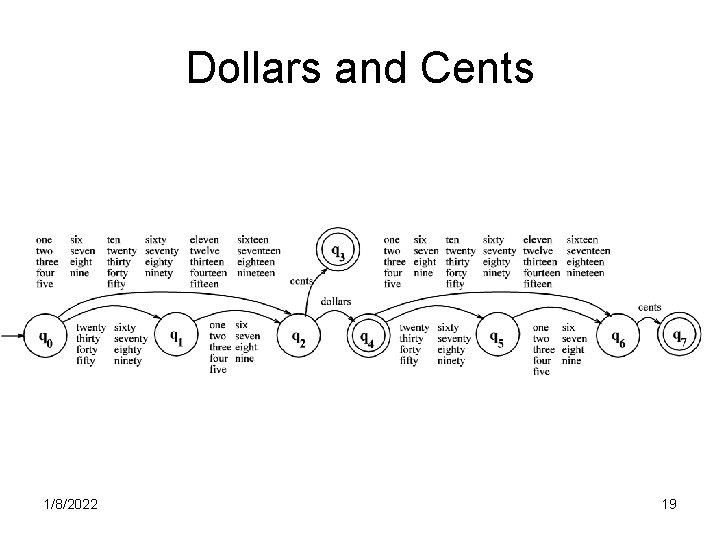
Alphabets • Alphabets means we need a finite set of symbols in the input. • These symbols can and will stand for bigger objects that can have internal structure. 1/8/2022 18
Dollars and Cents 1/8/2022 19
Recognition • The process of determining if a string should be accepted by a machine • The process of determining if a string is in the language we’re defining with the machine • The process of determining if a regular expression matches a string 1/8/2022 20
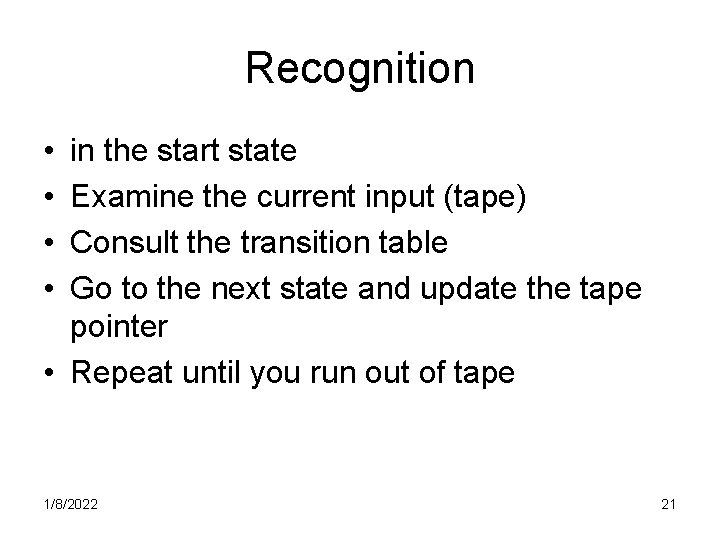
Recognition • • in the start state Examine the current input (tape) Consult the transition table Go to the next state and update the tape pointer • Repeat until you run out of tape 1/8/2022 21
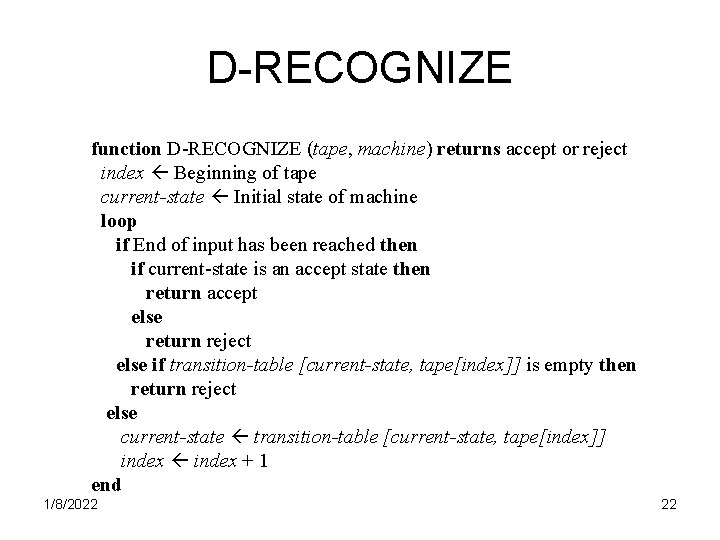
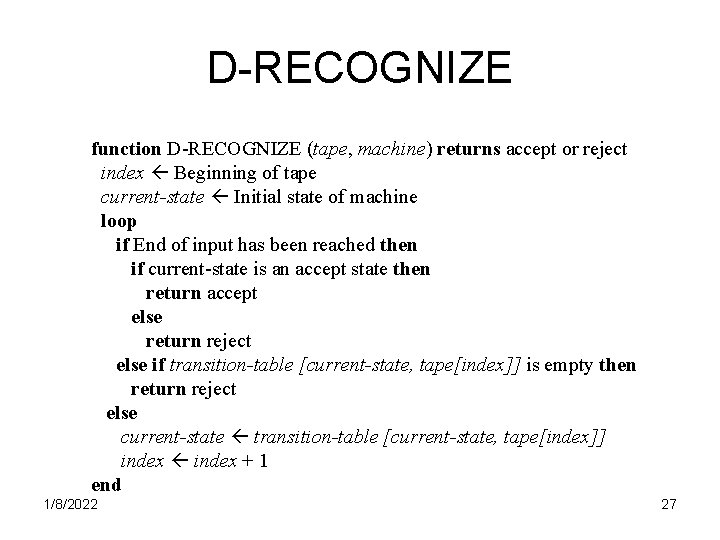
D-RECOGNIZE function D-RECOGNIZE (tape, machine) returns accept or reject index Beginning of tape current-state Initial state of machine loop if End of input has been reached then if current-state is an accept state then return accept else return reject else if transition-table [current-state, tape[index]] is empty then return reject else current-state transition-table [current-state, tape[index]] index + 1 end 1/8/2022 22
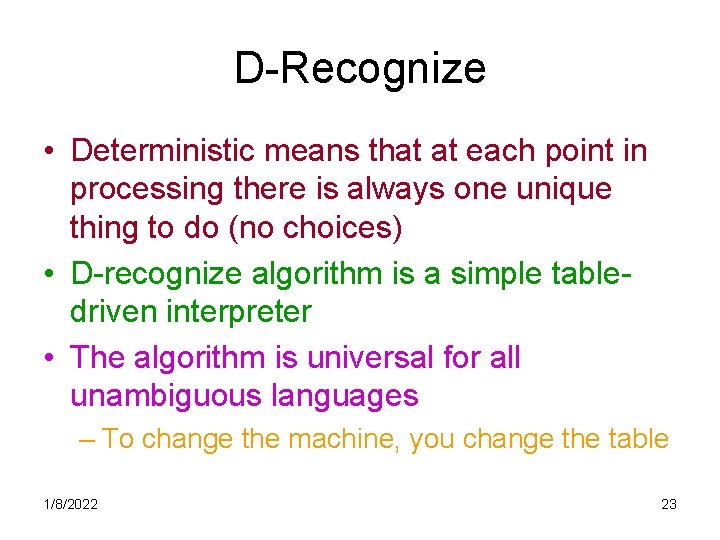
D-Recognize • Deterministic means that at each point in processing there is always one unique thing to do (no choices) • D-recognize algorithm is a simple tabledriven interpreter • The algorithm is universal for all unambiguous languages – To change the machine, you change the table 1/8/2022 23
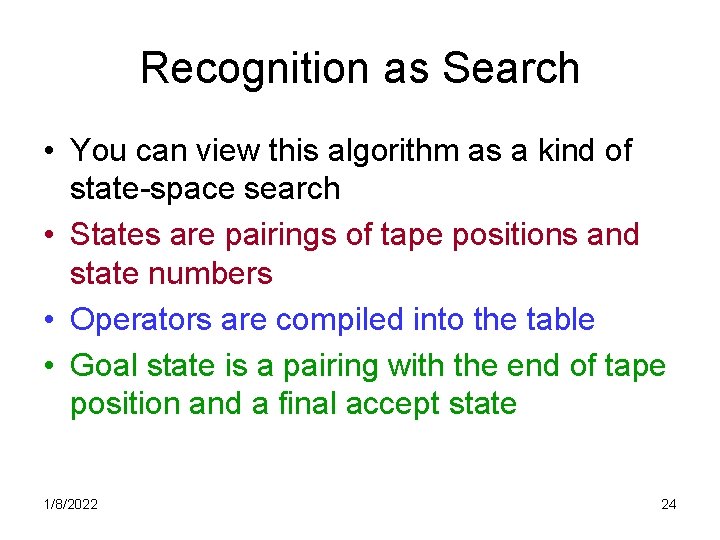
Recognition as Search • You can view this algorithm as a kind of state-space search • States are pairings of tape positions and state numbers • Operators are compiled into the table • Goal state is a pairing with the end of tape position and a final accept state 1/8/2022 24
Generative Formalisms • Formal Languages are sets of strings composed of symbols from a finite set of symbols • Finite-state automate define formal languages (without having to enumerate all the strings in the language) • The term Generative is based on the view that you can run the machine as a generator to get strings from the language 1/8/2022 25
Generative Formalisms • FSAs can be viewed from two perspectives: – Acceptors that can tell you if a string is in the language – Generators to produce all and only the strings in the language 1/8/2022 26
D-RECOGNIZE function D-RECOGNIZE (tape, machine) returns accept or reject index Beginning of tape current-state Initial state of machine loop if End of input has been reached then if current-state is an accept state then return accept else return reject else if transition-table [current-state, tape[index]] is empty then return reject else current-state transition-table [current-state, tape[index]] index + 1 end 1/8/2022 27
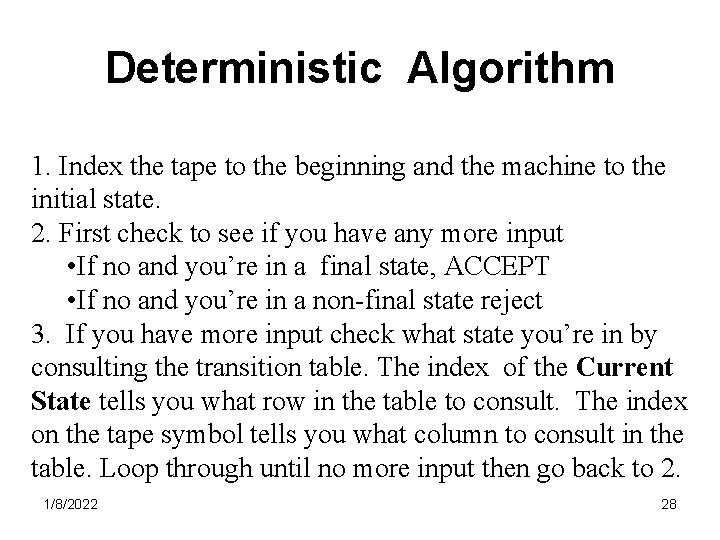
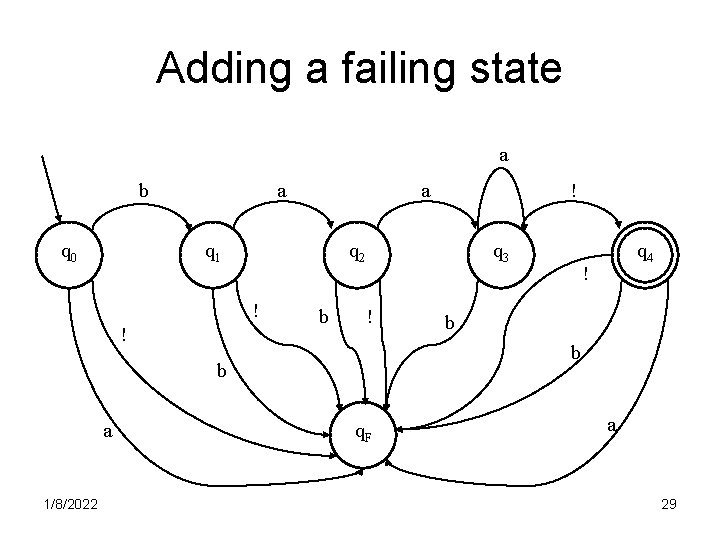
Deterministic Algorithm 1. Index the tape to the beginning and the machine to the initial state. 2. First check to see if you have any more input • If no and you’re in a final state, ACCEPT • If no and you’re in a non-final state reject 3. If you have more input check what state you’re in by consulting the transition table. The index of the Current State tells you what row in the table to consult. The index on the tape symbol tells you what column to consult in the table. Loop through until no more input then go back to 2. 1/8/2022 28
Adding a failing state a b q 0 a a q 1 q 2 ! ! b q 3 ! 1/8/2022 q 4 ! b b b a ! q. F a 29
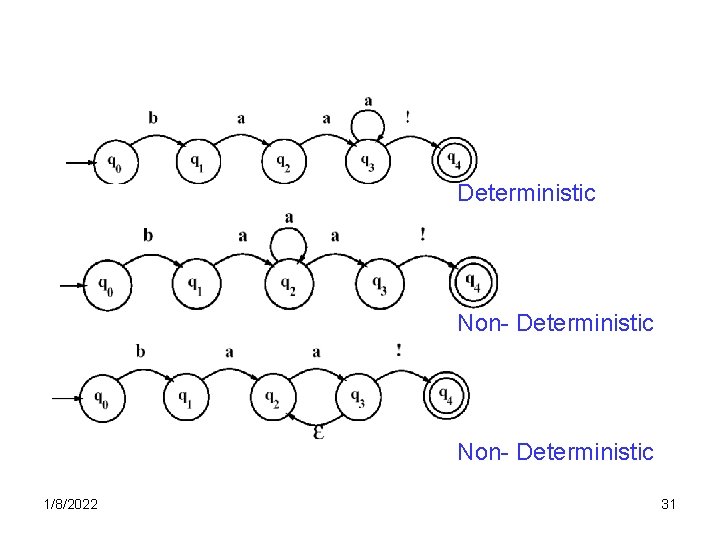
Languages and automata • Formal languages: regular languages, non-regular languages • deterministic vs. non-deterministic FSAs • Epsilon ( ) transitions – is the empty string & Ø is the empty set (empty regular language) 1/8/2022 30
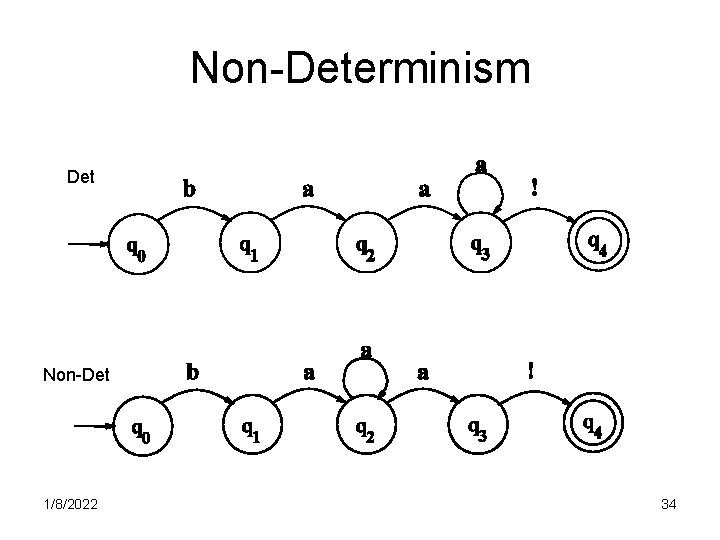
Deterministic Non- Deterministic 1/8/2022 31
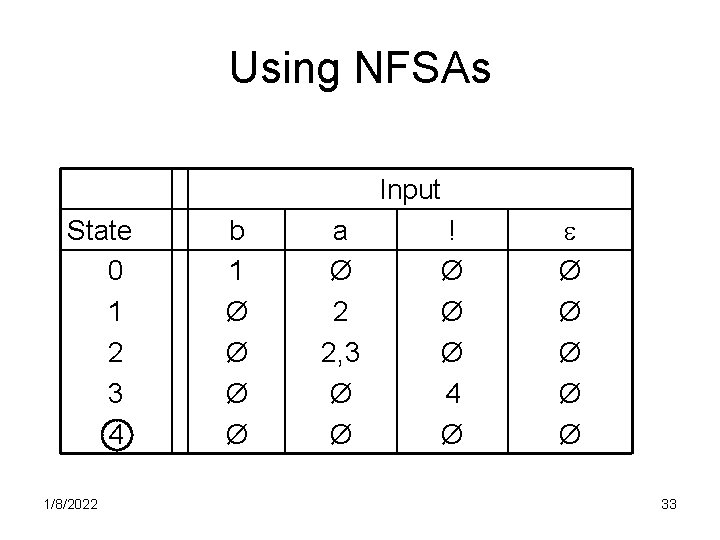
Using NFSAs to accept strings • Backup: add markers at choice points, then possibly revisit unexplored markers • Look-ahead: look ahead in input • Parallelism: look at alternatives in parallel 1/8/2022 32
Using NFSAs Input State 0 1 2 3 4 1/8/2022 b 1 Ø Ø a Ø 2 2, 3 Ø Ø ! Ø Ø Ø 4 Ø Ø Ø Ø 33
Non-Determinism Det Non-Det 1/8/2022 34
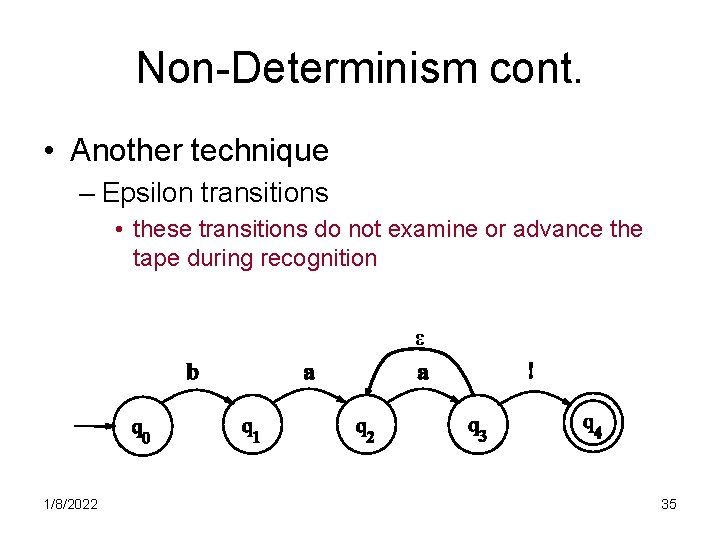
Non-Determinism cont. • Another technique – Epsilon transitions • these transitions do not examine or advance the tape during recognition ε 1/8/2022 35
Equivalence • Non-deterministic machines can be converted to deterministic • They have the same power; nondeterministic machines are not more powerful than deterministic ones • It also means that one way to do recognition with a non-deterministic machine is to turn it into a deterministic one 1/8/2022 36
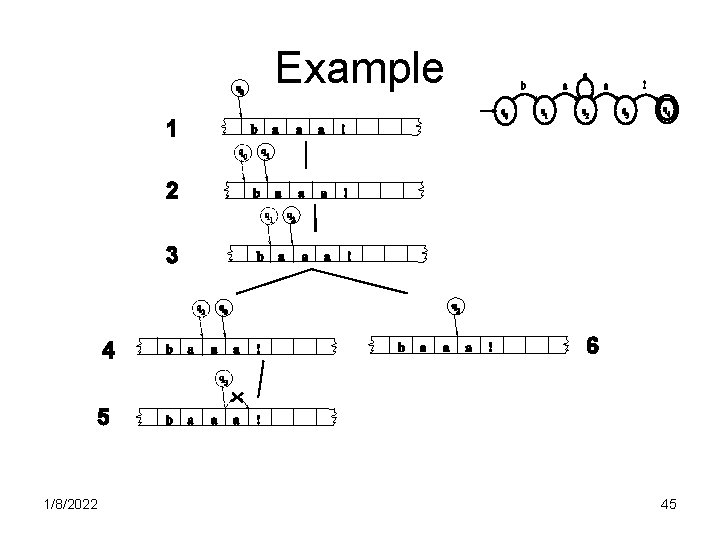
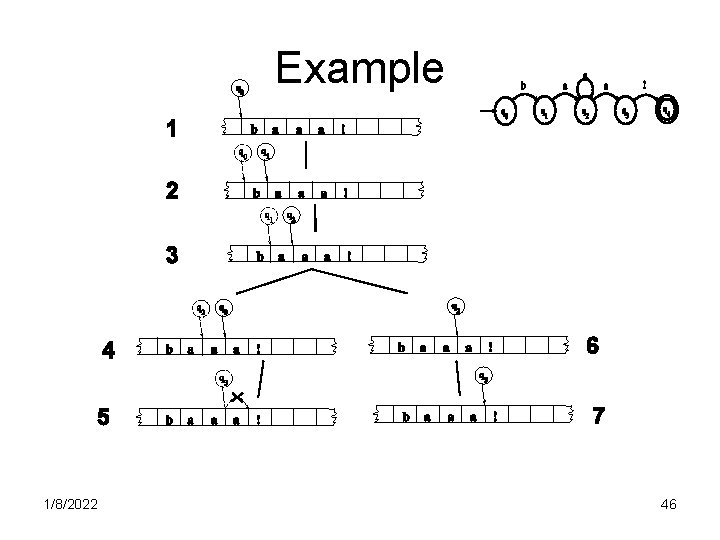
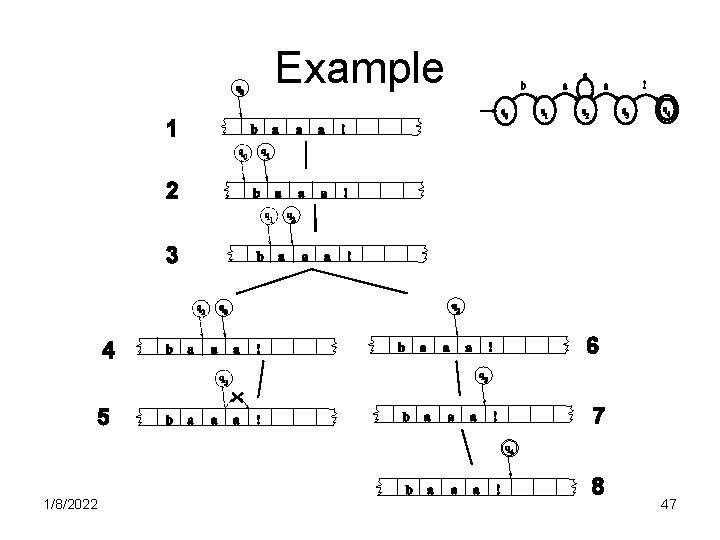
Non-Deterministic Recognition • In a ND FSA there exists at least one path through the machine for a string that is in the language defined by the machine • But not all paths directed through the machine for an accept string lead to an accept state • No paths through the machine lead to an accept state for a string not in the language 1/8/2022 37
Non-Deterministic Recognition • Success in a non-deterministic recognition occurs when a path is found through the machine that ends in an accept • Failure occurs when none of the possible paths lead to an accept state 1/8/2022 38
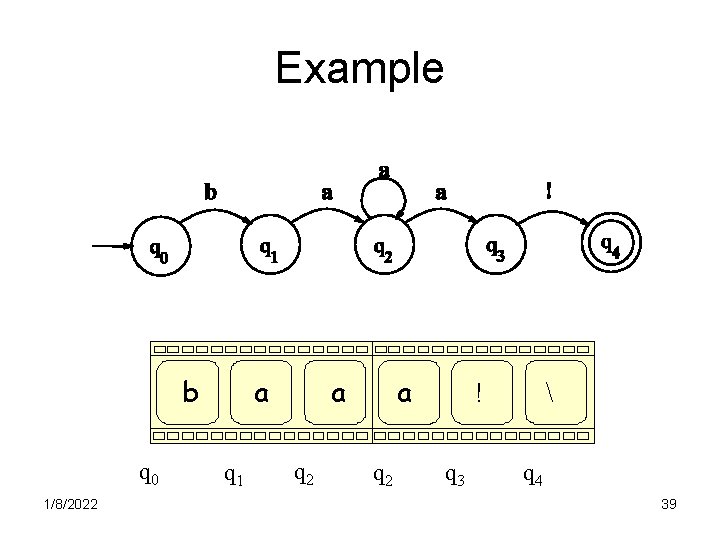
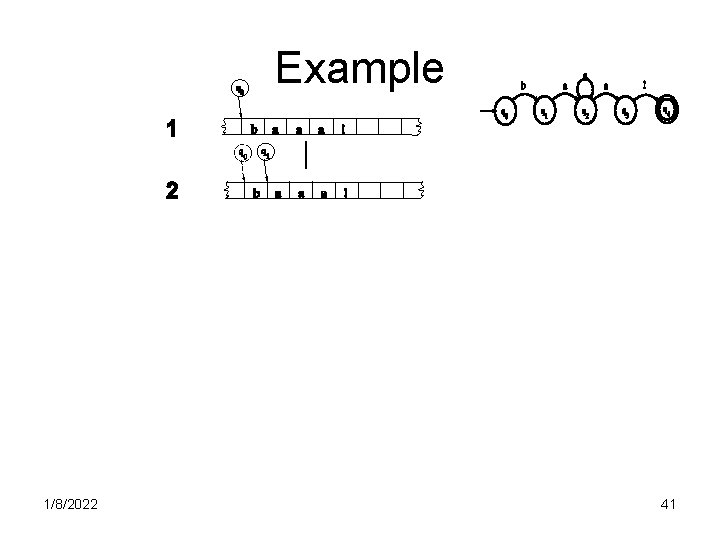
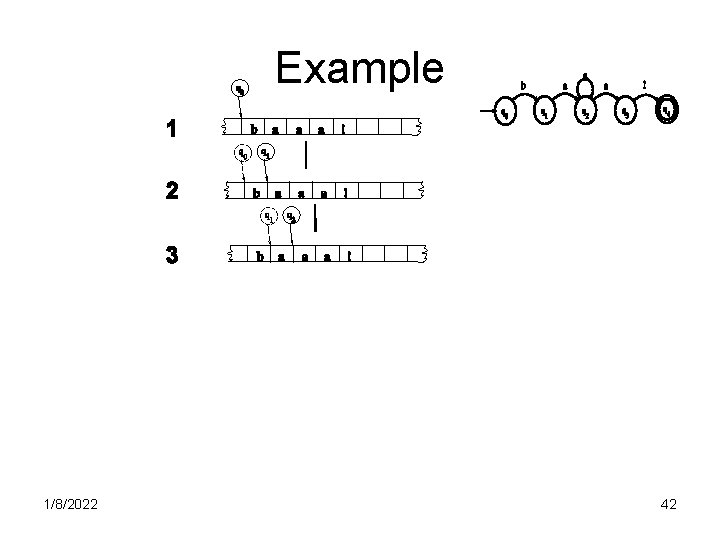
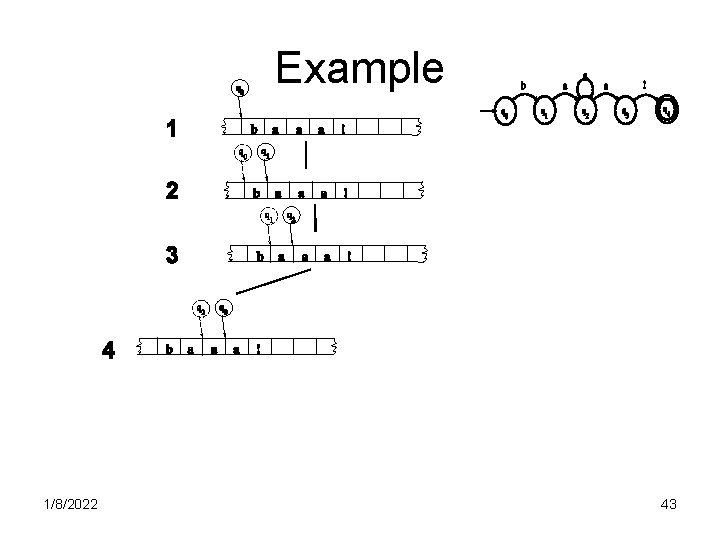
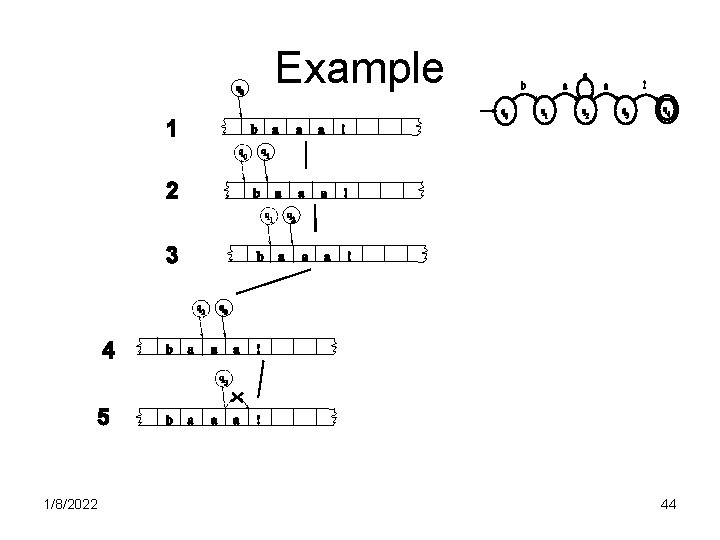
Example b q 0 1/8/2022 a q 1 a a q 2 ! q 3 q 4 39
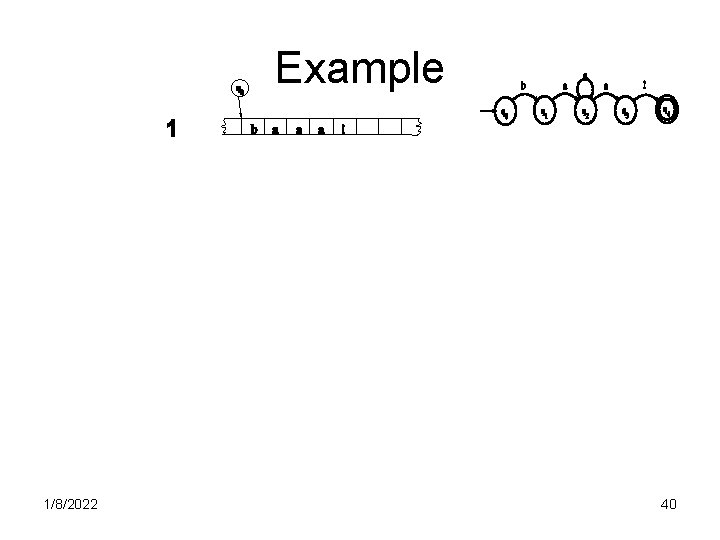
Example 1/8/2022 40
Example 1/8/2022 41
Example 1/8/2022 42
Example 1/8/2022 43
Example 1/8/2022 44
Example 1/8/2022 45
Example 1/8/2022 46
Example 1/8/2022 47
States in Search Space • States in the search space are pairings of tape positions and states in the machine • By keeping track of as yet unexplored states, a recognizer can systematically explore all the paths through the machine given an input 1/8/2022 48
Components of ND Automaton Search State: records the choice points by storing state, input pairs so you know what state you were at and what input you had read when the derivation branched. Agenda: At each point of nondeterminism the algorithm postpone pursuing some choices (paths) in favor of others. The agenda records what these choices are as they are encountered. Since this is non-deterministic, we have to allow the state to transition to multiple points ( a list of destination nodes). 1/8/2022 49
Non Deterministic Algorithm 1: Can you accept the string given input and state 2: If not , check the agenda and given the current state and the input then generate a new set of possible search states based on the state you are in and new input. Explore these states. 3: If not, see if there alternative search states waiting to be explored on the agenda. If either (2) or (3) end up, the states they lead you to become the current search state. Even if one path doesn’t succeed always need to check the agenda because you may come to ( Final state, 0 -input pair) on another path. 1/8/2022 50
Search in NFSA • Depth first Search • Last in First Out (LIFO) • States arranged in a STACK • Breadth first Search – First in first out (FIFO) – States organized in a queue 1/8/2022 51
When to choose what? • Depth first search is optimal when one alternative is highly favored because in most cases, you will never get to the less favored alternatives. • Breadth first search is optimal when can’t predict which alternative likely to work out. You will do extra work by computing paths that won’t lead to final output, but when error is detected at one path, don’t have to back up to get to other paths. Can just proceed with next step. • Unfortunately, often can’t tell which will save the most work. 1/8/2022 52
Infinite Search • If we’re not careful such searches can go into an infinite loop. 1/8/2022 53
Why to use Non-determinism • Non-determinism doesn’t get us more formal power and it causes headaches so why to use it? – More natural solutions – Deterministic Machines are too big 1/8/2022 54
Compositional Machines • Formal languages are sets of strings • We can talk about various set operations (intersection, union, concatenation) 1/8/2022 55
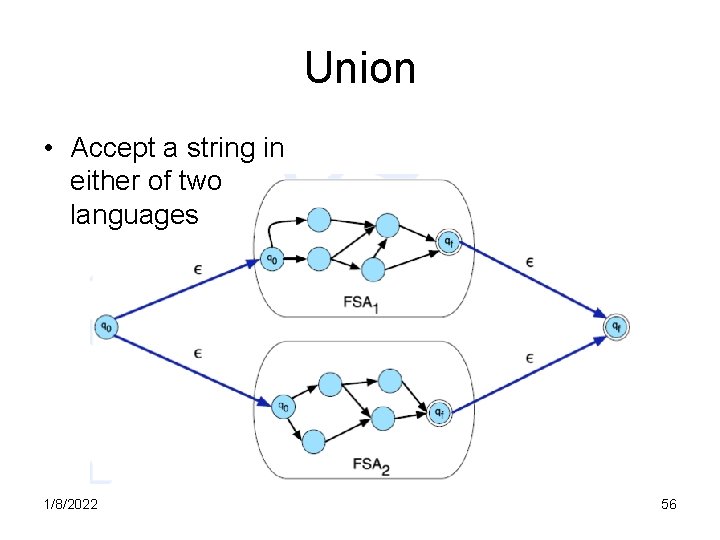
Union • Accept a string in either of two languages 1/8/2022 56
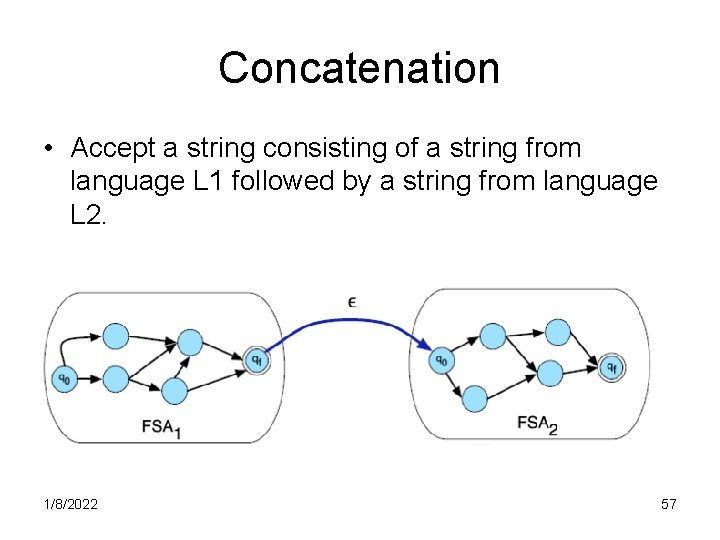
Concatenation • Accept a string consisting of a string from language L 1 followed by a string from language L 2. 1/8/2022 57
Negation • Construct a machine M 2 to accept all strings not accepted by machine M 1 and reject all the strings accepted by M 1 – Invert all the accept and not accept states in M 1 • Does that work for non-deterministic machines? 1/8/2022 58
Intersection • Accept a string that is in both of two specified languages • An indirect construction… • A^B = ~(~A or ~B) 1/8/2022 59