
Regression For classification the outputs is nominal l


- Slides: 35
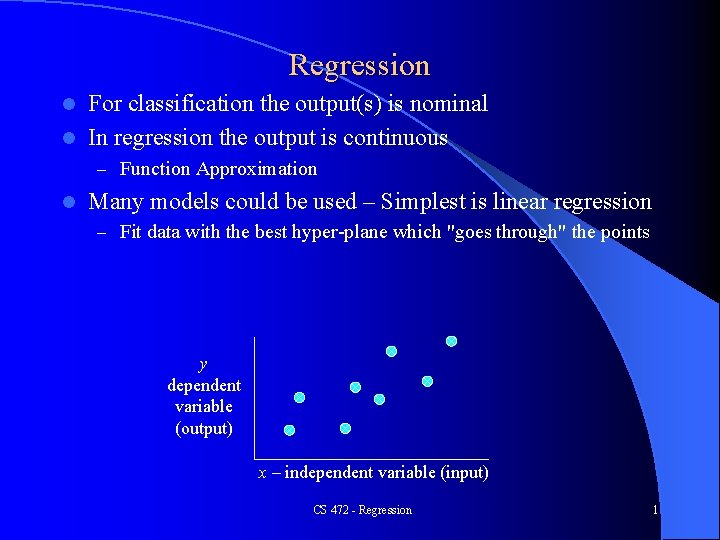
Regression For classification the output(s) is nominal l In regression the output is continuous l – Function Approximation l Many models could be used – Simplest is linear regression – Fit data with the best hyper-plane which "goes through" the points y dependent variable (output) x – independent variable (input) CS 472 - Regression 1
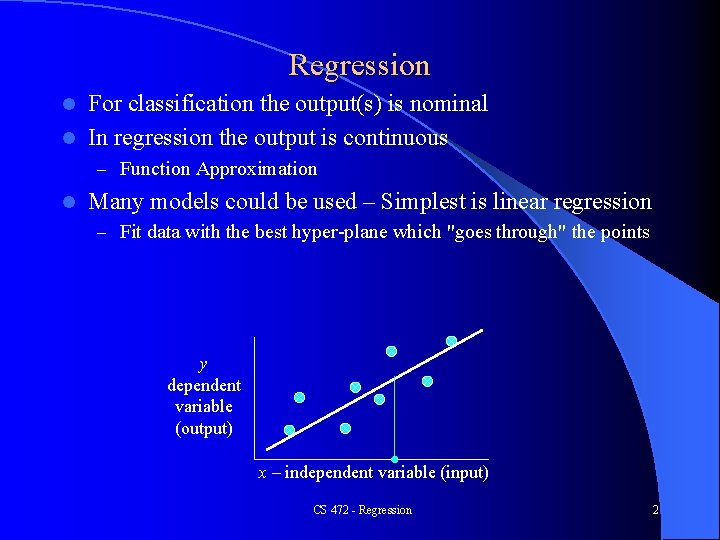
Regression For classification the output(s) is nominal l In regression the output is continuous l – Function Approximation l Many models could be used – Simplest is linear regression – Fit data with the best hyper-plane which "goes through" the points y dependent variable (output) x – independent variable (input) CS 472 - Regression 2
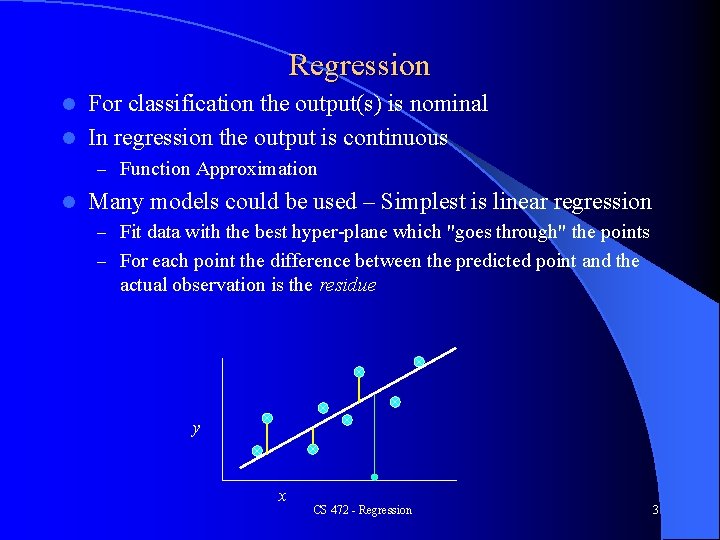
Regression For classification the output(s) is nominal l In regression the output is continuous l – Function Approximation l Many models could be used – Simplest is linear regression – Fit data with the best hyper-plane which "goes through" the points – For each point the difference between the predicted point and the actual observation is the residue y x CS 472 - Regression 3
Simple Linear Regression l For now, assume just one (input) independent variable x, and one (output) dependent variable y – Multiple linear regression assumes an input vector x – Multivariate linear regression assumes an output vector y We "fit" the points with a line (i. e. hyper-plane) l Which line should we use? l – Choose an objective function – For simple linear regression we choose sum squared error (SSE) l S (predictedi – actuali)2 = S (residuei)2 – Thus, find the line which minimizes the sum of the squared residues (e. g. least squares) – This mimics the case where data points were sampled from the actual hyperplane with Gaussian noise added CS 472 - Regression 4
How do we "learn" parameters l For the 2 -d problem (line) there are coefficients for the bias and the independent variable (y-intercept and slope) l To find the values for the coefficients which minimize the objective function we take the partial derivates of the objective function (SSE) with respect to the coefficients. Set these to 0, and solve. CS 472 - Regression 5
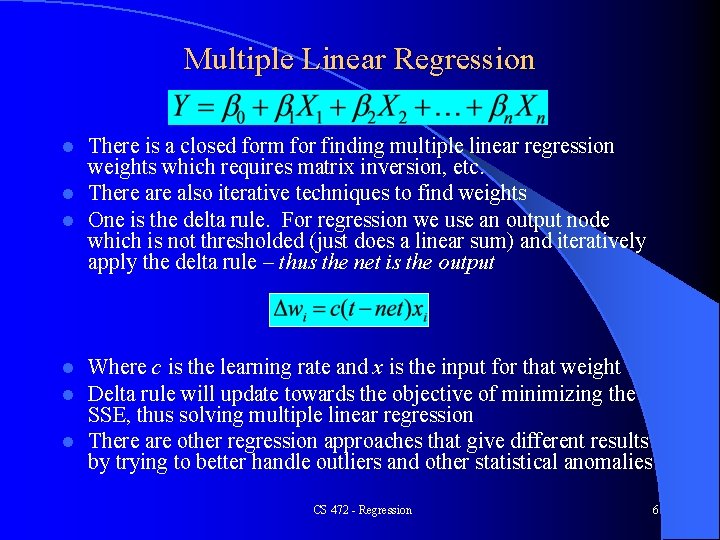
Multiple Linear Regression There is a closed form for finding multiple linear regression weights which requires matrix inversion, etc. l There also iterative techniques to find weights l One is the delta rule. For regression we use an output node which is not thresholded (just does a linear sum) and iteratively apply the delta rule – thus the net is the output l Where c is the learning rate and x is the input for that weight Delta rule will update towards the objective of minimizing the SSE, thus solving multiple linear regression l There are other regression approaches that give different results by trying to better handle outliers and other statistical anomalies l l CS 472 - Regression 6
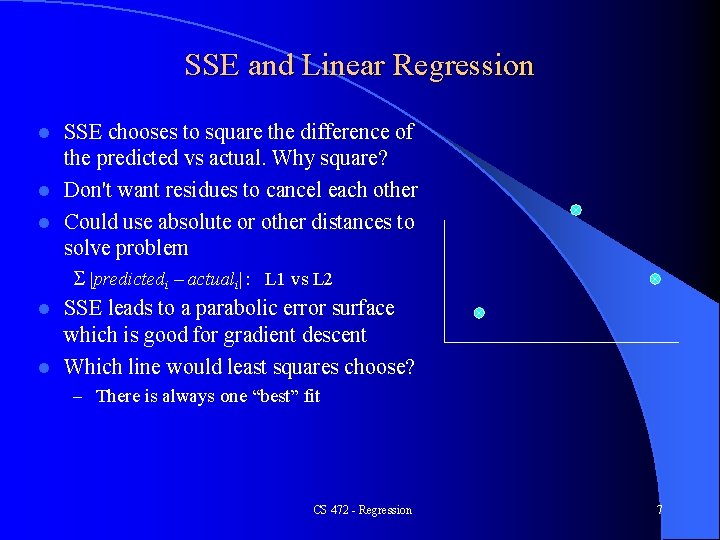
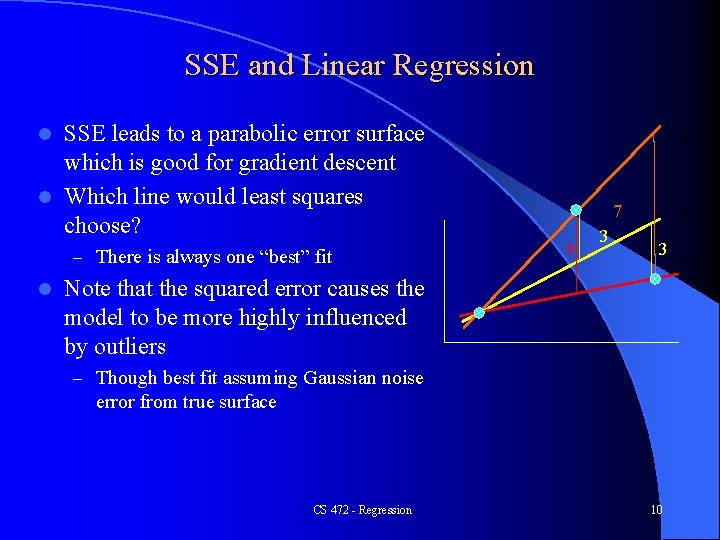
SSE and Linear Regression SSE chooses to square the difference of the predicted vs actual. Why square? l Don't want residues to cancel each other l Could use absolute or other distances to solve problem l S |predictedi – actuali| : L 1 vs L 2 SSE leads to a parabolic error surface which is good for gradient descent l Which line would least squares choose? l – There is always one “best” fit CS 472 - Regression 7
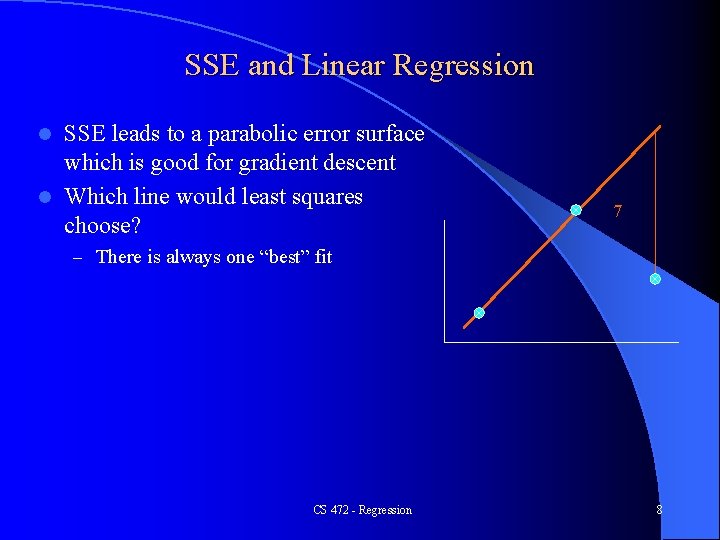
SSE and Linear Regression SSE leads to a parabolic error surface which is good for gradient descent l Which line would least squares choose? l 7 – There is always one “best” fit CS 472 - Regression 8
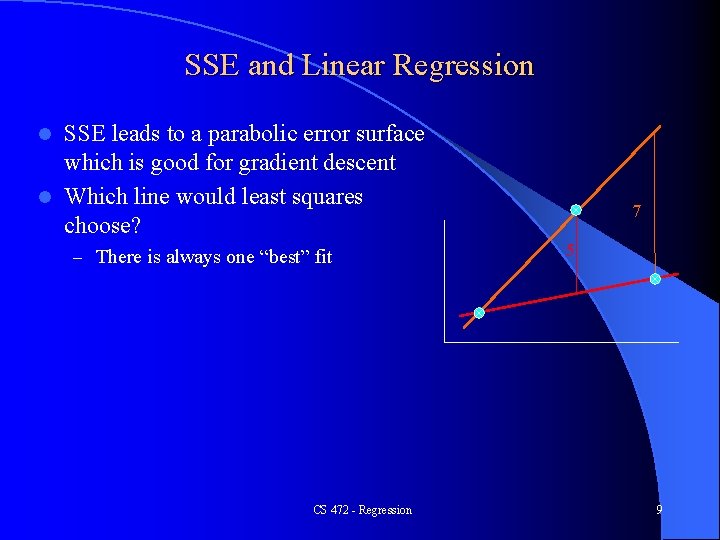
SSE and Linear Regression SSE leads to a parabolic error surface which is good for gradient descent l Which line would least squares choose? l – There is always one “best” fit CS 472 - Regression 7 5 9
SSE and Linear Regression SSE leads to a parabolic error surface which is good for gradient descent l Which line would least squares choose? l – There is always one “best” fit l 7 5 3 3 Note that the squared error causes the model to be more highly influenced by outliers – Though best fit assuming Gaussian noise error from true surface CS 472 - Regression 10
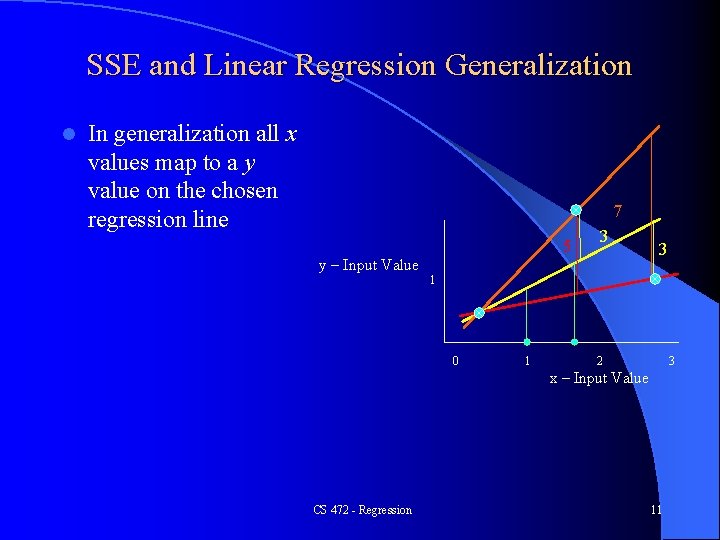
SSE and Linear Regression Generalization l In generalization all x values map to a y value on the chosen regression line 7 5 y – Input Value 3 3 1 0 1 2 3 x – Input Value CS 472 - Regression 11
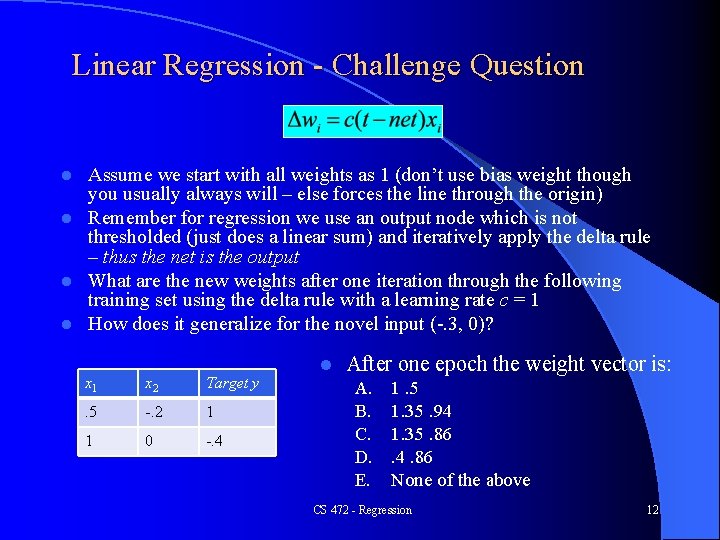
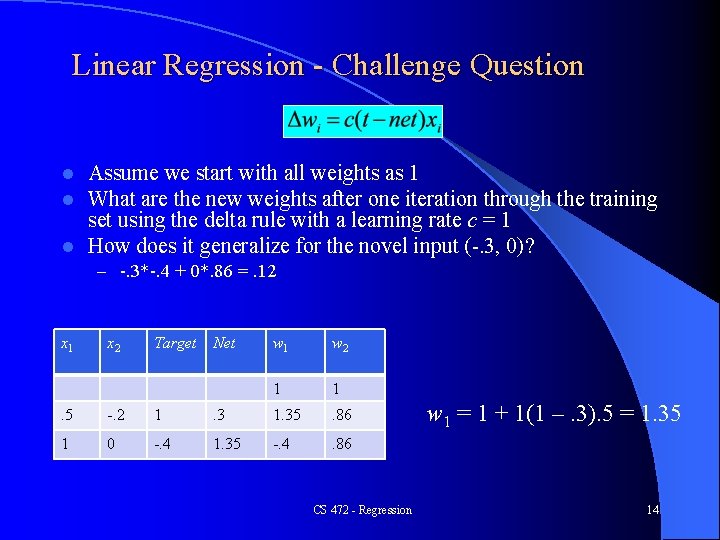
Linear Regression - Challenge Question Assume we start with all weights as 1 (don’t use bias weight though you usually always will – else forces the line through the origin) l Remember for regression we use an output node which is not thresholded (just does a linear sum) and iteratively apply the delta rule – thus the net is the output l What are the new weights after one iteration through the following training set using the delta rule with a learning rate c = 1 l How does it generalize for the novel input (-. 3, 0)? l x 1 x 2 Target y . 5 -. 2 1 1 0 -. 4 l After one epoch the weight vector is: A. B. C. D. E. 1. 5 1. 35. 94 1. 35. 86. 4. 86 None of the above CS 472 - Regression 12
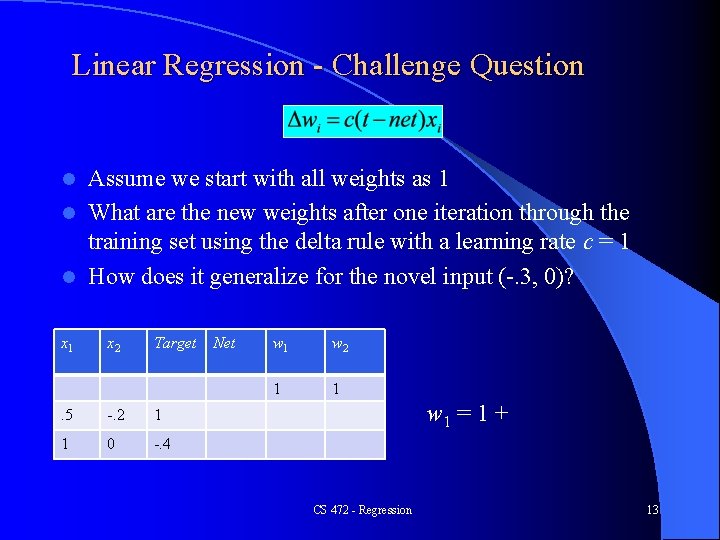
Linear Regression - Challenge Question Assume we start with all weights as 1 l What are the new weights after one iteration through the training set using the delta rule with a learning rate c = 1 l How does it generalize for the novel input (-. 3, 0)? l x 1 x 2 Target . 5 -. 2 1 1 0 -. 4 Net w 1 w 2 1 1 w 1 = 1 + CS 472 - Regression 13
Linear Regression - Challenge Question Assume we start with all weights as 1 What are the new weights after one iteration through the training set using the delta rule with a learning rate c = 1 l How does it generalize for the novel input (-. 3, 0)? l l – -. 3*-. 4 + 0*. 86 =. 12 x 1 x 2 Target Net w 1 w 2 1 1 . 5 -. 2 1 . 3 1. 35 . 86 1 0 -. 4 1. 35 -. 4 . 86 CS 472 - Regression w 1 = 1 + 1(1 –. 3). 5 = 1. 35 14
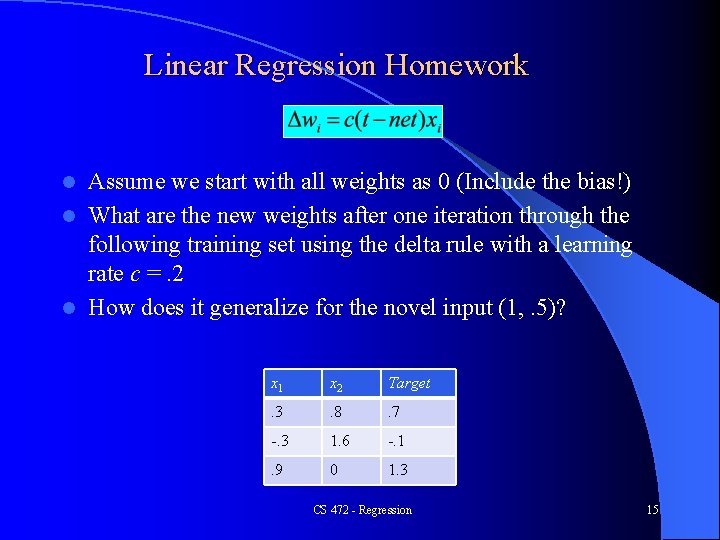
Linear Regression Homework Assume we start with all weights as 0 (Include the bias!) l What are the new weights after one iteration through the following training set using the delta rule with a learning rate c =. 2 l How does it generalize for the novel input (1, . 5)? l x 1 x 2 Target . 3 . 8 . 7 -. 3 1. 6 -. 1 . 9 0 1. 3 CS 472 - Regression 15
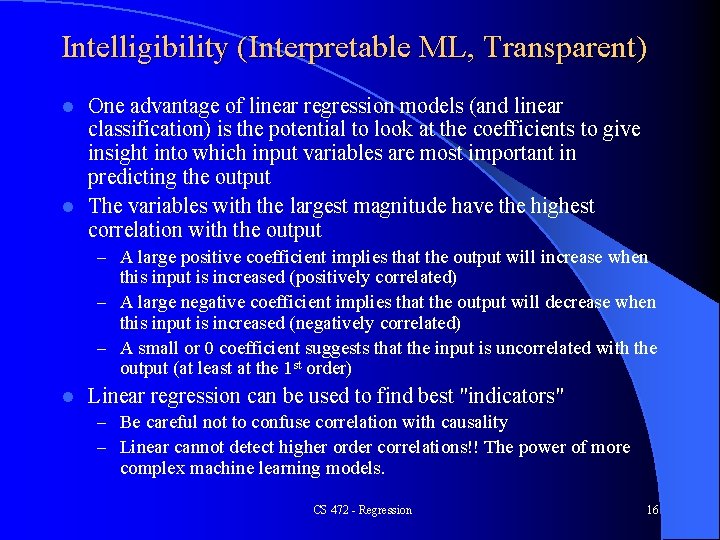
Intelligibility (Interpretable ML, Transparent) One advantage of linear regression models (and linear classification) is the potential to look at the coefficients to give insight into which input variables are most important in predicting the output l The variables with the largest magnitude have the highest correlation with the output l – A large positive coefficient implies that the output will increase when this input is increased (positively correlated) – A large negative coefficient implies that the output will decrease when this input is increased (negatively correlated) – A small or 0 coefficient suggests that the input is uncorrelated with the output (at least at the 1 st order) l Linear regression can be used to find best "indicators" – Be careful not to confuse correlation with causality – Linear cannot detect higher order correlations!! The power of more complex machine learning models. CS 472 - Regression 16
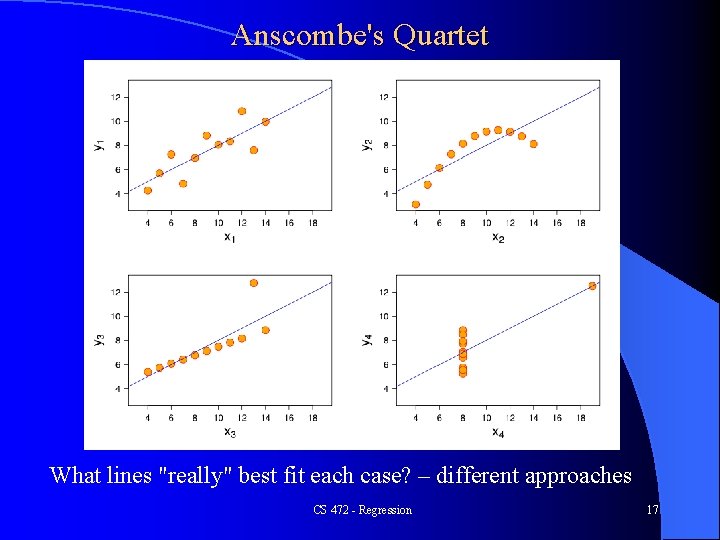
Anscombe's Quartet What lines "really" best fit each case? – different approaches CS 472 - Regression 17
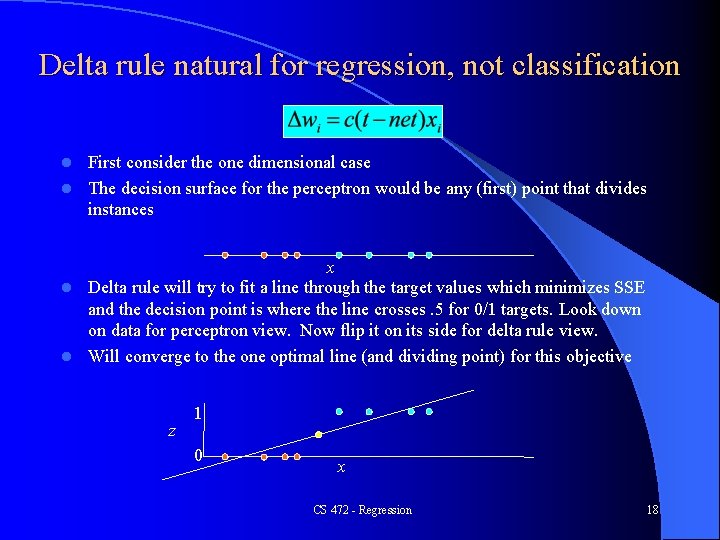
Delta rule natural for regression, not classification First consider the one dimensional case l The decision surface for the perceptron would be any (first) point that divides instances l x l Delta rule will try to fit a line through the target values which minimizes SSE and the decision point is where the line crosses. 5 for 0/1 targets. Look down on data for perceptron view. Now flip it on its side for delta rule view. l Will converge to the one optimal line (and dividing point) for this objective z 1 0 x CS 472 - Regression 18
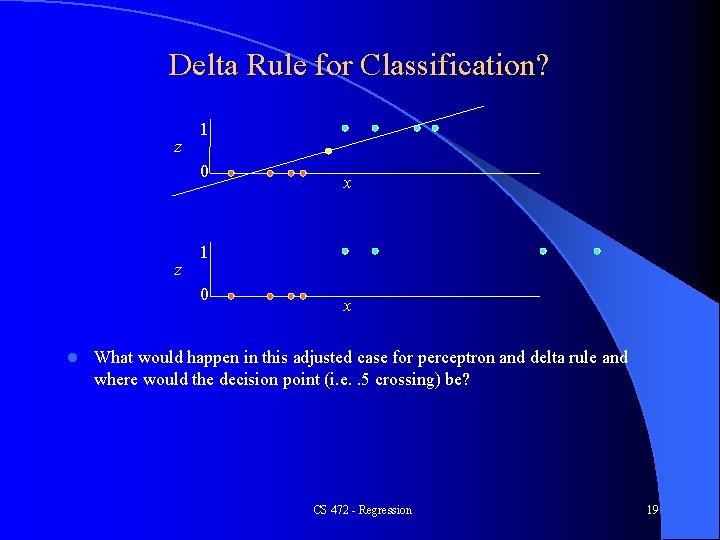
Delta Rule for Classification? z 1 0 l x x What would happen in this adjusted case for perceptron and delta rule and where would the decision point (i. e. . 5 crossing) be? CS 472 - Regression 19
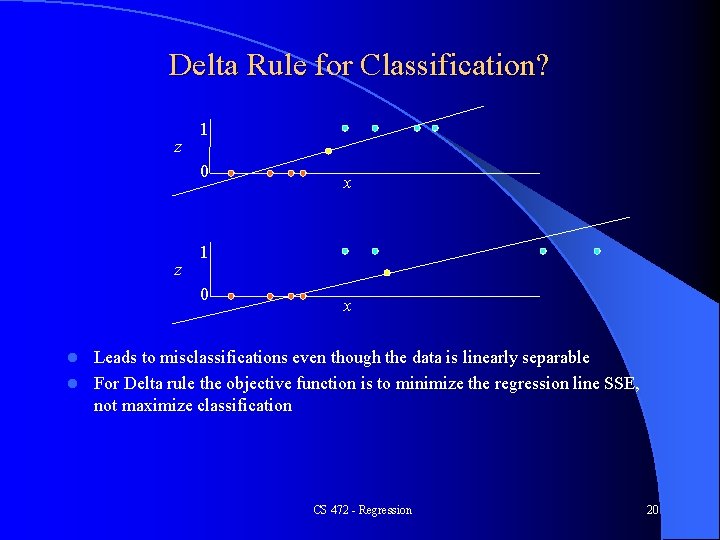
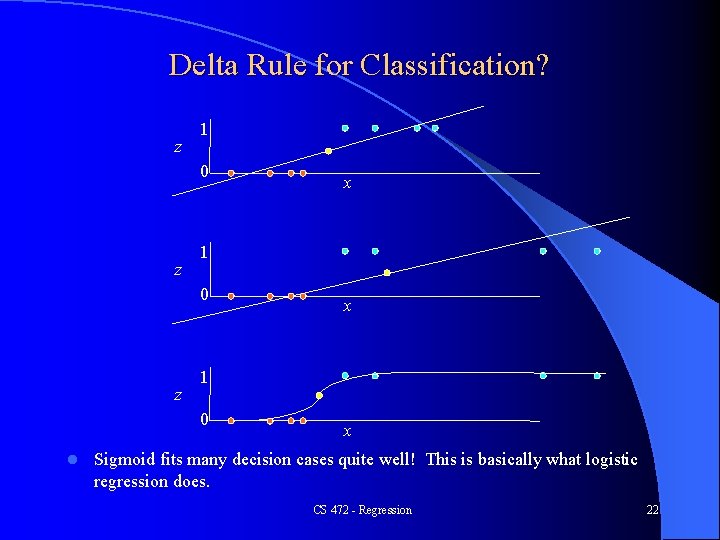
Delta Rule for Classification? z 1 0 z x 1 0 x Leads to misclassifications even though the data is linearly separable l For Delta rule the objective function is to minimize the regression line SSE, not maximize classification l CS 472 - Regression 20
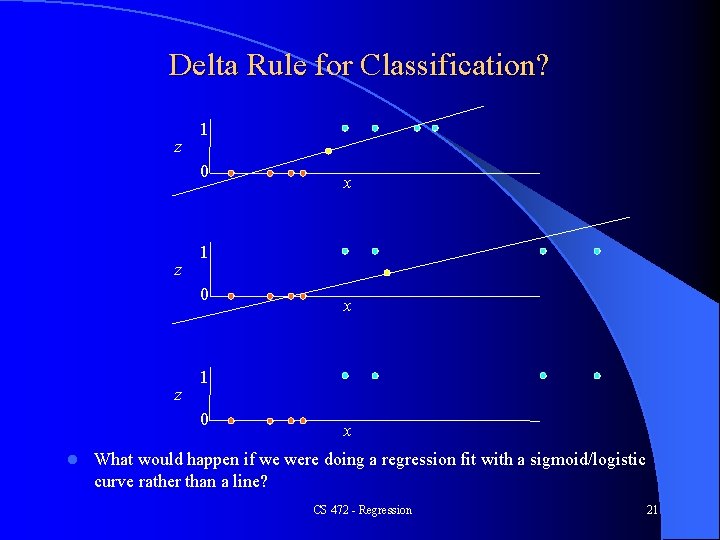
Delta Rule for Classification? z 1 0 z x 1 0 l x x What would happen if we were doing a regression fit with a sigmoid/logistic curve rather than a line? CS 472 - Regression 21
Delta Rule for Classification? z 1 0 z x 1 0 l x x Sigmoid fits many decision cases quite well! This is basically what logistic regression does. CS 472 - Regression 22
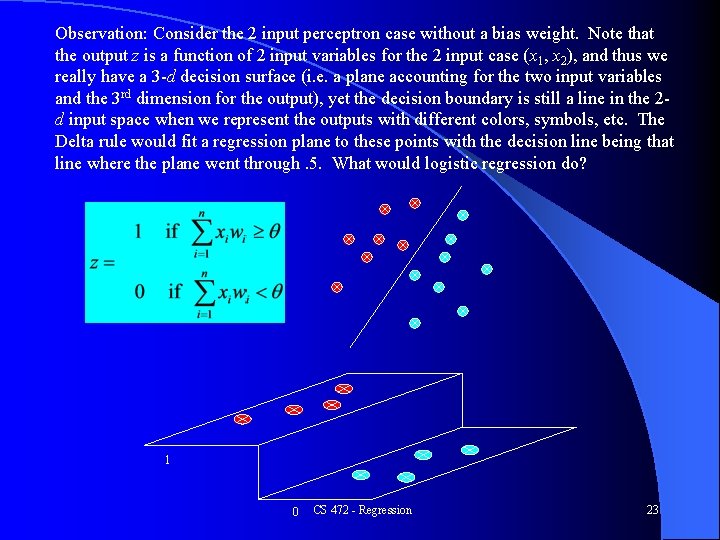
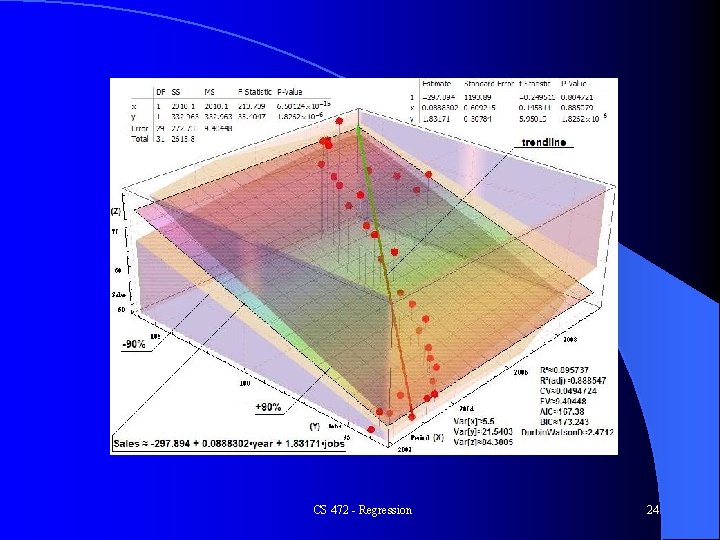
Observation: Consider the 2 input perceptron case without a bias weight. Note that the output z is a function of 2 input variables for the 2 input case (x 1, x 2), and thus we really have a 3 -d decision surface (i. e. a plane accounting for the two input variables and the 3 rd dimension for the output), yet the decision boundary is still a line in the 2 d input space when we represent the outputs with different colors, symbols, etc. The Delta rule would fit a regression plane to these points with the decision line being that line where the plane went through. 5. What would logistic regression do? 1 0 CS 472 - Regression 23
CS 472 - Regression 24
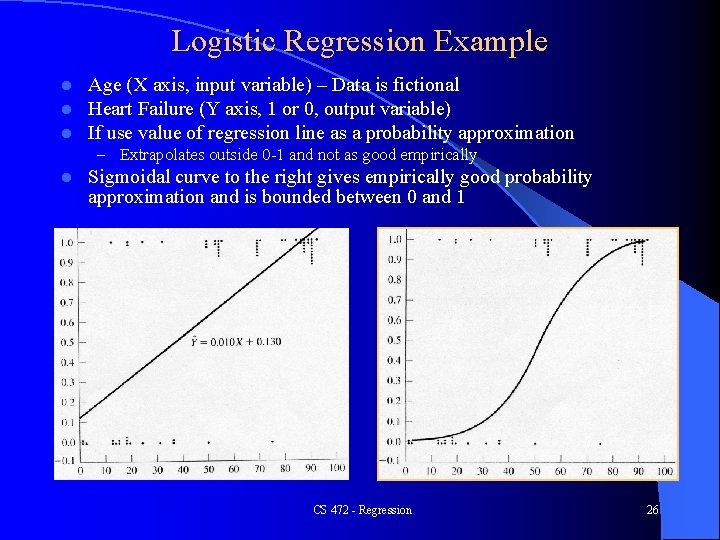
Logistic Regression One commonly used algorithm is Logistic Regression l Assumes that the dependent (output) variable is binary which is often the case in medical and other studies. (Does person have disease or not, survive or not, accepted or not, etc. ) l Like Quadric, Logistic Regression does a particular nonlinear transform on the data after which it just does linear regression on the transformed data l Logistic regression fits the data with a sigmoidal/logistic curve rather than a line and outputs an approximation of the probability of the output given the input l CS 472 - Regression 25
Logistic Regression Example l l l Age (X axis, input variable) – Data is fictional Heart Failure (Y axis, 1 or 0, output variable) If use value of regression line as a probability approximation – Extrapolates outside 0 -1 and not as good empirically l Sigmoidal curve to the right gives empirically good probability approximation and is bounded between 0 and 1 CS 472 - Regression 26
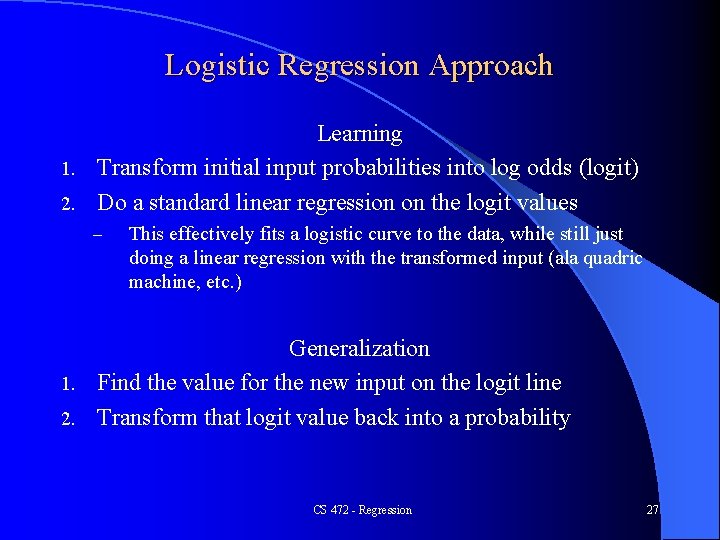
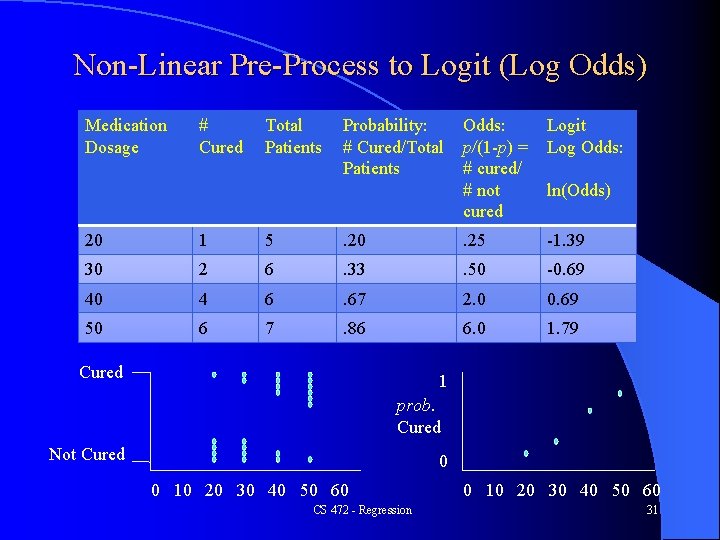
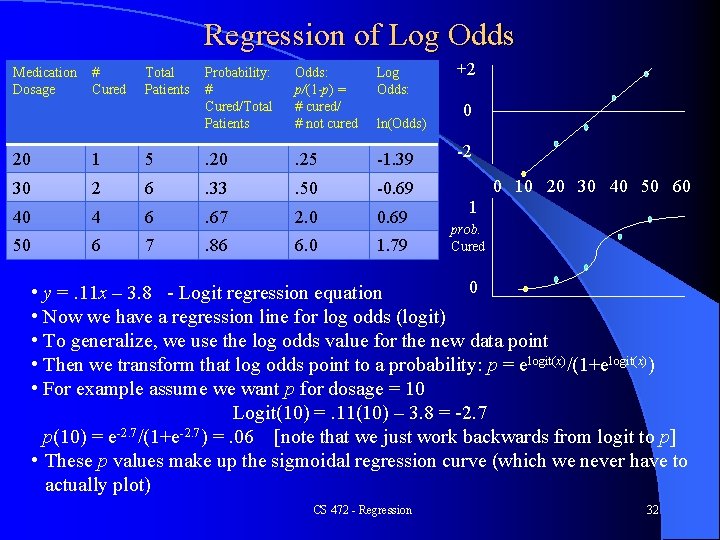
Logistic Regression Approach Learning 1. Transform initial input probabilities into log odds (logit) 2. Do a standard linear regression on the logit values – This effectively fits a logistic curve to the data, while still just doing a linear regression with the transformed input (ala quadric machine, etc. ) Generalization 1. Find the value for the new input on the logit line 2. Transform that logit value back into a probability CS 472 - Regression 27
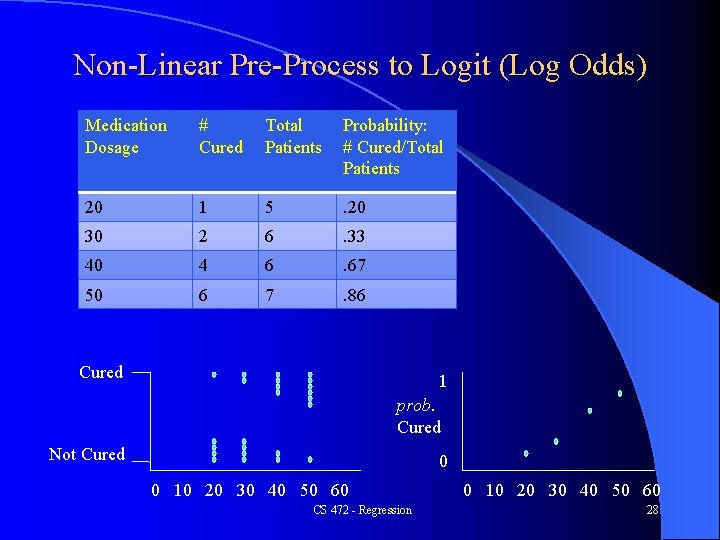
Non-Linear Pre-Process to Logit (Log Odds) Medication Dosage # Cured Total Patients Probability: # Cured/Total Patients 20 1 5 . 20 30 2 6 . 33 40 4 6 . 67 50 6 7 . 86 Cured 1 prob. Cured Not Cured 0 0 10 20 30 40 50 60 CS 472 - Regression 0 10 20 30 40 50 60 28
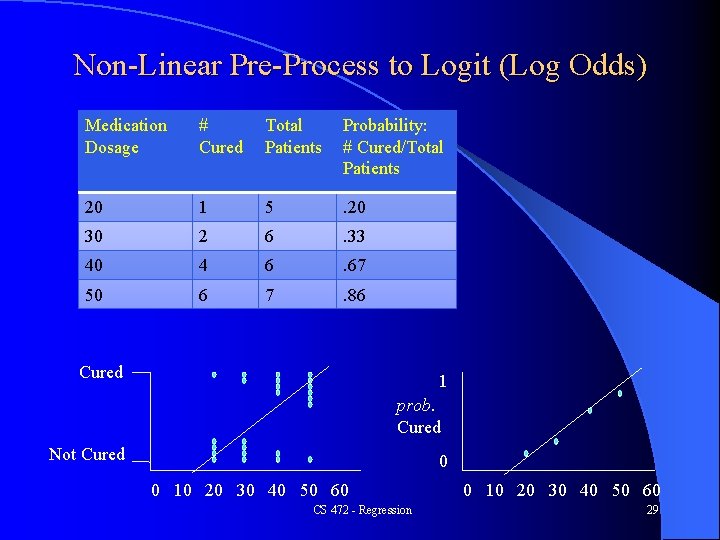
Non-Linear Pre-Process to Logit (Log Odds) Medication Dosage # Cured Total Patients Probability: # Cured/Total Patients 20 1 5 . 20 30 2 6 . 33 40 4 6 . 67 50 6 7 . 86 Cured 1 prob. Cured Not Cured 0 0 10 20 30 40 50 60 CS 472 - Regression 0 10 20 30 40 50 60 29
Logistic Regression Approach Could use linear regression with the probability points, but that would not extrapolate well l Logistic version is better but how do we get it? l Similar to Quadric we do a non-linear pre-process of the input and then do linear regression on the transformed values – do a linear regression on the log odds - Logit l 1 1 prob. Cured 0 0 0 10 20 30 40 50 60 CS 472 - Regression 30
Non-Linear Pre-Process to Logit (Log Odds) Medication Dosage # Cured Total Patients Probability: # Cured/Total Patients Odds: p/(1 -p) = # cured/ # not cured Logit Log Odds: ln(Odds) 20 1 5 . 20 . 25 -1. 39 30 2 6 . 33 . 50 -0. 69 40 4 6 . 67 2. 0 0. 69 50 6 7 . 86 6. 0 1. 79 Cured 1 prob. Cured Not Cured 0 0 10 20 30 40 50 60 CS 472 - Regression 0 10 20 30 40 50 60 31
Regression of Log Odds Medication Dosage # Cured Total Patients Probability: # Cured/Total Patients Odds: p/(1 -p) = # cured/ # not cured Log Odds: ln(Odds) 20 1 5 . 20 . 25 -1. 39 30 2 6 . 33 . 50 -0. 69 40 4 6 . 67 2. 0 0. 69 50 6 7 . 86 6. 0 1. 79 +2 0 -2 0 10 20 30 40 50 60 1 prob. Cured 0 • y =. 11 x – 3. 8 - Logit regression equation • Now we have a regression line for log odds (logit) • To generalize, we use the log odds value for the new data point • Then we transform that log odds point to a probability: p = elogit(x)/(1+elogit(x)) • For example assume we want p for dosage = 10 Logit(10) =. 11(10) – 3. 8 = -2. 7 p(10) = e-2. 7/(1+e-2. 7) =. 06 [note that we just work backwards from logit to p] • These p values make up the sigmoidal regression curve (which we never have to actually plot) CS 472 - Regression 32
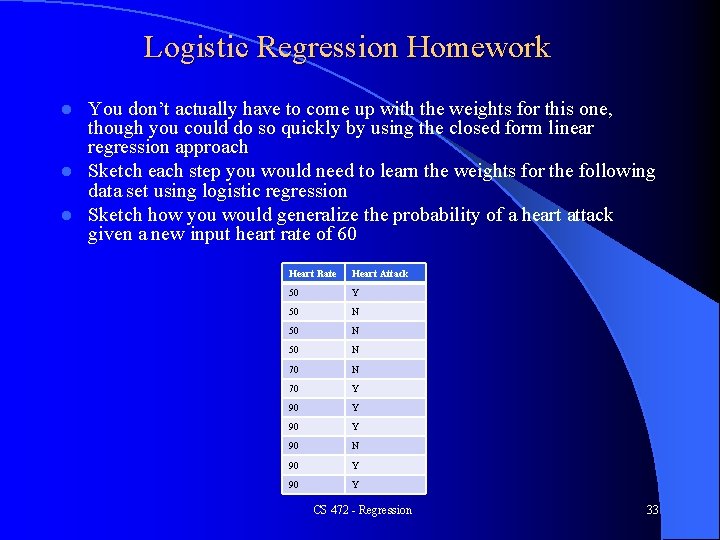
Logistic Regression Homework You don’t actually have to come up with the weights for this one, though you could do so quickly by using the closed form linear regression approach l Sketch each step you would need to learn the weights for the following data set using logistic regression l Sketch how you would generalize the probability of a heart attack given a new input heart rate of 60 l Heart Rate Heart Attack 50 Y 50 N 70 Y 90 N 90 Y CS 472 - Regression 33
Summary l Linear Regression and Logistic Regression are nice tools for many simple situations – But both force us to fit the data with one shape (line or sigmoid) which will often underfit Intelligible results l When problem includes more arbitrary non-linearity then we need more powerful models which we will introduce l – Though non-linear data transformation can help in these cases while still using a linear model for learning l These models are commonly used in data mining applications and also as a "first attempt" at understanding data trends, indicators, etc. CS 472 - Regression 34
Non-Linear Regression l All of the classification models which we will be discussing later in class can also be used for non-linear regression – MLP with Backpropagation, Decision Trees, Nearest Neighbor, etc. l They can learn to learn functions with arbitrarily complex high dimensional surfaces CS 472 - Regression 35