
Regolith Whats all that about Ian Roach MCA
Regolith What's all that about? Ian Roach MCA Lecturer, CRC LEME © CRC LEME 2007
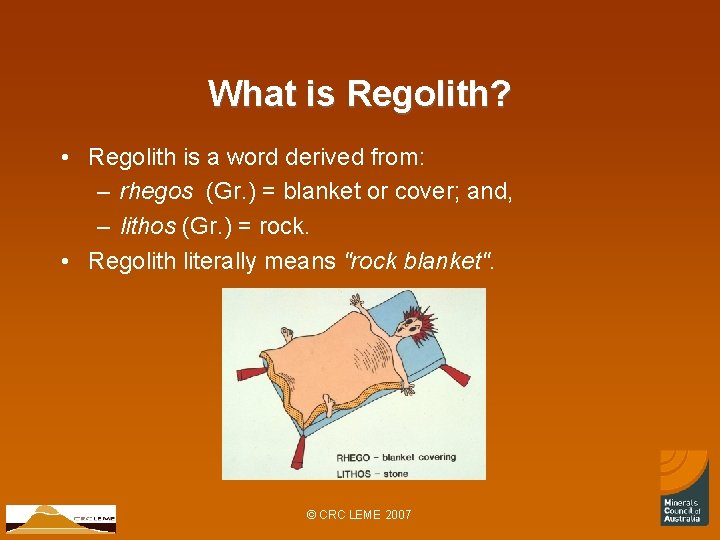
What is Regolith? • Regolith is a word derived from: – rhegos (Gr. ) = blanket or cover; and, – lithos (Gr. ) = rock. • Regolith literally means "rock blanket". © CRC LEME 2007
What is Regolith? • Term introduced by Merrill (1897). • Redefined in Eggleton (2001): "The entire unconsolidated or secondarily recemented cover that overlies coherent bedrock, that has been formed by weathering, erosion, transport and/or deposition of older material. The regolith thus includes fractured and weathered basement rocks, saprolites, soils, organic accumulations, volcanic material, glacial deposits, colluvium, alluvium, evaporitic sediments, aeolian deposits and groundwater. " • Or "Everything between fresh rock and fresh air"! © CRC LEME 2007
What is Regolith? • Rowley Twidale (1990): "The Regolith is a mass of weathered material that is charged with salts and biota. . it is a suppurating mass that gradually consumes any blocks enclosed within it, and is gradually gnawing away at. . the bedrock. In general, the regolith is a discontinuous, festering veneer…". In: Groundwater Geomorphology. Geological Society of America Special Publication 252. • Is there an image problem here? © CRC LEME 2007
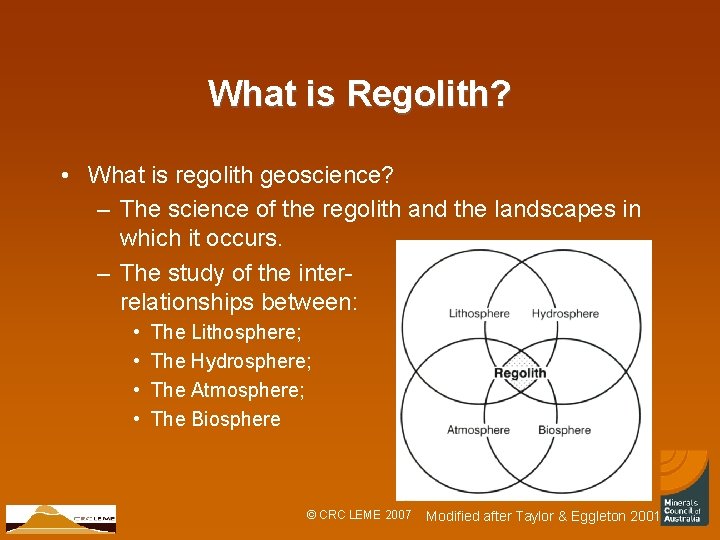
What is Regolith? • What is regolith geoscience? – The science of the regolith and the landscapes in which it occurs. – The study of the interrelationships between: • • The Lithosphere; The Hydrosphere; The Atmosphere; The Biosphere © CRC LEME 2007 Modified after Taylor & Eggleton 2001
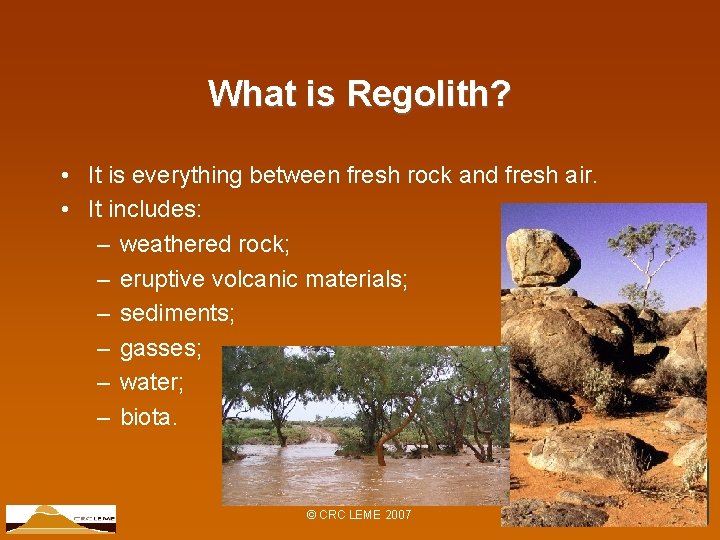
What is Regolith? • It is everything between fresh rock and fresh air. • It includes: – weathered rock; – eruptive volcanic materials; – sediments; – gasses; – water; – biota. © CRC LEME 2007
Regolith includes: • Weathered rock: – physically weathered rock - fragments of the original; – chemically weathered rock - new minerals, solutions and resistate minerals; – at the earth's surface; – within solid, unweathered rock bodies around fractures and joints within the earth. © CRC LEME 2007
Regolith includes: • Sediments - mainly unconsolidated: – various environments - fluvial, slope deposits, lacustrine, marine, aeolian, glacial; – may be physico-chemical: • Those derived by processes associated with: – Eh (electron potential) or redox reactions; – p. H (hydrogen potential, or acid-base) changes; – saturation (evaporation). • biochemical. – may be detrital: • distribution controlled by hydraulics of water, air and ice. © CRC LEME 2007
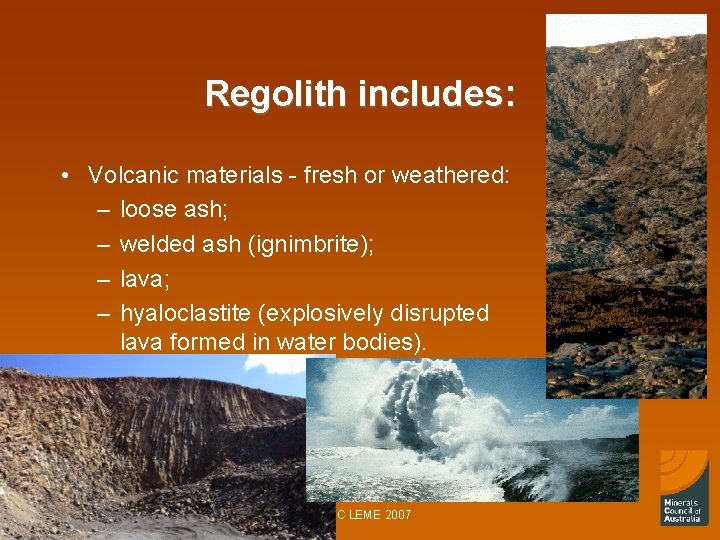
Regolith includes: • Volcanic materials - fresh or weathered: – loose ash; – welded ash (ignimbrite); – lava; – hyaloclastite (explosively disrupted lava formed in water bodies). © CRC LEME 2007
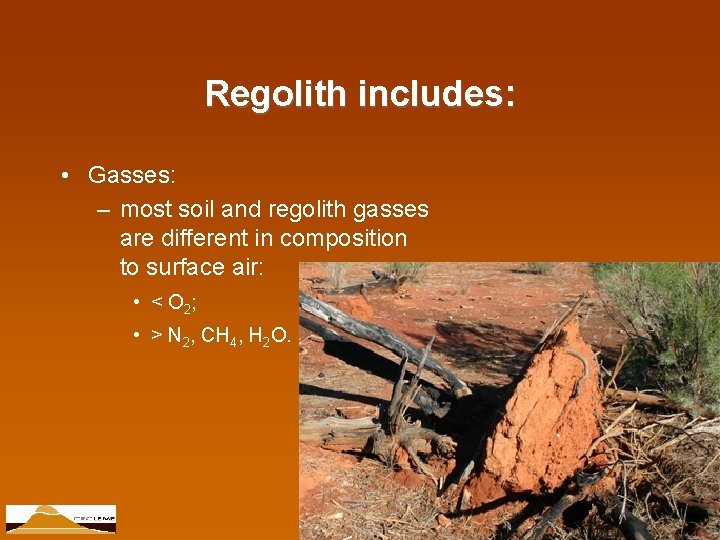
Regolith includes: • Gasses: – most soil and regolith gasses are different in composition to surface air: • < O 2; • > N 2, CH 4, H 2 O. © CRC LEME 2007
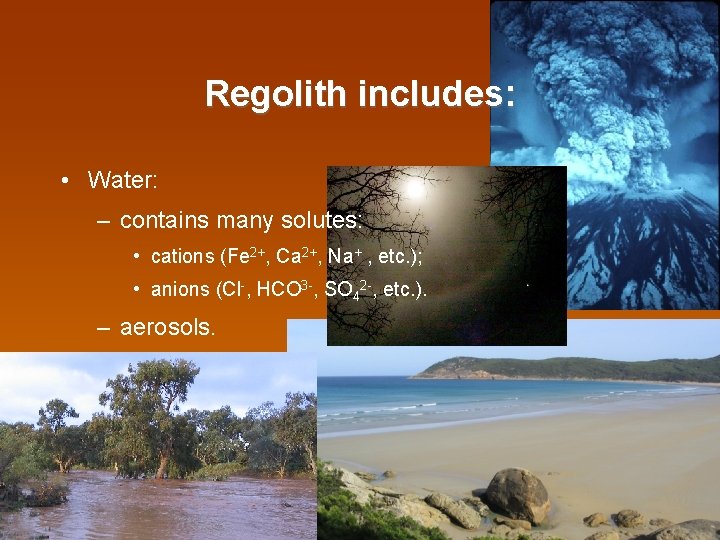
Regolith includes: • Water: – contains many solutes: • cations (Fe 2+, Ca 2+, Na+ , etc. ); • anions (Cl-, HCO 3 -, SO 42 -, etc. ). – aerosols. © CRC LEME 2007
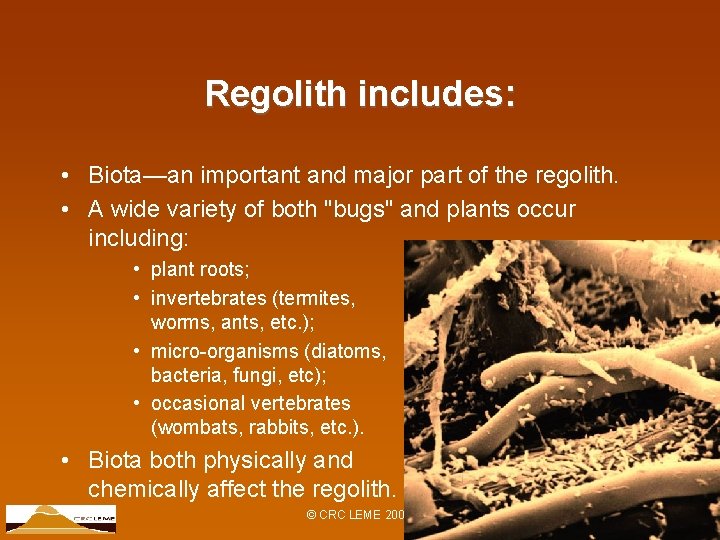
Regolith includes: • Biota—an important and major part of the regolith. • A wide variety of both "bugs" and plants occur including: • plant roots; • invertebrates (termites, worms, ants, etc. ); • micro-organisms (diatoms, bacteria, fungi, etc); • occasional vertebrates (wombats, rabbits, etc. ). • Biota both physically and chemically affect the regolith. © CRC LEME 2007
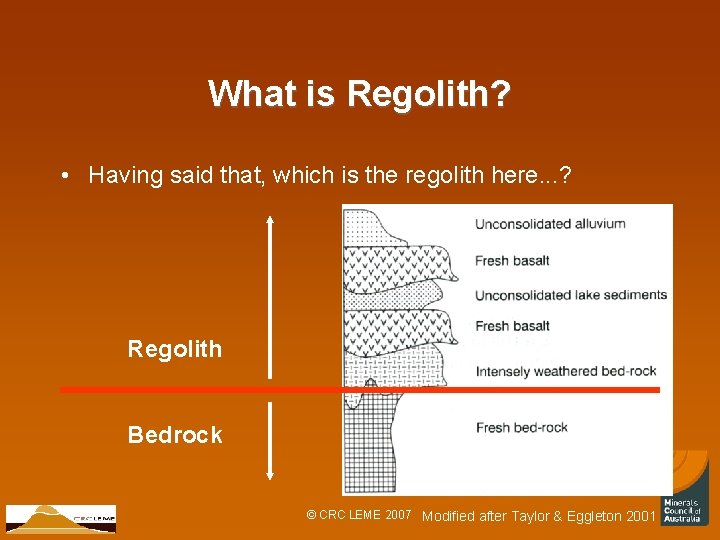
What is Regolith? • Having said that, which is the regolith here. . . ? Regolith Bedrock © CRC LEME 2007 Modified after Taylor & Eggleton 2001
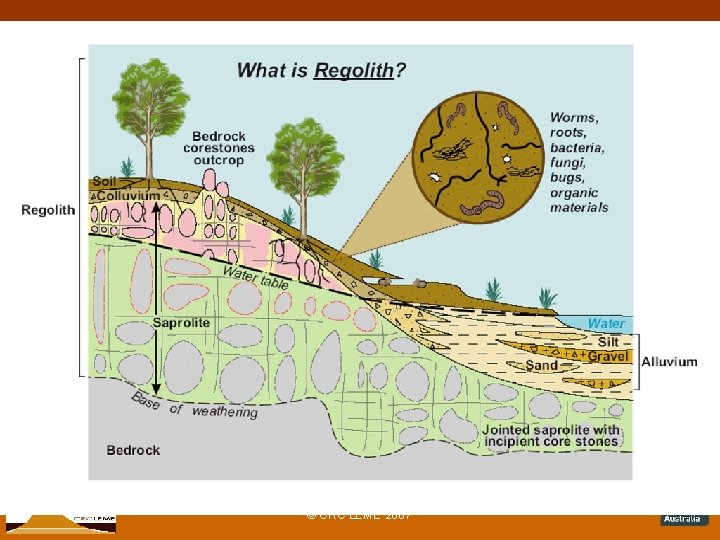
What is Regolith? © CRC LEME 2007
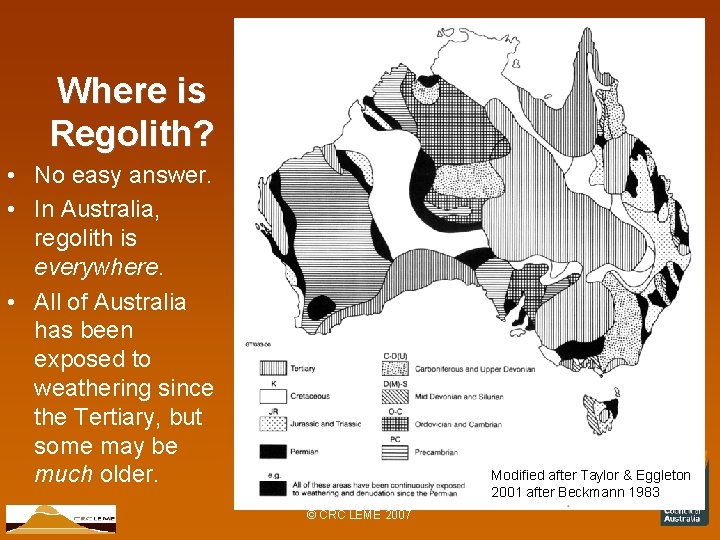
Where is Regolith? • No easy answer. • In Australia, regolith is everywhere. • All of Australia has been exposed to weathering since the Tertiary, but some may be much older. Modified after Taylor & Eggleton 2001 after Beckmann 1983 © CRC LEME 2007
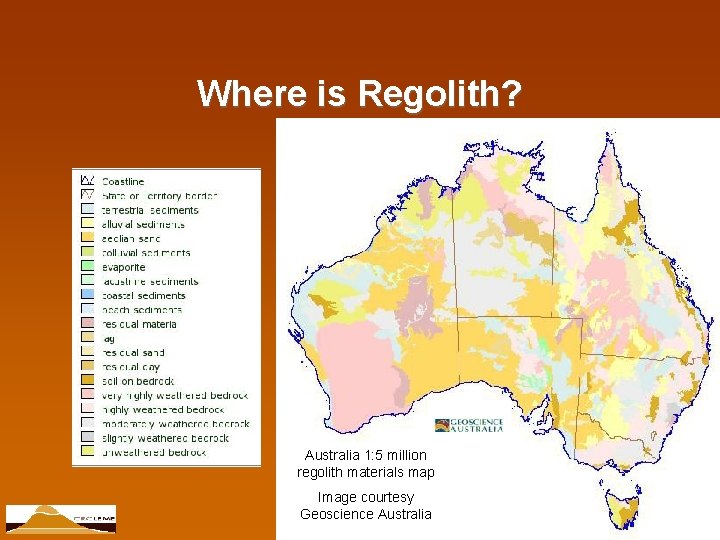
Where is Regolith? Australia 1: 5 million regolith materials map Image courtesy Geoscience © CRC LEMEAustralia 2007
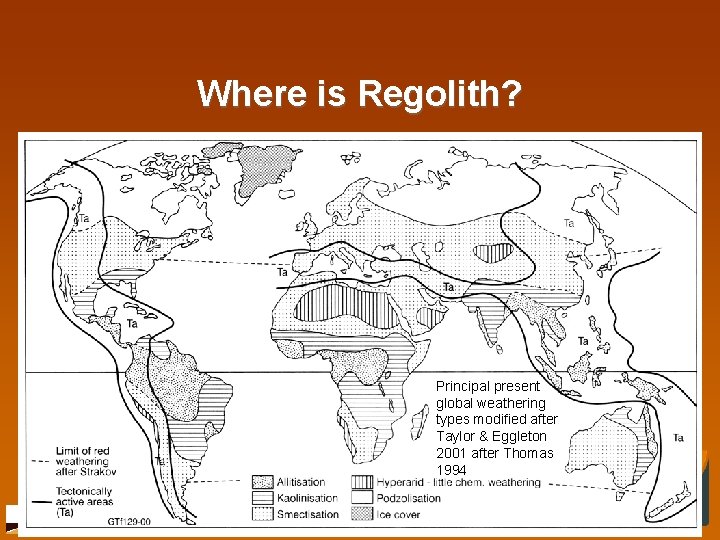
Where is Regolith? Principal present global weathering types modified after Taylor & Eggleton 2001 after Thomas 1994 © CRC LEME 2007
Where is Regolith? • Regolith is everywhere. • Modern regolith processes are principally climatecontrolled (except in areas with strongly active tectonics), thus similar weathering processes are occurring at similar latitudes, e. g. , Australia, Southern Africa and South America, North America, Europe and Russia. • Regolith may be modified by geologically recent events such as large-scale glaciation (North America, Europe, Russia) or desertification (North Africa, Middle East). © CRC LEME 2007
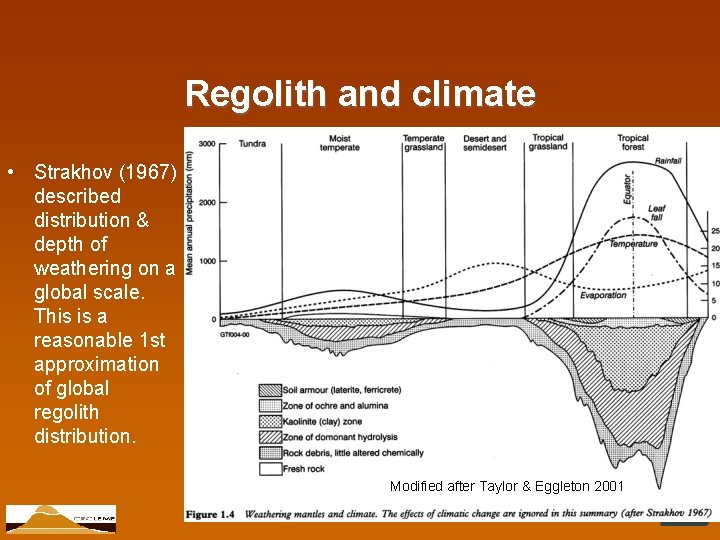
Regolith and climate • Strakhov (1967) described distribution & depth of weathering on a global scale. This is a reasonable 1 st approximation of global regolith distribution. Modified after Taylor & Eggleton 2001 © CRC LEME 2007
Regolith and climate • Most studies of global regolith distribution are climatebased; this is a major shortcoming. • You will see that much of the regolith preserved in Australia is relict—it is not related to the current climate. • Strakhov assumed tectonic stability and that regolith was thicker where climates are warmer and wetter. • Reality tells us that regolith preservation is controlled largely by (neo)tectonics and that the present is not necessarily the key to the past! © CRC LEME 2007
Why study Regolith? • Now, having been through all of that… What possible advantage would a knowledge of regolith have for you? © CRC LEME 2007
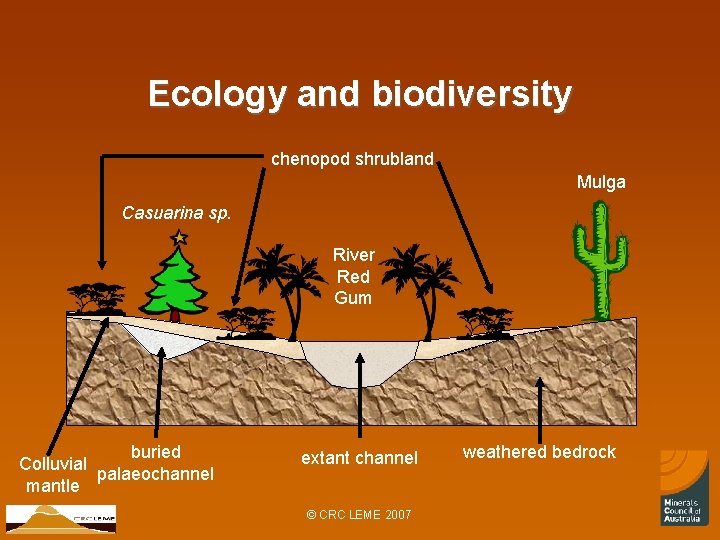
Ecology and biodiversity chenopod shrubland Mulga Casuarina sp. River Red Gum buried Colluvial palaeochannel mantle extant channel © CRC LEME 2007 weathered bedrock
National Parks • Most national, etc. , parks depend on scenery and/or ecological niches for their existence: • Wilsons Promontory - dissected Cretaceous ? weathering profiles with younger weathering and materials; • Kosciuszko - dissected planated and uplifted Mesozoic? land surface; • Uluru - desert landscapes, monoliths; • Kakadu - Quaternary and Proterozoic landscapes and ecology; • Yosemite - glacial landscapes with active uplift due to hotspot volcanism; • Stonehenge - regolith materials (sarsen stones or silcrete). © CRC LEME 2007
Natural Resource Management • Recent regolith work in Central western NSW: • • salts shown to be largely aeolian, minor rock weathering; salts stored in weathered rock (regolith); salt released by rising groundwaters; groundwater flow controlled by buried landscapes. • Understanding salinity depends on • • weathering history; landscape evolution; climate past and present; realization that Australia has always been salty. © CRC LEME 2007
Greenhouse – As rocks weather they consume CO 2: • they tend to become carbonated at Earth's surface, especially under arid conditions. – Additional CO 2 creates additional carbonic acid, creating more weathering. – Weathering buffers greenhouse in the long term. © CRC LEME 2007
Engineering • 2: 1 lattice clays and self-mulching clay soils expand when wetted (smectite 9. 6 Å dry - 15. 5 Å wet), strong pressures are developed during wetting/drying. • Optical fibre cable laying is a problem; cables can be progressively strained and snapped in swelling soils. • Building foundations in swelling ground must be specially treated. • Road pavement stabilization a problem in areas with swelling ground. • Aggregate from regolith materials for road/rail base (silcrete, calcrete, ferricrete). Each with own problems. © CRC LEME 2007
Agriculture • All agriculture occurs within the regolith • What about hydroponics? – Where do they get their fertilisers from? • Agriculture strongly relies on the upper part of the regolith, soil. • Regolith studies are crucial for soil management: • Stability/erodability; • Salinity issues; • Plant health (soil nutrient deficiencies/overabundances). © CRC LEME 2007
Mineral exploration • Positive effects of regolith processes: – larger target halo; – Useful sampling media: • Regolith carbonates and Au; • Ferruginous regolith and base metals/Au/PGE; • Biota and base metals/Au/PGE • Negative effects of regolith processes: – deposits hidden by transported regolith. • Need to first understand regolith structure and landscape relationships, then choose appropriate sampling media and exploration strategies. © CRC LEME 2007
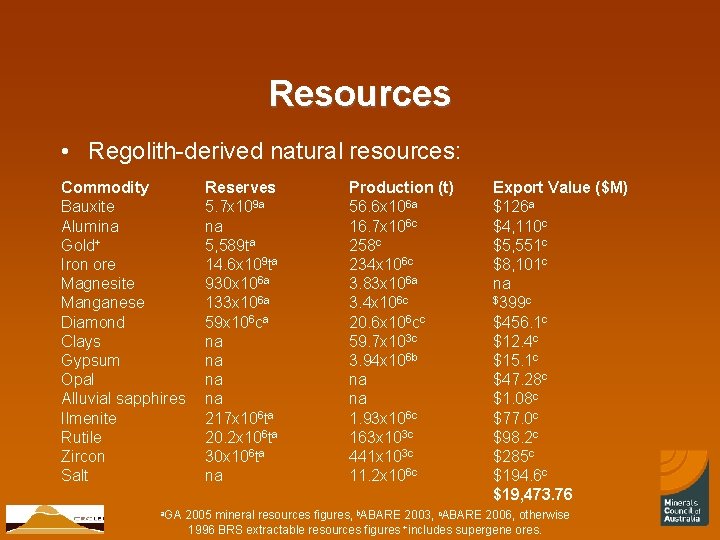
Resources • Regolith-derived natural resources: Commodity Bauxite Alumina Gold+ Iron ore Magnesite Manganese Diamond Clays Gypsum Opal Alluvial sapphires Ilmenite Rutile Zircon Salt a. GA Reserves 5. 7 x 10⁹ a na 5, 589 ta 14. 6 x 10⁹ ta 930 x 106 a 133 x 106 a 59 x 106 ca na na 217 x 106 ta 20. 2 x 10⁶ ta 30 x 106 ta na Production (t) 56. 6 x 10⁶ a 16. 7 x 10⁶ c 258 c 234 x 106 c 3. 83 x 106 a 3. 4 x 10⁶ c 20. 6 x 10⁶ cc 59. 7 x 10³ c 3. 94 x 106 b na na 1. 93 x 106 c 163 x 103 c 441 x 103 c 11. 2 x 10⁶ c Export Value ($M) $126 a $4, 110 c $5, 551 c $8, 101 c na $399 c $456. 1 c $12. 4 c $15. 1 c $47. 28 c $1. 08 c $77. 0 c $98. 2 c $285 c $194. 6 c $19, 473. 76 b. ABARE 2005 mineral resources©figures, CRC LEME 2007 2003, c. ABARE 2006, otherwise 1996 BRS extractable resources figures +includes supergene ores.
So there you have it. . . • Life on earth evolves around the evolving regolith. • We rely on the regolith to maintain our daily needs. • In weathered terrains we need to explore within and underneath the regolith for mineral deposits. • We need to understand the regolith to sustainably manage our natural resources. © CRC LEME 2007
References ABARE 2003, 2006. Australian Commodity Statistics 2003, 2006. Http: //www. abare. gov. au/ (Australian Bureau of Agricultural and Resource Economics). Beckmann G. G. 1983. Development of old landscapes and soils. In: Soils, an Australian viewpoint. CSIRO, Melbourne, 51 -72. Eggleton R. A. (ed. ) 2001. The Regolith Glossary. CRC LEME 144 pp. Merrill G. P. 1897. A treatise on rocks, rock weathering and soils. Macmillan, New York, 411 pp. Thomas M. F. 1994. Geomorphology in the tropics: a study of weathering and denudation in low latitudes. John Wiley, New York, 460 pp. Taylor G. & Eggleton R. A. 2001. Regolith Geology and Geomorphology. John Wiley & Sons Ltd, Chichester, 375 pp. Twidale C. R. 1990. In: Groundwater Geomorphology. Geological Society of America Special Publication 252. Walther J. 1916. Das geologische Alter und die Bildung des Laterits. Petermanns Geographischer Mitteilungen 62, 1 -7, 46 -53. Strakhov N. M. 1967. Principles of lithogenesis. Oliver and Boyd, Edinburgh. Acknowledgment: parts of this lecture are derived from an earlier version by Graham Taylor © CRC LEME 2007
- Slides: 31