
Regolith Profiles Types Materials Genesis and Terrestrial Processes
- Slides: 20
Regolith Profiles Types, Materials, Genesis and Terrestrial Processes Mehrooz F Aspandiar CRC LEME WASM, Curtin University of Technology © CRC LEME 2007
© CRC LEME 2007
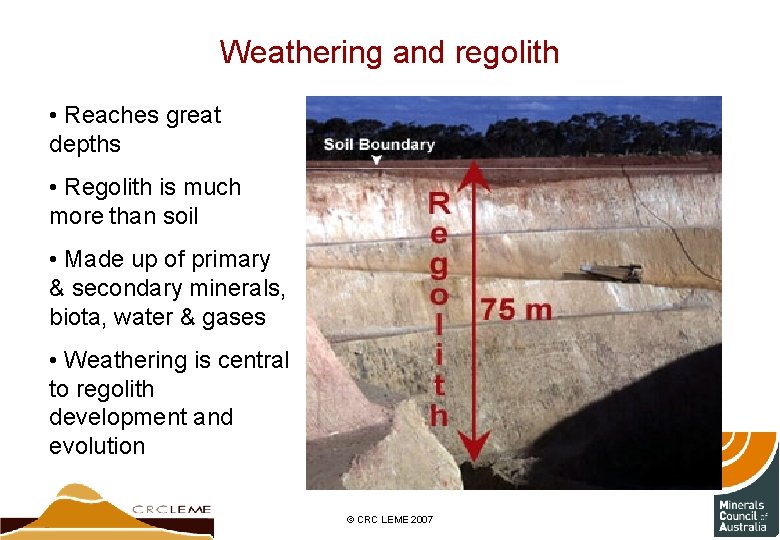
Weathering and regolith • Reaches great depths • Regolith is much more than soil • Made up of primary & secondary minerals, biota, water & gases • Weathering is central to regolith development and evolution © CRC LEME 2007
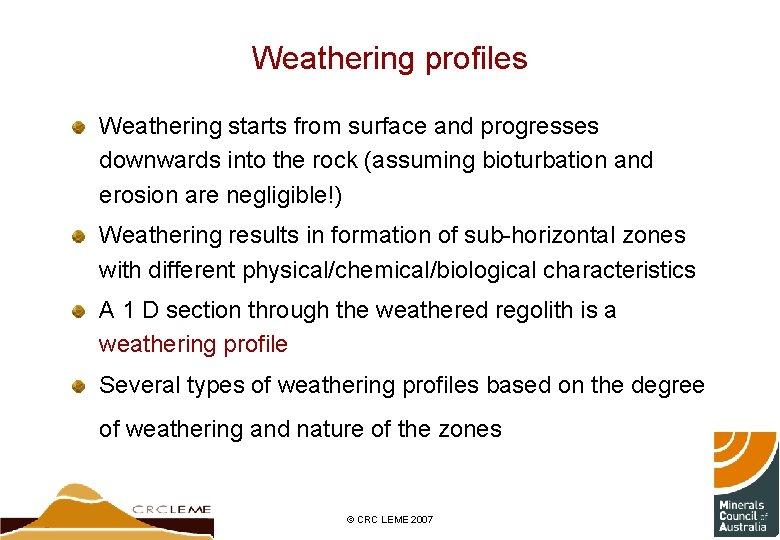
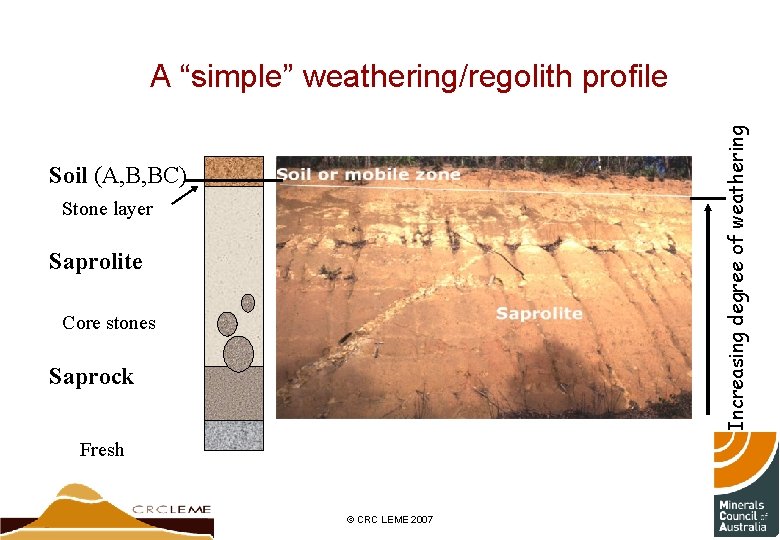
Weathering profiles Weathering starts from surface and progresses downwards into the rock (assuming bioturbation and erosion are negligible!) Weathering results in formation of sub-horizontal zones with different physical/chemical/biological characteristics A 1 D section through the weathered regolith is a weathering profile Several types of weathering profiles based on the degree of weathering and nature of the zones © CRC LEME 2007
Increasing degree of weathering A “simple” weathering/regolith profile Soil (A, B, BC) Stone layer Saprolite Core stones Saprock Fresh © CRC LEME 2007
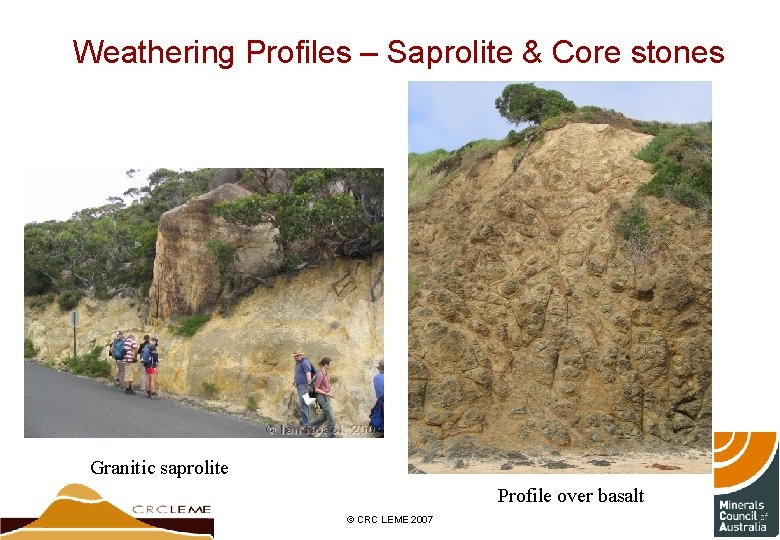
Weathering Profiles – Saprolite & Core stones Granitic saprolite Profile over basalt © CRC LEME 2007
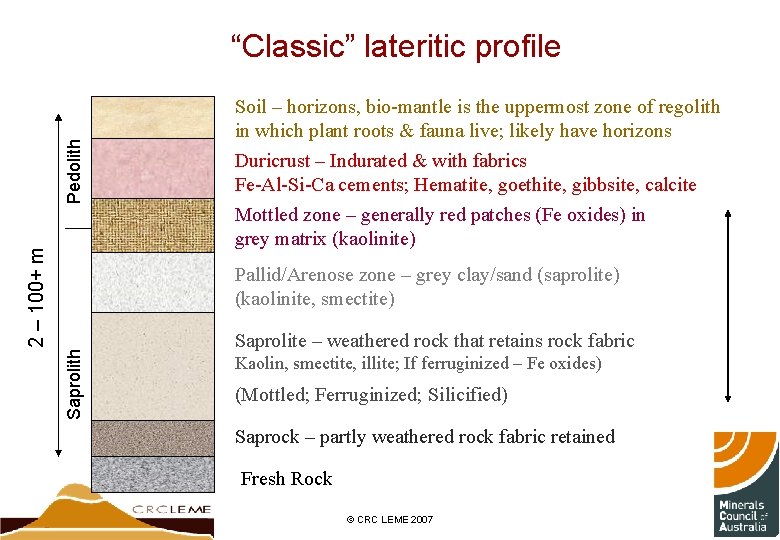
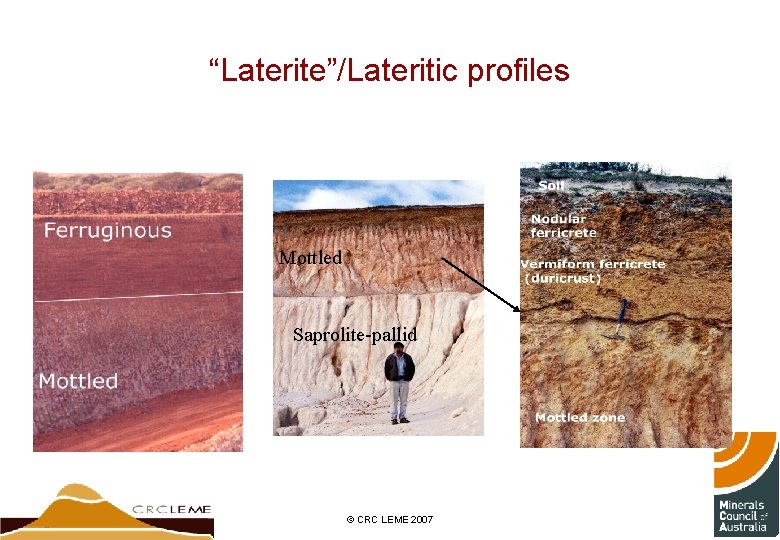
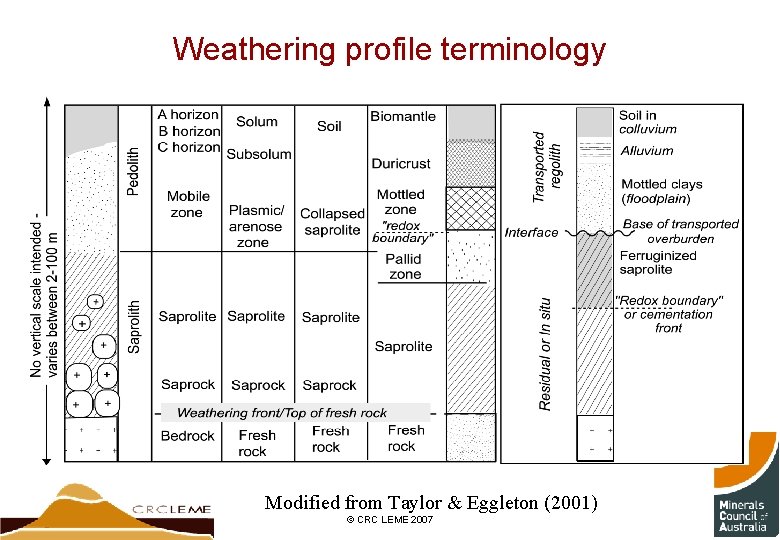
2 – 100+ m Pedolith “Classic” lateritic profile Soil – horizons, bio-mantle is the uppermost zone of regolith in which plant roots & fauna live; likely have horizons Duricrust – Indurated & with fabrics Fe-Al-Si-Ca cements; Hematite, goethite, gibbsite, calcite Mottled zone – generally red patches (Fe oxides) in grey matrix (kaolinite) Saprolith Pallid/Arenose zone – grey clay/sand (saprolite) (kaolinite, smectite) Saprolite – weathered rock that retains rock fabric Kaolin, smectite, illite; If ferruginized – Fe oxides) (Mottled; Ferruginized; Silicified) Saprock – partly weathered rock fabric retained Fresh Rock © CRC LEME 2007
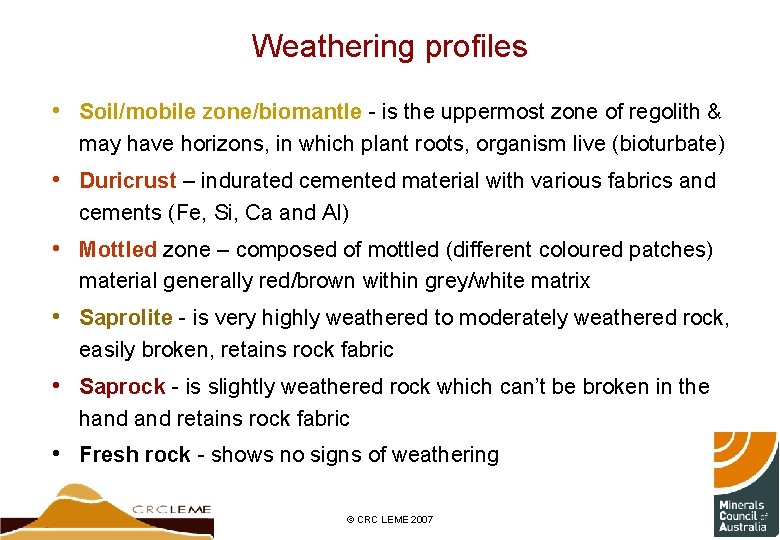
Weathering profiles • Soil/mobile zone/biomantle - is the uppermost zone of regolith & may have horizons, in which plant roots, organism live (bioturbate) • Duricrust – indurated cemented material with various fabrics and cements (Fe, Si, Ca and Al) • Mottled zone – composed of mottled (different coloured patches) material generally red/brown within grey/white matrix • Saprolite - is very highly weathered to moderately weathered rock, easily broken, retains rock fabric • Saprock - is slightly weathered rock which can’t be broken in the hand retains rock fabric • Fresh rock - shows no signs of weathering © CRC LEME 2007
“Laterite”/Lateritic profiles Mottled Saprolite-pallid © CRC LEME 2007
Weathering profile terminology Modified from Taylor & Eggleton (2001) © CRC LEME 2007
“Classic” weathering profiles – a few neglected but critical points All zones/materials shown in ‘classic’ profiles are NOT present and every material of profile can crop out at surface Thickness of zones varies laterally within metres – 2 D & 3 D variations are a norm Not all zones/materials form in the sequence generally depicted (top to bottom) Some zones/material may repeat in a profile Not everybody uses the same terminology! One term to refer to different materials and different terms for same material © CRC LEME 2007
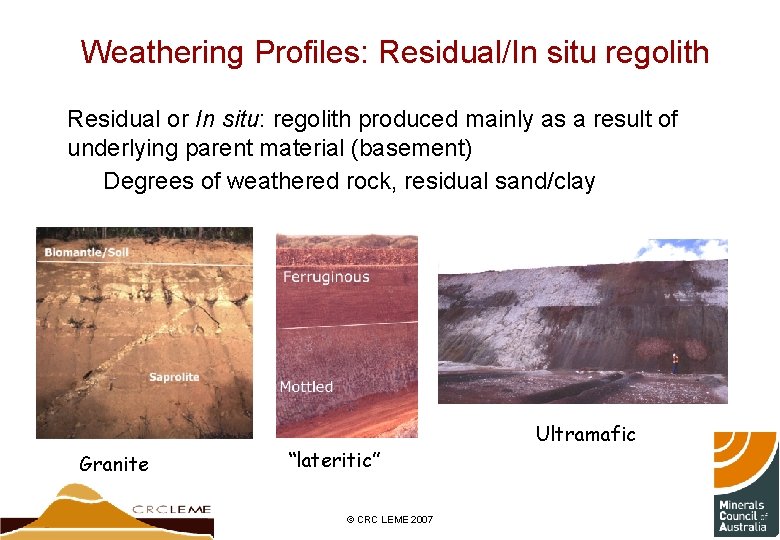
Weathering Profiles: Residual/In situ regolith Residual or In situ: regolith produced mainly as a result of underlying parent material (basement) Degrees of weathered rock, residual sand/clay Granite “lateritic” © CRC LEME 2007 Ultramafic
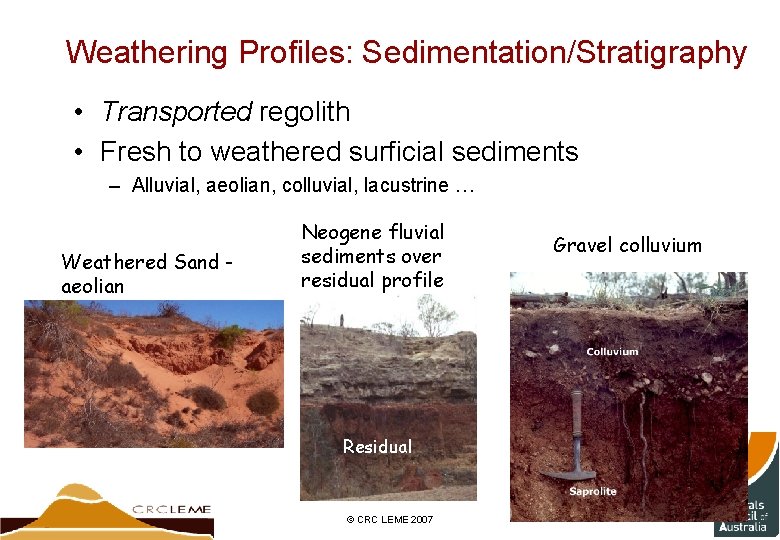
Weathering Profiles: Sedimentation/Stratigraphy • Transported regolith • Fresh to weathered surficial sediments – Alluvial, aeolian, colluvial, lacustrine … Weathered Sand aeolian Neogene fluvial sediments over residual profile Residual © CRC LEME 2007 Gravel colluvium
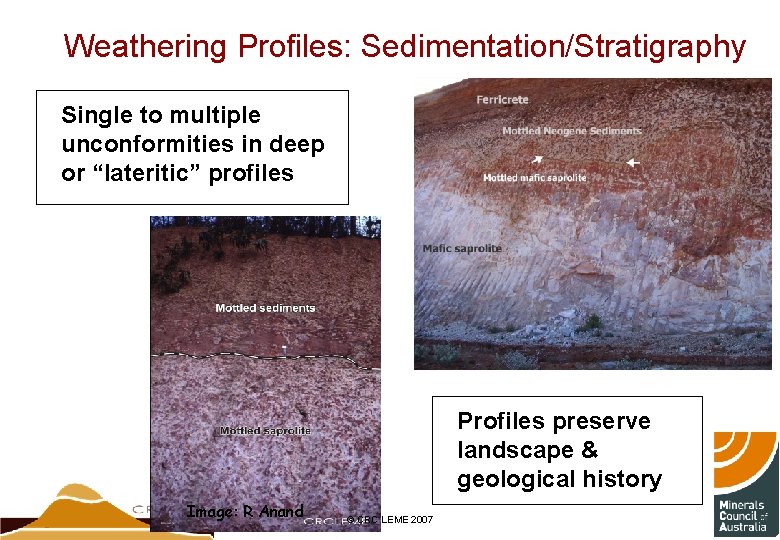
Weathering Profiles: Sedimentation/Stratigraphy Single to multiple unconformities in deep or “lateritic” profiles Profiles preserve landscape & geological history Image: R Anand © CRC LEME 2007
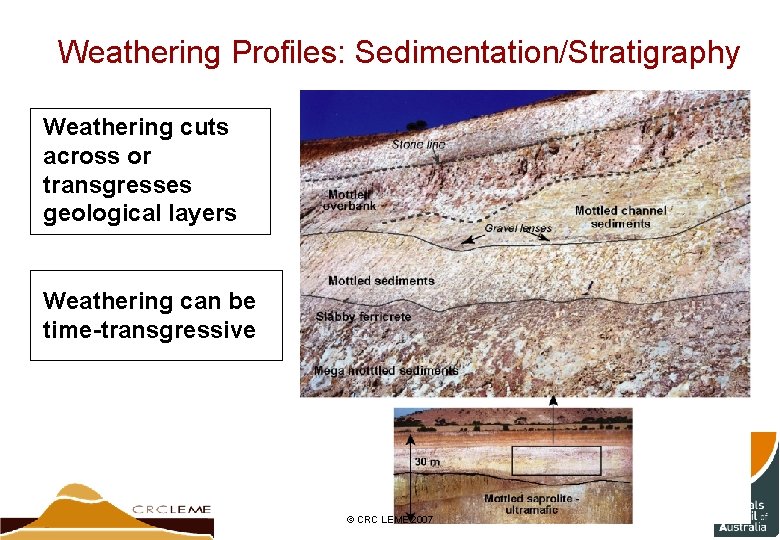
Weathering Profiles: Sedimentation/Stratigraphy Weathering cuts across or transgresses geological layers Weathering can be time-transgressive © CRC LEME 2007
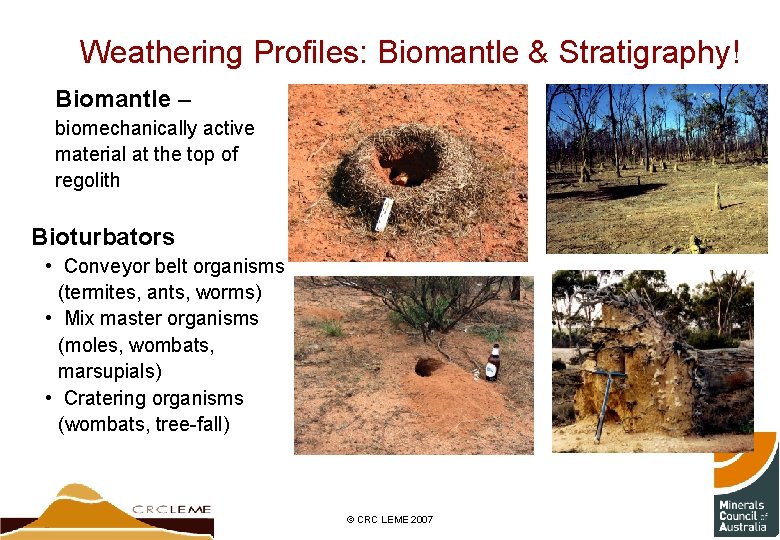
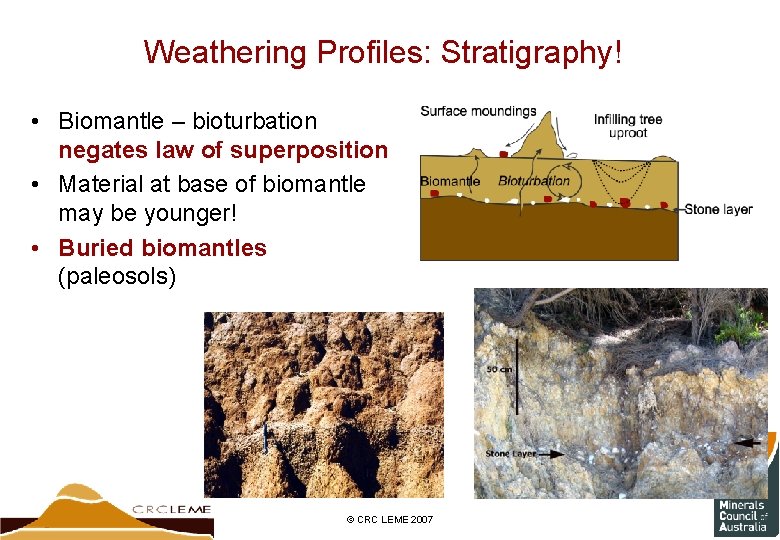
Weathering Profiles: Biomantle & Stratigraphy! Biomantle – biomechanically active material at the top of regolith Bioturbators • Conveyor belt organisms (termites, ants, worms) • Mix master organisms (moles, wombats, marsupials) • Cratering organisms (wombats, tree-fall) © CRC LEME 2007
Weathering Profiles: Stratigraphy! • Biomantle – bioturbation negates law of superposition • Material at base of biomantle may be younger! • Buried biomantles (paleosols) © CRC LEME 2007
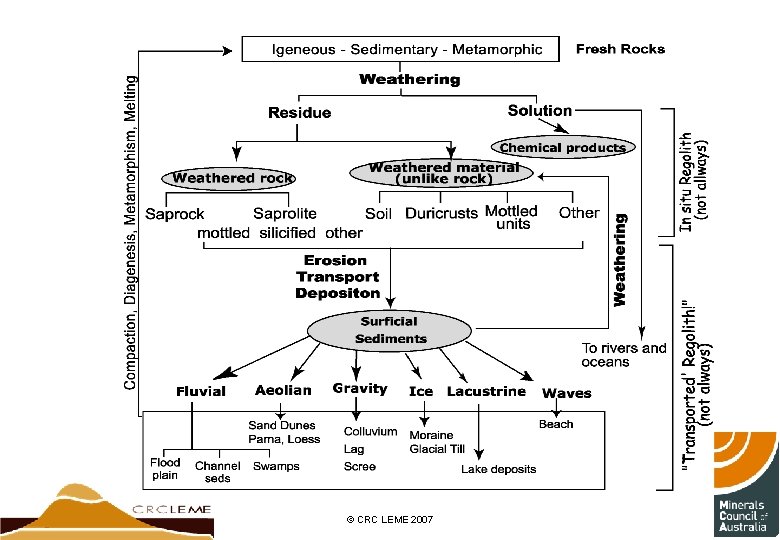
Genesis of weathering profiles Regolith forms and evolves by the interaction between weathering, erosion, transportation and sedimentation All the terrestrial processes operate at different rates and scales across the landscape and have an impact on the evolution of a weathering profile over time Need to separate terrestrial sediments from weathering features or character – tease out landscape history Need to consider the interaction between weathering, erosion and sedimentation within the landscape © CRC LEME 2007
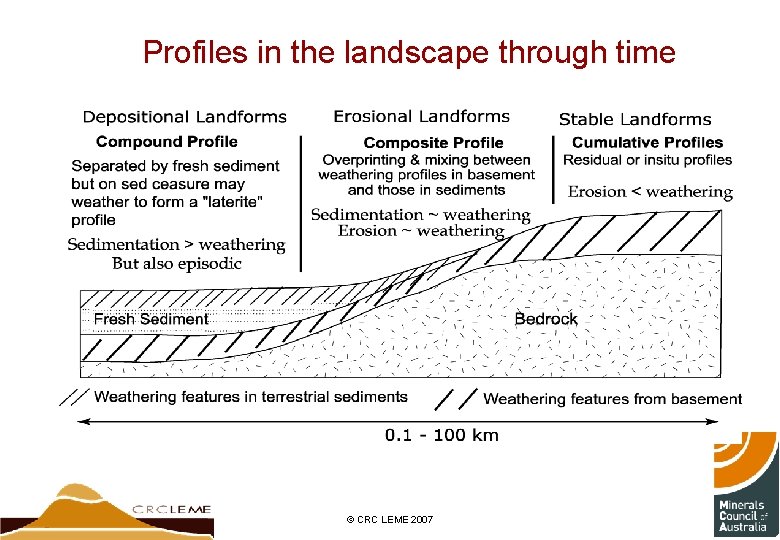
Profiles in the landscape through time © CRC LEME 2007
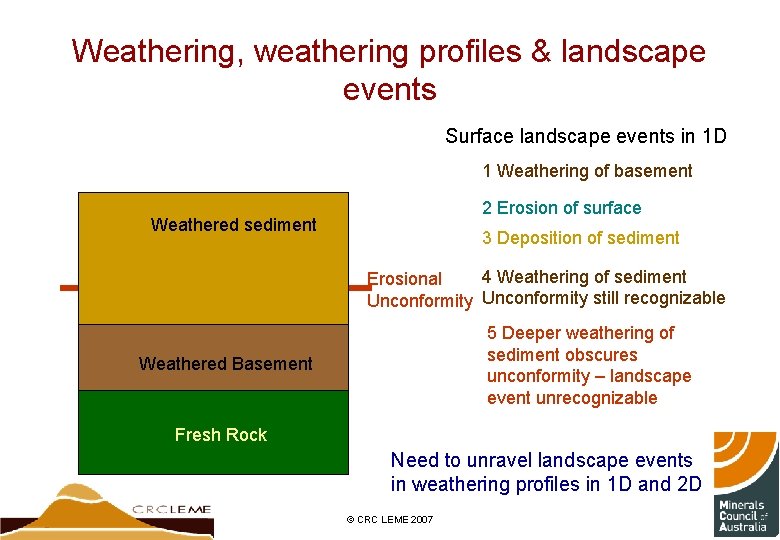
Weathering, weathering profiles & landscape events Surface landscape events in 1 D 1 Weathering of basement 2 Erosion of surface Weathered sediment 3 Deposition of sediment 4 Weathering of sediment Erosional Unconformity still recognizable 5 Deeper weathering of sediment obscures unconformity – landscape event unrecognizable Weathered Basement Fresh Rock Need to unravel landscape events in weathering profiles in 1 D and 2 D © CRC LEME 2007