
Registrybased Coverage Assessment at the Last Patient Encounter

Registry-based Coverage Assessment at the Last Patient Encounter M. Irigoyen, S. Findley, S. Chen, F. Chimkin, O. Peña Columbia University, New York, NY funded by CDC
Background • Immunization assessments using predetermined dates underestimate coverage because they include patients no longer active in the practice. • Assessments at the last patient encounter offer providers complementary perspectives on immunization status.
Objective To compare registry-based coverage assessments for the same group of children at two points in time - last patient encounter (last visit) - predetermined audit date.
Study Setting • 5 hospital-affiliated practices in Northern Manhattan, NYC • Shared immunization registry at all practices; registry has >95% capture rate • Low income, Latino children
Inclusion Criteria for the Assessment • • • 6 -23 months old at assessment 1+ visit to the practice Age at last visit >3 months 1+ immunizations in registry N= 6, 492
Assessment Outcomes • DTa. P: Polio: MMR: Hib: Hep. B (4: 3: 1: 3: 3) age-appropriate immunization coverage rates • Calculated for the same child at assessment date and at last patient encounter (last visit)
Fixed vs. Variable Date Assessments • Coverage at two points in time: – a fixed assessment date: 10/01/01, 4/01/02 and 10/01/02 – a variable assessment date, given by the date of the last patient encounter prior to the assessment date
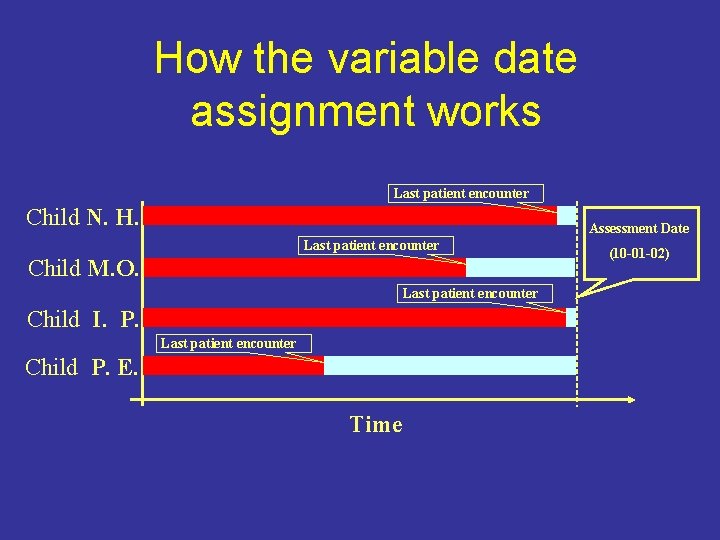
How the variable date assignment works Last patient encounter Child N. H. Assessment Date Last patient encounter Child M. O. Last patient encounter Child I. P. Last patient encounter Child P. E. Time (10 -01 -02)
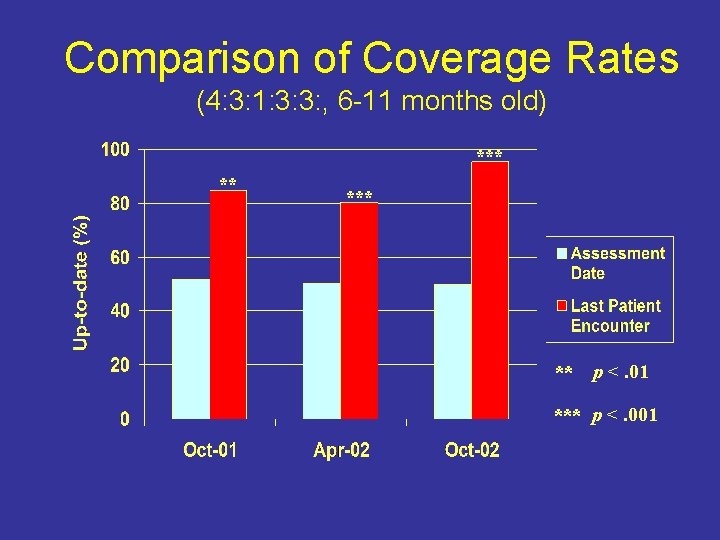
Comparison of Coverage Rates (4: 3: 1: 3: 3: , 6 -11 months old) *** ** p <. 01 *** p <. 001
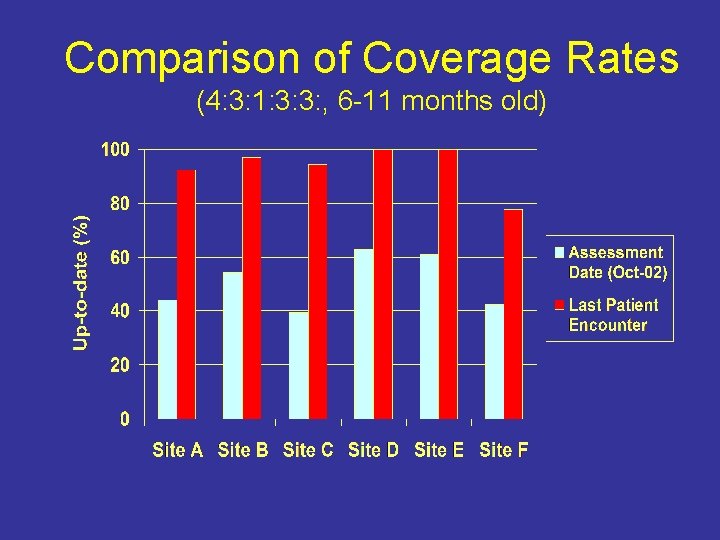
Comparison of Coverage Rates (4: 3: 1: 3: 3: , 6 -11 months old)
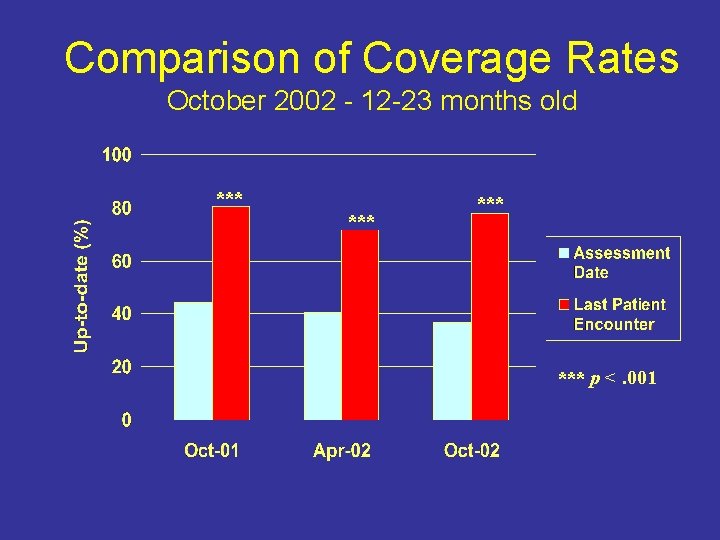
Comparison of Coverage Rates October 2002 - 12 -23 months old *** *** p <. 001
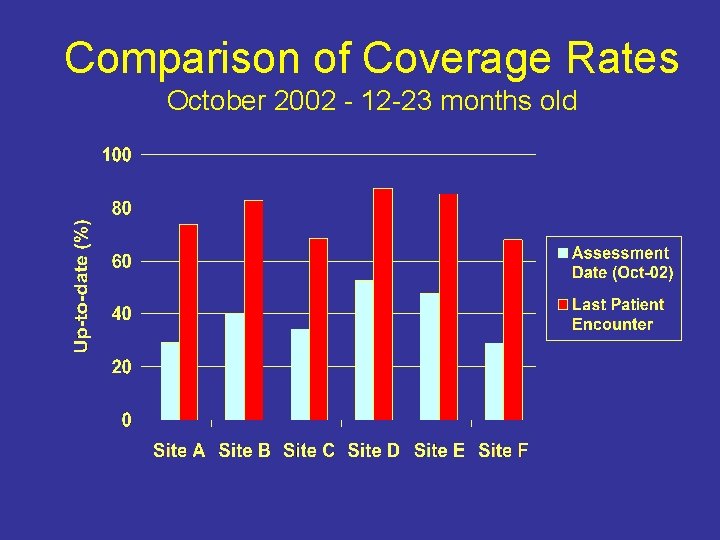
Comparison of Coverage Rates October 2002 - 12 -23 months old
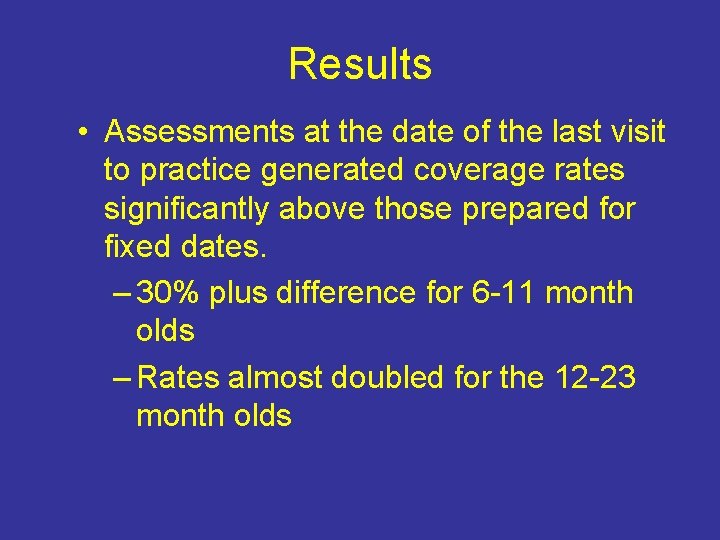
Results • Assessments at the date of the last visit to practice generated coverage rates significantly above those prepared for fixed dates. – 30% plus difference for 6 -11 month olds – Rates almost doubled for the 12 -23 month olds
Why different rates for the same children? • Fixed date assessments (CASA) have variable periods between last visit and assessment date • Registry includes children no longer active in the practice
Pros and Cons for Different Assessment Dates Fixed date • suitable for trend analysis • Allows for comparisons with nationwide data Last Encounter • snapshot for “best practices” • meaningful to the providers.
Strengths of Registry-based Assessments • All children are included • No bias toward frequent users • Includes immunizations given at other practices in the network • Quick and easy to program an assessment for any date
Weaknesses of Registrybased Assessments • Must explicitly exclude children no longer active in the practice • Still limited data on immunizations given out of network
Implications Registry-based assessments at an assessment date and at last patient encounter offer complementary perspectives on vaccine delivery and documentation that can guide registry quality improvement.
- Slides: 18