
Registration T11 Computer Vision University of Ioannina Christophoros
- Slides: 27
Registration T-11 Computer Vision University of Ioannina Christophoros Nikou Images and slides from: James Hayes, Brown University, Computer Vision course D. Forsyth and J. Ponce. Computer Vision: A Modern Approach, Prentice Hall, 2003. Computer Vision course by Svetlana Lazebnik, University of North Carolina at Chapel Hill. Computer Vision course by Kristen Grauman, University of Texas at Austin.
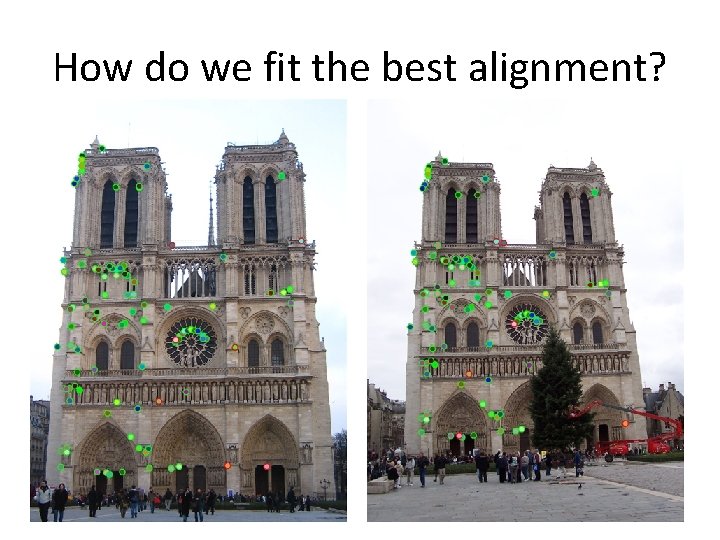
How do we fit the best alignment?
Alignment-Registration • Estimate parameters of model that maps one set of points to another • Typically want to solve for a global transformation that accounts for *most* true correspondences • Difficulties – Noise (typically 1 -3 pixels) – Outliers (often 50%) – Many-to-one matches or multiple objects
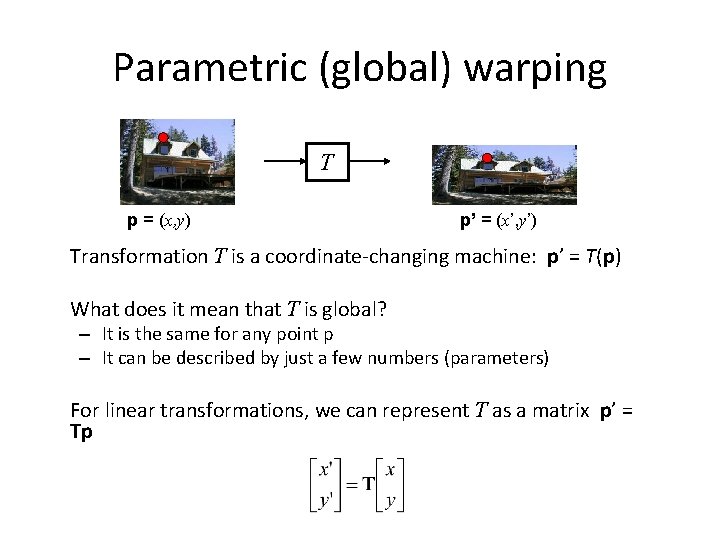
Parametric (global) warping T p = (x, y) p’ = (x’, y’) Transformation T is a coordinate-changing machine: p’ = T(p) What does it mean that T is global? – It is the same for any point p – It can be described by just a few numbers (parameters) For linear transformations, we can represent T as a matrix p’ = Tp
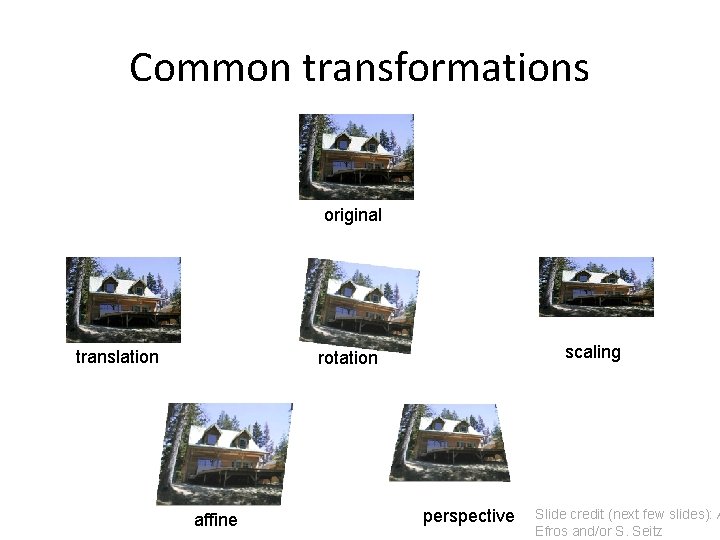
Common transformations original translation scaling rotation affine perspective Slide credit (next few slides): A Efros and/or S. Seitz
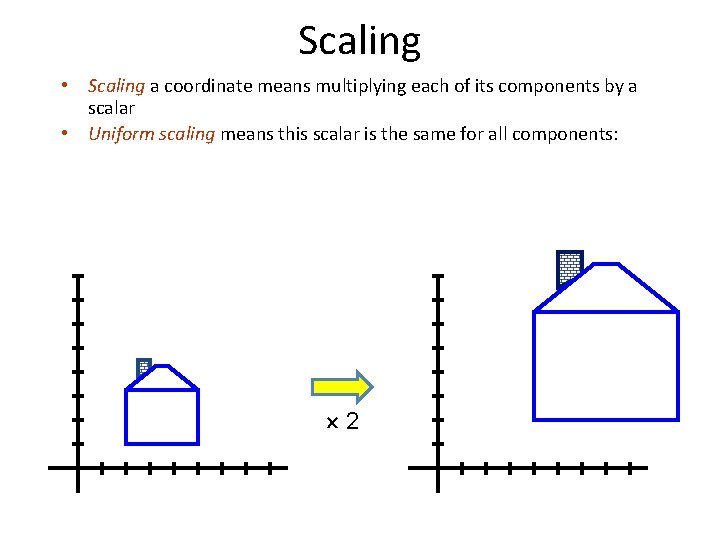
Scaling • Scaling a coordinate means multiplying each of its components by a scalar • Uniform scaling means this scalar is the same for all components: 2
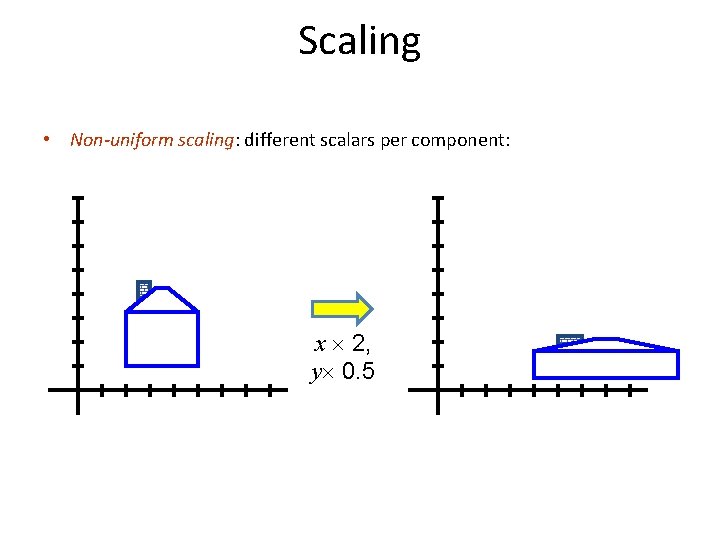
Scaling • Non-uniform scaling: different scalars per component: x 2, y 0. 5
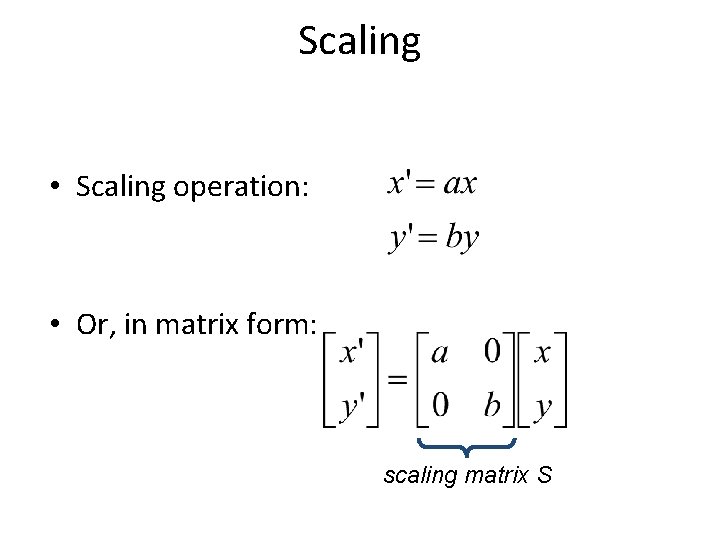
Scaling • Scaling operation: • Or, in matrix form: scaling matrix S
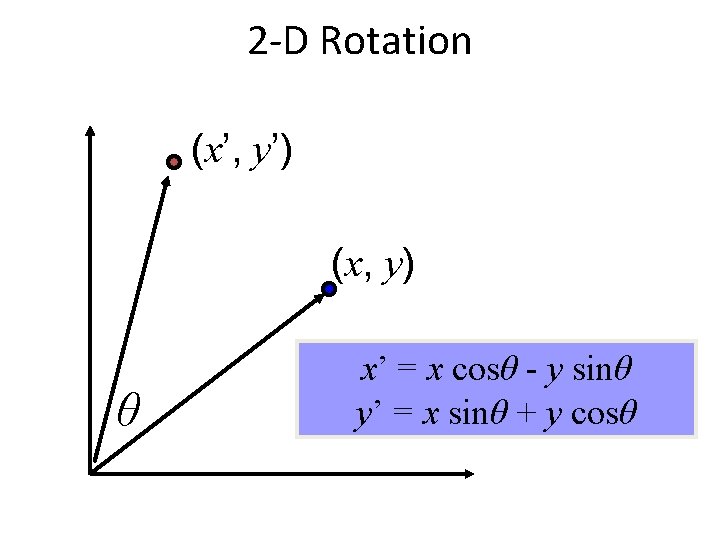
2 -D Rotation (x’, y’) (x, y) θ x’ = x cosθ - y sinθ y’ = x sinθ + y cosθ
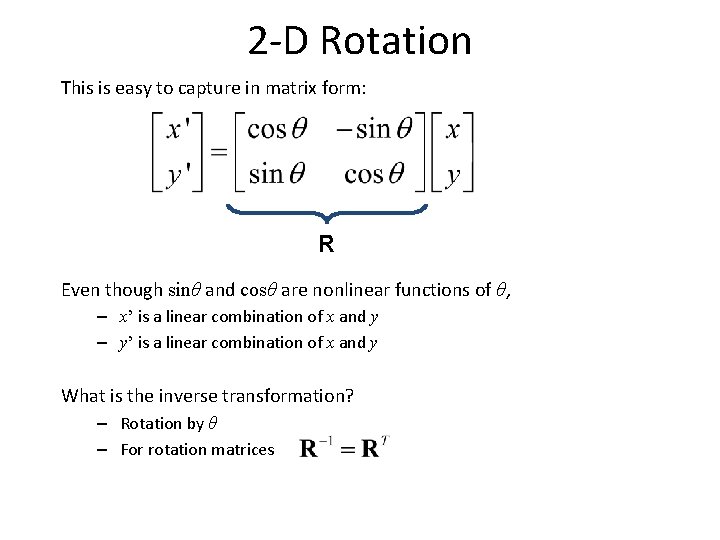
2 -D Rotation This is easy to capture in matrix form: R Even though sinθ and cosθ are nonlinear functions of θ, – x’ is a linear combination of x and y – y’ is a linear combination of x and y What is the inverse transformation? – Rotation by θ – For rotation matrices
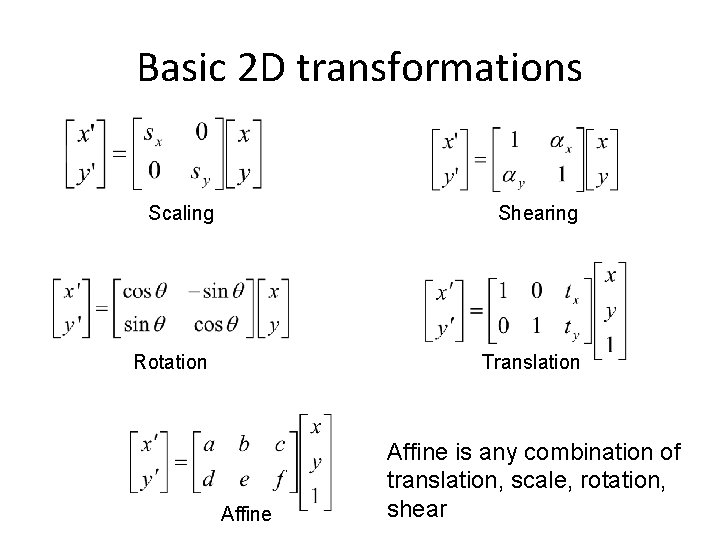
Basic 2 D transformations Scaling Shearing Rotation Translation Affine is any combination of translation, scale, rotation, shear
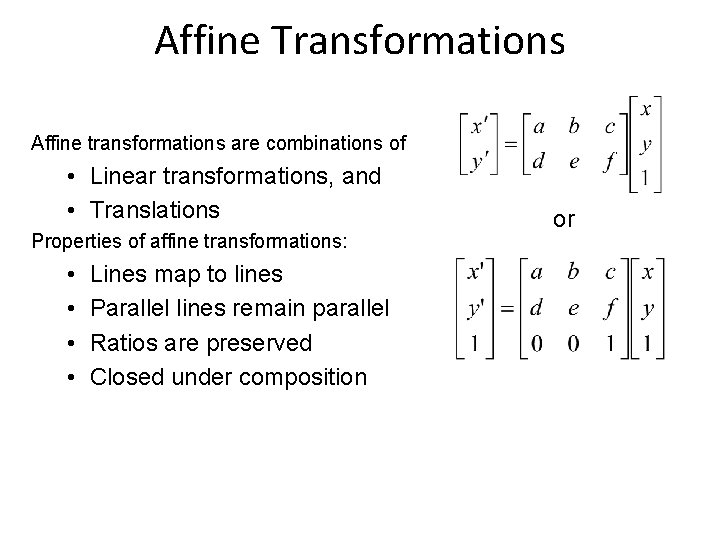
Affine Transformations Affine transformations are combinations of • Linear transformations, and • Translations Properties of affine transformations: • • Lines map to lines Parallel lines remain parallel Ratios are preserved Closed under composition or
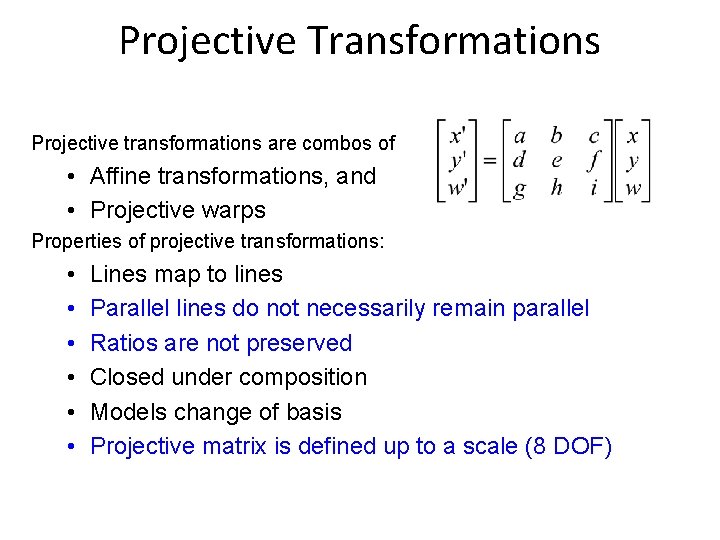
Projective Transformations Projective transformations are combos of • Affine transformations, and • Projective warps Properties of projective transformations: • • • Lines map to lines Parallel lines do not necessarily remain parallel Ratios are not preserved Closed under composition Models change of basis Projective matrix is defined up to a scale (8 DOF)
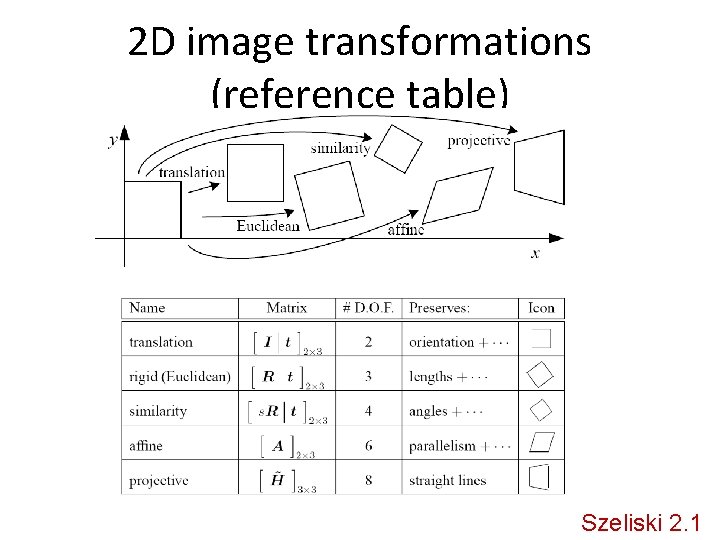
2 D image transformations (reference table) Szeliski 2. 1
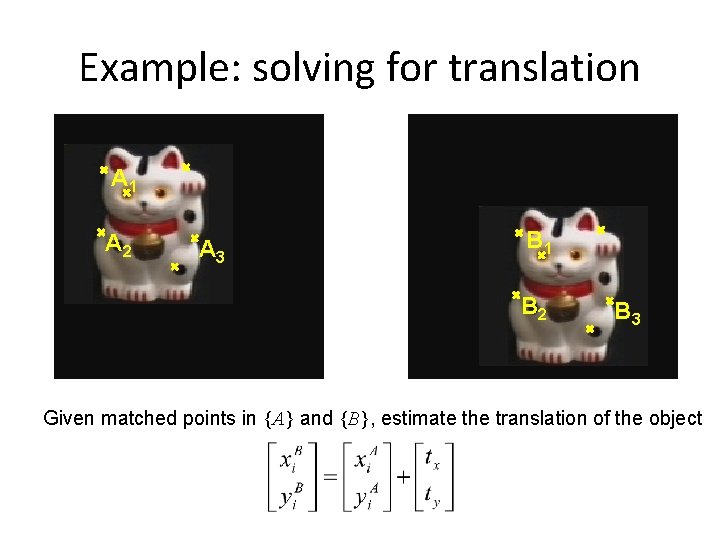
Example: solving for translation A 1 A 2 A 3 B 1 B 2 B 3 Given matched points in {A} and {B}, estimate the translation of the object
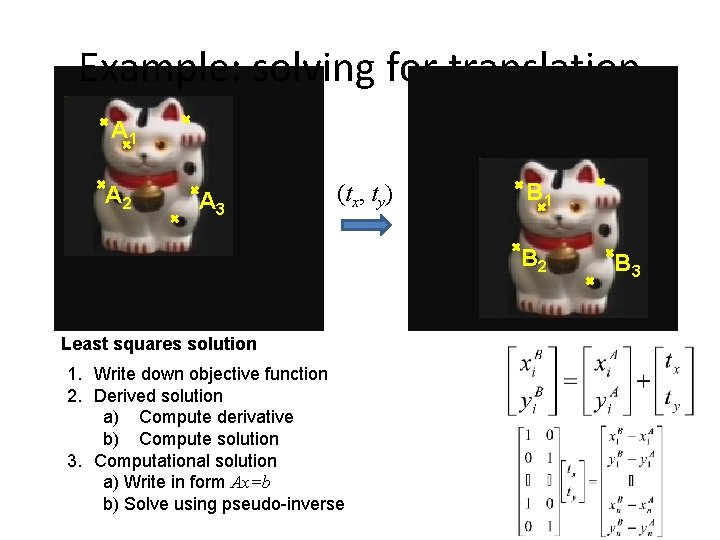
Example: solving for translation A 1 A 2 A 3 (tx, ty) B 1 B 2 Least squares solution 1. Write down objective function 2. Derived solution a) Compute derivative b) Compute solution 3. Computational solution a) Write in form Ax=b b) Solve using pseudo-inverse B 3
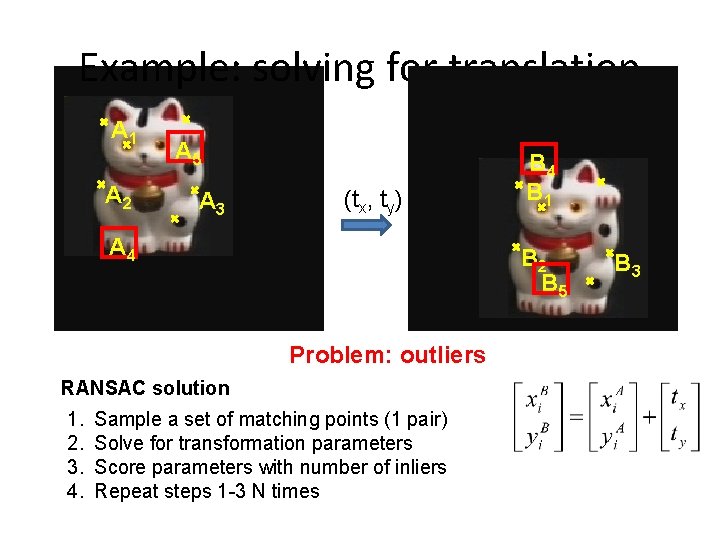
Example: solving for translation A 1 A 2 A 5 A 3 (tx, ty) A 4 B 2 B 5 Problem: outliers RANSAC solution 1. 2. 3. 4. B 4 B 1 Sample a set of matching points (1 pair) Solve for transformation parameters Score parameters with number of inliers Repeat steps 1 -3 N times B 3
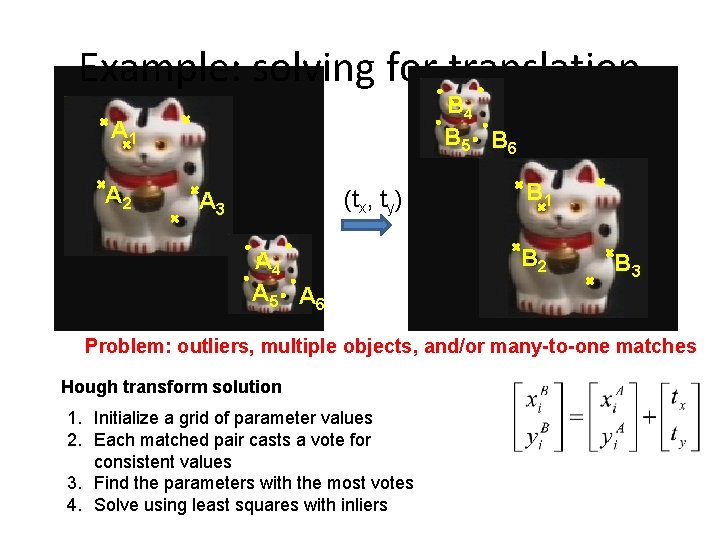
Example: solving for translation B 4 B 5 B 6 A 1 A 2 (tx, ty) A 3 A 4 A 5 A 6 B 1 B 2 B 3 Problem: outliers, multiple objects, and/or many-to-one matches Hough transform solution 1. Initialize a grid of parameter values 2. Each matched pair casts a vote for consistent values 3. Find the parameters with the most votes 4. Solve using least squares with inliers
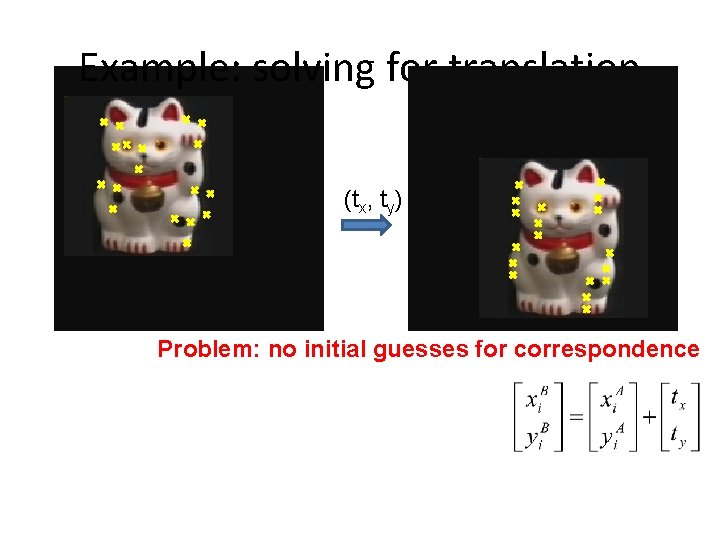
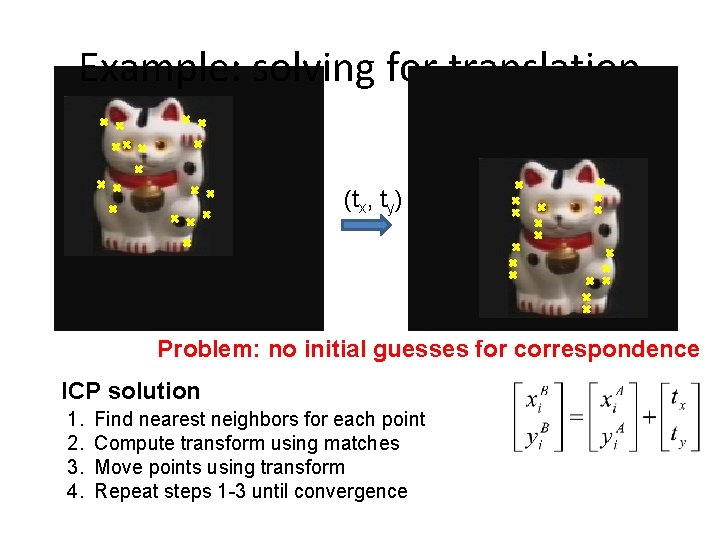
Example: solving for translation (tx, ty) Problem: no initial guesses for correspondence
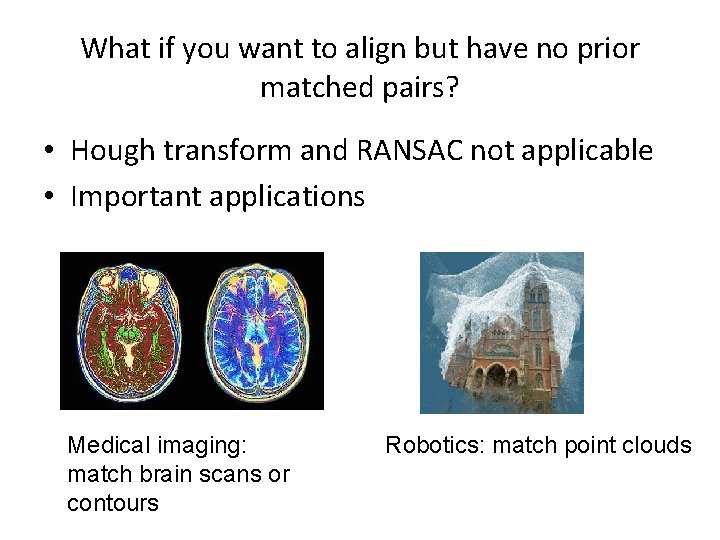
What if you want to align but have no prior matched pairs? • Hough transform and RANSAC not applicable • Important applications Medical imaging: match brain scans or contours Robotics: match point clouds
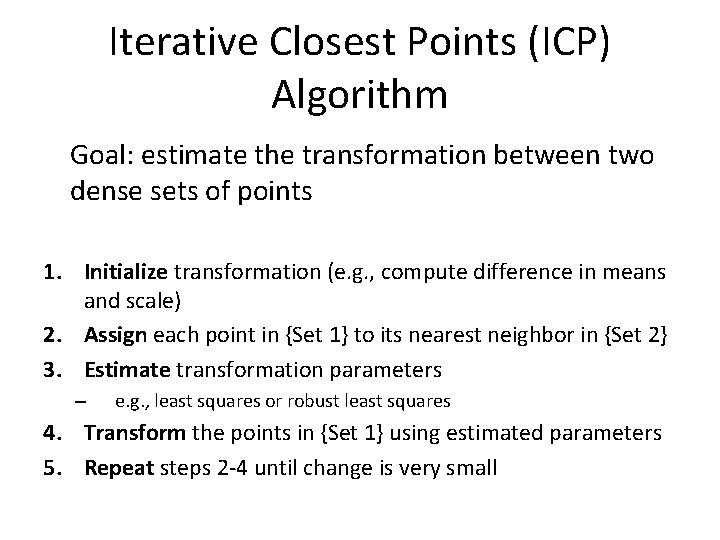
Iterative Closest Points (ICP) Algorithm Goal: estimate the transformation between two dense sets of points 1. Initialize transformation (e. g. , compute difference in means and scale) 2. Assign each point in {Set 1} to its nearest neighbor in {Set 2} 3. Estimate transformation parameters – e. g. , least squares or robust least squares 4. Transform the points in {Set 1} using estimated parameters 5. Repeat steps 2 -4 until change is very small
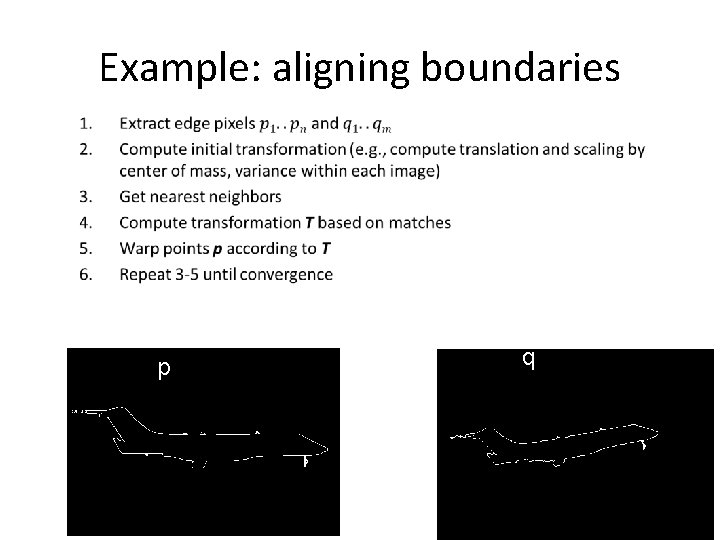
Example: aligning boundaries • p q
Example: solving for translation (tx, ty) Problem: no initial guesses for correspondence ICP solution 1. 2. 3. 4. Find nearest neighbors for each point Compute transform using matches Move points using transform Repeat steps 1 -3 until convergence
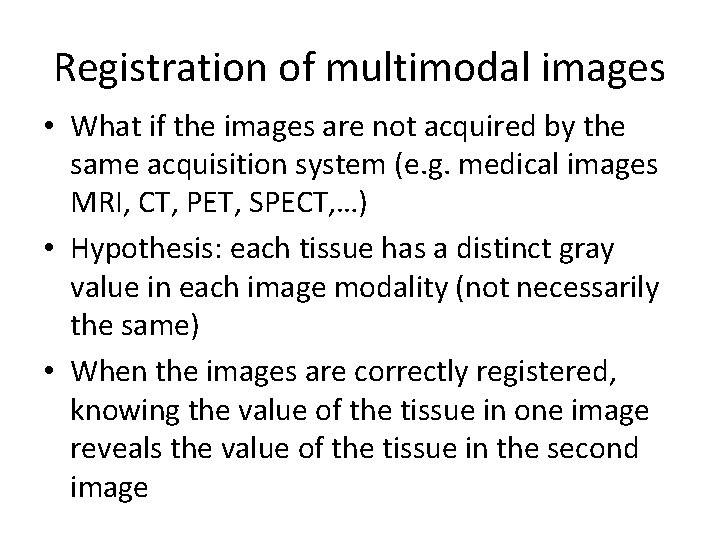
Registration of multimodal images • What if the images are not acquired by the same acquisition system (e. g. medical images MRI, CT, PET, SPECT, …) • Hypothesis: each tissue has a distinct gray value in each image modality (not necessarily the same) • When the images are correctly registered, knowing the value of the tissue in one image reveals the value of the tissue in the second image
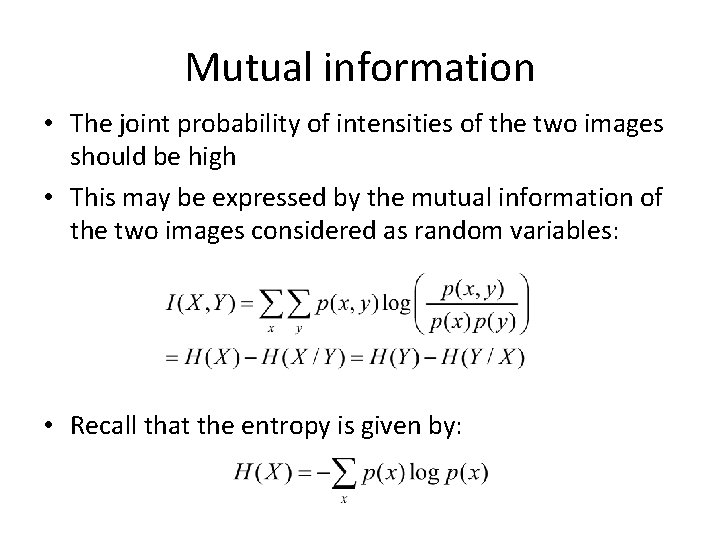
Mutual information • The joint probability of intensities of the two images should be high • This may be expressed by the mutual information of the two images considered as random variables: • Recall that the entropy is given by:
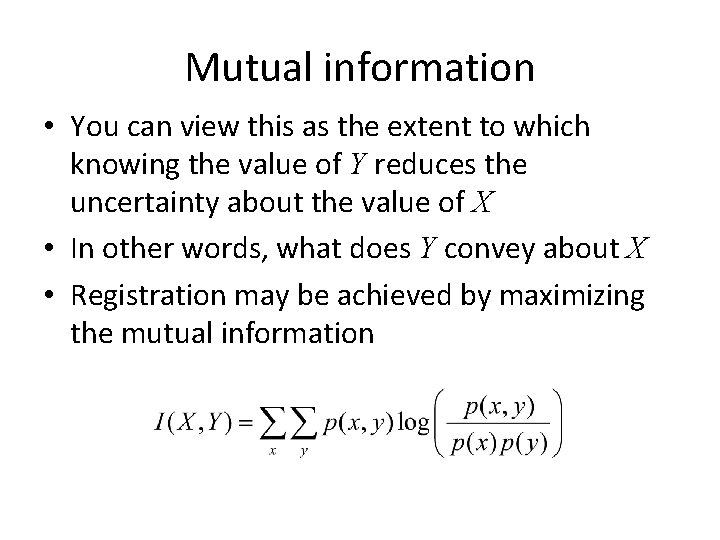
Mutual information • You can view this as the extent to which knowing the value of Y reduces the uncertainty about the value of X • In other words, what does Y convey about X • Registration may be achieved by maximizing the mutual information
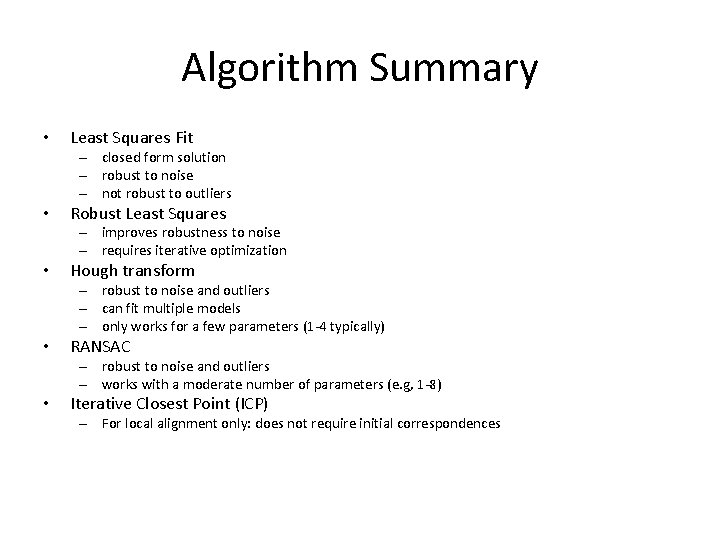
Algorithm Summary • Least Squares Fit – closed form solution – robust to noise – not robust to outliers • Robust Least Squares – improves robustness to noise – requires iterative optimization • Hough transform – robust to noise and outliers – can fit multiple models – only works for a few parameters (1 -4 typically) • RANSAC – robust to noise and outliers – works with a moderate number of parameters (e. g, 1 -8) • Iterative Closest Point (ICP) – For local alignment only: does not require initial correspondences