
Register Variables Declaring a variable as a register
Register Variables • Declaring a variable as a "register" variable is an advisory to the compiler to keep the normal location of the variable in a register, if possible • Gives extra speed for frequently modified variables. • There a limited number of registers in machine (where arithmetic is usually performed -- have to load register from memory location of variable, perform increment/decrement, store value back). • Undefined (i. e. garbage) value unless explicitly initialized in the source code
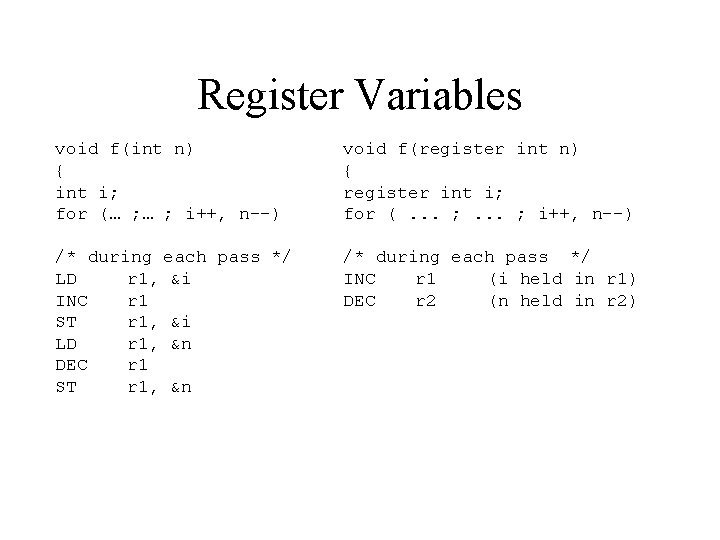
Register Variables void f(int n) { int i; for (… ; i++, n--) void f(register int n) { register int i; for (. . . ; i++, n--) /* during each pass */ LD r 1, &i INC r 1 ST r 1, &i LD r 1, &n DEC r 1 ST r 1, &n /* during each pass */ INC r 1 (i held in r 1) DEC r 2 (n held in r 2)
Register Variables • Advisory only, because number of registers is quite limited, and only in creating the code is it clear what is best. Still, it usually works. • A static variable cannot be register type (use register for all time). Can only have automatic variables and formal function parameters (treated like local variables) as register variables. • A pointer points to a position in memory. If n is a register variable, can't use “address of” &n!
C Preprocessor • Inclusion of other files – usually. h files #include “filename. h” • Simple macro substitution #define name substitute text • Macro substitution with arguments #define square(A) ((A)*(A)) enclose in ( )s n = square(x) + 1; n = ((x)*(x)) + 1; • Conditional inclusion
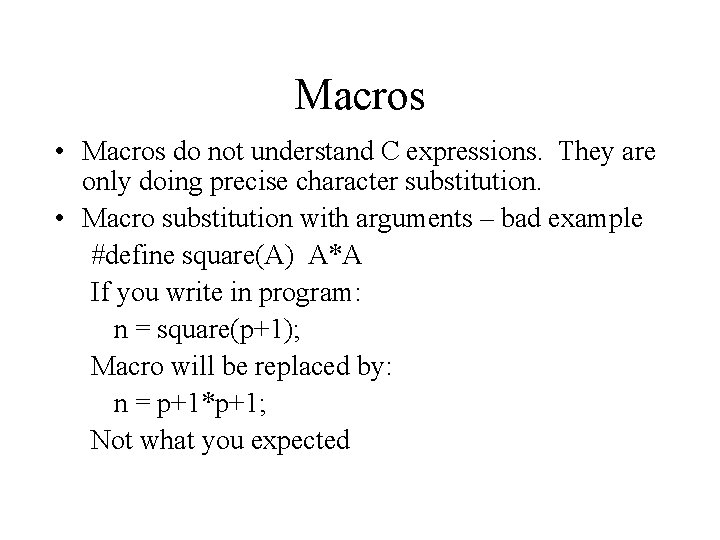
Macros • Macros do not understand C expressions. They are only doing precise character substitution. • Macro substitution with arguments – bad example #define square(A) A*A If you write in program: n = square(p+1); Macro will be replaced by: n = p+1*p+1; Not what you expected
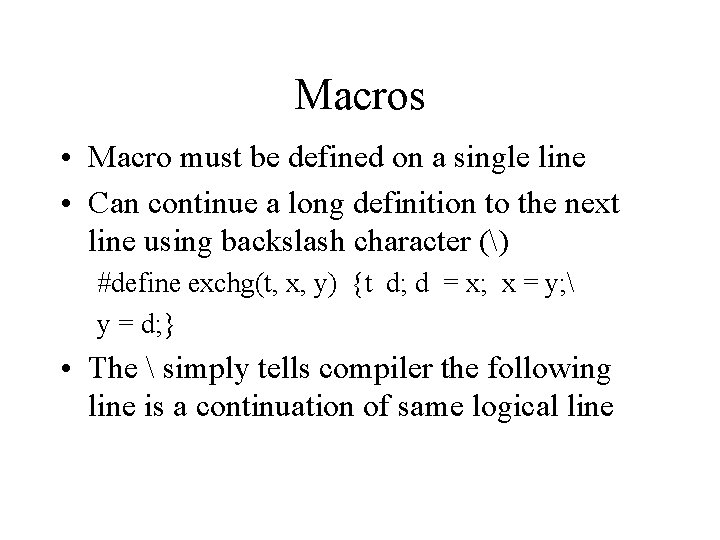
Macros • Macro must be defined on a single line • Can continue a long definition to the next line using backslash character () #define exchg(t, x, y) {t d; d = x; x = y; y = d; } • The simply tells compiler the following line is a continuation of same logical line
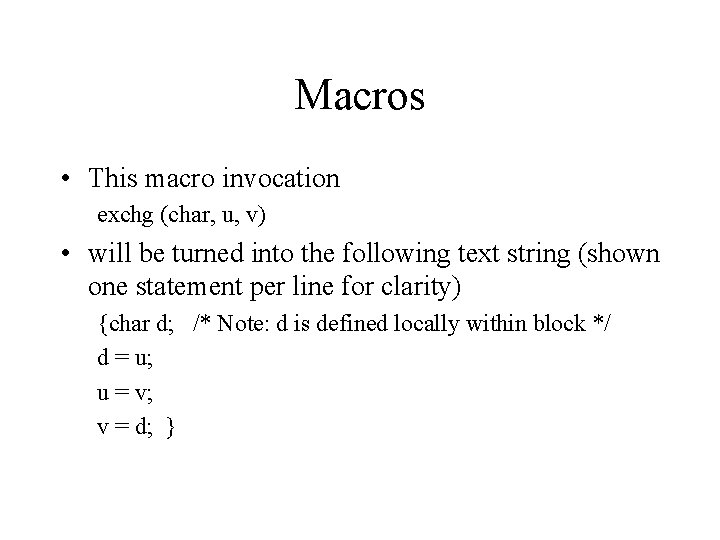
Macros • This macro invocation exchg (char, u, v) • will be turned into the following text string (shown one statement per line for clarity) {char d; /* Note: d is defined locally within block */ d = u; u = v; v = d; }
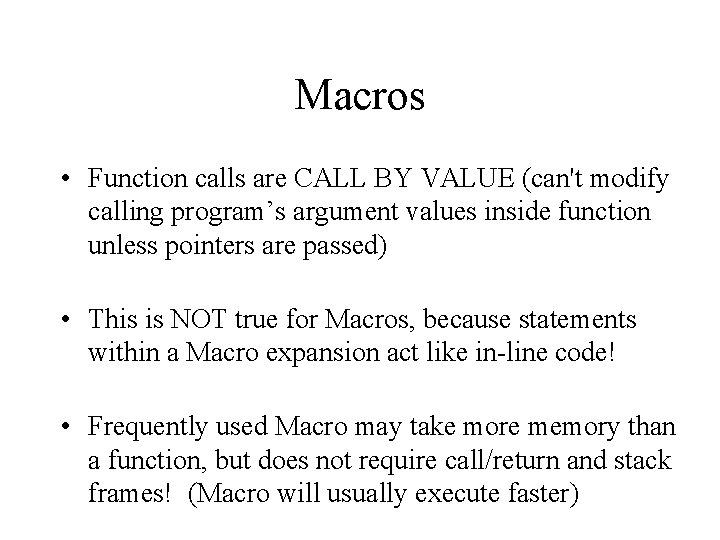
Macros • Function calls are CALL BY VALUE (can't modify calling program’s argument values inside function unless pointers are passed) • This is NOT true for Macros, because statements within a Macro expansion act like in-line code! • Frequently used Macro may take more memory than a function, but does not require call/return and stack frames! (Macro will usually execute faster)
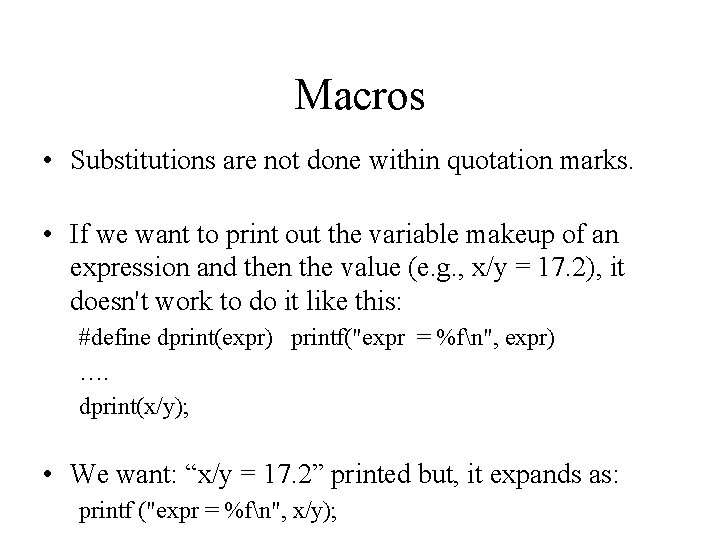
Macros • Substitutions are not done within quotation marks. • If we want to print out the variable makeup of an expression and then the value (e. g. , x/y = 17. 2), it doesn't work to do it like this: #define dprint(expr) printf("expr = %fn", expr) …. dprint(x/y); • We want: “x/y = 17. 2” printed but, it expands as: printf ("expr = %fn", x/y);
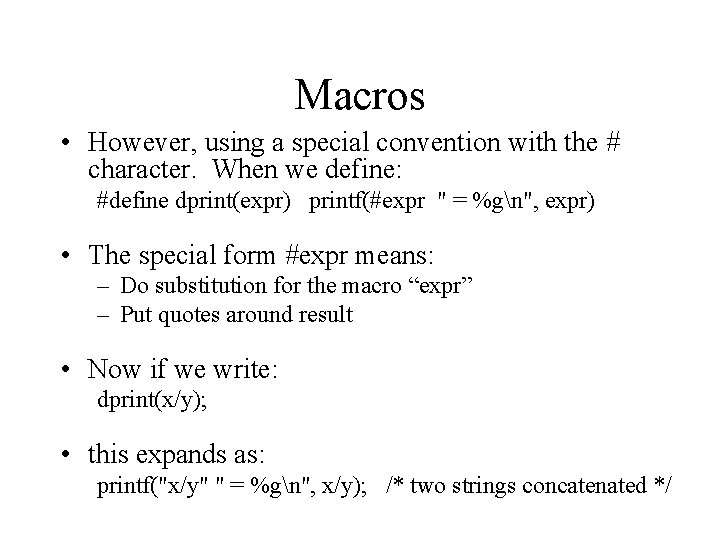
Macros • However, using a special convention with the # character. When we define: #define dprint(expr) printf(#expr " = %gn", expr) • The special form #expr means: – Do substitution for the macro “expr” – Put quotes around result • Now if we write: dprint(x/y); • this expands as: printf("x/y" " = %gn", x/y); /* two strings concatenated */
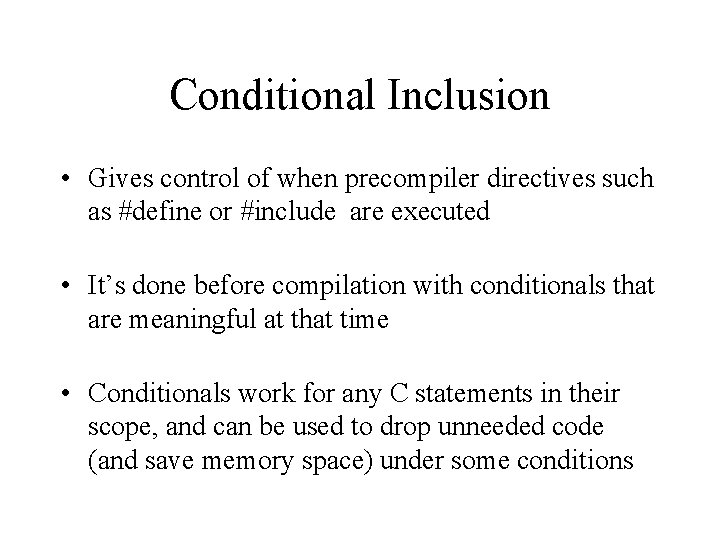
Conditional Inclusion • Gives control of when precompiler directives such as #define or #include are executed • It’s done before compilation with conditionals that are meaningful at that time • Conditionals work for any C statements in their scope, and can be used to drop unneeded code (and save memory space) under some conditions
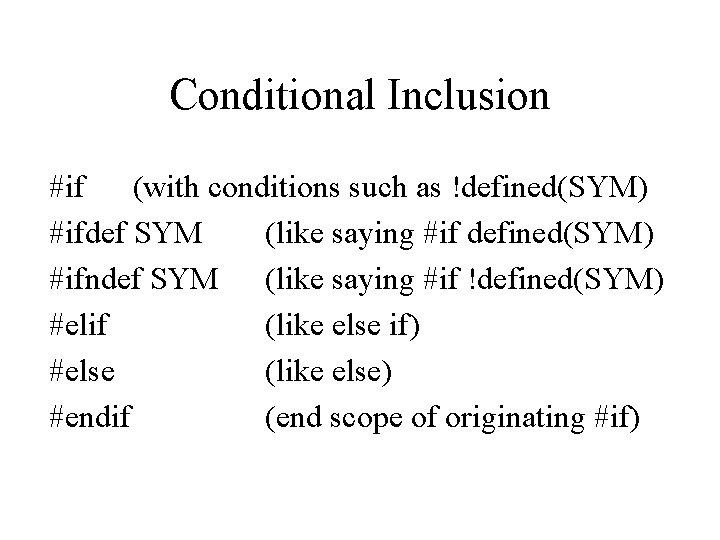
Conditional Inclusion #if (with conditions such as !defined(SYM) #ifdef SYM (like saying #if defined(SYM) #ifndef SYM (like saying #if !defined(SYM) #elif (like else if) #else (like else) #endif (end scope of originating #if)
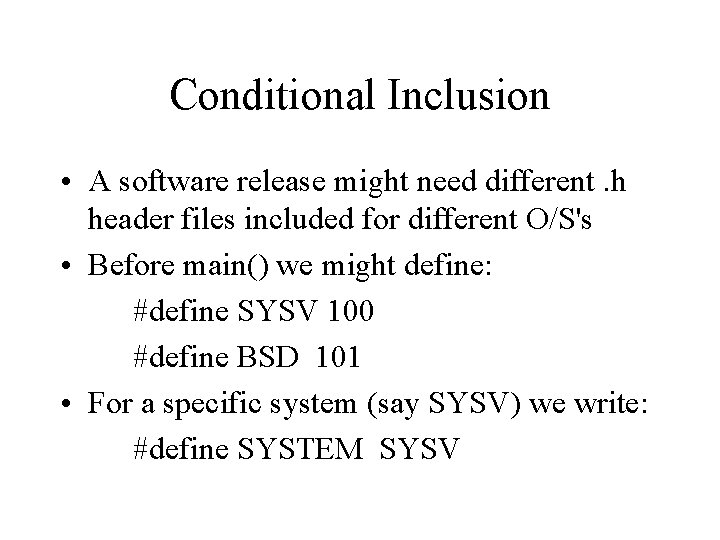
Conditional Inclusion • A software release might need different. h header files included for different O/S's • Before main() we might define: #define SYSV 100 #define BSD 101 • For a specific system (say SYSV) we write: #define SYSTEM SYSV
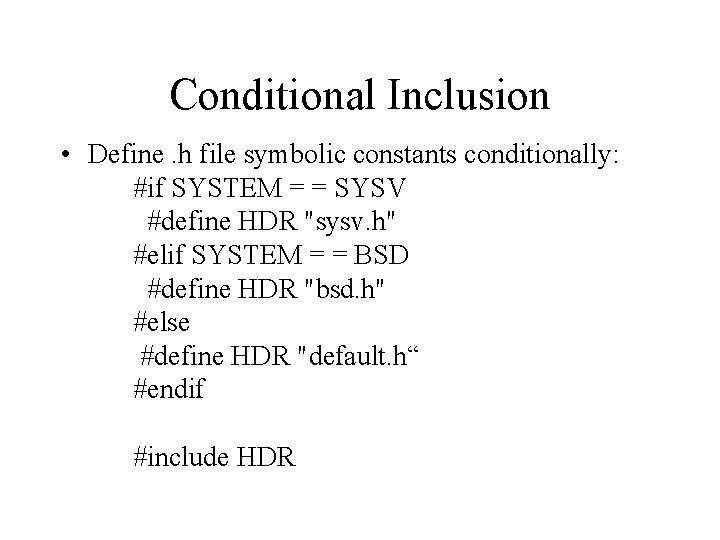
Conditional Inclusion • Define. h file symbolic constants conditionally: #if SYSTEM = = SYSV #define HDR "sysv. h" #elif SYSTEM = = BSD #define HDR "bsd. h" #else #define HDR "default. h“ #endif #include HDR
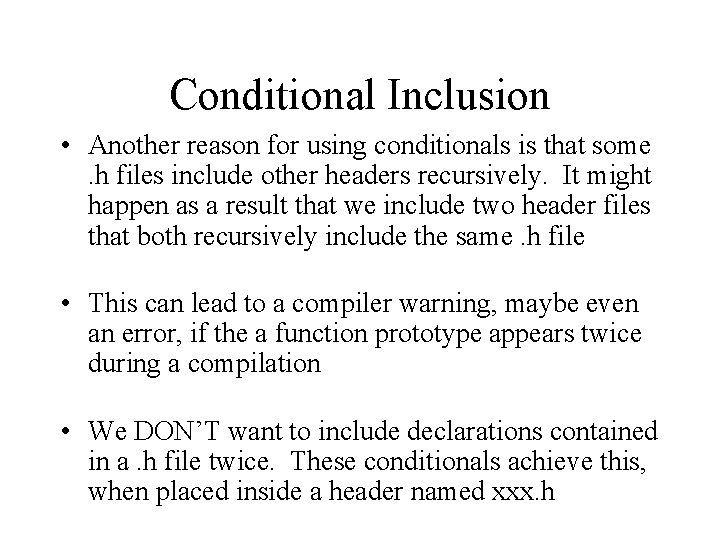
Conditional Inclusion • Another reason for using conditionals is that some. h files include other headers recursively. It might happen as a result that we include two header files that both recursively include the same. h file • This can lead to a compiler warning, maybe even an error, if the a function prototype appears twice during a compilation • We DON’T want to include declarations contained in a. h file twice. These conditionals achieve this, when placed inside a header named xxx. h
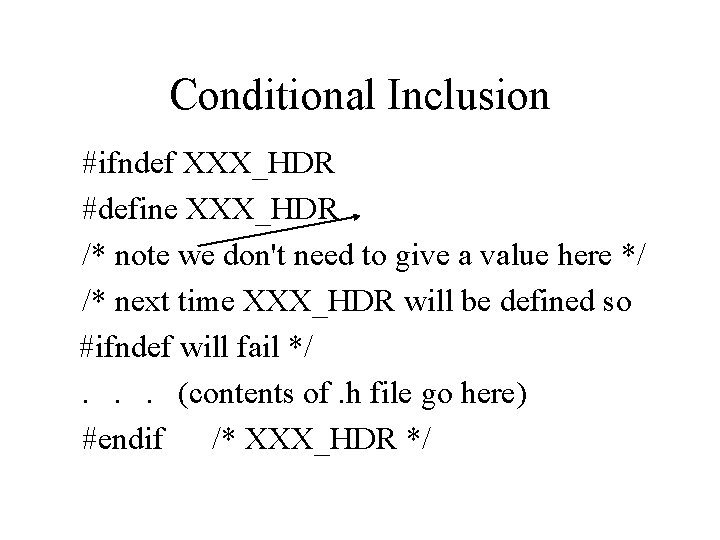
Conditional Inclusion #ifndef XXX_HDR #define XXX_HDR /* note we don't need to give a value here */ /* next time XXX_HDR will be defined so #ifndef will fail */. . . (contents of. h file go here) #endif /* XXX_HDR */
- Slides: 16