
Register Transfer and Microoperations 1 Overview Register Transfer

- Slides: 8
Register Transfer and Micro-operations 1 Overview Ø Register Transfer Language Ø Register Transfer Ø Bus and Memory Transfers Ø Arithmetic Micro-operations Ø Logic Micro-operations Ø Shift Micro-operations Ø Arithmetic Logic Shift Unit CSE 211, Computer Organization and Architecture Lecture 10
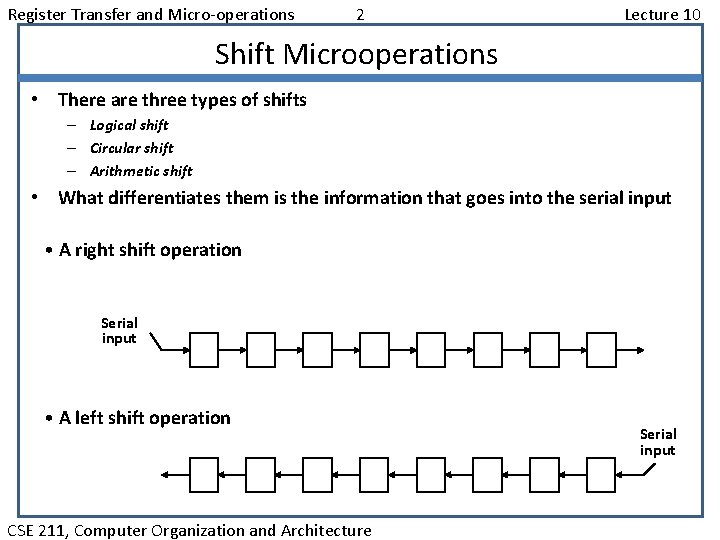
Register Transfer and Micro-operations 2 Lecture 10 Shift Microoperations • There are three types of shifts – Logical shift – Circular shift – Arithmetic shift • What differentiates them is the information that goes into the serial input • A right shift operation Serial input • A left shift operation CSE 211, Computer Organization and Architecture Serial input
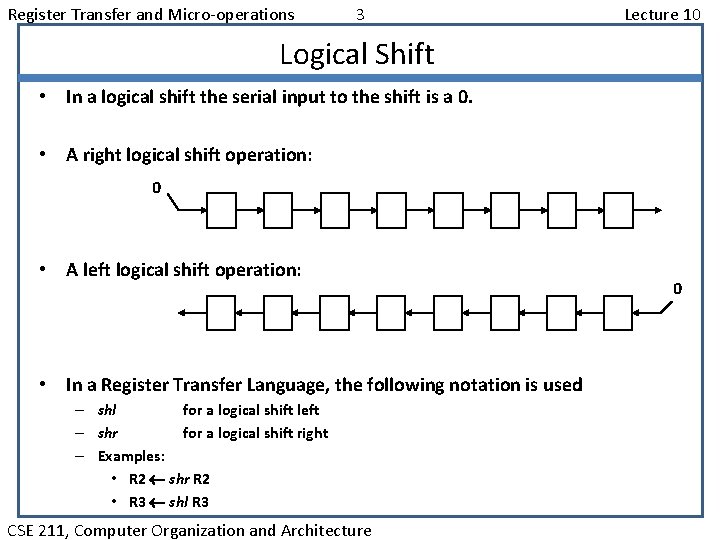
Register Transfer and Micro-operations 3 Lecture 10 Logical Shift • In a logical shift the serial input to the shift is a 0. • A right logical shift operation: 0 • A left logical shift operation: • In a Register Transfer Language, the following notation is used – shl for a logical shift left – shr for a logical shift right – Examples: • R 2 shr R 2 • R 3 shl R 3 CSE 211, Computer Organization and Architecture 0
Register Transfer and Micro-operations 4 Lecture 10 Circular Shift • In a circular shift the serial input is the bit that is shifted out of the other end of the register. • A right circular shift operation: • A left circular shift operation: • In a RTL, the following notation is used – cil for a circular shift left – cir for a circular shift right – Examples: • R 2 cir R 2 • R 3 cil R 3 CSE 211, Computer Organization and Architecture
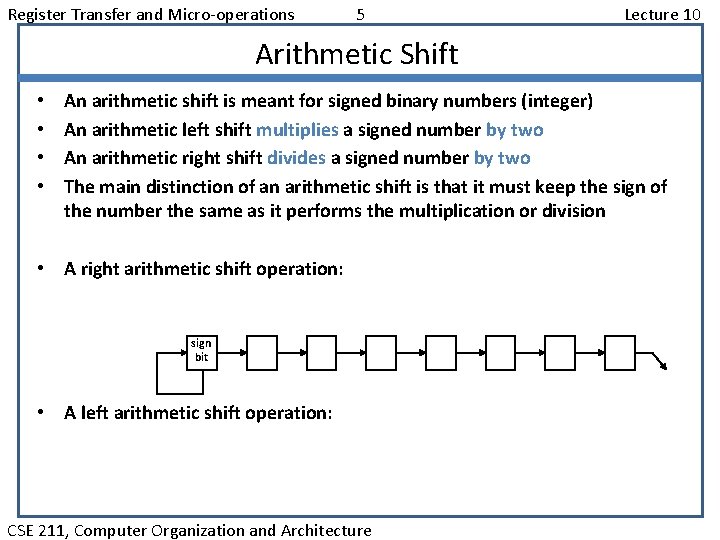
Register Transfer and Micro-operations 5 Lecture 10 Arithmetic Shift • • An arithmetic shift is meant for signed binary numbers (integer) An arithmetic left shift multiplies a signed number by two An arithmetic right shift divides a signed number by two The main distinction of an arithmetic shift is that it must keep the sign of the number the same as it performs the multiplication or division • A right arithmetic shift operation: sign bit • A left arithmetic shift operation: CSE 211, Computer Organization and Architecture
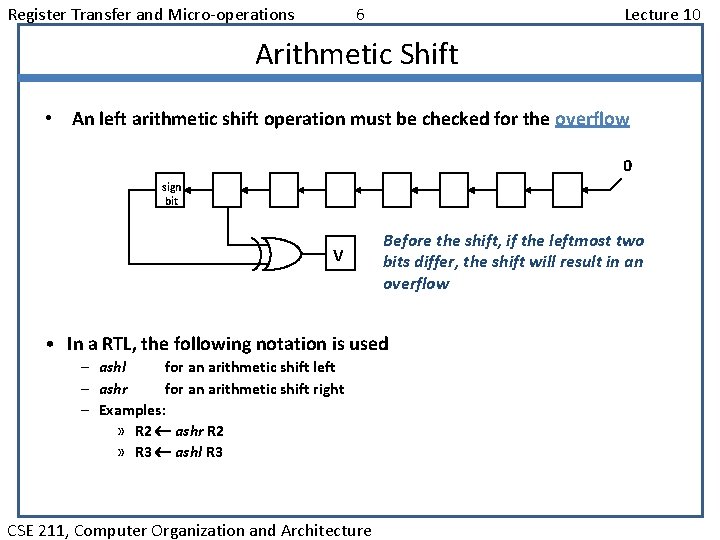
Register Transfer and Micro-operations 6 Lecture 10 Arithmetic Shift • An left arithmetic shift operation must be checked for the overflow 0 sign bit V Before the shift, if the leftmost two bits differ, the shift will result in an overflow • In a RTL, the following notation is used – ashl for an arithmetic shift left – ashr for an arithmetic shift right – Examples: » R 2 ashr R 2 » R 3 ashl R 3 CSE 211, Computer Organization and Architecture
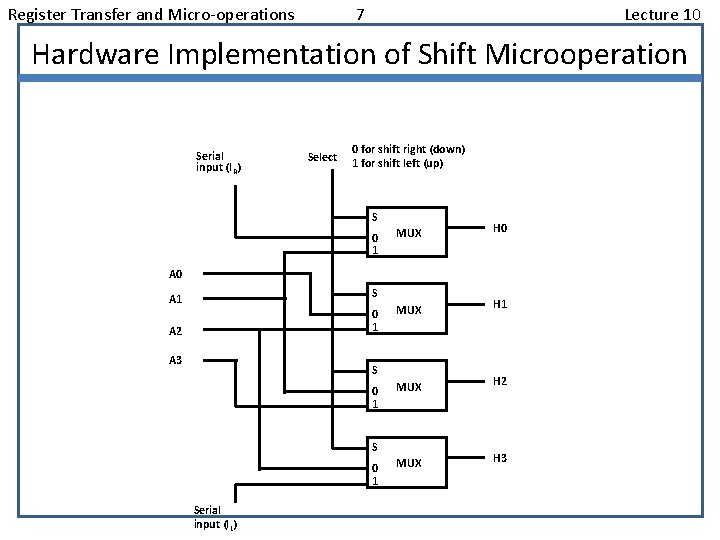
Register Transfer and Micro-operations 7 Lecture 10 Hardware Implementation of Shift Microoperation Serial input (IR) Select 0 for shift right (down) 1 for shift left (up) S 0 1 MUX H 0 MUX H 1 MUX H 2 MUX H 3 A 0 A 1 S A 2 0 1 A 3 S 0 1 Serial input (IL)
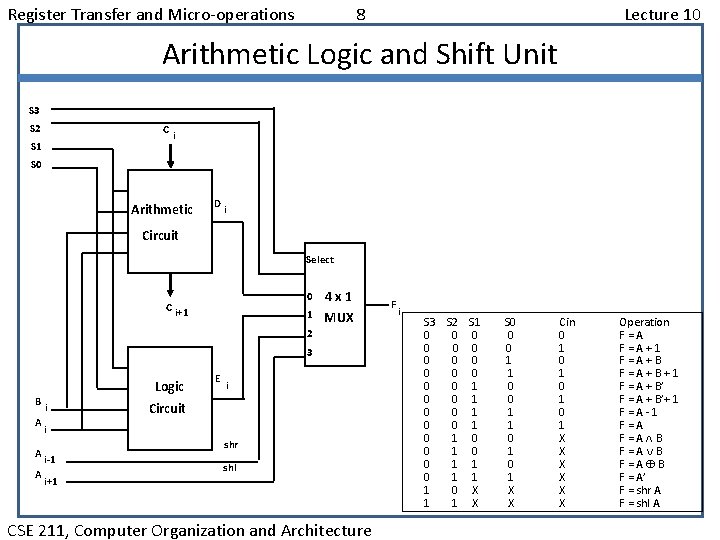
Register Transfer and Micro-operations 8 Lecture 10 Arithmetic Logic and Shift Unit S 3 S 2 C S 1 i S 0 Arithmetic D i Circuit Select C i+1 0 4 x 1 1 MUX 2 3 Logic Bi A A A E i Circuit i shr i-1 shl i+1 CSE 211, Computer Organization and Architecture F i S 3 S 2 S 1 0 0 0 0 1 0 0 1 0 0 1 1 1 0 X 1 1 X S 0 0 0 1 1 0 1 X X Cin 0 1 0 1 X X X Operation F=A+1 F=A+B+1 F = A + B’+ 1 F=A-1 F=A B F = A B F=A B F = A’ F = shr A F = shl A