
Regional updates Measles and Rubella Laboratory network in
Regional updates: Measles and Rubella Laboratory network in the South East Asia The 14 th Global Measles and Rubella Laboratory Network Meeting Geneva, 21 June 2016 Sirima Pattamadilok IVD WHO SEARO
Regional Measles and Rubella Goals 66 th Meeting of the SEAR Regional Committee in September 2013 in New Delhi resolved to adopt the goal of measles elimination and rubella/CRS control in the South-East Asia Region by 2020 1655 days remaining 2
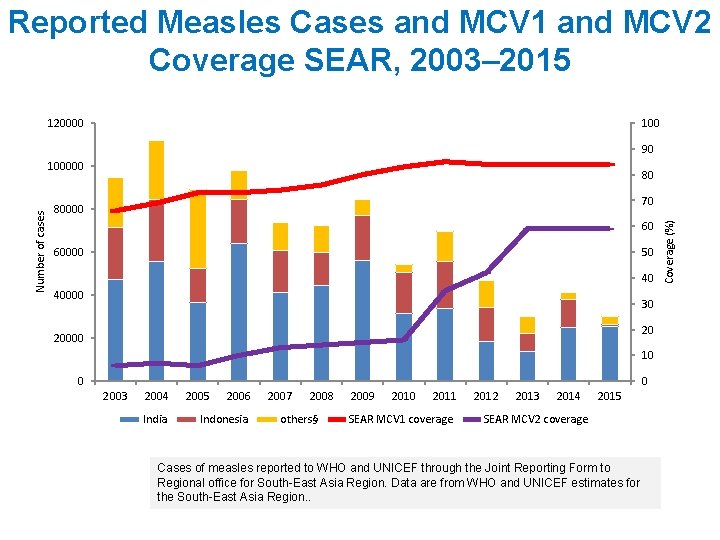
Reported Measles Cases and MCV 1 and MCV 2 Coverage SEAR, 2003– 2015 120000 100 90 80 70 80000 60 60000 50 40 40000 30 20 20000 10 0 0 2003 2004 India 2005 2006 Indonesia 2007 2008 others§ 2009 2010 2011 SEAR MCV 1 coverage 2012 2013 2014 2015 SEAR MCV 2 coverage Cases of measles reported to WHO and UNICEF through the Joint Reporting Form to Regional office for South-East Asia Region. Data are from WHO and UNICEF estimates for the South-East Asia Region. . Coverage (%) Number of cases 100000
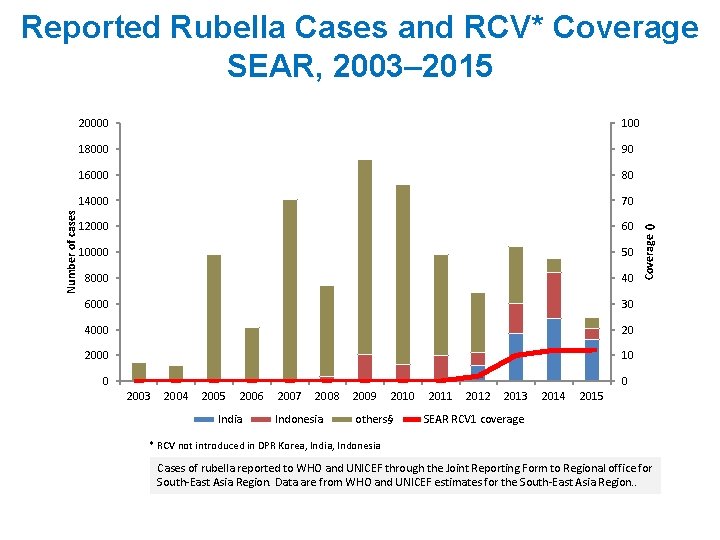
20000 18000 90 16000 80 14000 70 12000 60 10000 50 8000 40 6000 30 4000 20 2000 10 0 Coverage () Number of cases Reported Rubella Cases and RCV* Coverage SEAR, 2003– 2015 0 2003 2004 2005 2006 India 2007 2008 Indonesia 2009 2010 others§ 2011 2012 2013 2014 2015 SEAR RCV 1 coverage * RCV not introduced in DPR Korea, India, Indonesia Cases of rubella reported to WHO and UNICEF through the Joint Reporting Form to Regional office for South-East Asia Region. Data are from WHO and UNICEF estimates for the South-East Asia Region. .
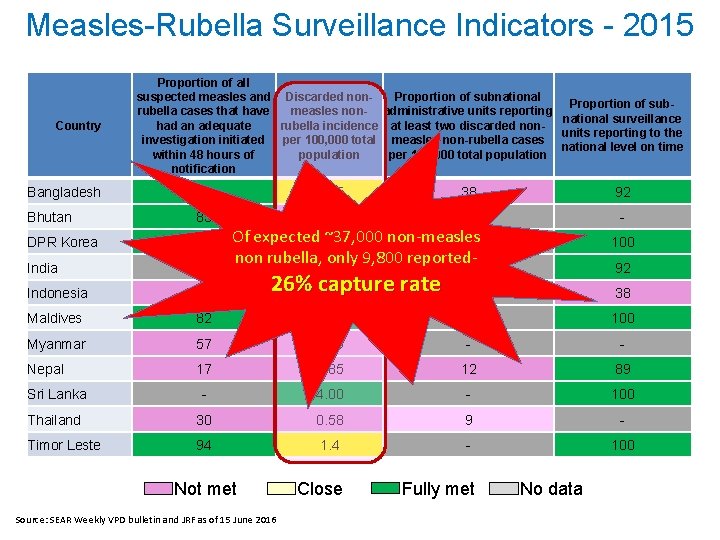
Measles-Rubella Surveillance Indicators - 2015 Country Proportion of all suspected measles and Discarded non. Proportion of subnational Proportion of subrubella cases that have measles non- administrative units reporting national surveillance had an adequate rubella incidence at least two discarded nonunits reporting to the investigation initiated per 100, 000 total measles non-rubella cases national level on time within 48 hours of population per 100, 000 total population notification Bangladesh 91 1. 85 38 92 Bhutan 83 0. 67 - - DPR Korea 96 India - Of expected ~37, 000 non-measles 0. 30 non rubella, only 9, 800 reported- 0. 38 26% capture rate 0. 62 100 - 92 - 38 Indonesia 44 Maldives 82 2. 34 - 100 Myanmar 57 0. 39 - - Nepal 17 0. 85 12 89 Sri Lanka - 4. 00 - 100 Thailand 30 0. 58 9 - Timor Leste 94 1. 4 - 100 Close Fully met Not met Source: SEAR Weekly VPD bulletin and JRF as of 15 June 2016 No data
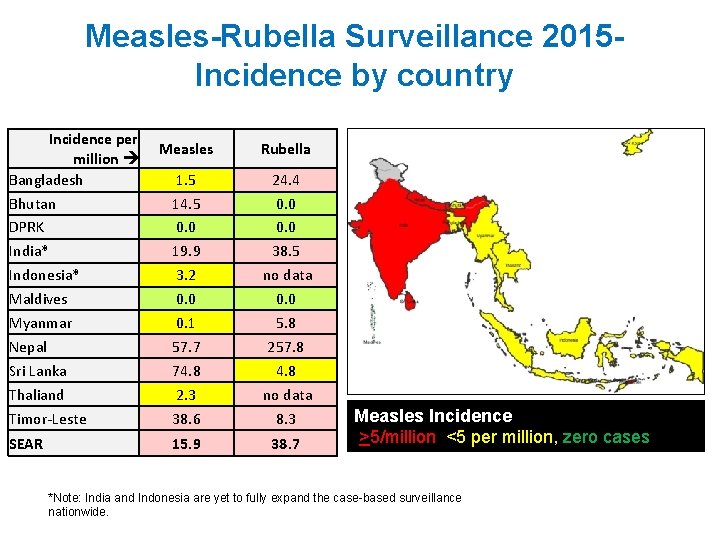
Measles-Rubella Surveillance 2015 Incidence by country Incidence per million Bangladesh Bhutan DPRK India* Indonesia* Maldives Myanmar Nepal Sri Lanka Thaliand Timor-Leste SEAR Measles Rubella 1. 5 14. 5 0. 0 19. 9 3. 2 0. 0 0. 1 57. 7 74. 8 2. 3 38. 6 24. 4 0. 0 38. 5 no data 0. 0 5. 8 257. 8 4. 8 no data 8. 3 15. 9 38. 7 Measles Incidence – >5/million; <5 per million, zero cases *Note: India and Indonesia are yet to fully expand the case-based surveillance nationwide.
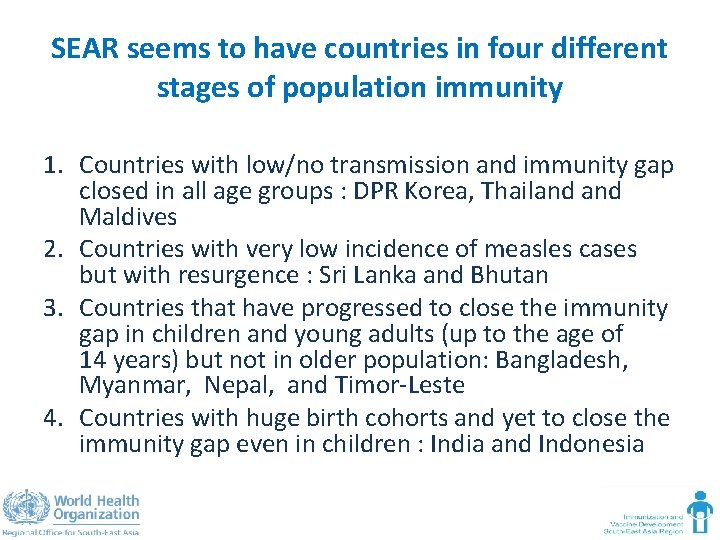
SEAR seems to have countries in four different stages of population immunity 1. Countries with low/no transmission and immunity gap closed in all age groups : DPR Korea, Thailand Maldives 2. Countries with very low incidence of measles cases but with resurgence : Sri Lanka and Bhutan 3. Countries that have progressed to close the immunity gap in children and young adults (up to the age of 14 years) but not in older population: Bangladesh, Myanmar, Nepal, and Timor-Leste 4. Countries with huge birth cohorts and yet to close the immunity gap even in children : India and Indonesia
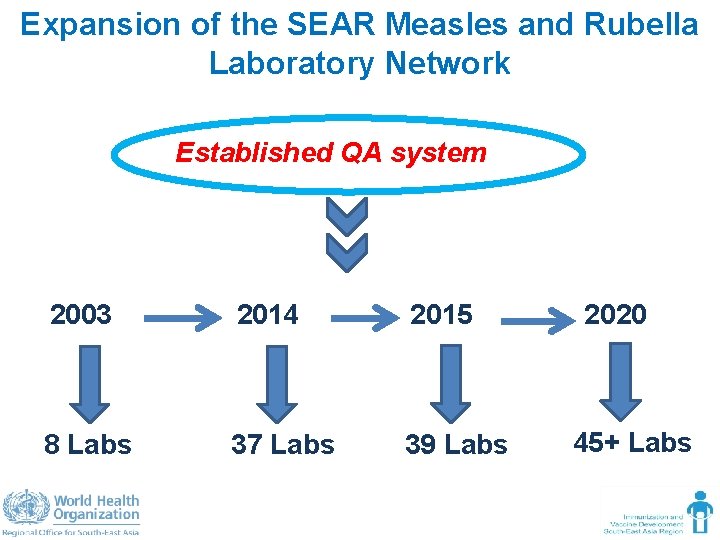
Expansion of the SEAR Measles and Rubella Laboratory Network Established QA system 2003 2014 2015 8 Labs 37 Labs 39 Labs 2020 45+ Labs
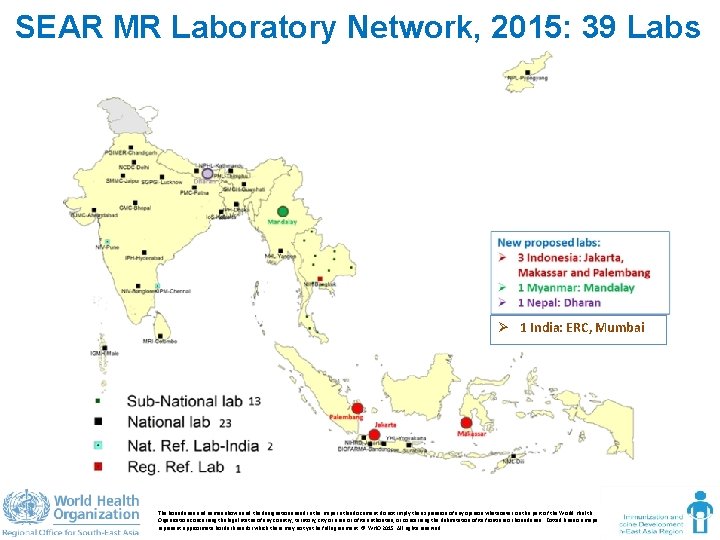
SEAR MR Laboratory Network, 2015: 39 Labs Ø 1 India: ERC, Mumbai The boundaries and names shown and the designations used in the maps in this document do not imply the expression of any opinion whatsoever on the part of the World Health Organization concerning the legal status of any country, territory, city or area or of its authorities, or concerning the delimitation of its frontiers or boundaries. Dotted lines on maps represent approximate border lines for which there may not yet be full agreement. WHO 2015. All rights reserved
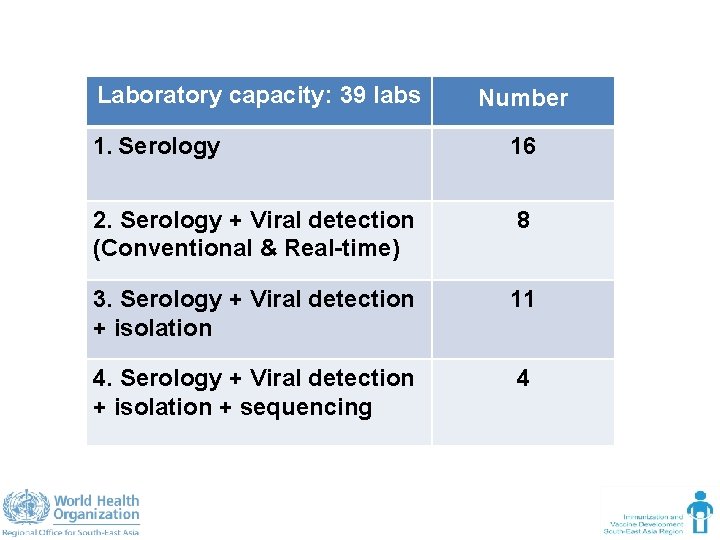
Laboratory capacity: 39 labs Number 1. Serology 16 2. Serology + Viral detection (Conventional & Real-time) 8 3. Serology + Viral detection + isolation 11 4. Serology + Viral detection + isolation + sequencing 4
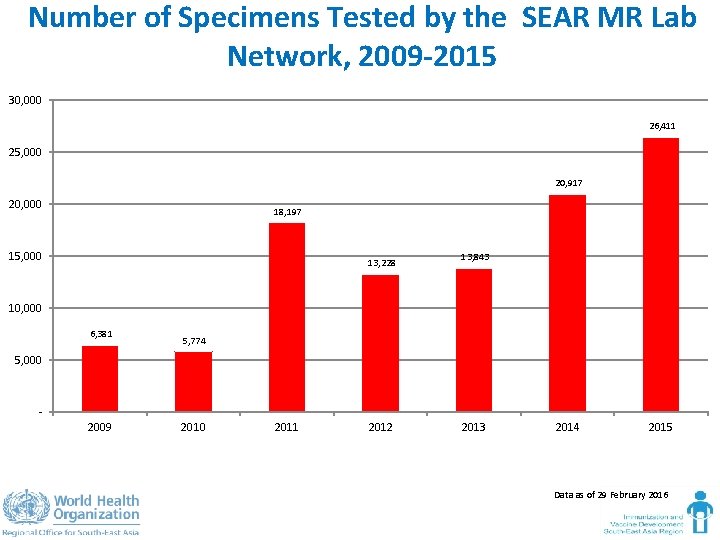
Number of Specimens Tested by the SEAR MR Lab Network, 2009 -2015 30, 000 26, 411 25, 000 20, 917 20, 000 18, 197 15, 000 13, 228 13, 843 10, 000 6, 381 5, 774 5, 000 2009 2010 2011 2012 2013 2014 2015 Data as of 29 February 2016
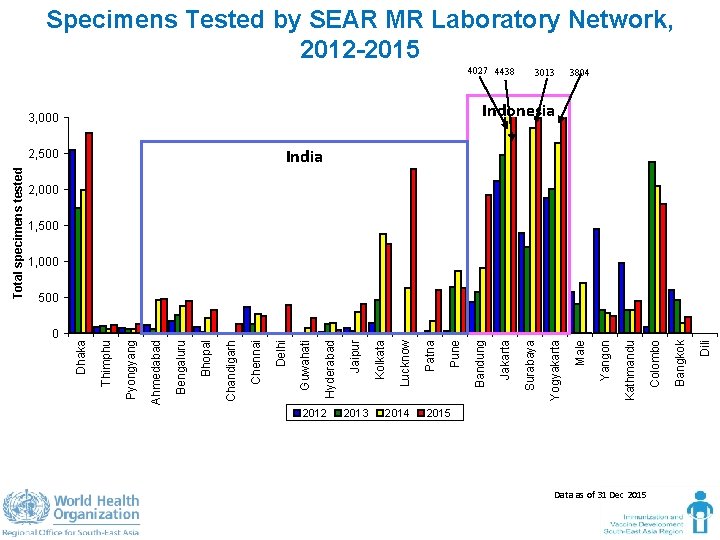
0 2012 2013 2014 2015 Data as of 31 Dec 2015 Dili Bangkok Colombo Kathmandu Yangon 3013 Male Yogyakarta 4027 4438 Surabaya Jakarta 3, 000 Bandung Pune Patna Lucknow Kolkata Jaipur Hyderabad Guwahati 2, 500 Delhi Chennai Chandigarh Bhopal Bengaluru Ahmedabad Pyongyang Thimphu Dhaka Total specimens tested Specimens Tested by SEAR MR Laboratory Network, 2012 -2015 3804 Indonesia India 2, 000 1, 500 1, 000 500
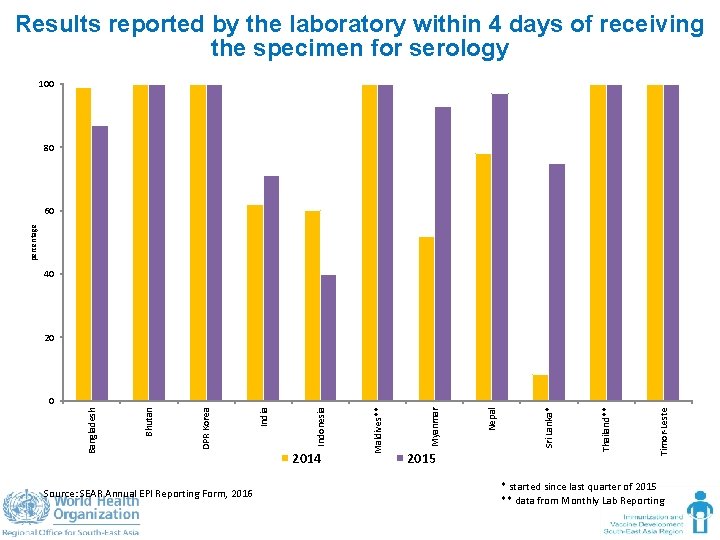
Results reported by the laboratory within 4 days of receiving the specimen for serology 100 80 percentage 60 40 20 Source: SEAR Annual EPI Reporting Form, 2016 Timor-Leste Sri Lanka* Nepal Myanmar 2015 Thailand** 2014 Maldives** Indonesia India DPR Korea Bhutan Bangladesh 0 * started since last quarter of 2015 ** data from Monthly Lab Reporting
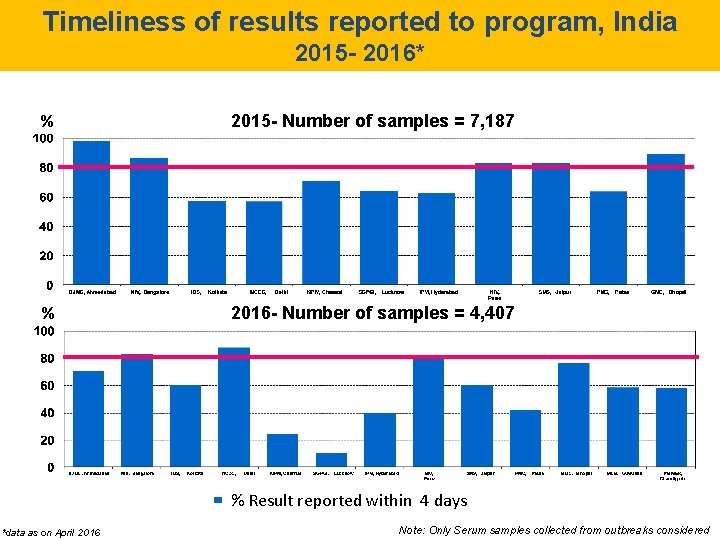
Timeliness of results reported to program, India 2015 - 2016* % 2015 - Number of samples = 7, 187 % 2016 - Number of samples = 4, 407 % Result reported within 4 days *data as on April 2016 Note: Only Serum samples collected from outbreaks considered
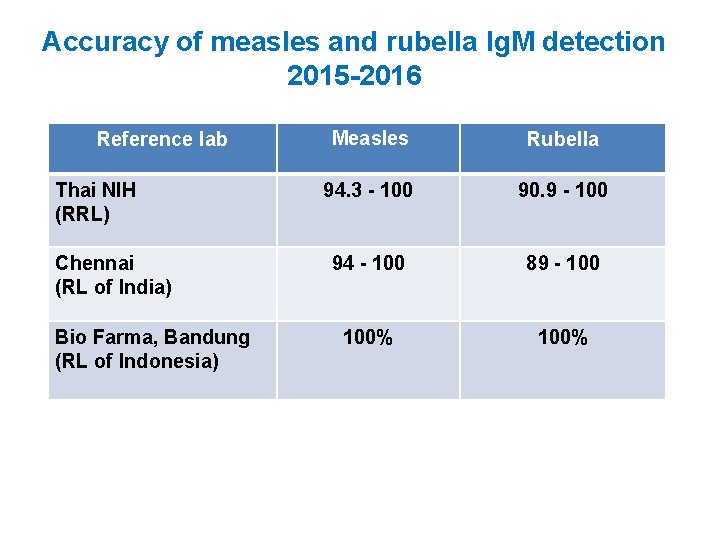
Accuracy of measles and rubella Ig. M detection 2015 -2016 Reference lab Thai NIH (RRL) Chennai (RL of India) Bio Farma, Bandung (RL of Indonesia) Measles Rubella 94. 3 - 100 90. 9 - 100 94 - 100 89 - 100%
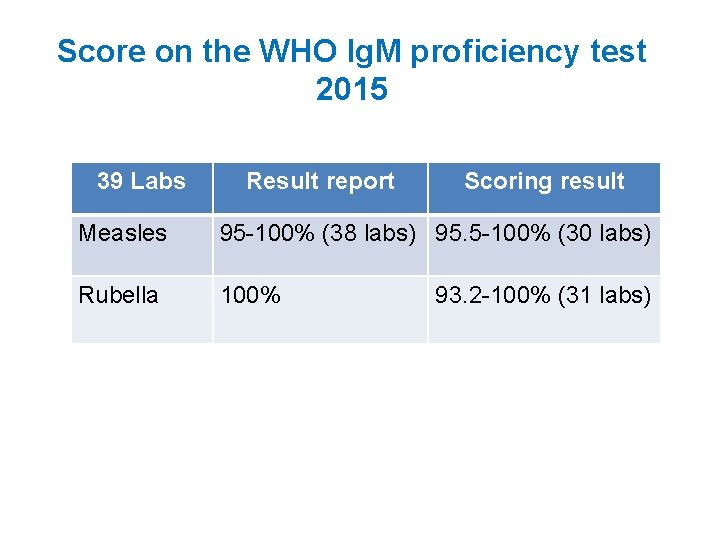
Score on the WHO Ig. M proficiency test 2015 39 Labs Result report Scoring result Measles 95 -100% (38 labs) 95. 5 -100% (30 labs) Rubella 100% 93. 2 -100% (31 labs)
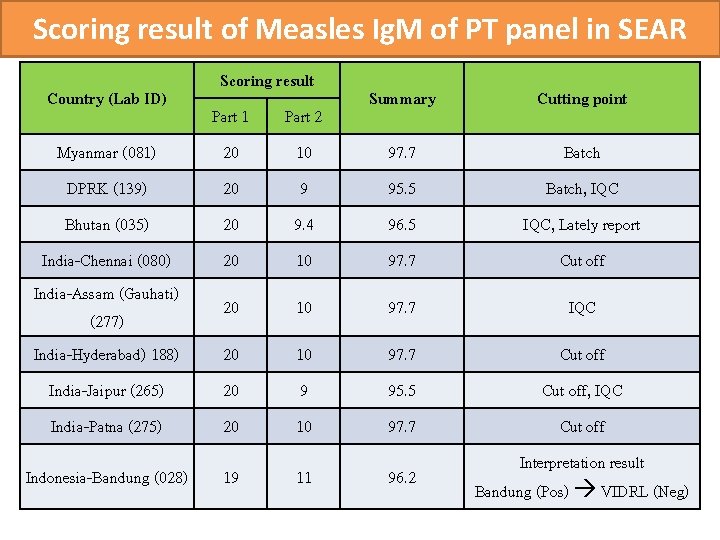
Scoring result of Measles Ig. M of PT panel in SEAR Country (Lab ID) Scoring result Summary Cutting point Batch, IQC Part 1 Part 2 Myanmar (081) DPRK (139) Bhutan (035) India-Chennai (080) India-Assam (Gauhati) (277) India-Hyderabad) 188) India-Jaipur (265) India-Patna (275) 20 20 10 9 9. 4 10 97. 7 95. 5 96. 5 97. 7 IQC, Lately report Cut off 20 10 97. 7 IQC 20 20 20 10 97. 7 95. 5 97. 7 Indonesia-Bandung (028) 19 11 96. 2 Cut off, IQC Cut off Interpretation result Bandung (Pos) VIDRL (Neg)

Scoring result of Rubella Ig. M of PT panel in SEAR Country Scoring result Summary Cutting point Part 1 Part 2 Sri Lanka 20 8 93. 2 Ru. M-IBL kit (kit validation criteria) Myanmar 20 10 97. 7 Batch DPRK 20 9 95. 5 Batch, IQC Bhutan 20 9. 4 96. 5 IQC, Late report India-Delhi 20 10 97. 7 IQC Ru. M India-Hyderabad 20 10 97. 7 Cut off India-Jaipur 20 9 95. 5 Cut off, IQC India-Patna 20 10 97. 7 Cut off
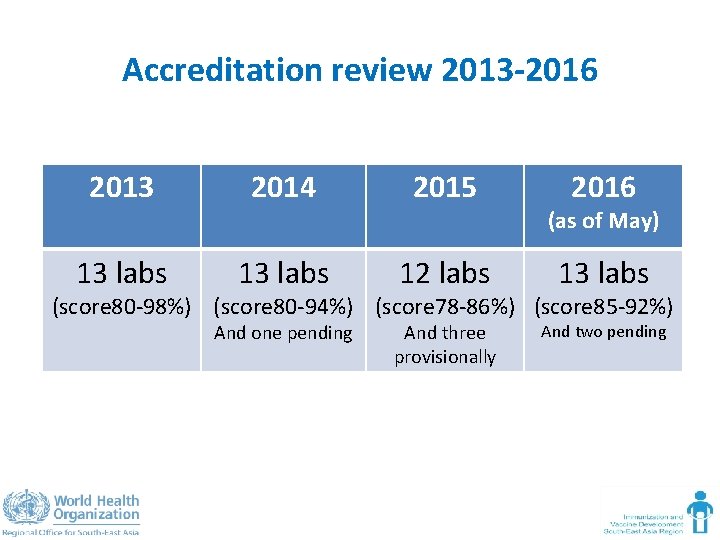
Accreditation review 2013 -2016 2013 2014 2015 2016 13 labs 12 labs 13 labs And one pending And three provisionally And two pending (as of May) (score 80 -98%) (score 80 -94%) (score 78 -86%) (score 85 -92%)
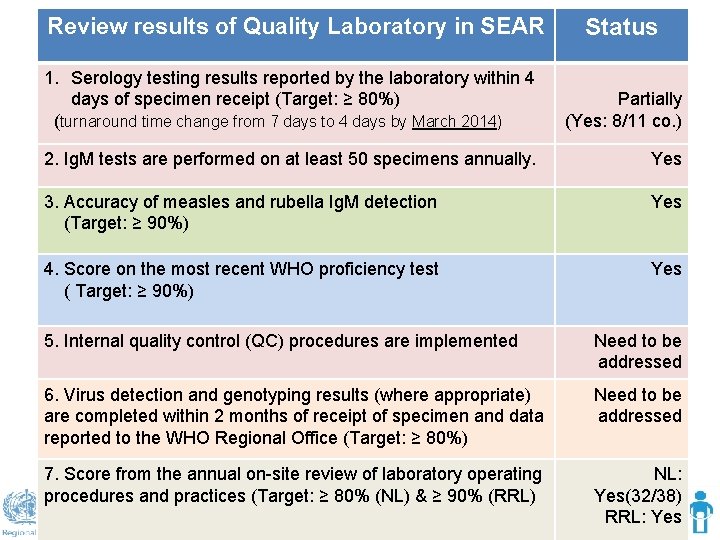
Review results of Quality Laboratory in SEAR Status 1. Serology testing results reported by the laboratory within 4 days of specimen receipt (Target: ≥ 80%) (turnaround time change from 7 days to 4 days by March 2014) Partially (Yes: 8/11 co. ) 2. Ig. M tests are performed on at least 50 specimens annually. Yes 3. Accuracy of measles and rubella Ig. M detection (Target: ≥ 90%) Yes 4. Score on the most recent WHO proficiency test ( Target: ≥ 90%) Yes 5. Internal quality control (QC) procedures are implemented Need to be addressed 6. Virus detection and genotyping results (where appropriate) are completed within 2 months of receipt of specimen and data reported to the WHO Regional Office (Target: ≥ 80%) Need to be addressed 7. Score from the annual on-site review of laboratory operating procedures and practices (Target: ≥ 80% (NL) & ≥ 90% (RRL) NL: Yes(32/38) RRL: Yes
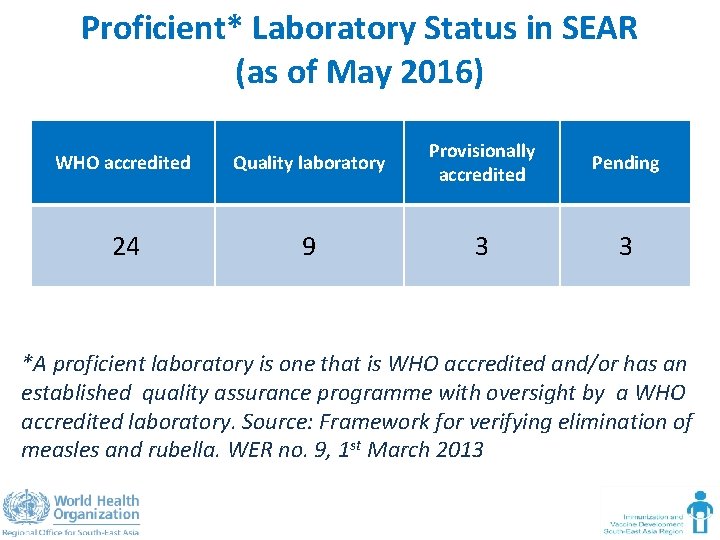
Proficient* Laboratory Status in SEAR (as of May 2016) WHO accredited Quality laboratory Provisionally accredited Pending 24 9 3 3 *A proficient laboratory is one that is WHO accredited and/or has an established quality assurance programme with oversight by a WHO accredited laboratory. Source: Framework for verifying elimination of measles and rubella. WER no. 9, 1 st March 2013
To enhance Internal quality control Opportunities for improvement • • Supervision In house control West guard rule In house calibration Document control GLP & Safety CQI Actions • Strengthen laboratory management skill and CQI (better we can do): The regional meeting was provided in Jakarta 2014) • Build the lab assessors: The workshop on capacity building in measles and rubella laboratory accreditation in Bangkok 2015
The further step for internal quality control improvement • To implement the internal quality auditing process: The Regional workshop for strengthening capacity and internal quality assurance for the SEAR measles and rubella laboratory network in Bhutan, August 2016
To enhance the virus detection and genotyping result • Establishing molecular labs • Use the referral system in regional network to enhance submission of genotypes sequencing data in Mea. NS and Rube. NS • Encouragement of genotypes data sharing: Indonesia started submitting the nucleotides sequence data to Mea. NS and Rube. NS in June 2016
Establishing the molecular labs for viral genome detection and amplification in 2014 -2016 • 2014: Provide molecular lab group training for 22 labs in 9 countries (Myanmar and Timor-Leste: not yet trained) • 2015: Provide on site training for 3 labs: – Sri Lanka: Conventional RT PCR – Nepal: Conventional RT PCR – Bangladesh: Conventional RT PCR • 2016: Provide on site training for 2 labs: – Myanmar: Conventional RT PCR and sequencing – Bhutan: Conventional RT PCR and Real time PCR
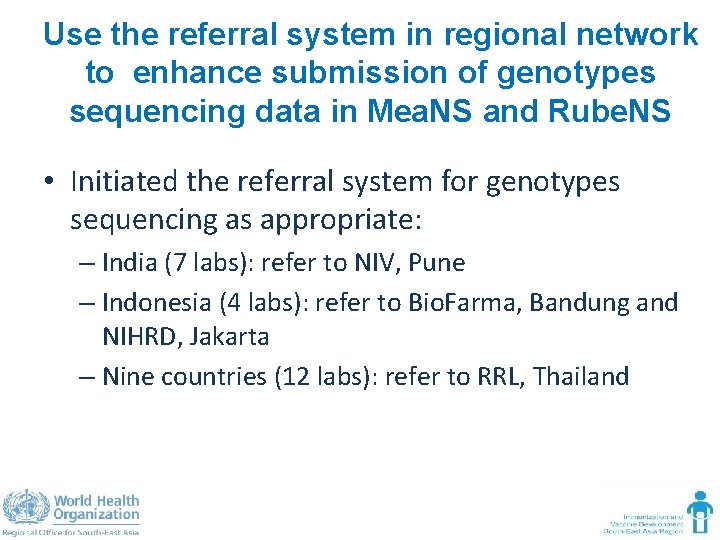
Use the referral system in regional network to enhance submission of genotypes sequencing data in Mea. NS and Rube. NS • Initiated the referral system for genotypes sequencing as appropriate: – India (7 labs): refer to NIV, Pune – Indonesia (4 labs): refer to Bio. Farma, Bandung and NIHRD, Jakarta – Nine countries (12 labs): refer to RRL, Thailand
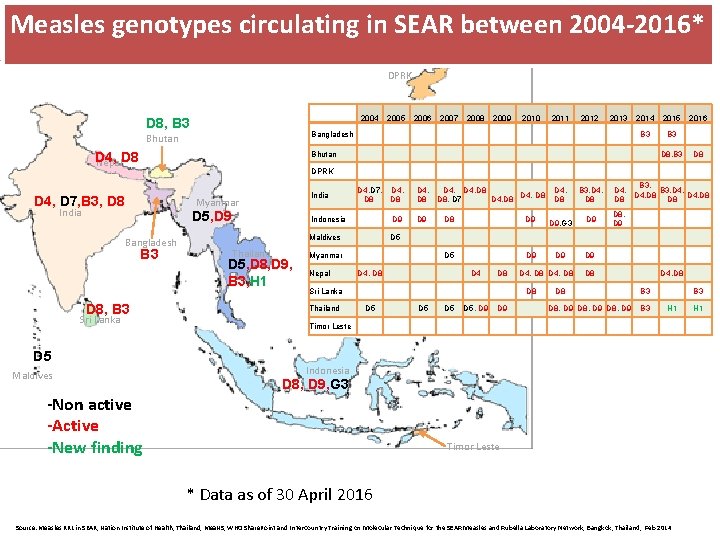
Measles genotypes circulating in SEAR between 2004 -2016* DPRK D 8, B 3 Bhutan D 4, Nepal. D 8 D 4, D 7, B 3, D 8 D 5, D 9 Bangladesh B 3 D 8, B 3 Sri Lanka D 5 Maldives Thailand 2005 2006 2007 2008 2009 2010 2011 2012 2013 2014 2015 Bangladesh B 3 Bhutan DPRK India Myanmar India 2004 D 5, D 8, D 9, B 3, H 1 D 4, D 7, D 4, D 8 D 9 D 8 D 9, G 3 D 9 D 8, D 9 Maldives D 5 Myanmar D 5 D 9 D 4, D 8 D 4 D 8 Sri Lanka Thailand D 5, D 9 D 4, D 8 D 8 D 4, D 8 B 3 D 8, D 9 B 3 H 1 Timor Leste Indonesia D 8, D 9, G 3 -Non active -Active -New finding D 8 B 3, D 4, D 8 D 4, B 3, D 4, D 8 D 4, D 8, D 7 D 4, D 8 D 8 D 8 Indonesia Nepal D 8, B 3 2016 Timor Leste * Data as of 30 April 2016 Source: Measles RRL in SEAR, Nation Institute of Health, Thailand, Mea. NS, WHO Share. Point and Intercountry Training on Molecular Technique for the SEAR Measles and Rubella Laboratory Network, Bangkok, Thailand, Feb 2014 H 1
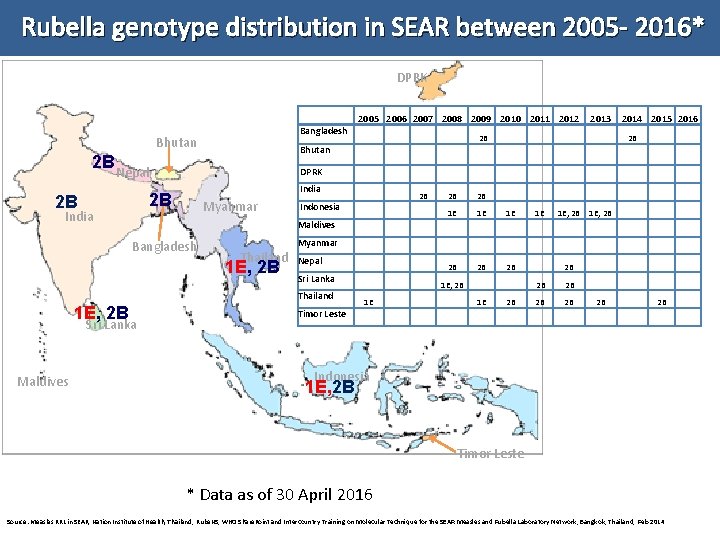
Rubella genotype distribution in SEAR between 2005 - 2016* DPRK 2005 2006 2007 2008 2009 2010 2011 2012 Bangladesh Bhutan 2 B Nepal DPRK India 2 B 2 B India Myanmar 2 B 2 B 2 B 1 E 2 B Indonesia Thailand Nepal Sri Lanka Thailand Sri Lanka 2 B 2014 2015 2016 2 B 1 E 1 E, 2 B 2 B 2 B 2 B Myanmar 1 E, 2 B Maldives Bangladesh 1 E, 2 B 2013 Timor Leste 1 E, 2 B 1 E 1 E 2 B 2 B 2 B Indonesia 1 E, 2 B Timor Leste * Data as of 30 April 2016 Source: Measles RRL in SEAR, Nation Institute of Health, Thailand, Rube. NS, WHO Share. Point and Intercountry Training on Molecular Technique for the SEAR Measles and Rubella Laboratory Network, Bangkok, Thailand, Feb 2014
The further step is for enhancing the use of molecular epidemiology data for identifying source of transmission
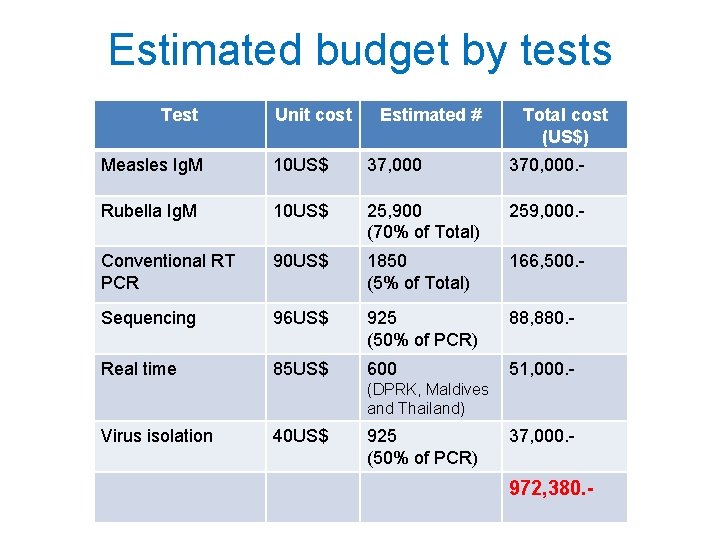
Estimated budget by tests Test Unit cost Estimated # Total cost (US$) Measles Ig. M 10 US$ 37, 000 370, 000. - Rubella Ig. M 10 US$ 25, 900 (70% of Total) 259, 000. - Conventional RT PCR 90 US$ 1850 (5% of Total) 166, 500. - Sequencing 96 US$ 925 (50% of PCR) 88, 880. - Real time 85 US$ 600 51, 000. - (DPRK, Maldives and Thailand) Virus isolation 40 US$ 925 (50% of PCR) 37, 000. - 972, 380. -
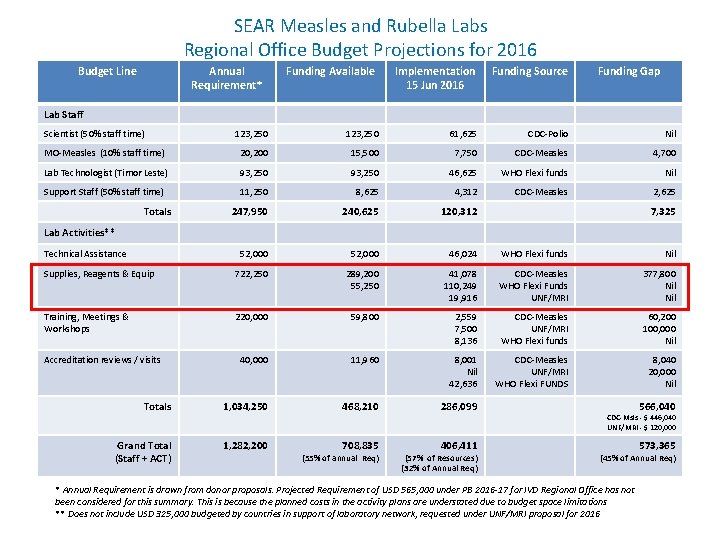
SEAR Measles and Rubella Labs Regional Office Budget Projections for 2016 Budget Line Annual Requirement* Funding Available Implementation 15 Jun 2016 Funding Source Funding Gap Lab Staff Scientist (50% staff time) 123, 250 61, 625 CDC-Polio Nil MO-Measles (10% staff time) 20, 200 15, 500 7, 750 CDC-Measles 4, 700 Lab Technologist (Timor Leste) 93, 250 46, 625 WHO Flexi funds Nil Support Staff (50% staff time) 11, 250 8, 625 4, 312 CDC-Measles 2, 625 247, 950 240, 625 120, 312 52, 000 46, 024 WHO Flexi funds Nil Supplies, Reagents & Equip 722, 250 289, 200 55, 250 41, 078 110, 249 19, 916 CDC-Measles WHO Flexi Funds UNF/MRI 377, 800 Nil Training, Meetings & Workshops 220, 000 59, 800 2, 559 7, 500 8, 136 CDC-Measles UNF/MRI WHO Flexi funds 60, 200 100, 000 Nil 40, 000 11, 960 8, 001 Nil 42, 636 CDC-Measles UNF/MRI WHO Flexi FUNDS 8, 040 20, 000 Nil Totals 1, 034, 250 468, 210 286, 099 Grand Total (Staff + ACT) 1, 282, 200 Totals 7, 325 Lab Activities** Technical Assistance Accreditation reviews / visits 708, 835 (55% of annual Req) 406, 411 (57% of Resources) (32% of Annual Req) 566, 040 CDC-Msls - $ 446, 040 UNF/MRI - $ 120, 000 573, 365 (45% of Annual Req) * Annual Requirement is drawn from donor proposals. Projected Requirement of USD 565, 000 under PB 2016 -17 for IVD Regional Office has not been considered for this summary. This is because the planned costs in the activity plans are understated due to budget space limitations ** Does not include USD 325, 000 budgeted by countries in support of laboratory network, requested under UNF/MRI proposal for 2016
To support CRS surveillance system • Regional workshop on strengthening laboratory capacity for Rubella/Congenital Rubella Syndrome (CRS) surveillance in October 2015, Bangkok, Thailand – To build capacity of labs to follow the new harmonized algorithm for lab-confirmation of CRS cases – To strengthen coordination between lab-network and the surveillance teams so that complete labsupported case-based CRS surveillance is functional in all countries in the region.
Verification Commissions and Committees • Regional Verification Commission Established in April 2016. – First meeting planned on 1 st week of August • All member states have a National Verification Committee (NVC). – DPR Korea is in the process of establishing the National Verification Committee
Challenges • Quality assurance of the laboratories is an issue. To sustain the proficiency status of the huge number of the SEAR MR laboratory network require well plan and new strategic approach. • Need strong collaboration among laboratory and epidemiologist to conduct molecular epidemiology and use data to identify the source of virus as indigenous, imported or import-related • Laboratory support for case confirmation, genotyping and logistic still seen as responsibility of the WHO supported MR Laboratory network. Needs to be streamlined to respective national procurement systems.
Challenges • Hard to reach areas (Bhutan, Bangladesh, Nepal, Myanmar and Maldives) are required to use DBS collection and quality assurance should be addressed • Viral detection not done regularly • The test algorithm for Point-of-Care-Testing devices should be addressed as well as the costs for testing at the labs • Data reporting system • Sustainability for elimination phase: funding and staffing
Transformation required …… • Strengthening quality assurance system – Implementation of internal auditing for all laboratories – Lab-assessors capacity for independent accreditation review annually – Random sampling by SEARO • Capacity building on molecular epidemiology to establish transmission pathways and genetic linkage • Country level implementation of laboratory supported CRS surveillance system • To provide technical support identifying alternate options for sample collection and ELISA diagnostic kits
Acknowledgements • National Reference Laboratories, National Laboratories and Sub-National Laboratories • Regional Reference Laboratory, Thai NIH • WHO-country office • US-CDC • PHE • Global Laboratory Coordinator
Dhanyavada Dhanybhad Dhon no baad Istuti Kaadinchhey la Kamsa hamnida Khob khun Kyeizu tin ba de Obrigada Shukuriyaa Terima kasih Thank you 38
- Slides: 38