
Regional Round Table on Remuneration PAPU Arusha Tanzania

Regional Round Table on Remuneration PAPU (Arusha, Tanzania) 21 to 23 January 2020 © UPU 2019 – All reserved © UPU 2019 – rights All rights reserved

2. Opening remarks and agenda POC C 2 RIG Co Chairs © UPU 2019 – All reserved © UPU 2019 – rights All rights reserved
Agenda – 14 January (morning) 1. Welcome and introduction 2 Opening remarks and agenda a. Congresses’ mandates on remuneration b. The Integrated Remuneration Plan (IRP): a roadmap for the development of an Integrated Remuneration System (IRS) 3. UPU remuneration in the current cycle 3. 1 Overview of the remuneration systems in current Congress cycle (2018 – 2021) 3. 2 Outcomes of the Third Extraordinary Congress on the review of E format remuneration 3. 3 Implementation of the E format remuneration a. Changes to current system parameters in the years 2020 and 2021 b. Self-declaration of E format rates from 2021 c. Accelerated implementation of self-declared E format rates from 1 July 2020 d. Notification requirements and deadlines e. Further work on the implementation f. Rate calculation tool 3. 4 Q & A – clarifications and comments © UPU 2019 – All rights reserved
Agenda – 14 January (afternoon) and 15 January 4. Proposals for an Integrated Remuneration System (IRS) 4. 1 Draft proposals on the IRS methodology a. Methodology for remuneration of basic letter-post services 2022 to 2025 b. Review of the Inward Land Rate (ILR) system for parcel-post services c. Remuneration of supplementary services (registered, insured and tracked delivery items) d. Remuneration response to the Integrated Product Plan (IPP) proposed changes to the portfolio of services e. Format separation and sampling f. Pay-for-performance 4. 2 Summary of proposals and documentation for the 2020 Congress) 4. 3 Discussion and regional views on the proposals for an Integrated Remuneration System 5. Future work on remuneration 5. 1 Abidjan Business Plan – Work Proposals for the further development of the IRP and the IRS and its implementation 6. Closing remarks © UPU 2019 – All rights reserved

Opening remarks Main reasons of holding the Regional Round Table on Remuneration are: 1. Inform UPU member countries of the draft proposals to Congress prepared by the POC and CA 2. Explain the rationale and background of these proposals and improve the understanding of the UPU members of the draft proposals 3. Discuss and exchange views on the proposals from a regional perspective 4. Collect those views and channel them into the discussions on the draft package proposals during the World Round Table on Remuneration © UPU 2019 – All rights reserved
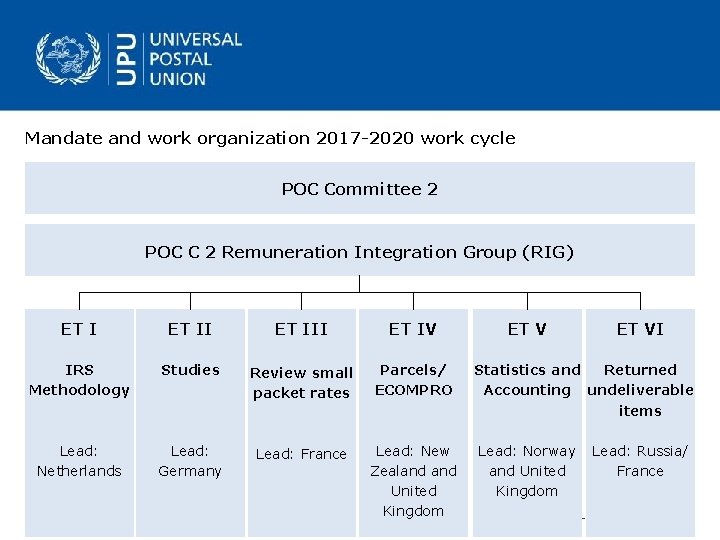
Mandate and work organization 2017 -2020 work cycle POC Committee 2 POC C 2 Remuneration Integration Group (RIG) ET III ET IV IRS Methodology Studies Review small packet rates Parcels/ ECOMPRO Lead: Netherlands Lead: Germany Lead: France Lead: New Zealand United Kingdom ET VI Statistics and Returned Accounting undeliverable items Lead: Norway and United Kingdom Lead: Russia/ France © UPU 2019 – All rights reserved
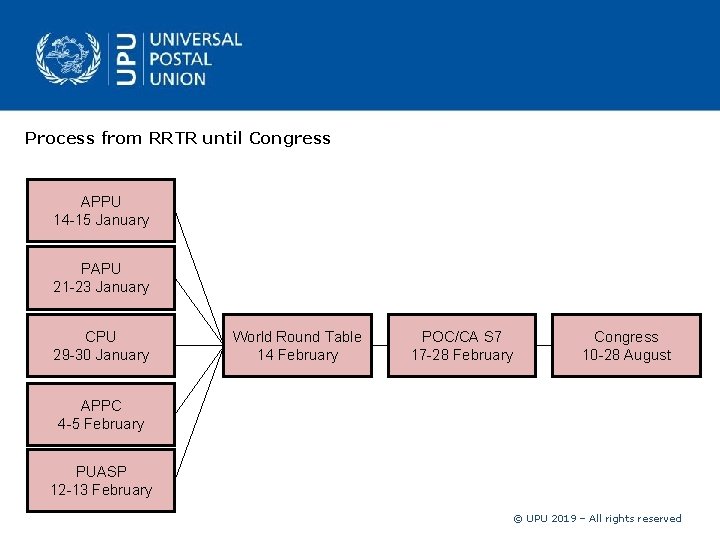
Process from RRTR until Congress APPU 14 -15 January PAPU 21 -23 January CPU 29 -30 January World Round Table 14 February POC/CA S 7 17 -28 February Congress 10 -28 August APPC 4 -5 February PUASP 12 -13 February © UPU 2019 – All rights reserved
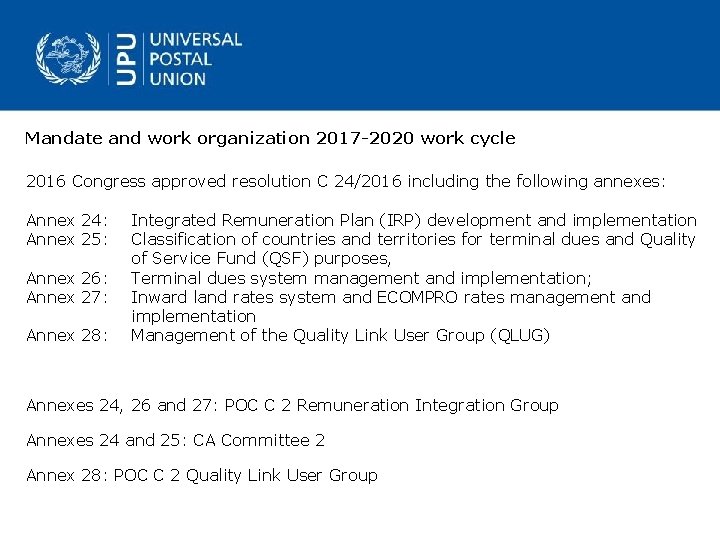
Mandate and work organization 2017 -2020 work cycle 2016 Congress approved resolution C 24/2016 including the following annexes: Annex 24: Annex 25: Annex 26: Annex 27: Annex 28: Integrated Remuneration Plan (IRP) development and implementation Classification of countries and territories for terminal dues and Quality of Service Fund (QSF) purposes, Terminal dues system management and implementation; Inward land rates system and ECOMPRO rates management and implementation Management of the Quality Link User Group (QLUG) Annexes 24, 26 and 27: POC C 2 Remuneration Integration Group Annexes 24 and 25: CA Committee 2 Annex 28: POC C 2 Quality Link User Group © UPU 2019 – All rights reserved
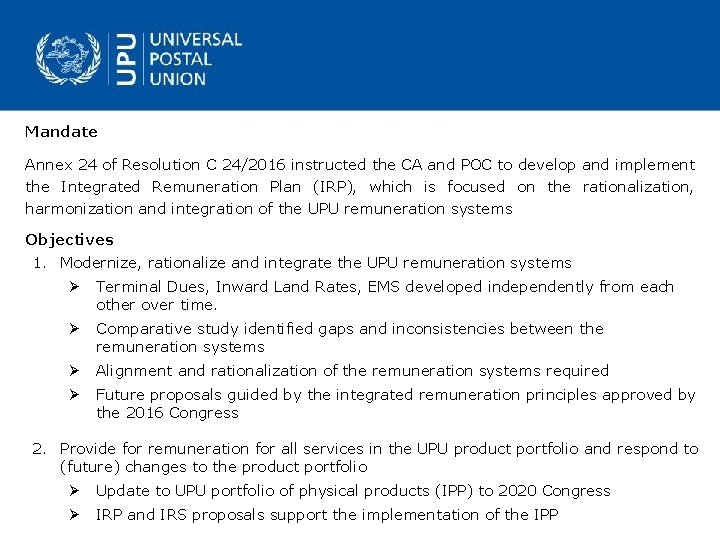
Mandate Annex 24 of Resolution C 24/2016 instructed the CA and POC to develop and implement the Integrated Remuneration Plan (IRP), which is focused on the rationalization, harmonization and integration of the UPU remuneration systems Objectives 1. Modernize, rationalize and integrate the UPU remuneration systems Ø Terminal Dues, Inward Land Rates, EMS developed independently from each other over time. Ø Comparative study identified gaps and inconsistencies between the remuneration systems Ø Alignment and rationalization of the remuneration systems required Ø Future proposals guided by the integrated remuneration principles approved by the 2016 Congress 2. Provide for remuneration for all services in the UPU product portfolio and respond to (future) changes to the product portfolio Ø Update to UPU portfolio of physical products (IPP) to 2020 Congress Ø IRP and IRS proposals support the implementation of the IPP © UPU 2019 – All rights reserved
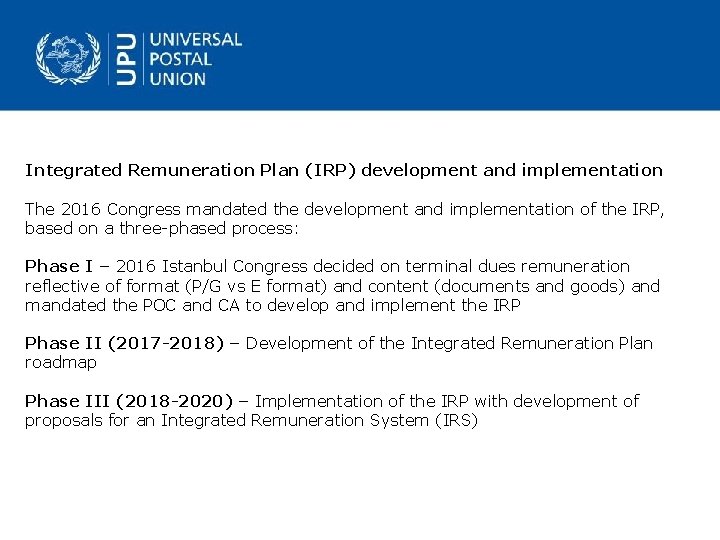
Integrated Remuneration Plan (IRP) development and implementation The 2016 Congress mandated the development and implementation of the IRP, based on a three phased process: Phase I – 2016 Istanbul Congress decided on terminal dues remuneration reflective of format (P/G vs E format) and content (documents and goods) and mandated the POC and CA to develop and implement the IRP Phase II (2017 -2018) – Development of the Integrated Remuneration Plan roadmap Phase III (2018 -2020) – Implementation of the IRP with development of proposals for an Integrated Remuneration System (IRS) © UPU 2019 – All rights reserved
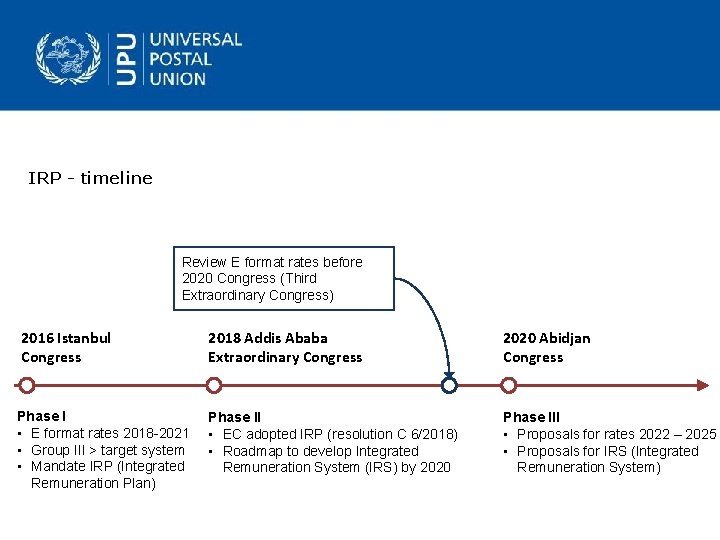
IRP - timeline Review E format rates before 2020 Congress (Third Extraordinary Congress) 2016 Istanbul Congress Phase I • E format rates 2018 -2021 • Group III > target system • Mandate IRP (Integrated Remuneration Plan) 2018 Addis Ababa Extraordinary Congress 2020 Abidjan Congress Phase II • EC adopted IRP (resolution C 6/2018) • Roadmap to develop Integrated Remuneration System (IRS) by 2020 Phase III • Proposals for rates 2022 – 2025 • Proposals for IRS (Integrated Remuneration System) © UPU 2019 – All rights reserved
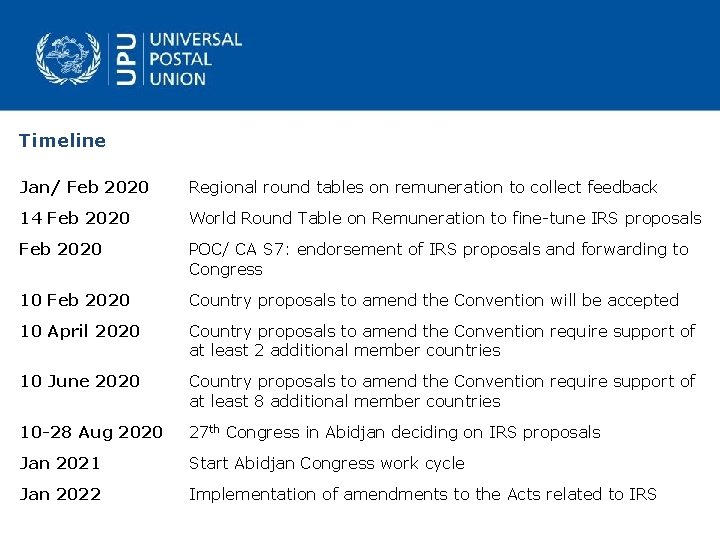
Timeline Jan/ Feb 2020 Regional round tables on remuneration to collect feedback 14 Feb 2020 World Round Table on Remuneration to fine tune IRS proposals Feb 2020 POC/ CA S 7: endorsement of IRS proposals and forwarding to Congress 10 Feb 2020 Country proposals to amend the Convention will be accepted 10 April 2020 Country proposals to amend the Convention require support of at least 2 additional member countries 10 June 2020 Country proposals to amend the Convention require support of at least 8 additional member countries 10 -28 Aug 2020 27 th Congress in Abidjan deciding on IRS proposals Jan 2021 Start Abidjan Congress work cycle Jan 2022 Implementation of amendments to the Acts related to IRS © UPU 2019 – All rights reserved
3. Integrated Product Plan for 2021 to 2024 Presentation by the International Bureau © UPU 2019 – All rights reserved
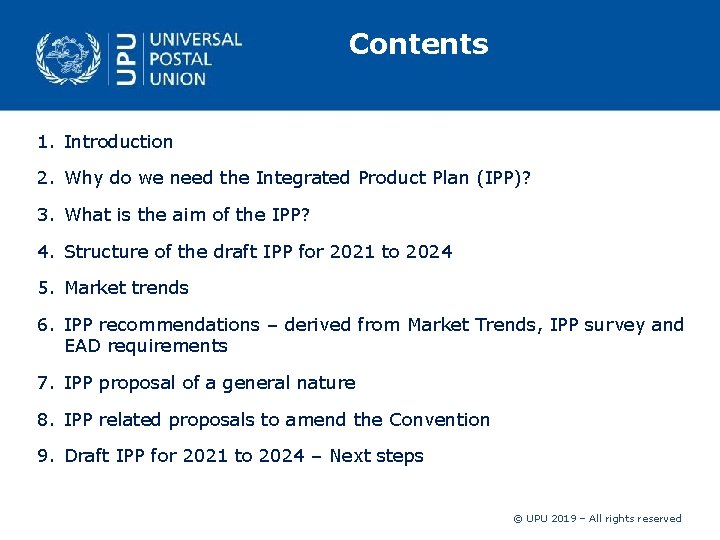
Contents 1. Introduction 2. Why do we need the Integrated Product Plan (IPP)? 3. What is the aim of the IPP? 4. Structure of the draft IPP for 2021 to 2024 5. Market trends 6. IPP recommendations – derived from Market Trends, IPP survey and EAD requirements 7. IPP proposal of a general nature 8. IPP related proposals to amend the Convention 9. Draft IPP for 2021 to 2024 – Next steps © UPU 2019 – All rights reserved
1. Introduction • In resolution C 15/2016, the 26 th Congress instructed the Postal Operations Council (POC) to: Ø ensure that the UPU keeps pace with change by modernizing letter post, parcel post and EMS using an integrated approach (both to product development and to remuneration systems), and ensuring speedier decision making in response to market needs Ø develop and implement POC activities (including remuneration, quality measurement, standards, accounting and operations) that are driven by product definition and development while at the same time recognizing customer, market and supply chain needs • In resolution C 5/2018, the second Extraordinary Congress instructed the POC to continue, amongst other things, with ensuring the ongoing review of the Integrated Product Plan (IPP) with the aim of submitting an updated version to the 27 th Congress in 2020 © UPU 2019 – All rights reserved
2. Why do we need the Integrated Product Plan (IPP)? • Customers and the marketplace are telling us we are not meeting their needs…we need to make urgent changes. • Designated Operators’ share is lagging the pace of e commerce boom • Many operators, particularly in developing countries have not shared in traffic growth despite ever increasing international e. Commerce traffic and/or steady growth in their regions • Designated Operator’s are losing market share. Alternative networks are offering what the customers want and need: quality of service and reliability, value added features, flexibility, customization and simplicity © UPU 2019 – All rights reserved
3. What is the aim of the IPP? It is a plan that will help the UPU’s members to develop a fully integrated portfolio of phys icalproducts (letter post, parcel post, EMS) with adequate and competitive remuneration sys tems that cover the costs of delivering the products and that also meets the requirements of the market, customer needs and the supply chain (EAD) Main objectives of the IPP: • The IPP should be recognised as the UPU’s response and roadmap to modernised and integrated physical postal services that are aligned to current needs • Opportunities created by e commerce are realized for the entire UPU membership • Integrated and outward facing approach to product development and oversight instead of past approaches that were inward and silo focused • Ensure alignment with emerging security and customs EAD requirements © UPU 2019 – All rights reserved
4. Structure of the draft IPP for 2021 to 2024 • The IPP outcomes and achievements for 2017 2020 (inc. 2 recommendations) • Market trends and recommended responses (inc. 6 recommendations) • Results and recommendations from the IPP review questionnaire and review of the IPP (inc. 9 recommendations) • EAD recommendations relating to the 2020 IPP (inc. 1 recommendation) • Resolution on the implementation of the IPP • IPP related proposals to amend the Convention and Regulations • Implementation of the IPP for the period 2021 2024 © UPU 2019 – All rights reserved
5. market trends • Cross border e commerce volume represents about 20% of global e commerce, is growing at twice the rate of domestic e commerce, and is expected to see further growth over the next few years. As cross border e commerce continues to grow, the perception of conventional postal providers is changing – namely: Ø Customers are requiring additional features (visibility, DDP, flexible delivery choice, returns and tracking) with cross border items that are not supported by the existing postal models and products; and Ø As indicated in a market survey carried out in July 2017 by Transport Intelligence, 75% of respondents believe that conventional express item providers will lose volumes to emerging competitors such as Amazon and Alibaba, which highlights the possible impact that such emerging competitors could have. • HOWEVER…. . Developing a product portfolio with services that include visibility, DDP, flexible delivery choice, returns and tracking on items containing goods will make postal operators a competitive option for both customers and cross border e commerce businesses © UPU 2019 – All rights reserved
6. IPP recommendations – derived from market trends • Activities should be carried out that focus on identifying ways of increasing Posts’ share in the “over 2 kg” market while at the same time consolidating the posts position as a major player in the under 2 kilo market segment; • Facilitate new technological needs (such as mobile devices, software modifications, IT infrastructure, cloud based infrastructure, etc. ), and develop provisions for a common data framework enabling communication among Posts and between Posts and other stakeholders; • Develop a framework to enable delivery duty paid (DDP) transactions for postal traffic • Note: These recommendations are derived from an analysis of Market Trends that were identified in a 2018 Accenture Analysis prepared specifically for inclusion in the UPU’s IPP for 2021– 2024 © UPU 2019 – All rights reserved
6. IPP recommendations – derived from market trends • Considering the capabilities of all member countries, the menu of services provided in the IPP should also clearly define visibility (tracking) standards and expectations, as appropriate, for each level of service while bearing in mind the “menu approach” principle • Implementation of activities aimed at improving delivery reliability through optimization of current processes and operations. These activities should include: Ø reviewing and developing solutions to improve label design, address presentation, sizes and dimensions of items, packaging and compliance with UPU regulations Ø facilitating processes that enable flexible delivery options • Look at improving the current UPU processes for the merchandise returns service with the aim of making the service more user friendly, efficient and attractive for customers, e tailers and supply chain stakeholders alike © UPU 2019 – All rights reserved
6. IPP recommendations – derived from IPP review • Develop, improve and maintain factors, such as speed of delivery, customer inquiry service, and easy customs clearance, to ensure they meet customer requirements • E commerce product market development should continue to be a priority for the next cycle. Development of the traditional letter post markets should also continue • Activities relating to the development of parcels, small packets and EMS should ensure that the services align with customer and market requirements for reliability, tracking, network coverage, as speed of delivery, customer inquiry service, and easy customs clearance • The issue of countries being unsure about when they will be able to exchange ITMATT messages should be addressed as a priority during the next cycle Note: The IPP review was sent to all UPU member countries in April 2019. A total of 109 member countries responded to the survey, representing a response rate of 57%. These recommendations are derived from an analysis of the responses to the review © UPU 2019 – All rights reserved
6. IPP recommendations – derived from EAD requirements • Continue product development to facilitate efficient compliance with the EAD roadmap implementation; • Continue coordinating EAD issues between POC bodies in relation to e commerce and IPP outreach communications and capacity building; • Continue to develop UPU regulations and standards to support compliance with EAD requirements; • Develop and implement plans for assessing quality of service and the level of compliance regarding the sending of UPU EDI messaging standard M 33 (ITMATT V 1); and • Develop and implement plans in collaboration with the QSF Common Fund to help member countries implement EAD, and especially to help designated operators build bridges for electronic data inter changewith national customs authorities and airlines © UPU 2019 – All rights reserved
7. IPP proposal of a general nature The PGN sets up the implementation of the IPP for 2021 to 2024 and instructs the POC to: • Ensure that the UPU keeps pace with changes by modernizing the products using an integrated approach; • Develop and implement POC activities driven by product definition in line with customer, market and supply chain needs; • Ensure close coordination between the UPU bodies providing a roadmap for implementation of EAD; and • Ensure the ongoing review of the IPP with a view to summiting an updated version to the 28 th Congress in 2024 The PGN also instructs the CA to: • Ensure issues of government policy and regulatory issues are properly address, discussed and decided in relation to the IPP © UPU 2019 – All rights reserved
8. IPP-related proposals to amend the Convention There are currently 4 proposed amendments to the Convention: Option 1 – makes the tracked delivery service mandatory for inbound and outbound (documents and goods) or Option 2 – makes the tracked delivery service mandatory for inbound (goods and documents) and optional for outbound (goods and documents) or Option 3 – makes the tracked delivery service mandatory for inbound and outbound (goods) and optional for inbound and outbound (documents) or Option 4 – makes the tracked delivery service mandatory for inbound (goods) and optional for outbound (goods) and optional for inbound and outbound (documents) Note: All proposals to make the tracked delivery service mandatory will be submitted to the Congress with remuneration responses as a “package”. This is in line with the results of the IPP survey where 90% of members stated that remuneration should be reviewed if the service is to become mandatory. © UPU 2019 – All rights reserved
9. Draft IPP for 2021 to 2024 – Next steps • The final draft of the IPP for 2021 to 2024 will be submitted to the S 7 POC and CA for endorsement • The final version of the IPP for 2021 to 2024 will then be submitted to the Abidjan Congress in August 2020 which will be asked to: Ø take note of the Congress Doc for the IPP for 2021 to 2024 and of the work carried out to develop the IPP for 2021 to 2024; Ø approve the proposal of a general nature (PGN) relating to the implementation of the seventeen recommendations included in the IPP for 2021 to 2024. © UPU 2019 – All rights reserved

MERCI THANK YOU © UPU 2019 – All rights reserved 27 27

4. UPU remuneration in the current cycle International Bureau © UPU 2019 – All reserved © UPU 2019 – rights All rights reserved
4. 1 Overview UPU remuneration systems 2018 -2021 © UPU 2019 – All rights reserved
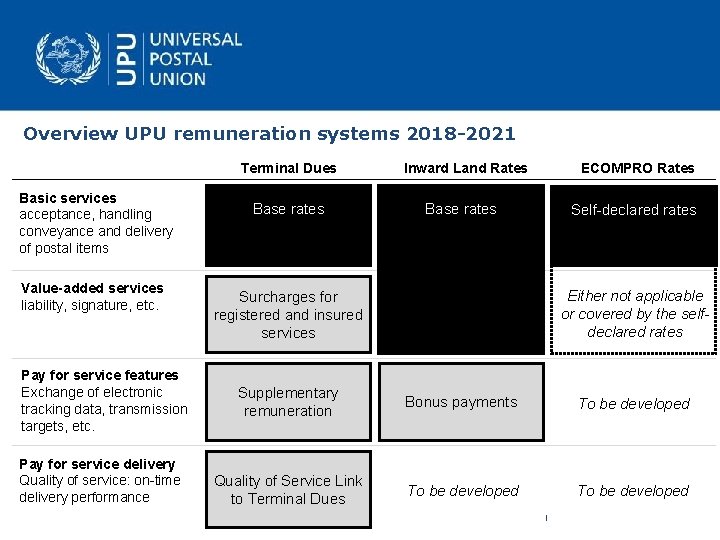
Overview UPU remuneration systems 2018 -2021 Terminal Dues Basic services acceptance, handling conveyance and delivery of postal items Value-added services liability, signature, etc. Pay for service features Exchange of electronic tracking data, transmission targets, etc. Pay for service delivery Quality of service: on-time delivery performance Base rates Inward Land Rates Base rates ECOMPRO Rates Self-declared rates Either not applicable or covered by the selfdeclared rates Surcharges for registered and insured services Supplementary remuneration Bonus payments To be developed Quality of Service Link to Terminal Dues To be developed © UPU 2019 – All rights reserved
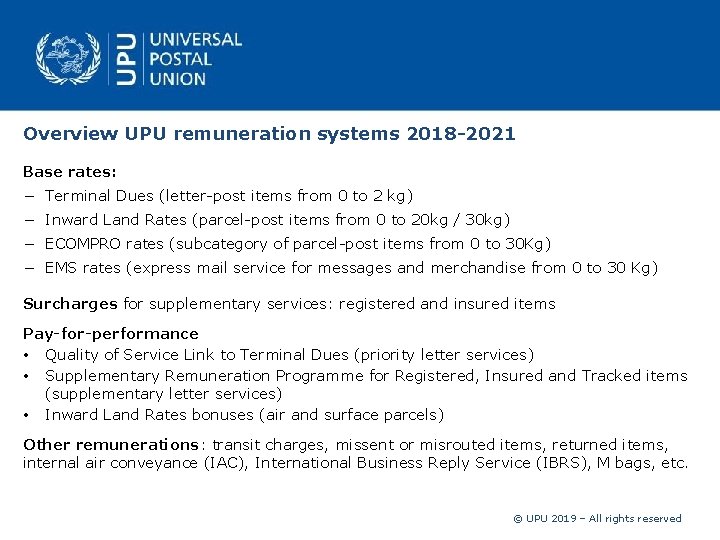
Overview UPU remuneration systems 2018 -2021 Base rates: − Terminal Dues (letter post items from 0 to 2 kg) − Inward Land Rates (parcel post items from 0 to 20 kg / 30 kg) − ECOMPRO rates (subcategory of parcel post items from 0 to 30 Kg) − EMS rates (express mail service for messages and merchandise from 0 to 30 Kg) Surcharges for supplementary services: registered and insured items Pay-for-performance • Quality of Service Link to Terminal Dues (priority letter services) • Supplementary Remuneration Programme for Registered, Insured and Tracked items (supplementary letter services) • Inward Land Rates bonuses (air and surface parcels) Other remunerations: transit charges, missent or misrouted items, returned items, internal air conveyance (IAC), International Business Reply Service (IBRS), M bags, etc. © UPU 2019 – All rights reserved
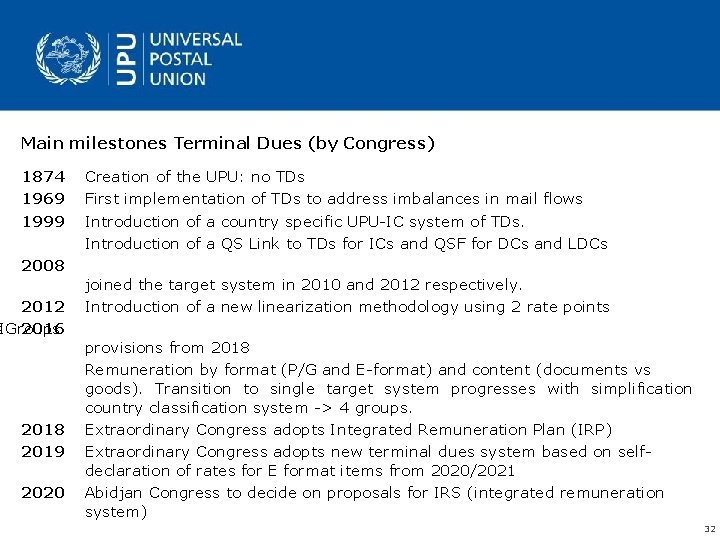
Main milestones Terminal Dues (by Congress) 1874 1969 1999 2008 2012 s. IGroups 2016 2018 2019 2020 Creation of the UPU: no TDs First implementation of TDs to address imbalances in mail flows Introduction of a country specific UPU IC system of TDs. Introduction of a QS Link to TDs for ICs and QSF for DCs and LDCs joined the target system in 2010 and 2012 respectively. Introduction of a new linearization methodology using 2 rate points provisions from 2018 Remuneration by format (P/G and E format) and content (documents vs goods). Transition to single target system progresses with simplification country classification system > 4 groups. Extraordinary Congress adopts Integrated Remuneration Plan (IRP) Extraordinary Congress adopts new terminal dues system based on self declaration of rates for E format items from 2020/2021 Abidjan Congress to decide on proposals for IRS (integrated remuneration system) © UPU 2019 – All rights reserved 32
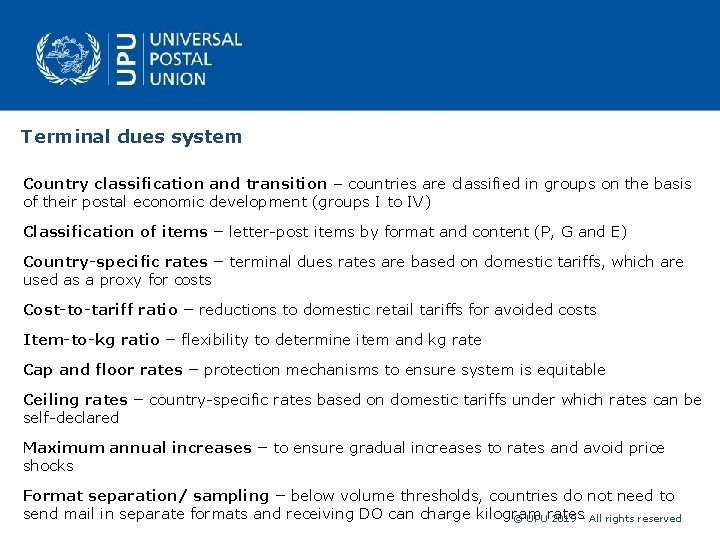
Terminal dues system Country classification and transition – countries are classified in groups on the basis of their postal economic development (groups I to IV) Classification of items – letter post items by format and content (P, G and E) Country-specific rates – terminal dues rates are based on domestic tariffs, which are used as a proxy for costs Cost-to-tariff ratio – reductions to domestic retail tariffs for avoided costs Item-to-kg ratio – flexibility to determine item and kg rate Cap and floor rates – protection mechanisms to ensure system is equitable Ceiling rates – country specific rates based on domestic tariffs under which rates can be self declared Maximum annual increases – to ensure gradual increases to rates and avoid price shocks Format separation/ sampling – below volume thresholds, countries do not need to send mail in separate formats and receiving DO can charge kilogram © UPUrates 2019 – All rights reserved
Country classification Congress decides on country classification: resolution C 7/2016, countries are classified in groups I, III and IV for terminal dues and QSF purposes; Purpose is to gradual transition of all countries from the transitional system to a single target system in which country specific, cost based rates are applied GROUP I – Countries and territories that were in the target system prior to 2010 and will apply the target system in the 2018– 2021 period GROUP II – Countries and territories that joined the target system in 2010 (formerly group 1. 2) and 2012 (formerly group 2) and will apply the target system in the 2018– 2021 period GROUP III – Countries and territories that joined the target system in 2016 and will apply the target system in the 2018– 2021 period GROUP IV (formerly groups 4 and 5) – Countries and territories that will apply the transition terminal dues system in the 2018– 2021 period © UPU 2019 – All rights reserved
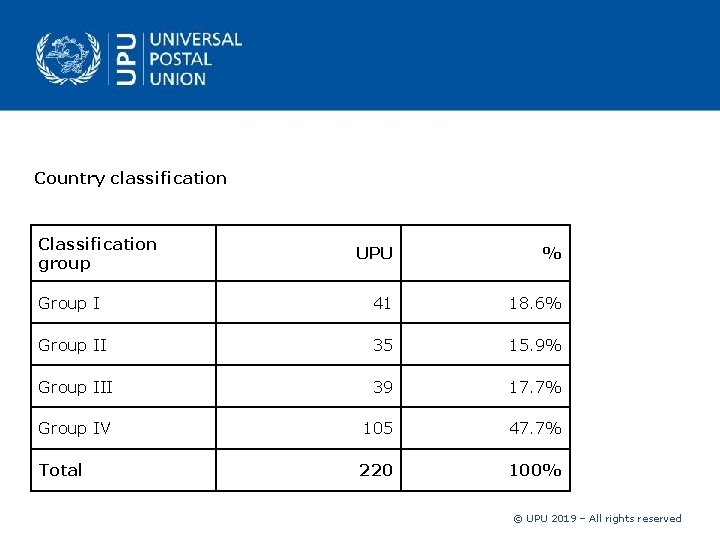
Country classification Classification group UPU % Group I 41 18. 6% Group II 35 15. 9% Group III 39 17. 7% Group IV 105 47. 7% Total 220 100% © UPU 2019 – All rights reserved
Target system: main principles DOs of member countries in Groups I, II and III Payment for letter post items on the basis of rates per item and per kg reflecting the handling costs in the country of destination Total rate per kg calculated on combining the P/G and E format item and kg rates below relevant thresholds Charges corresponding to priority items in the domestic service which are part of the universal service are used as basis for calculating TD rates The TD rates in the target system shall be calculated taking into account, where applicable in the domestic service, the classification of items based on their format and content (P, G and E format) DO in the target system shall exchange format separated mails in accordance with the conditions specified in the Regulations Sampling and format separation thresholds apply © UPU 2019 – All rights reserved
Transition system: main principles DOs of member countries in Groups IV Beneficiaries of QSF receipts (20% LDCs, 10% other Group IV countries) from countries in the target system In 2018/ 2019 countries in Group IV: Paid and received total rate per kg at the floor (minimum) rates No operational requirements of format separation and sampling From 2020 countries in Group IV: Pay and receive country specific terminal dues for E format items Below 100 t, based on the world average IPK, the floor P/G item and kg floor rates and the country specific E format rates are used (current system) From 2021, for flows below 100 t, if destination DO in target system self declares its E format rates, then the sending country in group IV pays floor kg rate Mandatory participation in the QS Link to terminal dues © UPU 2019 – All rights reserved
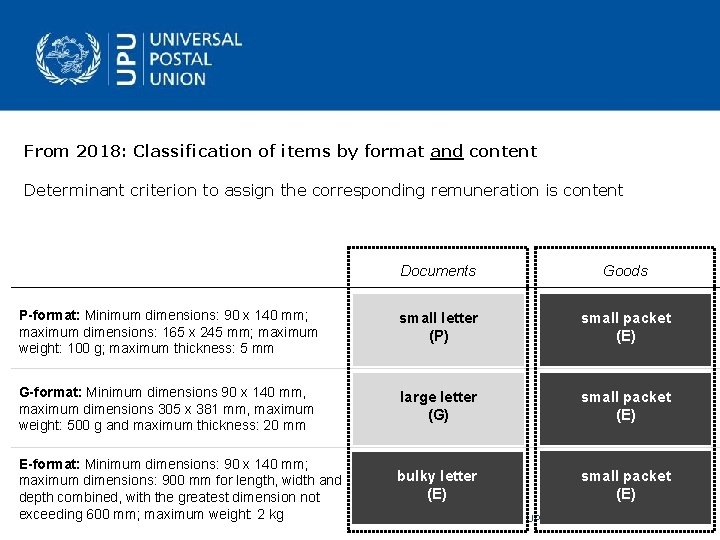
From 2018: Classification of items by format and content Determinant criterion to assign the corresponding remuneration is content Documents Goods P-format: Minimum dimensions: 90 x 140 mm; maximum dimensions: 165 x 245 mm; maximum weight: 100 g; maximum thickness: 5 mm small letter (P) small packet (E) G-format: Minimum dimensions 90 x 140 mm, maximum dimensions 305 x 381 mm, maximum weight: 500 g and maximum thickness: 20 mm large letter (G) small packet (E) E-format: Minimum dimensions: 90 x 140 mm; maximum dimensions: 900 mm for length, width and depth combined, with the greatest dimension not exceeding 600 mm; maximum weight: 2 kg bulky letter (E) small packet (E) © UPU 2019 – All rights reserved
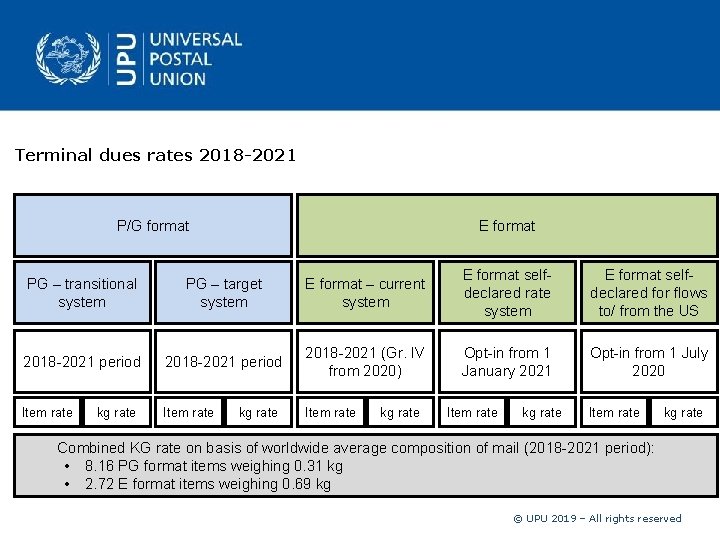
Terminal dues rates 2018 -2021 P/G format E format PG – transitional system PG – target system E format – current system E format selfdeclared rate system E format selfdeclared for flows to/ from the US 2018 -2021 period 2018 -2021 (Gr. IV from 2020) Opt-in from 1 January 2021 Opt-in from 1 July 2020 Item rate kg rate Item rate kg rate Combined KG rate on basis of worldwide average composition of mail (2018 -2021 period): • 8. 16 PG format items weighing 0. 31 kg • 2. 72 E format items weighing 0. 69 kg © UPU 2019 – All rights reserved
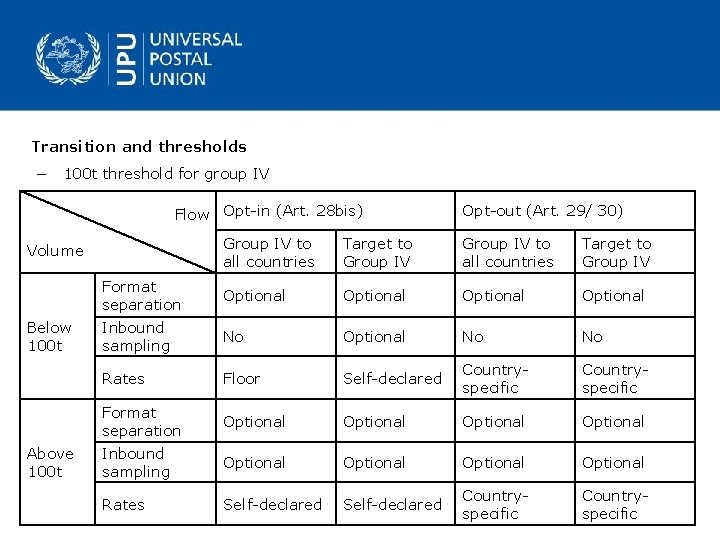
Transition and thresholds − 100 t threshold for group IV Flow Opt in (Art. 28 bis) Group IV to all countries Target to Group IV Format separation Optional Inbound sampling No Optional No No Rates Floor Self declared Country specific Format separation Optional Inbound sampling Optional Rates Self declared Country specific© UPU 2019 –specific All rights reserved Volume Below 100 t Above 100 t Opt out (Art. 29/ 30)
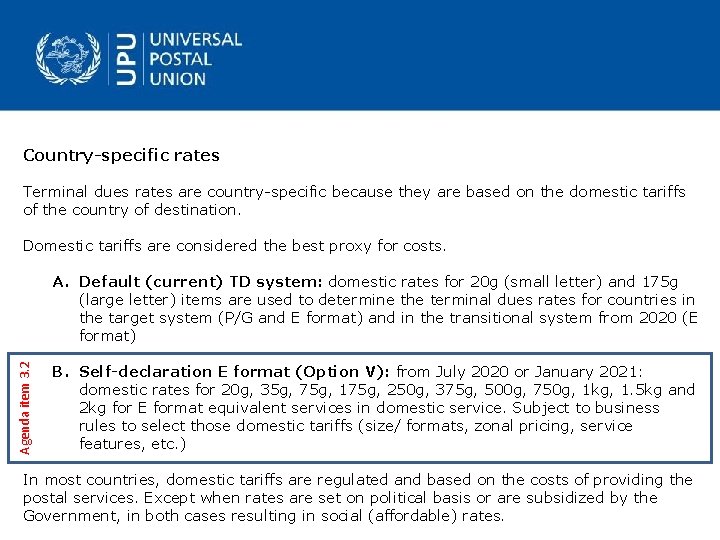
Country-specific rates Terminal dues rates are country specific because they are based on the domestic tariffs of the country of destination. Domestic tariffs are considered the best proxy for costs. Agenda item 3. 2 A. Default (current) TD system: domestic rates for 20 g (small letter) and 175 g (large letter) items are used to determine the terminal dues rates for countries in the target system (P/G and E format) and in the transitional system from 2020 (E format) B. Self-declaration E format (Option V): from July 2020 or January 2021: domestic rates for 20 g, 35 g, 75 g, 175 g, 250 g, 375 g, 500 g, 750 g, 1 kg, 1. 5 kg and 2 kg for E format equivalent services in domestic service. Subject to business rules to select those domestic tariffs (size/ formats, zonal pricing, service features, etc. ) In most countries, domestic tariffs are regulated and based on the costs of providing the postal services. Except when rates are set on political basis or are subsidized by the Government, in both cases resulting in social (affordable) rates. © UPU 2019 – All rights reserved
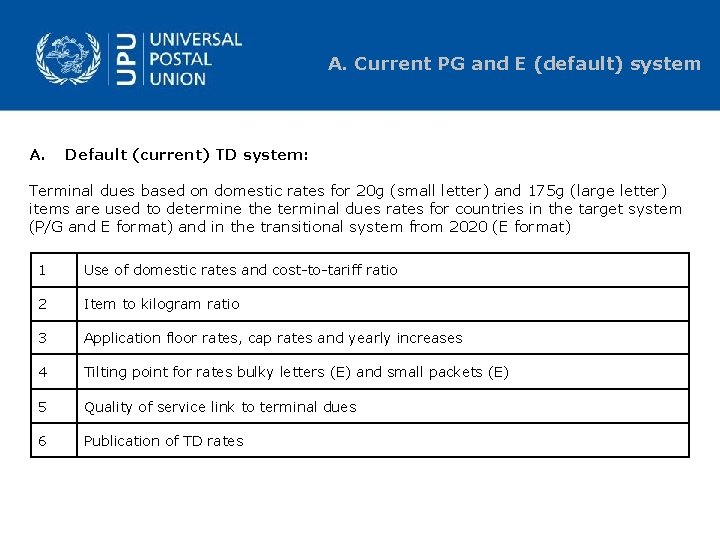
A. Current PG and E (default) system A. Default (current) TD system: Terminal dues based on domestic rates for 20 g (small letter) and 175 g (large letter) items are used to determine the terminal dues rates for countries in the target system (P/G and E format) and in the transitional system from 2020 (E format) 1 Use of domestic rates and cost to tariff ratio 2 Item to kilogram ratio 3 Application floor rates, cap rates and yearly increases 4 Tilting point for rates bulky letters (E) and small packets (E) 5 Quality of service link to terminal dues 6 Publication of TD rates © UPU 2019 – All rights reserved
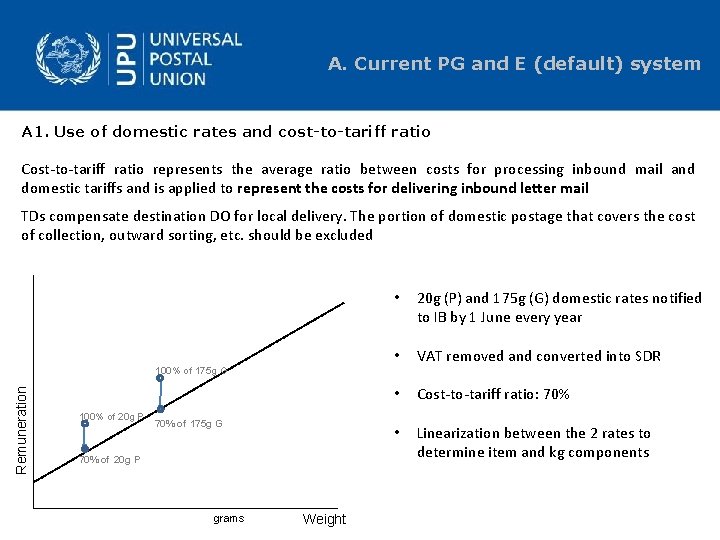
A. Current PG and E (default) system A 1. Use of domestic rates and cost-to-tariff ratio Cost-to-tariff ratio represents the average ratio between costs for processing inbound mail and domestic tariffs and is applied to represent the costs for delivering inbound letter mail TDs compensate destination DO for local delivery. The portion of domestic postage that covers the cost of collection, outward sorting, etc. should be excluded • 20 g (P) and 175 g (G) domestic rates notified to IB by 1 June every year • VAT removed and converted into SDR • Cost-to-tariff ratio: 70% • Linearization between the 2 rates to determine item and kg components Remuneration 100% of 175 g G 100% of 20 g P 70% of 175 g G 70% of 20 g P grams Weight © UPU 2019 – All rights reserved
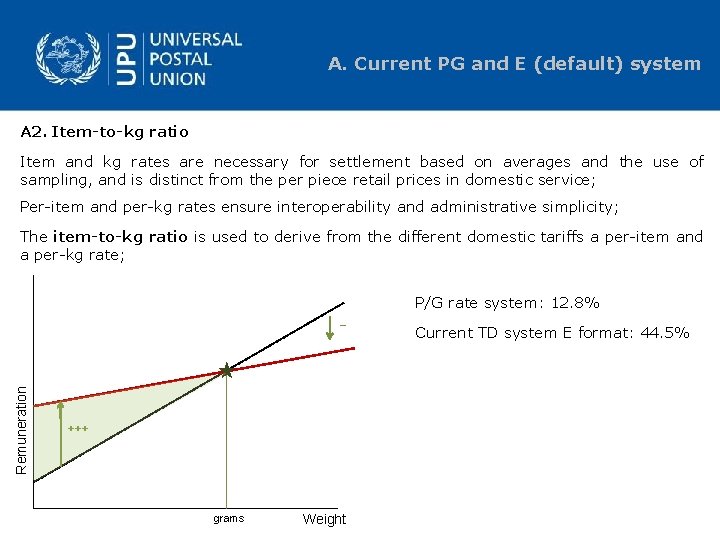
A. Current PG and E (default) system A 2. Item-to-kg ratio Item and kg rates are necessary for settlement based on averages and the use of sampling, and is distinct from the per piece retail prices in domestic service; Per item and per kg rates ensure interoperability and administrative simplicity; The item-to-kg ratio is used to derive from the different domestic tariffs a per item and a per kg rate; P/G rate system: 12. 8% Remuneration − Current TD system E format: 44. 5% +++ grams Weight © UPU 2019 – All rights reserved
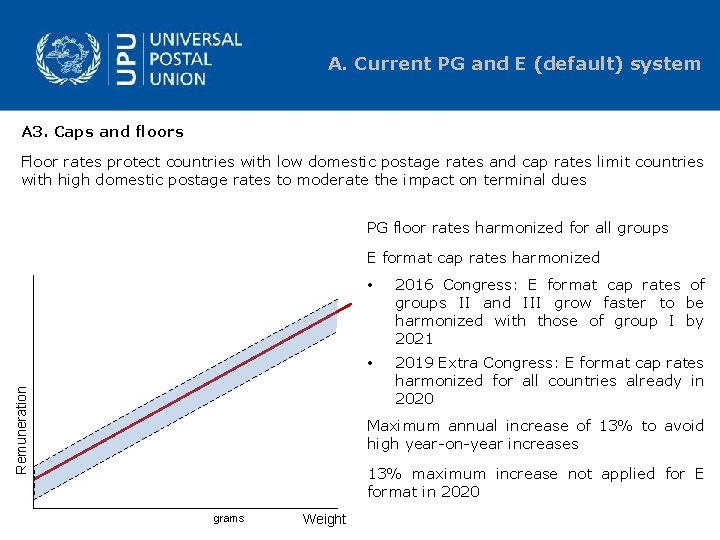
A. Current PG and E (default) system A 3. Caps and floors Floor rates protect countries with low domestic postage rates and cap rates limit countries with high domestic postage rates to moderate the impact on terminal dues PG floor rates harmonized for all groups Remuneration E format cap rates harmonized • 2016 Congress: E format cap rates of groups II and III grow faster to be harmonized with those of group I by 2021 • 2019 Extra Congress: E format cap rates harmonized for all countries already in 2020 Maximum annual increase of 13% to avoid high year on year increases 13% maximum increase not applied for E format in 2020 grams Weight © UPU 2019 – All rights reserved
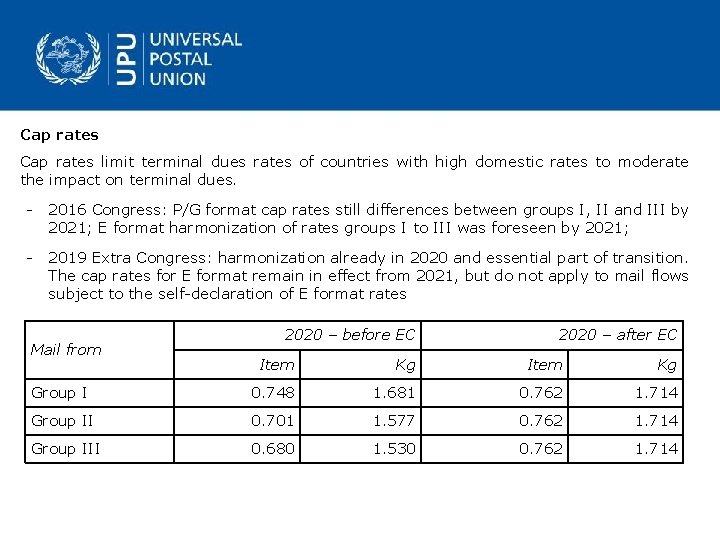
Cap rates limit terminal dues rates of countries with high domestic rates to moderate the impact on terminal dues. 2016 Congress: P/G format cap rates still differences between groups I, II and III by 2021; E format harmonization of rates groups I to III was foreseen by 2021; 2019 Extra Congress: harmonization already in 2020 and essential part of transition. The cap rates for E format remain in effect from 2021, but do not apply to mail flows subject to the self declaration of E format rates Mail from 2020 – before EC 2020 – after EC Item Kg Group I 0. 748 1. 681 0. 762 1. 714 Group II 0. 701 1. 577 0. 762 1. 714 Group III 0. 680 1. 530 0. 762 1. 714 © UPU 2019 – All rights reserved
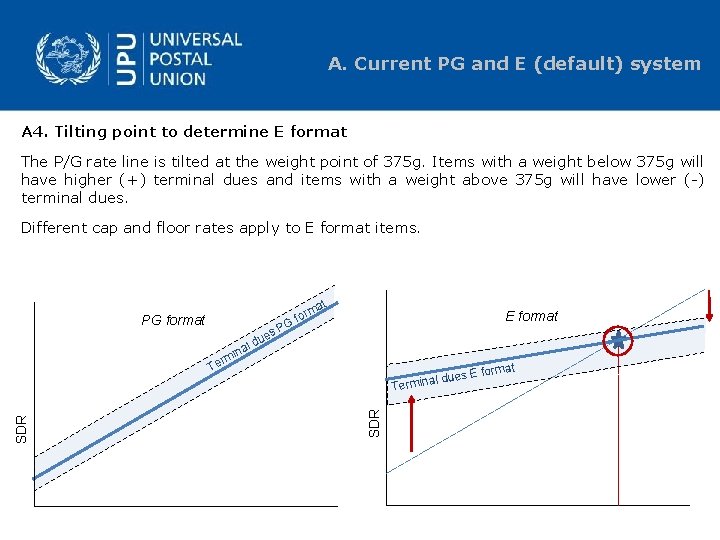
A. Current PG and E (default) system A 4. Tilting point to determine E format The P/G rate line is tilted at the weight point of 375 g. Items with a weight below 375 g will have higher (+) terminal dues and items with a weight above 375 g will have lower ( ) terminal dues. Different cap and floor rates apply to E format items. at PG format l na mi G s. P m for E format e du r Te dues E erminal format SDR T © UPU 2019 – All rights reserved
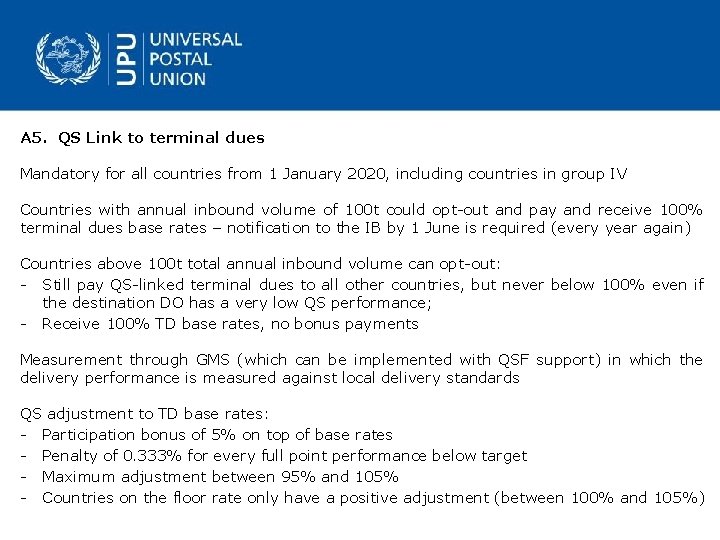
A 5. QS Link to terminal dues Mandatory for all countries from 1 January 2020, including countries in group IV Countries with annual inbound volume of 100 t could opt out and pay and receive 100% terminal dues base rates – notification to the IB by 1 June is required (every year again) Countries above 100 t total annual inbound volume can opt out: Still pay QS linked terminal dues to all other countries, but never below 100% even if the destination DO has a very low QS performance; Receive 100% TD base rates, no bonus payments Measurement through GMS (which can be implemented with QSF support) in which the delivery performance is measured against local delivery standards QS adjustment to TD base rates: Participation bonus of 5% on top of base rates Penalty of 0. 333% for every full point performance below target Maximum adjustment between 95% and 105% Countries on the floor rate only have a positive adjustment (between 100% and 105%) © UPU 2019 – All rights reserved
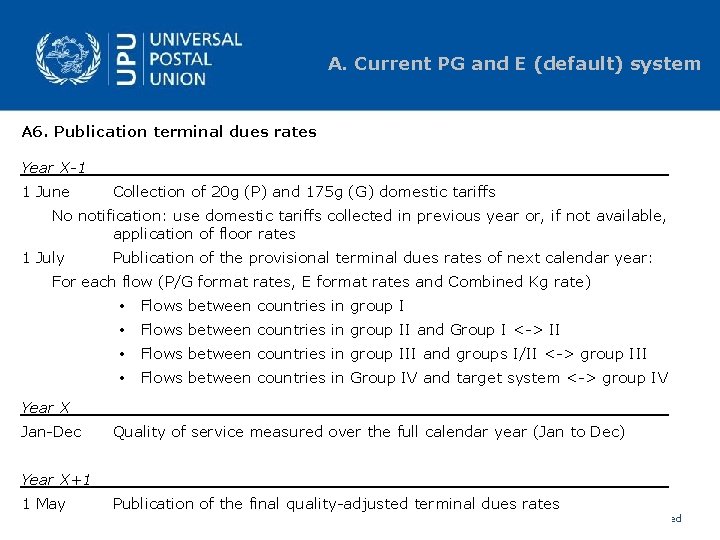
A. Current PG and E (default) system A 6. Publication terminal dues rates Year X-1 1 June Collection of 20 g (P) and 175 g (G) domestic tariffs No notification: use domestic tariffs collected in previous year or, if not available, application of floor rates 1 July Publication of the provisional terminal dues rates of next calendar year: For each flow (P/G format rates, E format rates and Combined Kg rate) • Flows between countries in group II and Group I < > II • Flows between countries in group III and groups I/II < > group III • Flows between countries in Group IV and target system < > group IV Year X Jan Dec Quality of service measured over the full calendar year (Jan to Dec) Year X+1 1 May Publication of the final quality adjusted terminal dues rates © UPU 2019 – All rights reserved
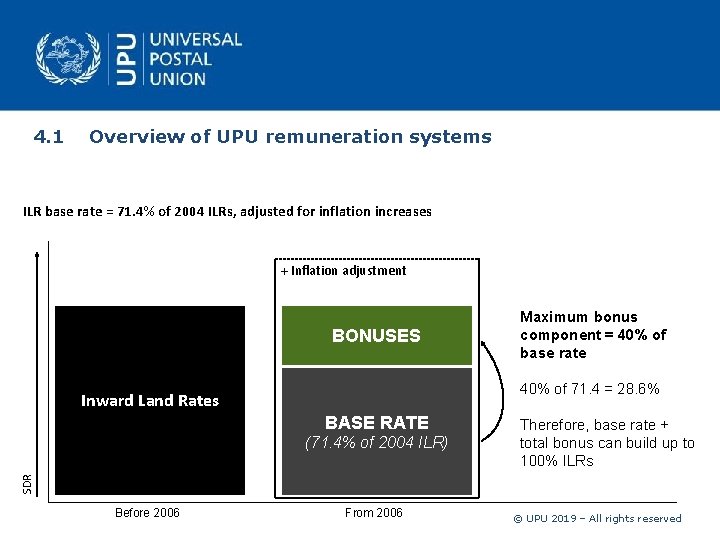
4. 1 Overview of UPU remuneration systems ILR base rate = 71. 4% of 2004 ILRs, adjusted for inflation increases + Inflation adjustment BONUSES Maximum bonus component = 40% of base rate 40% of 71. 4 = 28. 6% Inward Land Rates BASE RATE SDR (71. 4% of 2004 ILR) Therefore, base rate + total bonus can build up to 100% ILRs Before 2006 From 2006 © UPU 2019 – All rights reserved
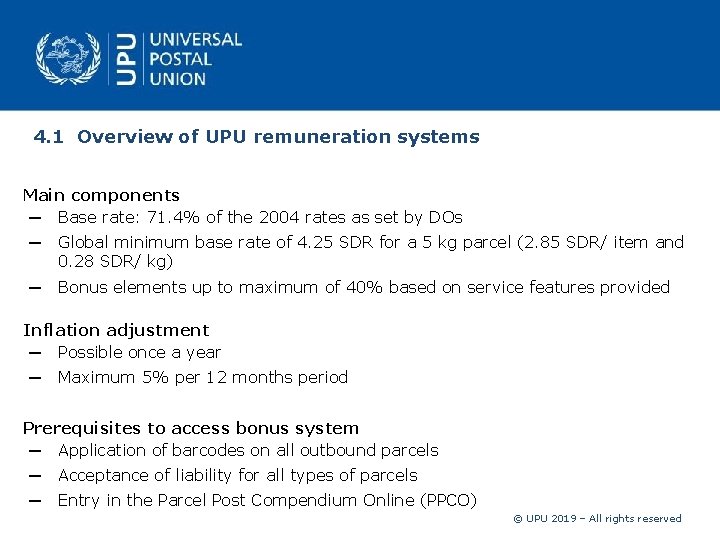
4. 1 Overview of UPU remuneration systems Main components ─ Base rate: 71. 4% of the 2004 rates as set by DOs ─ Global minimum base rate of 4. 25 SDR for a 5 kg parcel (2. 85 SDR/ item and 0. 28 SDR/ kg) ─ Bonus elements up to maximum of 40% based on service features provided Inflation adjustment ─ Possible once a year ─ Maximum 5% per 12 months period Prerequisites to access bonus system ─ Application of barcodes on all outbound parcels ─ Acceptance of liability for all types of parcels ─ Entry in the Parcel Post Compendium Online (PPCO) © UPU 2019 – All rights reserved
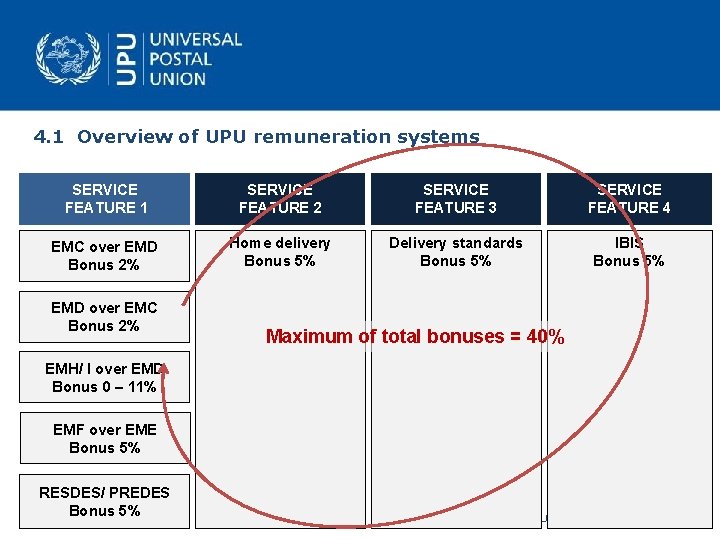
4. 1 Overview of UPU remuneration systems SERVICE FEATURE 1 SERVICE FEATURE 2 SERVICE FEATURE 3 SERVICE FEATURE 4 EMC over EMD Bonus 2% Home delivery Bonus 5% Delivery standards Bonus 5% IBIS Bonus 5% EMD over EMC Bonus 2% Maximum of total bonuses = 40% EMH/ I over EMD Bonus 0 – 11% EMF over EME Bonus 5% RESDES/ PREDES Bonus 5% © UPU 2019 – All rights reserved
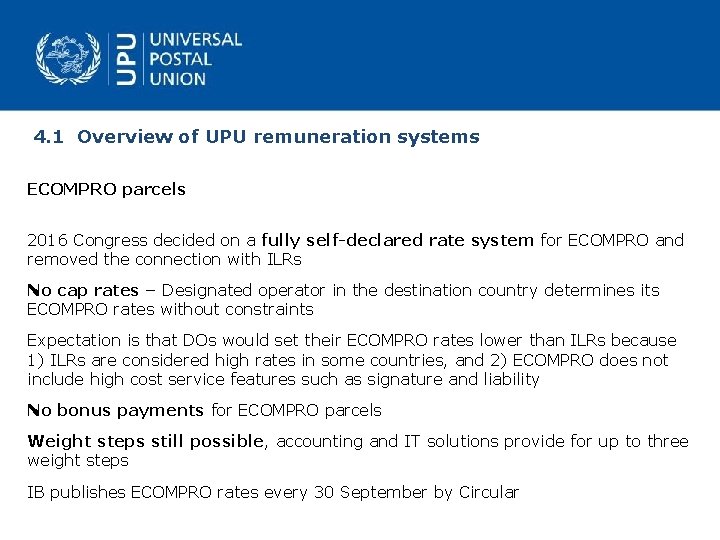
4. 1 Overview of UPU remuneration systems ECOMPRO parcels 2016 Congress decided on a fully self-declared rate system for ECOMPRO and removed the connection with ILRs No cap rates – Designated operator in the destination country determines its ECOMPRO rates without constraints Expectation is that DOs would set their ECOMPRO rates lower than ILRs because 1) ILRs are considered high rates in some countries, and 2) ECOMPRO does not include high cost service features such as signature and liability No bonus payments for ECOMPRO parcels Weight steps still possible, accounting and IT solutions provide for up to three weight steps IB publishes ECOMPRO rates every 30 September by Circular © UPU 2019 – All rights reserved

4. 2 Outcomes Third Extraordinary Congress on the review of E format remuneration © UPU 2019 – All rights reserved
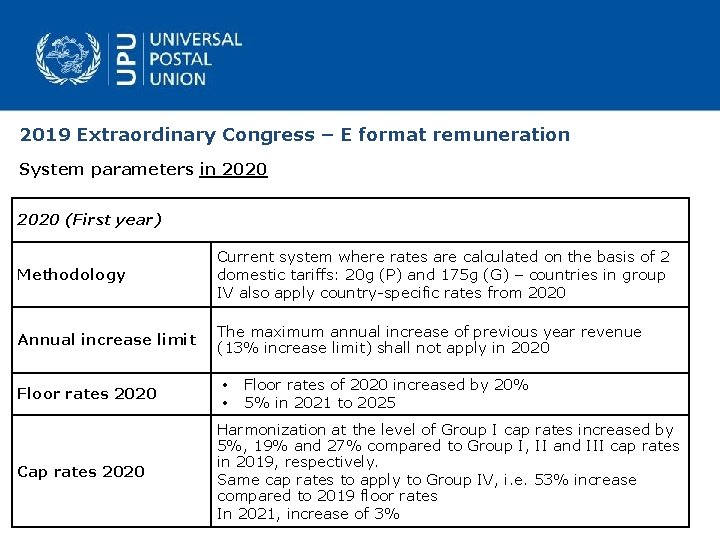
2019 Extraordinary Congress – E format remuneration System parameters in 2020 (First year) Methodology Current system where rates are calculated on the basis of 2 domestic tariffs: 20 g (P) and 175 g (G) – countries in group IV also apply country specific rates from 2020 Annual increase limit The maximum annual increase of previous year revenue (13% increase limit) shall not apply in 2020 Floor rates 2020 Cap rates 2020 • • Floor rates of 2020 increased by 20% 5% in 2021 to 2025 Harmonization at the level of Group I cap rates increased by 5%, 19% and 27% compared to Group I, II and III cap rates in 2019, respectively. Same cap rates to apply to Group IV, i. e. 53% increase compared to 2019 floor rates In 2021, increase of 3% © UPU 2019 – All rights reserved
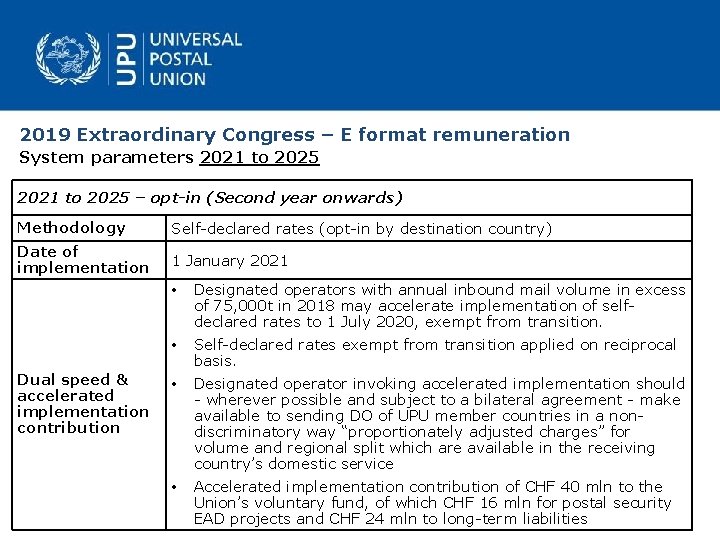
2019 Extraordinary Congress – E format remuneration System parameters 2021 to 2025 – opt-in (Second year onwards) Methodology Self declared rates (opt in by destination country) Date of implementation 1 January 2021 Dual speed & accelerated implementation contribution • Designated operators with annual inbound mail volume in excess of 75, 000 t in 2018 may accelerate implementation of self declared rates to 1 July 2020, exempt from transition. • Self declared rates exempt from transition applied on reciprocal basis. • Designated operator invoking accelerated implementation should wherever possible and subject to a bilateral agreement make available to sending DO of UPU member countries in a non discriminatory way “proportionately adjusted charges” for volume and regional split which are available in the receiving country’s domestic service • Accelerated implementation contribution of CHF 40 mln to the Union’s voluntary fund, of which CHF 16 mln for postal security UPU 2019 – All rights reserved EAD projects and CHF 24 mln to long term©liabilities
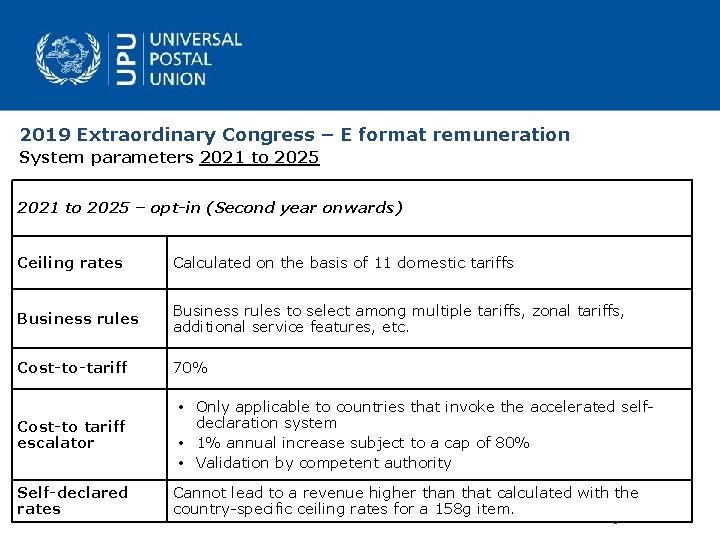
2019 Extraordinary Congress – E format remuneration System parameters 2021 to 2025 – opt-in (Second year onwards) Ceiling rates Calculated on the basis of 11 domestic tariffs Business rules to select among multiple tariffs, zonal tariffs, additional service features, etc. Cost-to-tariff 70% Cost-to tariff escalator Self-declared rates • Only applicable to countries that invoke the accelerated self declaration system • 1% annual increase subject to a cap of 80% • Validation by competent authority Cannot lead to a revenue higher than that calculated with the country specific ceiling rates for a 158 g item. © UPU 2019 – All rights reserved
4. 3 Implementation of E format remuneration © UPU 2019 – All rights reserved
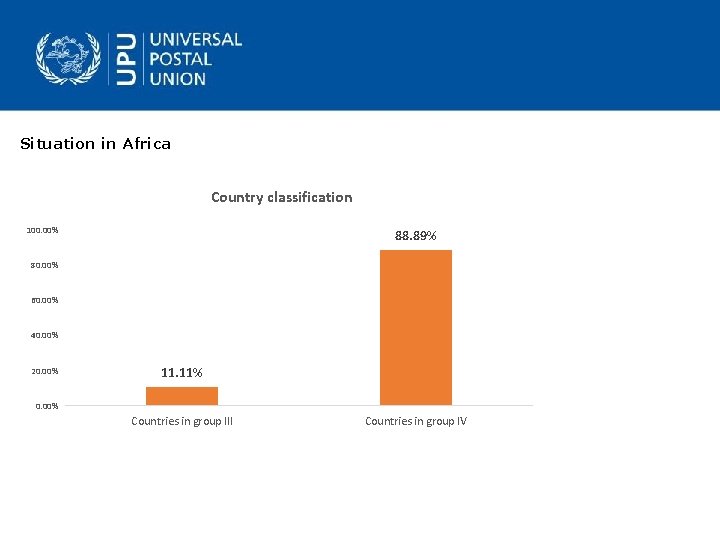
Situation in Africa Country classification 100. 00% 88. 89% 80. 00% 60. 00% 40. 00% 20. 00% 11. 11% 0. 00% Countries in group III Countries in group IV © UPU 2019 – All rights reserved
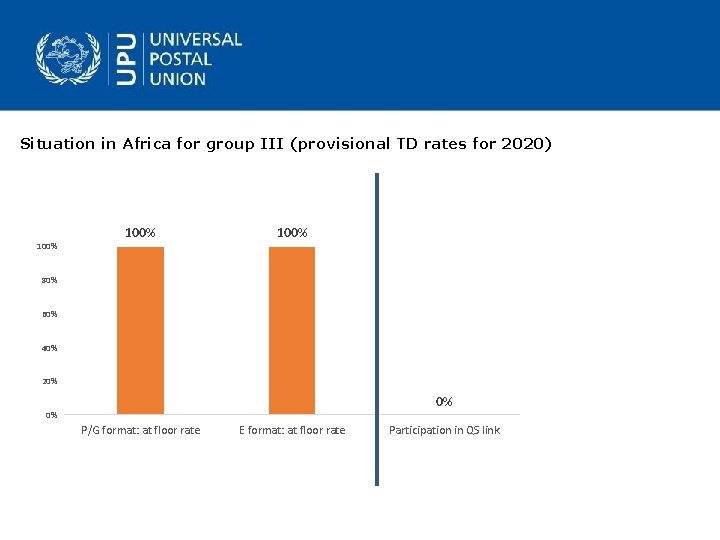
Situation in Africa for group III (provisional TD rates for 2020) 100% 80% 60% 40% 20% 0% 0% P/G format: at floor rate E format: at floor rate Participation in QS link © UPU 2019 – All rights reserved
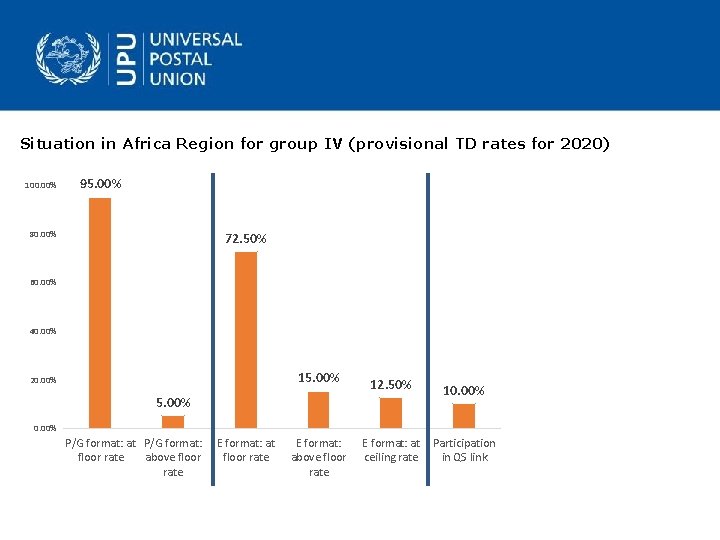
Situation in Africa Region for group IV (provisional TD rates for 2020) 100. 00% 95. 00% 80. 00% 72. 50% 60. 00% 40. 00% 15. 00% 20. 00% 12. 50% 5. 00% 10. 00% P/G format: at P/G format: floor rate above floor rate E format: at floor rate E format: above floor rate E format: at ceiling rate Participation in QS link © UPU 2019 – All rights reserved
Self-declaration of E format rates Countries have the choice to opt in to self declared rate system Any country opting out or does not respond to the consultation by the IB will apply the conditions and rates of the current system The rates will apply to all countries equally, i. e. a destination DO cannot self declare TD rates for one flow and opt out on other flows (except for particular flows below certain thresholds as defined in the Convention) Self declared rates are expressed in a per-item and per-kilogramme rate in local currency and shall not exceed the country specific ceiling rates and/ or maximum increases (next slides) The IB will convert the self declared rates into SDR values • Flows to/from the US: self declared rates could be implemented from 1 July 2020 (notification deadline 1 March 2020) • All other flows: self declared rates could be implemented from 1 January 2021 (notification deadline 1 June 2020) © UPU 2019 – All rights reserved
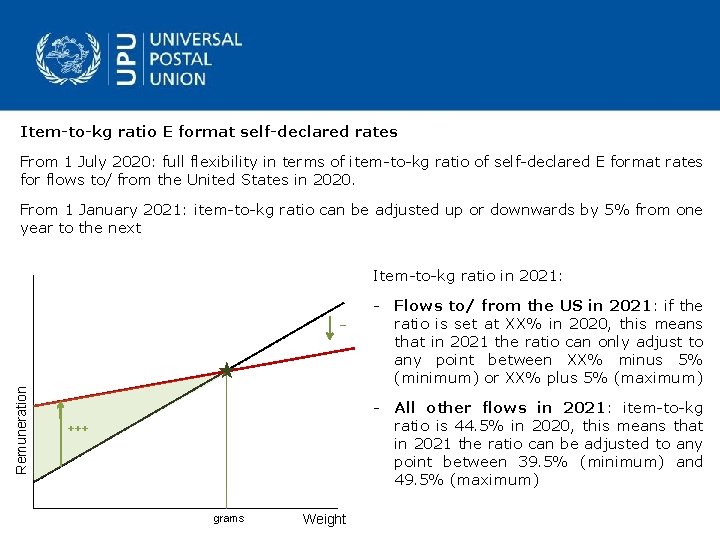
Item-to-kg ratio E format self-declared rates From 1 July 2020: full flexibility in terms of item to kg ratio of self declared E format rates for flows to/ from the United States in 2020. From 1 January 2021: item to kg ratio can be adjusted up or downwards by 5% from one year to the next Item to kg ratio in 2021: Remuneration − Flows to/ from the US in 2021: if the ratio is set at XX% in 2020, this means that in 2021 the ratio can only adjust to any point between XX% minus 5% (minimum) or XX% plus 5% (maximum) All other flows in 2021: item to kg ratio is 44. 5% in 2020, this means that in 2021 the ratio can be adjusted to any point between 39. 5% (minimum) and 49. 5% (maximum) +++ grams Weight © UPU 2019 – All rights reserved
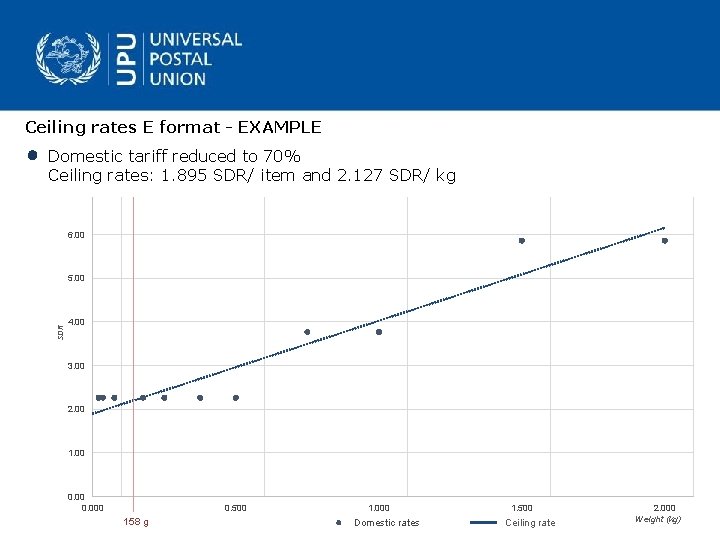
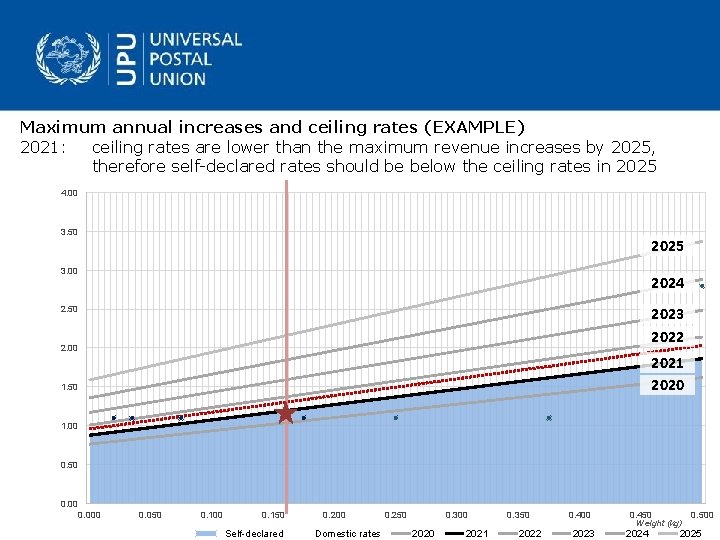
Ceiling rates E format Ceiling rates are country specific cap rates, based on 11 domestic tariffs as follows: • Tariffs of domestic equivalent E format items at 11 weight points 20 g, 35 g, 75 g, 175 g, 250 g, 375 g, 500 g, 750 g, 1 kg, 1. 5 kg and 2 kg • Calculated as per item and per kg rate through linear regression of aforementioned domestic rates at 70% (cost to tariff ratio, see next slide) • Follows technical business rules for selection of domestic tariffs, for zonal pricing, service features, etc. A country can self declare any rate as long as these rates are: Not higher than its ceiling rates Not increase with more than the maximum annual increase % (transition) Assessment at weight point of 158 g (average weight E format item) as follows: 1. Ceiling rate: item rate + 0. 158 * kg rate = ceiling rate revenue 2. Maximum increase: last year revenue at 158 g + X% = possible max revenue 3. Self declared rates: item rate + 0. 158 * kg rate = self declared revenue Self declared revenue at 158 g cannot exceed the lowest between 1) and 2) © UPU 2019 – All rights reserved
Selection of 11 domestic tariffs (business rules) • Domestic tariffs: 20 g, 35 g, 75 g, 175 g, 250 g, 375 g, 500 g, 750 g, 1 kg, 1. 5 kg and 2 kg in local currency • Zonal rates: use either the mid point rate or determine the rate according to the delivery zone that is located within the average internal conveyance distance • Multiple domestic tariffs: when multiple packet domestic tariffs based on thickness are available: applies the lesser for items up to 250 g and the higher for items above 250 g • Service features: • Service features such as tracking and signature (registration) should not be remunerated in the basic rates that are used to calculate the ceiling rates. • Reason: these service features are remunerated separately under the UPU Acts and double / over remuneration should be avoided • In case service features are included in the basic price, then the amounts in the UPU Acts are removed, but never more than 25% of the basic rate. Alternatively, removal of the domestic charge for the service feature. © UPU 2019 – All rights reserved
Cost-to-tariff ratio Cost to tariff ratio represents the average ratio between costs for processing inbound mail and domestic tariffs Opt-out: E format in the current system P/G and E format: 70% of 20 g (P) and 175 g (G) domestic rates Opt-in: E format self-declared rate system: • All flows except to and from the United States: the E format ceiling rates are based on 70% of domestic charges (all countries opting in) • Flows to and from the United States: • The E format ceiling rates are based on 70% of domestic charges in 2020 • Cost to tariff escalator: 1% annual increase subject to a cap of 80% (71% in 2021, 72% in 2022) • Escalator only applies if handling and delivery costs exceeds 70% of domestic tariff • • Reciprocity of this clause – mechanism works in both directions Validation by competent authority © UPU 2019 – All rights reserved
Ceiling rates E format - EXAMPLE Domestic tariff reduced to 70% Ceiling rates: 1. 895 SDR/ item and 2. 127 SDR/ kg 7. 00 6. 00 SDR 5. 00 4. 00 3. 00 2. 00 1. 00 0. 000 0. 500 158 g 1. 000 Domestic rates 1. 500 2. 000 © UPU reserved (kg) Ceiling rate 2019 – All rights Weight
Maximum annual increases (transition) Current system: P/G rates: max. annual increase of 13% E format rates: max. annual increase of 13% (except in 2020) E Format Self-declaration of rates: 2020 harmonized E format rates are published in IB circular 113/2019 – replacement of 16 December 2019 Maximum annual increases of revenue of average E format item (at 158 g): 2021: 15%, 2022: 15%, 2023: 16%, 2024: 16%, 2025: 17% Cumulative: 119% (Group I), 148% (Group II) and 164% (Group III) Maximum annual increases do not apply to self-declared E format rates for flows to and from the United States © UPU 2019 – All rights reserved
Maximum annual increases (transition) E Format Self-declaration of rates: EXAMPLE 1. Country X applies E format cap rates in 2020 (IB circular 113/2019) 0. 762 SDR/ item and 1. 714 SDR/ kg (revenue: 1. 033 SDR at 158 g) 2. Maximum revenue increase in 2021 compared to 2020: 15% 1. 033 SDR + 15% = 1. 188 SDR at 158 g 3. Ceiling rate calculated on the basis of 70% of 11 domestic tariffs: 0. 957 (item) and 2. 151 (kg) 4. Ceiling revenue at 158 g is 0. 957 + 0. 158 * 2. 151 SDR = 1. 297 SDR © UPU 2019 – All rights reserved
Maximum annual increases and ceiling rates (EXAMPLE) 2021: ceiling rates are lower than the maximum revenue increases by 2025, therefore self declared rates should be below the ceiling rates in 2025 4. 00 3. 50 2025 3. 00 2024 2023 2022 2. 50 2. 00 2021 2020 1. 50 1. 00 0. 50 0. 000 0. 050 0. 100 0. 150 Self-declared 0. 200 Domestic rates 0. 250 0. 300 2021 0. 350 0. 400 0. 500 © UPU 2019 – All rights 0. 450 reserved Weight (kg) 2022 2023 2024 2025
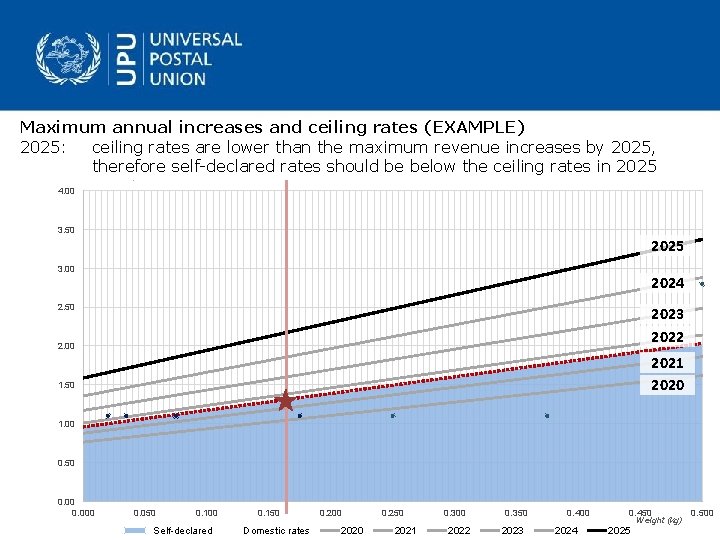
Maximum annual increases and ceiling rates (EXAMPLE) 2025: ceiling rates are lower than the maximum revenue increases by 2025, therefore self declared rates should be below the ceiling rates in 2025 4. 00 3. 50 2025 3. 00 2024 2. 50 2023 2022 2. 00 2021 2020 1. 50 1. 00 0. 50 0. 000 0. 050 0. 100 Self-declared 0. 150 Domestic rates 0. 200 2020 0. 250 2021 0. 300 2022 0. 350 0. 400 0. 450 © UPU 2019 – All rights Weight reserved (kg) 2023 2024 2025 0. 500
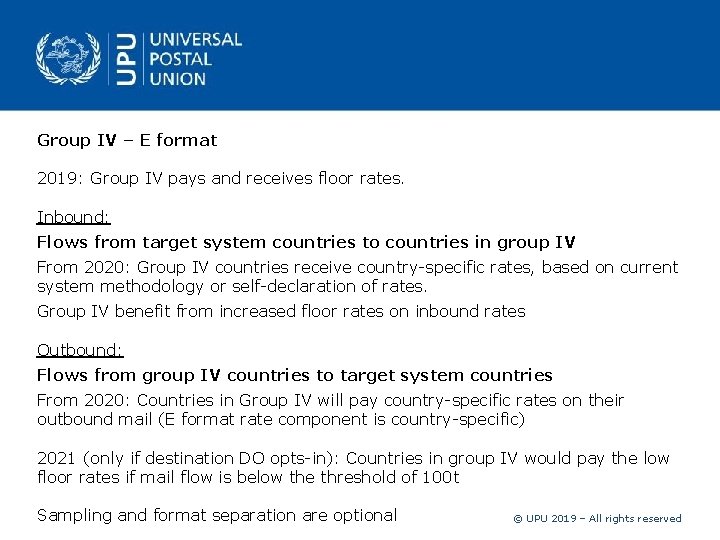
Group IV – E format 2019: Group IV pays and receives floor rates. Inbound: Flows from target system countries to countries in group IV From 2020: Group IV countries receive country specific rates, based on current system methodology or self declaration of rates. Group IV benefit from increased floor rates on inbound rates Outbound: Flows from group IV countries to target system countries From 2020: Countries in Group IV will pay country specific rates on their outbound mail (E format rate component is country specific) 2021 (only if destination DO opts in): Countries in group IV would pay the low floor rates if mail flow is below the threshold of 100 t Sampling and format separation are optional © UPU 2019 – All rights reserved
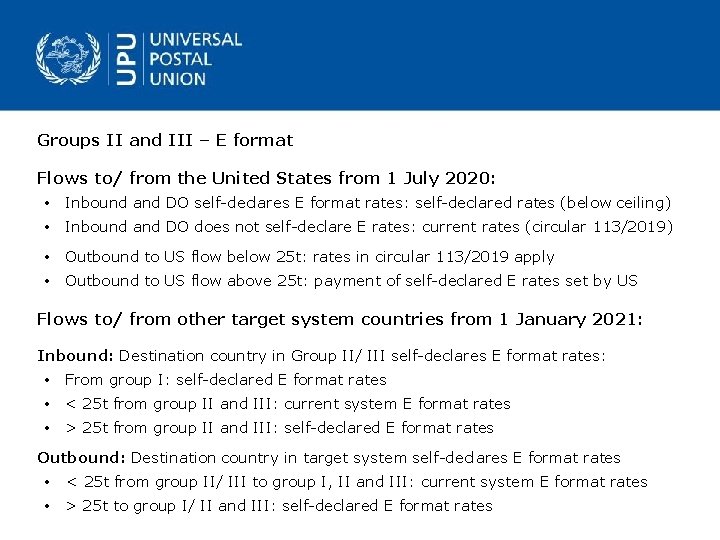
Groups II and III – E format Flows to/ from the United States from 1 July 2020: • Inbound and DO self declares E format rates: self declared rates (below ceiling) • Inbound and DO does not self declare E rates: current rates (circular 113/2019) • Outbound to US flow below 25 t: rates in circular 113/2019 apply • Outbound to US flow above 25 t: payment of self declared E rates set by US Flows to/ from other target system countries from 1 January 2021: Inbound: Destination country in Group II/ III self declares E format rates: • From group I: self declared E format rates • < 25 t from group II and III: current system E format rates • > 25 t from group II and III: self declared E format rates Outbound: Destination country in target system self declares E format rates • < 25 t from group II/ III to group I, II and III: current system E format rates • > 25 t to group I/ II and III: self declared E format rates © UPU 2019 – All rights reserved
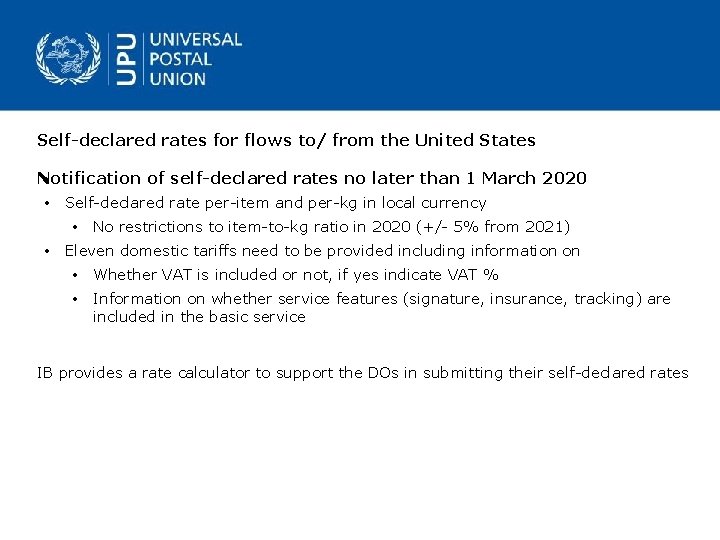
Self-declared rates for flows to/ from the United States Notification of self-declared rates no later than 1 March 2020 • Self declared rate per item and per kg in local currency • • No restrictions to item to kg ratio in 2020 (+/ 5% from 2021) Eleven domestic tariffs need to be provided including information on • Whether VAT is included or not, if yes indicate VAT % • Information on whether service features (signature, insurance, tracking) are included in the basic service IB provides a rate calculator to support the DOs in submitting their self declared rates © UPU 2019 – All rights reserved
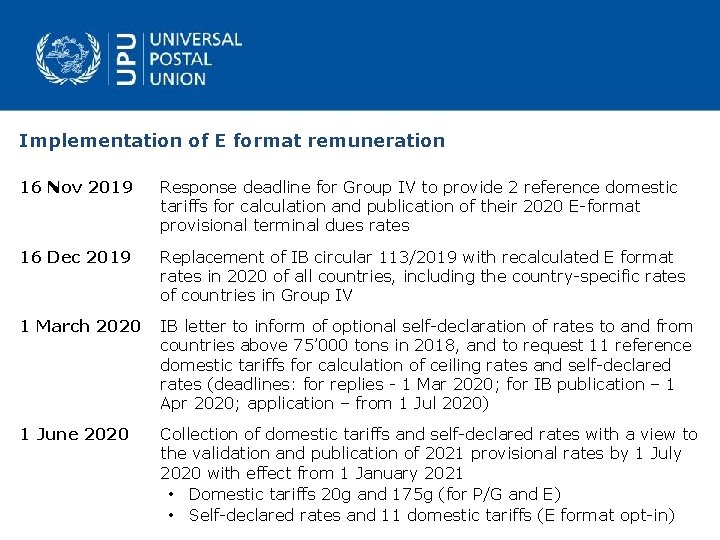
Implementation of E format remuneration 16 Nov 2019 Response deadline for Group IV to provide 2 reference domestic tariffs for calculation and publication of their 2020 E format provisional terminal dues rates 16 Dec 2019 Replacement of IB circular 113/2019 with recalculated E format rates in 2020 of all countries, including the country specific rates of countries in Group IV 1 March 2020 IB letter to inform of optional self declaration of rates to and from countries above 75’ 000 tons in 2018, and to request 11 reference domestic tariffs for calculation of ceiling rates and self declared rates (deadlines: for replies 1 Mar 2020; for IB publication – 1 Apr 2020; application – from 1 Jul 2020) 1 June 2020 Collection of domestic tariffs and self declared rates with a view to the validation and publication of 2021 provisional rates by 1 July 2020 with effect from 1 January 2021 • Domestic tariffs 20 g and 175 g (for P/G and E) • Self declared rates and 11 domestic tariffs (E 2019 format opt in) © UPU – All rights reserved

4. 4 Further work on the implementation of E format remuneration © UPU 2019 – All rights reserved
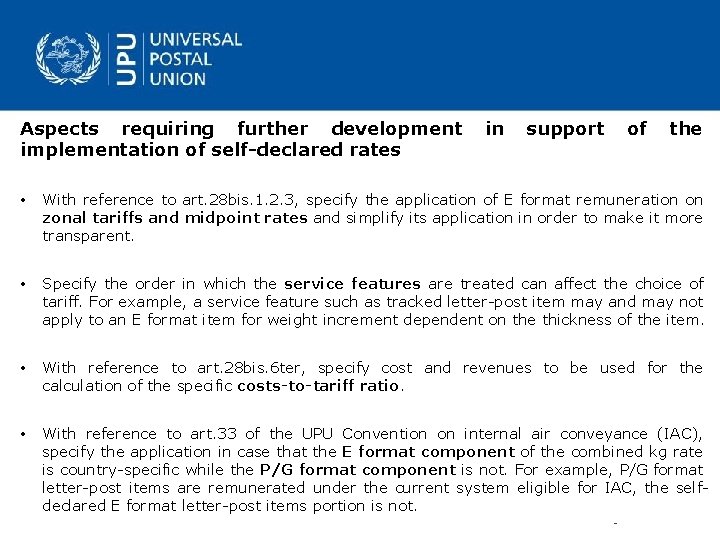
Aspects requiring further development implementation of self-declared rates in support of the • With reference to art. 28 bis. 1. 2. 3, specify the application of E format remuneration on zonal tariffs and midpoint rates and simplify its application in order to make it more transparent. • Specify the order in which the service features are treated can affect the choice of tariff. For example, a service feature such as tracked letter post item may and may not apply to an E format item for weight increment dependent on the thickness of the item. • With reference to art. 28 bis. 6 ter, specify cost and revenues to be used for the calculation of the specific costs-to-tariff ratio. • With reference to art. 33 of the UPU Convention on internal air conveyance (IAC), specify the application in case that the E format component of the combined kg rate is country specific while the P/G format component is not. For example, P/G format letter post items are remunerated under the current system eligible for IAC, the self declared E format letter post items portion is not. © UPU 2019 – All rights reserved
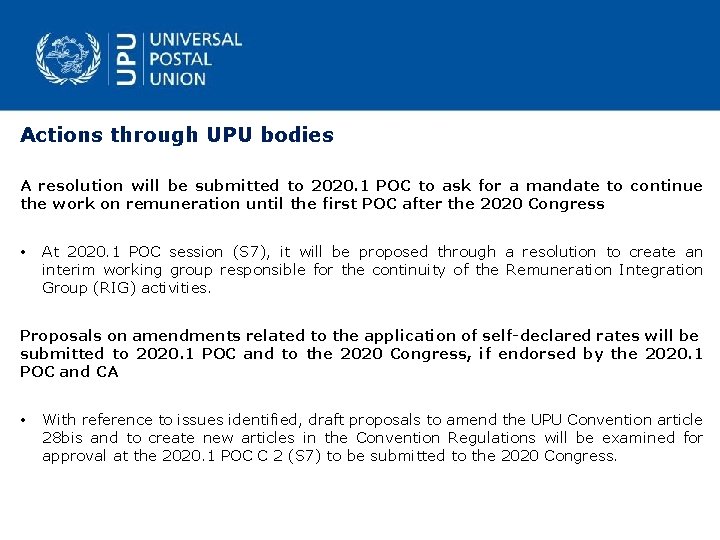
Actions through UPU bodies A resolution will be submitted to 2020. 1 POC to ask for a mandate to continue the work on remuneration until the first POC after the 2020 Congress • At 2020. 1 POC session (S 7), it will be proposed through a resolution to create an interim working group responsible for the continuity of the Remuneration Integration Group (RIG) activities. Proposals on amendments related to the application of self-declared rates will be submitted to 2020. 1 POC and to the 2020 Congress, if endorsed by the 2020. 1 POC and CA • With reference to issues identified, draft proposals to amend the UPU Convention article 28 bis and to create new articles in the Convention Regulations will be examined for approval at the 2020. 1 POC C 2 (S 7) to be submitted to the 2020 Congress. © UPU 2019 – All rights reserved
4. 5 Rate calculation tool – Examples of calculation © UPU 2019 – All rights reserved
Worksheet named Local Calculator • The IB will collect self declared rates in the local currency • The conversion into SDR will only be done at the very end and that the guideline charges for service features will need to be converted from SDR into local currency in order to deduct them from the domestic rates expressed in local currency • The assessment of self declared rates against the ceiling rates will also be done in local currency • Only the self declared rates will be converted into SDR at the end of the exercise © UPU 2019 – All rights reserved
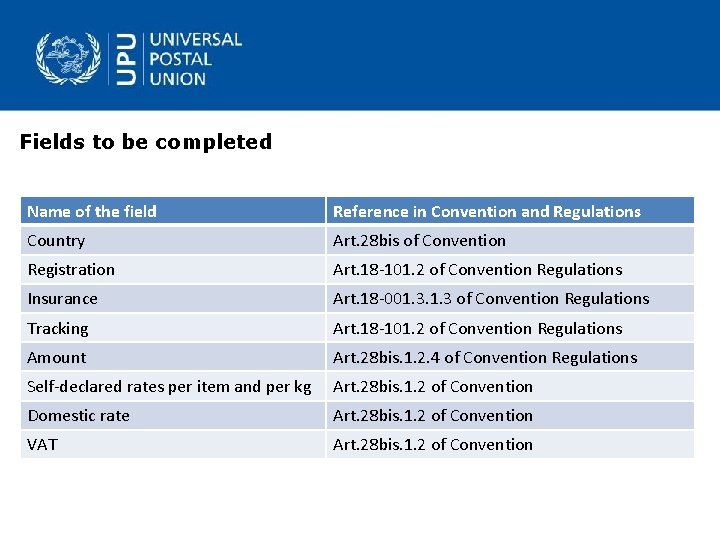
Fields to be completed Name of the field Reference in Convention and Regulations Country Art. 28 bis of Convention Registration Art. 18 -101. 2 of Convention Regulations Insurance Art. 18 -001. 3 of Convention Regulations Tracking Art. 18 -101. 2 of Convention Regulations Amount Art. 28 bis. 1. 2. 4 of Convention Regulations Self-declared rates per item and per kg Art. 28 bis. 1. 2 of Convention Domestic rate Art. 28 bis. 1. 2 of Convention VAT Art. 28 bis. 1. 2 of Convention © UPU 2019 – All rights reserved
- Slides: 81