
Regional Resource Efficient and Cleaner Production Demonstration Component
- Slides: 14
Regional Resource Efficient and Cleaner Production Demonstration Component Ea. P GREEN Program Malkhaz Adeishvili National Coordinator in Georgia 26 June, 2014
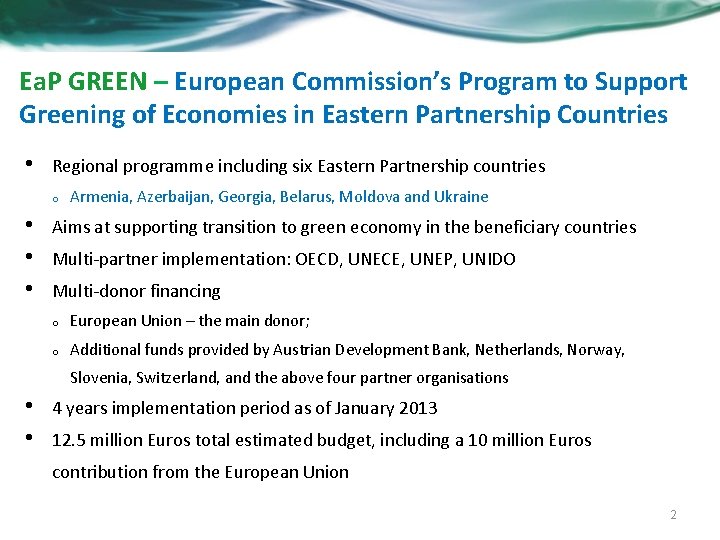
Ea. P GREEN – European Commission’s Program to Support Greening of Economies in Eastern Partnership Countries • Regional programme including six Eastern Partnership countries o • • • Armenia, Azerbaijan, Georgia, Belarus, Moldova and Ukraine Aims at supporting transition to green economy in the beneficiary countries Multi-partner implementation: OECD, UNECE, UNEP, UNIDO Multi-donor financing o European Union – the main donor; o Additional funds provided by Austrian Development Bank, Netherlands, Norway, Slovenia, Switzerland, and the above four partner organisations • • 4 years implementation period as of January 2013 12. 5 million Euros total estimated budget, including a 10 million Euros contribution from the European Union 2
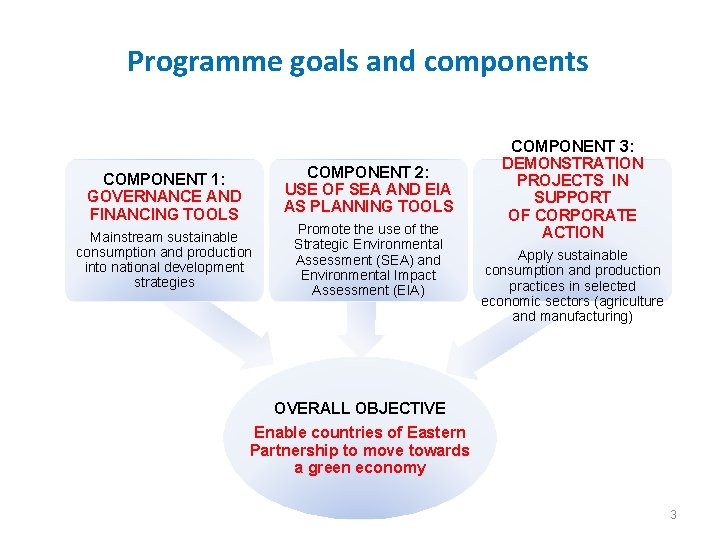
Programme goals and components COMPONENT 2: USE OF SEA AND EIA AS PLANNING TOOLS COMPONENT 1: GOVERNANCE AND FINANCING TOOLS Mainstream sustainable consumption and production into national development strategies Promote the use of the Strategic Environmental Assessment (SEA) and Environmental Impact Assessment (EIA) COMPONENT 3: DEMONSTRATION PROJECTS IN SUPPORT OF CORPORATE ACTION Apply sustainable consumption and production practices in selected economic sectors (agriculture and manufacturing) OVERALL OBJECTIVE Enable countries of Eastern Partnership to move towards a green economy 3
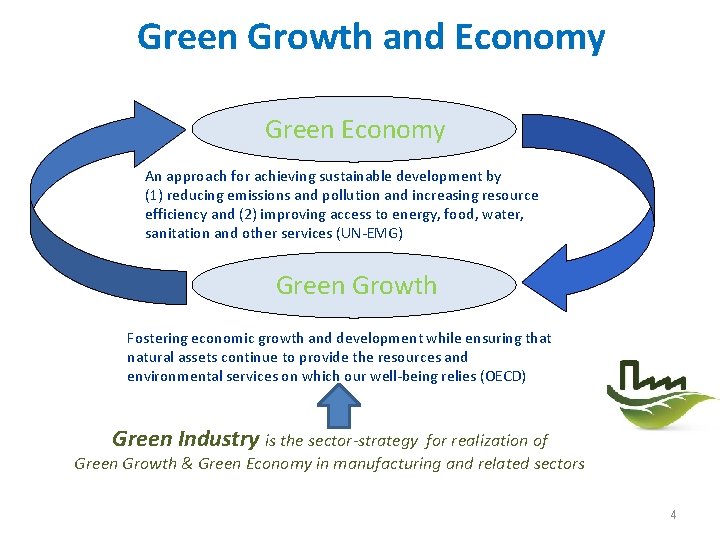
Green Growth and Economy Green Economy An approach for achieving sustainable development by (1) reducing emissions and pollution and increasing resource efficiency and (2) improving access to energy, food, water, sanitation and other services (UN-EMG) Green Growth Fostering economic growth and development while ensuring that natural assets continue to provide the resources and environmental services on which our well-being relies (OECD) Green Industry is the sector-strategy for realization of Green Growth & Green Economy in manufacturing and related sectors 4
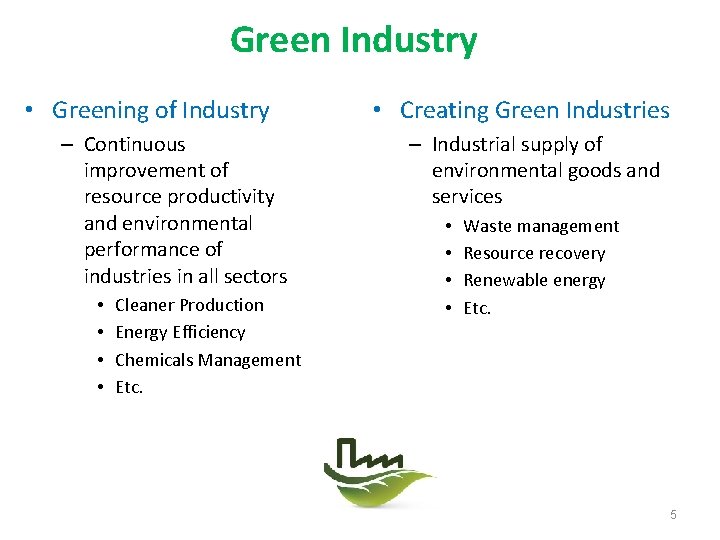
Green Industry • Greening of Industry – Continuous improvement of resource productivity and environmental performance of industries in all sectors • • Cleaner Production Energy Efficiency Chemicals Management Etc. • Creating Green Industries – Industrial supply of environmental goods and services • • Waste management Resource recovery Renewable energy Etc. 5
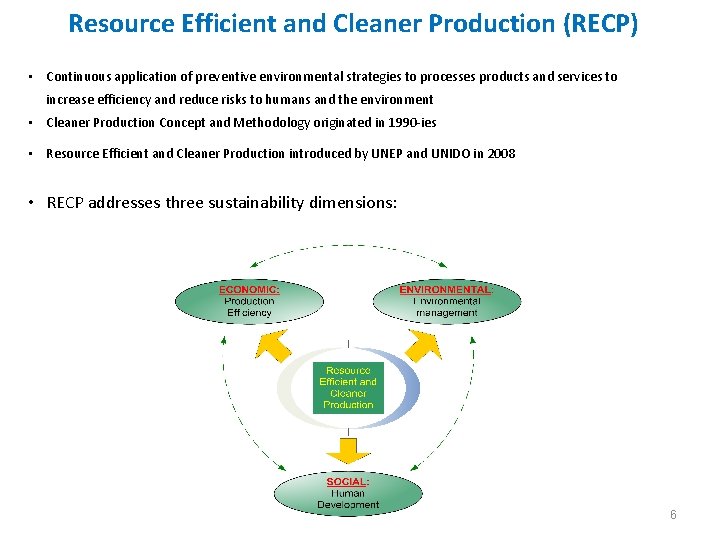
Resource Efficient and Cleaner Production (RECP) • Continuous application of preventive environmental strategies to processes products and services to increase efficiency and reduce risks to humans and the environment • Cleaner Production Concept and Methodology originated in 1990 -ies • Resource Efficient and Cleaner Production introduced by UNEP and UNIDO in 2008 • RECP addresses three sustainability dimensions: 6
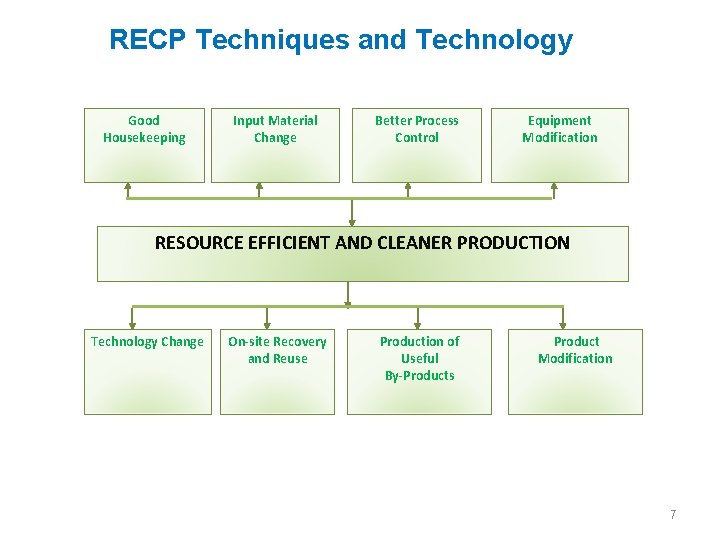
RECP Techniques and Technology Good Housekeeping Input Material Change Better Process Control Equipment Modification RESOURCE EFFICIENT AND CLEANER PRODUCTION Technology Change On-site Recovery and Reuse Production of Useful By-Products Product Modification 7
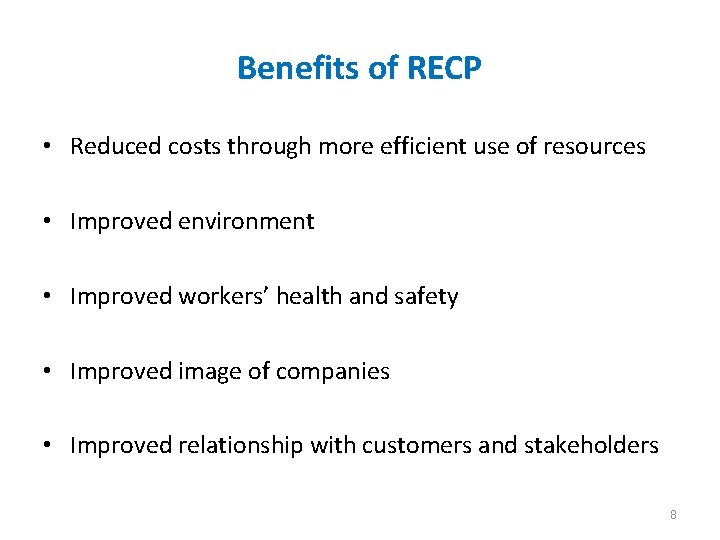
Benefits of RECP • Reduced costs through more efficient use of resources • Improved environment • Improved workers’ health and safety • Improved image of companies • Improved relationship with customers and stakeholders 8
Ea. P RECP Demonstrations Component specific objectives: 1. Human and Institutional Capacity Development 2. Demonstration, Dissemination and Replication 3. Technology Support 9
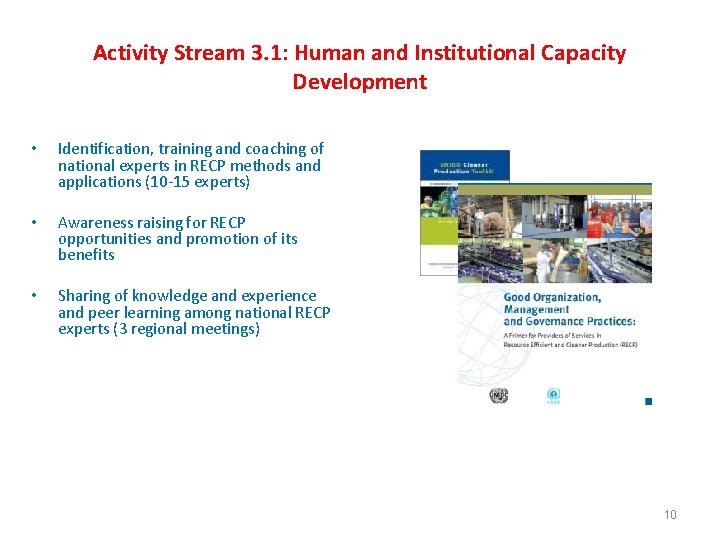
Activity Stream 3. 1: Human and Institutional Capacity Development • Identification, training and coaching of national experts in RECP methods and applications (10 -15 experts) • Awareness raising for RECP opportunities and promotion of its benefits • Sharing of knowledge and experience and peer learning among national RECP experts (3 regional meetings) 10
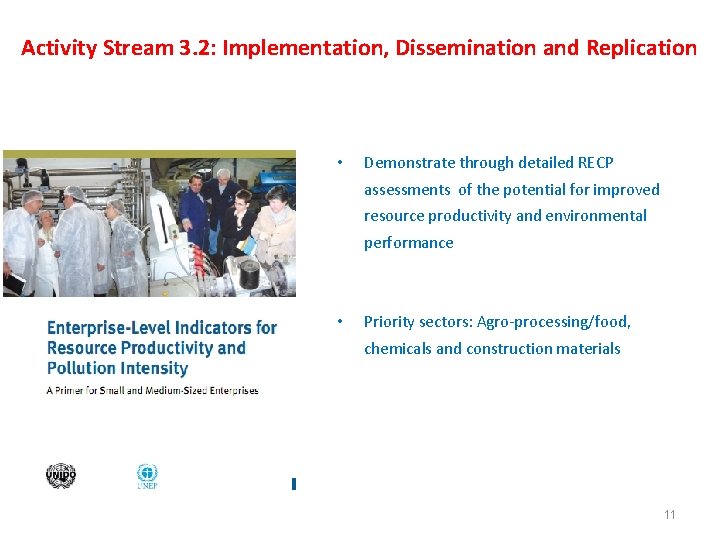
Activity Stream 3. 2: Implementation, Dissemination and Replication • Demonstrate through detailed RECP assessments of the potential for improved resource productivity and environmental performance • Priority sectors: Agro-processing/food, chemicals and construction materials 11
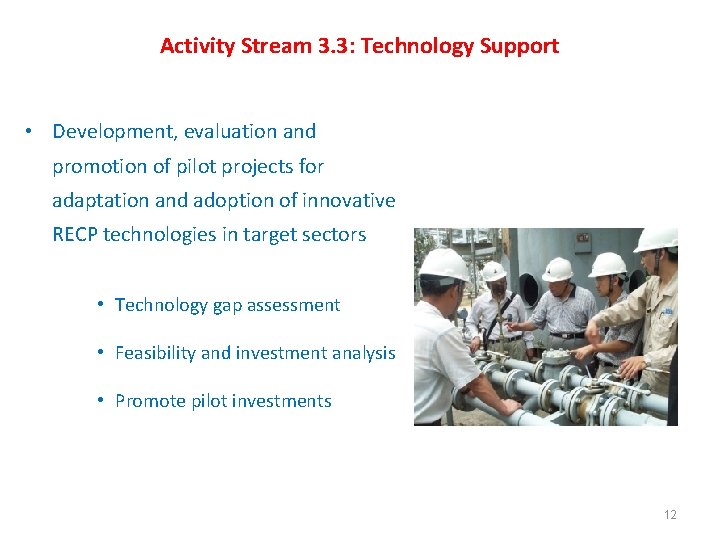
Activity Stream 3. 3: Technology Support • Development, evaluation and promotion of pilot projects for adaptation and adoption of innovative RECP technologies in target sectors • Technology gap assessment • Feasibility and investment analysis • Promote pilot investments 12
Organization of Work • UNIDO office in Vienna - RECP program management in 6 countries • National Focal Points from Government (Environment and Economy) • National Steering Committee - Representatives of Government, NGO, Business Sector and Academia • National Coordinator • Administrative Support Unite – Energy Efficiency Center of Georgia 13
Actions in 2014 • Kick-of meeting in Vienna - 10 -11 February • Selection of national experts (March 2014) – 10 experts selected in Georgia • Selection of companies (March-April, 2014) – 7 companies preselected: - JSC “Sarini”, Rustavi city, metal constructions, www. sarini. ge - LTD “Rusmetali”, Rustavi city, ferro-alloys production, www. rusmetali. com - Gori Feeding Cannery Kula, Gori city, canned products and juice, http: //www. kula. ge - LTD “Devis Puri”, Tbilisi, bakery - LTD DIO, Tbilisi, metal-plastic windows and doors, www. dio. ge - Road Construction Company Tbilisi, # 1 Asphalt Plant, Tbilisi - LTD Ec. Oil, Tbilisi, oil production, www. ecoil. ge • 2 days training of experts and 8 company visits - April 2014 • Initial RECP assessments in the selected companies – June-July 2014 • 2 days training of experts – July 2014 • Final RECP assessment – July-October 2014 • Final report and case studies • Regional Conference – November 2014 14