
Regional Integration in Latin America Trade Treaty Equal

- Slides: 40
Regional Integration in Latin America
Trade Treaty • Equal treatment of all on a multilateral basis – Most favored nation (MFN) principle: any access given to a country must be given must be extended to all other members. – ex) GATT, WTO • Preferential treaties – Special access to the markets of member countries. Departure from MFN principle.
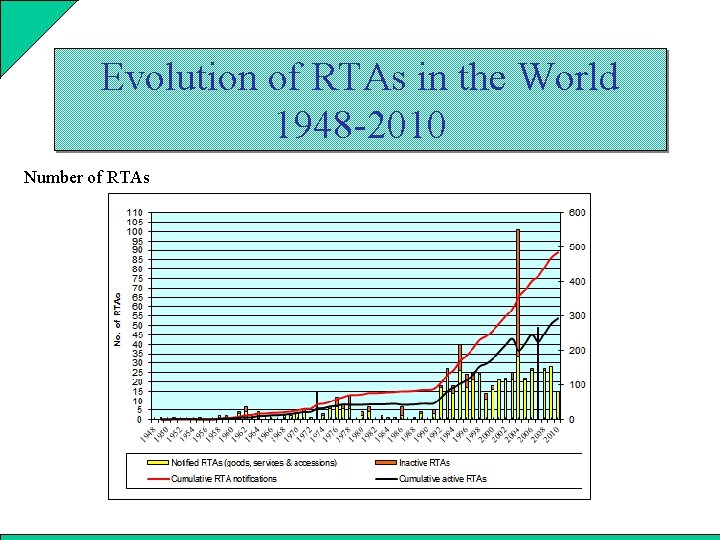
Evolution of RTAs in the World 1948 -2010 Number of RTAs
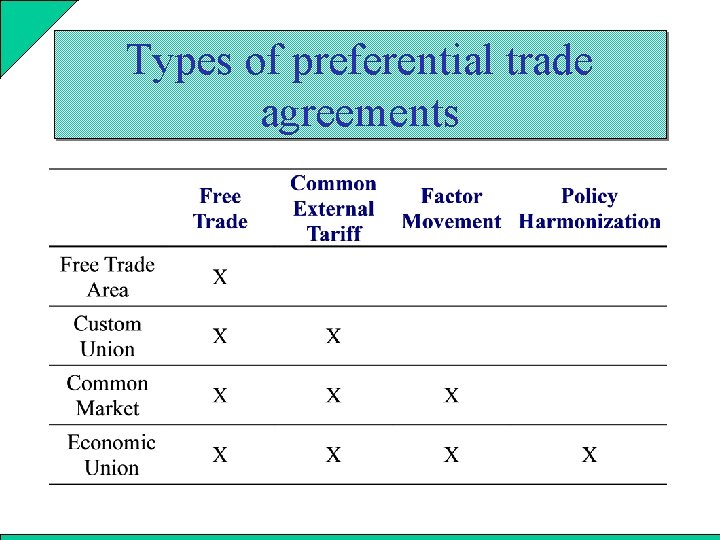
Types of preferential trade agreements
FTA and CU • FTA: To prohibit trade that may avoid some members' higher tariffs by entering the area through low-tariff members, rules of origin is required in FTAs. • CU: The members of custom union must reach agreement on the height of the common tariff as well as the distribution of the tariff proceeds among the member countries.
Economic Effects • Trade Creation and Trade Diversion • Terms of trade • Increasing returns and increased competition • Investment
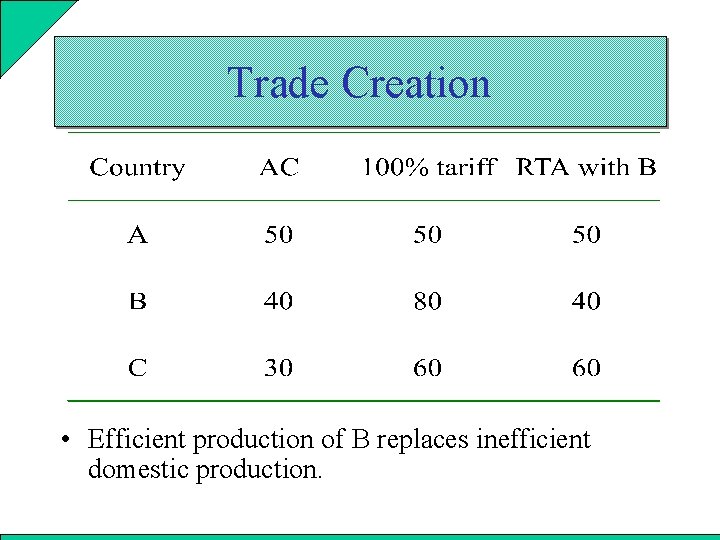
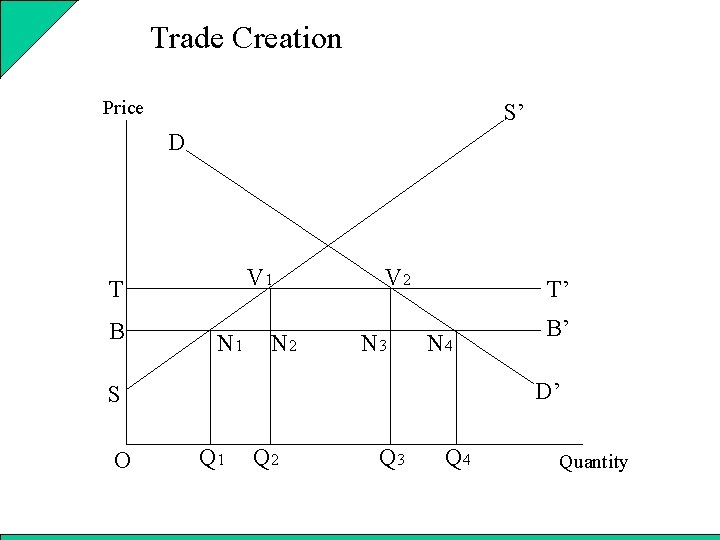
Trade Creation • Efficient production of B replaces inefficient domestic production.
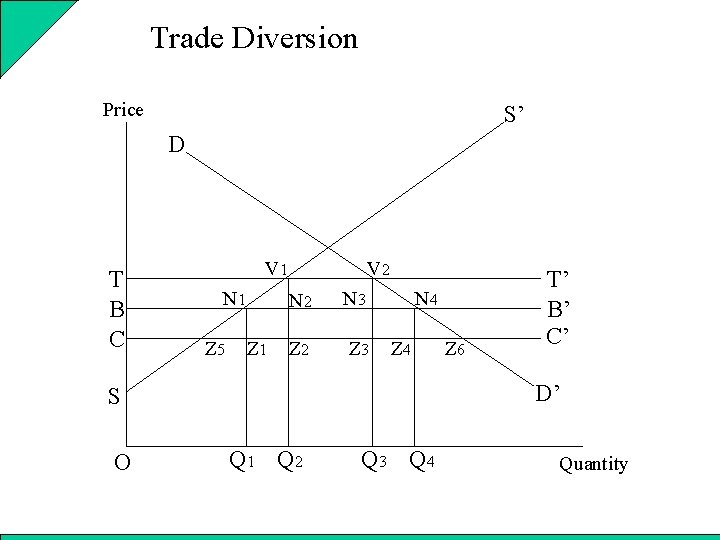
Trade Diversion • Inefficient production of B replaces efficient production of C.
Trade Creation Price S’ D V 1 T B N 1 N 2 V 2 N 3 T’ N 4 D’ S O B’ Q 1 Q 2 Q 3 Q 4 Quantity
Trade Diversion Price S’ D T B C V 1 N 1 Z 5 Z 1 V 2 N 3 Z 2 Z 3 N 4 Z 4 D’ S O Z 6 T’ B’ C’ Q 1 Q 2 Q 3 Q 4 Quantity
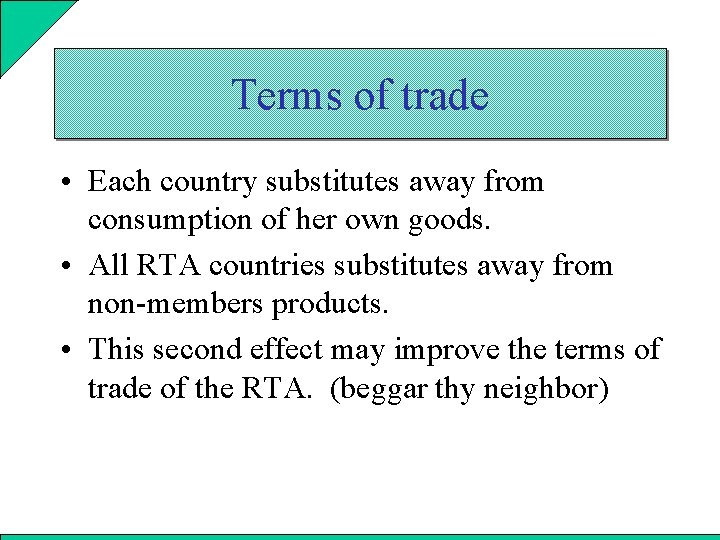
Terms of trade • Each country substitutes away from consumption of her own goods. • All RTA countries substitutes away from non-members products. • This second effect may improve the terms of trade of the RTA. (beggar thy neighbor)
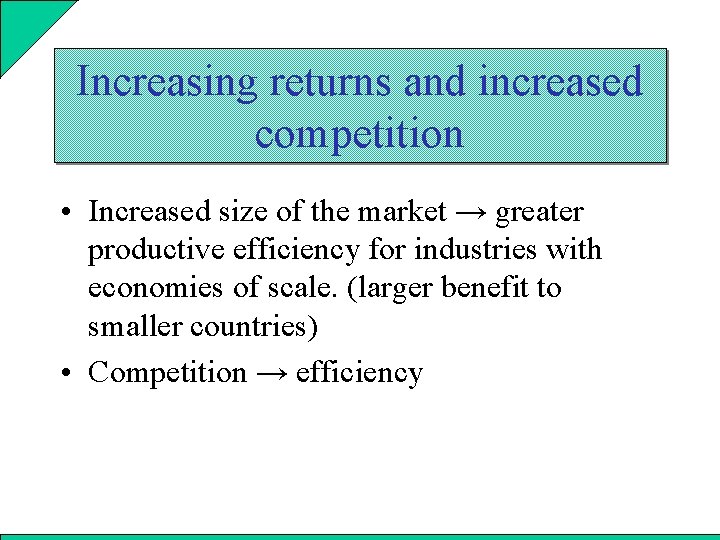
Increasing returns and increased competition • Increased size of the market → greater productive efficiency for industries with economies of scale. (larger benefit to smaller countries) • Competition → efficiency
Investment • RTA can stimulate investment both between the members and from outside the RTA. – reduction in distortions → increase the quantity of investment – larger size of the market – tariff jumping by foreign investors
GATT and RTA • Regional trade agreements were accommodated within GATT, although this actually meant a departure from the MFN principle. – GATT Art. XXIV – Enabling Clause – GATS Art. V
GATT Article XXIV • RTAs are sanctioned by Article XXIV if they satisfy two criteria – the duties and other regulations of commerce shall not on the whole be higher or more restrictive than those prior to the formation of such agreement, and – duties and other restrictive regulations of commerce are eliminated with respect to substantially all the trade between the constituent territories.
Critics • Does 'on the whole' mean simple average or weighted average or alignment at the lowest tariff? • What does 'substantially all’ mean? – Most of RTAs violates this condition as they do not include agriculture.
Interim Period • Creation of the union or area can come in stages, if an interim agreement includes a plan and schedule forming it. • How long is ‘an interim’? – Some RTAs ware in an interim for ever.
Reality • Until 1989, for the 71 regional arrangements reviewed, GATT has never censured an agreement as being incompatible with its standards, and only four arrangements have been formally declared to be compatible.
Uruguay Round and Art. XXIV • A formula for the definition of the average tariff has been adopted to improve 'on the whole'. • The transition period for the formation plan of an RTA should not exceed 10 years.
Enabling Clause • The Enabling Clause establishes the principles for the creation of RTAs among developing countries. • The clause states: – "Notwithstanding the provisions of Article I of the General Agreement, contracting parties may accord differential and more favorable treatment to developing countries, without according such treatment to other contracting parties. "
Implications of Enabling Clause • The enabling clause – permits developing countries to create regional trading arrangements that do not conform to Article XXIV. – gives authority to industrial countries to provide trade preferences to developing countries. – exempts developing countries from reciprocity on trade negotiations under GATT.
GATS Art. V • Members may be a party to or enter into an agreement liberalizing trade in services, provided that the agreement • (a) has substantial sectoral coverage, and • (b) provides for the absence or elimination of substantially all discrimination between or among the parties, in the sectors covered under subparagraph (a).
Friends or Rivals? • “. . . To a much greater extent than is often acknowledged, regional and multilateral integration initiatives are complements rather than alternatives in the pursuit of more open trade. ” • That is the conclusion of a 1995 study by the WTO Secretariat.
Sampson's view • RTAs promote regional trade liberalization as an advanced implementation of multilateral trade liberalization. • Many countries in RTAs are also active in the multilateral system. They see no contradiction between pursuing a faster pace of liberalization through RTAs while pursuing more far-reaching global market openness through multilateral liberalization.
Bhagwati's View • GATT Principle: MFN • Exception: Art. XXIV • Rationale – Single-nation characteristics – The strong restriction preclude the possibility that all kinds of preferential arrangements would break out. • But the inherent ambiguity and the political pressures have combined to frustrate the full import of the original desire to sanction only 100 per cent preferences.
First Regionalism: 1960 s • EC, Pacific Free Trade Area, LAFTA • Most of the attempts failed. – US had no interest. – Rather than using trade liberalization and hence prices to guide industry allocation, the developing countries sought to allocate industries by bureaucratic negotiation and tie trade to such allocations. • Was the failure a blessing?
Second Regionalism: 1980 s • The main driving force: United States – – – alternative (or supplement) to multilateralism accelerate the multilateral process trade deficit > demands for results on trade a countervailing bloc to EC political factor: mexican immigration danger of US banks > a package of economic initiatives to assist Latin American nations • Higher possibility of success(? )
Impact • Static impact effect • Dynamic time-path question – Is Regionalism quicker? – Is Regionalism more efficient? – Is Regionalism more certain?
Experience: North-North • Low transport cost, large markets, and large scope for variety producing specialization among partners considerably raised the potential for economic benefits from integration. Relatively similar levels of development and intra- rather than interindustry specialization reduced the need for compensation.
South-South • Often, not even implemented. • too ambitious for the members' limited administrative capacities. • difficult to devise compensation schemes • extension of import-substitution policy • distraction of policy thinking from the unilateral trade liberalization
South-South agreements may involve losses for the bloc, though the poorer country will lose the most because: (i) the more advanced country has a more developed manufacturing sector and exports to the poorer country at high (protected) prices. (ii) the poorer country had more to gain from trading with the world than the richer partner because of its comparative advantage associated with a larger difference in endowments with the world; it therefore loses more from forming the bloc and trading less with the world.
North-South • A key perceived benefit was the cementing of recent reforms and economic institutions. The objectives of the Northern partners are mostly non-economic.
N-S RIAs are likely to be superior to S-S ones because (i) they can provide lock-in mechanisms and improve policy credibility; (ii) the lock-in in terms of democracy and governance is also more likely in North-South than in South-South RIAs; (iii) benefits from RIAs in terms of larger markets are only likely to occur if ‘deep integration’ takes, and since the developed partner’s institutions are superior to those of the South, a North-South RTA is likely to provide more benefits from ‘deep integration’;
(iv) endowment differences are larger between members of a North-South RTA than between members of a South-South RTA, so that the Southern member is likely to better exploit its comparative advantage in a North-South RTA than in a South-South one; (v) a Southern member is more likely to be able to attract FDI in a N-S RIA though these benefits are unlikely to take place unless it undertakes needed economic reforms;
(vi) in order to raise long-term growth, the crucial ingredient seems to be knowledge and technology, and since most of these are produced in the North, opening up to the North through a North-South RIA is likely to result in greater knowledge absorption and generate more growth than opening up to the South through a South-South RIA. (vii) S-S RIAs can of course lead to positive scale and competition effects. But these require deep integration. And they can be attained through UTL. Of course, it may be easier to do regionally from a political viewpoint (less competition, plus reciprocal).
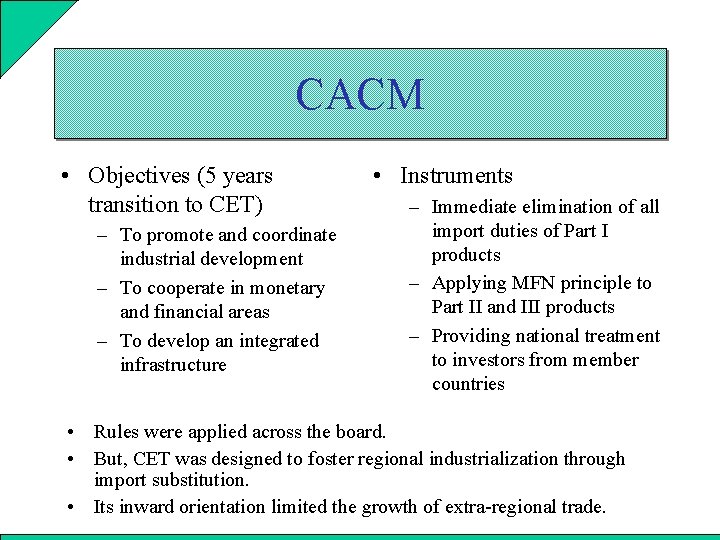
Findings • Among the South-South arrangements, only the CACM registered a noticeable, though temporary, increase in intra-regional exports. CACM was just about the only South-South arrangement which implemented tariff cuts across the board rather than on a piecemeal basis. • All North-North arrangements reveal much higher shares of intra-regional exports. • North-North increased their share in world exports while South-South usually experienced a decline.
LAFTA • Objectives (12 years transition) – Gradually to eliminate intraregional trade impediments – To expand intra-regional markets – To promote industrial integration • Instruments – National and common lists of products – Special list of preferential concessions to lesser developed members – Compensation mechanisms to benefit from nonreciprocal trade concessions • It was mainly during the formative years of LAFTA that regional trade barriers were reduced, but this did not create a significant long-run trend in regional trade.
CACM • Objectives (5 years transition to CET) – To promote and coordinate industrial development – To cooperate in monetary and financial areas – To develop an integrated infrastructure • Instruments – Immediate elimination of all import duties of Part I products – Applying MFN principle to Part II and III products – Providing national treatment to investors from member countries • Rules were applied across the board. • But, CET was designed to foster regional industrialization through import substitution. • Its inward orientation limited the growth of extra-regional trade.
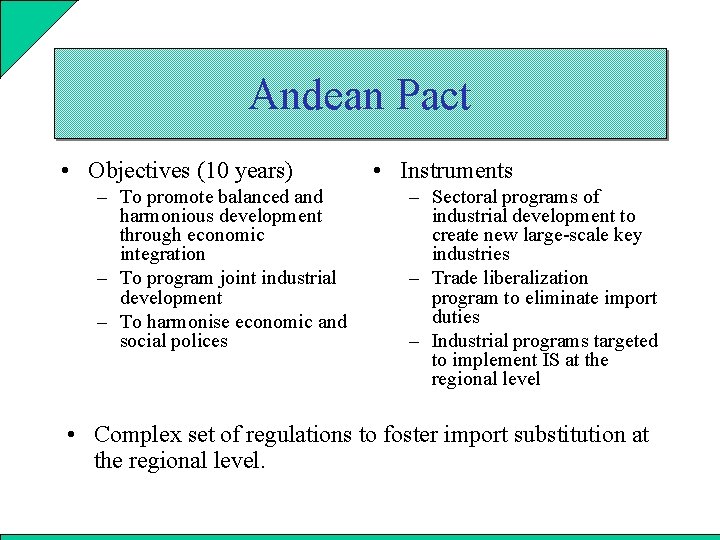
Andean Pact • Objectives (10 years) – To promote balanced and harmonious development through economic integration – To program joint industrial development – To harmonise economic and social polices • Instruments – Sectoral programs of industrial development to create new large-scale key industries – Trade liberalization program to eliminate import duties – Industrial programs targeted to implement IS at the regional level • Complex set of regulations to foster import substitution at the regional level.
IR(intra-regional exports/total exports) and Share of RI scheme in total world exports