
Regional initiatives in support of Statistical Capacity Development
- Slides: 9
Regional initiatives in support of Statistical Capacity Development in Asia. Pacific Alick Mjuma Nyasulu ESCAP, Statistics Division 13 th SPECA Working Group on Statistics Shymkent Kazakhstan 1 -3 October 2018 STATISTICS
ESCAP is placed at the center for monitoring and review of the SDGs • ESCAP’s annual Commission sessions focus on SDGrelated issues, e. g. • Annual Asia-Pacific Forum for Sustainable Development (APFSD) • Regional data user-producer forum important to raise awareness of statistical issues (e. g. in policy community) and policy priorities (among producers) • Regional Roadmap for implementing the 2030 Agenda STATISTICS
ESCAP Committee on Statistics • Biennial meeting place for leaders of NSSs • High level of interaction with member countries during and between sessions • Have guided regional/subregional consultations on statistics & data in support of global & regional monitoring (IAEG & HLG) • Will support integration of SDGs monitoring & statistics/data in national development plans (Collective Vision and subregional workshops) STATISTICS
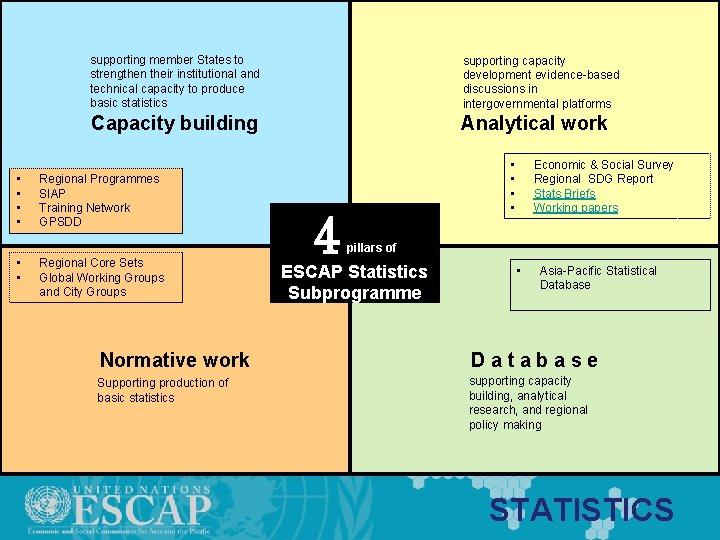
supporting member States to strengthen their institutional and technical capacity to produce basic statistics supporting capacity development evidence-based discussions in intergovernmental platforms Capacity building Analytical work • • Regional Programmes SIAP Training Network GPSDD • • Regional Core Sets Global Working Groups and City Groups 4 • • Economic & Social Survey Regional SDG Report Stats Briefs Working papers pillars of ESCAP Statistics Subprogramme • Asia-Pacific Statistical Database Normative work Database Supporting production of basic statistics supporting capacity building, analytical research, and regional policy making STATISTICS
ESCAP provides a data hub for the region • The Statistical Database covers the region and contains over 600 data series on a wide range of topics on population, education, health, poverty and inequalities, gender, economy, environment and connectivity • Data being repackaged and presented in line with the SDG requirements STATISTICS
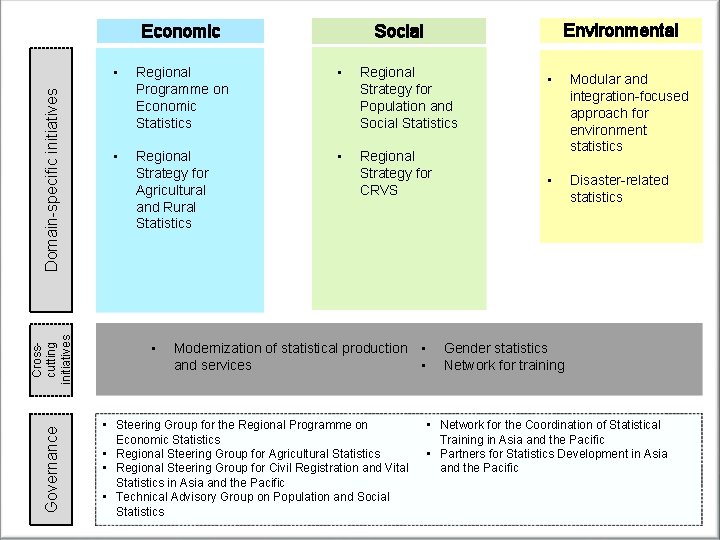
Domain-specific initiatives Governance Crosscutting initiatives Environmental Social Economic • Regional Programme on Economic Statistics • Regional Strategy for Population and Social Statistics • Regional Strategy for Agricultural and Rural Statistics • Regional Strategy for CRVS • Modernization of statistical production • and services • • Steering Group for the Regional Programme on Economic Statistics • Regional Steering Group for Agricultural Statistics • Regional Steering Group for Civil Registration and Vital Statistics in Asia and the Pacific • Technical Advisory Group on Population and Social Statistics • Modular and integration-focused approach for environment statistics • Disaster-related statistics Gender statistics Network for training • Network for the Coordination of Statistical Training in Asia and the Pacific • Partners for Statistics Development in Asia and the Pacific STATISTICS
The case of Economic Statistics • Multi-year Regional Programme on Economic Statistics embedded in the intergovernmental process • Guided by Steering Group for RPES (heads of macroeconomic statistics departments from NSOs and CBs and international organizations) • 4 Task Forces leading the work on Capacity Screening Round II, Statistical Business Registers, Quality Assurance Frameworks for Economic Statistics and the substantive organization of the Asia-Pacific Economic Statistics Week 2018 STATISTICS
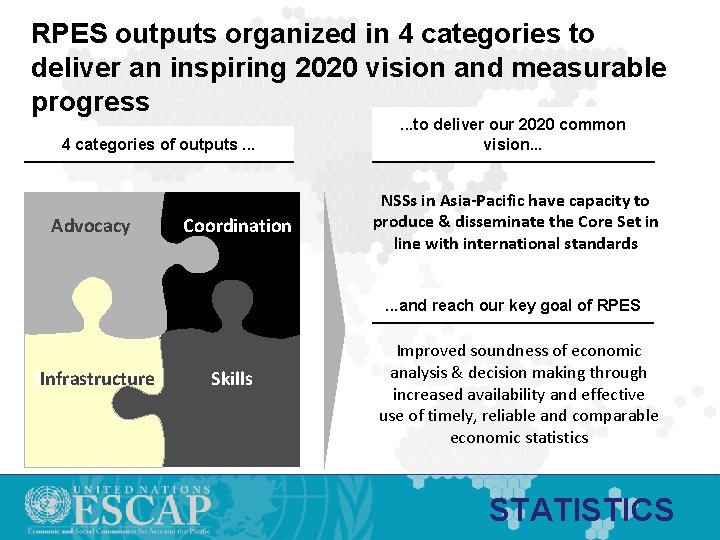
RPES outputs organized in 4 categories to deliver an inspiring 2020 vision and measurable progress 4 categories of outputs. . . Advocacy Coordination . . . to deliver our 2020 common vision. . . NSSs in Asia-Pacific have capacity to produce & disseminate the Core Set in line with international standards. . . and reach our key goal of RPES Infrastructure Skills Improved soundness of economic analysis & decision making through increased availability and effective use of timely, reliable and comparable economic statistics STATISTICS
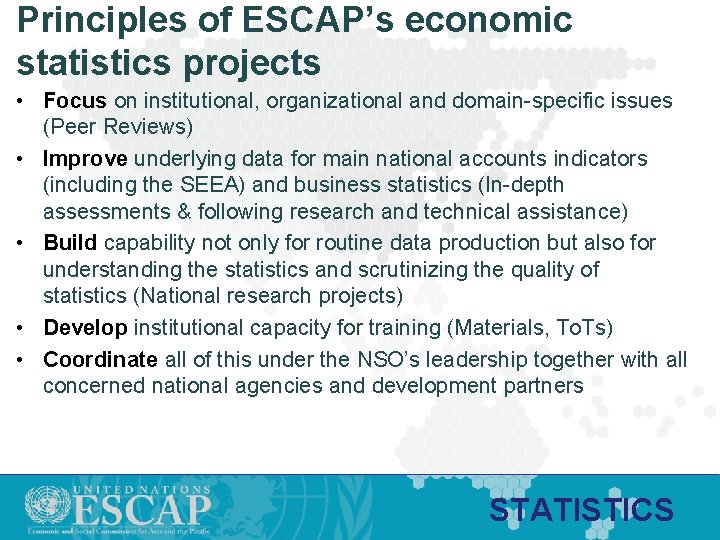
Principles of ESCAP’s economic statistics projects • Focus on institutional, organizational and domain-specific issues (Peer Reviews) • Improve underlying data for main national accounts indicators (including the SEEA) and business statistics (In-depth assessments & following research and technical assistance) • Build capability not only for routine data production but also for understanding the statistics and scrutinizing the quality of statistics (National research projects) • Develop institutional capacity for training (Materials, To. Ts) • Coordinate all of this under the NSO’s leadership together with all concerned national agencies and development partners STATISTICS