
Regional Goals Local Actions A Network Approach to
- Slides: 1
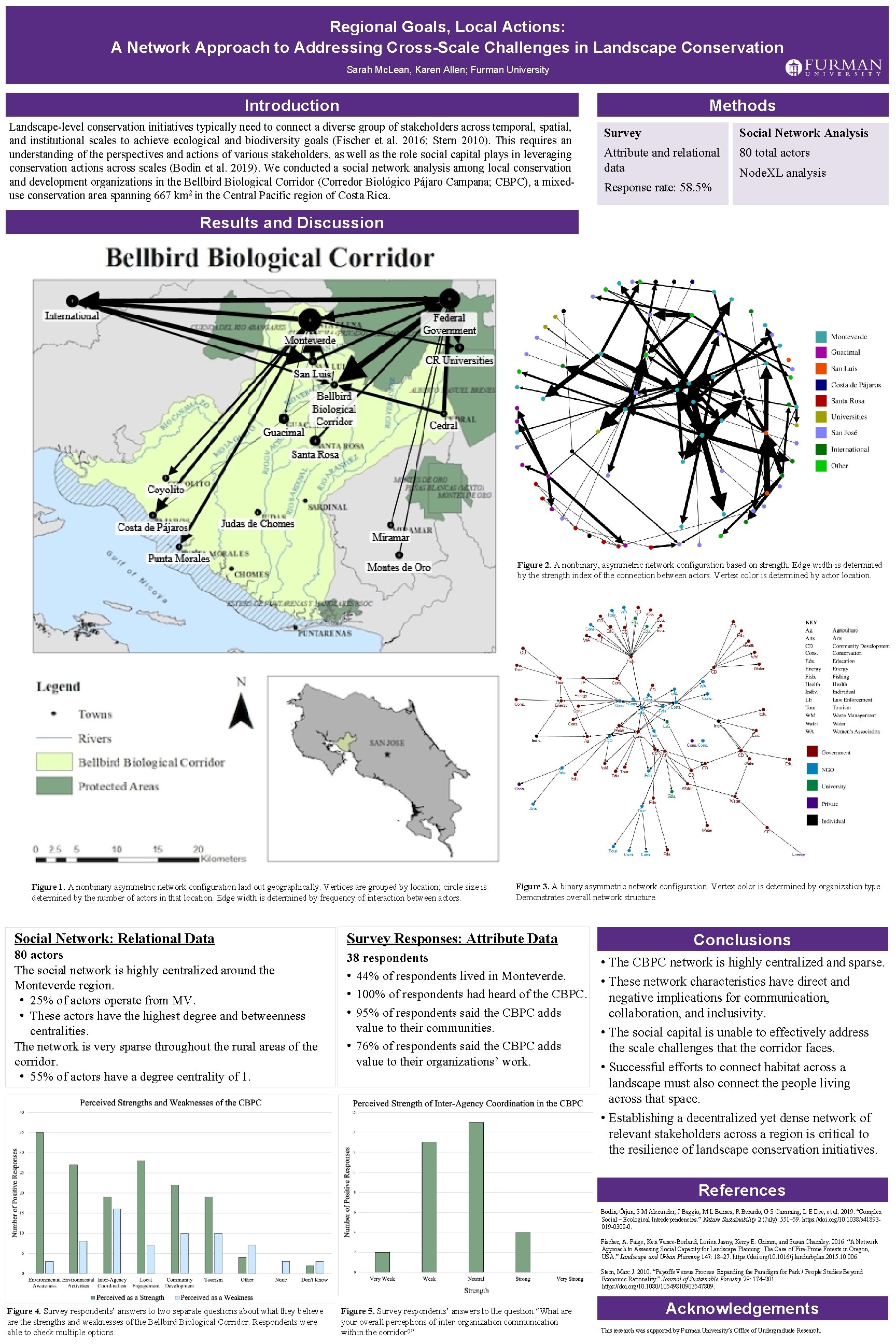
Regional Goals, Local Actions: A Network Approach to Addressing Cross-Scale Challenges in Landscape Conservation Sarah Mc. Lean, Karen Allen; Furman University Methods Introduction Landscape-level conservation initiatives typically need to connect a diverse group of stakeholders across temporal, spatial, and institutional scales to achieve ecological and biodiversity goals (Fischer et al. 2016; Stern 2010). This requires an understanding of the perspectives and actions of various stakeholders, as well as the role social capital plays in leveraging conservation actions across scales (Bodin et al. 2019). We conducted a social network analysis among local conservation and development organizations in the Bellbird Biological Corridor (Corredor Biológico Pájaro Campana; CBPC), a mixeduse conservation area spanning 667 km 2 in the Central Pacific region of Costa Rica. Survey Social Network Analysis Attribute and relational data 80 total actors Node. XL analysis Response rate: 58. 5% Results and Discussion Figure 2. A nonbinary, asymmetric network configuration based on strength. Edge width is determined by the strength index of the connection between actors. Vertex color is determined by actor location. Figure 1. A nonbinary asymmetric network configuration laid out geographically. Vertices are grouped by location; circle size is determined by the number of actors in that location. Edge width is determined by frequency of interaction between actors. Figure 3. A binary asymmetric network configuration. Vertex color is determined by organization type. Demonstrates overall network structure. Social Network: Relational Data Survey Responses: Attribute Data 80 actors The social network is highly centralized around the Monteverde region. • 25% of actors operate from MV. • These actors have the highest degree and betweenness centralities. The network is very sparse throughout the rural areas of the corridor. • 55% of actors have a degree centrality of 1. 38 respondents • 44% of respondents lived in Monteverde. • 100% of respondents had heard of the CBPC. • 95% of respondents said the CBPC adds value to their communities. • 76% of respondents said the CBPC adds value to their organizations’ work. Conclusions • The CBPC network is highly centralized and sparse. • These network characteristics have direct and negative implications for communication, collaboration, and inclusivity. • The social capital is unable to effectively address the scale challenges that the corridor faces. • Successful efforts to connect habitat across a landscape must also connect the people living across that space. • Establishing a decentralized yet dense network of relevant stakeholders across a region is critical to the resilience of landscape conservation initiatives. References Bodin, Örjan, S M Alexander, J Baggio, M L Barnes, R Berardo, G S Cumming, L E Dee, et al. 2019. “Complex Social – Ecological Interdependencies. ” Nature Sustainability 2 (July): 551– 59. https: //doi. org/10. 1038/s 41893019 -0308 -0. Fischer, A. Paige, Ken Vance-Borland, Lorien Jasny, Kerry E. Grimm, and Susan Charnley. 2016. “A Network Approach to Assessing Social Capacity for Landscape Planning: The Case of Fire-Prone Forests in Oregon, USA. ” Landscape and Urban Planning 147: 18– 27. https: //doi. org/10. 1016/j. landurbplan. 2015. 10. 006. Stern, Marc J. 2010. “Payoffs Versus Process Expanding the Paradigm for Park / People Studies Beyond Economic Rationality. ” Journal of Sustainable Forestry 29: 174– 201. https: //doi. org/10. 1080/10549810903547809. Figure 4. Survey respondents’ answers to two separate questions about what they believe are the strengths and weaknesses of the Bellbird Biological Corridor. Respondents were able to check multiple options. Figure 5. Survey respondents’ answers to the question “What are your overall perceptions of inter-organization communication within the corridor? ” Acknowledgements This research was supported by Furman University’s Office of Undergraduate Research.