
Regional and national farming systems information for planning

- Slides: 23
Regional and national farming systems information for planning: Background & approach Jean-Marc Boffa Piloting a Farming Systems Approach to Investment Planning for Climate-Smart Smallholder Agriculture in Africa 16‐ 17 Sept 2015, Nashera Hotel, Morogoro, Tanzania
Opportunities and challenges for agriculture in Africa • Strong records of economic growth in African countries (non ag sectors, large scale ag, ) • Yet need to consolidate poverty reduction and food and nutritional security • Need for higher investment in agriculture • Smallholder participation in growth • Address development constraints (inputs, markets, labor productivity) • Recognition of agriculture’s role in creating wealth compared to other sectors and need for transformation
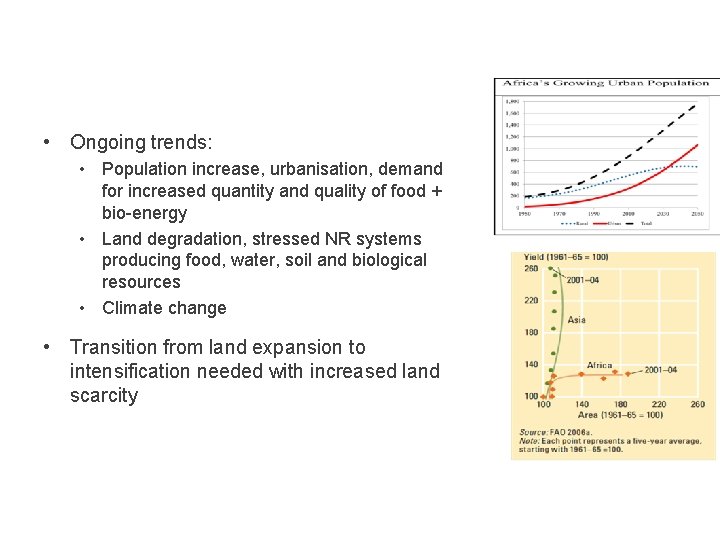
• Ongoing trends: • Population increase, urbanisation, demand for increased quantity and quality of food + bio-energy • Land degradation, stressed NR systems producing food, water, soil and biological resources • Climate change • Transition from land expansion to intensification needed with increased land scarcity
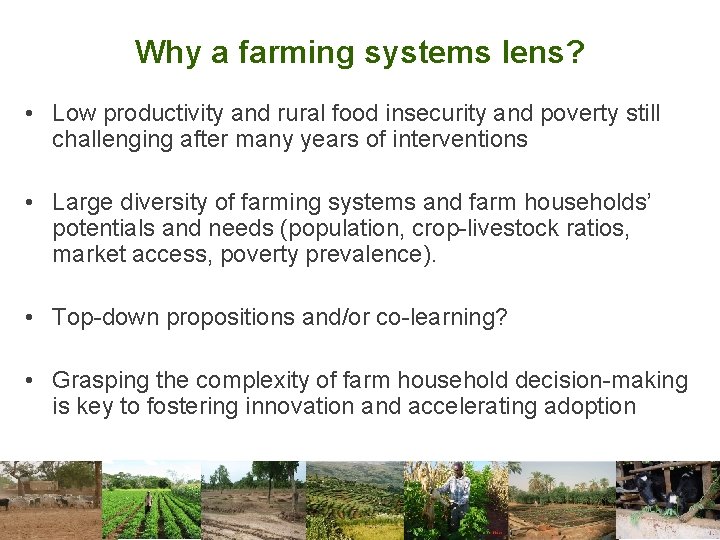
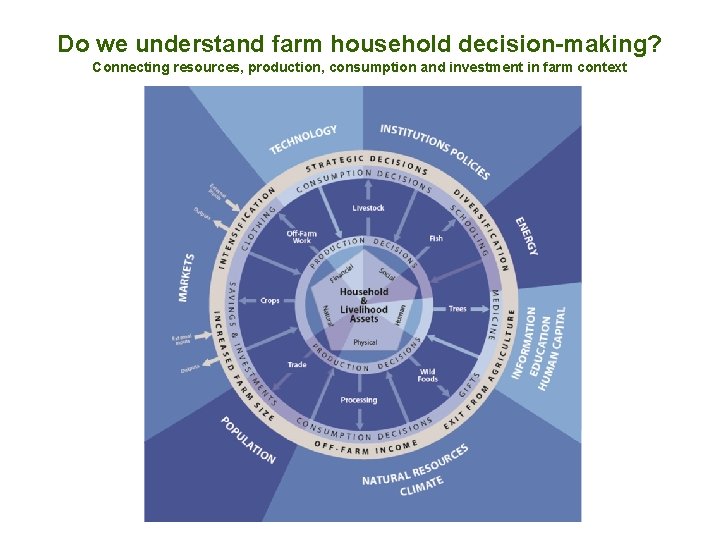
Why a farming systems lens? • Low productivity and rural food insecurity and poverty still challenging after many years of interventions • Large diversity of farming systems and farm households’ potentials and needs (population, crop-livestock ratios, market access, poverty prevalence). • Top-down propositions and/or co-learning? • Grasping the complexity of farm household decision-making is key to fostering innovation and accelerating adoption
Do we understand farm household decision-making? Connecting resources, production, consumption and investment in farm context
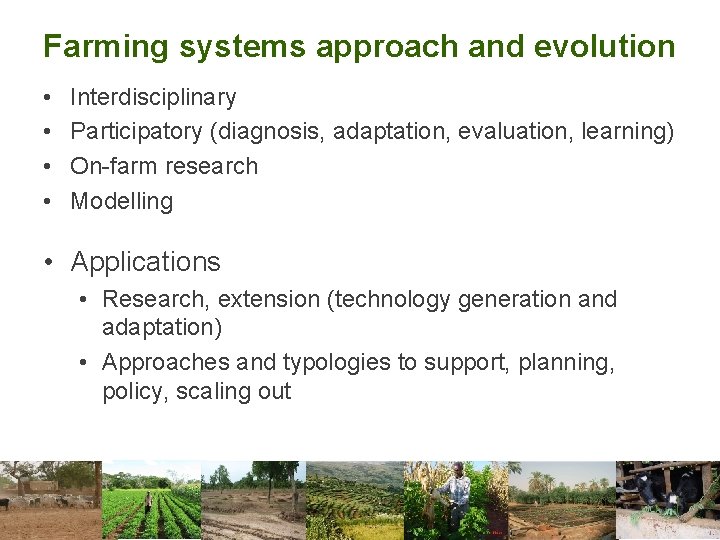
Farming systems approach and evolution • • Interdisciplinary Participatory (diagnosis, adaptation, evaluation, learning) On-farm research Modelling • Applications • Research, extension (technology generation and adaptation) • Approaches and typologies to support, planning, policy, scaling out
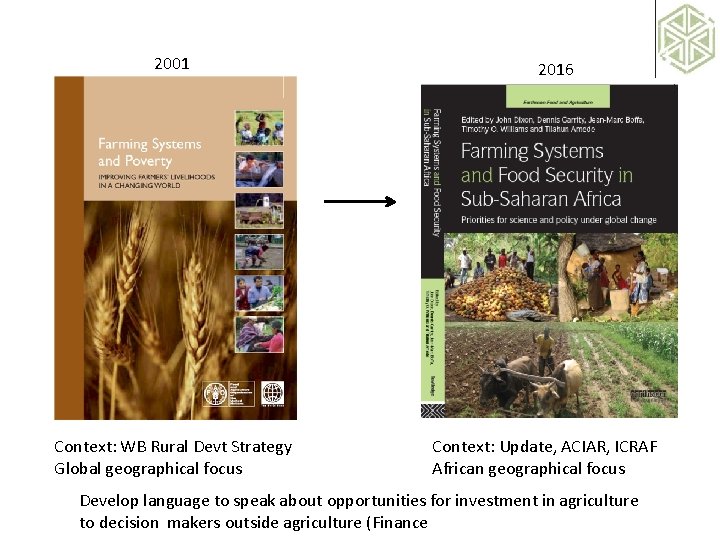
2001 Context: WB Rural Devt Strategy Global geographical focus 2016 Context: Update, ACIAR, ICRAF African geographical focus Develop language to speak about opportunities for investment in agriculture to decision makers outside agriculture (Finance
Simplifying complexity • Investment planning needs simplified broad patterns, key trends and major opportunities • Large populations of farm systems have broadly similar patterns of livelihood (crop/livestock) and consumption patterns, as well as constraints and opportunities. • Make it relevant to policy‐making : Similar development strategies and interventions apply. • See farms as systems. Interactions between farm components. • Workable number of systems for effective targeting (max 12‐ 15) • Recognizable internal heterogeneity (sub‐systems)
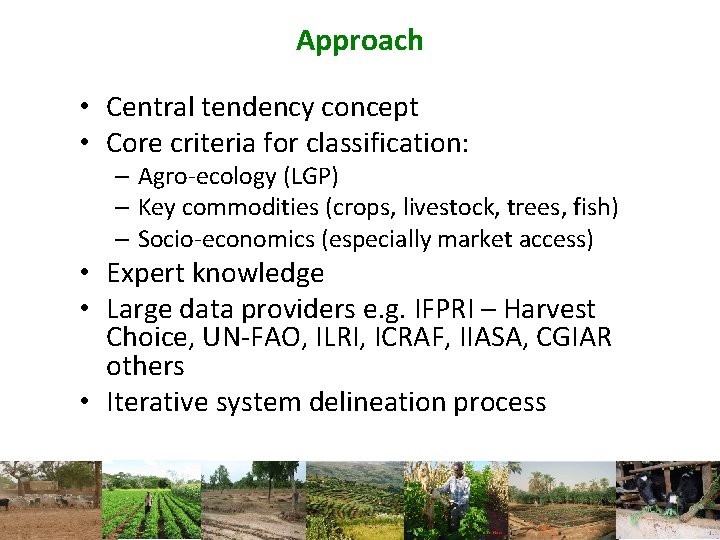
Approach • Central tendency concept • Core criteria for classification: – Agro‐ecology (LGP) – Key commodities (crops, livestock, trees, fish) – Socio‐economics (especially market access) • Expert knowledge • Large data providers e. g. IFPRI – Harvest Choice, UN‐FAO, ILRI, ICRAF, IIASA, CGIAR others • Iterative system delineation process
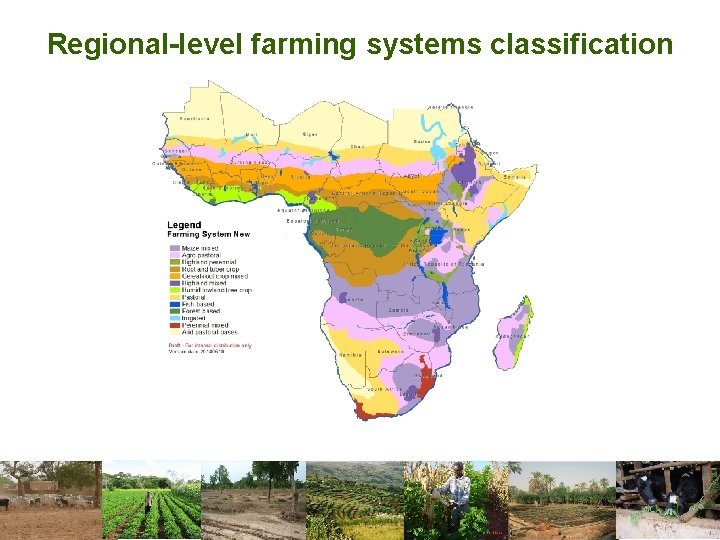
Regional-level farming systems classification
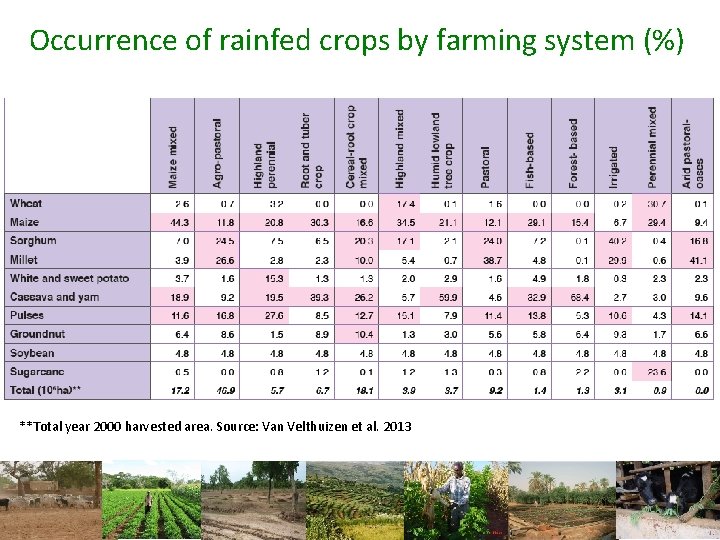
Occurrence of rainfed crops by farming system (%) **Total year 2000 harvested area. Source: Van Velthuizen et al. 2013
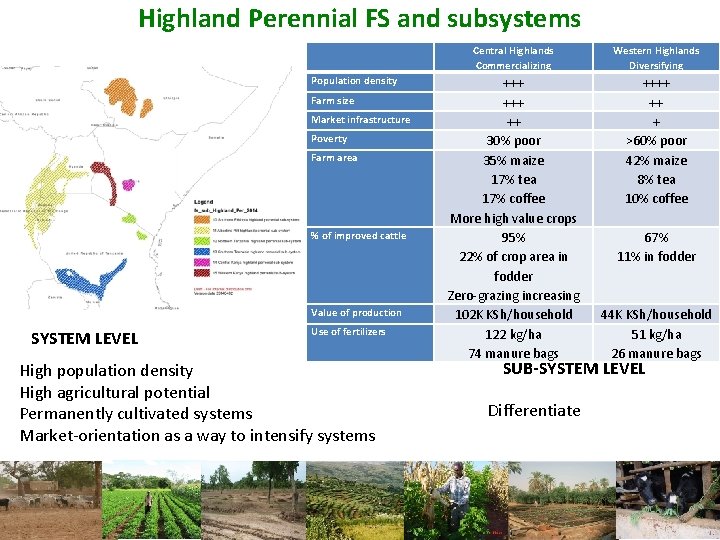
Highland Perennial FS and subsystems Population density Farm size Market infrastructure Poverty Farm area % of improved cattle Value of production SYSTEM LEVEL Use of fertilizers High population density High agricultural potential Permanently cultivated systems Market‐orientation as a way to intensify systems Central Highlands Commercializing Western Highlands Diversifying +++ ++ 30% poor 35% maize 17% tea 17% coffee More high value crops 95% 22% of crop area in fodder Zero‐grazing increasing 102 K KSh/household 122 kg/ha 74 manure bags ++++ ++ + >60% poor 42% maize 8% tea 10% coffee 67% 11% in fodder 44 K KSh/household 51 kg/ha 26 manure bags SUB-SYSTEM LEVEL Differentiate
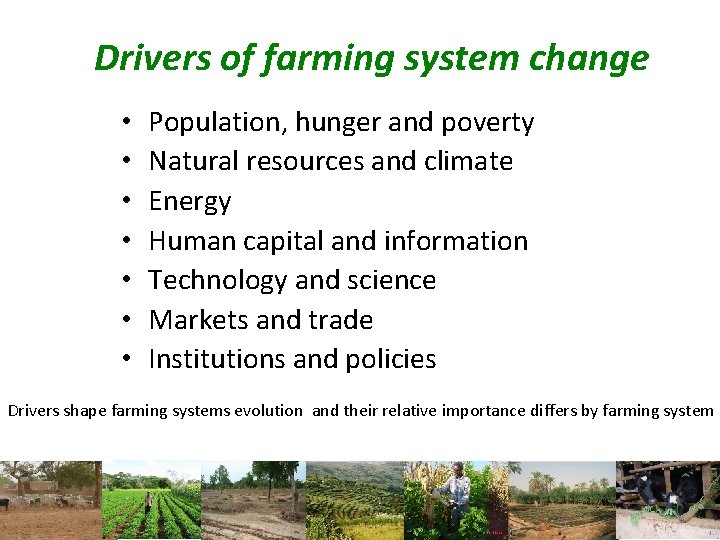
Drivers of farming system change • • Population, hunger and poverty Natural resources and climate Energy Human capital and information Technology and science Markets and trade Institutions and policies Drivers shape farming systems evolution and their relative importance differs by farming system
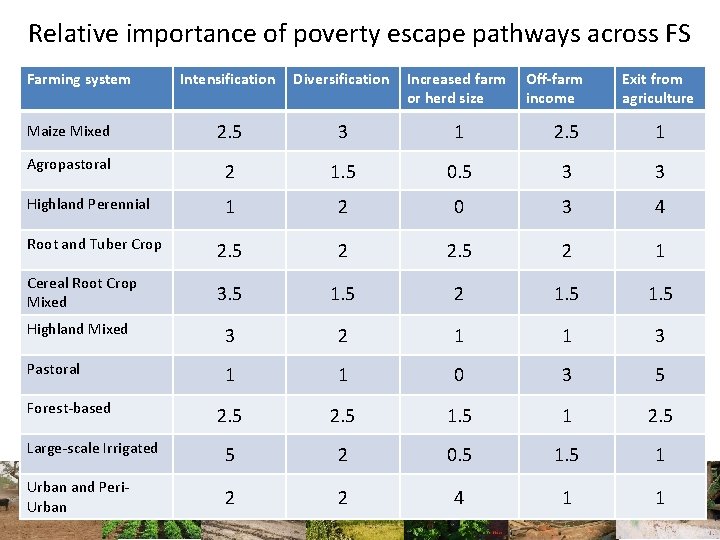
Relative importance of poverty escape pathways across FS Farming system Intensification Diversification Increased farm or herd size Maize Mixed 2. 5 3 1 2. 5 1 Agropastoral 2 1. 5 0. 5 3 3 Highland Perennial 1 2 0 3 4 Root and Tuber Crop 2. 5 2 1 Cereal Root Crop Mixed 3. 5 1. 5 2 1. 5 Highland Mixed 3 2 1 1 3 Pastoral 1 1 0 3 5 2. 5 1 2. 5 Large‐scale Irrigated 5 2 0. 5 1 Urban and Peri‐ Urban 2 2 4 1 1 Forest‐based Off-farm income Exit from agriculture
Informing planners • Set investment priorities according to main poverty / production deficits / exploitable yield gaps in each farming system. • What are the pathways to wealth creation / elimination of rural poverty (intensification, diversification, farm size increase, off‐farm employment, exit from agriculture) specific to each FS? • What combinations of economic policies, technologies and institutional innovations would be effective in each farming system?
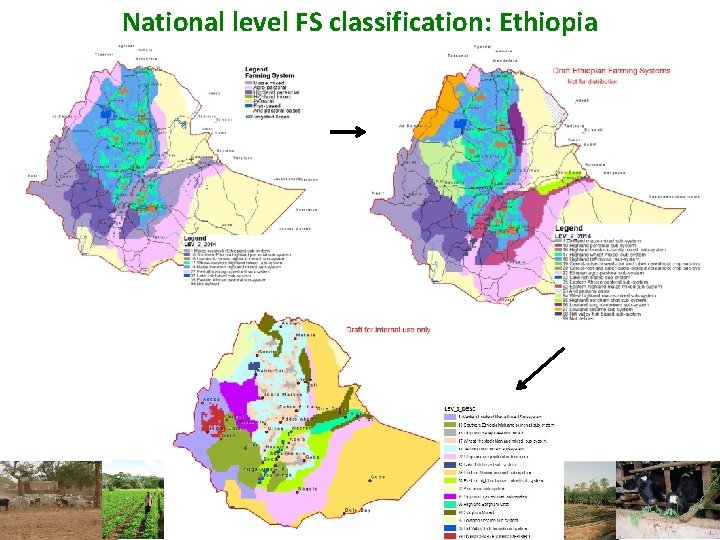
National level FS classification: Ethiopia
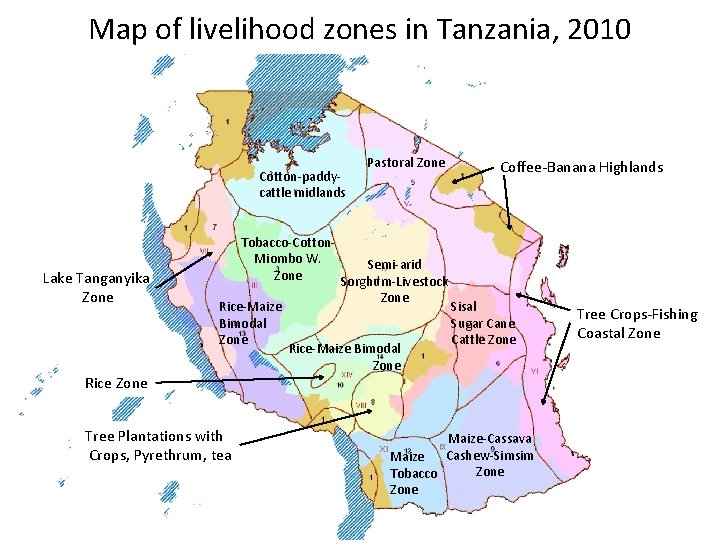
Prepared by Joseph Perfect and A. E. Majule Inst. of Resource Assessment University of Dar es Salaam w/ FAO 2010
Map of livelihood zones in Tanzania, 2010 Cotton‐paddy‐ cattle midlands Lake Tanganyika Zone Rice Zone Pastoral Zone Coffee‐Banana Highlands Tobacco‐Cotton‐ Miombo W. Semi‐arid Zone Sorghum‐Livestock Zone Rice‐Maize Sisal Bimodal Sugar Cane Zone Cattle Zone Rice‐Maize Bimodal Zone Tree Plantations with Crops, Pyrethrum, tea Maize‐Cassava Cashew‐Simsim Maize Zone Tobacco Zone Tree Crops‐Fishing Coastal Zone
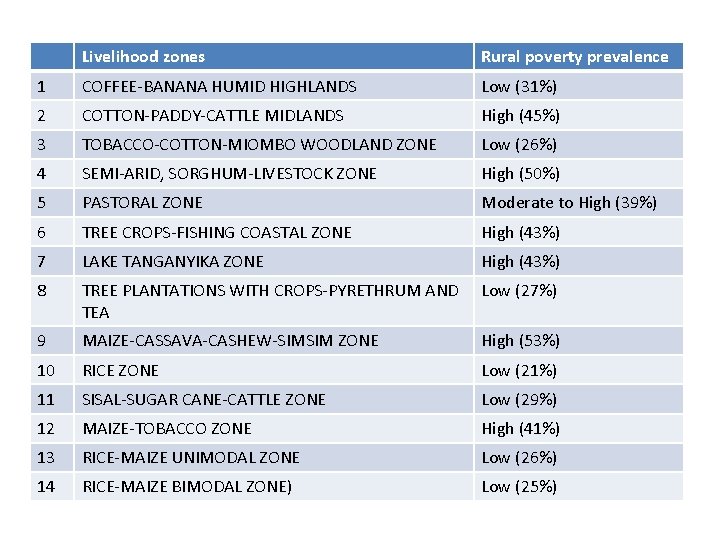
Livelihood zones Rural poverty prevalence 1 COFFEE‐BANANA HUMID HIGHLANDS Low (31%) 2 COTTON‐PADDY‐CATTLE MIDLANDS High (45%) 3 TOBACCO‐COTTON‐MIOMBO WOODLAND ZONE Low (26%) 4 SEMI‐ARID, SORGHUM‐LIVESTOCK ZONE High (50%) 5 PASTORAL ZONE Moderate to High (39%) 6 TREE CROPS‐FISHING COASTAL ZONE High (43%) 7 LAKE TANGANYIKA ZONE High (43%) 8 TREE PLANTATIONS WITH CROPS‐PYRETHRUM AND TEA Low (27%) 9 MAIZE‐CASSAVA‐CASHEW‐SIMSIM ZONE High (53%) 10 RICE ZONE Low (21%) 11 SISAL‐SUGAR CANE‐CATTLE ZONE Low (29%) 12 MAIZE‐TOBACCO ZONE High (41%) 13 RICE‐MAIZE UNIMODAL ZONE Low (26%) 14 RICE‐MAIZE BIMODAL ZONE) Low (25%)
Key points • System as an entity for which a holistic vision and transformation pathways can be developed – based on the analysis of its drivers of change, trends, constraints, opportunities. • More efficient targeting and impact of investment, than planning strictly by administrative boundaries or agro‐ecological zones. • Workable number of FS classes reduces complexity and facilitates targeting by decision makers. • Process builds on consensus and provides a shared language and a common platform for planning across sectors and institutions.
Key points – Cont’d • Good data is key. Info platforms allows evidence‐based policy development and program planning and implementation • Allows integration, drawing on comparative advantages of geographic areas ‐> reduce unnecessary duplication or overlap ‐> enhance synergies and complementarities. • Facilitates scaling up and spill‐over of successful approaches / technologies from one place to similar areas with similar systems • Structure to monitor progress and evaluate the effectiveness of interventions across a region, country or district
Way forward • How can FS information systems assist in current planning initiatives for ag growth? • What scales are relevant? • Current initiatives? SAGCOT, district development planning, etc?
Acknowledgments • Sokoine University of Agriculture • ACIAR • Univ. of Queensland • Many colleagues in many NARS and Intl organizations in regional and national studies