
Region Segmentation Readings Chapter 10 10 1 Additional
![Mean Shift [Comaniciu & Meer] • Iterative Mode Search 1. 2. 3. 4. Initialize](https://slidetodoc.com/presentation_image_h2/6239f4397025bbd0feeb4fedef1ba588/image-42.jpg "Mean Shift [Comaniciu & Meer] • Iterative Mode Search 1. 2. 3. 4. Initialize")
- Slides: 47
Region Segmentation Readings: Chapter 10: 10. 1 Additional Materials Provided • K-means Clustering (text) • EM Clustering (paper) • Graph Partitioning (text) • Mean-Shift Clustering (paper) 1
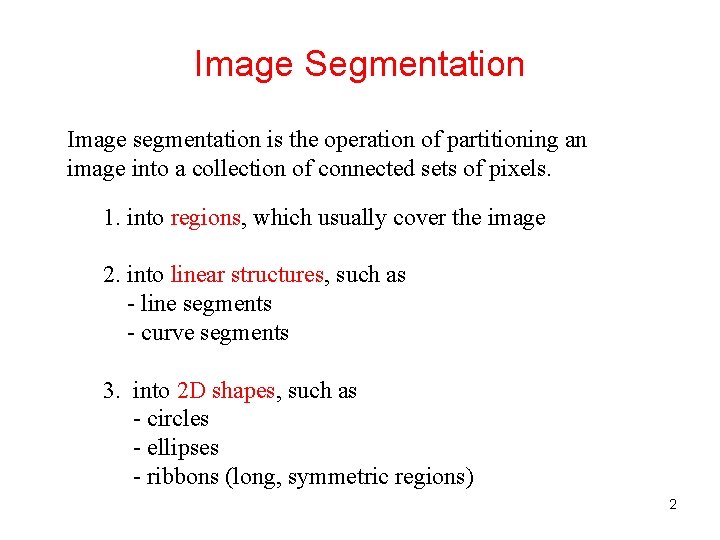
Image Segmentation Image segmentation is the operation of partitioning an image into a collection of connected sets of pixels. 1. into regions, which usually cover the image 2. into linear structures, such as - line segments - curve segments 3. into 2 D shapes, such as - circles - ellipses - ribbons (long, symmetric regions) 2
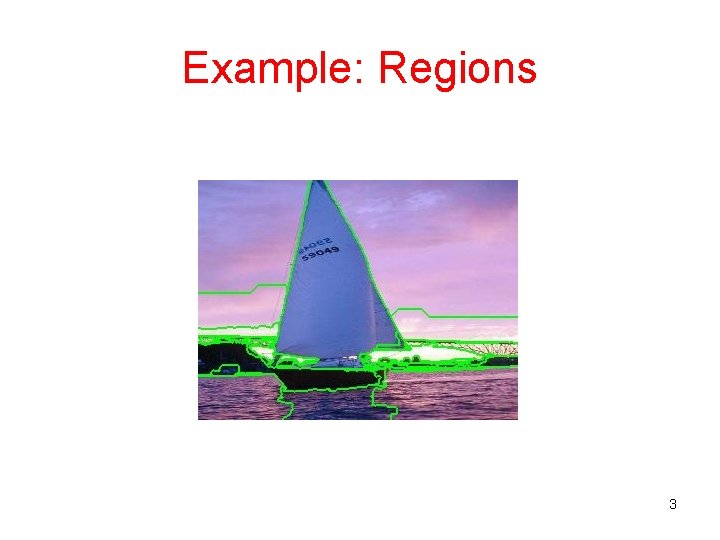
Example: Regions 3
Main Methods of Region Segmentation 1. Region Growing 2. Split and Merge 3. Clustering 4
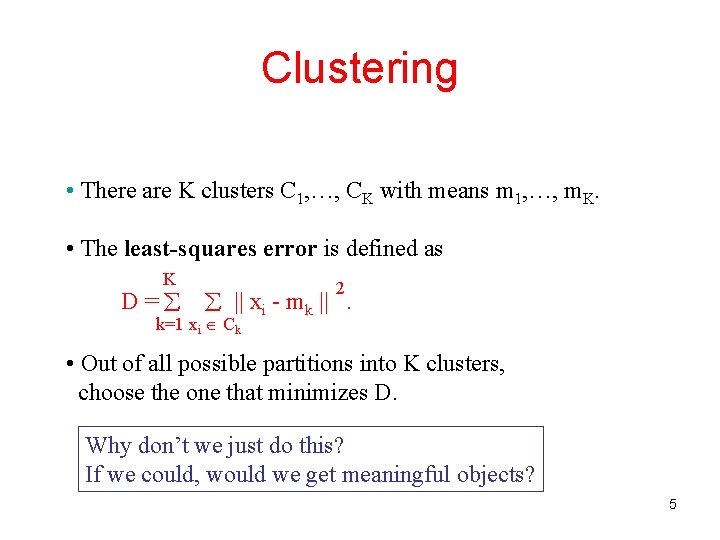
Clustering • There are K clusters C 1, …, CK with means m 1, …, m. K. • The least-squares error is defined as K D= 2 || xi - mk ||. k=1 xi Ck • Out of all possible partitions into K clusters, choose the one that minimizes D. Why don’t we just do this? If we could, would we get meaningful objects? 5
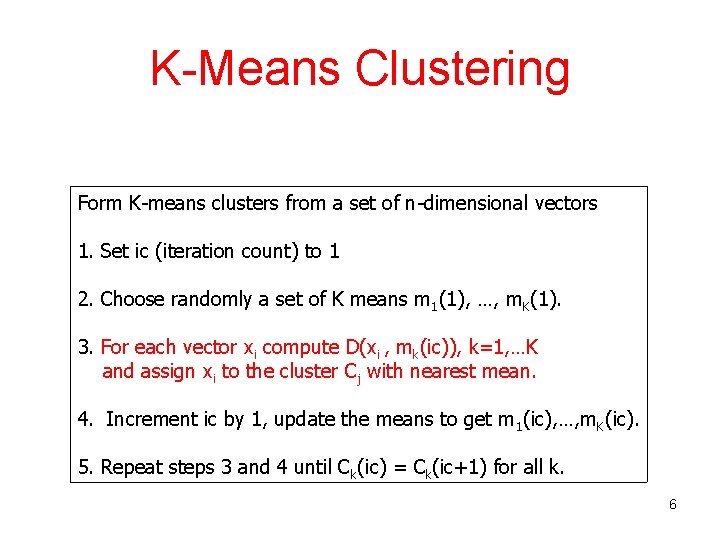
K-Means Clustering Form K-means clusters from a set of n-dimensional vectors 1. Set ic (iteration count) to 1 2. Choose randomly a set of K means m 1(1), …, m. K(1). 3. For each vector xi compute D(xi , mk(ic)), k=1, …K and assign xi to the cluster Cj with nearest mean. 4. Increment ic by 1, update the means to get m 1(ic), …, m. K(ic). 5. Repeat steps 3 and 4 until Ck(ic) = Ck(ic+1) for all k. 6
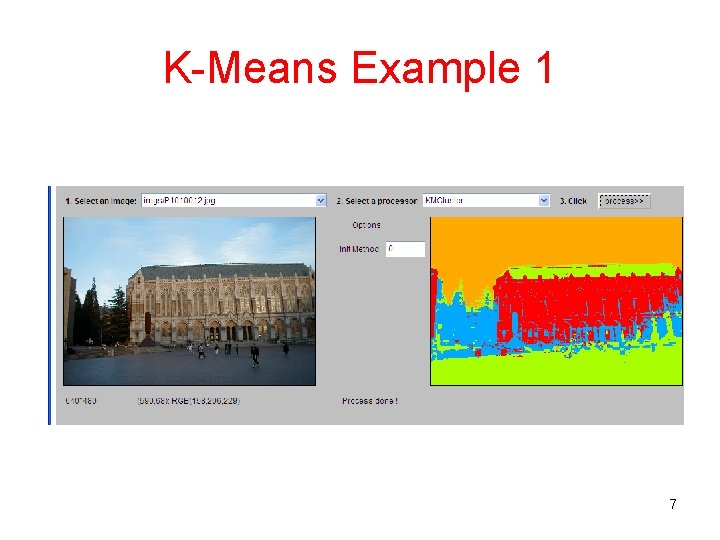
K-Means Example 1 7
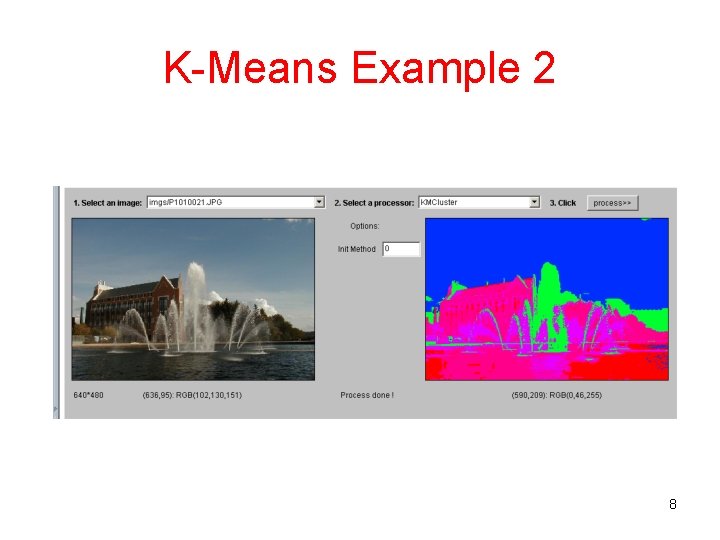
K-Means Example 2 8
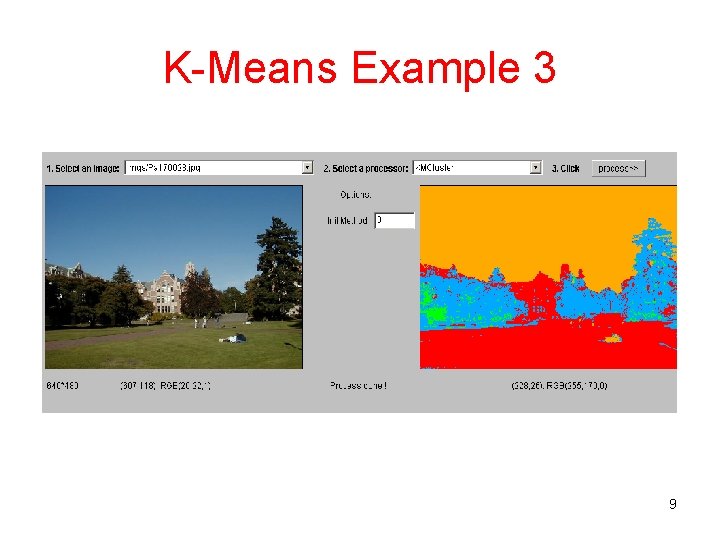
K-Means Example 3 9
K-means Variants • Different ways to initialize the means • Different stopping criteria • Dynamic methods for determining the right number of clusters (K) for a given image • The EM Algorithm: a probabilistic formulation of K-means 10
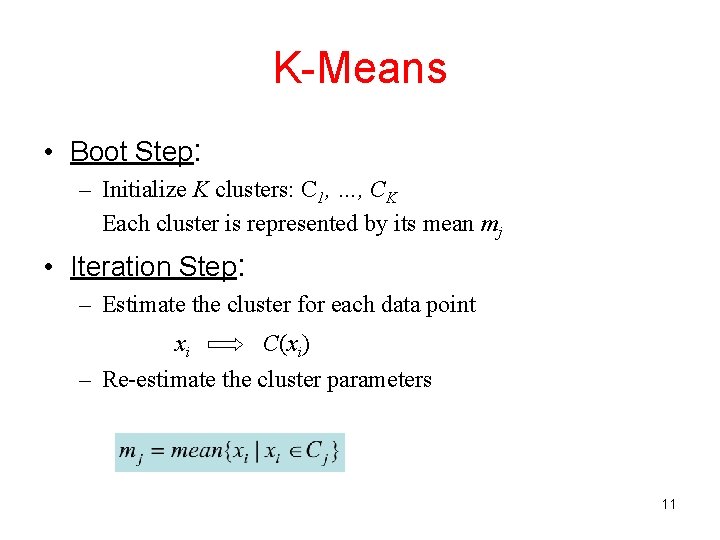
K-Means • Boot Step: – Initialize K clusters: C 1, …, CK Each cluster is represented by its mean mj • Iteration Step: – Estimate the cluster for each data point xi C(xi) – Re-estimate the cluster parameters 11
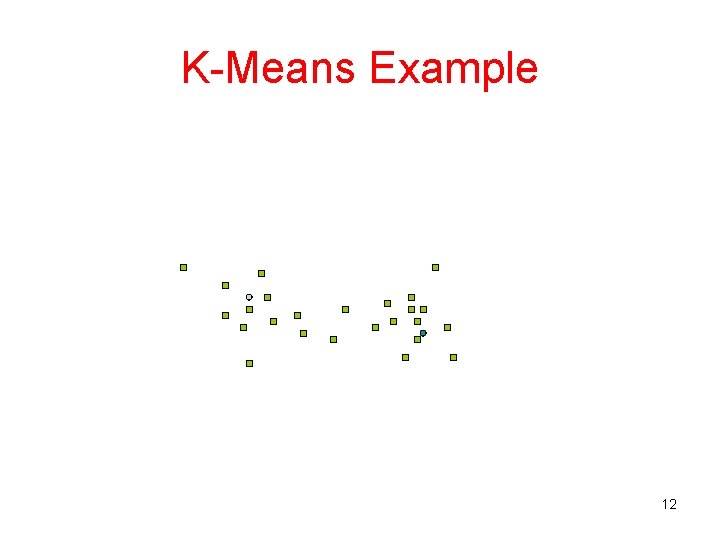
K-Means Example 12
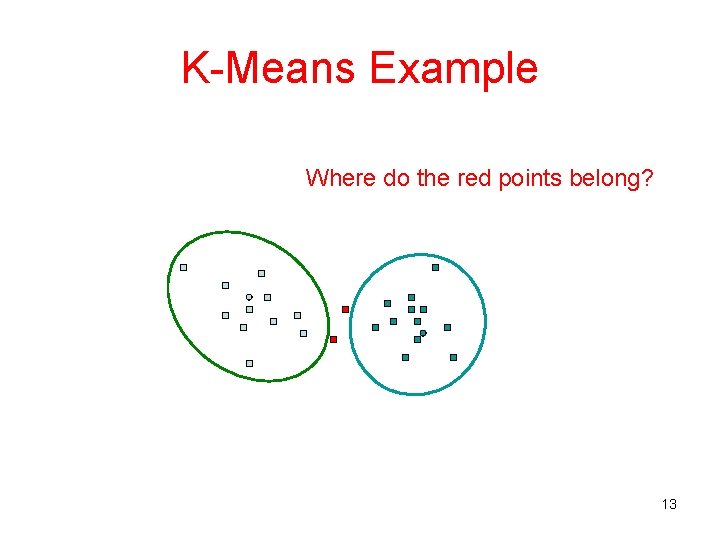
K-Means Example Where do the red points belong? 13
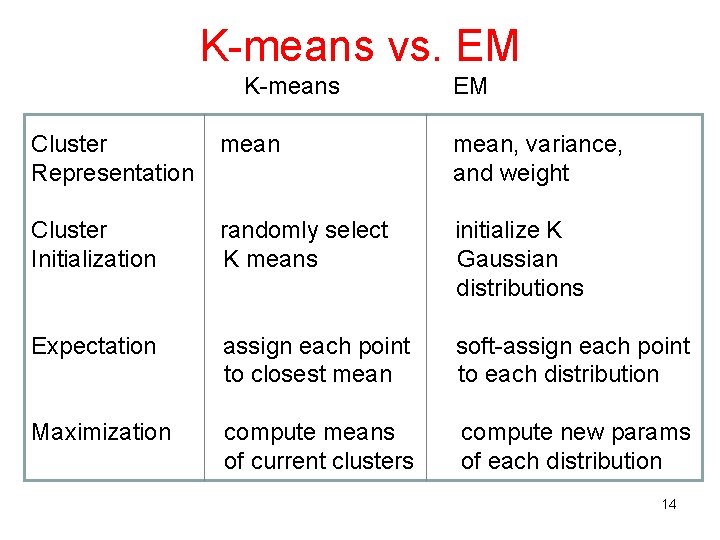
K-means vs. EM K-means EM Cluster Representation mean, variance, and weight Cluster Initialization randomly select K means initialize K Gaussian distributions Expectation assign each point to closest mean soft-assign each point to each distribution Maximization compute means of current clusters compute new params of each distribution 14
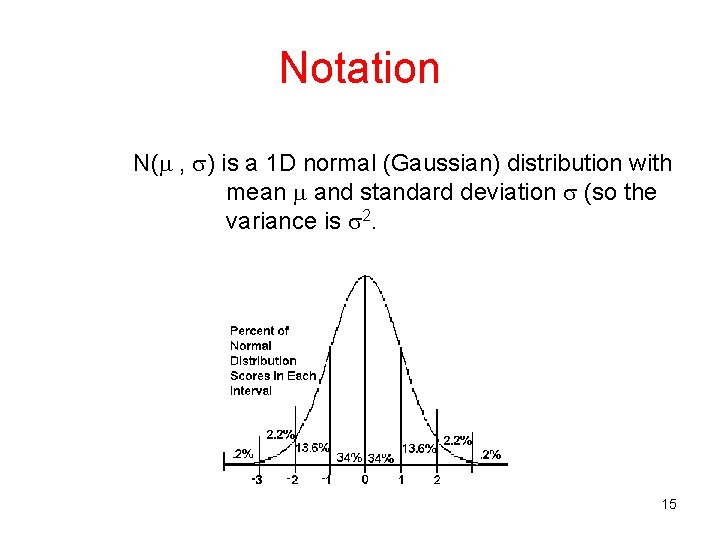
Notation N( , ) is a 1 D normal (Gaussian) distribution with mean and standard deviation (so the variance is 2. 15
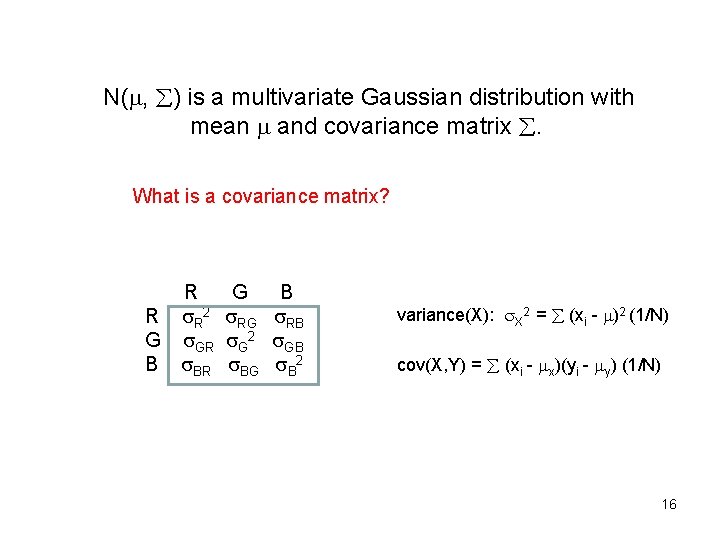
N( , ) is a multivariate Gaussian distribution with mean and covariance matrix . What is a covariance matrix? R G B R R 2 GR BR G B RG RB G 2 GB BG B 2 variance(X): X 2 = (xi - )2 (1/N) cov(X, Y) = (xi - x)(yi - y) (1/N) 16
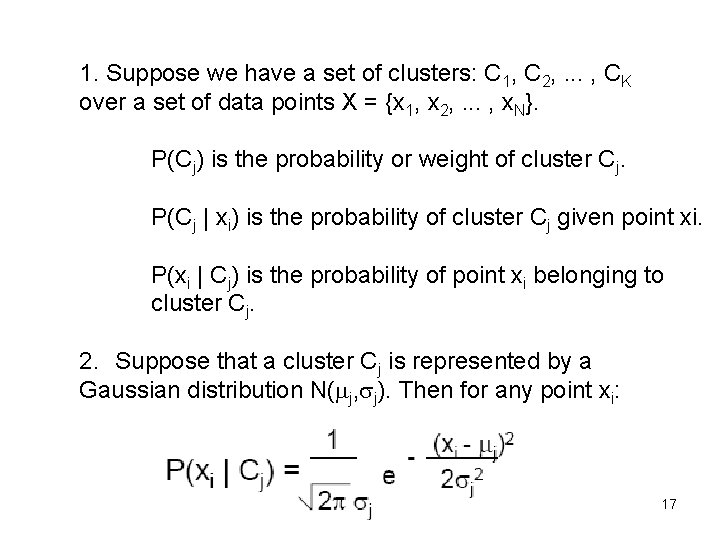
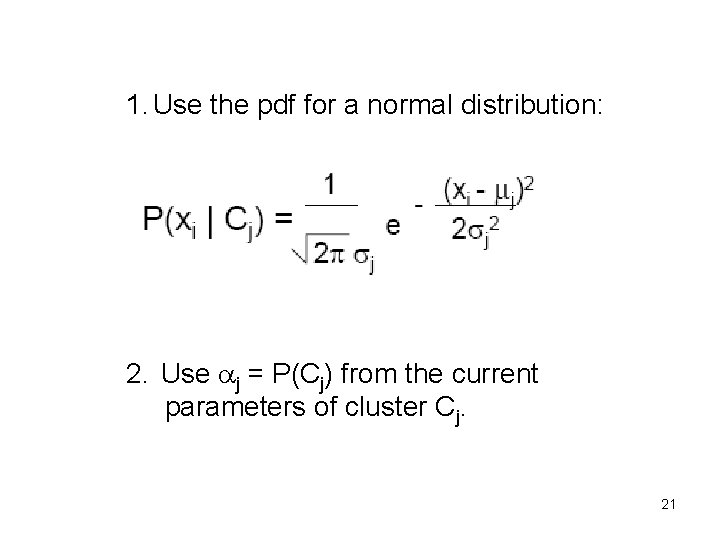
1. Suppose we have a set of clusters: C 1, C 2, . . . , CK over a set of data points X = {x 1, x 2, . . . , x. N}. P(Cj) is the probability or weight of cluster Cj. P(Cj | xi) is the probability of cluster Cj given point xi. P(xi | Cj) is the probability of point xi belonging to cluster Cj. 2. Suppose that a cluster Cj is represented by a Gaussian distribution N( j, j). Then for any point xi: 17
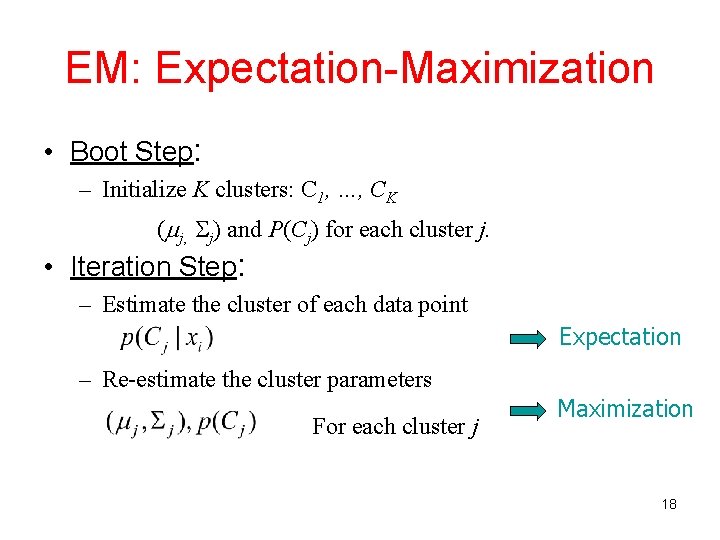
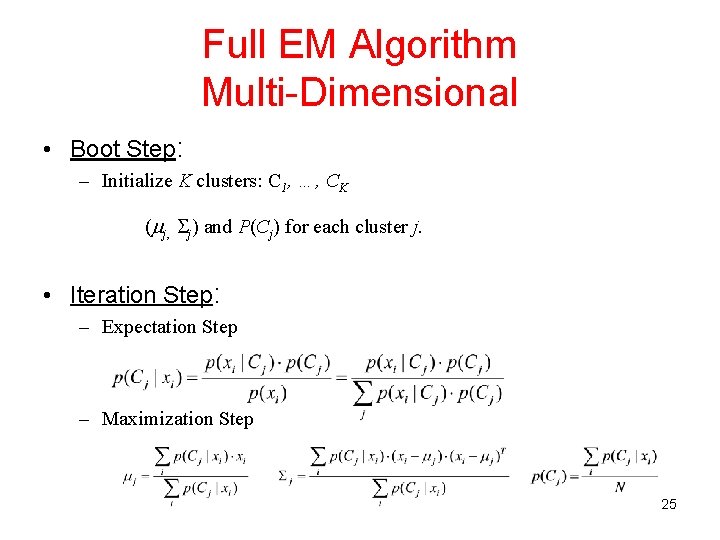
EM: Expectation-Maximization • Boot Step: – Initialize K clusters: C 1, …, CK ( j, j) and P(Cj) for each cluster j. • Iteration Step: – Estimate the cluster of each data point Expectation – Re-estimate the cluster parameters For each cluster j Maximization 18
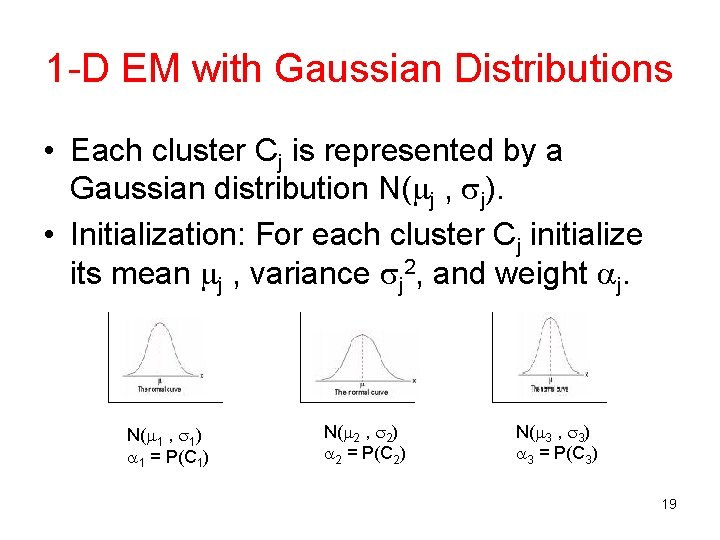
1 -D EM with Gaussian Distributions • Each cluster Cj is represented by a Gaussian distribution N( j , j). • Initialization: For each cluster Cj initialize its mean j , variance j 2, and weight j. N( 1 , 1) 1 = P(C 1) N( 2 , 2) 2 = P(C 2) N( 3 , 3) 3 = P(C 3) 19
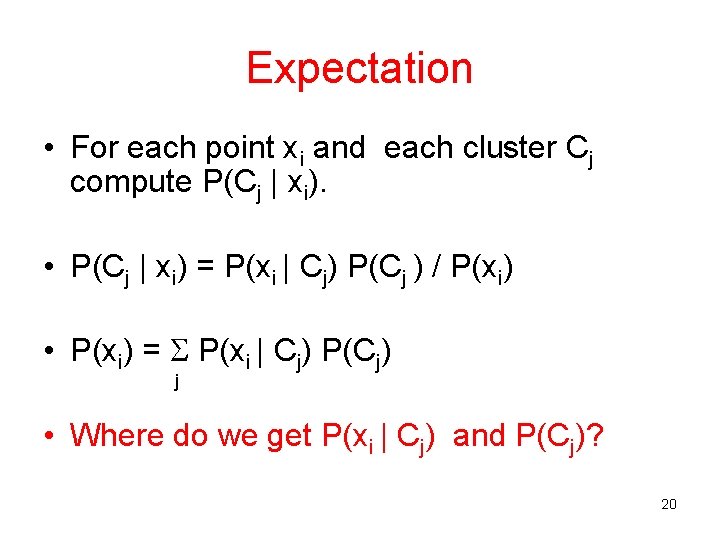
Expectation • For each point xi and each cluster Cj compute P(Cj | xi). • P(Cj | xi) = P(xi | Cj) P(Cj ) / P(xi) • P(xi) = P(xi | Cj) P(Cj) j • Where do we get P(xi | Cj) and P(Cj)? 20
1. Use the pdf for a normal distribution: 2. Use j = P(Cj) from the current parameters of cluster Cj. 21
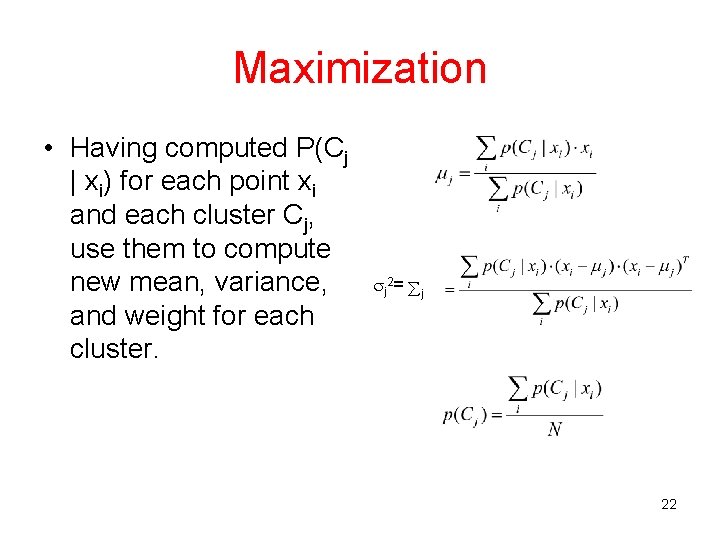
Maximization • Having computed P(Cj | xi) for each point xi and each cluster Cj, use them to compute new mean, variance, and weight for each cluster. j 2= j 22
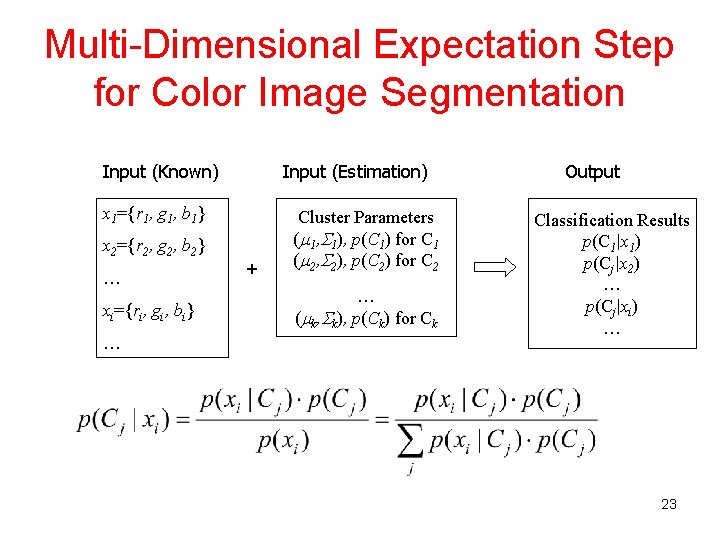
Multi-Dimensional Expectation Step for Color Image Segmentation Input (Known) Input (Estimation) x 1={r 1, g 1, b 1} x 2={r 2, g 2, b 2} … xi={ri, gi, bi} … + Cluster Parameters ( 1, 1), p(C 1) for C 1 ( 2, 2), p(C 2) for C 2 … ( k, k), p(Ck) for Ck Output Classification Results p(C 1|x 1) p(Cj|x 2) … p(Cj|xi) … 23
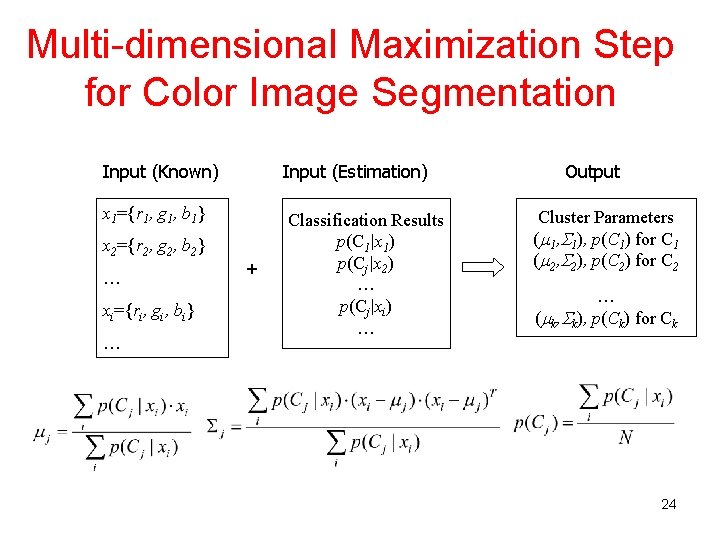
Multi-dimensional Maximization Step for Color Image Segmentation Input (Known) Input (Estimation) x 1={r 1, g 1, b 1} Classification Results p(C 1|x 1) p(Cj|x 2) … p(Cj|xi) … x 2={r 2, g 2, b 2} … xi={ri, gi, bi} … + Output Cluster Parameters ( 1, 1), p(C 1) for C 1 ( 2, 2), p(C 2) for C 2 … ( k, k), p(Ck) for Ck 24
Full EM Algorithm Multi-Dimensional • Boot Step: – Initialize K clusters: C 1, …, CK ( j, j) and P(Cj) for each cluster j. • Iteration Step: – Expectation Step – Maximization Step 25
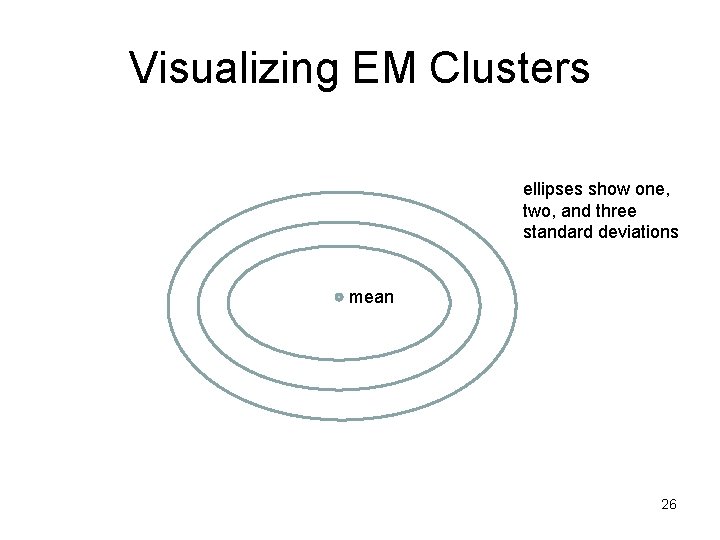
Visualizing EM Clusters ellipses show one, two, and three standard deviations mean 26
EM Demo • Demo http: //www. neurosci. aist. go. jp/~akaho/Mixture. EM. html • Example http: //www-2. cs. cmu. edu/~awm/tutorials/gmm 13. pdf 27
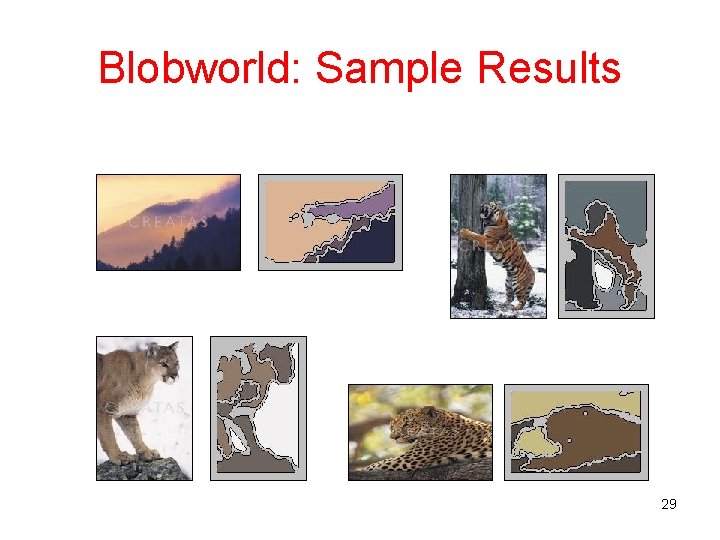
EM Applications • Blobworld: Image segmentation using Expectation-Maximization and its application to image querying • Yi’s Generative/Discriminative Learning of object classes in color images 28
Blobworld: Sample Results 29
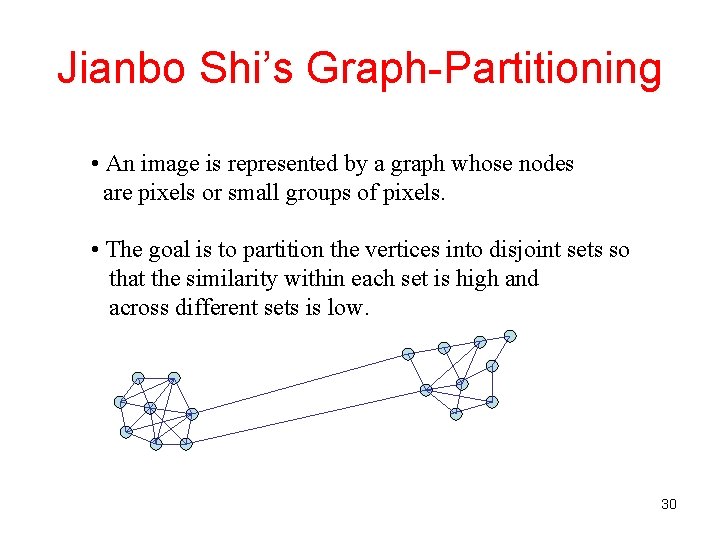
Jianbo Shi’s Graph-Partitioning • An image is represented by a graph whose nodes are pixels or small groups of pixels. • The goal is to partition the vertices into disjoint sets so that the similarity within each set is high and across different sets is low. 30
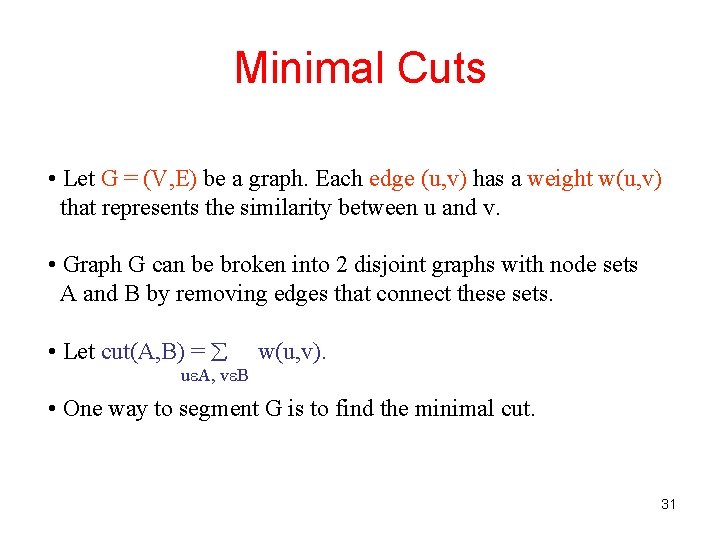
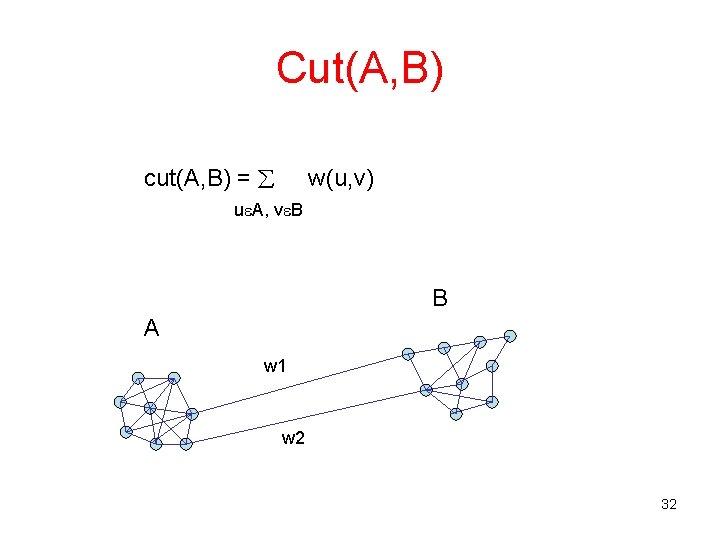
Minimal Cuts • Let G = (V, E) be a graph. Each edge (u, v) has a weight w(u, v) that represents the similarity between u and v. • Graph G can be broken into 2 disjoint graphs with node sets A and B by removing edges that connect these sets. • Let cut(A, B) = w(u, v). u A, v B • One way to segment G is to find the minimal cut. 31
Cut(A, B) cut(A, B) = w(u, v) u A, v B B A w 1 w 2 32
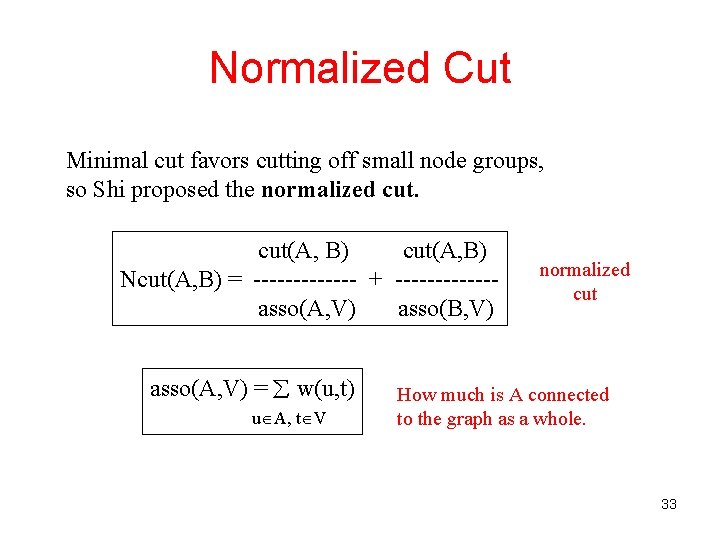
Normalized Cut Minimal cut favors cutting off small node groups, so Shi proposed the normalized cut(A, B) Ncut(A, B) = ------- + ------asso(A, V) asso(B, V) asso(A, V) = w(u, t) u A, t V normalized cut How much is A connected to the graph as a whole. 33
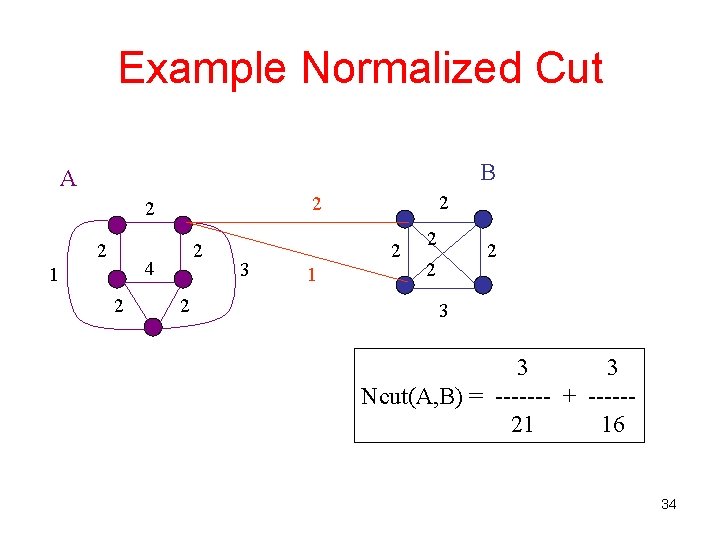
Example Normalized Cut B A 2 2 4 1 2 2 2 3 2 1 2 2 2 3 3 3 Ncut(A, B) = ------- + -----21 16 34
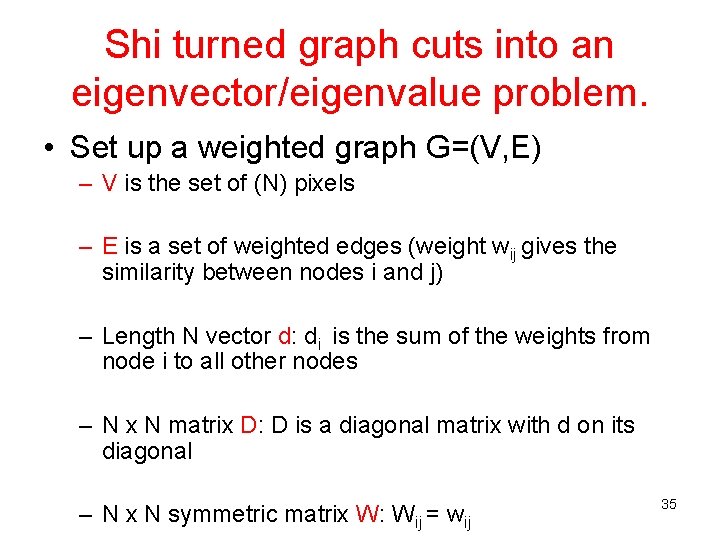
Shi turned graph cuts into an eigenvector/eigenvalue problem. • Set up a weighted graph G=(V, E) – V is the set of (N) pixels – E is a set of weighted edges (weight wij gives the similarity between nodes i and j) – Length N vector d: di is the sum of the weights from node i to all other nodes – N x N matrix D: D is a diagonal matrix with d on its diagonal – N x N symmetric matrix W: Wij = wij 35
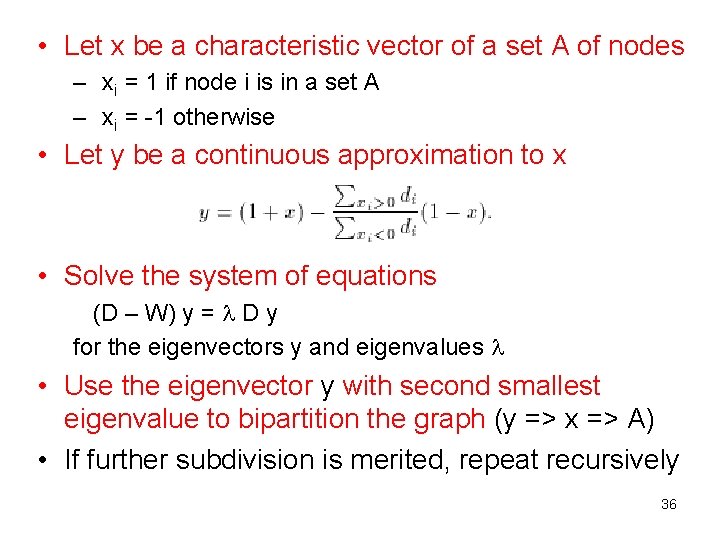
• Let x be a characteristic vector of a set A of nodes – xi = 1 if node i is in a set A – xi = -1 otherwise • Let y be a continuous approximation to x • Solve the system of equations (D – W) y = D y for the eigenvectors y and eigenvalues • Use the eigenvector y with second smallest eigenvalue to bipartition the graph (y => x => A) • If further subdivision is merited, repeat recursively 36
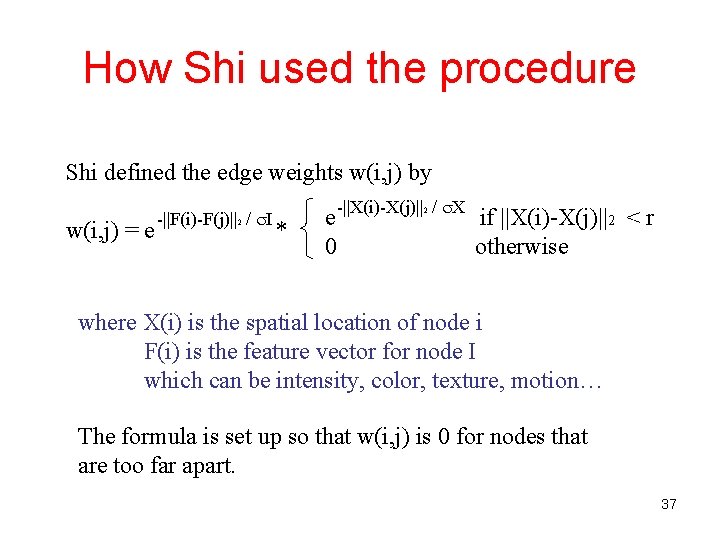
How Shi used the procedure Shi defined the edge weights w(i, j) by w(i, j) = e -||F(i)-F(j)||2 / I * e -||X(i)-X(j)|| 0 2 / X if ||X(i)-X(j)||2 < r otherwise where X(i) is the spatial location of node i F(i) is the feature vector for node I which can be intensity, color, texture, motion… The formula is set up so that w(i, j) is 0 for nodes that are too far apart. 37
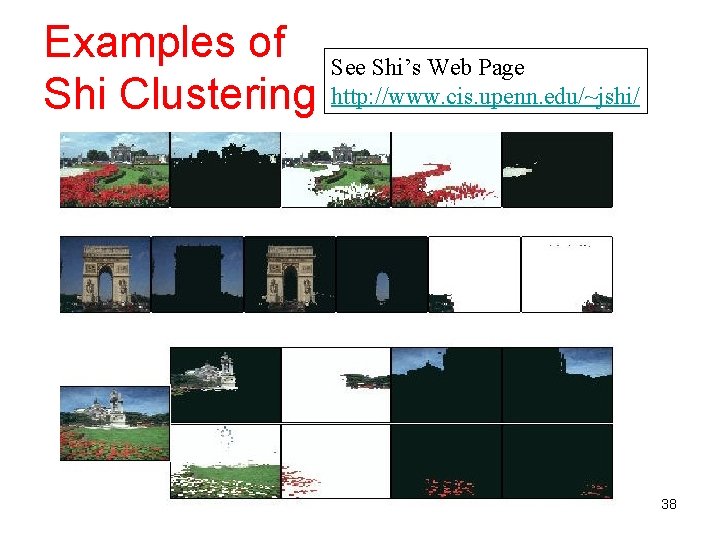
Examples of Shi Clustering See Shi’s Web Page http: //www. cis. upenn. edu/~jshi/ 38
Problems with Graph Cuts • Need to know when to stop • Very Slooooow Problems with EM • Local minima • Need to know number of segments • Need to choose generative model 39
Mean-Shift Clustering • • Simple, like K-means But you don’t have to select K Statistical method Guaranteed to converge to a fixed number of clusters. 40
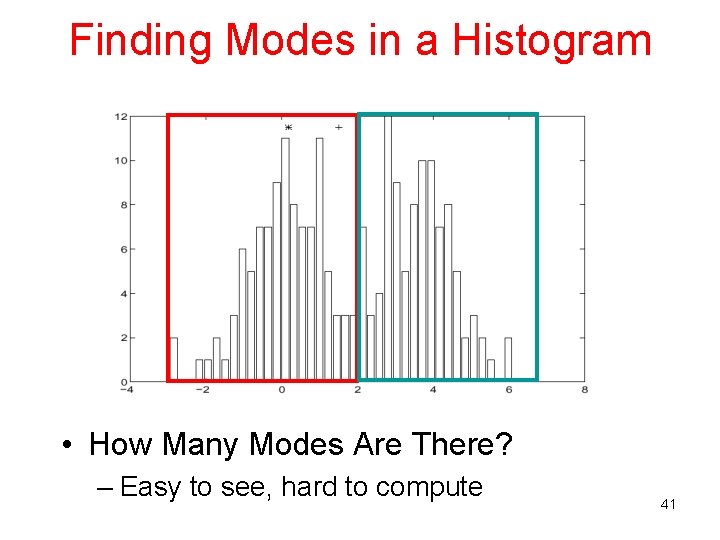
Finding Modes in a Histogram • How Many Modes Are There? – Easy to see, hard to compute 41
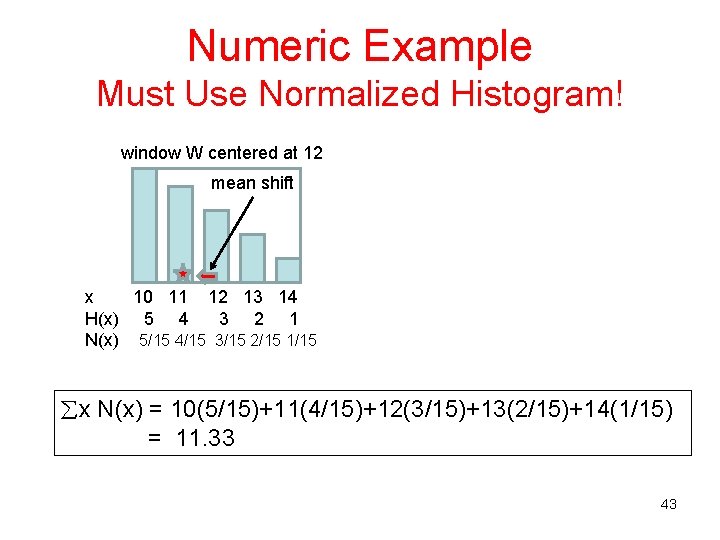
Mean Shift [Comaniciu & Meer] • Iterative Mode Search 1. 2. 3. 4. Initialize random seed, and window W Calculate center of gravity (the “mean”) of W: Translate the search window to the mean Repeat Step 2 until convergence 42
Numeric Example Must Use Normalized Histogram! window W centered at 12 mean shift x 10 11 12 13 14 H(x) 5 4 3 2 1 N(x) 5/15 4/15 3/15 2/15 1/15 x N(x) = 10(5/15)+11(4/15)+12(3/15)+13(2/15)+14(1/15) = 11. 33 43
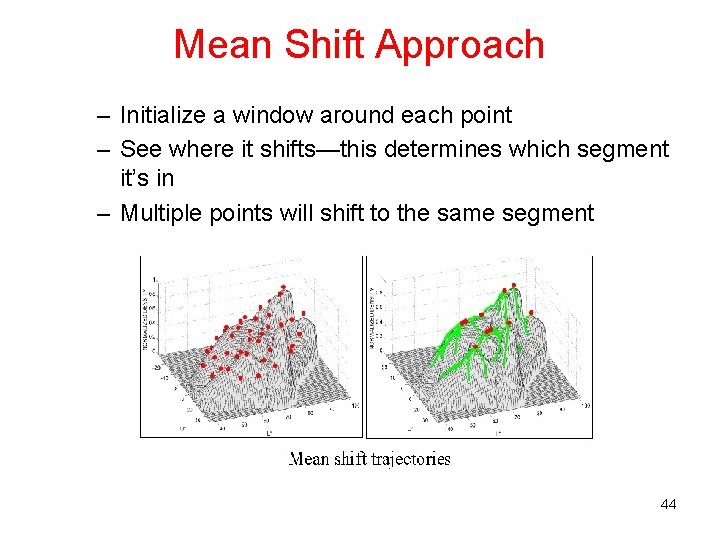
Mean Shift Approach – Initialize a window around each point – See where it shifts—this determines which segment it’s in – Multiple points will shift to the same segment 44
Segmentation Algorithm • First run the mean shift procedure for each data point x and store its convergence point z. • Link together all the z’s that are closer than. 5 from each other to form clusters • Assign each point to its cluster • Eliminate small regions 45
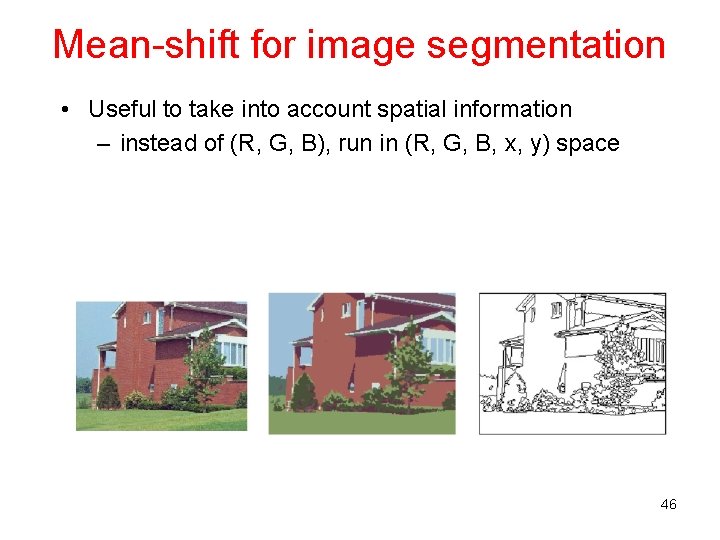
Mean-shift for image segmentation • Useful to take into account spatial information – instead of (R, G, B), run in (R, G, B, x, y) space 46
References – Shi and Malik, “Normalized Cuts and Image Segmentation, ” Proc. CVPR 1997. – Carson, Belongie, Greenspan and Malik, “Blobworld: Image Segmentation Using Expectation-Maximization and its Application to Image Querying, ” IEEE PAMI, Vol 24, No. 8, Aug. 2002. – Comaniciu and Meer, “Mean shift analysis and applications, ” Proc. ICCV 1999. 47