
Region Filling Seed Fill Approaches 2 algorithms Boundary
Region Filling • Seed Fill Approaches – 2 algorithms: Boundary Fill and Flood Fill – works at the pixel level – suitable for interactive painting apllications • Scanline Fill Approaches – works at the polygon level – better performance 168 471 Computer Graphics, KKU. Lecture 7 1

Seed Fill Algorithms: Connectedness • 4 -connected region: From a given pixel, the region that you can get to by a series of 4 way moves (N, S, E and W( • 8 -connected region: From a given pixel, the region that you can get to by a series of 8 way moves (N, S, E, W, NE, NW, SE, and SW ( 4 -connected 8 -connected 168 471 Computer Graphics, KKU. Lecture 7 2
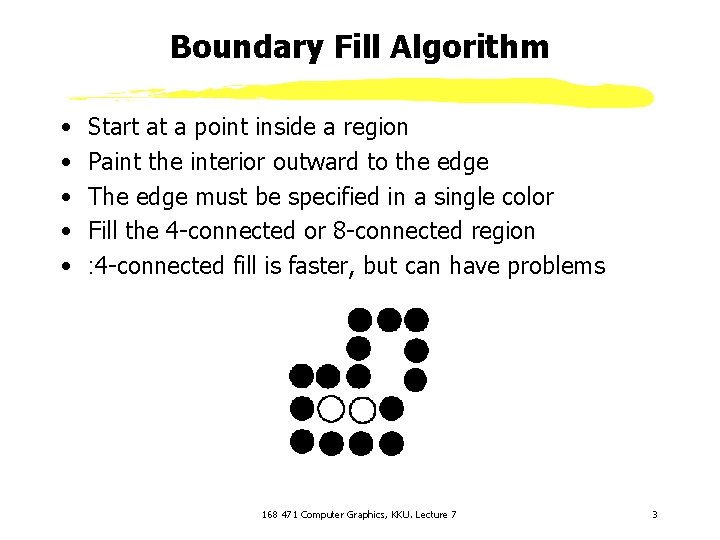
Boundary Fill Algorithm • • • Start at a point inside a region Paint the interior outward to the edge The edge must be specified in a single color Fill the 4 -connected or 8 -connected region : 4 -connected fill is faster, but can have problems 168 471 Computer Graphics, KKU. Lecture 7 3

Boundary Fill Algorithm (cont(. void Boundary. Fill 4(int x, int y , color newcolor, color edgecolor( } int current; current = Read. Pixel(x, y; ( if(current != edgecolor && current != newcolor( } Boundary. Fill 4(x+1, y, newcolor, edgecolor; ( Boundary. Fill 4(x-1, y, newcolor, edgecolor; ( Boundary. Fill 4(x, y+1, newcolor, edgecolor; ( Boundary. Fill 4(x, y-1, newcolor, edgecolor; ( { { 168 471 Computer Graphics, KKU. Lecture 7 4
Flood Fill Algorithm • Used when an area defined with multiple color boundaries • Start at a point inside a region • Replace a specified interior color (old color) with fill color • Fill the 4 -connected or 8 -connected region until all interior points being replaced 168 471 Computer Graphics, KKU. Lecture 7 5
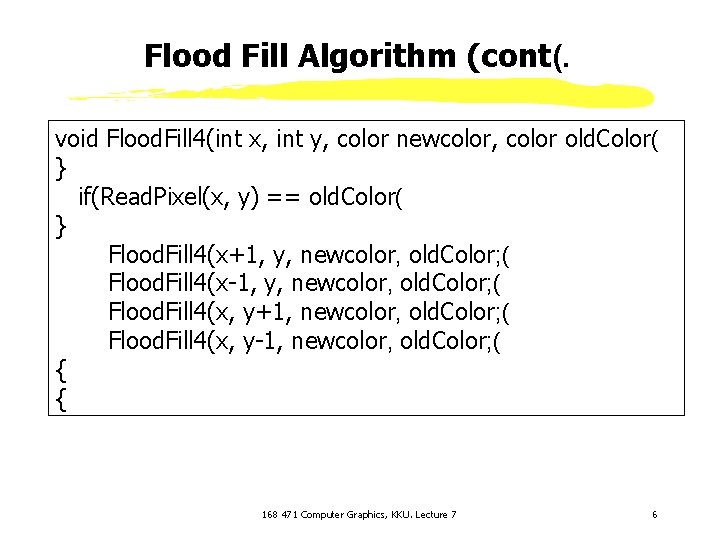
Flood Fill Algorithm (cont(. void Flood. Fill 4(int x, int y, color newcolor, color old. Color( } if(Read. Pixel(x, y) == old. Color( } Flood. Fill 4(x+1, y, newcolor, old. Color; ( Flood. Fill 4(x-1, y, newcolor, old. Color; ( Flood. Fill 4(x, y+1, newcolor, old. Color; ( Flood. Fill 4(x, y-1, newcolor, old. Color; ( { { 168 471 Computer Graphics, KKU. Lecture 7 6

Polygon Types 168 471 Computer Graphics, KKU. Lecture 7 7
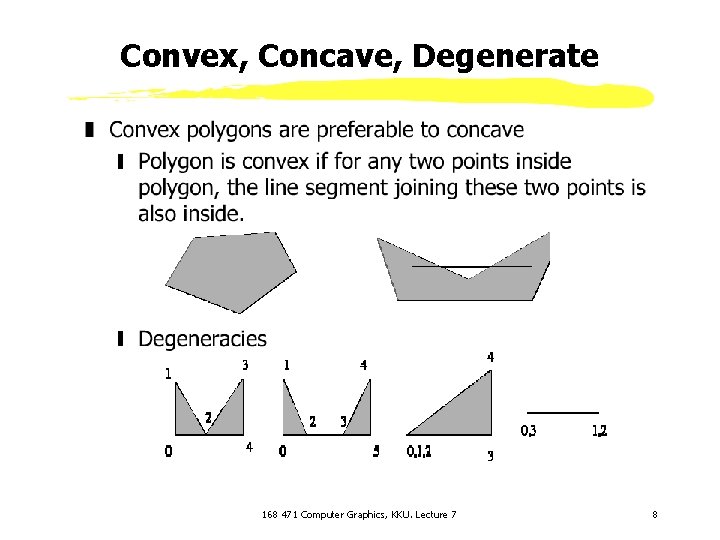
Convex, Concave, Degenerate 168 471 Computer Graphics, KKU. Lecture 7 8
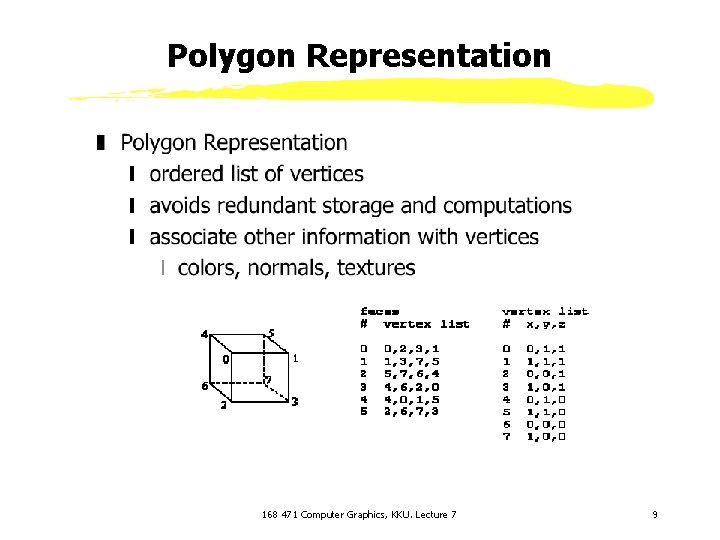
Polygon Representation 168 471 Computer Graphics, KKU. Lecture 7 9
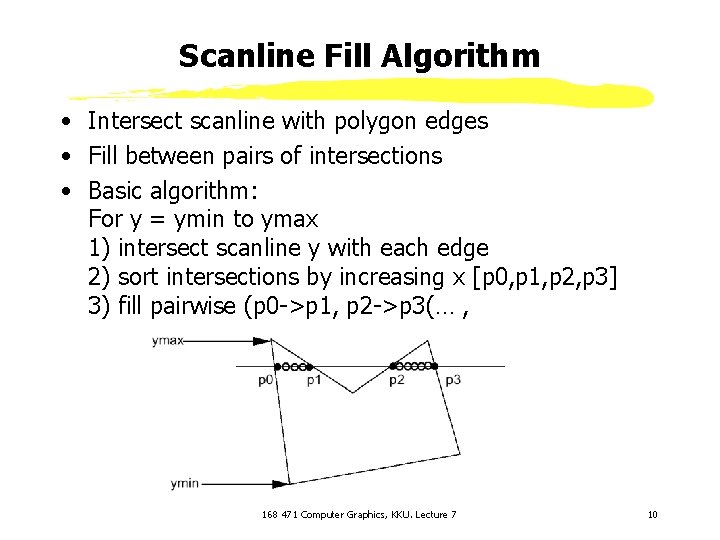
Scanline Fill Algorithm • Intersect scanline with polygon edges • Fill between pairs of intersections • Basic algorithm: For y = ymin to ymax 1) intersect scanline y with each edge 2) sort intersections by increasing x [p 0, p 1, p 2, p 3] 3) fill pairwise (p 0 ->p 1, p 2 ->p 3(… , 168 471 Computer Graphics, KKU. Lecture 7 10
Spacial Handling • Make sure we only fill the interior pixels Define interior: For a given pair of intersection points (Xi, Y), (Xj, Y) -> Fill ceilling(Xi) to floor(Xj) important when we have polygons adjacent to each other. 168 471 Computer Graphics, KKU. Lecture 7 11
Spacial Handling (cont(. • Intersection has an integer X coordinate ->if Xi is integer, we define it to be interior ->if Xj is integer, we define it to be exterior (so don’t fill( 168 471 Computer Graphics, KKU. Lecture 7 12
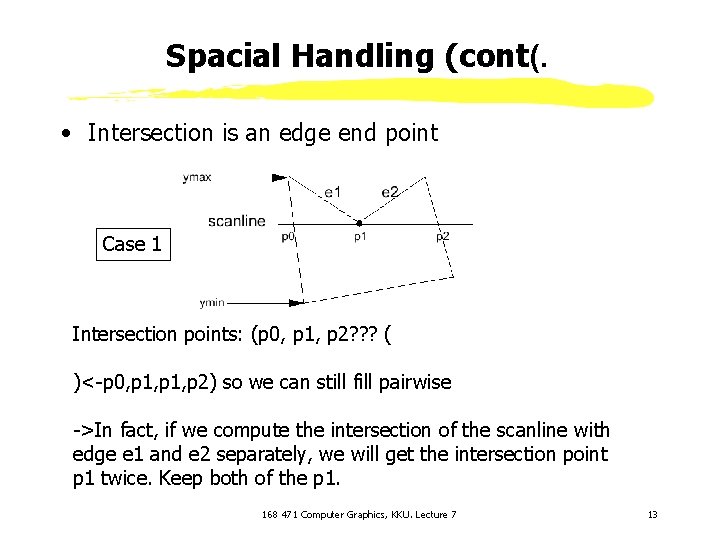
Spacial Handling (cont(. • Intersection is an edge end point Case 1 Intersection points: (p 0, p 1, p 2? ? ? ( )<-p 0, p 1, p 2) so we can still fill pairwise ->In fact, if we compute the intersection of the scanline with edge e 1 and e 2 separately, we will get the intersection point p 1 twice. Keep both of the p 1. 168 471 Computer Graphics, KKU. Lecture 7 13
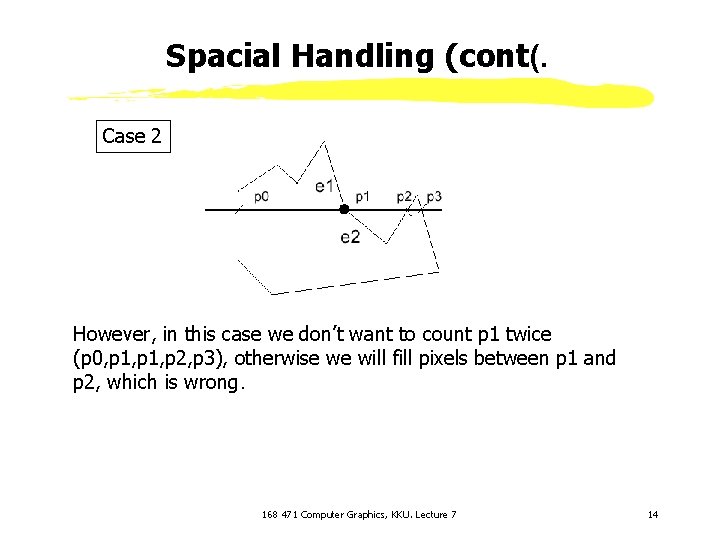
Spacial Handling (cont(. Case 2 However, in this case we don’t want to count p 1 twice (p 0, p 1, p 2, p 3), otherwise we will fill pixels between p 1 and p 2, which is wrong. 168 471 Computer Graphics, KKU. Lecture 7 14
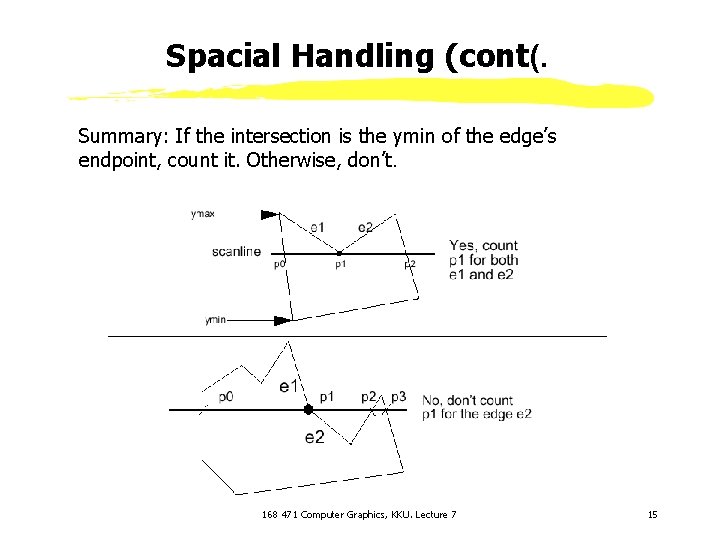
Spacial Handling (cont(. Summary: If the intersection is the ymin of the edge’s endpoint, count it. Otherwise, don’t. 168 471 Computer Graphics, KKU. Lecture 7 15
- Slides: 15