
Region 9 The Latest from EPA Region 9
- Slides: 34
Region 9 The Latest from EPA Region 9 Matthew Lakin, Ph. D. Deputy Director Air and Radiation Division U. S. EPA Region 9 California Desert Air Working Group November 7, 2019
Region 9 Overview • National: o o NAAQS Review and Implementation Agency Priority: Reducing Nonattainment Areas Agency Priority: Streamlining SIP Processing Agency Priority: Permitting Improvements o Electronic Permits System o Exceptional Events o Ozone Implementation Updates 2
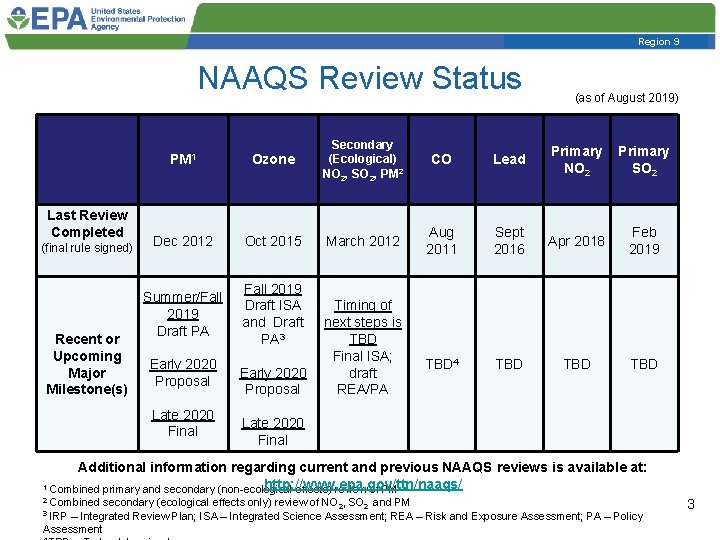
Region 9 NAAQS Review Status Last Review Completed (final rule signed) Recent or Upcoming Major Milestone(s) (as of August 2019) Ozone Secondary (Ecological) NO 2, SO 2, PM 2 CO Lead Primary NO 2 Primary SO 2 Dec 2012 Oct 2015 March 2012 Aug 2011 Sept 2016 Apr 2018 Feb 2019 Summer/Fall 2019 Draft PA Fall 2019 Draft ISA and Draft PA 3 TBD 4 TBD TBD PM 1 Early 2020 Proposal Late 2020 Final Early 2020 Proposal Timing of next steps is TBD Final ISA; draft REA/PA Late 2020 Final Additional information regarding current and previous NAAQS reviews is available at: http: //www. epa. gov/ttn/naaqs/ 1 Combined primary and secondary (non-ecological effects) review of PM 2 Combined secondary (ecological effects only) review of NO , SO and PM 2 2, 3 IRP – Integrated Review Plan; ISA – Integrated Science Assessment; REA – Risk and Exposure Assessment; PA – Policy Assessment 3
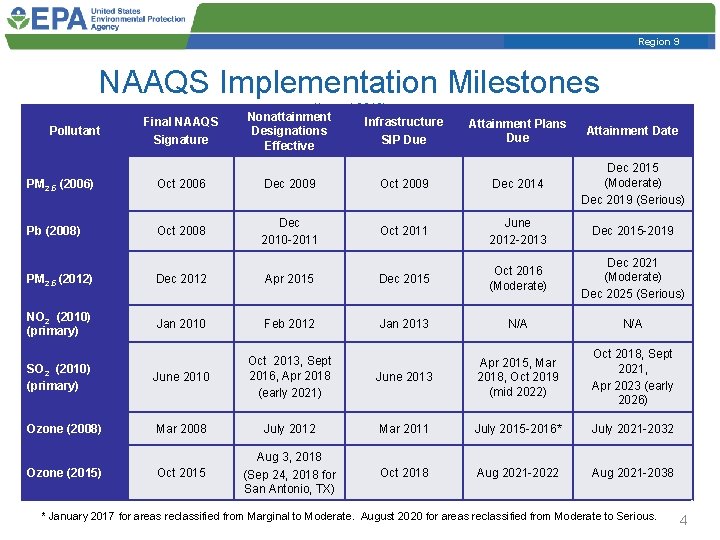
Region 9 NAAQS Implementation Milestones Pollutant Final NAAQS Signature (August 2019) Nonattainment Infrastructure Designations SIP Due Effective Attainment Plans Due Attainment Date PM 2. 5 (2006) Oct 2006 Dec 2009 Oct 2009 Dec 2014 Dec 2015 (Moderate) Dec 2019 (Serious) Pb (2008) Oct 2008 Dec 2010 -2011 Oct 2011 June 2012 -2013 Dec 2015 -2019 Dec 2021 (Moderate) Dec 2025 (Serious) PM 2. 5 (2012) Dec 2012 Apr 2015 Dec 2015 Oct 2016 (Moderate) NO 2 (2010) (primary) Jan 2010 Feb 2012 Jan 2013 N/A SO 2 (2010) (primary) June 2010 Oct 2013, Sept 2016, Apr 2018 (early 2021) June 2013 Apr 2015, Mar 2018, Oct 2019 (mid 2022) Oct 2018, Sept 2021, Apr 2023 (early 2026) Ozone (2008) Mar 2008 July 2012 Mar 2011 July 2015 -2016* July 2021 -2032 Oct 2015 Aug 3, 2018 (Sep 24, 2018 for San Antonio, TX) Oct 2018 Aug 2021 -2022 Aug 2021 -2038 Ozone (2015) * January 2017 for areas reclassified from Marginal to Moderate. August 2020 for areas reclassified from Moderate to Serious. 4 4
Region 9 Agency Priority: Reducing the Number of Nonattainment Areas
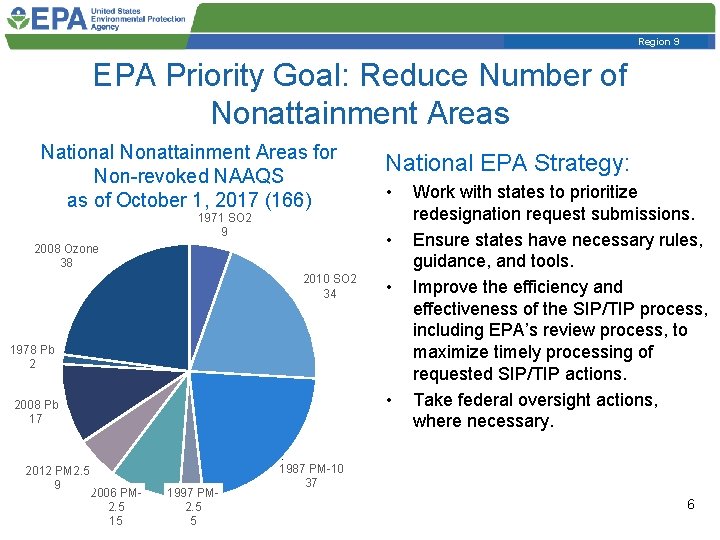
Region 9 EPA Priority Goal: Reduce Number of Nonattainment Areas National Nonattainment Areas for Non-revoked NAAQS as of October 1, 2017 (166) 1971 SO 2 9 National EPA Strategy: • • 2008 Ozone 38 2010 SO 2 34 • 1978 Pb 2 • 2008 Pb 17 2012 PM 2. 5 9 2006 PM 2. 5 15 1997 PM 2. 5 5 Work with states to prioritize redesignation request submissions. Ensure states have necessary rules, guidance, and tools. Improve the efficiency and effectiveness of the SIP/TIP process, including EPA’s review process, to maximize timely processing of requested SIP/TIP actions. Take federal oversight actions, where necessary. 1987 PM-10 37 6
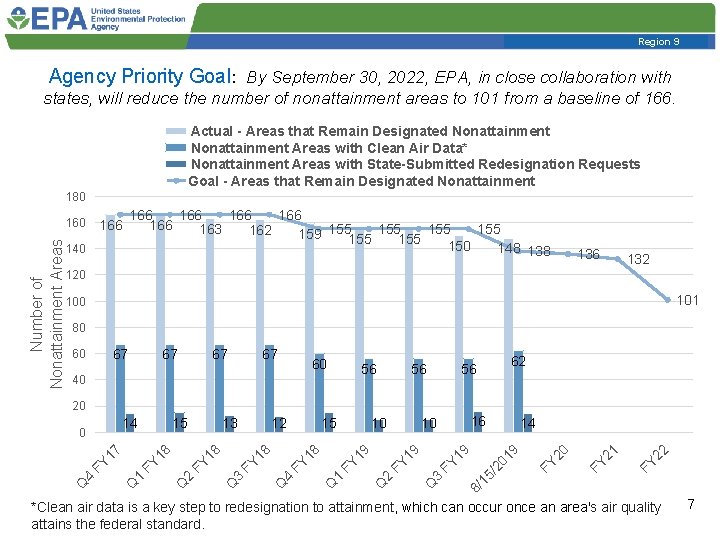
Region 9 Agency Priority Goal: By September 30, 2022, EPA, in close collaboration with states, will reduce the number of nonattainment areas to 101 from a baseline of 166. Actual - Areas that Remain Designated Nonattainment Areas with Clean Air Data* Nonattainment Areas with State-Submitted Redesignation Requests Goal - Areas that Remain Designated Nonattainment 180 Number of Nonattainment Areas 160 166 140 166 166 166 163 155 162 159 155155 155 150 148 136 132 120 101 100 80 67 67 67 60 56 40 56 62 56 20 16 22 FY 21 FY 20 8/ 15 FY 01 9 14 /2 19 FY Q 3 FY 19 10 Q 2 19 FY Q 1 18 FY 3 10 15 Q 4 18 12 FY 18 FY Q 2 18 FY Q 1 17 FY Q 4 13 15 Q 14 0 *Clean air data is a key step to redesignation to attainment, which can occur once an area's air quality attains the federal standard. 7
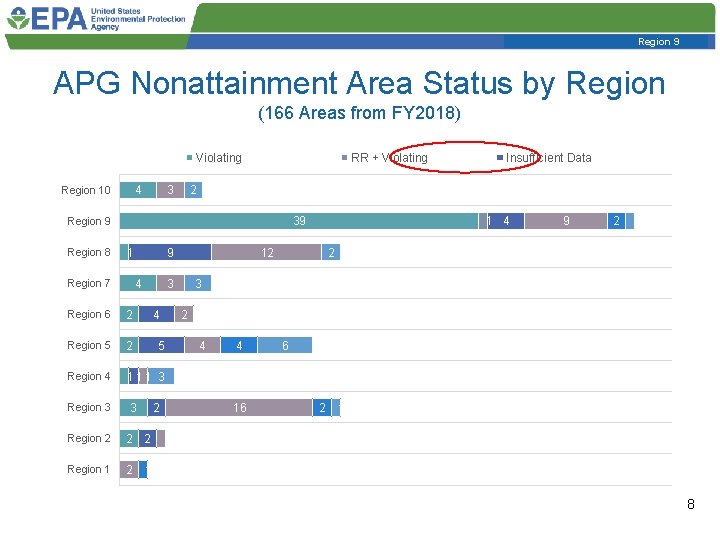
Region 9 APG Nonattainment Area Status by Region (166 Areas from FY 2018) Violating 4 Region 10 3 RR + Violating 2 39 Region 8 1 9 4 Region 7 2 Region 5 2 Region 4 111 3 Region 3 4 2 Region 2 2 2 Region 1 2 9 2 1 2 3 2 5 3 1 4 12 3 Region 6 Insufficient Data 4 4 16 6 2 1 1 1 8
Region 9 Agency Priority: Improving State Implementation Plan Reviews
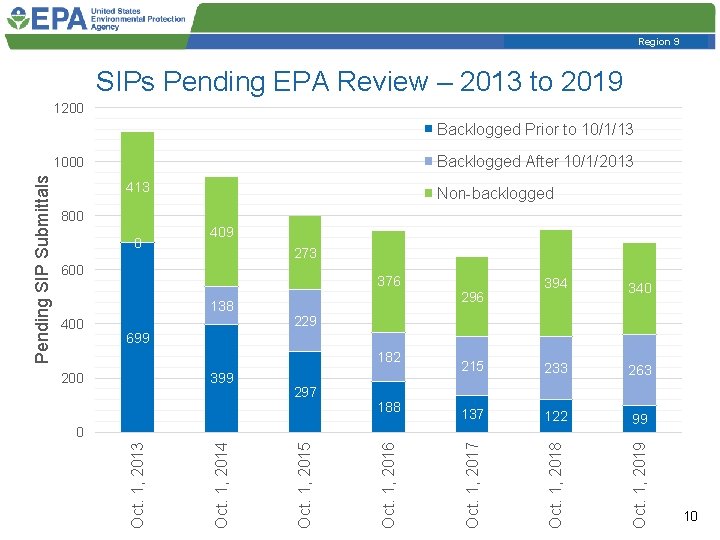
Region 9 SIPs Pending EPA Review – 2013 to 2019 1200 Backlogged Prior to 10/1/13 Backlogged After 10/1/2013 413 Non-backlogged 800 0 409 273 600 215 233 263 188 137 122 99 Oct. 1, 2018 Oct. 1, 2019 400 340 Oct. 1, 2017 138 394 Oct. 1, 2016 376 296 229 699 182 200 399 297 Oct. 1, 2015 Oct. 1, 2014 0 Oct. 1, 2013 Pending SIP Submittals 1000 10
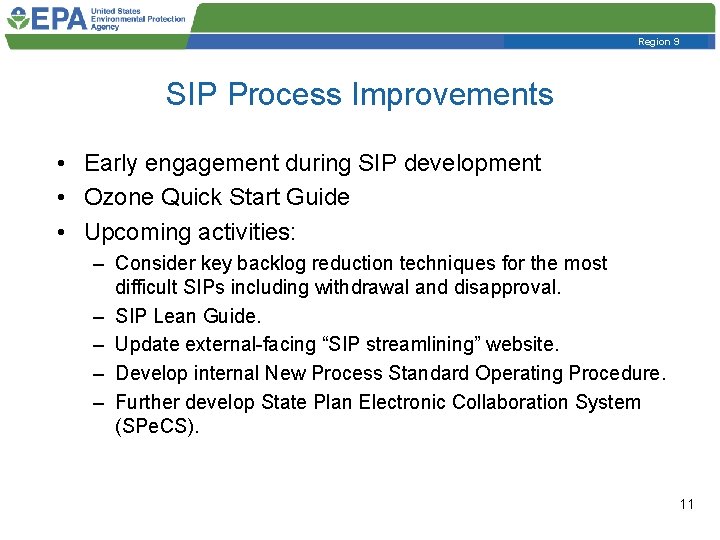
Region 9 SIP Process Improvements • Early engagement during SIP development • Ozone Quick Start Guide • Upcoming activities: – Consider key backlog reduction techniques for the most difficult SIPs including withdrawal and disapproval. – SIP Lean Guide. – Update external-facing “SIP streamlining” website. – Develop internal New Process Standard Operating Procedure. – Further develop State Plan Electronic Collaboration System (SPe. CS). 11
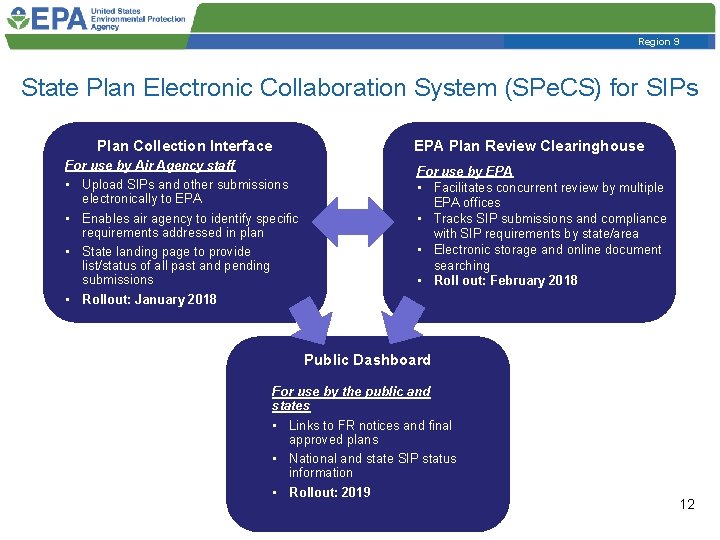
Region 9 State Plan Electronic Collaboration System (SPe. CS) for SIPs Plan Collection Interface EPA Plan Review Clearinghouse For use by Air Agency staff • Upload SIPs and other submissions electronically to EPA • Enables air agency to identify specific requirements addressed in plan • State landing page to provide list/status of all past and pending submissions • Rollout: January 2018 For use by EPA • Facilitates concurrent review by multiple EPA offices • Tracks SIP submissions and compliance with SIP requirements by state/area • Electronic storage and online document searching • Roll out: February 2018 Public Dashboard For use by the public and states • Links to FR notices and final approved plans • National and state SIP status information • Rollout: 2019 12
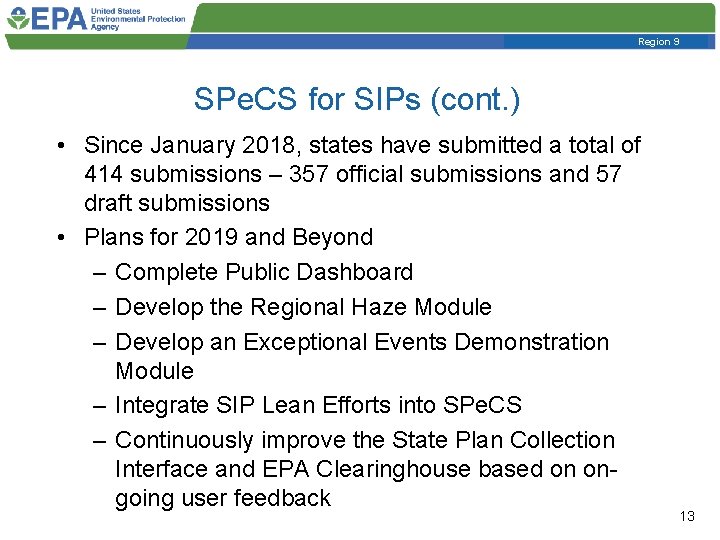
Region 9 SPe. CS for SIPs (cont. ) • Since January 2018, states have submitted a total of 414 submissions – 357 official submissions and 57 draft submissions • Plans for 2019 and Beyond – Complete Public Dashboard – Develop the Regional Haze Module – Develop an Exceptional Events Demonstration Module – Integrate SIP Lean Efforts into SPe. CS – Continuously improve the State Plan Collection Interface and EPA Clearinghouse based on ongoing user feedback 13
Region 9 Agency Priority: Streamlining Permitting
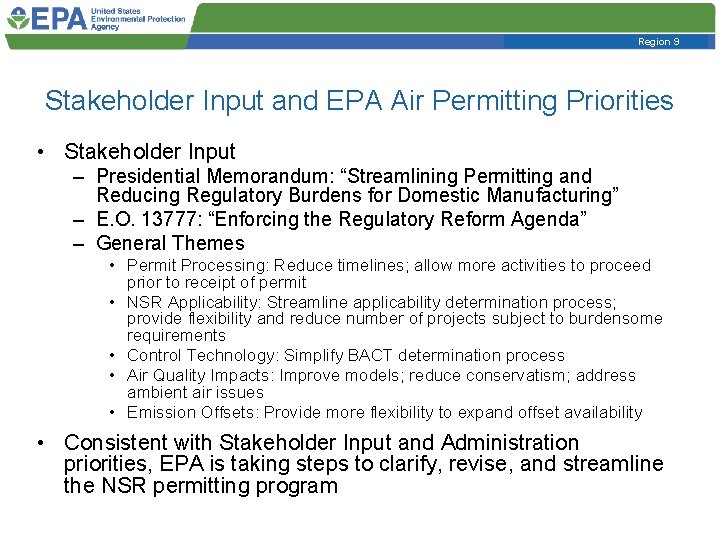
Region 9 Stakeholder Input and EPA Air Permitting Priorities • Stakeholder Input – Presidential Memorandum: “Streamlining Permitting and Reducing Regulatory Burdens for Domestic Manufacturing” – E. O. 13777: “Enforcing the Regulatory Reform Agenda” – General Themes • Permit Processing: Reduce timelines; allow more activities to proceed prior to receipt of permit • NSR Applicability: Streamline applicability determination process; provide flexibility and reduce number of projects subject to burdensome requirements • Control Technology: Simplify BACT determination process • Air Quality Impacts: Improve models; reduce conservatism; address ambient air issues • Emission Offsets: Provide more flexibility to expand offset availability • Consistent with Stakeholder Input and Administration priorities, EPA is taking steps to clarify, revise, and streamline the NSR permitting program 15
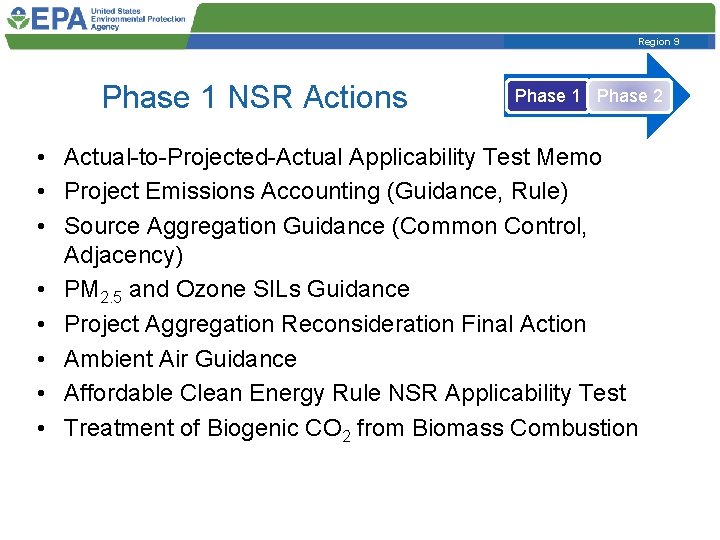
Region 9 Phase 1 NSR Actions Phase 1 Phase 2 • Actual-to-Projected-Actual Applicability Test Memo • Project Emissions Accounting (Guidance, Rule) • Source Aggregation Guidance (Common Control, Adjacency) • PM 2. 5 and Ozone SILs Guidance • Project Aggregation Reconsideration Final Action • Ambient Air Guidance • Affordable Clean Energy Rule NSR Applicability Test • Treatment of Biogenic CO 2 from Biomass Combustion 16
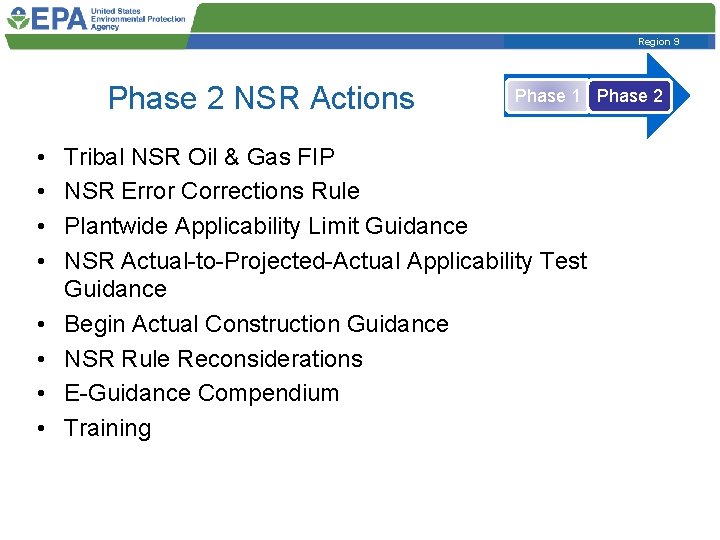
Region 9 Phase 2 NSR Actions • • Phase 1 Phase 2 Tribal NSR Oil & Gas FIP NSR Error Corrections Rule Plantwide Applicability Limit Guidance NSR Actual-to-Projected-Actual Applicability Test Guidance Begin Actual Construction Guidance NSR Rule Reconsiderations E-Guidance Compendium Training 17
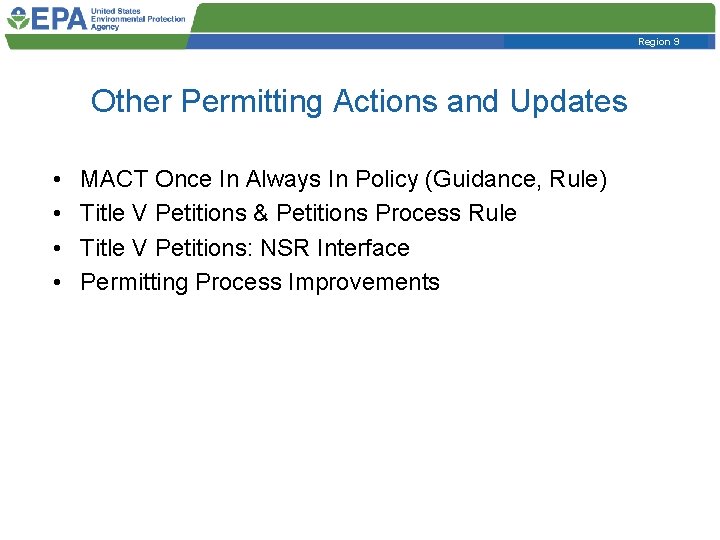
Region 9 Other Permitting Actions and Updates • • MACT Once In Always In Policy (Guidance, Rule) Title V Petitions & Petitions Process Rule Title V Petitions: NSR Interface Permitting Process Improvements 18
Region 9 Questions? Contact: Gerardo Rios, Manager of the Permits Office (415) 972 -3974 Rios. Gerardo@epa. gov List of Air Permitting Contacts at EPA Region 9: https: //www. epa. gov/caa-permitting-epaspacific-southwest-region-9 19
Region 9 Electronic Permit System
Region 9 What is the Electronic Permits System? • It is a portal that allows state/local/tribal permitting agencies to submit electronically draft NSR/title V permits for EPA review. • The system includes a custom dashboard for each permitting agency that allows them to have a complete record of what was submitted to EPA and any formal feedback to was provided. • EPS provides immediate confirmation of a received submittal. • EPS automatically provides the deadline for EPA review (only adjusted if information is missing). 21
Region 9 Electronic Permit System www. cdx. epa. gov • The system went online in November of 2018. • Status updates: – Delivered 7 webinar trainings. – Based on feedback from current users, we are working on updates to the system.
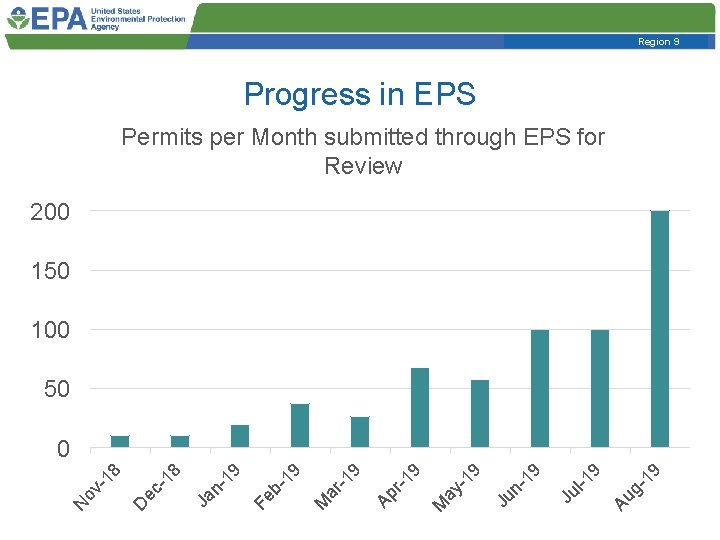
Region 9 Progress in EPS Permits per Month submitted through EPS for Review 200 150 100 50 19 Au g- -1 9 Ju l 9 Ju n 1 19 ay M Ap r-1 9 9 ar -1 M 19 Fe b- 9 Ja n 1 -1 8 D ec N ov -1 8 0
Region 9 EPS Updates in the next few months • Adding project numbers and applications numbers to the form (not required fields). • Changing check boxes for permit type and source type to a multi-select dropdown. • General improvements to business rules. • Multi-select review status so we can communicate more specific review statuses back to permitting authorities. • Public dashboard: The public dashboard will have the EPA petition dates available to start. • BACT/LAER Clearinghouse: Taking in state input at this stage. Contact Sheila Tsai (EPA Region 9) if you are interested in joining the state workgroup
Region 9 More Information • Training is available upon request. • If you have specific questions or feedback on improvements, please contact: Contacts: • Sheila Tsai, Tsai. Ya-Ting@epa. gov (415) 972 -3328 • Gerardo Rios, Rios. Gerardo@epa. gov (415) 972 -3974
Region 9 Exceptional Events
Region 9 Exceptional Events Update • EPA has concurred on 25 state demonstrations that were submitted since EPA revised the Exceptional Events Rule in September 2016 • We continue developing new guidance documents to help right-size demonstrations and facilitate the exceptional events process – Thank you for feedback on drafts! – – Stratospheric Ozone Intrusion Guidance – Released November 2018 Updated High Wind Dust Event Guidance – Released April 4, 2019 Clarification Memo on Data Modification – Released April 4, 2019 Prescribed Fire Guidance – Released August 9, 2019 • EPA’s exceptional events webpage provides key resources, including example demonstrations for Ozone and PM, and will continue to be updated as new materials become available https: //www. epa. gov/air-quality-analysis/treatment-air-quality-datainfluenced-exceptional-events 27
Region 9 Exceptional Events Recent EPA Region 9 EE work: • Concurrence on two Phoenix ozone wildfire events. • Working on PM 10 high wind dust events in Imperial County, CA. • We appreciate the ongoing engagement and open dialogue with our State/Local/Tribal agencies. – Early engagement on possible events has been saving agencies time and resources when events do not have regulatory significance. – Early engagement can also help focus analyses in instances where there are multiple potential events. 28
Region 9 – Ozone Implementation Updates
Region 9 1997 and 2008 Ozone Nonattainment Areas • 1997 ozone NAAQS: – EPA approved a voluntary reclassification for the Coachella 1997 ozone nonattainment area to be bumped up from Severe to Extreme. • 2008 ozone NAAQS, moderate areas: – EPA granted a voluntary reclassification from Moderate to Serious for Eastern Kern. – EPA made final determinations that: • Mariposa attained by the moderate attainment date. • Western Nevada and San Diego did not attain by their attainment dates and were reclassified to Serious. 30
Region 9 1997 and 2008 Ozone Nonattainment Areas • 2008 ozone NAAQS, all areas: – EPA has most of the attainment plans for the 2008 ozone NAAQS in house, and we have completed final action on the attainment plans for San Joaquin Valley and South Coast. We intend to propose action on the remaining plans this fiscal year. – EPA, CARB, and the Air Districts have been working on commitment letters to address the contingency requirement for 2008 ozone plans and ensure consistency with the Bahr v. EPA decision. 31
Region 9 2015 Ozone NAAQS • EPA completed designations for the 2015 ozone NAAQS in 2018. Region 9 areas that were designated for 2015, but were not previously designated for the 2008 ozone NAAQS were: – Amador County – Sutter Buttes – Tuolumne County • October 2018: CARB submitted an infrastructure SIP update for the 2015 ozone NAAQS. EPA, CARB, and Districts are working on required emergency episode plans. 32
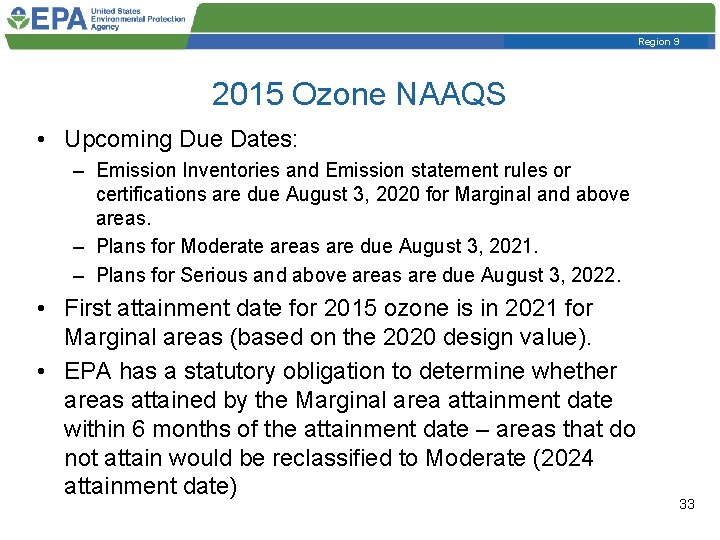
Region 9 2015 Ozone NAAQS • Upcoming Due Dates: – Emission Inventories and Emission statement rules or certifications are due August 3, 2020 for Marginal and above areas. – Plans for Moderate areas are due August 3, 2021. – Plans for Serious and above areas are due August 3, 2022. • First attainment date for 2015 ozone is in 2021 for Marginal areas (based on the 2020 design value). • EPA has a statutory obligation to determine whether areas attained by the Marginal area attainment date within 6 months of the attainment date – areas that do not attain would be reclassified to Moderate (2024 attainment date) 33
Region 9 Questions? Matt Lakin. Matthew@epa. gov (415) 972 -3851