
Regents Physics n Circuits Unit Part I n
- Slides: 13
Regents Physics n Circuits Unit Part I n Resistivity and Ohm’s Law
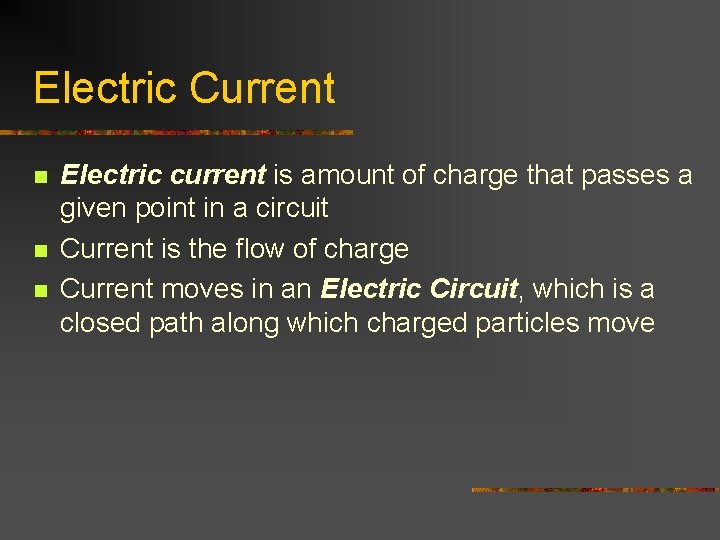
Electric Current n n n Electric current is amount of charge that passes a given point in a circuit Current is the flow of charge Current moves in an Electric Circuit, which is a closed path along which charged particles move
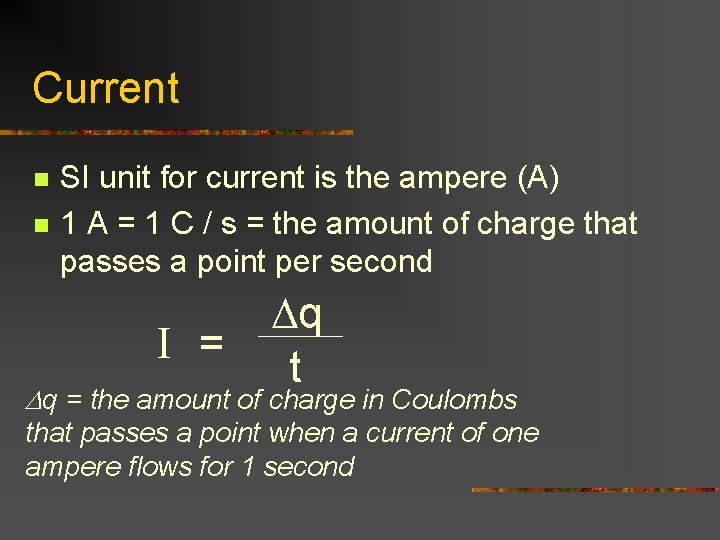
Current n n SI unit for current is the ampere (A) 1 A = 1 C / s = the amount of charge that passes a point per second I = q t q = the amount of charge in Coulombs that passes a point when a current of one ampere flows for 1 second
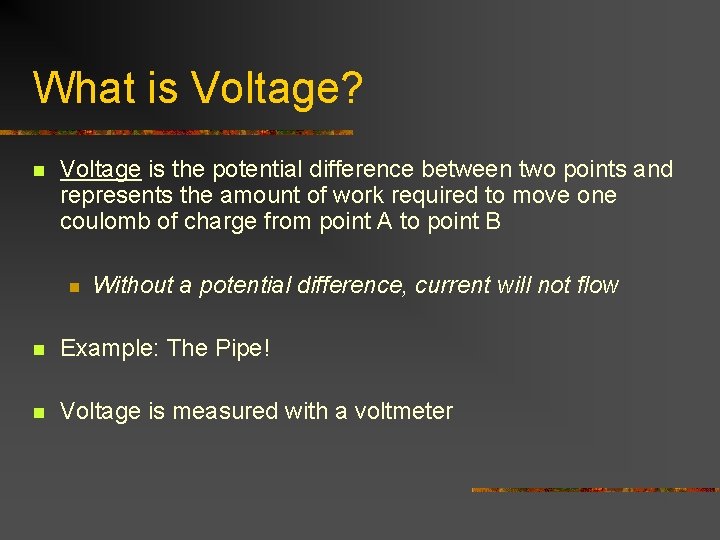
What is Voltage? n Voltage is the potential difference between two points and represents the amount of work required to move one coulomb of charge from point A to point B n Without a potential difference, current will not flow n Example: The Pipe! n Voltage is measured with a voltmeter
How Does Charge Move? n n Positive charges tend to move from points of higher potential to points of lower potential, n or From positive potential to negative potential Negative charges tend to move in the opposite direction The direction of a current can be defined as either of these directions
How Does Charge Move? n n Conventional current is the direction of positive charge flowing from positive to negative terminals n However… Since most current consists of electron flow, in Regents Physics we say current is the flow of negative charge from negative to positive terminals
Conductivity in Solids n For a current to exist in an electric circuit, the circuit must consist of materials through which charge can move n The ability of a material to conduct electricity depends on the number of free charges per unit volume and their mobility n Conductivity – is a property of a material that depends on the availability of charges that are relatively free to move under the influence of an electric field
Conductivity in Solids n Different materials have difference conductivity values n Pure metals have many electrons, and these electrons are not bound, or are only loosely bound, to any particular atom n So metals are good conductors since their electrons move easily n Nonmetals are not since their electrons are tightly bound – called insulators
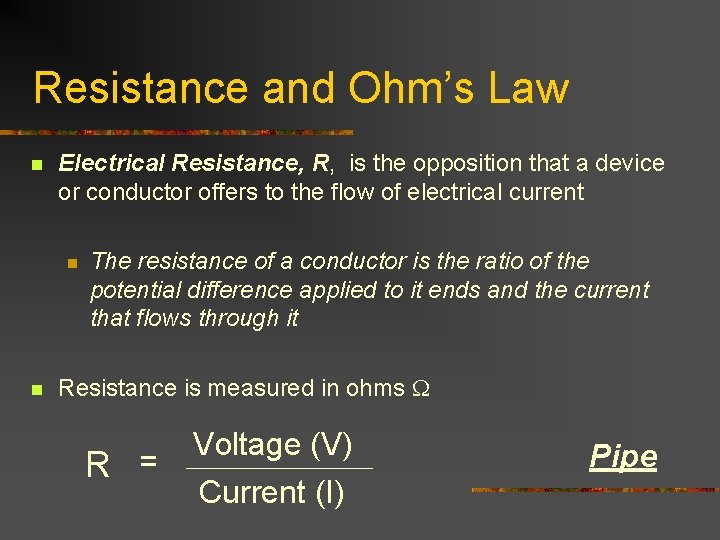
Resistance and Ohm’s Law n Electrical Resistance, R, is the opposition that a device or conductor offers to the flow of electrical current n n The resistance of a conductor is the ratio of the potential difference applied to it ends and the current that flows through it Resistance is measured in ohms R = Voltage (V) Current (I) Pipe
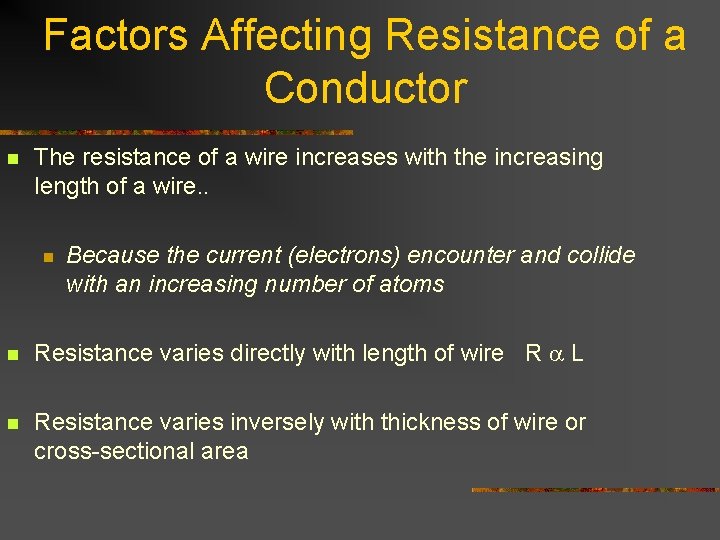
Factors Affecting Resistance of a Conductor n The resistance of a wire increases with the increasing length of a wire. . n Because the current (electrons) encounter and collide with an increasing number of atoms n Resistance varies directly with length of wire R L n Resistance varies inversely with thickness of wire or cross-sectional area
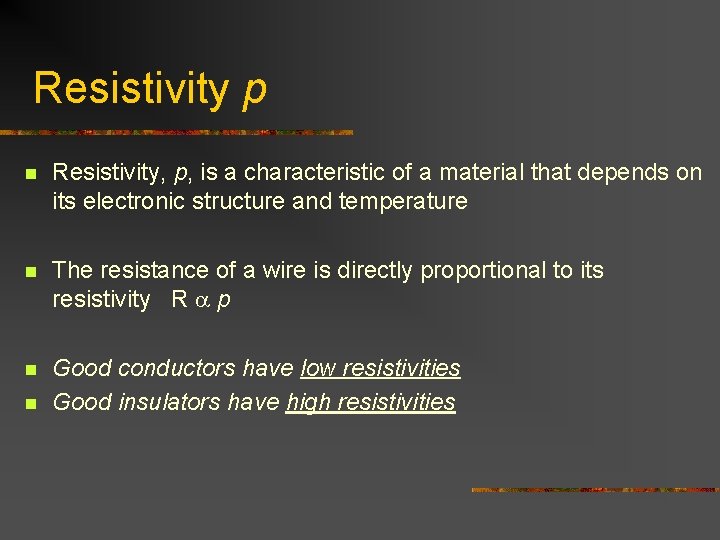
Resistivity p n Resistivity, p, is a characteristic of a material that depends on its electronic structure and temperature n The resistance of a wire is directly proportional to its resistivity R p n Good conductors have low resistivities Good insulators have high resistivities n
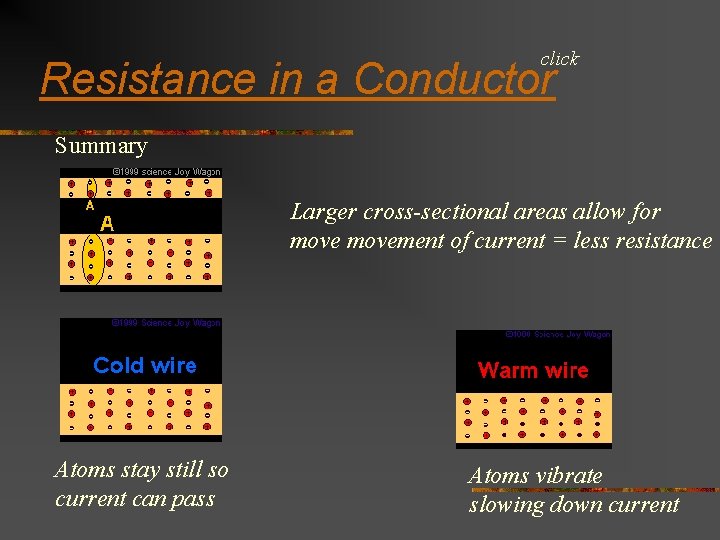
click Resistance in a Conductor Summary Larger cross-sectional areas allow for movement of current = less resistance Atoms stay still so current can pass Atoms vibrate slowing down current
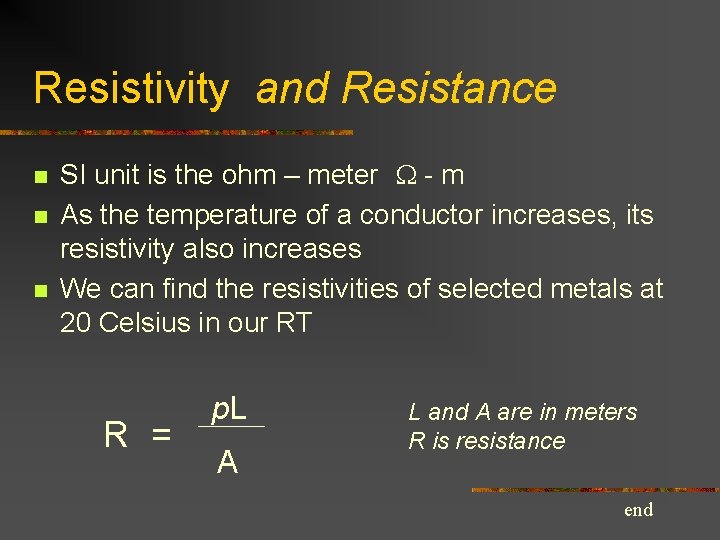
Resistivity and Resistance n n n SI unit is the ohm – meter - m As the temperature of a conductor increases, its resistivity also increases We can find the resistivities of selected metals at 20 Celsius in our RT R = p. L A L and A are in meters R is resistance end