
Regeneration A New Algorithm in Numerical Algebraic Geometry
Regeneration: A New Algorithm in Numerical Algebraic Geometry Charles Wampler General Motors R&D Center (Adjunct, Univ. Notre Dame) Including joint work with Andrew Sommese, University of Notre Dame Jon Hauenstein, University of Notre Dame Fo. CM 2008, Hong Kong
Outline n n Brief overview of Numerical Algebraic Geometry Building blocks for Regeneration n n Description of Regeneration n n Parameter continuation Polynomial-product decomposition Deflation of multiplicity>1 components A new equation-by-equation algorithm that can be used to find positive dimensional sets and/or isolated solutions Leading alternatives to regeneration n Polyhedral homotopy n n Diagonal homotopy n n For finding isolated roots of sparse systems An existing equation-by-equation approach Comparison of regeneration to the alternatives Fo. CM 2008, Hong Kong 2
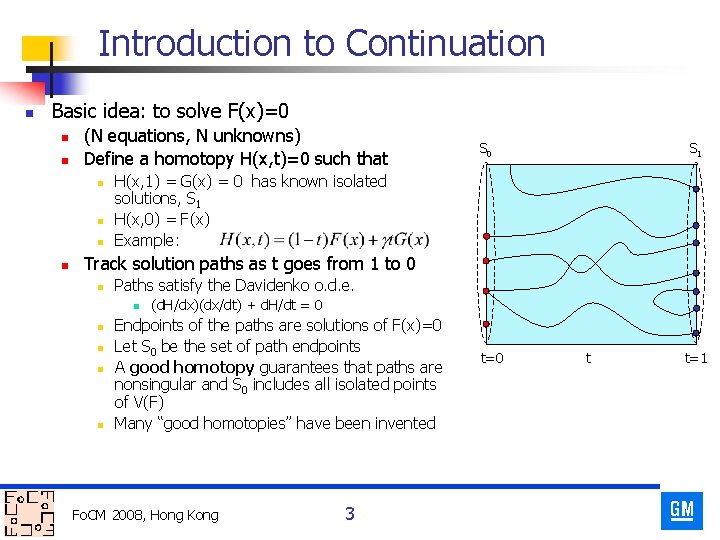
Introduction to Continuation n Basic idea: to solve F(x)=0 n n (N equations, N unknowns) Define a homotopy H(x, t)=0 such that n n S 0 S 1 H(x, 1) = G(x) = 0 has known isolated solutions, S 1 H(x, 0) = F(x) Example: Track solution paths as t goes from 1 to 0 n Paths satisfy the Davidenko o. d. e. n n n (d. H/dx)(dx/dt) + d. H/dt = 0 Endpoints of the paths are solutions of F(x)=0 Let S 0 be the set of path endpoints A good homotopy guarantees that paths are nonsingular and S 0 includes all isolated points of V(F) Many “good homotopies” have been invented Fo. CM 2008, Hong Kong 3 t=0 t t=1

Basic Total-degree Homotopy To find all isolated solutions to the polynomial system F: CN CN, i. e. , form the linear homotopy H(x, t) = (1 -t)F(x) + t. G(x)=0, where Fo. CM 2008, Hong Kong 4
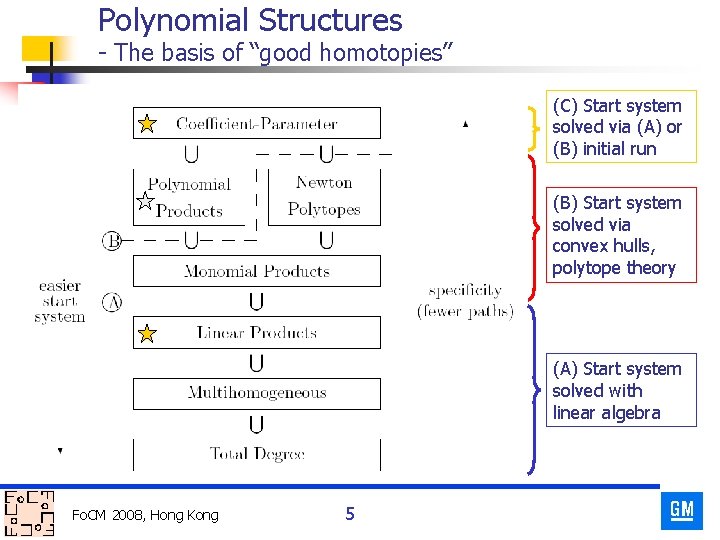
Polynomial Structures - The basis of “good homotopies” (C) Start system solved via (A) or (B) initial run (B) Start system solved via convex hulls, polytope theory (A) Start system solved with linear algebra Fo. CM 2008, Hong Kong 5
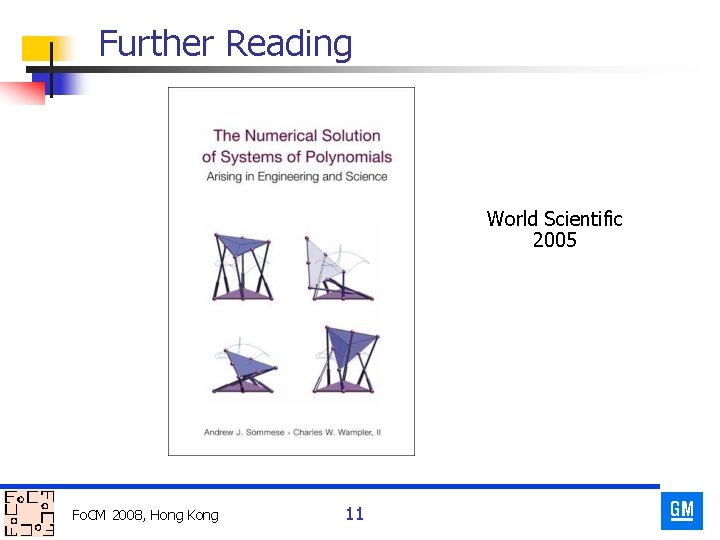
Numerical Algebraic Geometry n n Extension of polynomial continuation to include finding positive dimensional solution components and performing algebraic operations on them. First conception n n Numerical irreducible decomposition and related algorithms n n Sommese & Wampler, Fo. CM 1995, Park City, UT Sommese, Verschelde, & Wampler, 2000 -2004 Monograph covering to year 2005 n Sommese & Wampler, World Scientific, 2005 Fo. CM 2008, Hong Kong 6
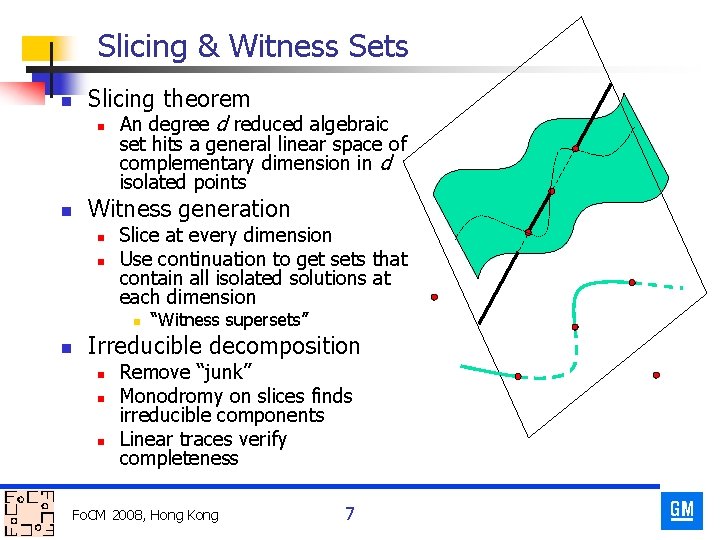
Slicing & Witness Sets n Slicing theorem n n An degree d reduced algebraic set hits a general linear space of complementary dimension in d isolated points Witness generation n n Slice at every dimension Use continuation to get sets that contain all isolated solutions at each dimension n n “Witness supersets” Irreducible decomposition n Remove “junk” Monodromy on slices finds irreducible components Linear traces verify completeness Fo. CM 2008, Hong Kong 7
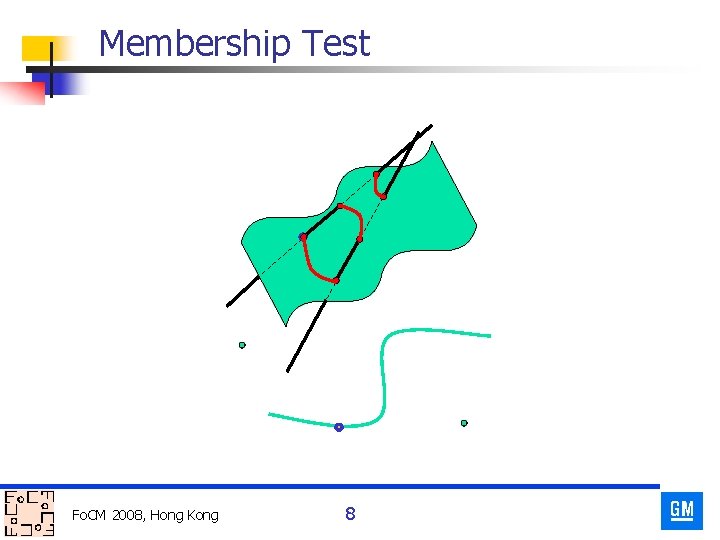
Membership Test Fo. CM 2008, Hong Kong 8
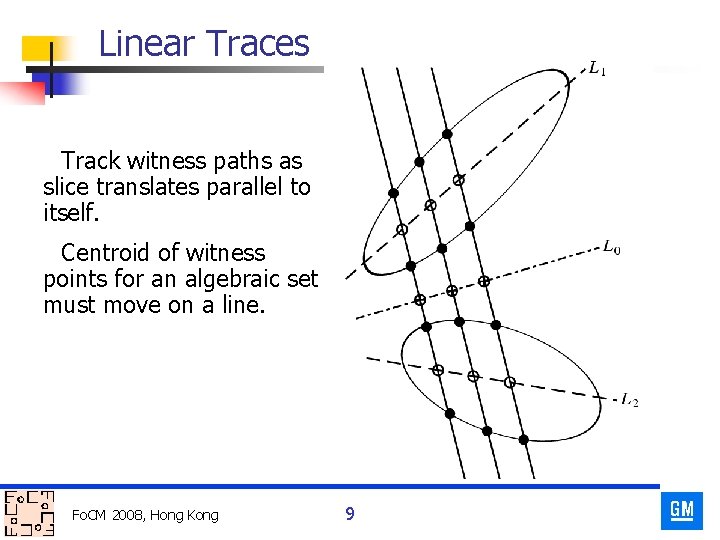
Linear Traces n. Track witness paths as slice translates parallel to itself. n. Centroid of witness points for an algebraic set must move on a line. Fo. CM 2008, Hong Kong 9
Real Points on a Complex Curve n Go to Griffis-Duffy movie… Fo. CM 2008, Hong Kong 10
Further Reading World Scientific 2005 Fo. CM 2008, Hong Kong 11
Regeneration n Building blocks Regeneration algorithm Comparison to pre-existing numerical continuation alternatives Fo. CM 2008, Hong Kong 12
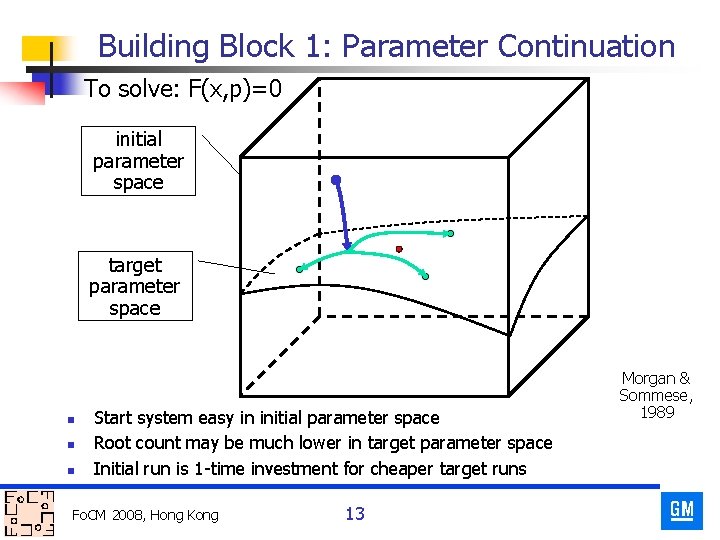
Building Block 1: Parameter Continuation To solve: F(x, p)=0 initial parameter space target parameter space n n n Start system easy in initial parameter space Root count may be much lower in target parameter space Initial run is 1 -time investment for cheaper target runs Fo. CM 2008, Hong Kong 13 Morgan & Sommese, 1989
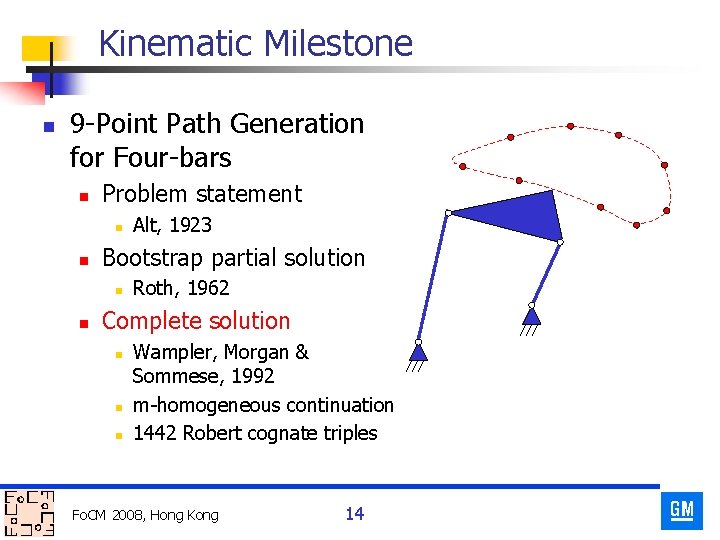
Kinematic Milestone n 9 -Point Path Generation for Four-bars n Problem statement n n Bootstrap partial solution n n Alt, 1923 Roth, 1962 Complete solution n Wampler, Morgan & Sommese, 1992 m-homogeneous continuation 1442 Robert cognate triples Fo. CM 2008, Hong Kong 14
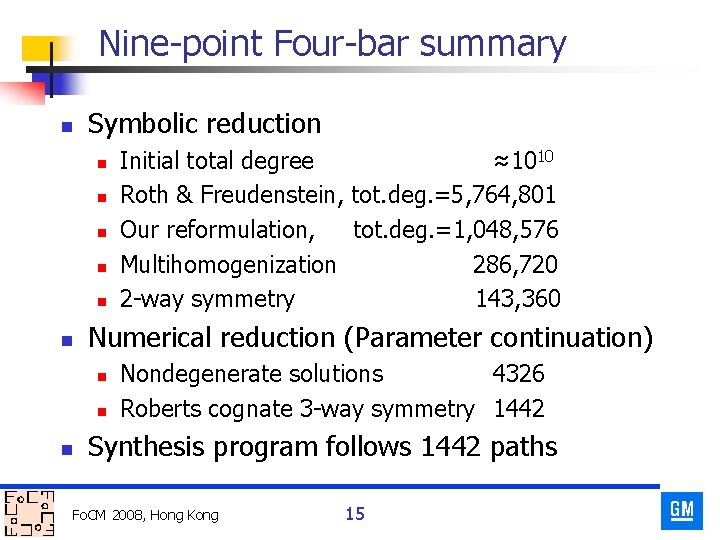
Nine-point Four-bar summary n Symbolic reduction n n n Numerical reduction (Parameter continuation) n n n Initial total degree ≈1010 Roth & Freudenstein, tot. deg. =5, 764, 801 Our reformulation, tot. deg. =1, 048, 576 Multihomogenization 286, 720 2 -way symmetry 143, 360 Nondegenerate solutions 4326 Roberts cognate 3 -way symmetry 1442 Synthesis program follows 1442 paths Fo. CM 2008, Hong Kong 15
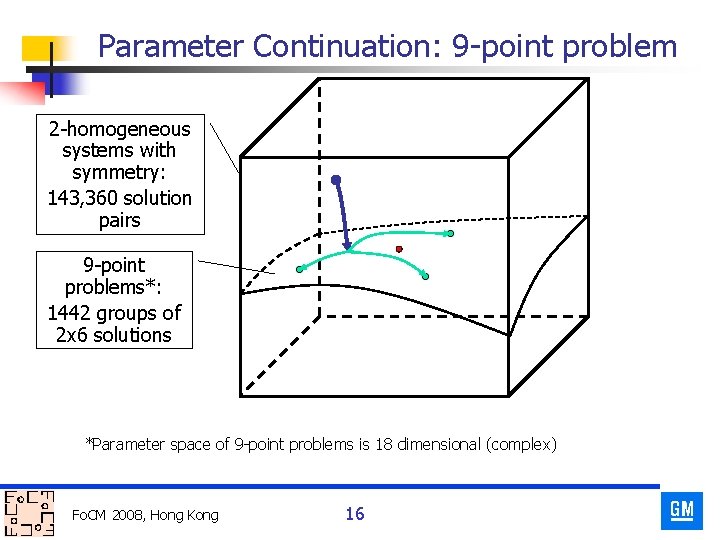
Parameter Continuation: 9 -point problem 2 -homogeneous systems with symmetry: 143, 360 solution pairs 9 -point problems*: 1442 groups of 2 x 6 solutions *Parameter space of 9 -point problems is 18 dimensional (complex) Fo. CM 2008, Hong Kong 16
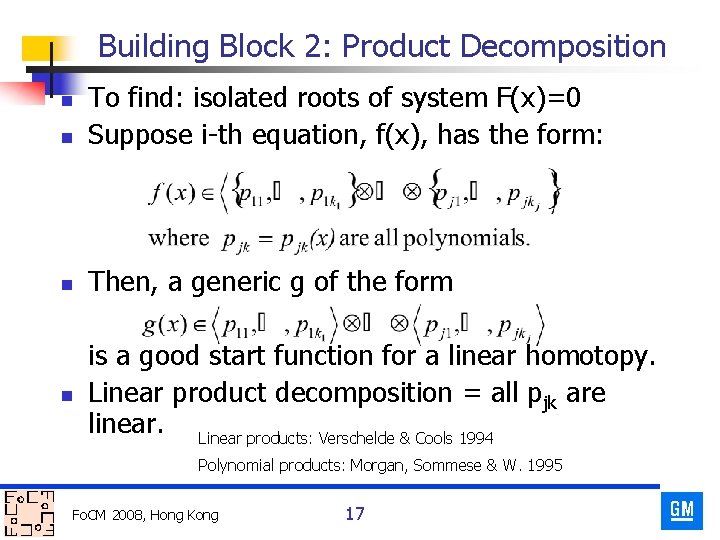
Building Block 2: Product Decomposition n To find: isolated roots of system F(x)=0 Suppose i-th equation, f(x), has the form: n Then, a generic g of the form n is a good start function for a linear homotopy. Linear product decomposition = all pjk are linear. Linear products: Verschelde & Cools 1994 n Polynomial products: Morgan, Sommese & W. 1995 Fo. CM 2008, Hong Kong 17
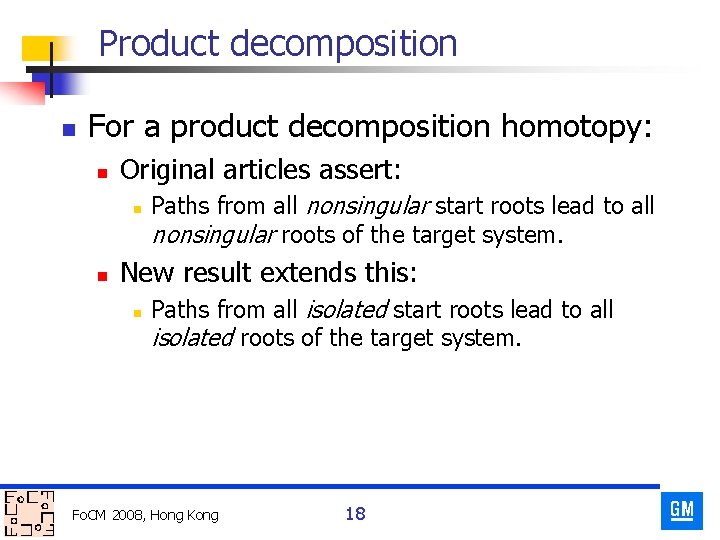
Product decomposition n For a product decomposition homotopy: n Original articles assert: n n Paths from all nonsingular start roots lead to all nonsingular roots of the target system. New result extends this: n Paths from all isolated start roots lead to all isolated roots of the target system. Fo. CM 2008, Hong Kong 18
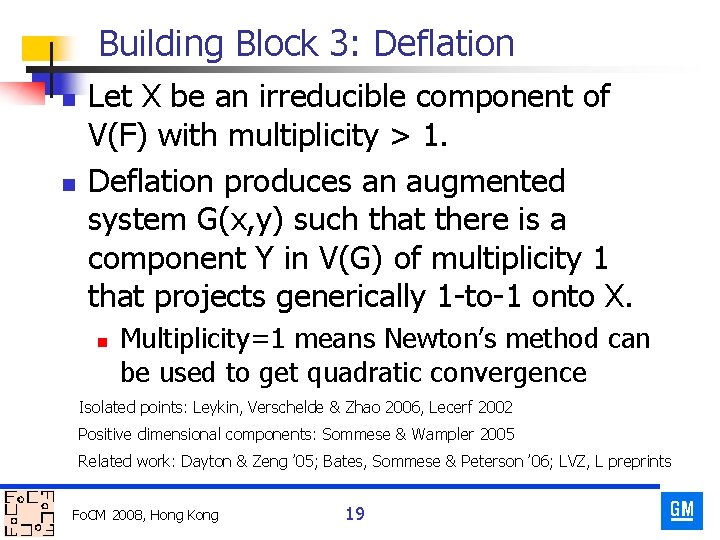
Building Block 3: Deflation n n Let X be an irreducible component of V(F) with multiplicity > 1. Deflation produces an augmented system G(x, y) such that there is a component Y in V(G) of multiplicity 1 that projects generically 1 -to-1 onto X. n Multiplicity=1 means Newton’s method can be used to get quadratic convergence Isolated points: Leykin, Verschelde & Zhao 2006, Lecerf 2002 Positive dimensional components: Sommese & Wampler 2005 Related work: Dayton & Zeng ’ 05; Bates, Sommese & Peterson ’ 06; LVZ, L preprints Fo. CM 2008, Hong Kong 19
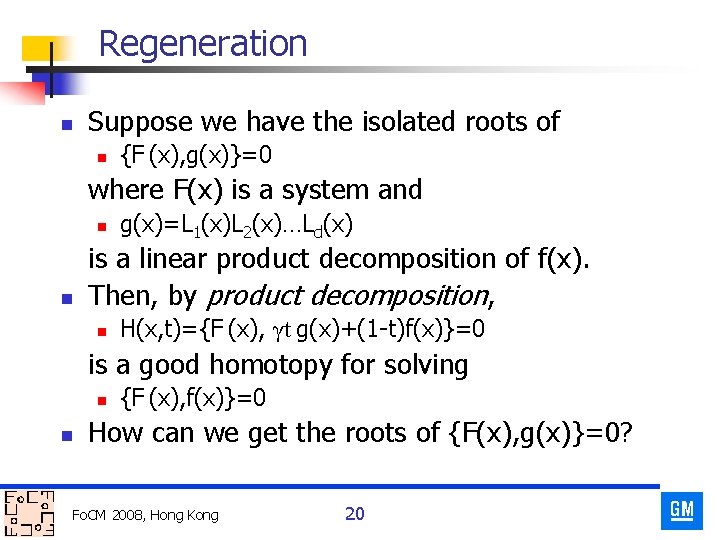
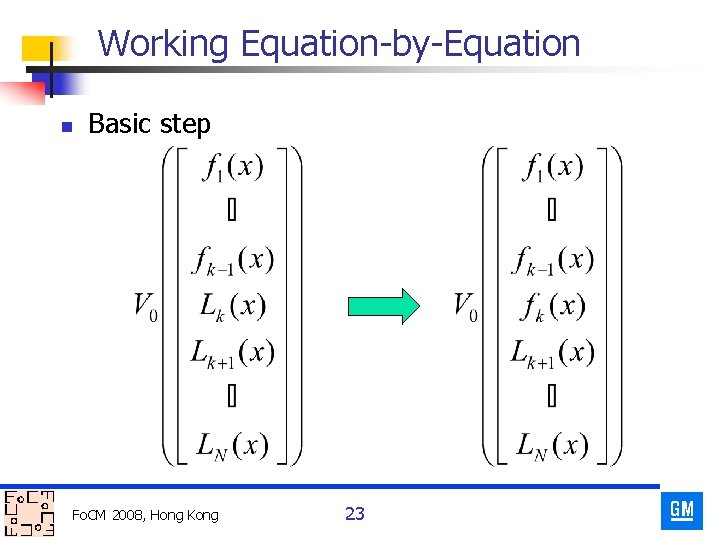
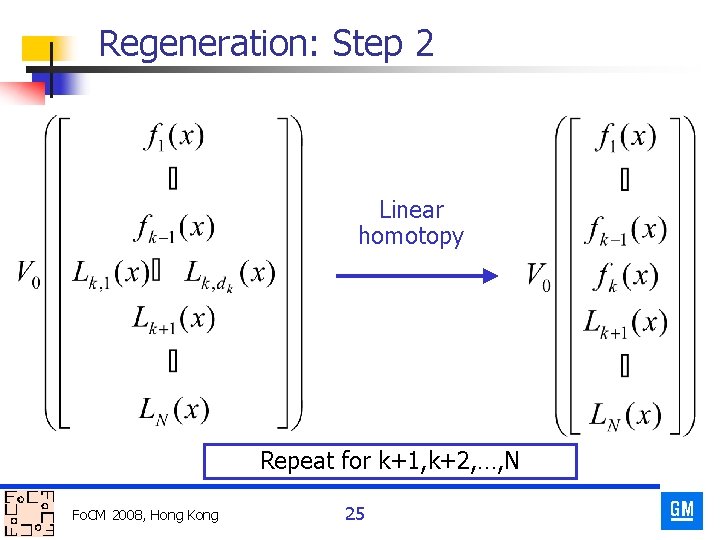
Regeneration n Suppose we have the isolated roots of n {F (x), g(x)}=0 where F(x) is a system and n n g(x)=L 1(x)L 2(x)…Ld(x) is a linear product decomposition of f(x). Then, by product decomposition, n H(x, t)={F (x), γt g(x)+(1 -t)f(x)}=0 is a good homotopy for solving n n {F (x), f(x)}=0 How can we get the roots of {F(x), g(x)}=0? Fo. CM 2008, Hong Kong 20
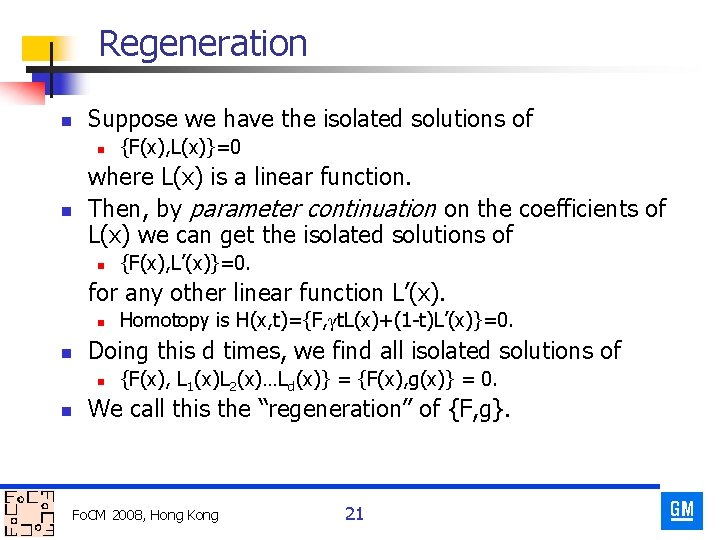
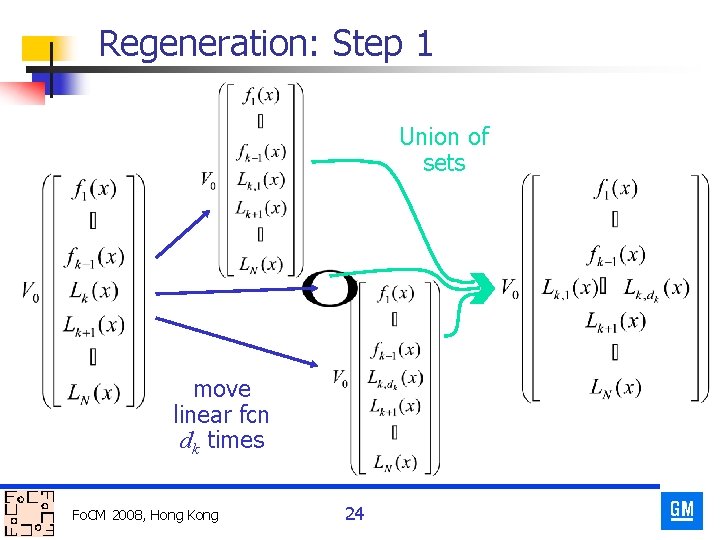
Regeneration n Suppose we have the isolated solutions of n n {F(x), L(x)}=0 where L(x) is a linear function. Then, by parameter continuation on the coefficients of L(x) we can get the isolated solutions of n {F(x), L’(x)}=0. for any other linear function L’(x). n n Doing this d times, we find all isolated solutions of n n Homotopy is H(x, t)={F, γt. L(x)+(1 -t)L’(x)}=0. {F(x), L 1(x)L 2(x)…Ld(x)} = {F(x), g(x)} = 0. We call this the “regeneration” of {F, g}. Fo. CM 2008, Hong Kong 21

Tracking multiplicity > 1 paths n For both regenerating {F, g} and tracking to {F, f}, we want to track all isolated solutions. n n n Some of these may be multiplicity > 1. In each case, there is a homotopy H(x, t)=0 The paths we want to track are curves in V(H) n n Each curve has a deflation. We track the deflated curves. Fo. CM 2008, Hong Kong 22
Working Equation-by-Equation n Basic step Fo. CM 2008, Hong Kong 23
Regeneration: Step 1 Union of sets move linear fcn dk times Fo. CM 2008, Hong Kong 24
Regeneration: Step 2 Linear homotopy Repeat for k+1, k+2, …, N Fo. CM 2008, Hong Kong 25
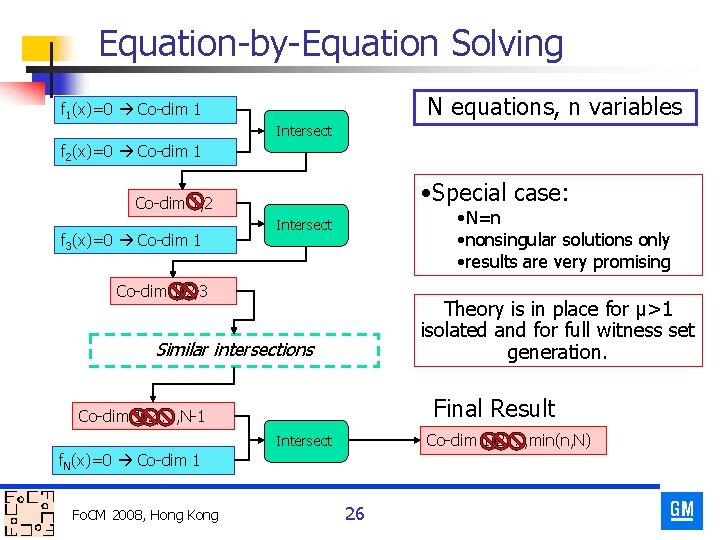
Equation-by-Equation Solving N equations, n variables f 1(x)=0 Co-dim 1 Intersect f 2(x)=0 Co-dim 1 • Special case: Co-dim 1, 2 f 3(x)=0 Co-dim 1 • N=n • nonsingular solutions only • results are very promising Intersect Co-dim 1, 2, 3 Theory is in place for μ>1 isolated and for full witness set generation. Similar intersections Final Result Co-dim 1, 2, . . . , N-1 Co-dim 1, 2, . . . , min(n, N) Intersect f. N(x)=0 Co-dim 1 Fo. CM 2008, Hong Kong 26
Alternatives 1 n Polyhedral homotopies (a. k. a. , BKK) n n Finds all isolated solutions Parameter space = coefficients of all monomials n n Root count = mixed volume (Bernstein’s Theorem) Always ≤ root count for best linear product n n Homotopies n n n Verschelde, Verlinden & Cools, ’ 94; Huber & Sturmfels, ’ 95 T. Y. Li with various co-authors, 1997 -present Advantage: n n Especially suited to sparse polynomials Reduction in # of paths Disadvantage: n Mixed volume calculation is combinatorial Fo. CM 2008, Hong Kong 27
Alternatives 2: Diagonal homotopy n Given: n n n Find: n n X × Y is an irreducible component of V(F(x), G(y)) WX × WY is its witness set Compute irreducible decomposition of the diagonal, x – y = 0 restricted to X × Y Can be used to work equation-by-equation n n Intersection of X and Y Method: n n WX = Witness set for irreducible X in V(F) WY = Witness set for irreducible Y in V(G) Let F be the first k equations & G be the (k+1)st one Sommese, Verschelde, & Wampler 2004, 2008. Fo. CM 2008, Hong Kong 28
Other alternatives n Numerical n n Symbolic n n n Exclusion methods (e. g. , interval arithmetic) Grobner bases Border bases Resultants Geometric resolution Here, we will compare only to the alternatives using numerical homotopy. A more complete comparison is a topic for future work. Fo. CM 2008, Hong Kong 29
Software for polynomial continuation n PHC (first release 1997) n n J. Verschelde First publicly available implementation of polyhedral method Used in SVW series of papers Isolated points n n Positive dimensional sets n n Basics, diagonal homotopy Hom 4 PS-2. 0 (released 2008) n n T. Y. Li Isolated points: n n n Multihomogeneous & polyhedral method Fastest polyhedral code available Bertini (ver 1. 0 released Apr. 20, 2008) n n D. Bates, J. Hauenstein, A. Sommese, C. Wampler Isolated points n n Positive dimensional sets n n Multihomogeneous, regeneration Basics, diagonal homotopy Automatically adjusts precision: adaptive multiprecision Fo. CM 2008, Hong Kong 30
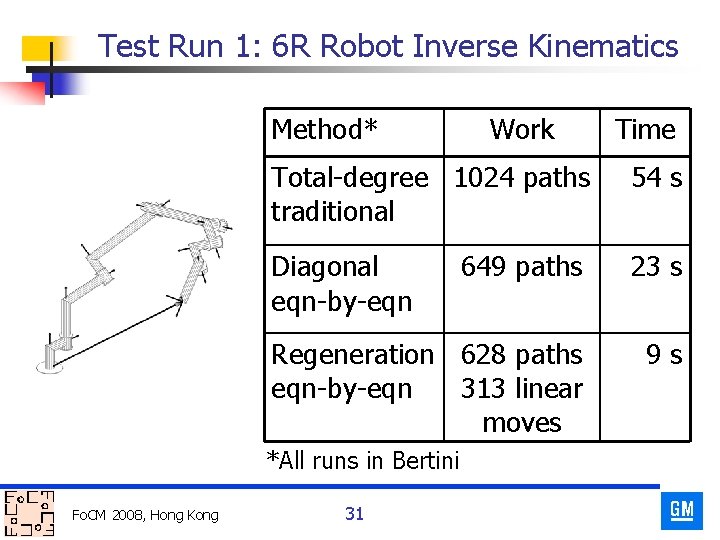
Test Run 1: 6 R Robot Inverse Kinematics Method* Time Total-degree 1024 paths traditional 54 s Diagonal eqn-by-eqn 649 paths 23 s Regeneration 628 paths eqn-by-eqn 313 linear moves 9 s *All runs in Bertini Fo. CM 2008, Hong Kong Work 31
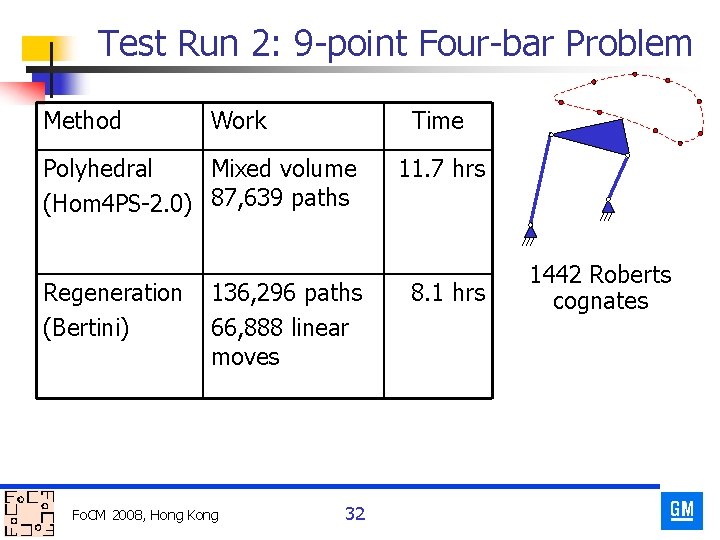
Test Run 2: 9 -point Four-bar Problem Method Work Time Polyhedral Mixed volume (Hom 4 PS-2. 0) 87, 639 paths Regeneration (Bertini) 136, 296 paths 66, 888 linear moves Fo. CM 2008, Hong Kong 32 11. 7 hrs 8. 1 hrs 1442 Roberts cognates
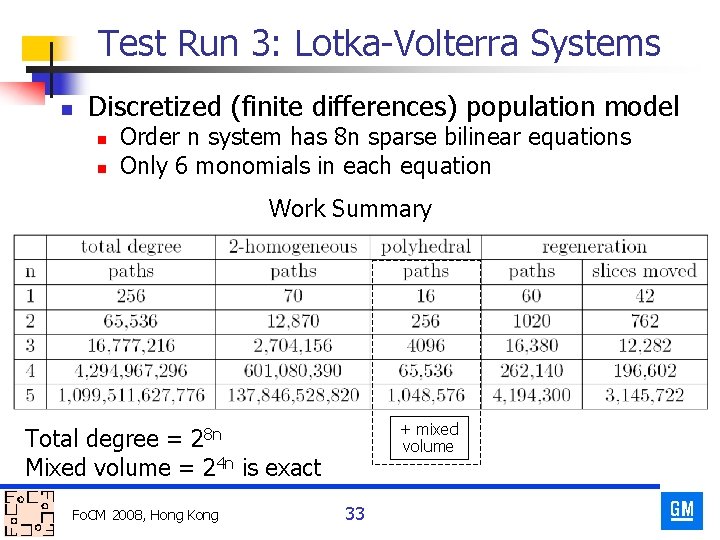
Test Run 3: Lotka-Volterra Systems n Discretized (finite differences) population model n n Order n system has 8 n sparse bilinear equations Only 6 monomials in each equation Work Summary + mixed volume Total degree = 28 n Mixed volume = 24 n is exact Fo. CM 2008, Hong Kong 33
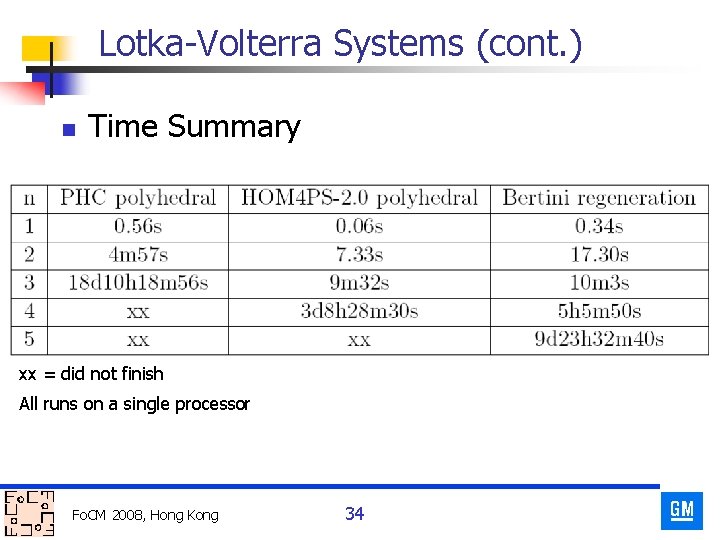
Lotka-Volterra Systems (cont. ) n Time Summary xx = did not finish All runs on a single processor Fo. CM 2008, Hong Kong 34
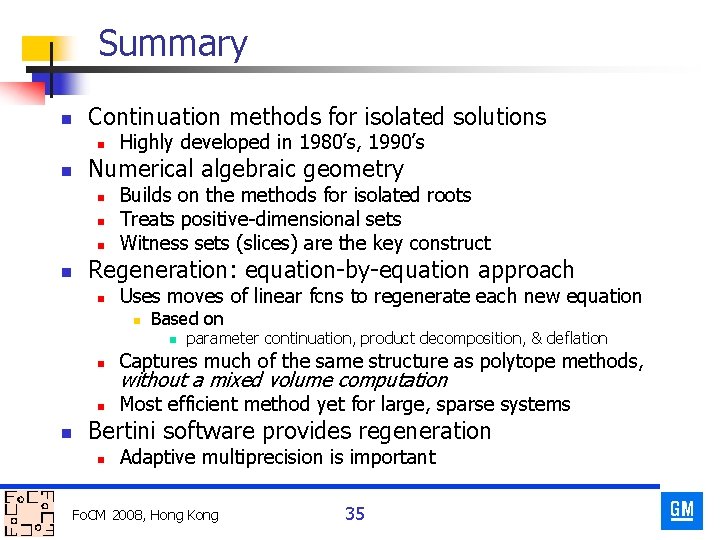
Summary n Continuation methods for isolated solutions n n Numerical algebraic geometry n n Highly developed in 1980’s, 1990’s Builds on the methods for isolated roots Treats positive-dimensional sets Witness sets (slices) are the key construct Regeneration: equation-by-equation approach n Uses moves of linear fcns to regenerate each new equation n Based on n n parameter continuation, product decomposition, & deflation n Captures much of the same structure as polytope methods, n Most efficient method yet for large, sparse systems without a mixed volume computation Bertini software provides regeneration n Adaptive multiprecision is important Fo. CM 2008, Hong Kong 35
- Slides: 35