
REFRIGERATION COMPRESSED AIR SYSTEMS EFFICIENT USE OF ENERGY


- Slides: 26
REFRIGERATION, COMPRESSED AIR SYSTEMS & EFFICIENT USE OF ENERGY 1
Principles of Refrigeration means to COOL AN OBJECT BELOW ITS SURROUNDING TEMPERATURE 2
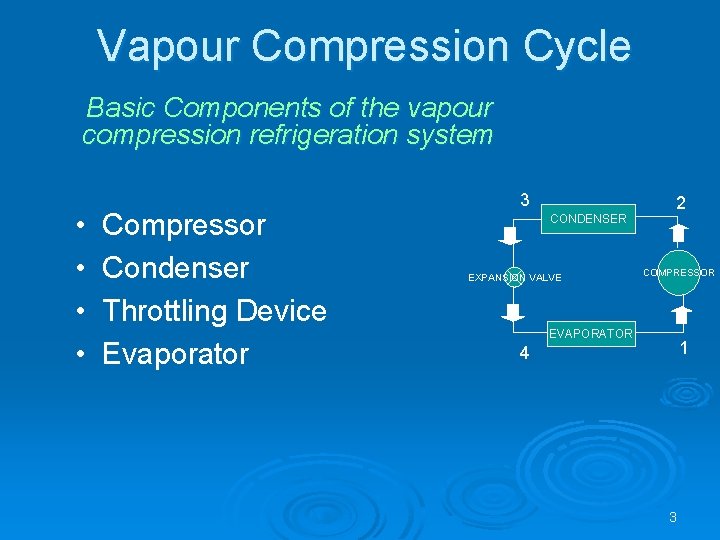
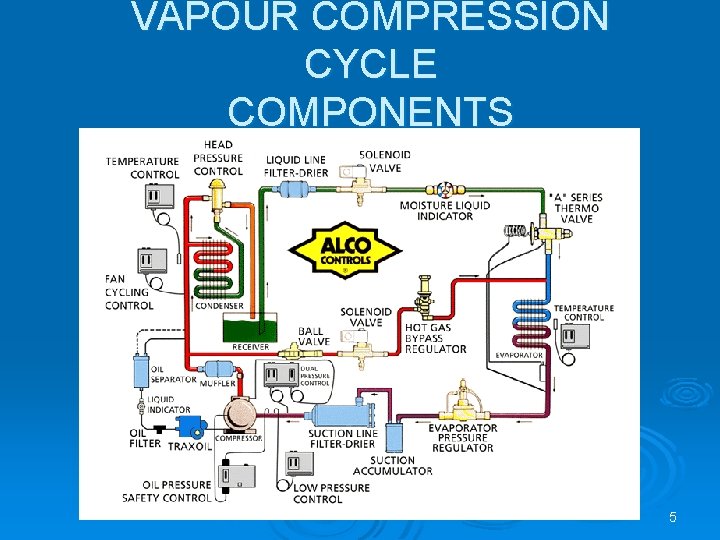
Vapour Compression Cycle Basic Components of the vapour compression refrigeration system • • Compressor Condenser Throttling Device Evaporator 3 CONDENSER EXPANSION VALVE 2 COMPRESSOR EVAPORATOR 1 4 3
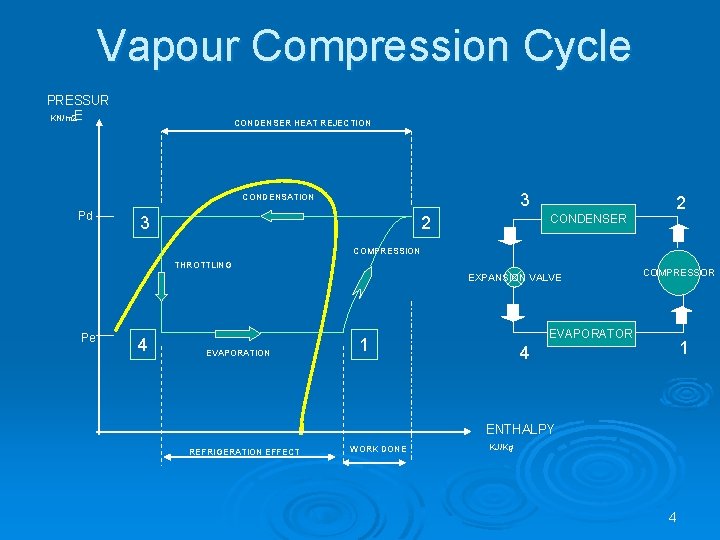
Vapour Compression Cycle PRESSUR KN/m 2 E CONDENSER HEAT REJECTION 3 CONDENSATION Pd 3 2 CONDENSER 2 COMPRESSION THROTTLING EXPANSION VALVE Pe 4 EVAPORATION COMPRESSOR EVAPORATOR 1 1 4 ENTHALPY REFRIGERATION EFFECT WORK DONE KJ/Kg 4
VAPOUR COMPRESSION CYCLE COMPONENTS 5
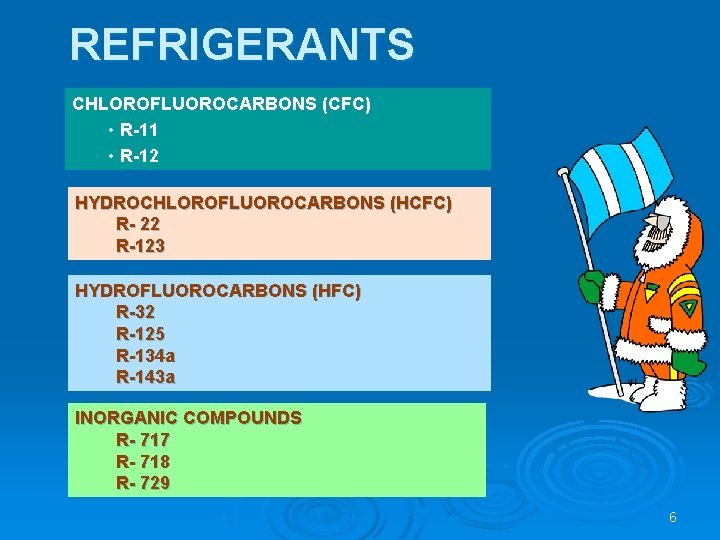
REFRIGERANTS CHLOROFLUOROCARBONS (CFC) • R-11 • R-12 HYDROCHLOROFLUOROCARBONS (HCFC) R- 22 R-123 HYDROFLUOROCARBONS (HFC) R-32 R-125 R-134 a R-143 a INORGANIC COMPOUNDS R- 717 R- 718 R- 729 6
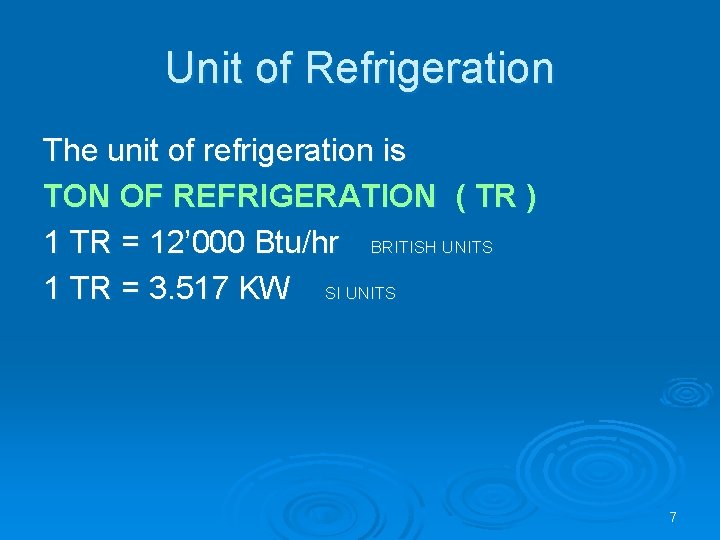
Unit of Refrigeration The unit of refrigeration is TON OF REFRIGERATION ( TR ) 1 TR = 12’ 000 Btu/hr BRITISH UNITS 1 TR = 3. 517 KW SI UNITS 7
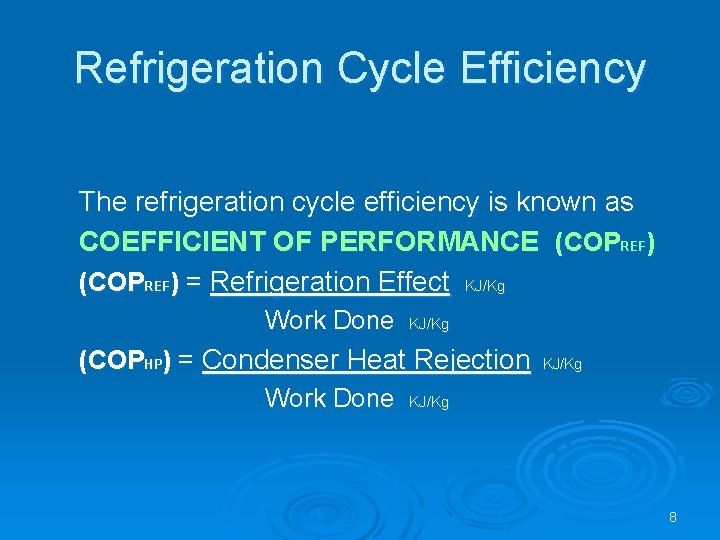
Refrigeration Cycle Efficiency The refrigeration cycle efficiency is known as COEFFICIENT OF PERFORMANCE (COPREF) = Refrigeration Effect KJ/Kg Work Done KJ/Kg (COPHP) = Condenser Heat Rejection Work Done KJ/Kg 8
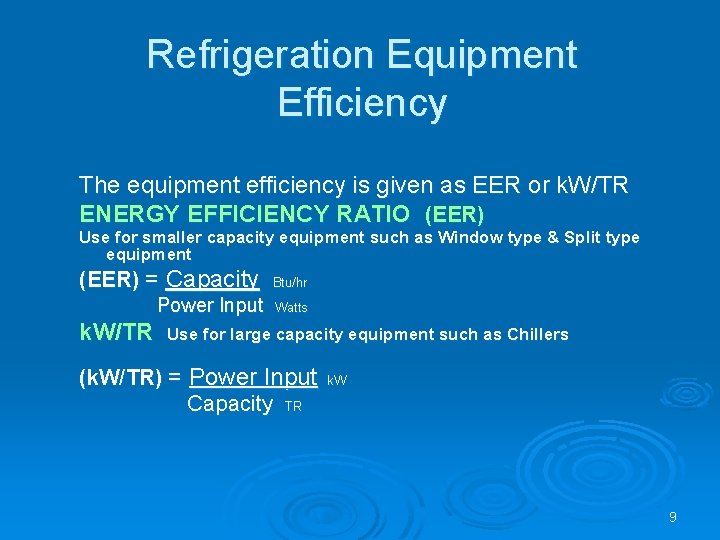
Refrigeration Equipment Efficiency The equipment efficiency is given as EER or k. W/TR ENERGY EFFICIENCY RATIO (EER) Use for smaller capacity equipment such as Window type & Split type equipment (EER) = Capacity Power Input k. W/TR Btu/hr Watts Use for large capacity equipment such as Chillers (k. W/TR) = Power Input Capacity TR k. W 9
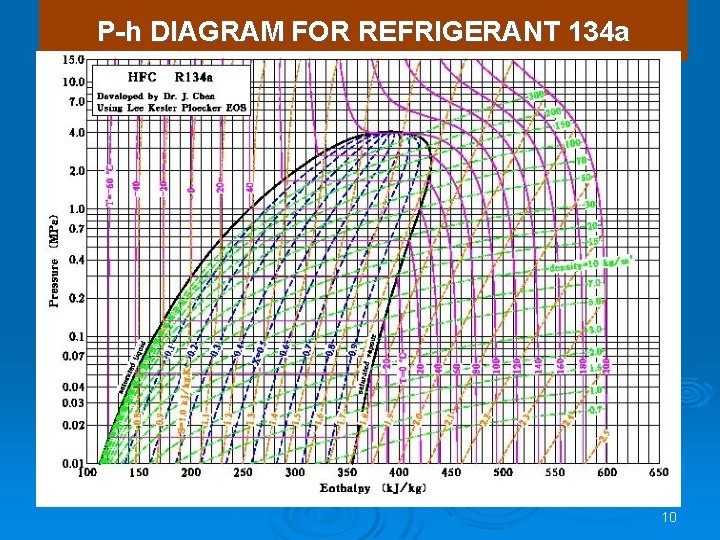
P-h DIAGRAM FOR REFRIGERANT 134 a 10
MONTRÉAL PROTOCOL OBLIGATIONS 1. 2. 3. Face-out of CFC in year 2005 Introduction of Quota for HCFC in year 2015 Face-out of HCFC in year 2040 11
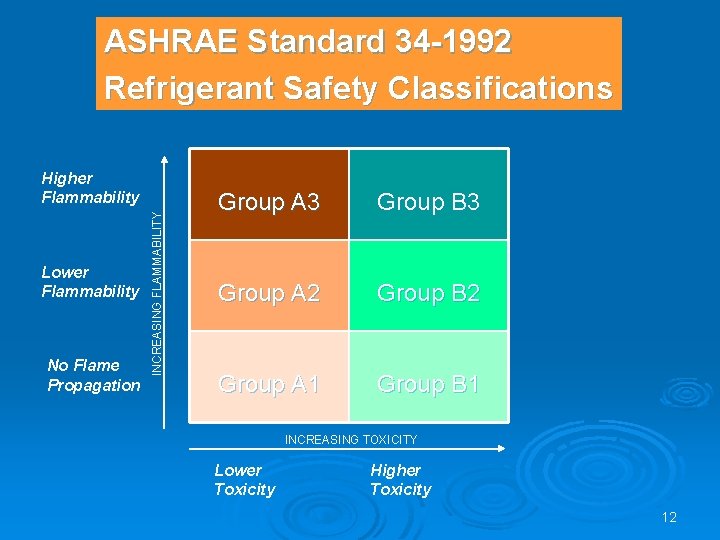
ASHRAE Standard 34 -1992 Refrigerant Safety Classifications Lower Flammability No Flame Propagation INCREASING FLAMMABILITY Higher Flammability Group A 3 Group B 3 Group A 2 Group B 2 Group A 1 Group B 1 INCREASING TOXICITY Lower Toxicity Higher Toxicity 12
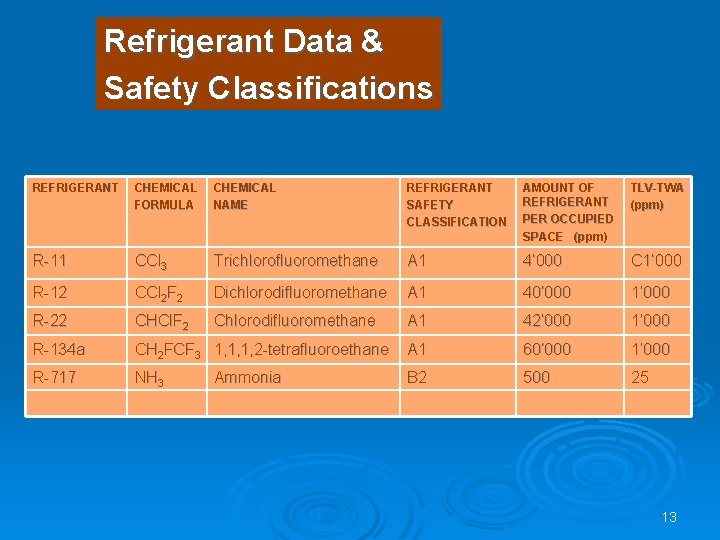
Refrigerant Data & Safety Classifications REFRIGERANT CHEMICAL FORMULA CHEMICAL NAME REFRIGERANT SAFETY CLASSIFICATION AMOUNT OF REFRIGERANT PER OCCUPIED SPACE (ppm) TLV-TWA (ppm) R-11 CCl 3 Trichlorofluoromethane A 1 4’ 000 C 1’ 000 R-12 CCl 2 F 2 Dichlorodifluoromethane A 1 40’ 000 1’ 000 R-22 CHCl. F 2 Chlorodifluoromethane A 1 42’ 000 1’ 000 R-134 a CH 2 FCF 3 1, 1, 1, 2 -tetrafluoroethane A 1 60’ 000 1’ 000 R-717 NH 3 B 2 500 25 Ammonia 13
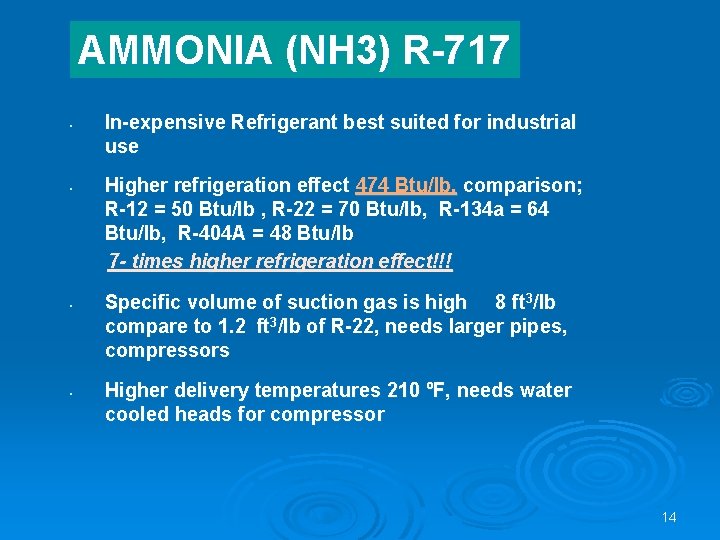
AMMONIA (NH 3) R-717 • • In-expensive Refrigerant best suited for industrial use Higher refrigeration effect 474 Btu/lb, comparison; R-12 = 50 Btu/lb , R-22 = 70 Btu/lb, R-134 a = 64 Btu/lb, R-404 A = 48 Btu/lb 7 - times higher refrigeration effect!!! Specific volume of suction gas is high 8 ft 3/lb compare to 1. 2 ft 3/lb of R-22, needs larger pipes, compressors Higher delivery temperatures 210 ºF, needs water cooled heads for compressor 14
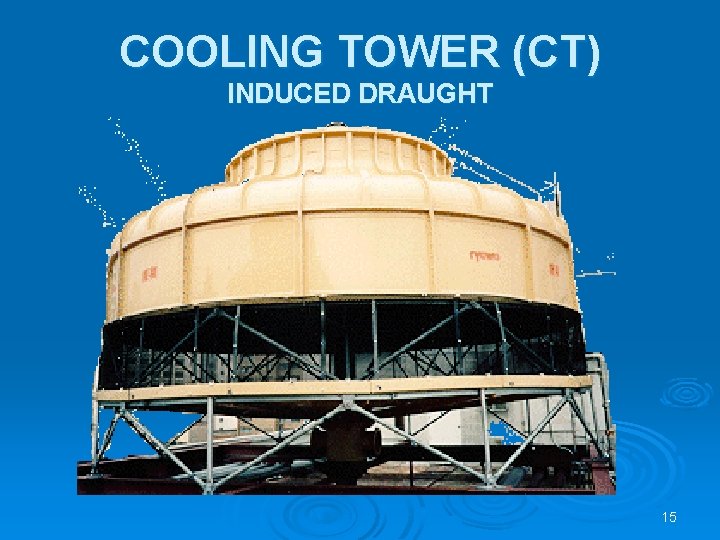
COOLING TOWER (CT) INDUCED DRAUGHT 15
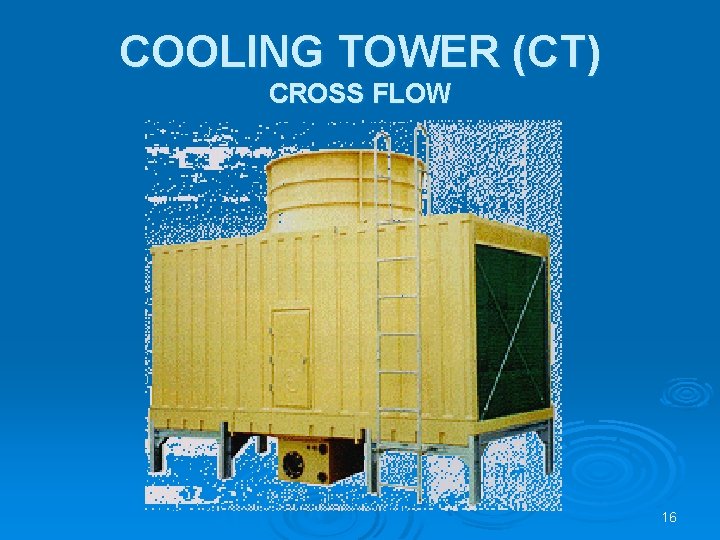
COOLING TOWER (CT) CROSS FLOW 16
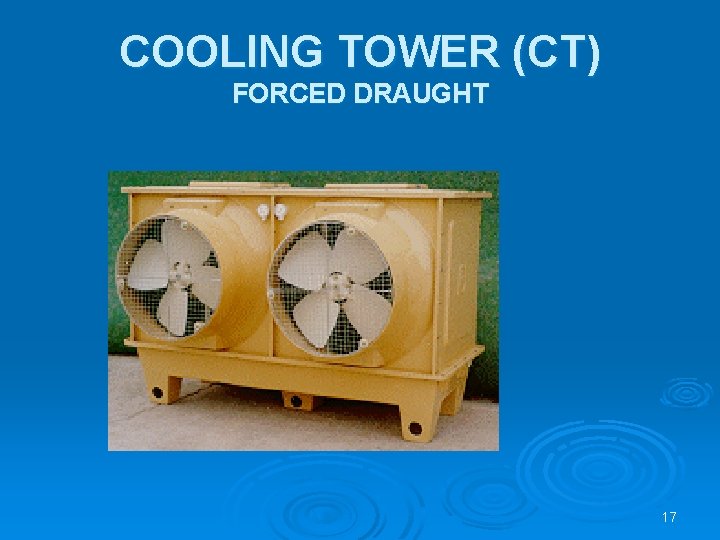
COOLING TOWER (CT) FORCED DRAUGHT 17
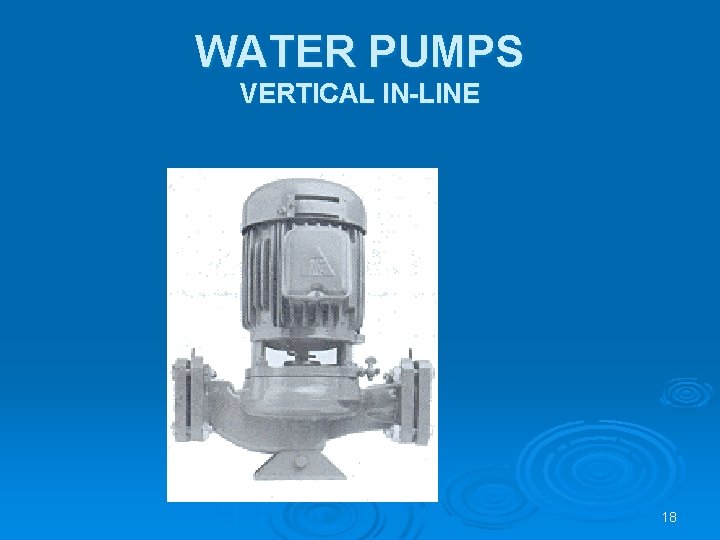
WATER PUMPS VERTICAL IN-LINE 18
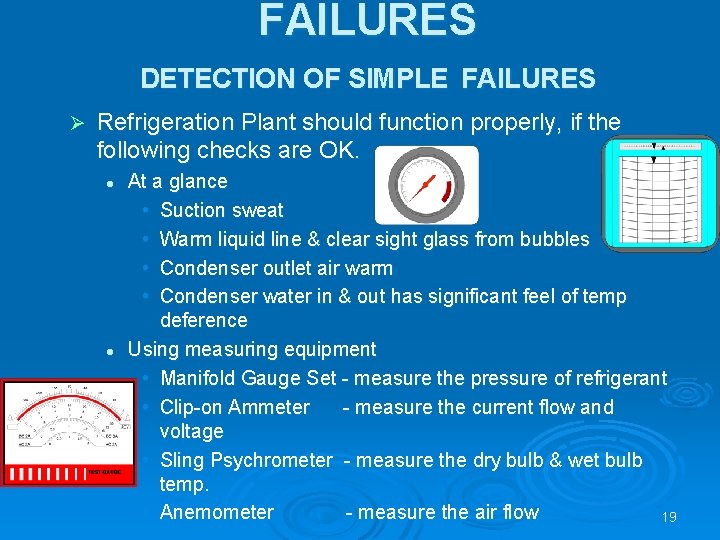
FAILURES DETECTION OF SIMPLE FAILURES Ø Refrigeration Plant should function properly, if the following checks are OK. l l At a glance • Suction sweat • Warm liquid line & clear sight glass from bubbles • Condenser outlet air warm • Condenser water in & out has significant feel of temp deference Using measuring equipment • Manifold Gauge Set - measure the pressure of refrigerant • Clip-on Ammeter - measure the current flow and voltage • Sling Psychrometer - measure the dry bulb & wet bulb temp. • Anemometer - measure the air flow 19
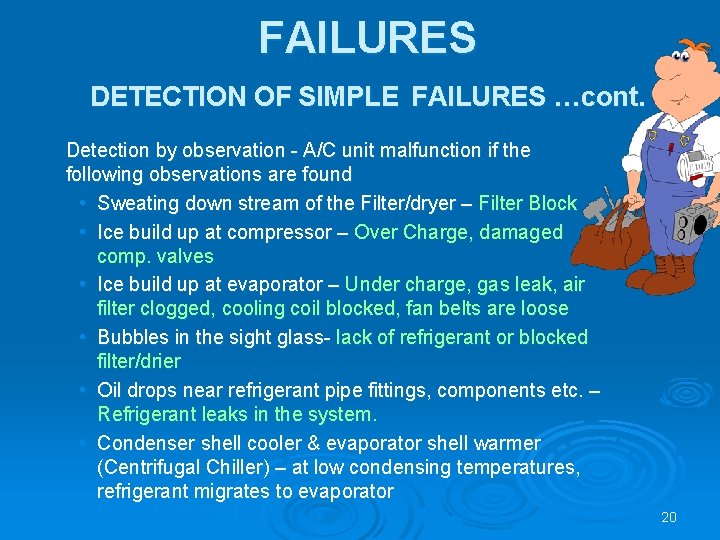
FAILURES DETECTION OF SIMPLE FAILURES …cont. Detection by observation - A/C unit malfunction if the following observations are found • Sweating down stream of the Filter/dryer – Filter Block • Ice build up at compressor – Over Charge, damaged comp. valves • Ice build up at evaporator – Under charge, gas leak, air filter clogged, cooling coil blocked, fan belts are loose • Bubbles in the sight glass- lack of refrigerant or blocked filter/drier • Oil drops near refrigerant pipe fittings, components etc. – Refrigerant leaks in the system. • Condenser shell cooler & evaporator shell warmer (Centrifugal Chiller) – at low condensing temperatures, refrigerant migrates to evaporator 20
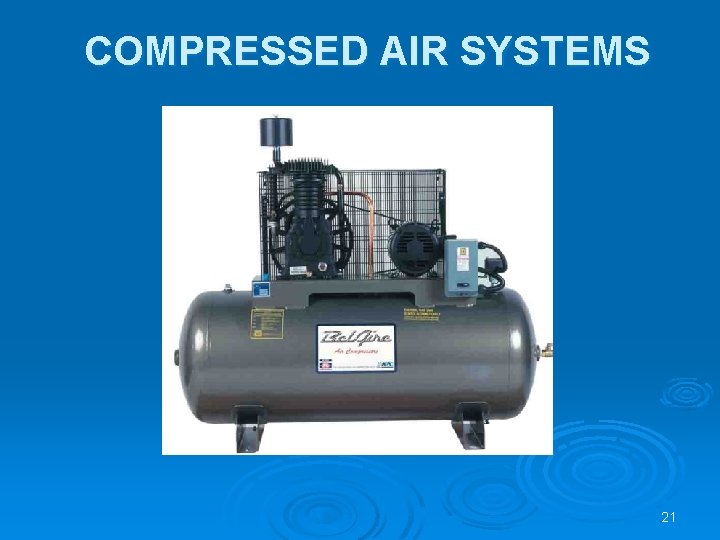
COMPRESSED AIR SYSTEMS 21
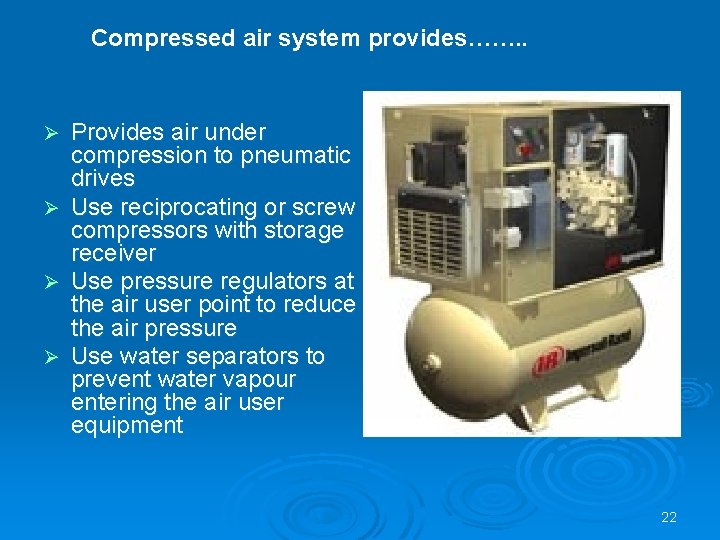
Compressed air system provides……. . Provides air under compression to pneumatic drives Ø Use reciprocating or screw compressors with storage receiver Ø Use pressure regulators at the air user point to reduce the air pressure Ø Use water separators to prevent water vapour entering the air user equipment Ø 22
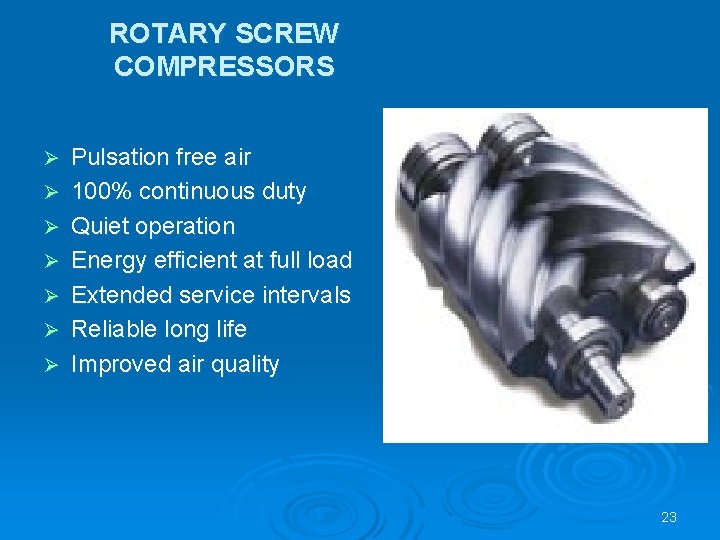
ROTARY SCREW COMPRESSORS Ø Ø Ø Ø Pulsation free air 100% continuous duty Quiet operation Energy efficient at full load Extended service intervals Reliable long life Improved air quality 23
TIPS FOR COMPRESSED AIR SYSTEMS Ø Ø Ø Ø Locate the compressor closest to the largest air user to reduce pressure drop through the air line Ventilate the compressor well Keep 3 feet around the compressor unit Surrounding temperature should be below 115 ºF Avoid extreme humidity Keep air filters clean all the time Use refrigerated and desiccant dryers to reduce water vapour concentration 24
EFFICIENT USE OF ENERGY Resources are limited and conserve energy Refrigeration l l Reduce heat transfer Select energy efficient equipments Compressed air systems l l l Fix all leaks in the piping Regulate lowest pressure at air user Reduce blow-offs Shut-off air supply to off-line air users Consider multi staged compressors 25
THANK 26