
Refresh Teaching Improving student learning with individual feedback
Refresh Teaching: Improving student learning with individual feedback Tuesday, 5 th of December 2017 Educational Development and Technology Dr. Urs Brändle, Marco Lehre | 21. 02. 2021 | 1
Feedback “Information about reactions to a product, a person's performance of a task, etc. which is used as a basis for improvement. ” (Oxford Dictionary) “What is the shortest word in the English language that contains the letters: abcdef? Answer: feedback. Don’t forget that feedback is one of the essential elements of good communication. ” (anonymous, from www. cognology. com. au) Educational Development and Technology Dr. Urs Brändle, Marco Lehre | 21. 02. 2021 | 2

Constructive Alignment & Feedback Intended Learning Outcomes r Pee Teaching and Learning Acitivities Assessment summative Educational Development and Technology ne hi ac M Ex pe r t formative Dr. Urs Brändle, Marco Lehre | 21. 02. 2021 | 3

Feedback and learning David J. Nicol & Debra Macfarlane‐Dick (2006) Formative assessment and self‐regulated learning: a model and seven principles of good feedback practice, Studies in Higher Education, 31: 2, 199 -218, DOI: 10. 1080/03075070600572090 Effective feedback leads to learning gains. To benefit from feedback in academic tasks, students need to know 1. 2. 3. What good performance is How current performance relates to good performance (for this, the student must be able to compare current and good performance) How to act to close the gap between current and good performance. Sadler, D. R. (1989) Formative assessment and the design of instructional systems, Instructional Science, 18, 119– 144. Students have to possess their OWN evaluative abilities; they cannot solely rely on ‘outside’ source. Consequently, we need to help students with SELF-ASSESSMENT skills. From https: //blogs. ubc. ca/iiqbal/2016/12/19/formativeassessment-to-enhance-self-regulated-learning/ Educational Development and Technology Dr. Urs Brändle, Marco Lehre | 21. 02. 2021 | 4

Feedback and learning: The Model A. Teacher sets task B. Student draws on prior knowledge and motivational beliefs C. Student formulates his or her own task goals (may differ from original) D. Students decides strategy to generate outcome E. Internal outcome (cognitive, motivational) F. External outcome (eg. product or behaviour) internal feeback by comparing outcomes with task G. Feedback is provided (teacher, peer, computer) external feeback must be internalized Educational Development and Technology Dr. Urs Brändle, Marco Lehre | 21. 02. 2021 | 5
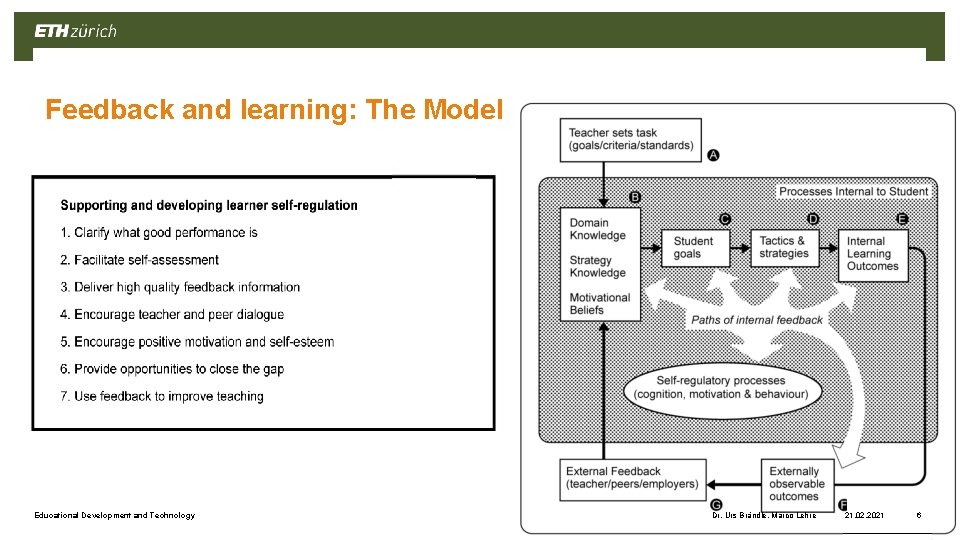
Feedback and learning: The Model Educational Development and Technology Dr. Urs Brändle, Marco Lehre | 21. 02. 2021 | 6
- Slides: 6