
Refraction Reflection Total internal reflection Critical Angle PHYSICS
- Slides: 16
Refraction & Reflection Total internal reflection Critical Angle PHYSICS
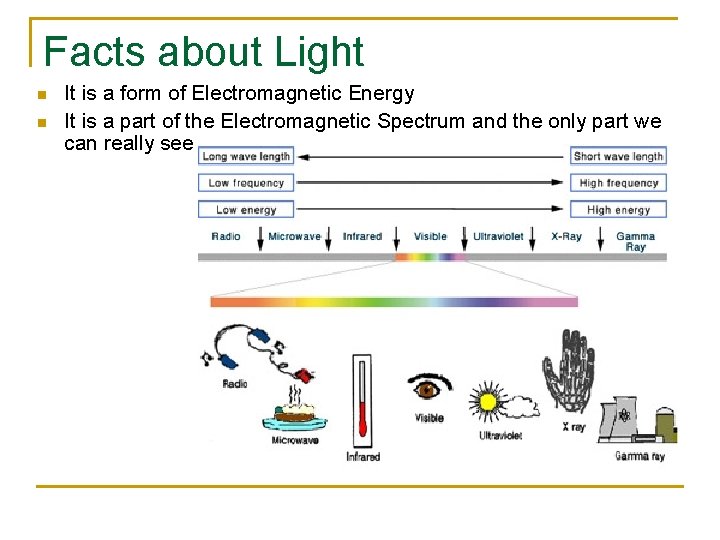
Facts about Light n n It is a form of Electromagnetic Energy It is a part of the Electromagnetic Spectrum and the only part we can really see
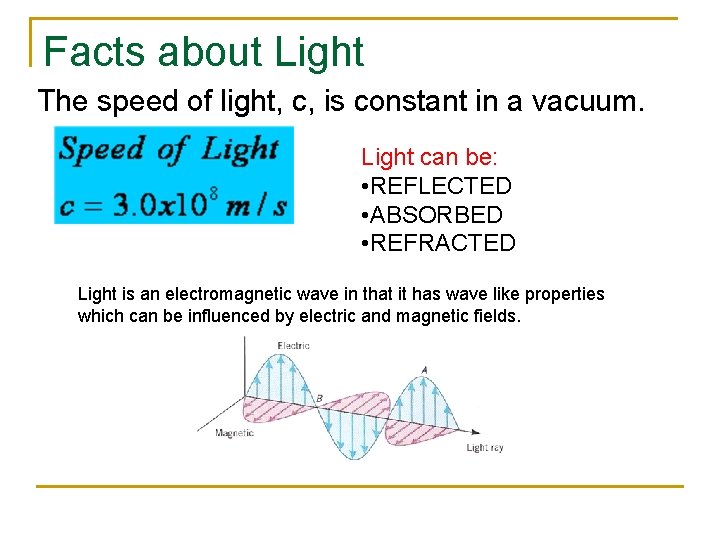
Facts about Light The speed of light, c, is constant in a vacuum. Light can be: • REFLECTED • ABSORBED • REFRACTED Light is an electromagnetic wave in that it has wave like properties which can be influenced by electric and magnetic fields.
Facts about Light The speed of light, c, is constant in a vacuum. Light can be: • REFLECTED • ABSORBED • REFRACTED Light is an electromagnetic wave in that it has wave like properties which can be influenced by electric and magnetic fields.
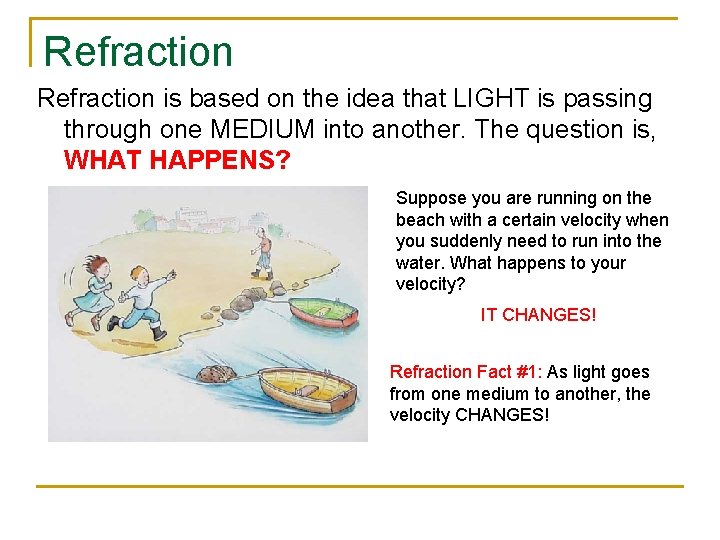
Refraction is based on the idea that LIGHT is passing through one MEDIUM into another. The question is, WHAT HAPPENS? Suppose you are running on the beach with a certain velocity when you suddenly need to run into the water. What happens to your velocity? IT CHANGES! Refraction Fact #1: As light goes from one medium to another, the velocity CHANGES!
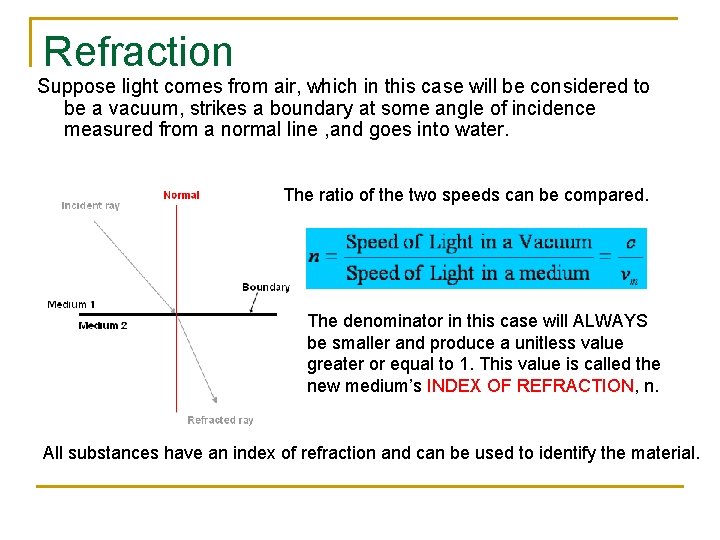
Refraction Suppose light comes from air, which in this case will be considered to be a vacuum, strikes a boundary at some angle of incidence measured from a normal line , and goes into water. The ratio of the two speeds can be compared. The denominator in this case will ALWAYS be smaller and produce a unitless value greater or equal to 1. This value is called the new medium’s INDEX OF REFRACTION, n. All substances have an index of refraction and can be used to identify the material.
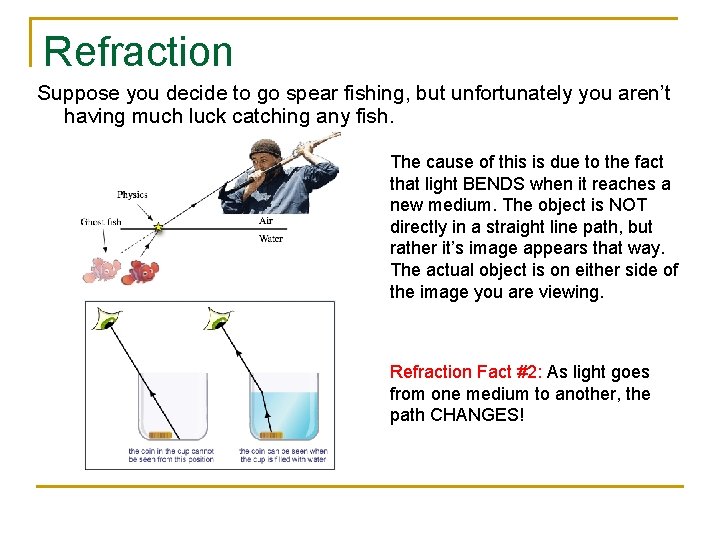
Refraction Suppose you decide to go spear fishing, but unfortunately you aren’t having much luck catching any fish. The cause of this is due to the fact that light BENDS when it reaches a new medium. The object is NOT directly in a straight line path, but rather it’s image appears that way. The actual object is on either side of the image you are viewing. Refraction Fact #2: As light goes from one medium to another, the path CHANGES!
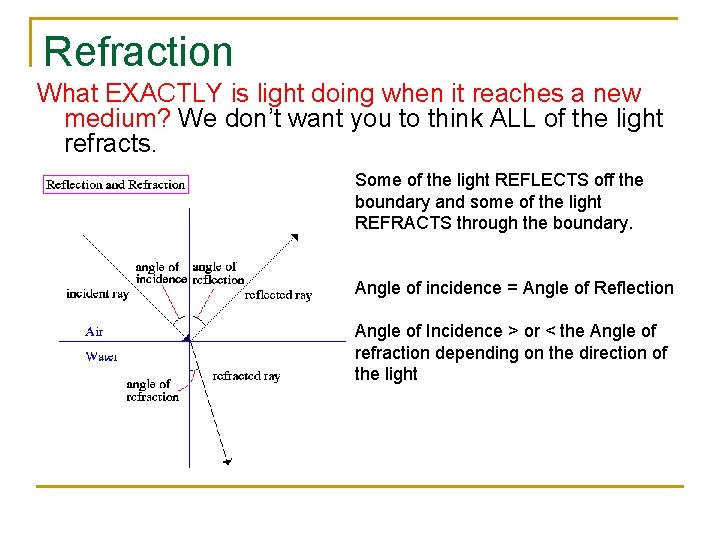
Refraction What EXACTLY is light doing when it reaches a new medium? We don’t want you to think ALL of the light refracts. Some of the light REFLECTS off the boundary and some of the light REFRACTS through the boundary. Angle of incidence = Angle of Reflection Angle of Incidence > or < the Angle of refraction depending on the direction of the light
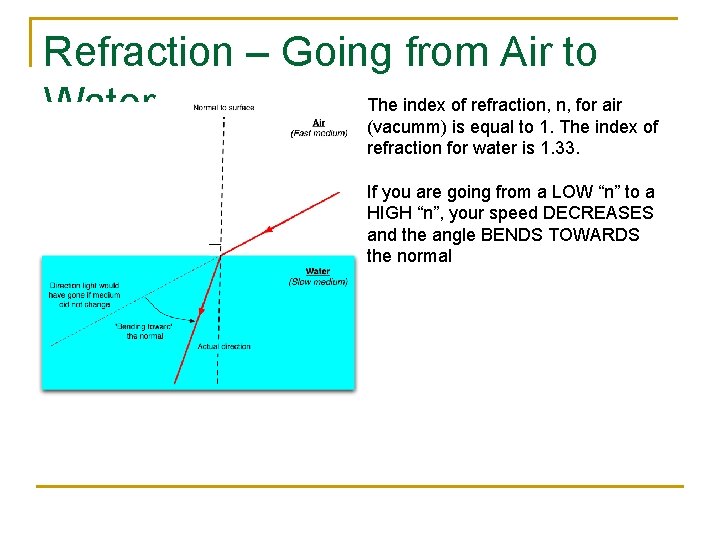
Refraction – Going from Air to The index of refraction, n, for air Water (vacumm) is equal to 1. The index of refraction for water is 1. 33. If you are going from a LOW “n” to a HIGH “n”, your speed DECREASES and the angle BENDS TOWARDS the normal
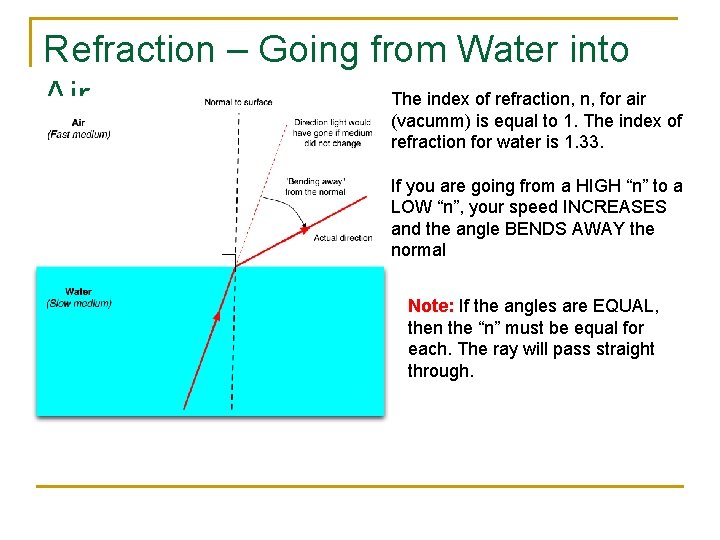
Refraction – Going from Water into The index of refraction, n, for air Air (vacumm) is equal to 1. The index of refraction for water is 1. 33. If you are going from a HIGH “n” to a LOW “n”, your speed INCREASES and the angle BENDS AWAY the normal Note: If the angles are EQUAL, then the “n” must be equal for each. The ray will pass straight through.
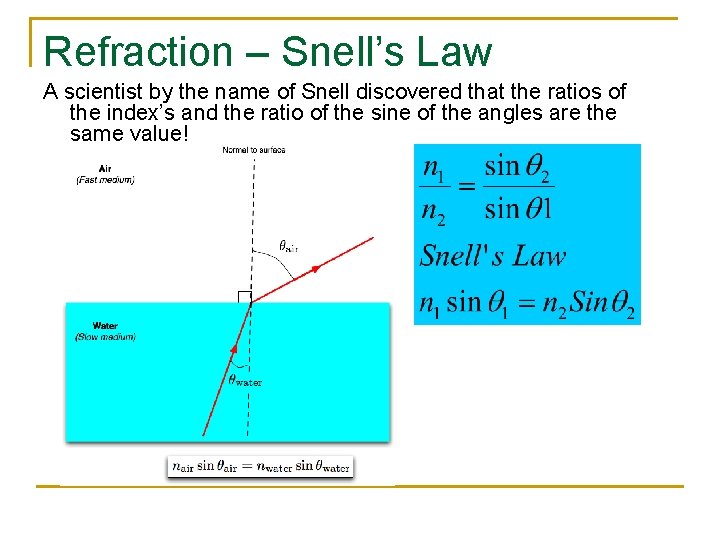
Refraction – Snell’s Law A scientist by the name of Snell discovered that the ratios of the index’s and the ratio of the sine of the angles are the same value!
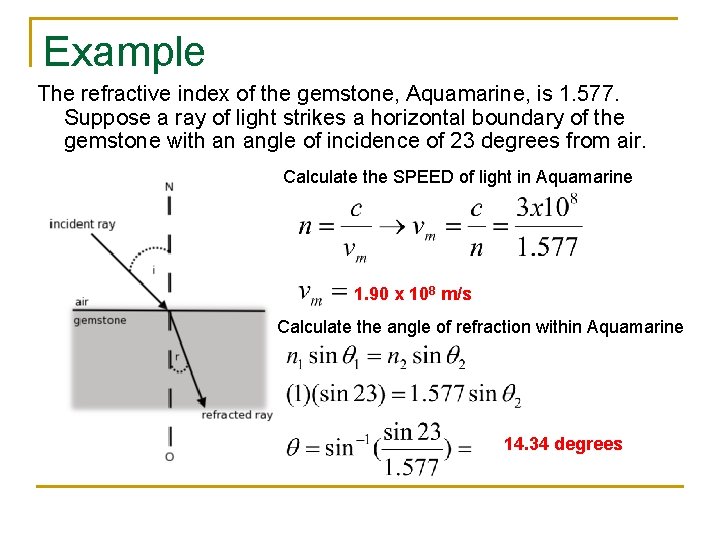
Example The refractive index of the gemstone, Aquamarine, is 1. 577. Suppose a ray of light strikes a horizontal boundary of the gemstone with an angle of incidence of 23 degrees from air. Calculate the SPEED of light in Aquamarine 1. 90 x 108 m/s Calculate the angle of refraction within Aquamarine 14. 34 degrees
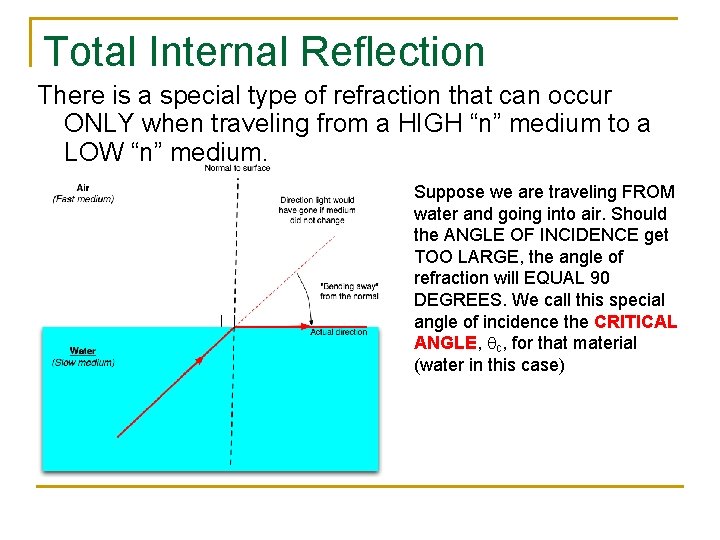
Total Internal Reflection There is a special type of refraction that can occur ONLY when traveling from a HIGH “n” medium to a LOW “n” medium. Suppose we are traveling FROM water and going into air. Should the ANGLE OF INCIDENCE get TOO LARGE, the angle of refraction will EQUAL 90 DEGREES. We call this special angle of incidence the CRITICAL ANGLE, qc, for that material (water in this case)
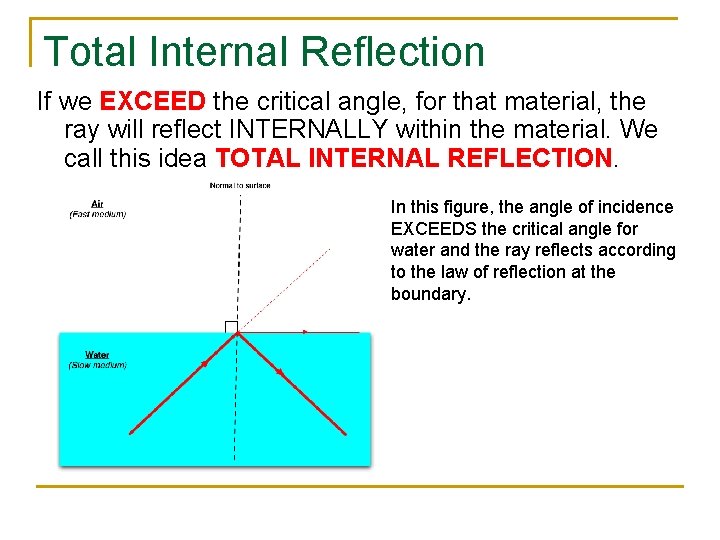
Total Internal Reflection If we EXCEED the critical angle, for that material, the ray will reflect INTERNALLY within the material. We call this idea TOTAL INTERNAL REFLECTION. In this figure, the angle of incidence EXCEEDS the critical angle for water and the ray reflects according to the law of reflection at the boundary.
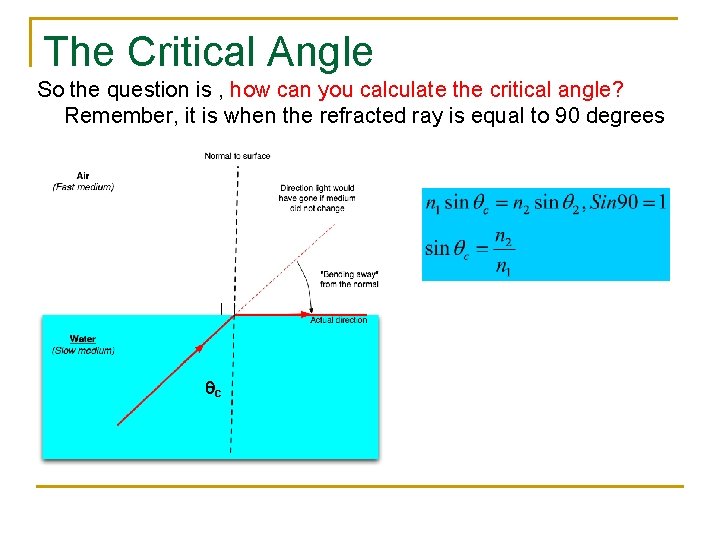
The Critical Angle So the question is , how can you calculate the critical angle? Remember, it is when the refracted ray is equal to 90 degrees qc
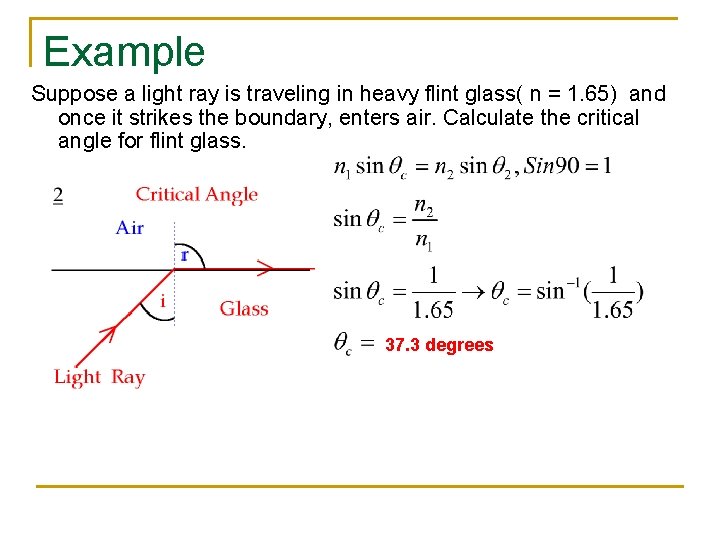
Example Suppose a light ray is traveling in heavy flint glass( n = 1. 65) and once it strikes the boundary, enters air. Calculate the critical angle for flint glass. 37. 3 degrees