
REFRACTION PH 2 2 Refraction The speed of
- Slides: 13
REFRACTION PH 2. 2
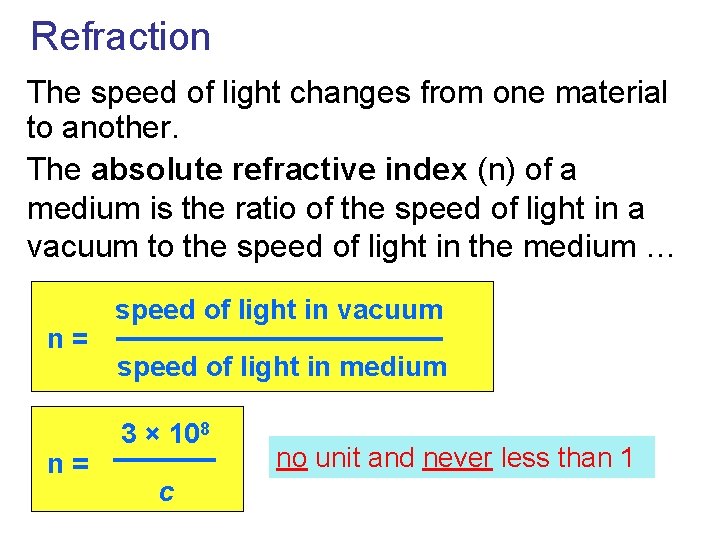
Refraction The speed of light changes from one material to another. The absolute refractive index (n) of a medium is the ratio of the speed of light in a vacuum to the speed of light in the medium … n= n= speed of light in vacuum speed of light in medium 3 × 10⁸ c no unit and never less than 1
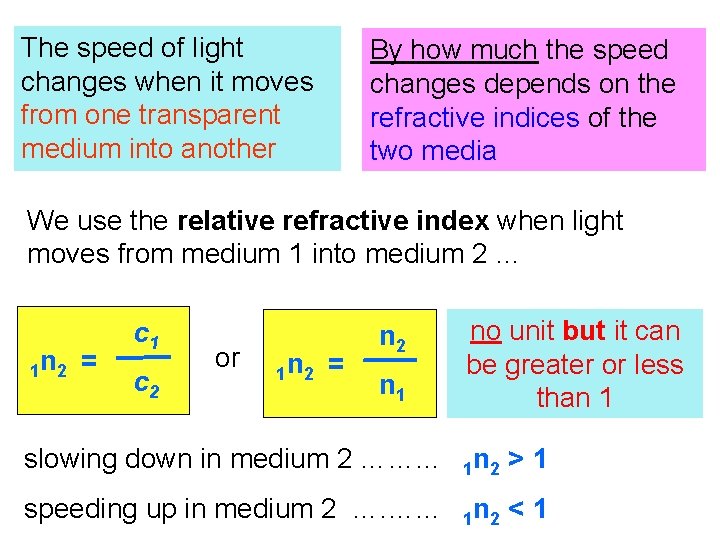
The speed of light changes when it moves from one transparent medium into another By how much the speed changes depends on the refractive indices of the two media We use the relative refractive index when light moves from medium 1 into medium 2 … 1 n 2 = c 1 c 2 or 1 n 2 = n 2 n 1 no unit but it can be greater or less than 1 slowing down in medium 2 ……. . . 1 n 2 >1 speeding up in medium 2 …. …. . . 1 n 2 <1
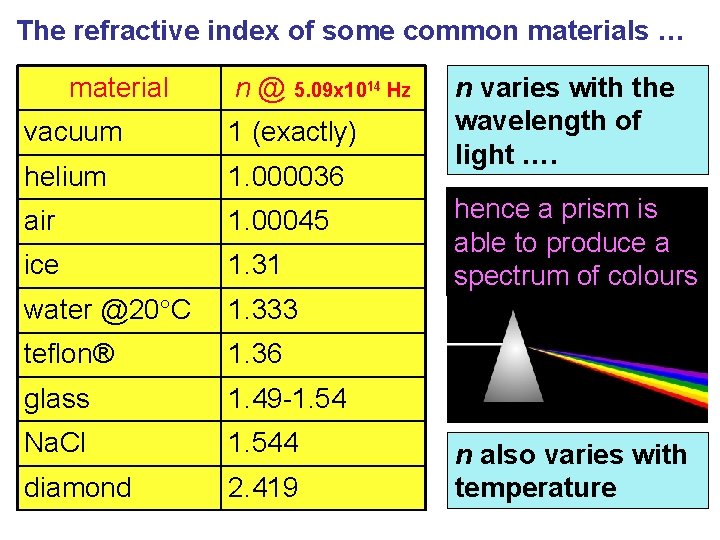
The refractive index of some common materials … material n @ 5. 09 x 1014 Hz vacuum 1 (exactly) helium 1. 000036 air 1. 00045 ice 1. 31 water @20 C 1. 333 teflon® 1. 36 glass 1. 49 -1. 54 Na. Cl 1. 544 diamond 2. 419 n varies with the wavelength of light …. hence a prism is able to produce a spectrum of colours n also varies with temperature
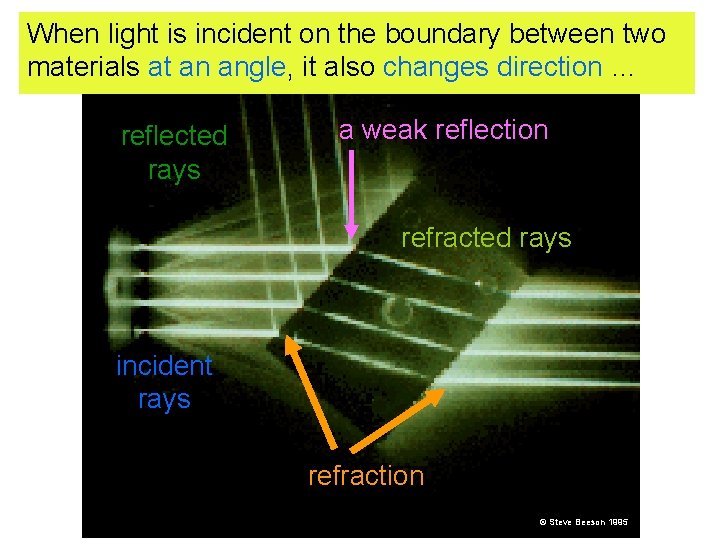
When light is incident on the boundary between two materials at an angle, it also changes direction … reflected rays a weak reflection refracted rays incident rays refraction © Steve Beeson 1995
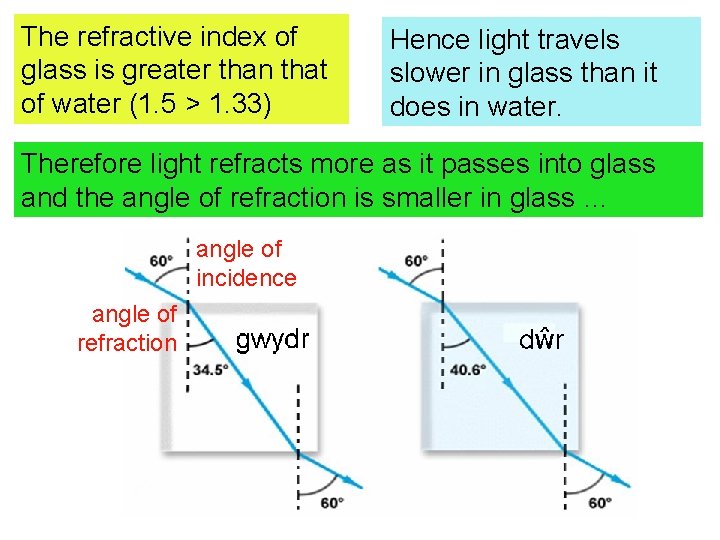
The refractive index of glass is greater than that of water (1. 5 > 1. 33) Hence light travels slower in glass than it does in water. Therefore light refracts more as it passes into glass and the angle of refraction is smaller in glass … angle of incidence angle of refraction
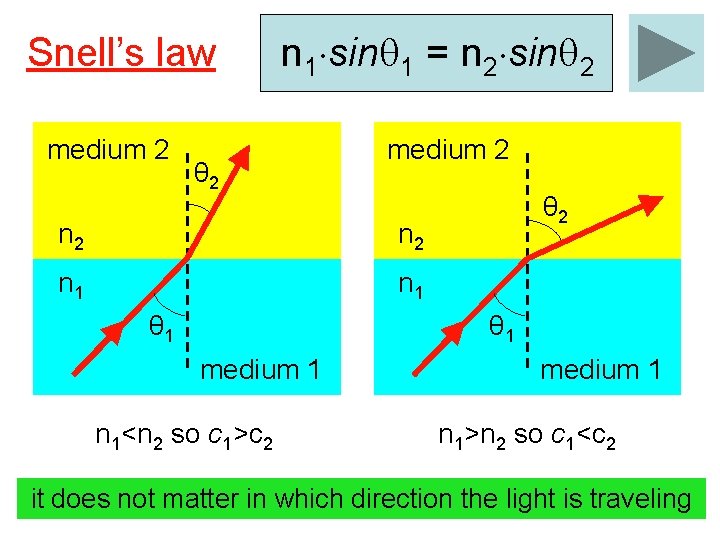
Snell’s law medium 2 n 1 sin 1 = n 2 sin 2 θ 2 medium 2 n 2 n 1 θ 1 θ 2 θ 1 medium 1 n 1<n 2 so c 1>c 2 medium 1 n 1>n 2 so c 1<c 2 it does not matter in which direction the light is traveling
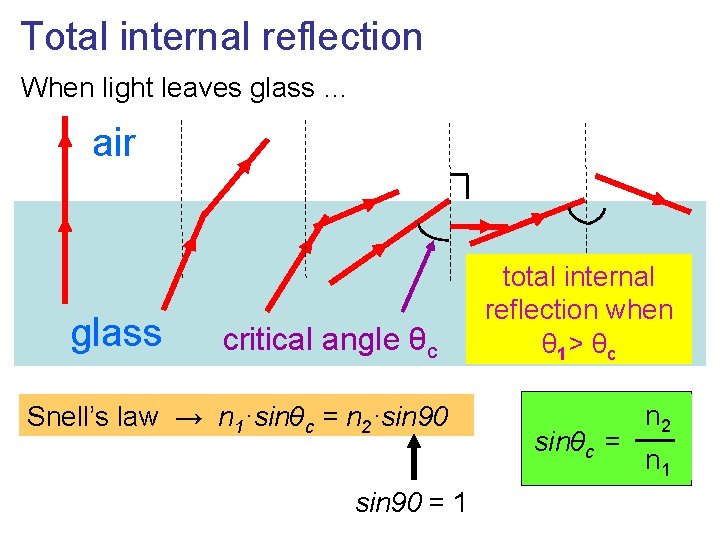
Total internal reflection When light leaves glass … air glass critical angle θc Snell’s law → n 1·sinθc = n 2·sin 90 = 1 total internal reflection when θ 1> θ c sinθc = n 2 n 1
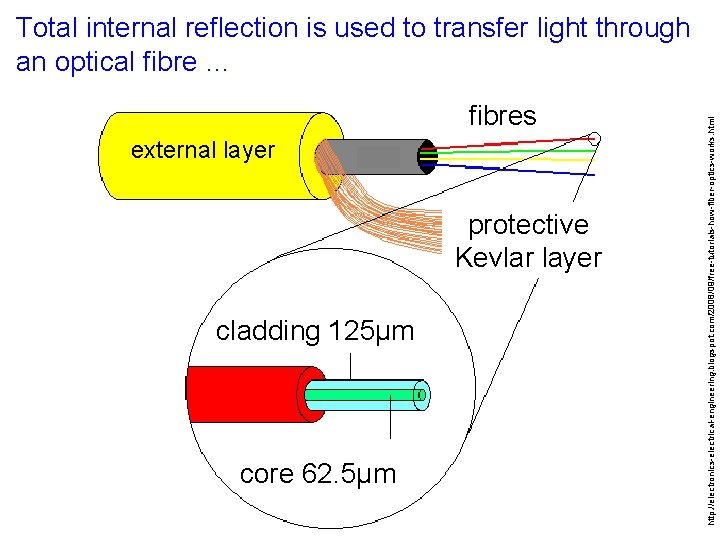
fibres external layer protective Kevlar layer cladding 125μm core 62. 5μm http: //electronics-electrical-engineering. blogspot. com/2008/09/free-tutorials-how-fiber-optics-works. html Total internal reflection is used to transfer light through an optical fibre …
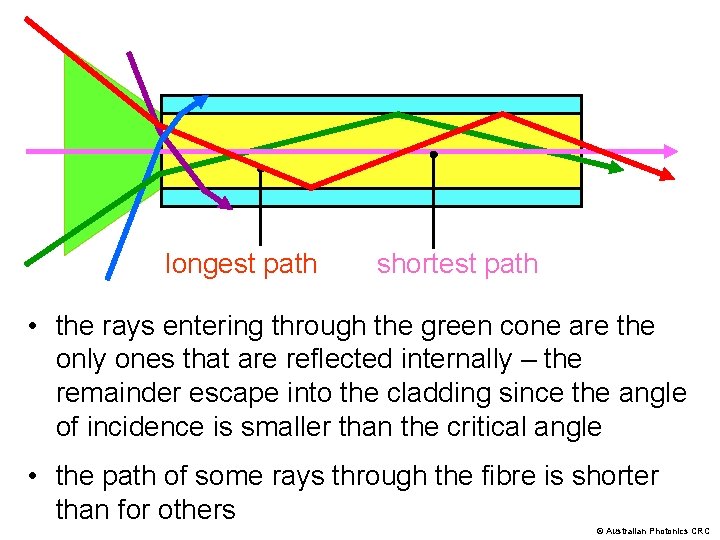
longest path shortest path • the rays entering through the green cone are the only ones that are reflected internally – the remainder escape into the cladding since the angle of incidence is smaller than the critical angle • the path of some rays through the fibre is shorter than for others © Australian Photonics CRC
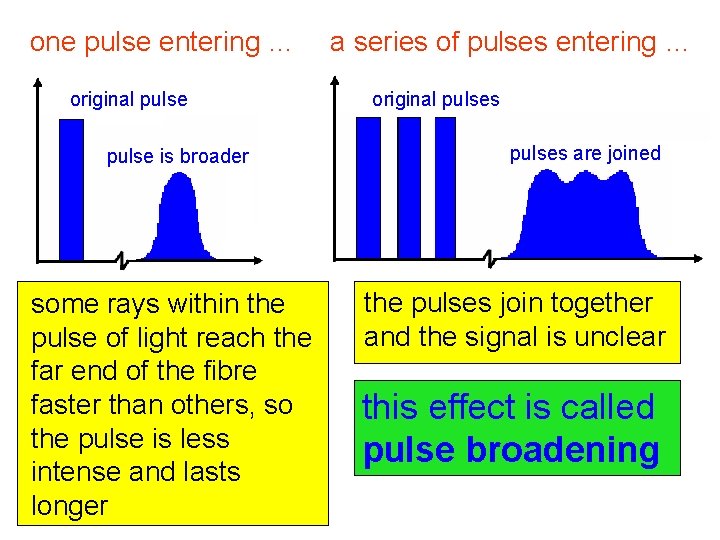
one pulse entering … original pulse is broader some rays within the pulse of light reach the far end of the fibre faster than others, so the pulse is less intense and lasts longer a series of pulses entering … original pulses are joined the pulses join together and the signal is unclear this effect is called pulse broadening
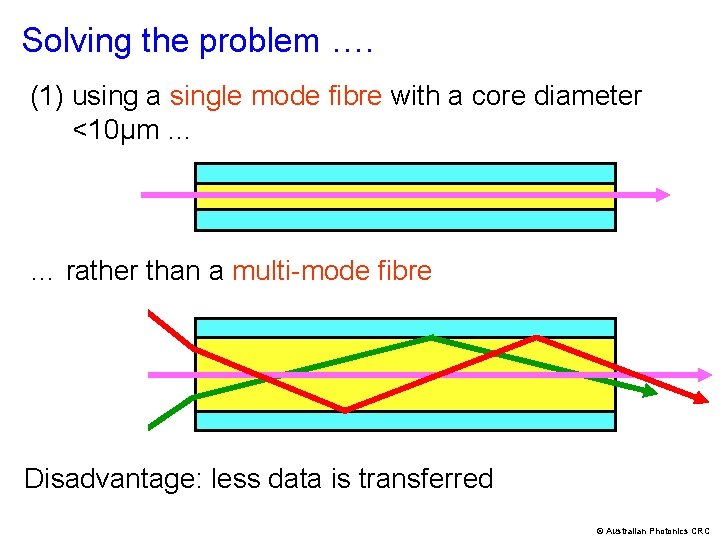
Solving the problem …. (1) using a single mode fibre with a core diameter <10μm … … rather than a multi-mode fibre Disadvantage: less data is transferred © Australian Photonics CRC
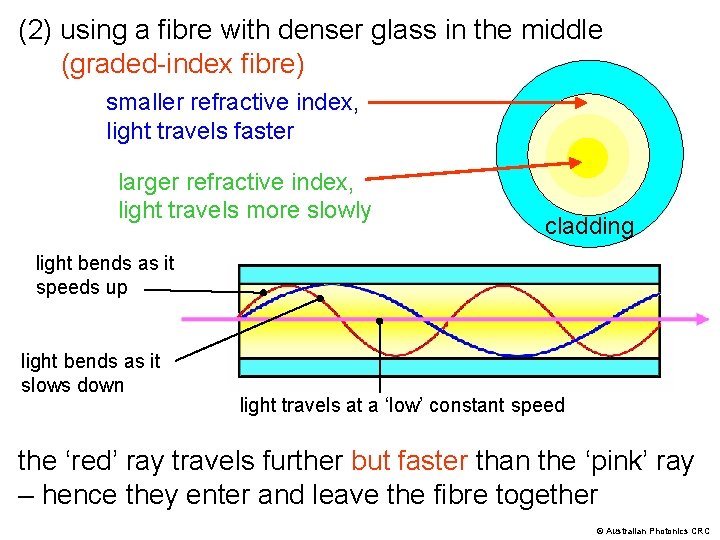
(2) using a fibre with denser glass in the middle (graded-index fibre) smaller refractive index, light travels faster larger refractive index, light travels more slowly cladding light bends as it speeds up light bends as it slows down light travels at a ‘low’ constant speed the ‘red’ ray travels further but faster than the ‘pink’ ray – hence they enter and leave the fibre together © Australian Photonics CRC