
Refraction of Light When light rays enter a

- Slides: 10
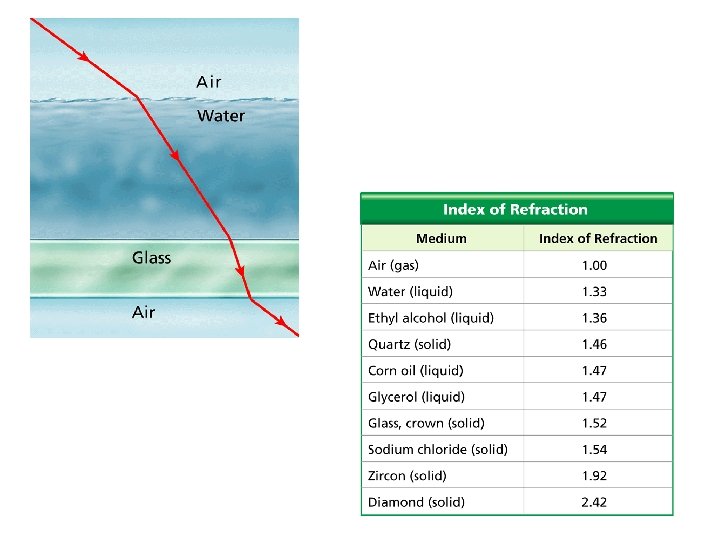
Refraction of Light • When light rays enter a medium at an angle, the change in speed causes the rays to bend, or change direction • Some mediums cause light to bend more than others • A material’s index of refraction is a measure of how much a ray of light bends when it enters that material – Higher the index the more it bends
Seeing Light
The Human Eye • Allows you to sense light • See light when a process occurs that involves both your eyes and brain
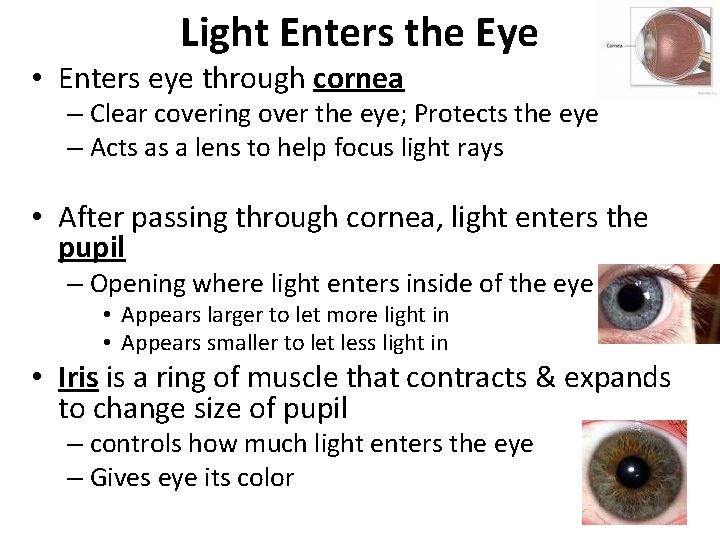
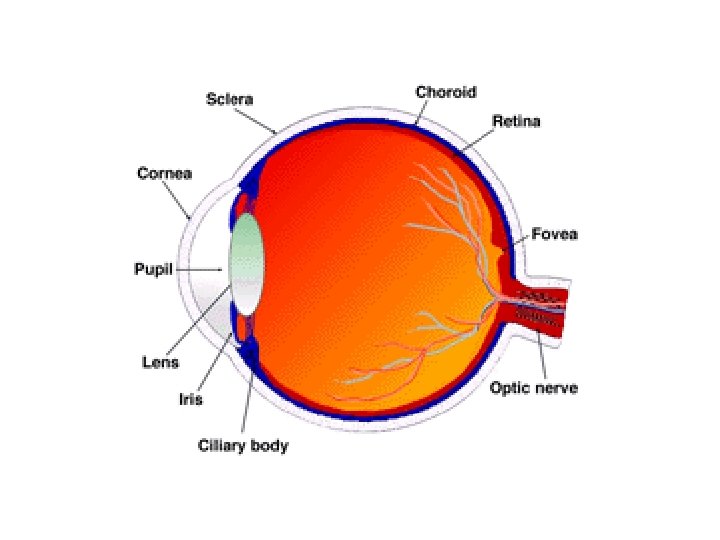
Light Enters the Eye • Enters eye through cornea – Clear covering over the eye; Protects the eye – Acts as a lens to help focus light rays • After passing through cornea, light enters the pupil – Opening where light enters inside of the eye • Appears larger to let more light in • Appears smaller to let less light in • Iris is a ring of muscle that contracts & expands to change size of pupil – controls how much light enters the eye – Gives eye its color
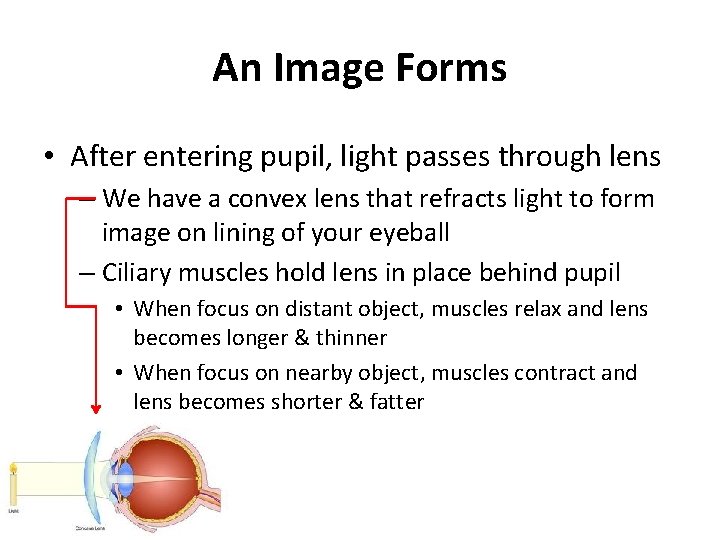
An Image Forms • After entering pupil, light passes through lens – We have a convex lens that refracts light to form image on lining of your eyeball – Ciliary muscles hold lens in place behind pupil • When focus on distant object, muscles relax and lens becomes longer & thinner • When focus on nearby object, muscles contract and lens becomes shorter & fatter
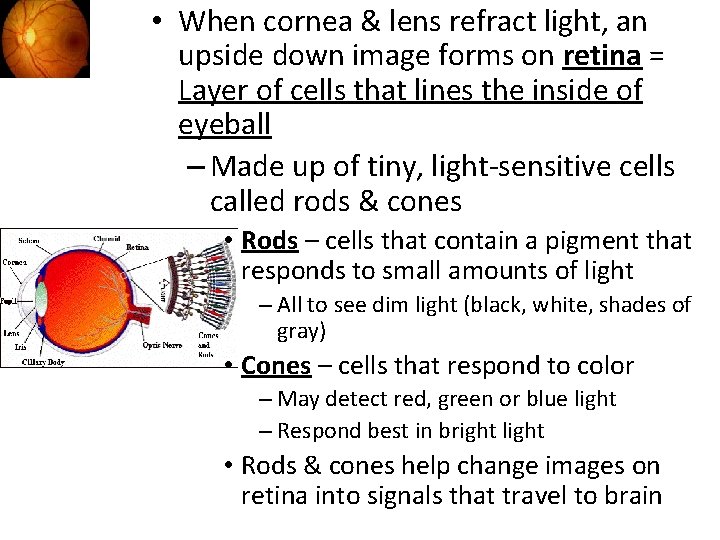
• When cornea & lens refract light, an upside down image forms on retina = Layer of cells that lines the inside of eyeball – Made up of tiny, light-sensitive cells called rods & cones • Rods – cells that contain a pigment that responds to small amounts of light – All to see dim light (black, white, shades of gray) • Cones – cells that respond to color – May detect red, green or blue light – Respond best in bright light • Rods & cones help change images on retina into signals that travel to brain
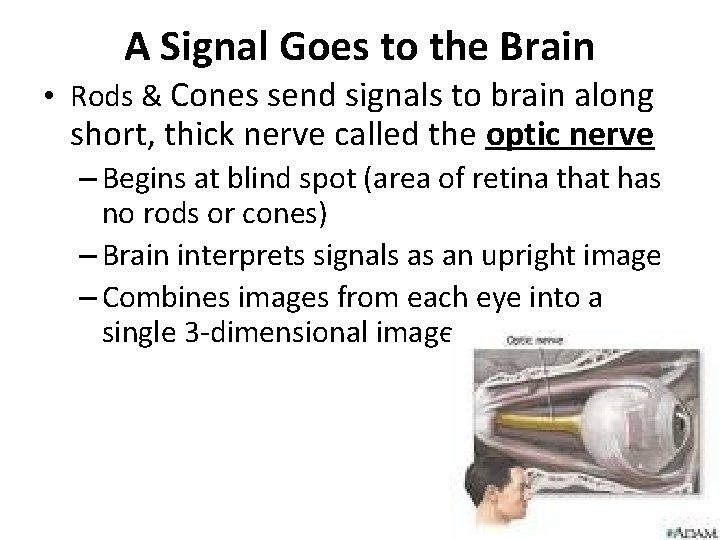
A Signal Goes to the Brain • Rods & Cones send signals to brain along short, thick nerve called the optic nerve – Begins at blind spot (area of retina that has no rods or cones) – Brain interprets signals as an upright image – Combines images from each eye into a single 3 -dimensional image