
Refraction Bending of light Wheels of a car
Refraction Bending of light

Wheels of a car Smooth surface Wheels slow down on rough surface Rough Surface

Wheels of a car Smooth surface Normal (perpendicular to boundary) øi øi = incident angle ør = refracted angle ør Rough Surface The rough surface causes a bent path of the wheels.
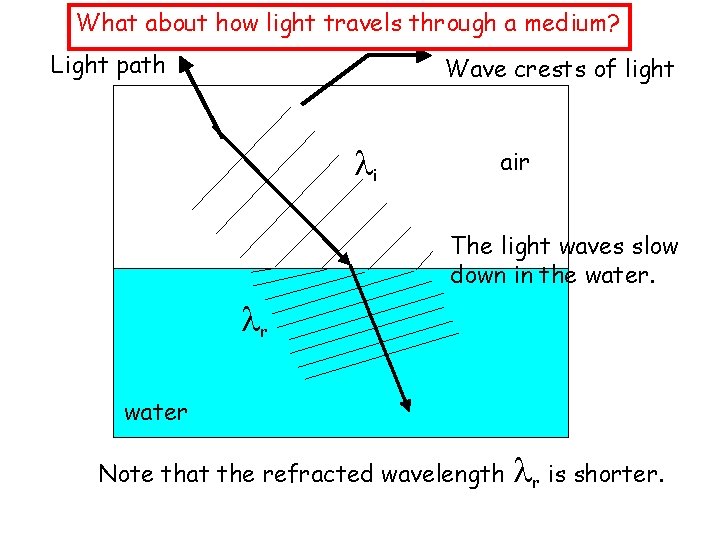
What about how light travels through a medium? Light path Wave crests of light i air The light waves slow down in the water. r water Note that the refracted wavelength r is shorter.
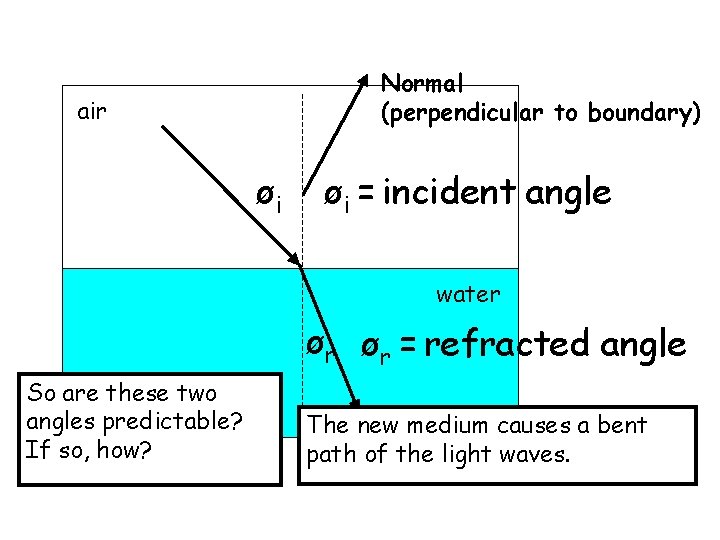
Normal (perpendicular to boundary) air øi øi = incident angle water ør ør = refracted angle So are these two angles predictable? If so, how? The new medium causes a bent path of the light waves.
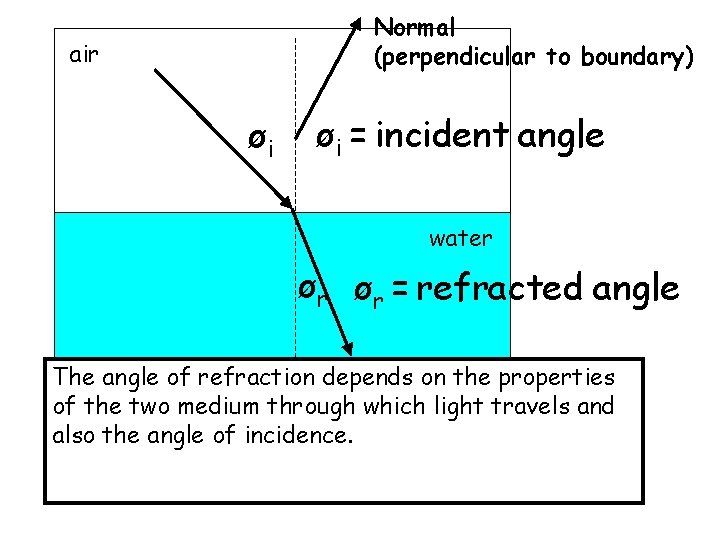
Normal (perpendicular to boundary) air øi øi = incident angle water ør ør = refracted angle The angle of refraction depends on the properties of the two medium through which light travels and also the angle of incidence.
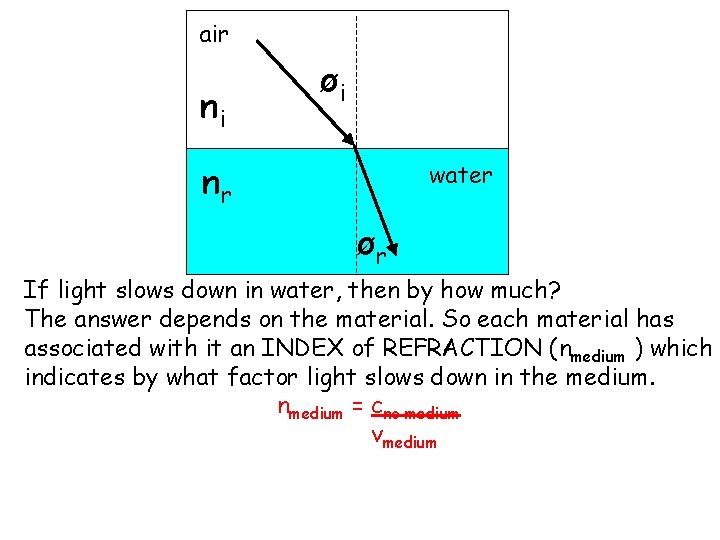
air ni øi nr water ør If light slows down in water, then by how much? The answer depends on the material. So each material has associated with it an INDEX of REFRACTION (nmedium ) which indicates by what factor light slows down in the medium. nmedium = cno medium vmedium
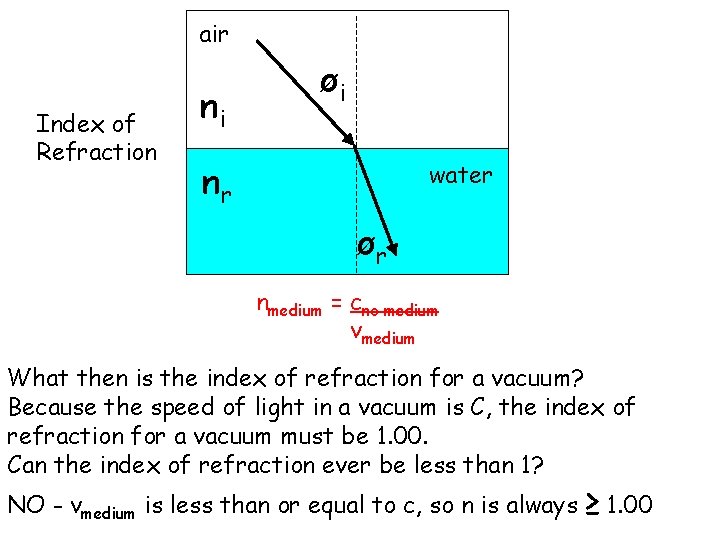
air Index of Refraction ni øi nr water ør nmedium = cno medium vmedium What then is the index of refraction for a vacuum? Because the speed of light in a vacuum is C, the index of refraction for a vacuum must be 1. 00. Can the index of refraction ever be less than 1? NO - vmedium is less than or equal to c, so n is always ≥ 1. 00
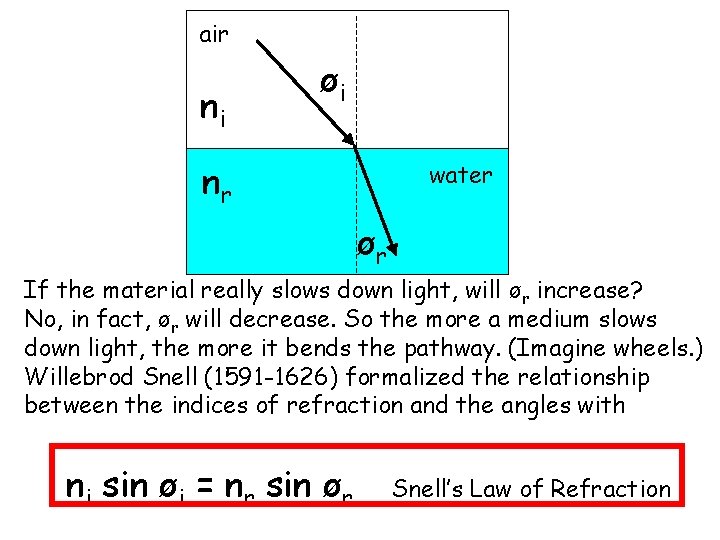
air ni øi nr water ør If the material really slows down light, will ør increase? No, in fact, ør will decrease. So the more a medium slows down light, the more it bends the pathway. (Imagine wheels. ) Willebrod Snell (1591 -1626) formalized the relationship between the indices of refraction and the angles with ni sin øi = nr sin ør Snell’s Law of Refraction
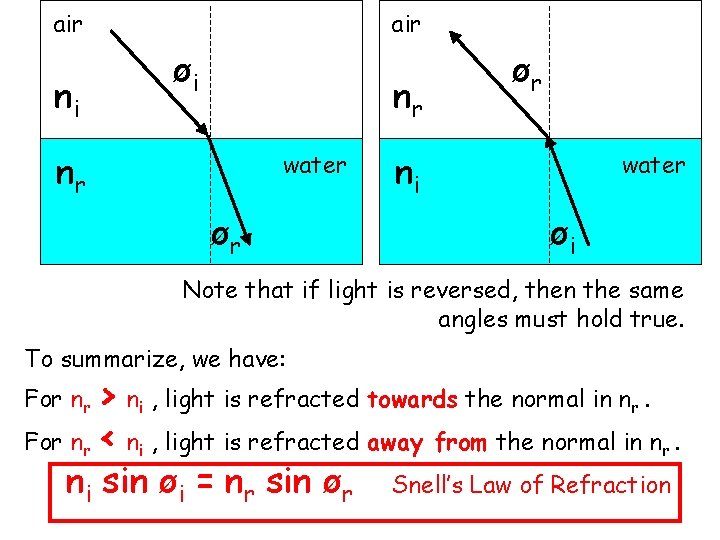
air ni øi nr nr water ør ør ni water øi Note that if light is reversed, then the same angles must hold true. To summarize, we have: For nr > ni , light is refracted towards the normal in nr. For nr < ni , light is refracted away from the normal in nr. ni sin øi = nr sin ør Snell’s Law of Refraction
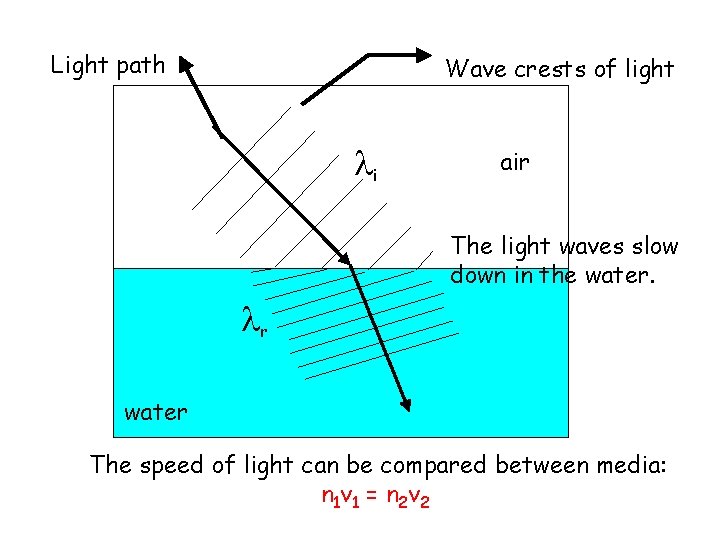
Light path Wave crests of light i air The light waves slow down in the water. r water The speed of light can be compared between media: n 1 v 1 = n 2 v 2
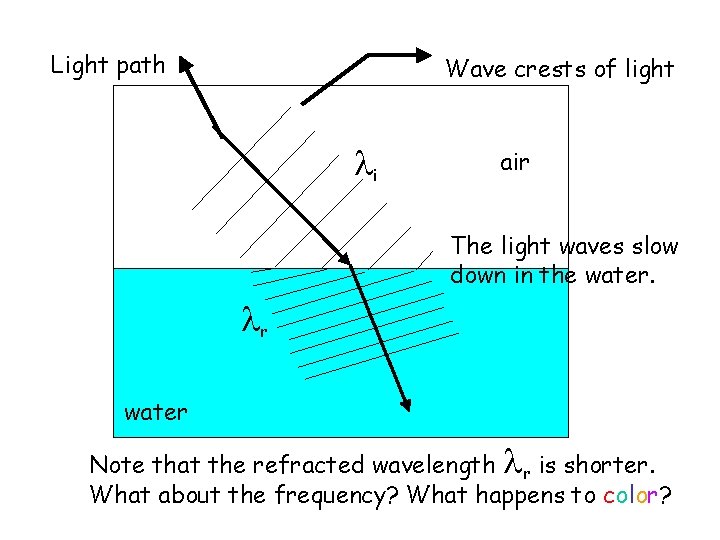
Light path Wave crests of light i air The light waves slow down in the water. r water Note that the refracted wavelength r is shorter. What about the frequency? What happens to color?
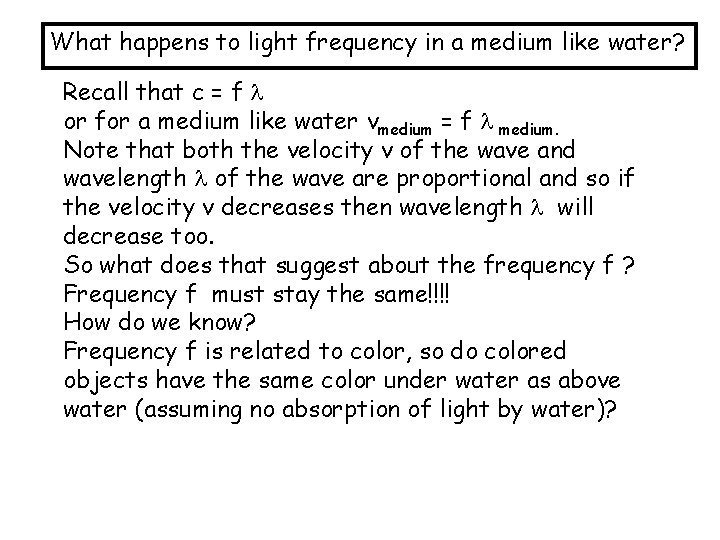
What happens to light frequency in a medium like water? Recall that c = f or for a medium like water vmedium = f medium. Note that both the velocity v of the wave and wavelength of the wave are proportional and so if the velocity v decreases then wavelength will decrease too. So what does that suggest about the frequency f ? Frequency f must stay the same!!!! How do we know? Frequency f is related to color, so do colored objects have the same color under water as above water (assuming no absorption of light by water)?
Applications of Refraction Mirages Dusk, dawn, a clear blue sky Rainbows CDs, DVDs A diamond’s “fire”
- Slides: 14