
Reforms to Budget Formulation in Uganda The challenges

Reforms to Budget Formulation in Uganda The challenges of building and maintaining and a credible process Tim Williamson tim@praxisdevelopment. net 1
Why Uganda? • Successful Reforms to Public Expenditure Management since 1990 s built a credible budget process – Especially in terms of establishing Fiscal Discipline and in Budget Formulation • More Recently, some emerging challenges in maintaining credibility – Institutional and Governance related 2
3 Parts • Part 1: Reforms to Public Financial Management • Part 2: The Budget Formulation Process • Part 3: Successes, Failures and Challenges 3
Part 1: Reforms to Public Financial Management Sequencing, Instruments and Institutions 4
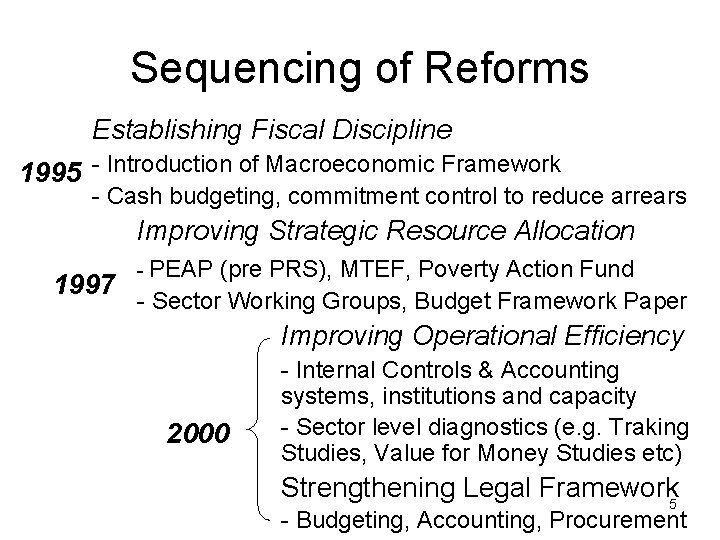
Sequencing of Reforms Establishing Fiscal Discipline 1995 - Introduction of Macroeconomic Framework - Cash budgeting, commitment control to reduce arrears Improving Strategic Resource Allocation - PEAP (pre PRS), MTEF, Poverty Action Fund 1997 - Sector Working Groups, Budget Framework Paper Improving Operational Efficiency 2000 - Internal Controls & Accounting systems, institutions and capacity - Sector level diagnostics (e. g. Traking Studies, Value for Money Studies etc) Strengthening Legal Framework 5 - Budgeting, Accounting, Procurement
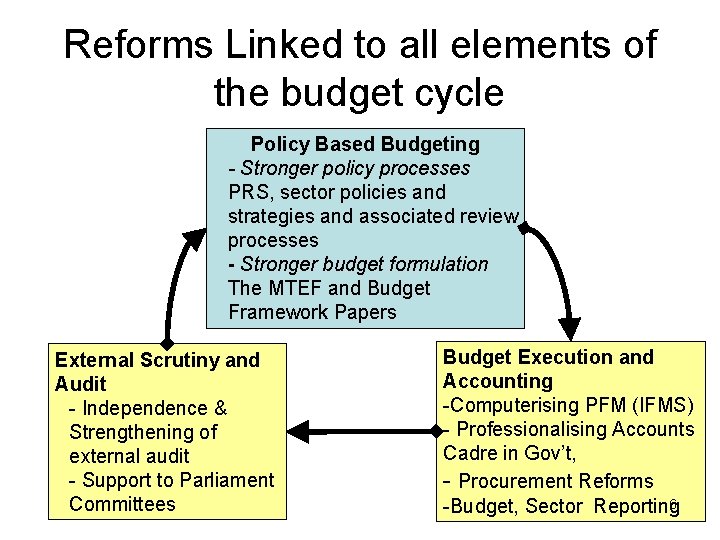
Reforms Linked to all elements of the budget cycle Policy Based Budgeting - Stronger policy processes PRS, sector policies and strategies and associated review processes - Stronger budget formulation The MTEF and Budget Framework Papers External Scrutiny and Audit - Independence & Strengthening of external audit - Support to Parliament Committees Budget Execution and Accounting -Computerising PFM (IFMS) - Professionalising Accounts Cadre in Gov’t, - Procurement Reforms 6 -Budget, Sector Reporting
Part 2: The Budget Formulation Process The MTEF, Performance Focus 7
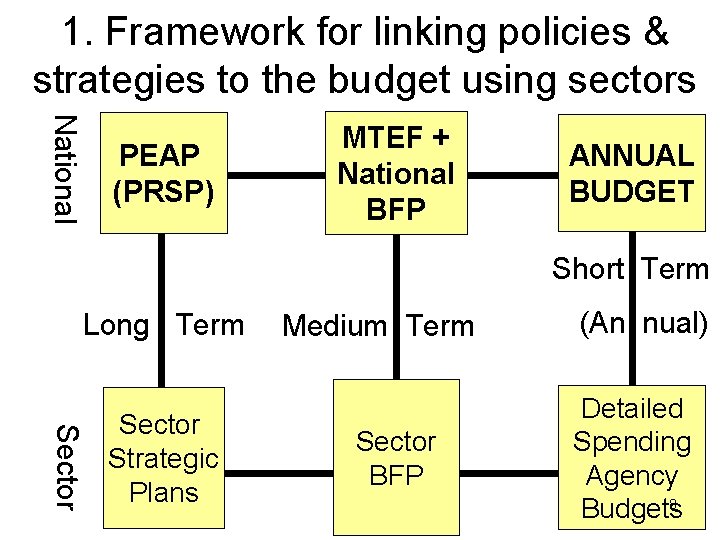
1. Framework for linking policies & strategies to the budget using sectors National PEAP (PRSP) MTEF + National BFP ANNUAL BUDGET Short Term Long Term Sector Strategic Plans Medium Term Sector BFP (An nual) Detailed Spending Agency 8 Budgets
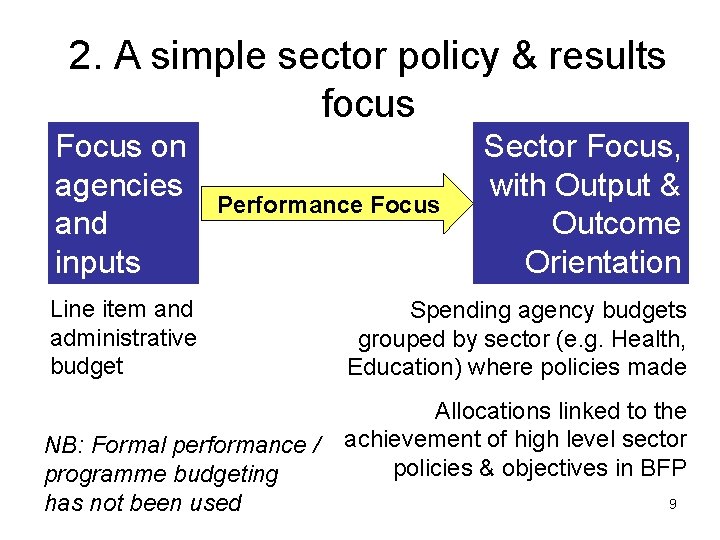
2. A simple sector policy & results focus Focus on agencies and inputs Performance Focus Line item and administrative budget NB: Formal performance / programme budgeting has not been used Sector Focus, with Output & Outcome Orientation Spending agency budgets grouped by sector (e. g. Health, Education) where policies made Allocations linked to the achievement of high level sector policies & objectives in BFP 9
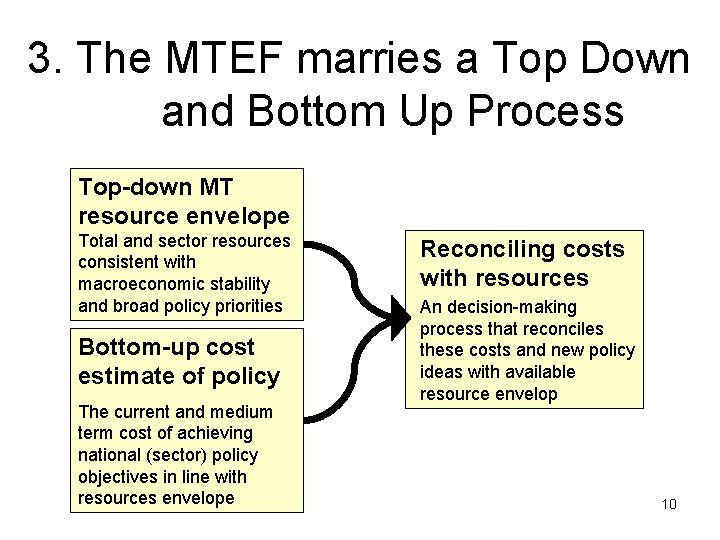
3. The MTEF marries a Top Down and Bottom Up Process Top-down MT resource envelope Total and sector resources consistent with macroeconomic stability and broad policy priorities Bottom-up cost estimate of policy The current and medium term cost of achieving national (sector) policy objectives in line with resources envelope Reconciling costs with resources An decision-making process that reconciles these costs and new policy ideas with available resource envelop 10
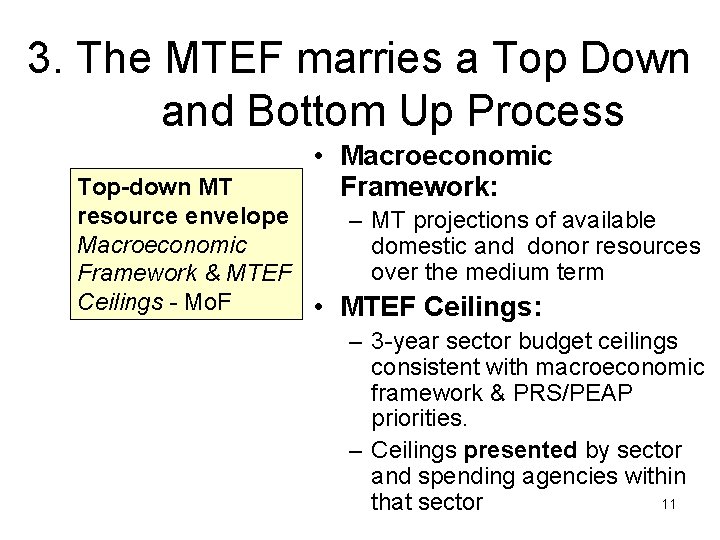
3. The MTEF marries a Top Down and Bottom Up Process • Macroeconomic Framework: Top-down MT resource envelope – MT projections of available Macroeconomic domestic and donor resources over the medium term Framework & MTEF Ceilings - Mo. F • MTEF Ceilings: – 3 -year sector budget ceilings consistent with macroeconomic framework & PRS/PEAP priorities. – Ceilings presented by sector and spending agencies within 11 that sector
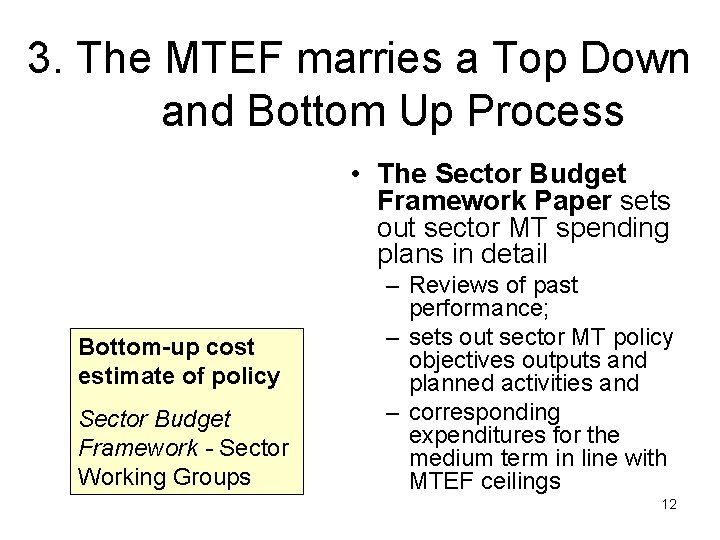
3. The MTEF marries a Top Down and Bottom Up Process • The Sector Budget Framework Paper sets out sector MT spending plans in detail Bottom-up cost estimate of policy Sector Budget Framework - Sector Working Groups – Reviews of past performance; – sets out sector MT policy objectives outputs and planned activities and – corresponding expenditures for the medium term in line with MTEF ceilings 12
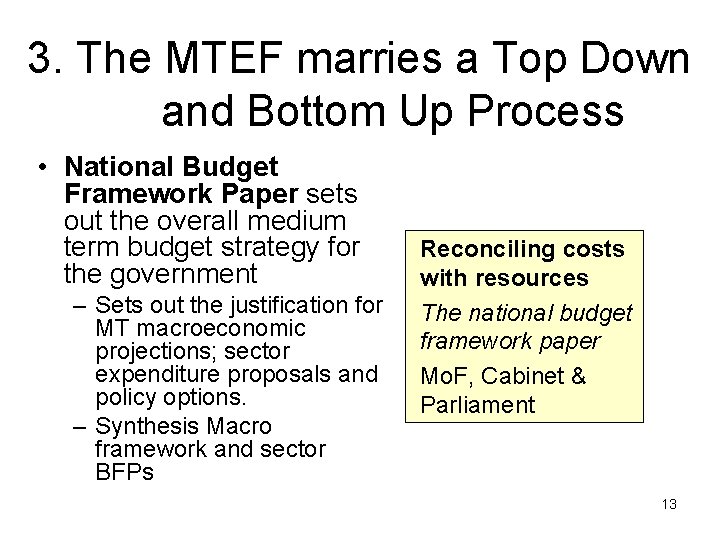
3. The MTEF marries a Top Down and Bottom Up Process • National Budget Framework Paper sets out the overall medium term budget strategy for the government – Sets out the justification for MT macroeconomic projections; sector expenditure proposals and policy options. – Synthesis Macro framework and sector BFPs Reconciling costs with resources The national budget framework paper Mo. F, Cabinet & Parliament 13
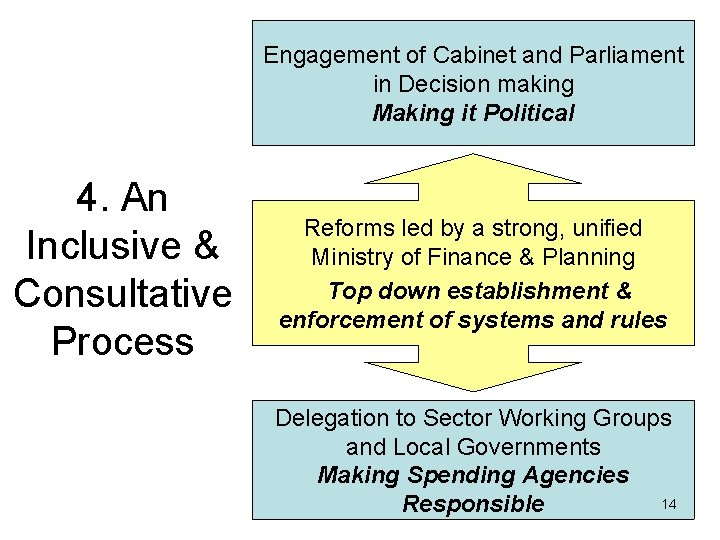
Engagement of Cabinet and Parliament in Decision making Making it Political 4. An Inclusive & Consultative Process Reforms led by a strong, unified Ministry of Finance & Planning Top down establishment & enforcement of systems and rules Delegation to Sector Working Groups and Local Governments Making Spending Agencies 14 Responsible
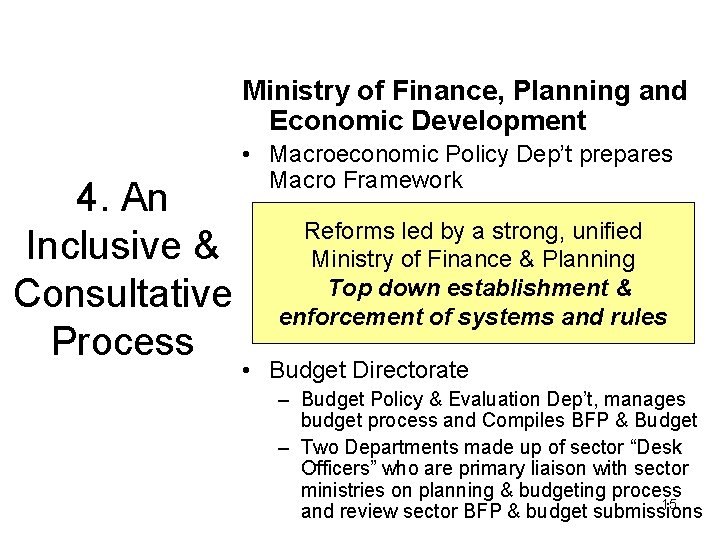
Ministry of Finance, Planning and Economic Development 4. An Inclusive & Consultative Process • Macroeconomic Policy Dep’t prepares Macro Framework Reforms led by a strong, unified Ministry of Finance & Planning Top down establishment & enforcement of systems and rules • Budget Directorate – Budget Policy & Evaluation Dep’t, manages budget process and Compiles BFP & Budget – Two Departments made up of sector “Desk Officers” who are primary liaison with sector ministries on planning & budgeting process 15 and review sector BFP & budget submissions
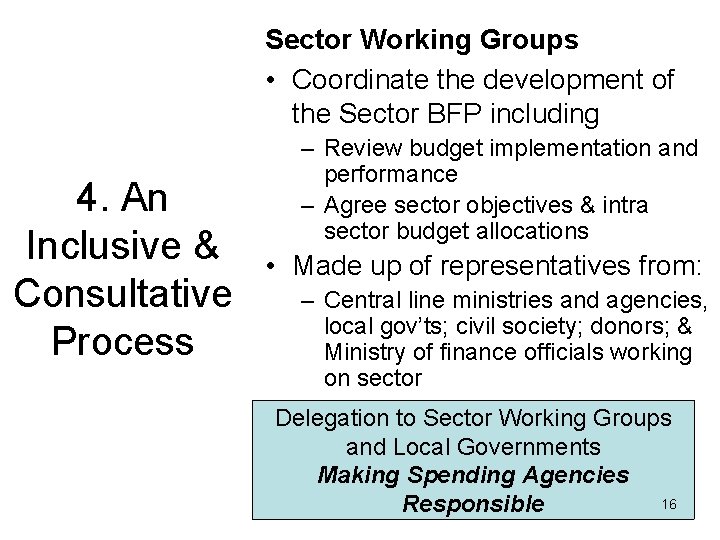
Sector Working Groups • Coordinate the development of the Sector BFP including 4. An Inclusive & Consultative Process – Review budget implementation and performance – Agree sector objectives & intra sector budget allocations • Made up of representatives from: – Central line ministries and agencies, local gov’ts; civil society; donors; & Ministry of finance officials working on sector Delegation to Sector Working Groups and Local Governments Making Spending Agencies 16 Responsible
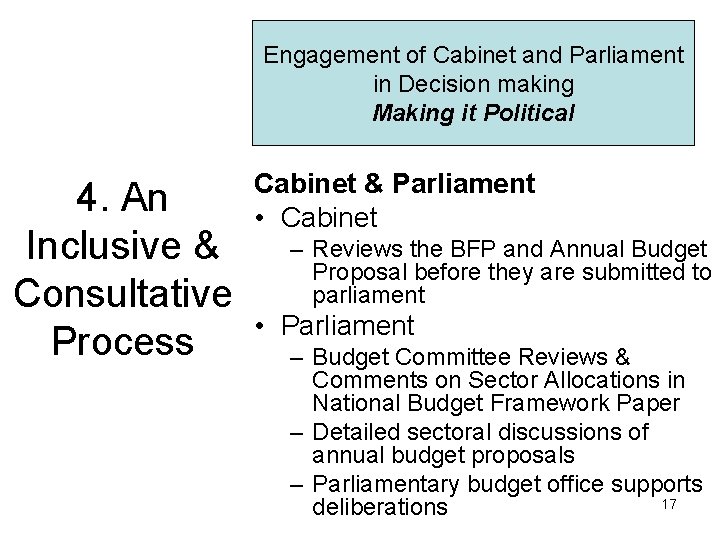
Engagement of Cabinet and Parliament in Decision making Making it Political 4. An Inclusive & Consultative Process Cabinet & Parliament • Cabinet – Reviews the BFP and Annual Budget Proposal before they are submitted to parliament • Parliament – Budget Committee Reviews & Comments on Sector Allocations in National Budget Framework Paper – Detailed sectoral discussions of annual budget proposals – Parliamentary budget office supports 17 deliberations
4. An Inclusive & Consultative Process 18
5. Integrating the local government dimension • Districts are the main implementers of basic services in Uganda. – The BFP process is replicated through Local Government Budget Framework Papers, prepared by districts – National policy priorities are funded at local governments via earmarked conditional grants which appear in sector MTEF’s – Large increases in allocations to local governments, in line with their functions • National priorities vs local discretion - getting the balance right – ¾ of increases in local funding have come in the form of conditional grants, which led to fragmented budgets & undermined discretion – Since 2000 efforts to consolidate the grant system, by increasing focus on the budget, introducing discretionary development grants, and introducing flexibility in the recurrent grants system. 19
6. Integrating aid into the process and encouraging budget support • Aid and Donors integrated into MTEF – Aid to spending agencies reflected in MTEF since 1997 – Donors part of sector working groups from the start, which has improved information sharing – Project Aid now included in Integrated Sector Budget Ceilings from 2003 (intention is that sectors can switch from projects to the budget without resources) • Donor Shifts towards sector and general budget support – Increased on-budget funding and attention paid to the budget process – Poverty Action Fund helped give credibility through protection of budget disbursements to PRS priority areas 20
Part 3 – Successes, Failures and Challenges Factors behind Success, and Emerging Challenges 21
A Credible Process • The MTEF is the Only Game in Town – The first year of the MTEF is the budget – A unified calendar for the MTEF and budget • Overall credibility of the macroeconomic framework – Fiscal aggregates have now been reliable for over a decade (+/- 3%) • Budgetary resources are made available during the financial year – E. g. in 2005/06 only one sector had disbursements < 95%, although there are variations by spending agency and budget type (recurrent, development) 22
Factors Behind Early Success • Strong leadership from MFPED, and willingness to manage a transparent, consultative process: – Engagement of Cabinet; – delegation to Sectors and Sector Working Groups; and – allowed civil society and donors to take part • Political support to: – fiscal discipline; – reallocation of resources to poverty priority areas, – sticking to the budget • The process was demanding but kept simple – I. e. no complicated programme/performance budgeting 23
Yet, there have been gaps • Across the board, there has not been enough focus on operationally efficiency of sector budget allocations • Sector budget submissions are of variable quality, and some have remained weak: – Costing is not comprehensive across sectors – Weak link of allocations with policy objectives • Harder PFM reforms started late in the reform process – Budget reporting has been on the basis of disbursements and not expenditures • The budget is approved after the beginning of the financial year, leading to some uncertainty 24
… and are emerging challenges • Emerging Issues – Increasingly difficult to adhere to budget calendar, and maintain consultations – Budget formulation becoming more routine, technical, and less strategic – Mo. F is finding it increasingly difficult to maintain the rules of the game, especially during budget implementation – Fragmentation in policies/plans (National Planning Authority, Manifesto, “Prosperity for All”, Rural Dev. Strategy) • Underlying factors – Changes in Leadership in the Mo. F (political and tech. ) – Change in political environment, (shift from no-party to multi party democracy, changing policy agenda). 25

Thank You 26
- Slides: 26