
Reforming Water Governance Principles Enabling Practice Dr Mark
Reforming Water Governance: Principles Enabling Practice Dr Mark Smith Head IUCN Water Programme Gland, Switzerland INTERNATIONAL UNION FOR CONSERVATION OF NATURE 5 th GEF-IW Conference Cairns, Australia October 2009
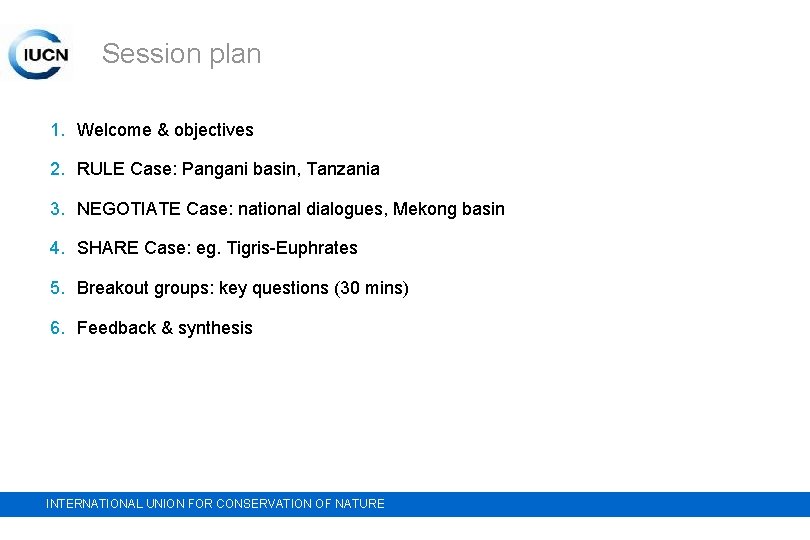
Session plan 1. Welcome & objectives 2. RULE Case: Pangani basin, Tanzania 3. NEGOTIATE Case: national dialogues, Mekong basin 4. SHARE Case: eg. Tigris-Euphrates 5. Breakout groups: key questions (30 mins) 6. Feedback & synthesis INTERNATIONAL UNION FOR CONSERVATION OF NATURE
Simple Objectives • Identify strategies, skills and tools needed for effective water reforms • Prioritisation of needs • Better able to identify key entry points for building national and transboundary water governance capacity INTERNATIONAL UNION FOR CONSERVATION OF NATURE

Water Governance Capacity: a Framework for Reforms Dr Mark Smith Head IUCN Water Programme Gland, Switzerland 5 th GEF-IW Conference Cairns, Australia October 2009
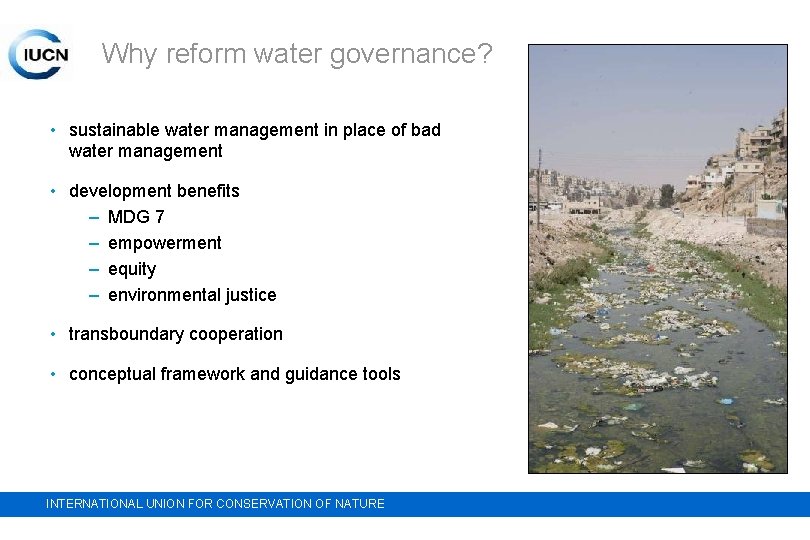
Why reform water governance? • sustainable water management in place of bad water management • development benefits – MDG 7 – empowerment – equity – environmental justice • transboundary cooperation • conceptual framework and guidance tools INTERNATIONAL UNION FOR CONSERVATION OF NATURE

Water Governance Capacity “Water Governance Capacity is a nation’s level of competence to implement effective water management through policies, laws, institutions, regulations and compliance mechanisms” → Without clear policy… it is difficult to establish coherent laws → Without clear laws… it is difficult for institutions to know how to operate → Without effective institutions… implementation and enforcement will be lax A country needs balanced, coordinated Water Governance Capacity INTERNATIONAL UNION FOR CONSERVATION OF NATURE
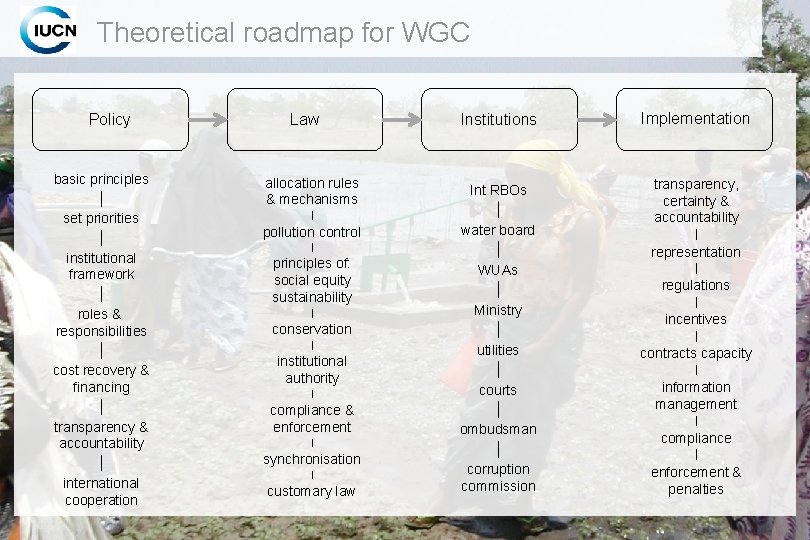
Theoretical roadmap for WGC Policy basic principles set priorities institutional framework roles & responsibilities cost recovery & financing transparency & accountability Institutions Implementation allocation rules & mechanisms Int RBOs pollution control water board transparency, certainty & accountability Law principles of: social equity sustainability representation WUAs regulations Ministry conservation institutional authority compliance & enforcement synchronisation international customary law cooperation UNION FOR CONSERVATION OF NATURE INTERNATIONAL incentives utilities contracts capacity courts information management ombudsman corruption commission compliance enforcement & penalties
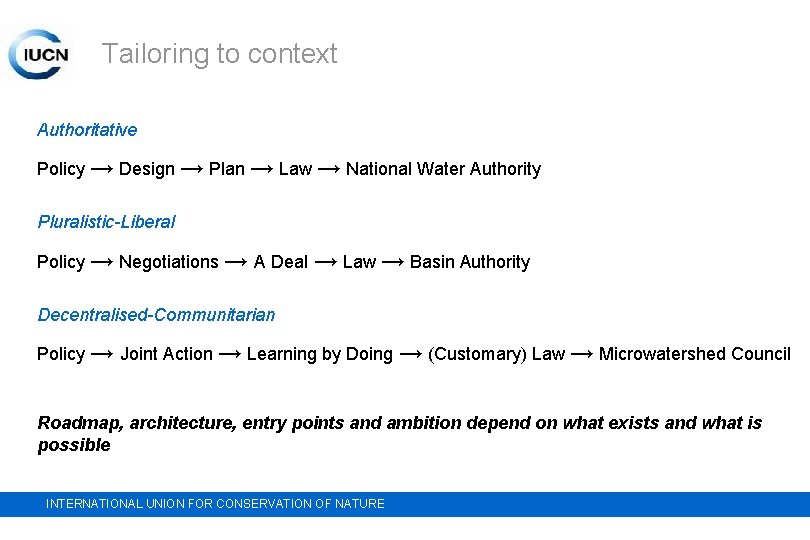
Tailoring to context Authoritative Policy → Design → Plan → Law → National Water Authority Pluralistic-Liberal Policy → Negotiations → A Deal → Law → Basin Authority Decentralised-Communitarian Policy → Joint Action → Learning by Doing → (Customary) Law → Microwatershed Council Roadmap, architecture, entry points and ambition depend on what exists and what is possible INTERNATIONAL UNION FOR CONSERVATION OF NATURE
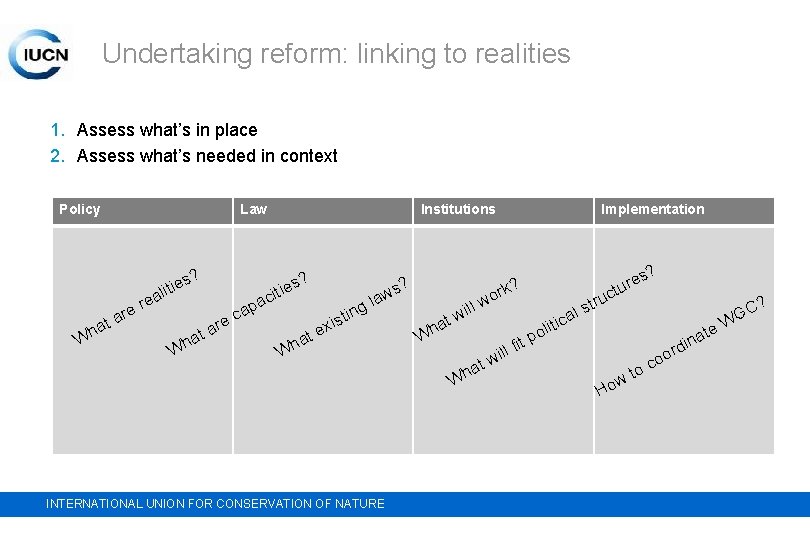
Undertaking reform: linking to realities 1. Assess what’s in place 2. Assess what’s needed in context Policy Law s litie t a Wh ? ? ies ea r e ar re ta ha W Institutions cit a p ca t a Wh lw wil p t i f l es tur uc r l st tica oli il w at Wh INTERNATIONAL UNION FOR CONSERVATION OF NATURE ? ? ork aw i x te a Wh l g n sti s? Implementation w Ho ? or t o oc te a din C G W
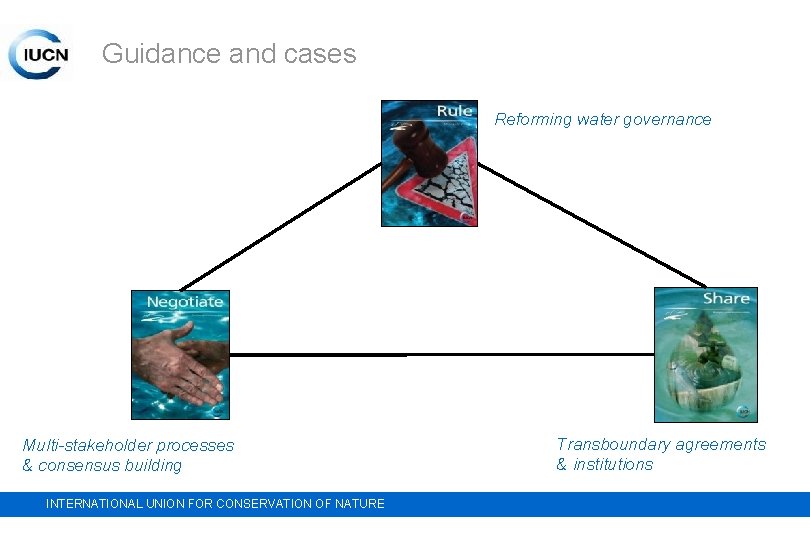
Guidance and cases Reforming water governance Multi-stakeholder processes & consensus building INTERNATIONAL UNION FOR CONSERVATION OF NATURE Transboundary agreements & institutions
Session plan 1. Welcome & objectives 2. RULE Case: Pangani basin, Tanzania 3. NEGOTIATE Case: national dialogues, Mekong basin 4. SHARE Case: eg. Tigris-Euphrates 5. Breakout groups: key questions (30 mins) 6. Feedback & synthesis INTERNATIONAL UNION FOR CONSERVATION OF NATURE
- Slides: 12