
Reformers of the Progressive Era California Connections US

- Slides: 18
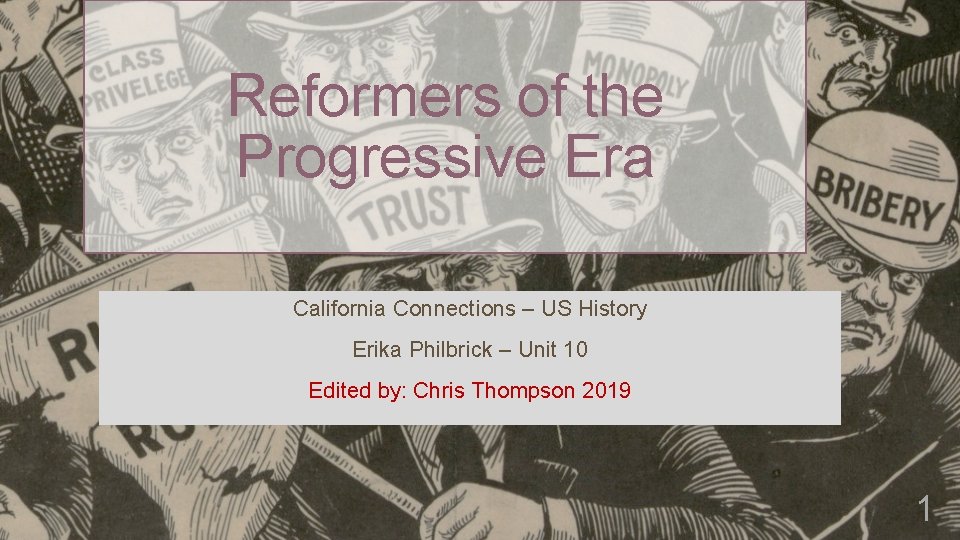
Reformers of the Progressive Era California Connections – US History Erika Philbrick – Unit 10 Edited by: Chris Thompson 2019 1
What is in your food? Imagine a time before the FDA existed. If these are our standards today, what do you think was in our food previously? 2
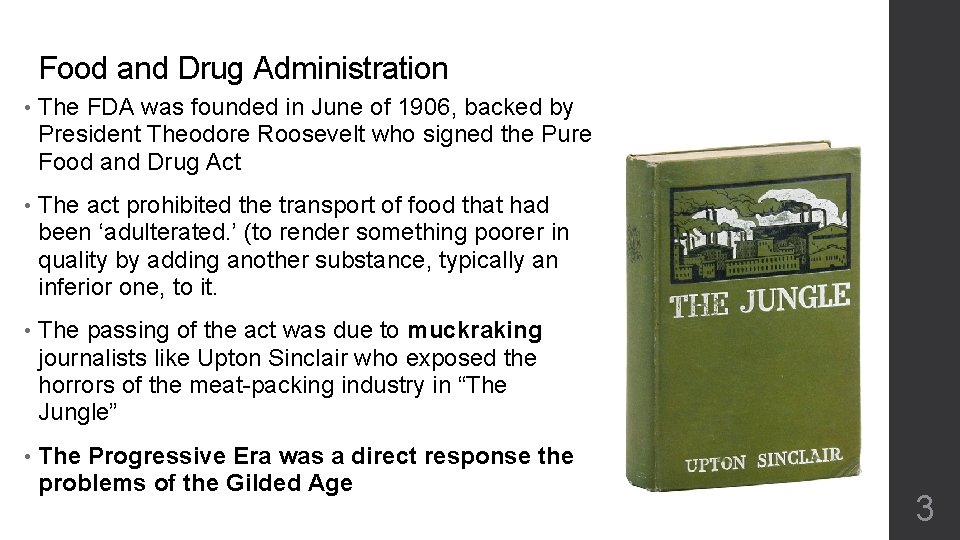
Food and Drug Administration • The FDA was founded in June of 1906, backed by President Theodore Roosevelt who signed the Pure Food and Drug Act • The act prohibited the transport of food that had been ‘adulterated. ’ (to render something poorer in quality by adding another substance, typically an inferior one, to it. • The passing of the act was due to muckraking journalists like Upton Sinclair who exposed the horrors of the meat-packing industry in “The Jungle” • The Progressive Era was a direct response the problems of the Gilded Age 3
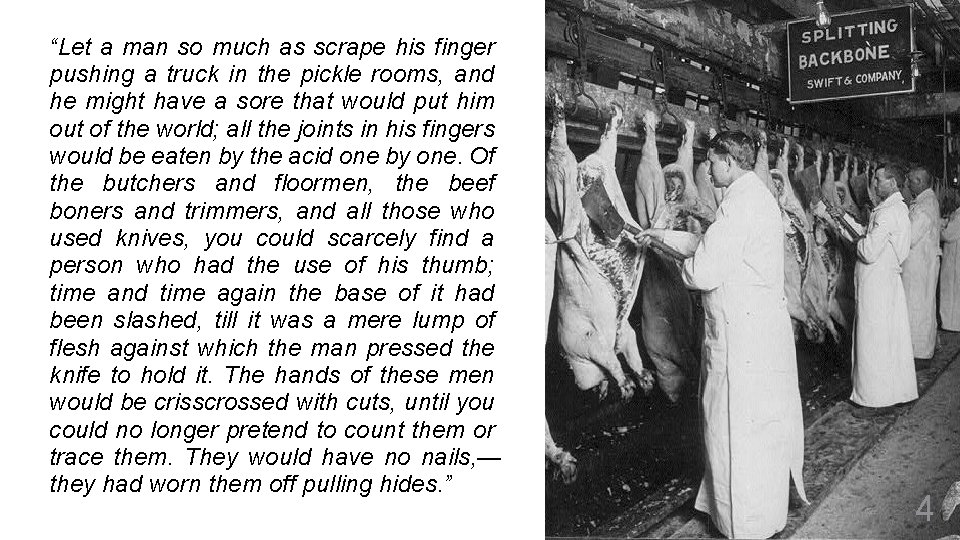
“Let a man so much as scrape his finger pushing a truck in the pickle rooms, and he might have a sore that would put him out of the world; all the joints in his fingers would be eaten by the acid one by one. Of the butchers and floormen, the beef boners and trimmers, and all those who used knives, you could scarcely find a person who had the use of his thumb; time and time again the base of it had been slashed, till it was a mere lump of flesh against which the man pressed the knife to hold it. The hands of these men would be crisscrossed with cuts, until you could no longer pretend to count them or trace them. They would have no nails, — they had worn them off pulling hides. ” 4
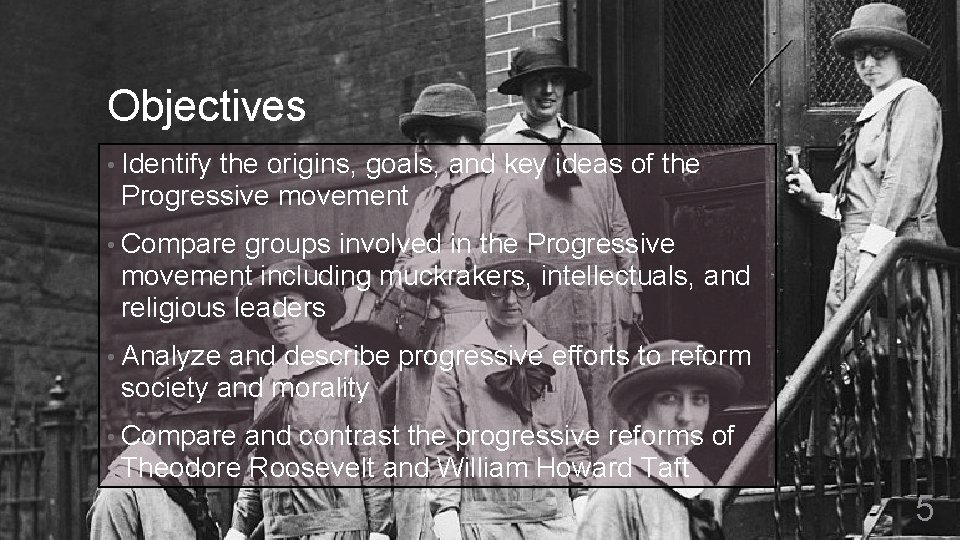
Objectives • Identify the origins, goals, and key ideas of the Progressive movement • Compare groups involved in the Progressive movement including muckrakers, intellectuals, and religious leaders • Analyze and describe progressive efforts to reform society and morality • Compare and contrast the progressive reforms of Theodore Roosevelt and William Howard Taft 5
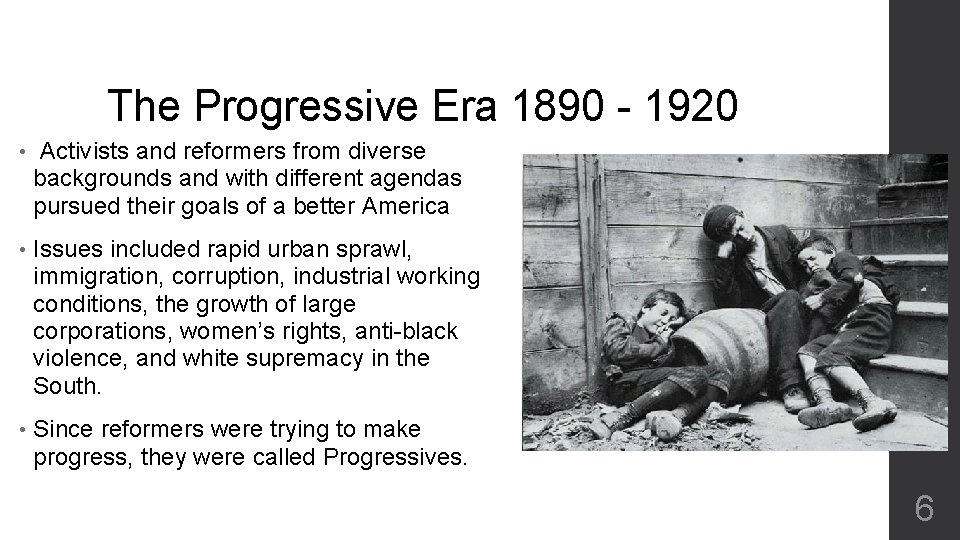
The Progressive Era 1890 - 1920 • Activists and reformers from diverse backgrounds and with different agendas pursued their goals of a better America • Issues included rapid urban sprawl, immigration, corruption, industrial working conditions, the growth of large corporations, women’s rights, anti-black violence, and white supremacy in the South. • Since reformers were trying to make progress, they were called Progressives. 6
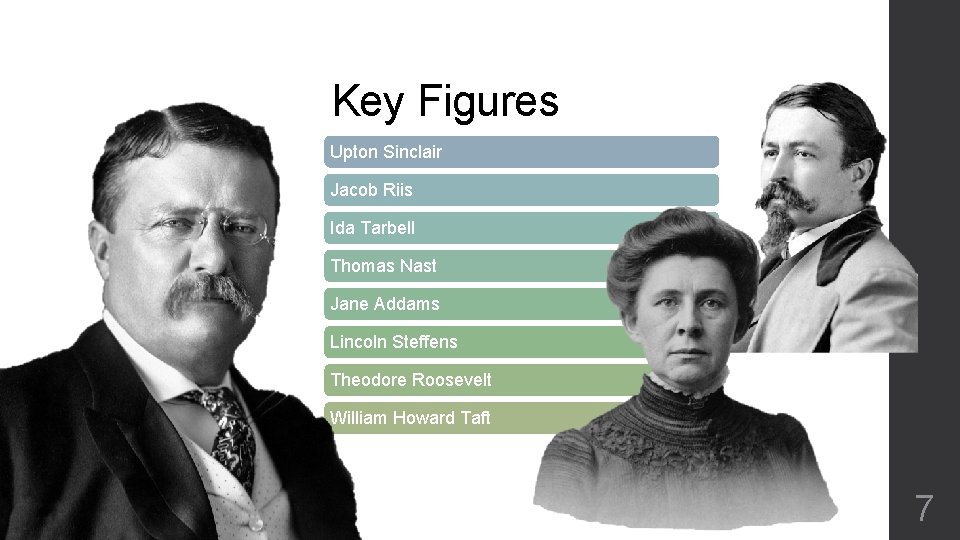
Key Figures Upton Sinclair Jacob Riis Ida Tarbell Thomas Nast Jane Addams Lincoln Steffens Theodore Roosevelt William Howard Taft 7
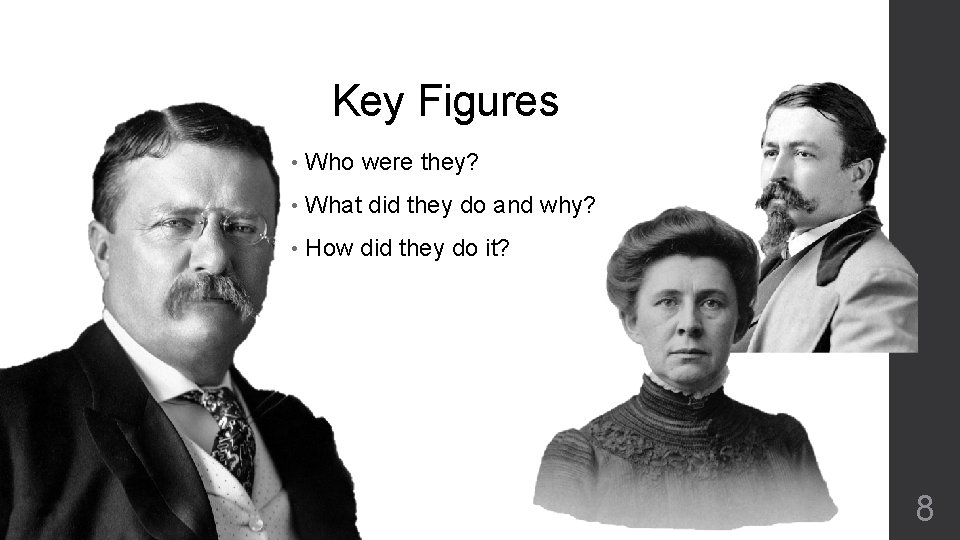
Key Figures • Who were they? • What did they do and why? • How did they do it? 8
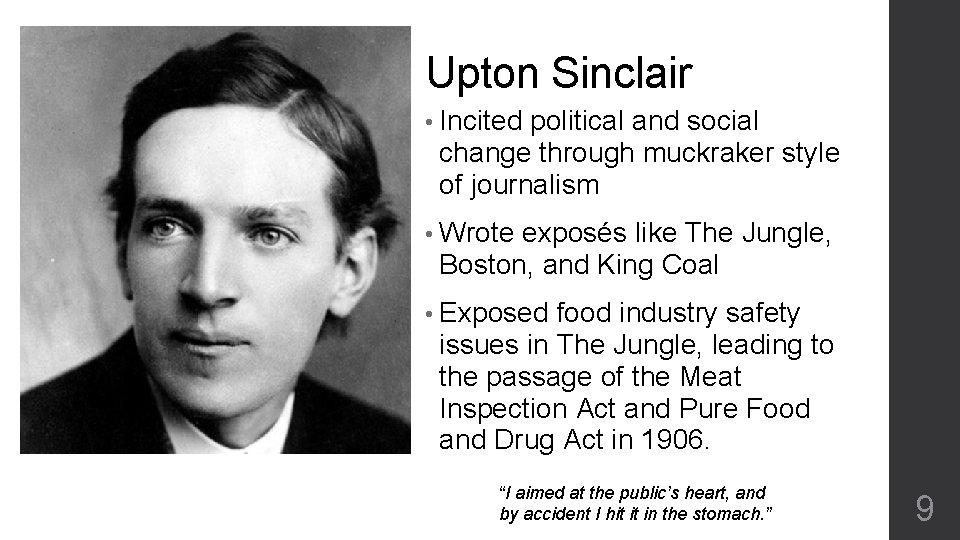
Upton Sinclair • Incited political and social change through muckraker style of journalism • Wrote exposés like The Jungle, Boston, and King Coal • Exposed food industry safety issues in The Jungle, leading to the passage of the Meat Inspection Act and Pure Food and Drug Act in 1906. “I aimed at the public’s heart, and by accident I hit it in the stomach. ” 9
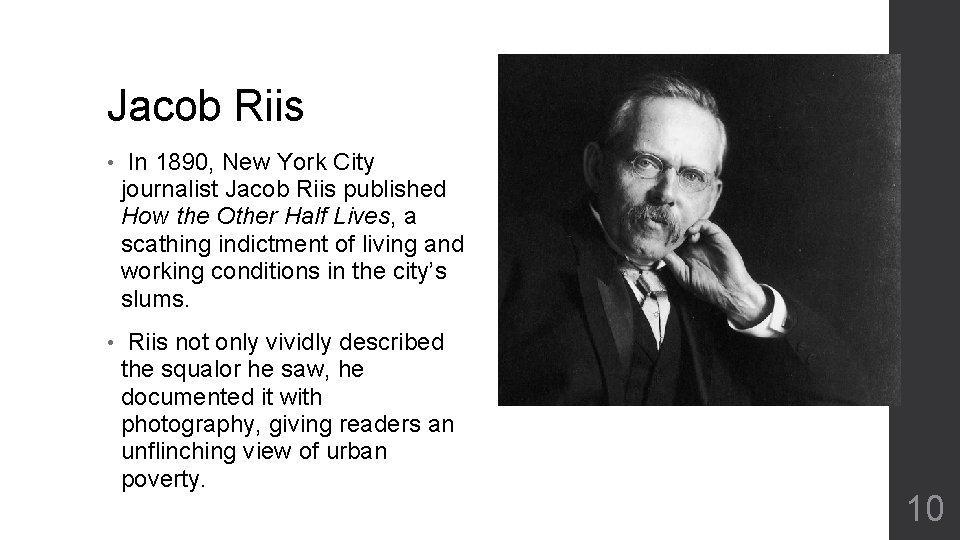
Jacob Riis • In 1890, New York City journalist Jacob Riis published How the Other Half Lives, a scathing indictment of living and working conditions in the city’s slums. • Riis not only vividly described the squalor he saw, he documented it with photography, giving readers an unflinching view of urban poverty. 10
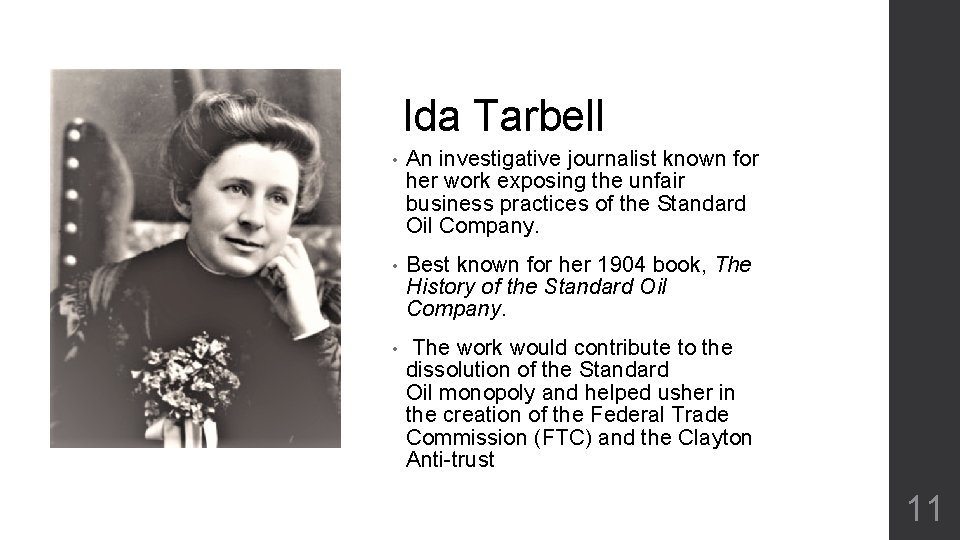
Ida Tarbell • An investigative journalist known for her work exposing the unfair business practices of the Standard Oil Company. • Best known for her 1904 book, The History of the Standard Oil Company. • The work would contribute to the dissolution of the Standard Oil monopoly and helped usher in the creation of the Federal Trade Commission (FTC) and the Clayton Anti-trust 11
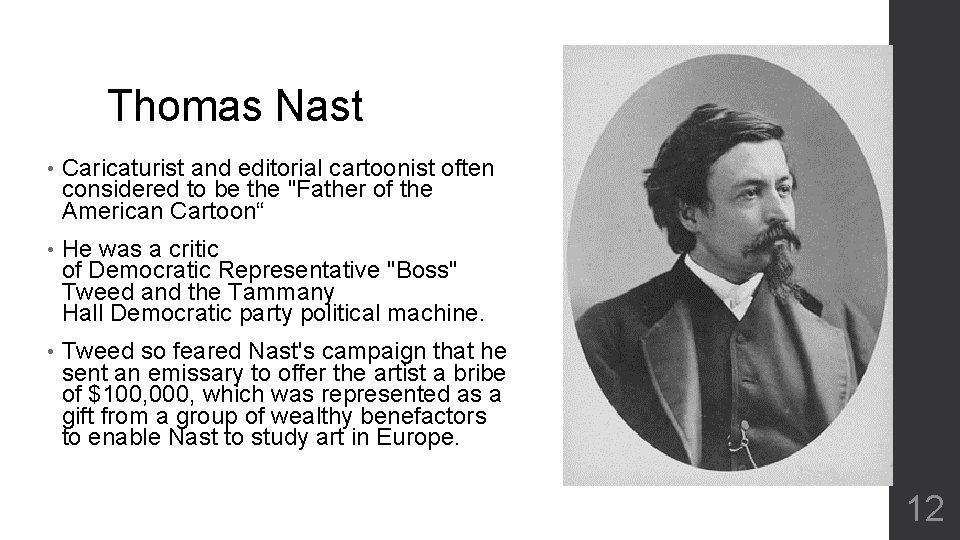
Thomas Nast • Caricaturist and editorial cartoonist often considered to be the "Father of the American Cartoon“ • He was a critic of Democratic Representative "Boss" Tweed and the Tammany Hall Democratic party political machine. • Tweed so feared Nast's campaign that he sent an emissary to offer the artist a bribe of $100, 000, which was represented as a gift from a group of wealthy benefactors to enable Nast to study art in Europe. 12
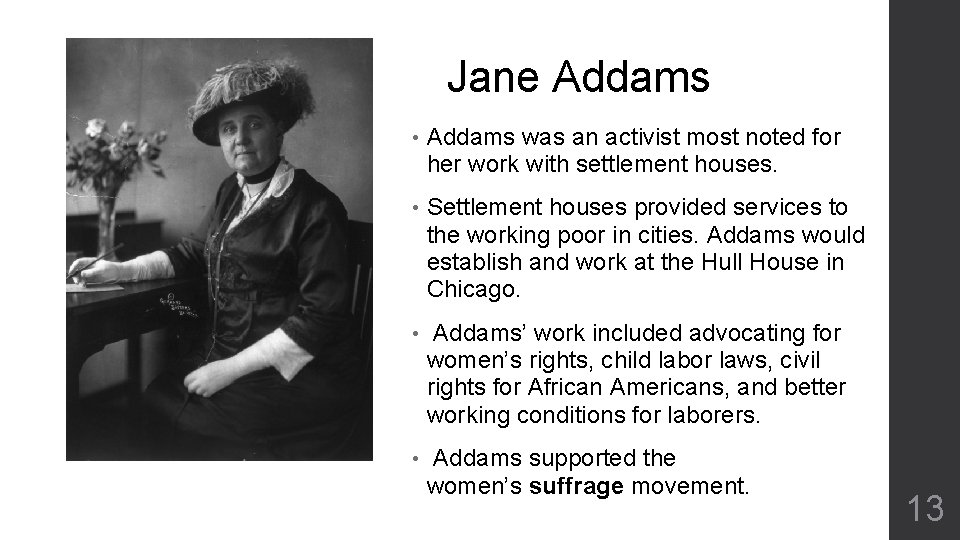
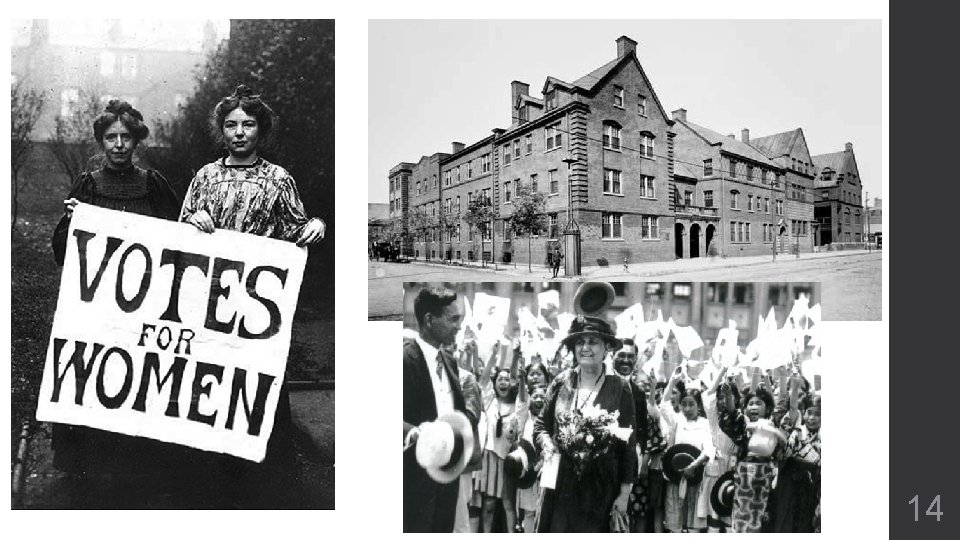
Jane Addams • Addams was an activist most noted for her work with settlement houses. • Settlement houses provided services to the working poor in cities. Addams would establish and work at the Hull House in Chicago. • Addams’ work included advocating for women’s rights, child labor laws, civil rights for African Americans, and better working conditions for laborers. • Addams supported the women’s suffrage movement. 13
14
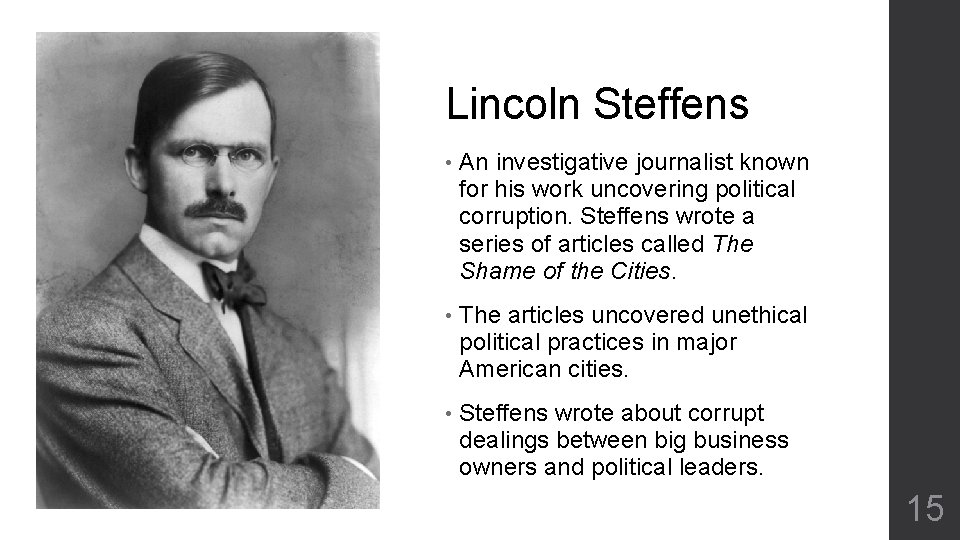
Lincoln Steffens • An investigative journalist known for his work uncovering political corruption. Steffens wrote a series of articles called The Shame of the Cities. • The articles uncovered unethical political practices in major American cities. • Steffens wrote about corrupt dealings between big business owners and political leaders. 15
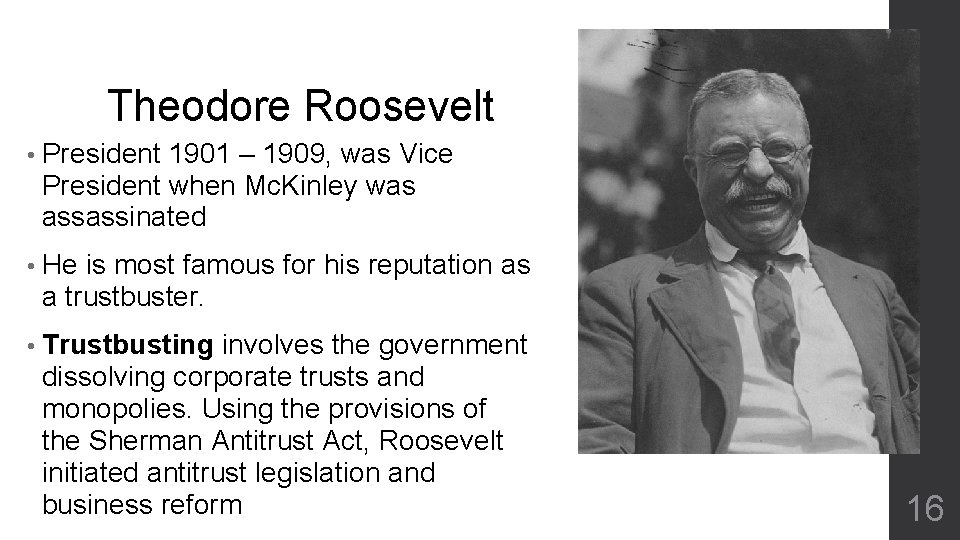
Theodore Roosevelt • President 1901 – 1909, was Vice President when Mc. Kinley was assassinated • He is most famous for his reputation as a trustbuster. • Trustbusting involves the government dissolving corporate trusts and monopolies. Using the provisions of the Sherman Antitrust Act, Roosevelt initiated antitrust legislation and business reform 16
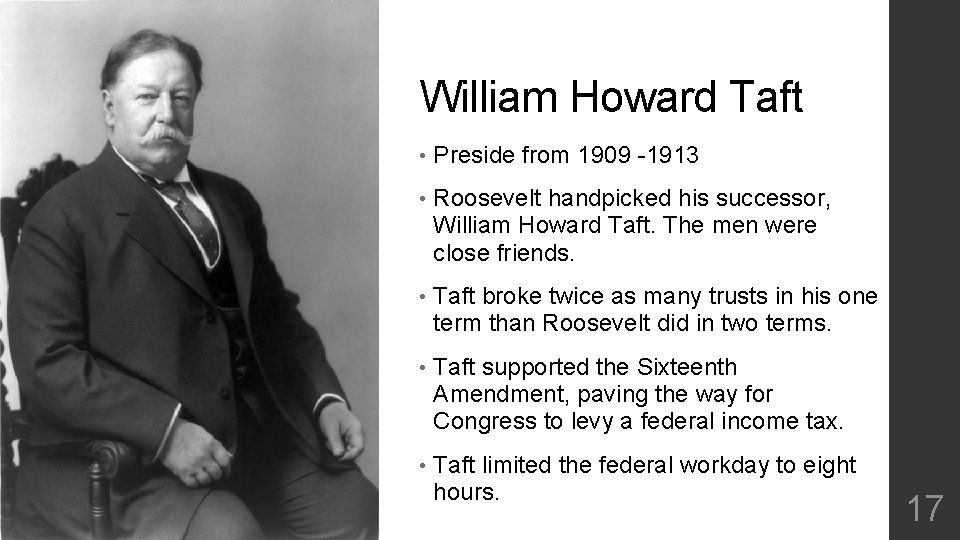
William Howard Taft • Preside from 1909 -1913 • Roosevelt handpicked his successor, William Howard Taft. The men were close friends. • Taft broke twice as many trusts in his one term than Roosevelt did in two terms. • Taft supported the Sixteenth Amendment, paving the way for Congress to levy a federal income tax. • Taft limited the federal workday to eight hours. 17
The Legacy of the Progressive Era • The Progressive Era was a time to push America forward. Reformers were no longer content with a limited government that did not regulate business or protect citizens. • The Progressive Party, also known as the Bull Moose party, was formed by Theodore Roosevelt’s statement that he was as fit as a “bull moose” led to the party’s spirited nickname. The party followed a progressive platform focused on reform in several areas: trustbusting child labor laws women’s suffrage workers’ compensation social welfare assistance “A great democracy has got to be progressive, or it soon will cease to be either great or a democracy. . . ” —Theodore Roosevelt 18