
REFORMERS IN THE WHITE HOUSE Roosevelt Changes the


- Slides: 26
REFORMERS IN THE WHITE HOUSE
Roosevelt Changes the Relationship between Government and Business ■ In the late 1800 s, the United States had several weak and ineffective Presidents. The arrival of Theodore Roosevelt, a charismatic figure who embraced Progressive ideals, ushered in a new era. ■ Rooseveltpushed formany Progressive reforms and expanded the powers of the presidency. He changed the way Americans viewed the roles of the President and the government. ■ In 1901, when Theodore Roosevelt became President of the United States, he was only 43 years old. – He gained the reputation for being smart, energetic, and opinionated.
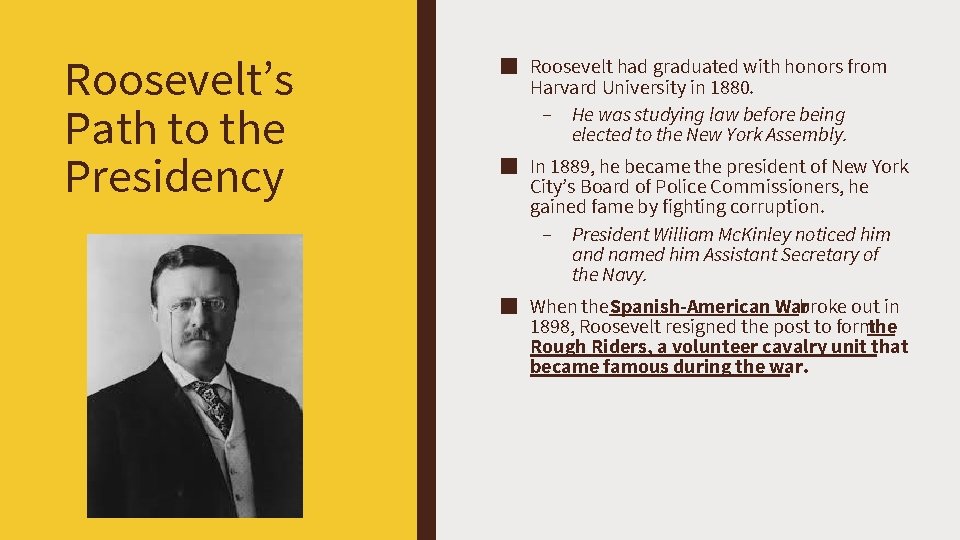
Roosevelt’s Path to the Presidency ■ Roosevelt had graduated with honors from Harvard University in 1880. – He was studying law before being elected to the New York Assembly. ■ In 1889, he became the president of New York City’s Board of Police Commissioners, he gained fame by fighting corruption. – President William Mc. Kinley noticed him and named him Assistant Secretary of the Navy. ■ When the Spanish-American War broke out in 1898, Roosevelt resigned the post to formthe Rough Riders, a volunteer cavalry unit that became famous during the war.
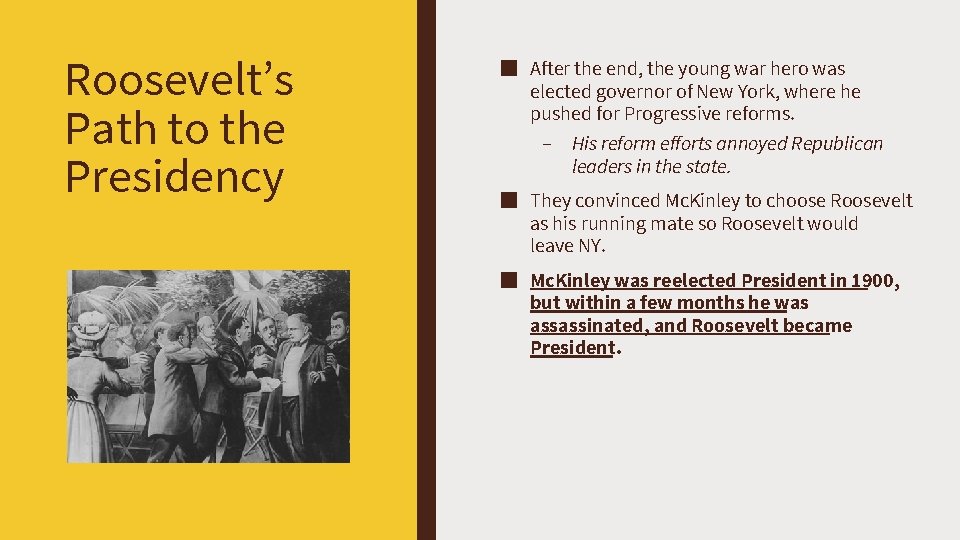
Roosevelt’s Path to the Presidency ■ After the end, the young war hero was elected governor of New York, where he pushed for Progressive reforms. – His reform efforts annoyed Republican leaders in the state. ■ They convinced Mc. Kinley to choose Roosevelt as his running mate so Roosevelt would leave NY. ■ Mc. Kinley was reelected President in 1900, but within a few months he was assassinated, and Roosevelt became President.
Roosevelt’s Path to the Presidency ■ Progressive reformers were pleased to see the benefitsof the ICC spreading , namely that the powerful railroads were finally under control. – This pleased farmers as well, who had long sought those regulations. ■ He called his programthe Square Deal. Its goals were to keep the wealthy and powerful from taking advantage of small business owners and the poor. ■ His ideas of fair governmentdid not mean that everyone would get rich or that the government should take care of the lazy.
Intervening Between Owners and Workers ■ Roosevelt often stepped into labor disputes with the authority and power of the federal government. ■ Ex: 1902 - Pennsylvania coal miners went on strike. The miners wanted a pay raise and a shorter workday. He sympathized with the overworked miners, but he knew that a steady supply of coal was needed to keep factories running and homes warm. He wanted the strike ended quickly. – First, he tried to get mine owners to listen to the workers’ concerns; that failed. – He threatened to send federal troops to take control of the mines and run them with federal employees; that worked.
The ICC Takes on the Railroads ■ In 1887, Congress had created the. Interstate Commerce Commission (ICC) to oversee rail charges for shipments that passed through more than one state. – In response to the large charges the RR companies would charge farmers. ■ The ICC was supposed tomake sure that all shippers were charged the same amounts. ■ In 1906, Roosevelt got Congress topass the Hepburn Act, which gave the ICC even greater powers. – It allowed ICC for the first time to set maximum shipping rates. – Set maximum rates for ferries, toll bridges, and oil pipelines. – Gave the ICC the legal force of a court order.
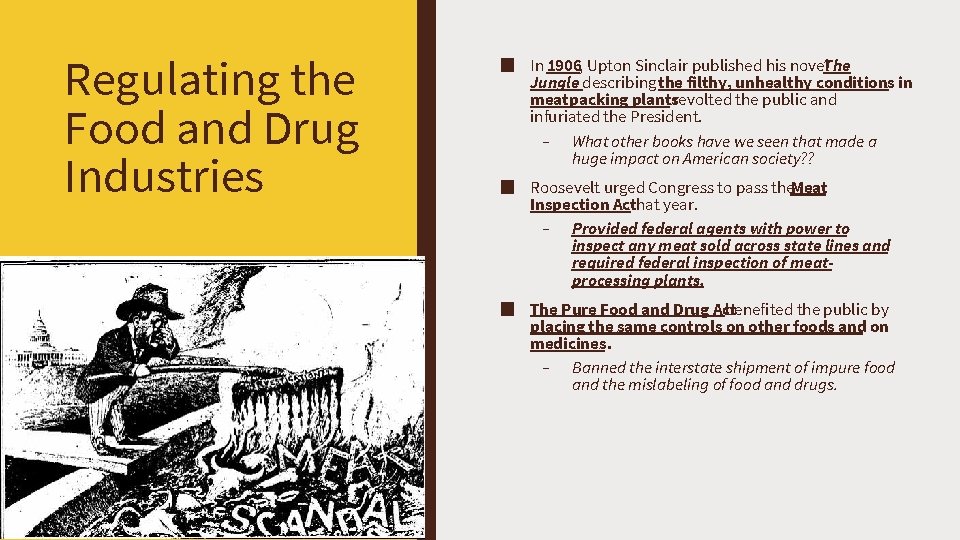
Regulating the Food and Drug Industries ■ In 1906, Upton Sinclair published his novel. The Jungle describing the filthy, unhealthy conditions in meatpacking plantsrevolted the public and infuriated the President. – What other books have we seen that made a huge impact on American society? ? ■ Roosevelt urged Congress to pass the. Meat Inspection Actthat year. – Provided federal agents with power to inspect any meat sold across state lines and required federal inspection of meatprocessing plants. ■ The Pure Food and Drug Act benefited the public by placing the same controls on other foods and on medicines. – Banned the interstate shipment of impure food and the mislabeling of food and drugs.
Managing the Environment ■ Roosevelt’s deep reverence for nature also shaped his policies. The books he published on hunting and the rugged West reflected his fascination with the competition between humans and the wilderness. ■ He was pleased that the federal government had established. Yellowstone National Park in 1872 to protect wildlife , and he admired California naturalist. John Muir, whose efforts had led Congress tocreate Yosemite National Park in 1890.
Conservation or Preservation? ■ In 1891, Congress had given the President the power to protect timberlands by setting aside land as federal forests. ■ Following Muir’s advice, Roosevelt closed off more than 100 million acres of forestland. – Unlike Muir, Roosevelt wanted to conserve and use the forests valuable resources. ■ Roosevelt drew on the “rational use” ideas of. Gifford Pinchot, who led the Division of Forestry in the U. S. Department of Agriculture. – He recommended that forests be persevered for public use. Meaning that trees should have time to fully mature and then be logged for wood. ■ Roosevelt worked with Congress to establish five national parks and established 18 national monuments or historical landmarks underthe Antiquities Act of 1906.
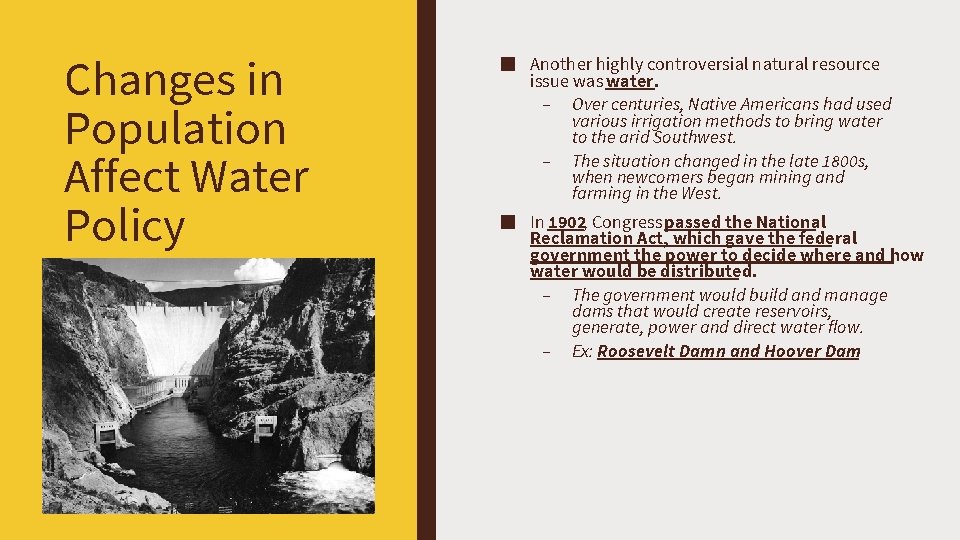
Changes in Population Affect Water Policy ■ Another highly controversial natural resource issue was water. – Over centuries, Native Americans had used various irrigation methods to bring water to the arid Southwest. – The situation changed in the late 1800 s, when newcomers began mining and farming in the West. ■ In 1902, Congress passed the National Reclamation Act, which gave the federal government the power to decide where and how water would be distributed. – The government would build and manage dams that would create reservoirs, generate, power and direct water flow. – Ex: Roosevelt Damn and Hoover Dam
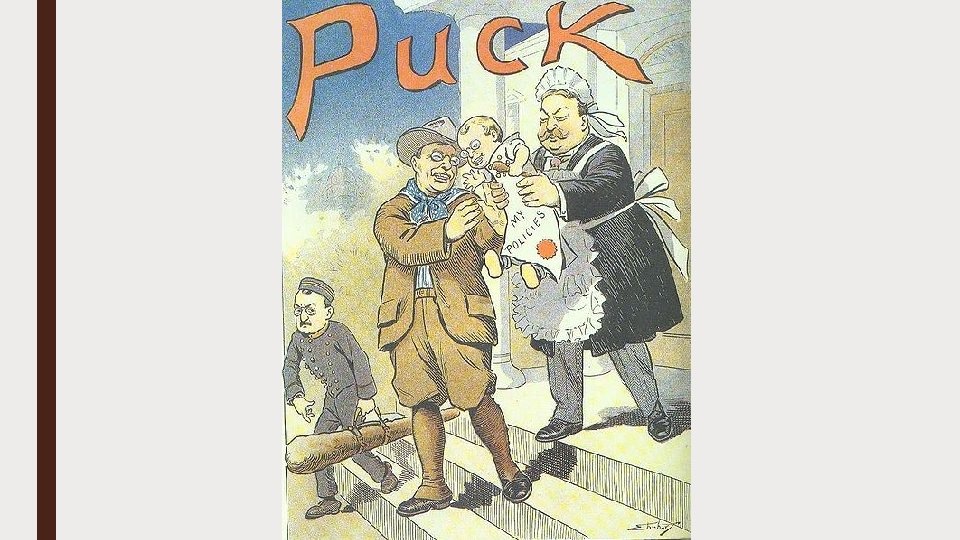
A New Direction in Presidential Politics ■ Roosevelt left the presidency after two terms in office , saying he wished to enjoy private life. ■ He was still a powerful force in the Republican Party, however, and he used that power to help his Secretary of War. William Howard Taft win the presidency in 1908. ■ Roosevelt expected Taft tocontinue his programs of managing business and natural resources. ■ Policies cartoonists made caricatures of Roosevelt handing over what he called “my policies” to Taft, who seemed to have no ideas of his own.
POLITICAL CARTOON ACTIVITY
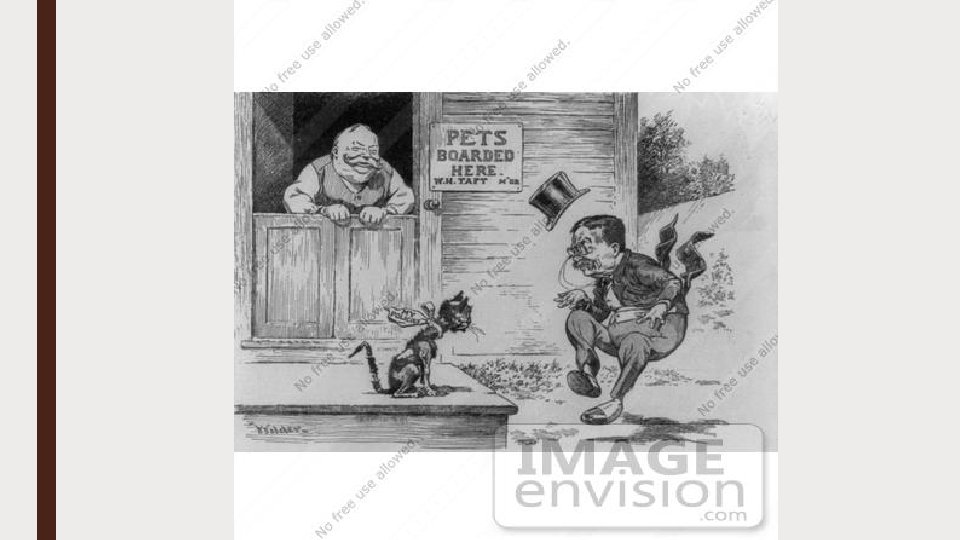
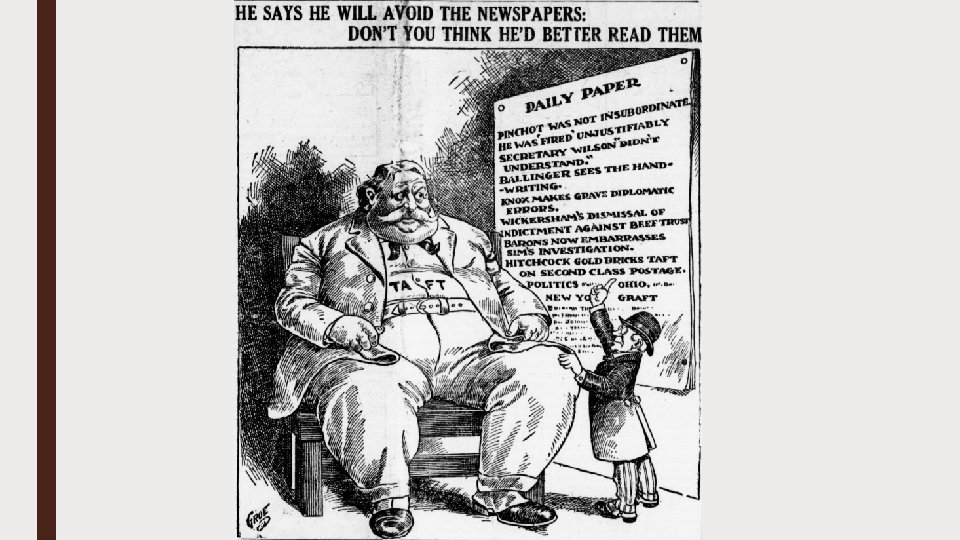
- GET INTO GROUPS OF 4 - TAKE OUT A PIECE OF PAPER TO TURN INTO, SEPARATELY! - IN YOUR GROUPS, ANSWER THESE QUESTIONS: - WHAT IS THIS IMAGE TRYING TO TELL THE VIEWER? - HOW DO YOU THINK IT REFLECTED ON THE TWO PRESIDENTS?
Taft’s Agenda Differs ■ Taft soon set his own agenda though. ■ He approved many tariffs and acts that Roosevelt never wanted to approve. ■ He dropped Roosevelt's distinction between good trusts and bad trusts. ■ Taft’s Justice Department broughtlawsuits against twice as many corporations as Roosevelt’s had done. – One result being in 1911, the Supreme Court “busted” the trust built by the Standard Oil Company. ■ Taft further infuriated Roosevelt and other Progressives in the Republican Party when he fired Gifford Pinchot.
Roosevelt’s Response ■ Roosevelt began traveling the country speaking about what he calledthe New Nationalism – A program to restore the government’s trustbusting power. ■ He vowed to tackle the trusts in a third presidential term. ■ The Taft-Rooseveltbattle split the Republican Partyas an election neared. ■ Progressives bolted from the Republican party and set up the. Progressive Party.
Wilson Takes Advantage of Republican Discord ■ The split created an opportunity for the Democratsand their candidate, Woodrow Wilson, to win the White House. ■ Wilson’s ideas had caught the attention of William Jennings Bryan, who helped Wilson win the Democratic nomination. ■ Wilson shaped his ideas into a program he called the New Freedom. – Looked like New Nationalism – Place strict government controls on corporations – Provide more opportunities and freedoms for small businesses ■ He did not win the majority of the popular vote, Wilson received more than four times the number of Electoral College votes that went to Roosevelt or to Taft.
Wilson Endorses Further Regulation ■ Republicans Theodore Roosevelt and William Howard Taft introduced the country to forceful Progressive Presidents. ■ Democrat Woodrow Wilson used the expanded power of the presidency to promote a far -reaching reform agenda. Some of Wilson’s economic and antitrust measures are still important in American life today. ■ President Wilson attacked what he calledthe “triple wall of privilege”- the tariffs, the banks, and the trusts - that blocked businesses from being free. Early in his first term, he pushed for new laws that would bring down those three walls and give the government more control over the economy.
A New Tax on Income ■ Wilson aimed to preventbig manufacturersfrom possibly charging unfairly high process to their customers. – Lower the tariffs on goods imported from foreign countries so consumers could buy foreign goods if American companies’ prices were too high ■ Tariffs had been one of the main sources of revenue, or money coming in, for the federal government. ■ To make up for the loss of tariffrevenue the Underwood Tariff Act of 1913 would cut tariffs and create a graduated income tax. ■ The recentlypassed Sixteenth Amendment gave Congress the power to collect an income tax without restrictions. – A graduated income tax means that wealthy people pay a higher percentage of their income than do poor people.
Regulation of Commercial Banks ■ Wilson triedto change the banking system. ■ At the time, the countryhad no central authority to supervise banks and establish monetary policy – Control of the supply of money in circulation at any given time – Helps to influence and control interest rates with the goal of promoting economic growth and stability and controlling inflation and deflation ■ A bank might not have full access to its reserves when customers needed to withdraw or borrow money.
Regulation of Commercial Banks ■ Wilson pushed Congress to pass the. Federal Reserve Act of 1913. – Placed commercials banks under the control of a Federal Reserve Board, which set up regional banks to hold the reserve funds from those commercial banks – Helps protect the American economy from having too much money end up in the hands of one person, bank, region – Sets the interest rate thank banks pay to borrow money from other banks, and its supervises banks to make sure they are well run
Wilson and Congress Strengthen Antitrust Regulation ■ In 1914, Wilson persuaded Congress to create the Federal Trade Commission (FTC). – Members were named by the President to monitor business practices that might lead to monopoly – Charged with watching out for false advertising or dishonest labeling ■ Congress also passed the Clayton Antitrust Act (1914) – Strengthened earlier antitrust laws by spelling out those activities in which businesses could not engage
EXIT TICKET: WHAT IS THE LEGACY OF THE PROGRESSIVE POLITICAL REFORM MOVEMENTS? MINIMUM 4 SENTENCE