
Reformation Theology compared with Reformed Theology What is
- Slides: 26
Reformation Theology compared with “Reformed” Theology What is and isn’t Biblical by Scott Mitchell, Asst. Pastor Calvary Chapel of Boston
Outline: n I. 5 Solas of the Reformation n II. 5 Points of Calvinism (soteriological) n III. Predestination according to Calvinism n IV. Biblical Points of Calvary Chapel n V. Final Points of Comparison n VI. Correcting Misunderstandings
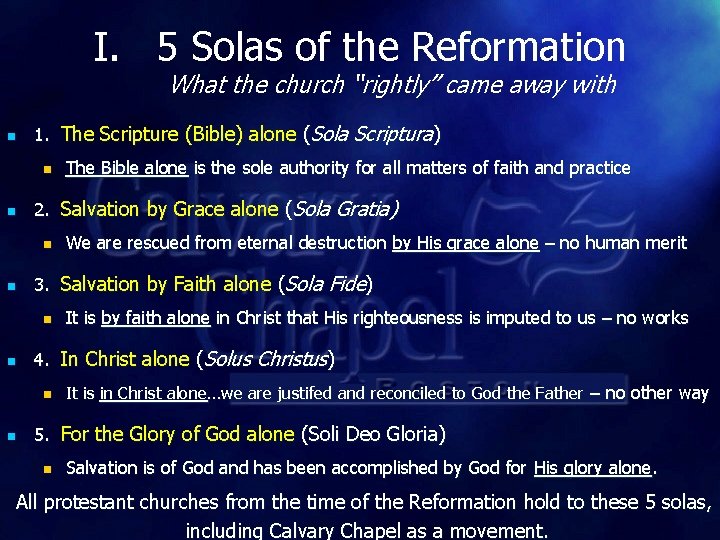
I. 5 Solas of the Reformation What the church “rightly” came away with n 1. The Scripture (Bible) alone (Sola Scriptura) n n 2. Salvation by Grace alone (Sola Gratia) n n It is by faith alone in Christ that His righteousness is imputed to us – no works 4. In Christ alone (Solus Christus) n n We are rescued from eternal destruction by His grace alone – no human merit 3. Salvation by Faith alone (Sola Fide) n n The Bible alone is the sole authority for all matters of faith and practice It is in Christ alone…we are justifed and reconciled to God the Father – no other way 5. For the Glory of God alone (Soli Deo Gloria) n Salvation is of God and has been accomplished by God for His glory alone. All protestant churches from the time of the Reformation hold to these 5 solas, including Calvary Chapel as a movement.
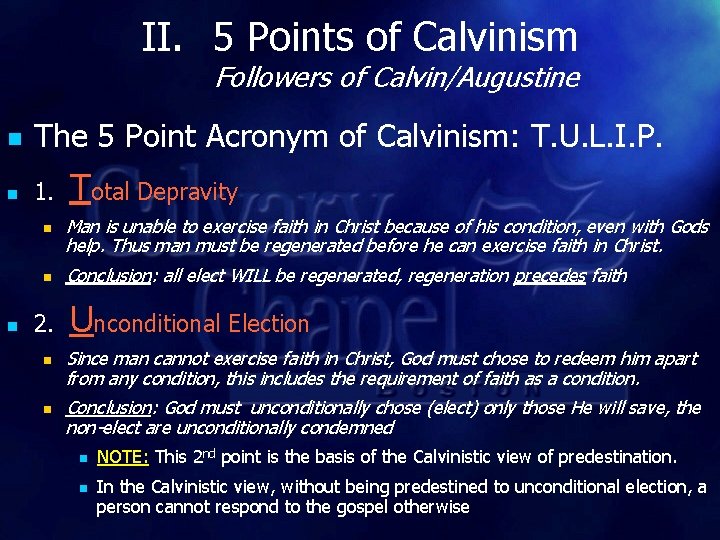
II. 5 Points of Calvinism Followers of Calvin/Augustine n The 5 Point Acronym of Calvinism: T. U. L. I. P. n 1. n n n 2. n n Total Depravity Man is unable to exercise faith in Christ because of his condition, even with Gods help. Thus man must be regenerated before he can exercise faith in Christ. Conclusion: all elect WILL be regenerated, regeneration precedes faith Unconditional Election Since man cannot exercise faith in Christ, God must chose to redeem him apart from any condition, this includes the requirement of faith as a condition. Conclusion: God must unconditionally chose (elect) only those He will save, the non-elect are unconditionally condemned n n NOTE: This 2 nd point is the basis of the Calvinistic view of predestination. In the Calvinistic view, without being predestined to unconditional election, a person cannot respond to the gospel otherwise
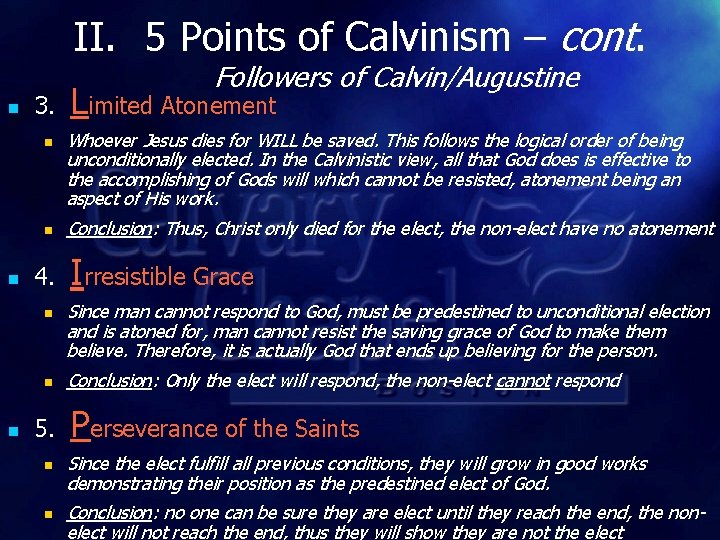
II. 5 Points of Calvinism – cont. n 3. n n n 4. n n n 5. n n Followers of Calvin/Augustine Limited Atonement Whoever Jesus dies for WILL be saved. This follows the logical order of being unconditionally elected. In the Calvinistic view, all that God does is effective to the accomplishing of Gods will which cannot be resisted, atonement being an aspect of His work. Conclusion: Thus, Christ only died for the elect, the non-elect have no atonement Irresistible Grace Since man cannot respond to God, must be predestined to unconditional election and is atoned for, man cannot resist the saving grace of God to make them believe. Therefore, it is actually God that ends up believing for the person. Conclusion: Only the elect will respond, the non-elect cannot respond Perseverance of the Saints Since the elect fulfill all previous conditions, they will grow in good works demonstrating their position as the predestined elect of God. Conclusion: no one can be sure they are elect until they reach the end, the nonelect will not reach the end, thus they will show they are not the elect
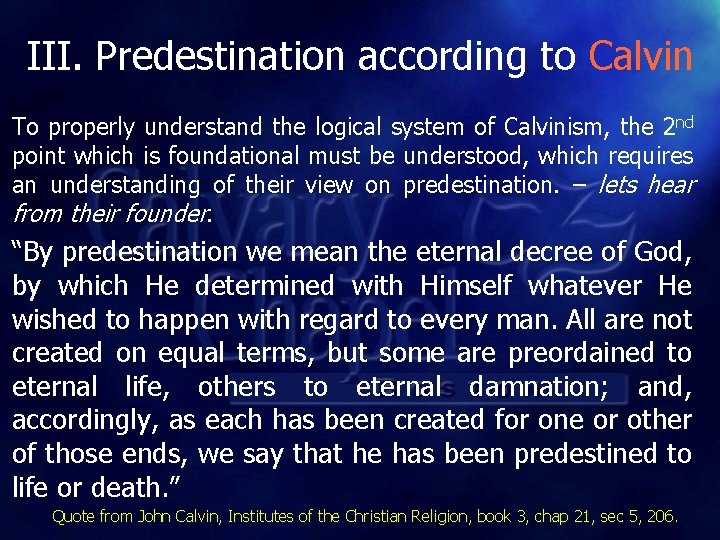
III. Predestination according to Calvin To properly understand the logical system of Calvinism, the 2 nd point which is foundational must be understood, which requires an understanding of their view on predestination. – lets hear from their founder. “By predestination we mean the eternal decree of God, by which He determined with Himself whatever He wished to happen with regard to every man. All are not created on equal terms, but some are preordained to eternal life, others to eternal damnation; and, accordingly, as each has been created for one or other of those ends, we say that he has been predestined to life or death. ” Quote from John Calvin, Institutes of the Christian Religion, book 3, chap 21, sec 5, 206.
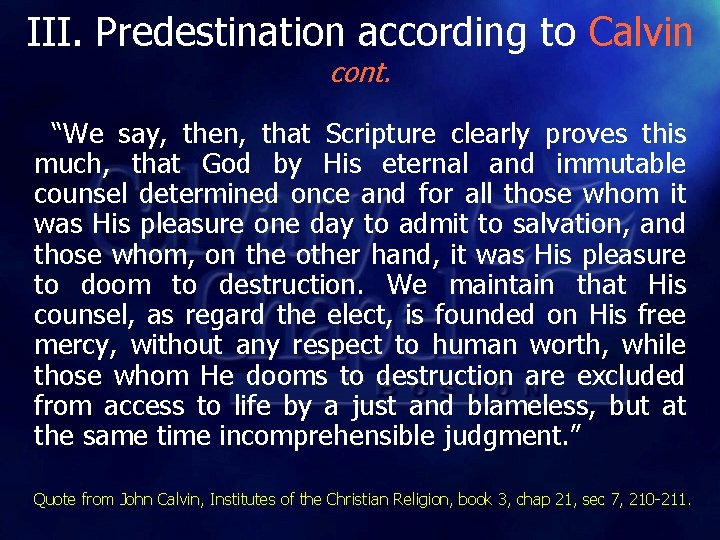
III. Predestination according to Calvin cont. “We say, then, that Scripture clearly proves this much, that God by His eternal and immutable counsel determined once and for all those whom it was His pleasure one day to admit to salvation, and those whom, on the other hand, it was His pleasure to doom to destruction. We maintain that His counsel, as regard the elect, is founded on His free mercy, without any respect to human worth, while those whom He dooms to destruction are excluded from access to life by a just and blameless, but at the same time incomprehensible judgment. ” Quote from John Calvin, Institutes of the Christian Religion, book 3, chap 21, sec 7, 210 -211.
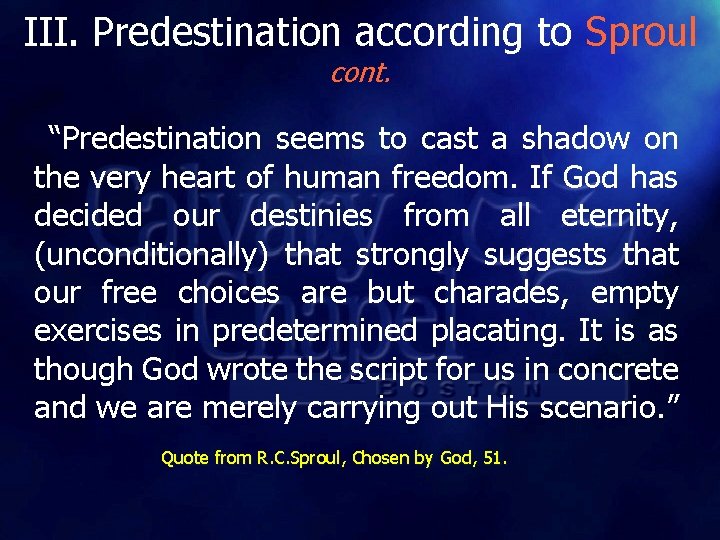
III. Predestination according to Sproul cont. “Predestination seems to cast a shadow on the very heart of human freedom. If God has decided our destinies from all eternity, (unconditionally) that strongly suggests that our free choices are but charades, empty exercises in predetermined placating. It is as though God wrote the script for us in concrete and we are merely carrying out His scenario. ” Quote from R. C. Sproul, Chosen by God, 51.
III. Predestination according to Sproul cont. “It was certainly loving of God to predestine the salvation of His people, those the Bible calls the "elect or chosen ones. " It is the nonelect that are the problem. If some people are not elected unto salvation then it would seem that God is not all that loving toward them. For them it seems that it would have been more loving of God not to have allowed them to be born. That may indeed be the case. ” Quote from R. C. Sproul, Chosen by God, 32.
III. Predestination according to Sproul cont. “Though there is strong sentiment to speak of single predestination only, and to avoid any discussion of double predestination, we must still face the questions on the table. Unless we conclude that every human being is predestined to salvation, we must face the flip side of election. If there is such a thing as predestination at all, and if that predestination does include all people, we must not shrink from the necessary inference that there are two sides to predestination. It is not enough to talk about Jacob; we must also consider Esau. ” Quote from R. C. Sproul, Chosen by God, 141.
IV. Biblical Points of Calvary Chapel I. Saving faith in Christ always and immediately results in regeneration and any and all lost sinners can believe in Christ and be born again (Jn. 1: 10 -13, 16: 8, 12: 32, 20: 30 -31; Eph. 1: 13) - Saving faith in Christ is before and results in the regeneration (born again) of the believer - God draws sinners to Jesus Christ by His Holy Spirit to make the choice by faith
IV. Biblical Points of Calvary Chapel II. God desires all men to be saved and has determined that all can and will be saved on the condition they believe (have faith) in Jesus Christ (Jn. 3: 15 -18; 1 Tim. 2: 3 -4; Acts 16: 27 -31) - Man’s depravity is not so total that the image of God is no longer there (Gen. 9: 6) - Man in his lost condition can respond to God (Gen. 3: 813, 4: 6 -12), but not without the work of the Holy Spirit (Gen 6: 3). - Therefore, all can believe so all can be saved so we preach the gospel to all!
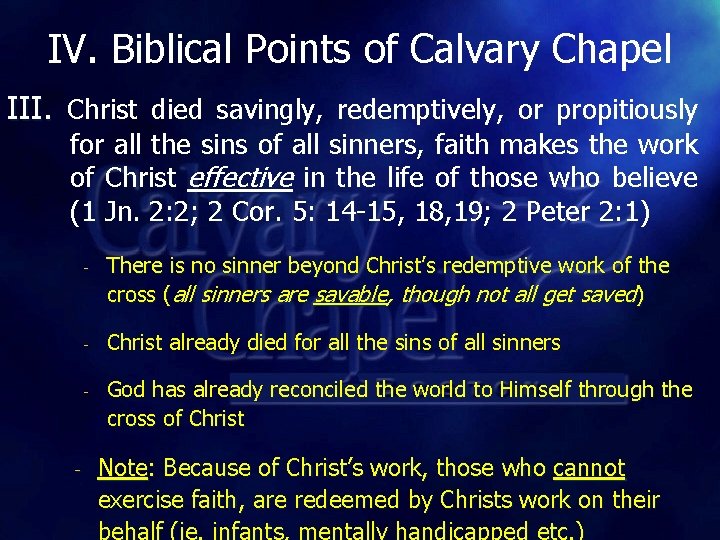
IV. Biblical Points of Calvary Chapel III. Christ died savingly, redemptively, or propitiously for all the sins of all sinners, faith makes the work of Christ effective in the life of those who believe (1 Jn. 2: 2; 2 Cor. 5: 14 -15, 18, 19; 2 Peter 2: 1) - - There is no sinner beyond Christ’s redemptive work of the cross (all sinners are savable, though not all get saved) - Christ already died for all the sins of all sinners - God has already reconciled the world to Himself through the cross of Christ Note: Because of Christ’s work, those who cannot exercise faith, are redeemed by Christs work on their behalf (ie. infants, mentally handicapped etc. )
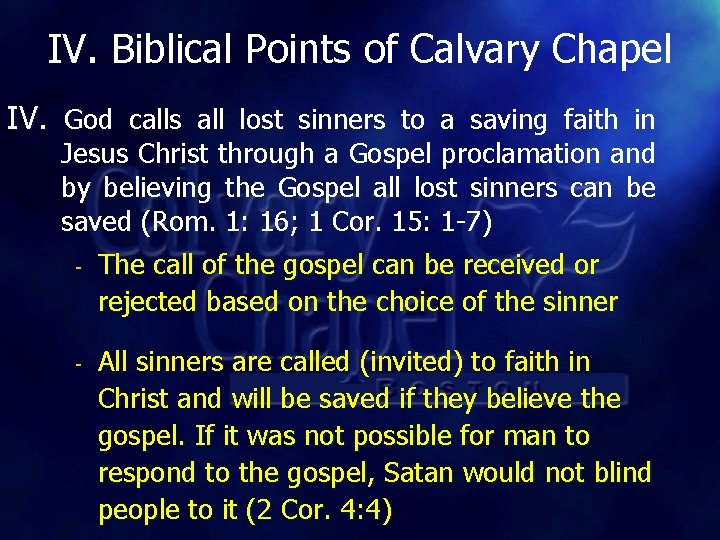
IV. Biblical Points of Calvary Chapel IV. God calls all lost sinners to a saving faith in Jesus Christ through a Gospel proclamation and by believing the Gospel all lost sinners can be saved (Rom. 1: 16; 1 Cor. 15: 1 -7) - The call of the gospel can be received or rejected based on the choice of the sinner - All sinners are called (invited) to faith in Christ and will be saved if they believe the gospel. If it was not possible for man to respond to the gospel, Satan would not blind people to it (2 Cor. 4: 4)
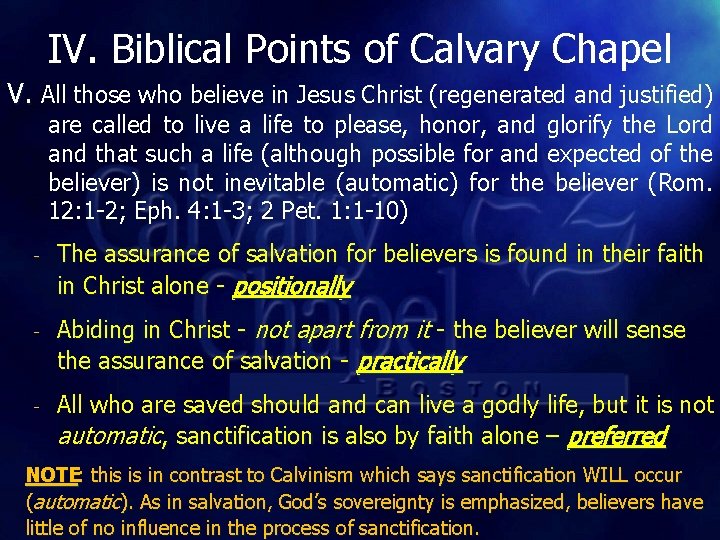
IV. Biblical Points of Calvary Chapel V. All those who believe in Jesus Christ (regenerated and justified) are called to live a life to please, honor, and glorify the Lord and that such a life (although possible for and expected of the believer) is not inevitable (automatic) for the believer (Rom. 12: 1 -2; Eph. 4: 1 -3; 2 Pet. 1: 1 -10) - - - The assurance of salvation for believers is found in their faith in Christ alone - positionally Abiding in Christ - not apart from it - the believer will sense the assurance of salvation - practically All who are saved should and can live a godly life, but it is not automatic, sanctification is also by faith alone – preferred NOTE: this is in contrast to Calvinism which says sanctification WILL occur (automatic). As in salvation, God’s sovereignty is emphasized, believers have little of no influence in the process of sanctification.
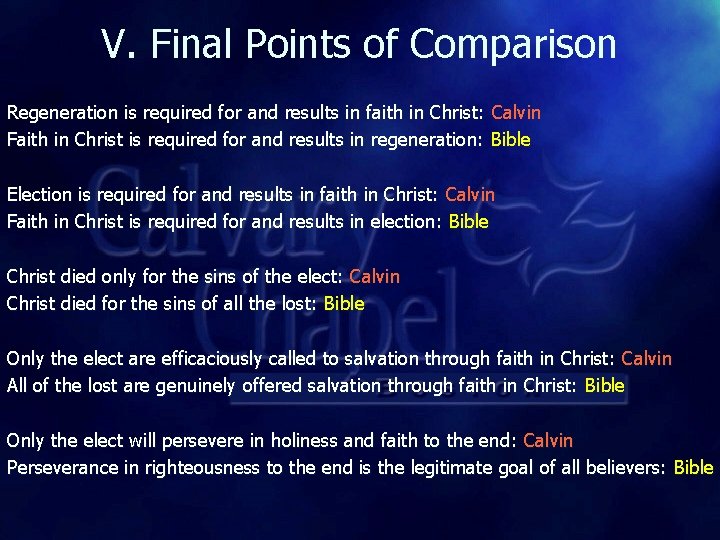
V. Final Points of Comparison Regeneration is required for and results in faith in Christ: Calvin Faith in Christ is required for and results in regeneration: Bible Election is required for and results in faith in Christ: Calvin Faith in Christ is required for and results in election: Bible Christ died only for the sins of the elect: Calvin Christ died for the sins of all the lost: Bible Only the elect are efficaciously called to salvation through faith in Christ: Calvin All of the lost are genuinely offered salvation through faith in Christ: Bible Only the elect will persevere in holiness and faith to the end: Calvin Perseverance in righteousness to the end is the legitimate goal of all believers: Bible
V. Final Points of Comparison – cont. Traditional Reformed Calvinism has many other differences in their doctrine and practice than what we believe and teach at Calvary Chapel. Though presentation only focuses on the aspect of salvation, some of the following are other particular differences: Follow a method of bible interpretation that is allegorical: Reformed Calvinism n This results in viewing the bible differently based on Calvinistic doctrines. Follow a method of bible interpretation that is literal: Bible – Calvary Chapel n This results in adjusting doctrines to what the bible literally teaches. Do not interpret prophecy literally in a consistent manner: Reformed Calvinism n This results in an Amillennial view of the future kingdom on earth. Interpret prophecy in a consistent literal manner: Bible – Calvary Chapel n This results in a Premillennial view of the future kingdom on earth.
V. Final Points of Comparison – cont. Follow the practice of infant baptism: Reformed Calvinism n This is a result of the Reformers following the Roman Catholic church practice. Follow the practice of publically dedicating children: Bible – Calvary Chapel n This is a result of examples in the bible of people dedicating their children. Believe we are currently in the prophesied Kingdom of God: Reformed Calvinism n This is a result of Replacement Theology – the church taking Israel's position. Believe the Kingdom of God will only come through Israel: Bible – Calvary Chapel n This is a result of a literal understanding of Israel's role defined by scripture. Replacement Theology: the belief that the church “replaces” the nation of Israel in NT prophecy & program. The covenant made with both Abraham (unconditional) and Moses (conditional) are allegorized and spiritualized to fit the church. This results in fostering hatred to Israel and bad bible interpretation. Replacement Theology is a Satanic evil that has no place in Christian theology.
VI. Correcting Misunderstandings n n n Not being a Calvinist, does not make a person Arminian, nor the opposite, it is a non-sequitur; but often claimed to be true n Calvinism and Arminianism are extreme systems n It is not required to fit into or adhere to one or the other system Predestination is not a word owned by Calvinists n It is used in the NT in contexts removed from Calvinist’s interpretations n “Election” would also fall under this same criteria of “context” Faith is not considered a “work” in the Bible n n Man is said to be saved by it, and he can’t be saved by works Paul “contrasts” both faith and works in his argument on justification by faith apart from works – Calvinists call faith a work if it is not faith exercised by God on behalf of the individual (ie. believes for them).
VI. Correcting Misunderstandings cont n Calvinists teach that “faith” in Eph 2: 8 is the “gift”… n But, in Eph 2: 8, the word faith is not the “gift” spoken of n n n The gift “refers not to faith or grace, but to the act of being saved by grace conditioned on faith on our part” (Robertson’s Word Pictures) The gift is “not faith, but the salvation” (Vincent’s Word Studies) The gift is “not your faith”, the gift of God is “of your salvation” (Henry Alford Greek NT) “The salvation is not an achievement but a gift, and a gift from none other than God” (Expositors Greek NT by Nicholl) The word “gift” (doron Strong's #1435) under heading number 1, “of salvation by grace as the “gift” of God” (Vine’s Expository Dictionary of NT Words)
VI. Correcting Misunderstandings n. In cont Eph 2: 8, the word faith is not the “gift” spoken of A fuller explanation: The words, "through faith" speak of the instrument or means whereby the sinner avails himself of this salvation which God offers him in pure grace… The word "that" is touto, "this, " a demonstrative pronoun in the neuter gender. The Greek word "faith" is feminine in gender and therefore touto could not refer to "faith. " It refers to the general idea of salvation in the immediate context. The translation reads, "and this not out from you as a source, of God (it is) the gift. " That is, salvation is a gift of God. It does not find its source in man. Furthermore, this salvation is not "out of a source of works. " This explains salvation by grace. It is not produced by man nor earned by him. It is a gift from God with no strings tied to it. Paul presents the same truth in Romans 4: 4, 5 when speaking of the righteousness which God imputed to Abraham, where he says: "Now, to the one who works, his wages are not looked upon as a favor but as that which is justly or legally due. But to the one who does not work but believes on the One who justifies the impious, his faith is computed for righteousness. “ (Wuest’s Word Studies in NT)
VI. Correcting Misunderstandings cont n. Even John Calvin doesn’t agree with the modern movement of Reformed theologians that attempt to make “faith” the “gift of God”. He says the following: And here we must advert to a very common error in the interpretation of this passage. Many persons restrict the word gift to faith alone. But Paul is only repeating in other words the former sentiment. His meaning is, not that faith is the gift of God, but that salvation is given to us by God, or, that we obtain it by the gift of God. . “ (John Calvin’s commentary on Ephesians 2: 9) * This is important because Calvinists today teach that God regenerates a person in order to exercise faith in Christ. IE. , God irresistibly makes them believe, in effect; providing the faith for them or believing for them to be saved.
VI. Correcting Misunderstandings cont n The Bible never has regeneration prior to faith, it always follows faith; which is the condition of salvation n Rom 4: 3 (quoted of Abraham in Gen 15: 6, foundational to all Paul's teaching on justification by faith) n Eph 2: 8 (note previous grammatical presentation, faith not the “gift”) n Gal 6: 15 (new creation after explaining faith required for justification) n n 1 Pet 1: 23 (born again by the Word of God, faith comes by hearing the Word of God, Rom 10: 17) John 3 The explanation by the Son n v 3 – “unless you are born again, you can’t see the kingdom of God” – Jesus; truth stated! V 9 – “how can these things be? ” – Nichodemus; question asked about that truth. V 15, 16, 18 – “whosoever believes” – Jesus; answer given!
VI. Correcting Misunderstandings cont n The Bible is the ONLY authoritative teaching on the “doctrines of GRACE” (replacement phrase for Calvinism by Calvinists) n It has appeared to all men (Titus 2: 11) n Man is saved by it (Eph 2: 8) n Faith is according to it (4: 16) n Man is justified by it (Rom 3: 24) n It is contrasted with works (Rom 11: 6) n It can be received in vain (2 Cor 6: 1) n Redemption and forgiveness is from it (Eph 1: 7)
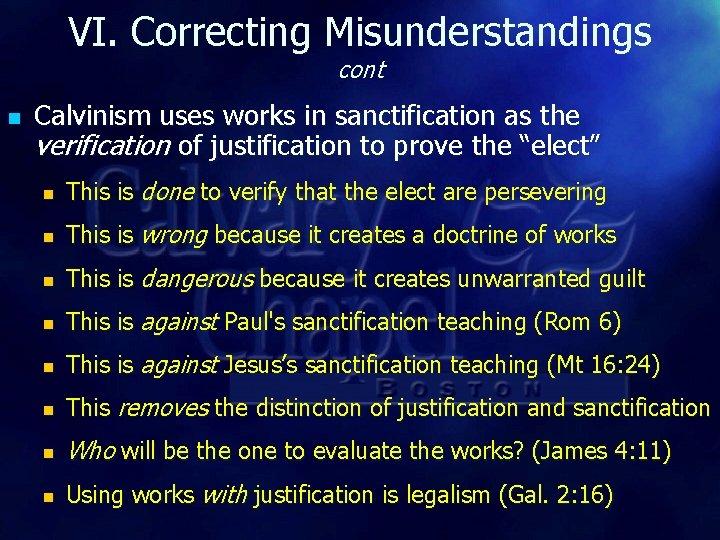
VI. Correcting Misunderstandings cont n Calvinism uses works in sanctification as the verification of justification to prove the “elect” n This is done to verify that the elect are persevering n This is wrong because it creates a doctrine of works n This is dangerous because it creates unwarranted guilt n This is against Paul's sanctification teaching (Rom 6) n This is against Jesus’s sanctification teaching (Mt 16: 24) n This removes the distinction of justification and sanctification n Who will be the one to evaluate the works? (James 4: 11) n Using works with justification is legalism (Gal. 2: 16)
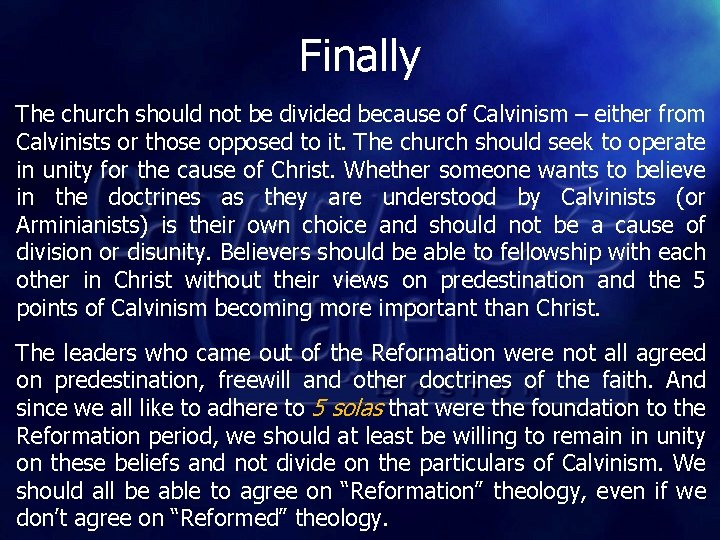
Finally The church should not be divided because of Calvinism – either from Calvinists or those opposed to it. The church should seek to operate in unity for the cause of Christ. Whether someone wants to believe in the doctrines as they are understood by Calvinists (or Arminianists) is their own choice and should not be a cause of division or disunity. Believers should be able to fellowship with each other in Christ without their views on predestination and the 5 points of Calvinism becoming more important than Christ. The leaders who came out of the Reformation were not all agreed on predestination, freewill and other doctrines of the faith. And since we all like to adhere to 5 solas that were the foundation to the Reformation period, we should at least be willing to remain in unity on these beliefs and not divide on the particulars of Calvinism. We should all be able to agree on “Reformation” theology, even if we don’t agree on “Reformed” theology.