
Reflexive verbs and morning routine FR 2 Objectives
Reflexive verbs and morning routine FR 2 Objectives: - Communicate about your own morning routine - Describe someone’s morning routine in present tense and past tense
Review • What is a reflexive verb? How do you know when you see one? • Give 2 examples of reflexive verbs in French
Vocab review • Translate: se maquiller se laver se promener se raser se parfumer se lever se coucher
Reflexive pronouns • What are they? Me, te, se, nous, vous, se Remember the song? http: //www. youtube. com/watch? v=Up. SO 6 Sst 7 Ac
What are they doing? • Look at the picture and say what the persons are doing. Use reflexive verbs.
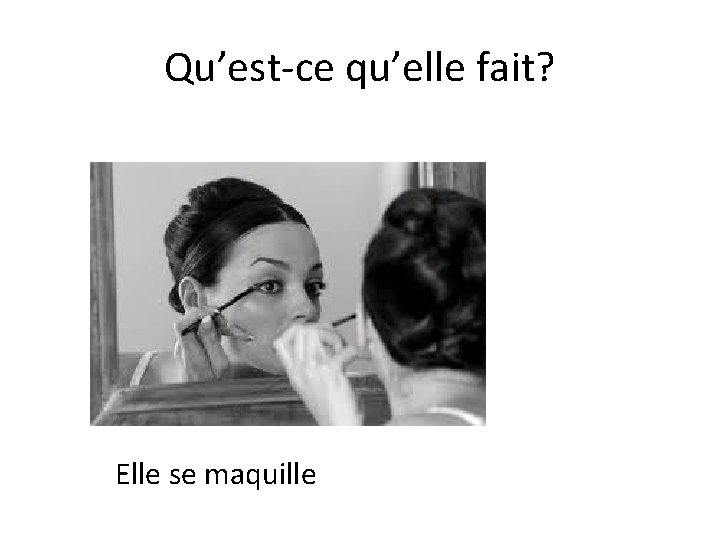
Qu’est-ce qu’elle fait? Elle se maquille
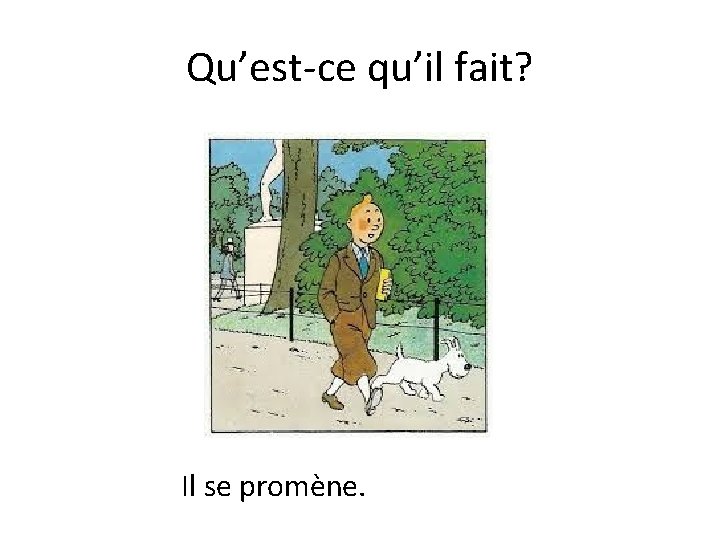
Qu’est-ce qu’il fait? Il se promène.
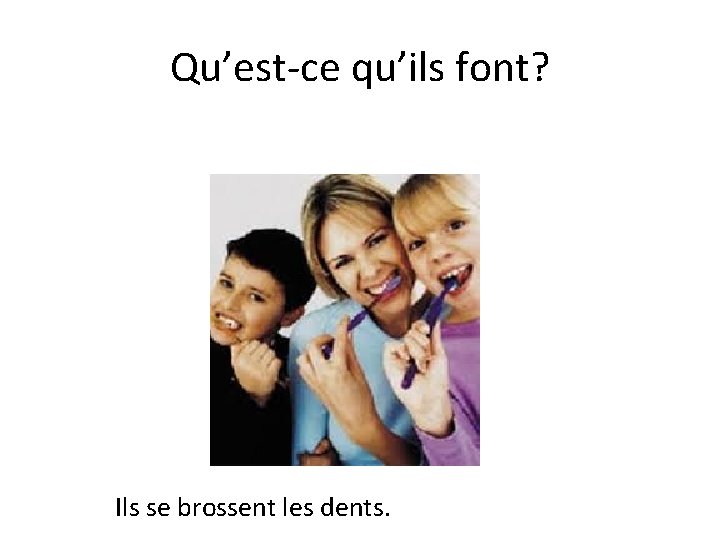
Qu’est-ce qu’ils font? Ils se brossent les dents.
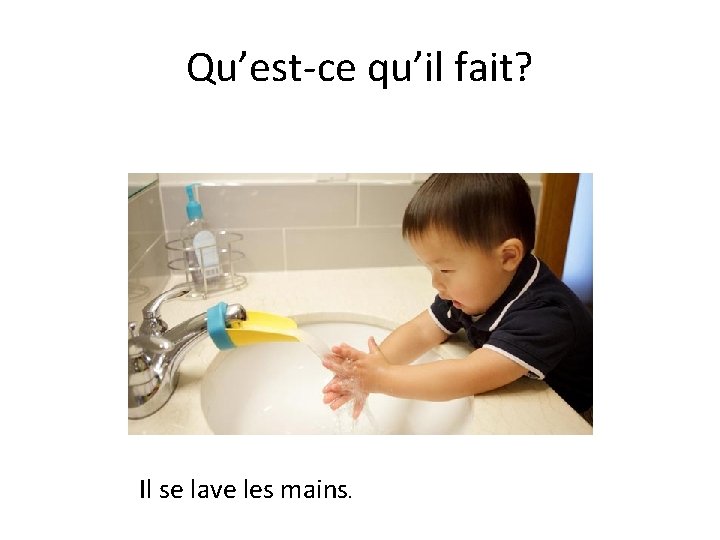
Qu’est-ce qu’il fait? Il se lave les mains.
Et toi, qu’est-ce que tu fais le matin? D’abord je_____, ensuite je______, puis je_______.
Past tense: passé composé Let’s try to remember! 1. What are the 2 main components of passé composé ? 2. What are the 2 auxiliary verbs we can use? 3. How do you know which auxiliary verb to use? 4. What is the past participle of –ER verbs? –IR verbs? –RE verbs
Translate • I spoke French. J’ai parlé français. • I went to the movies. Je suis allé(e) au cinéma. • She danced. Elle a dansé.
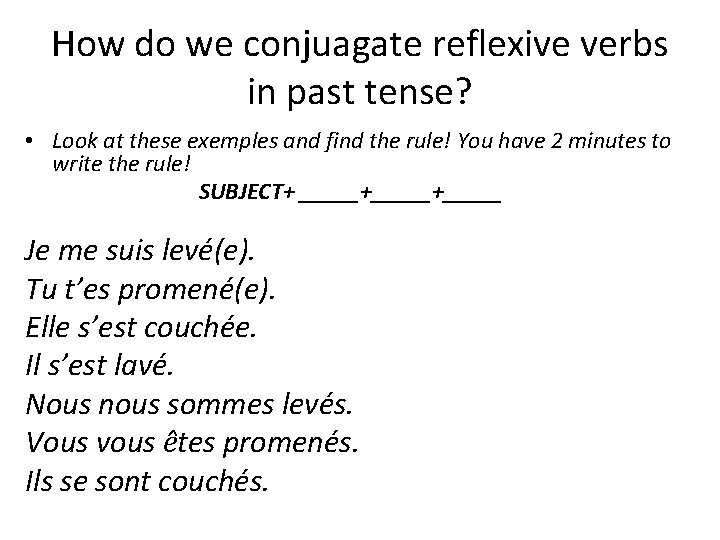
How do we conjuagate reflexive verbs in past tense? • Look at these exemples and find the rule! You have 2 minutes to write the rule! SUBJECT+ _____+_____ Je me suis levé(e). Tu t’es promené(e). Elle s’est couchée. Il s’est lavé. Nous nous sommes levés. Vous vous êtes promenés. Ils se sont couchés.
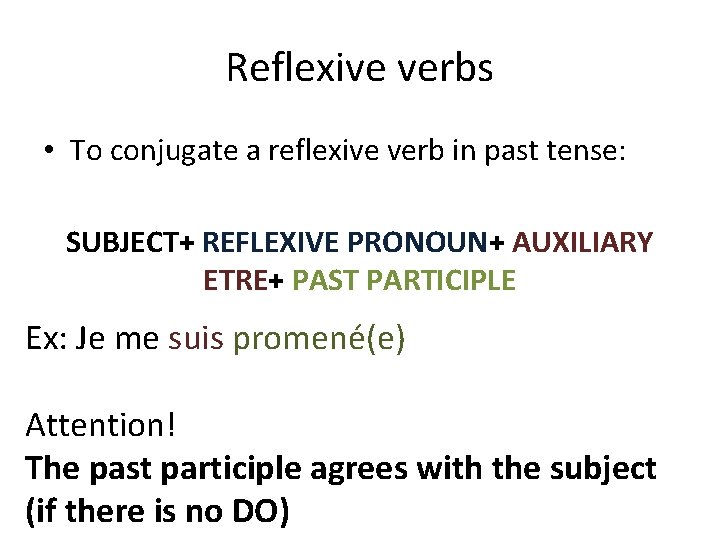
Reflexive verbs • To conjugate a reflexive verb in past tense: SUBJECT+ REFLEXIVE PRONOUN+ AUXILIARY ETRE+ PAST PARTICIPLE Ex: Je me suis promené(e) Attention! The past participle agrees with the subject (if there is no DO)
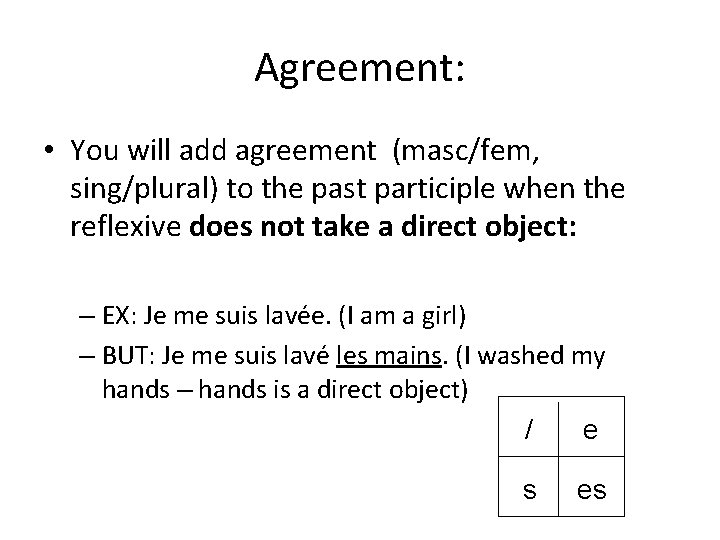
Agreement: • You will add agreement (masc/fem, sing/plural) to the past participle when the reflexive does not take a direct object: – EX: Je me suis lavée. (I am a girl) – BUT: Je me suis lavé les mains. (I washed my hands – hands is a direct object) / e s es
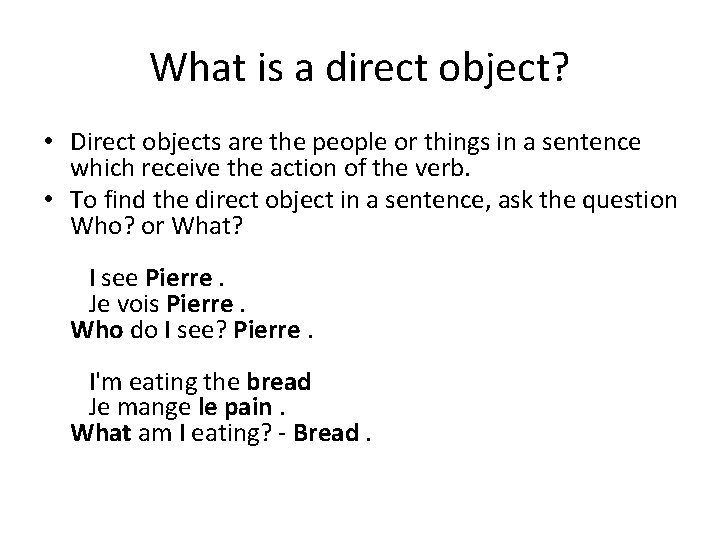
What is a direct object? • Direct objects are the people or things in a sentence which receive the action of the verb. • To find the direct object in a sentence, ask the question Who? or What? I see Pierre. Je vois Pierre. Who do I see? Pierre. I'm eating the bread Je mange le pain. What am I eating? - Bread.
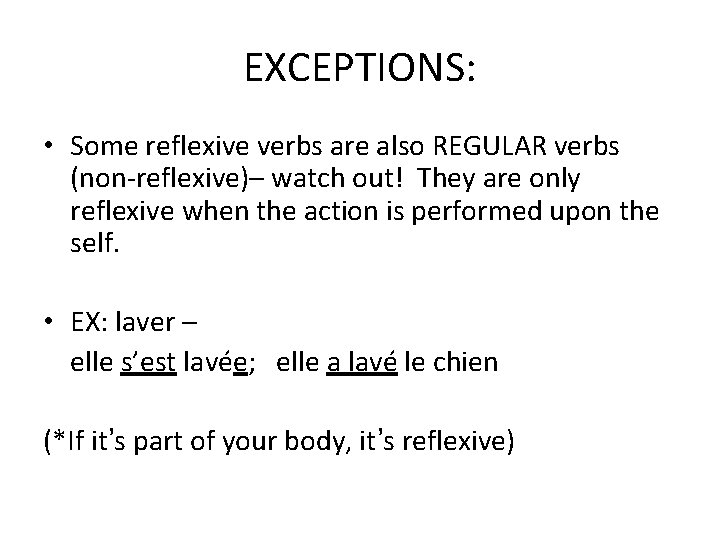
EXCEPTIONS: • Some reflexive verbs are also REGULAR verbs (non-reflexive)– watch out! They are only reflexive when the action is performed upon the self. • EX: laver – elle s’est lavée; elle a lavé le chien (*If it’s part of your body, it’s reflexive)
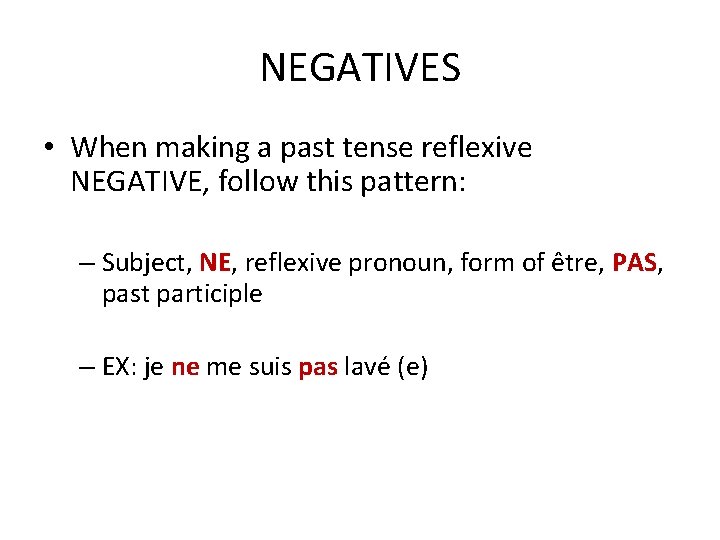
NEGATIVES • When making a past tense reflexive NEGATIVE, follow this pattern: – Subject, NE, reflexive pronoun, form of être, PAS, past participle – EX: je ne me suis pas lavé (e)
Practice: • Qu’est-ce qu’ils ont fait ce matin?
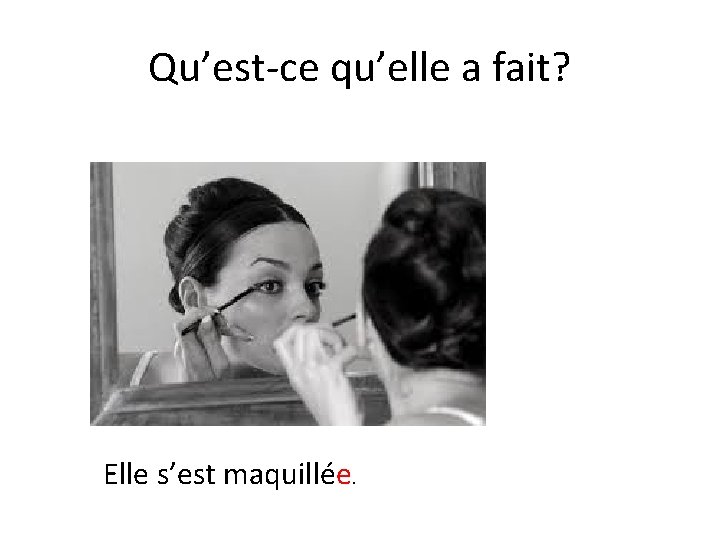
Qu’est-ce qu’elle a fait? Elle s’est maquillée.
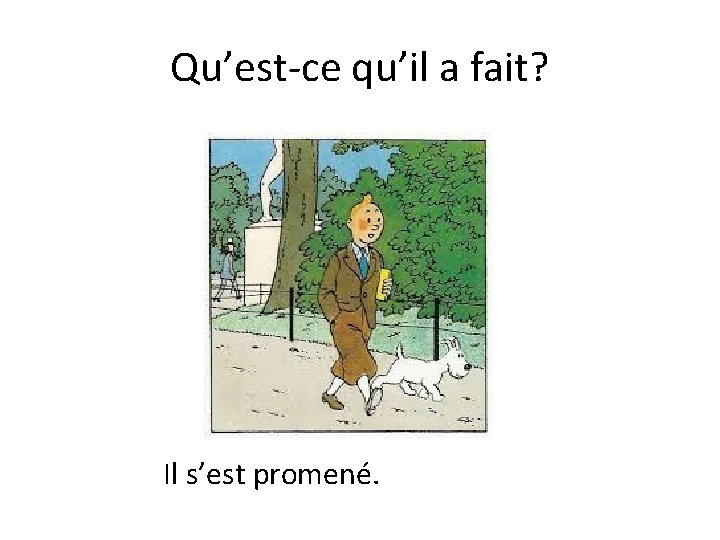
Qu’est-ce qu’il a fait? Il s’est promené.
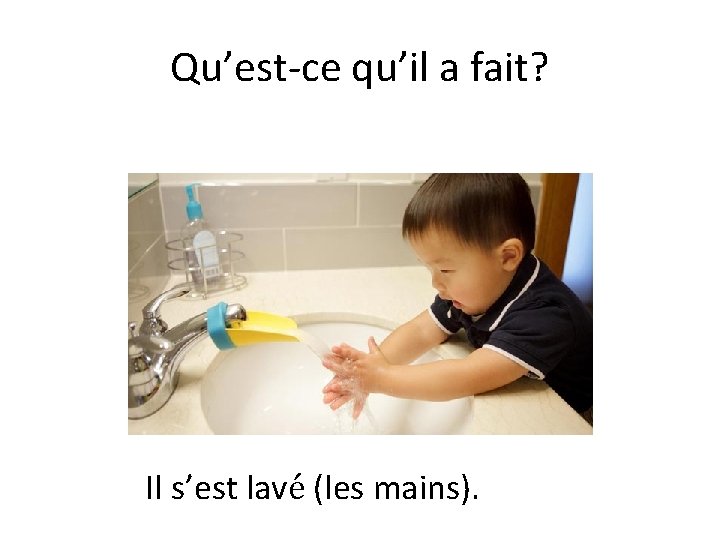
Qu’est-ce qu’il a fait? Il s’est lavé (les mains).
Et toi, qu’est-ce que tu as fait ce matin? • Write 4 sentences about what you did this morning. Use reflexive verbs. • Share with the class. • Listen! I will ask you questions about your classmates’ daily routine.
Qu’est-ce que Mr Bean a fait ce matin? 1. Watch the video: http: //www. youtube. com/watch? v=d. XPLh. E_z 57 M 2. Take notes about what you see in French. 3. Write as many sentences as you can to describe what Mr Bean did. Useful words we don’t know: Sonner: to ring Se cogner: to hit something S’étirer: to stretch
Handout: Practice • New verbs: S’ennuyer: to be bored Se passer: to happen S’asseoir: to sit down ( « assis » is the past participle)

Stop here for today
Dice game In groups of 3 -4 1 judge, the others are players Throw the 2 dices (1 with verb, 1 with subject) Conjugate the given verb with the given subject in past tense • The judge gives you the point if it’s correct. • When time is over, the person with the most points wins. • •
Dice Game • If one dice shows: JE • And the other shows: se maquiller You will conjugate the verb « se maquiller » with the subject « je » : je me suis maquillé(e). What if one dice shows « tu » and the other one « se laver » ? Tu te laves. Ok! Let’s play!
Your comic strip • Take out the comic strip you made last week about your daily routine. • Change your sentences to past tense. (no need to write, just in your head) • Share orally with a classmate. • Switch.

Jeopardy • http: //www. quia. com/cb/37675. html
- Slides: 30