
Reflectivity Measurements of Oxide Layers on Glass Reflectivity
- Slides: 18
Reflectivity Measurements of Oxide Layers on Glass
Reflectivity Measurements of Oxide Layers on Glass Contents: • • • Applications Principle Instrumentation Evaluation Examples Conclusions
Applications X-ray reflectivity : Measurement to determine • Layer thickness ( 0. 5 - 1%) • Density ( 1 - 2%) • Interface roughness, etc. of • Glass coatings • Semiconductors • Magnetic or optical media, etc.
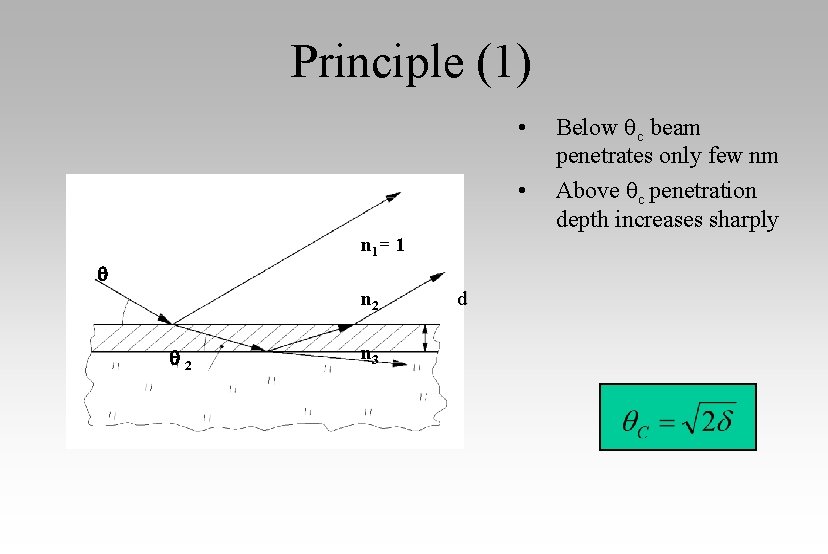
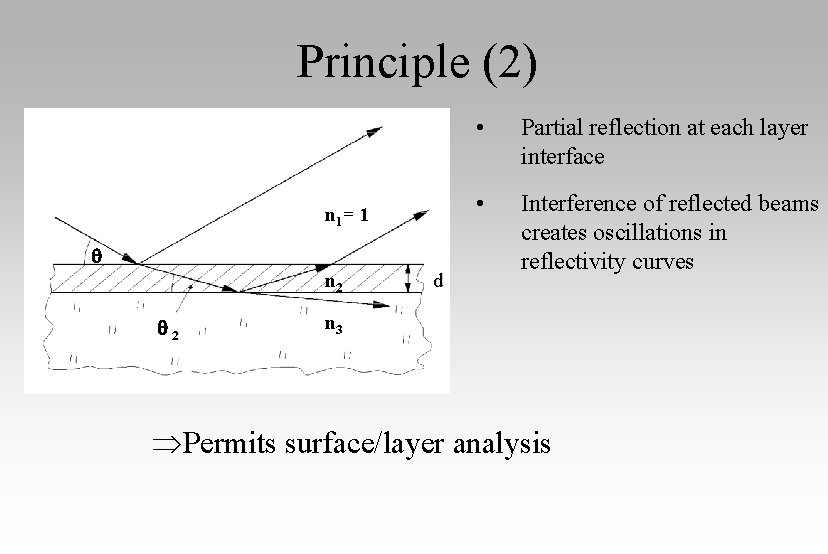
Principle (1) • • n 1 = 1 n 2 2 n 3 d Below c beam penetrates only few nm Above c penetration depth increases sharply
Principle (2) n 1 = 1 n 2 2 d • Partial reflection at each layer interface • Interference of reflected beams creates oscillations in reflectivity curves n 3 ÞPermits surface/layer analysis
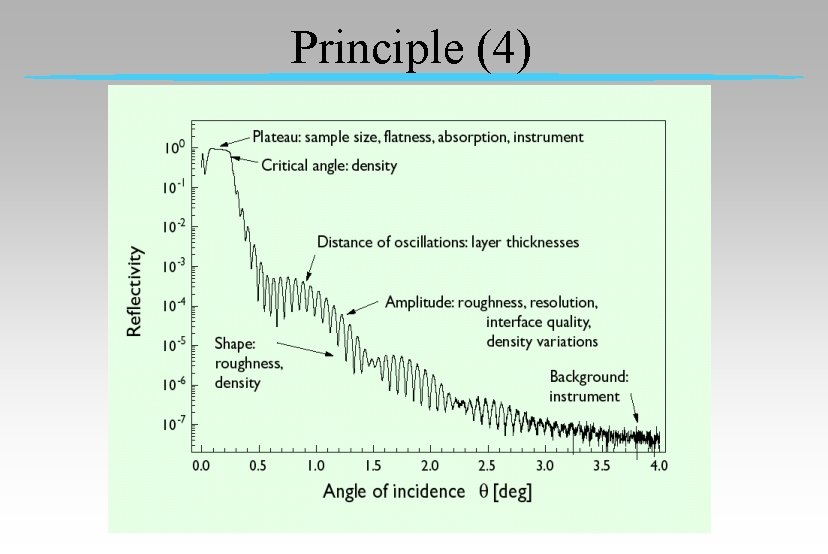
Principle (3) Oxide layers on glass Grazing incidence X-ray reflectivity (GIXR): • Sample reflectivity measured around critical angle of total reflection c • Measurement over 4 - 5º range, 7+orders of reflectivity magnitude • Coupled -2 scan
Principle (4)
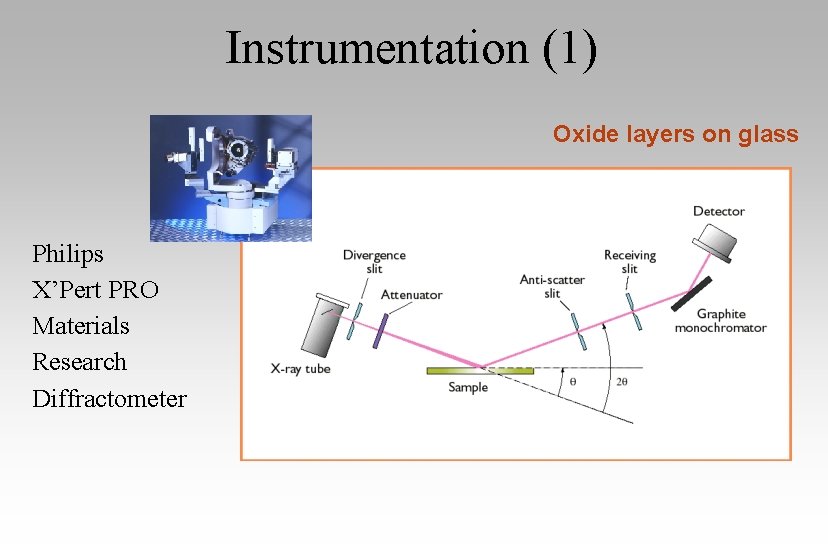
Instrumentation (1) Oxide layers on glass Philips X’Pert PRO Materials Research Diffractometer
Instrumentation (2) • X-ray tube Cu anode, m. A • PDS beam width <0. 04º 2 • Alignment accuracy ± 0. 001 º (in w) • Attenuator automatic at high • PRS/PASS coupled (50 -100 mm) • Monochromator graphite • Soller slits 0. 04 rad LFF, 40 k. V/40 intensities
Evaluation Oxide layers on glass • GIXA software simulates and fits experimental data • User inputs estimates of instrumental resolution, sample parameters • Calculate simulated curve, compare with collected data • Manual/automatic fit
Application examples Measurement of oxide layers on glass surfaces to monitor changes in glass melt and surface corrosion during production Acknowledgement: Dr. O. Anderson, SCHOTT GLAS, Germany
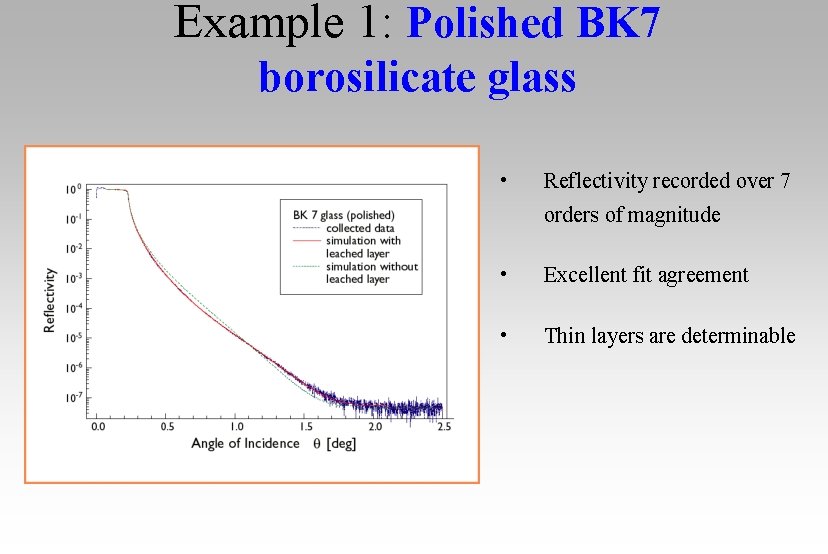
Example 1: Polished BK 7 borosilicate glass • Reflectivity recorded over 7 orders of magnitude • Excellent fit agreement • Thin layers are determinable
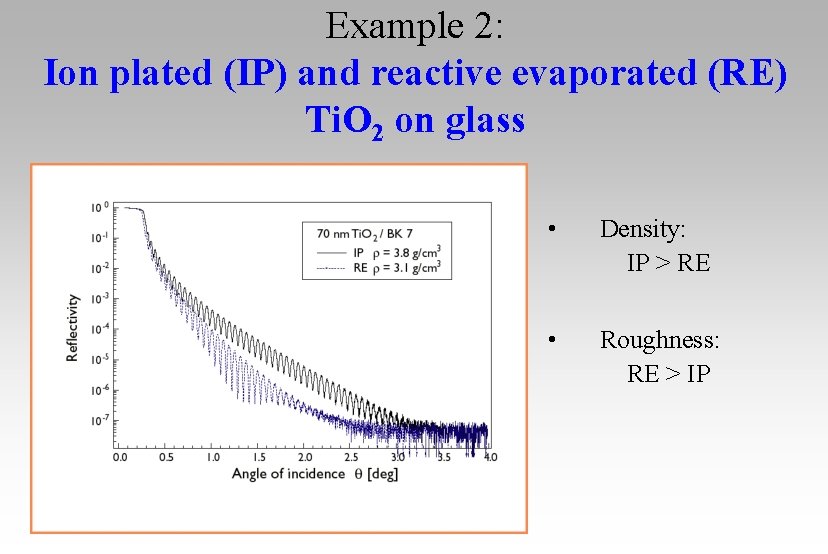
Example 2: Ion plated (IP) and reactive evaporated (RE) Ti. O 2 on glass • Density: IP > RE • Roughness: RE > IP
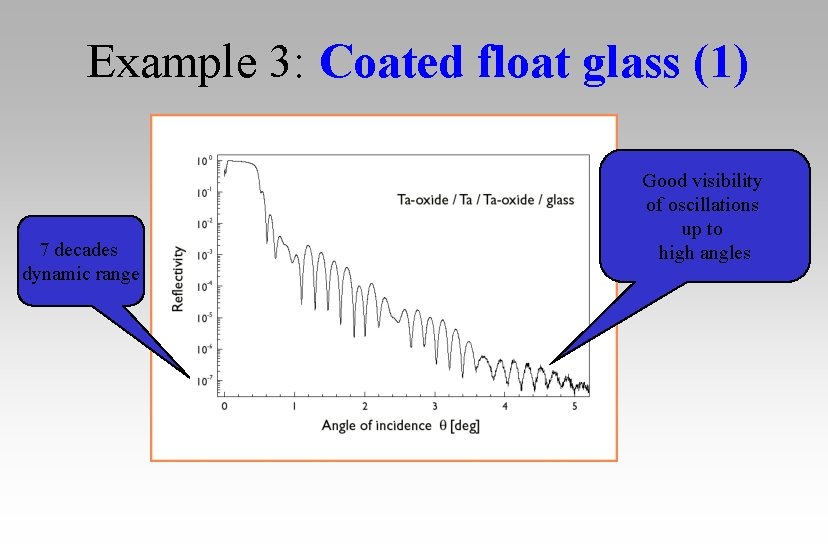
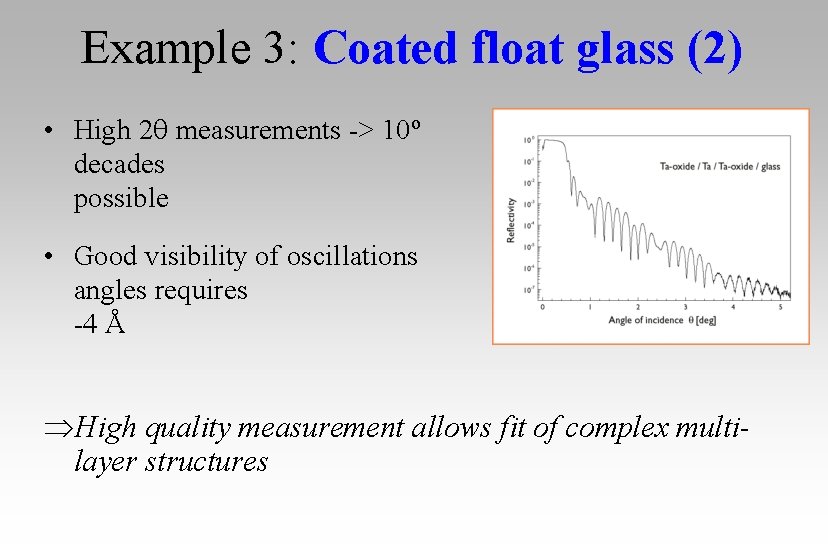
Example 3: Coated float glass (1) 7 decades dynamic range Good visibility of oscillations up to high angles
Example 3: Coated float glass (2) • High 2 measurements -> 10º decades possible • Good visibility of oscillations angles requires -4 Å over 7 dynamic range up to high interface roughness < 3 ÞHigh quality measurement allows fit of complex multilayer structures
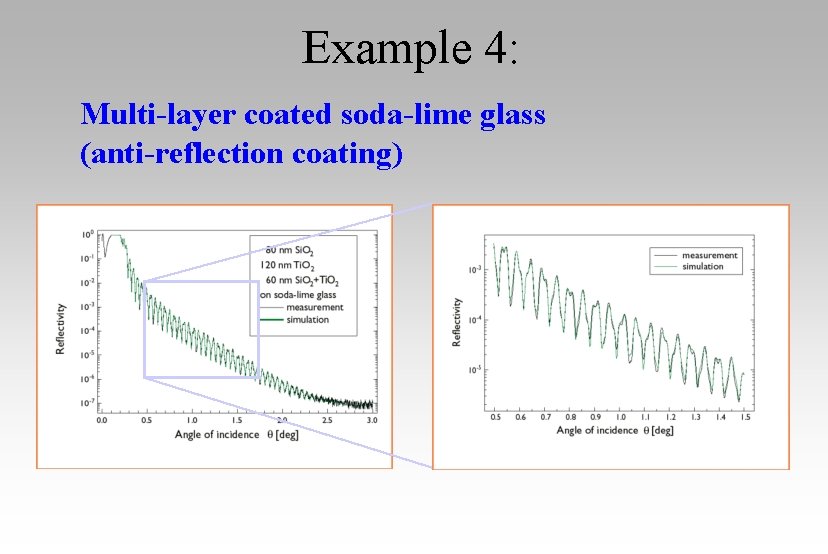
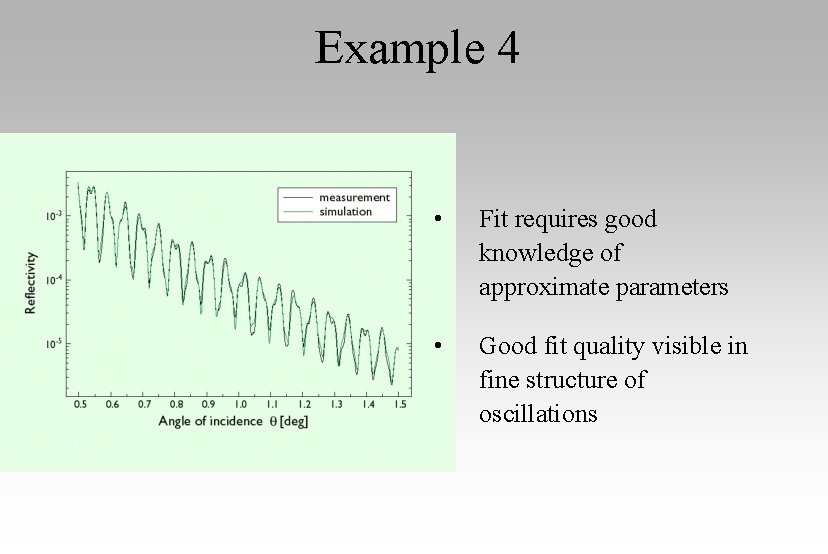
Example 4: Multi-layer coated soda-lime glass (anti-reflection coating)
Example 4 • Fit requires good knowledge of approximate parameters • Good fit quality visible in fine structure of oscillations
Conclusion • X-ray reflectivity is a powerful technique for measuring parameters of thin layers • High quality data can be recorded with the X’Pert PRO diffraction system (Large dynamic range / up to high 2 -angles) ð Even thin layers and interface layers are determinable ð Allows fit of complex multi-layer structures X-ray