
REFLECTIVE PROBLEM SOLVING MENTORPROTG SCENARIOS Learning does not
REFLECTIVE PROBLEM SOLVING MENTOR/PROTÉGÉ SCENARIOS Learning does not happen without reflection.
Scenario #1 “Cookie Cutter Lesson Plans” It’s the first semester and the teacher next door that you’re mentoring has taught several lessons. Hearing from the students, the lessons have been good; however, you notice the structure of the lessons have all been exactly the same with little variety. � What would you do to address this situation? � How would you guide your protégé on how to incorporate multiple teaching strategies for his/her teaching. DC
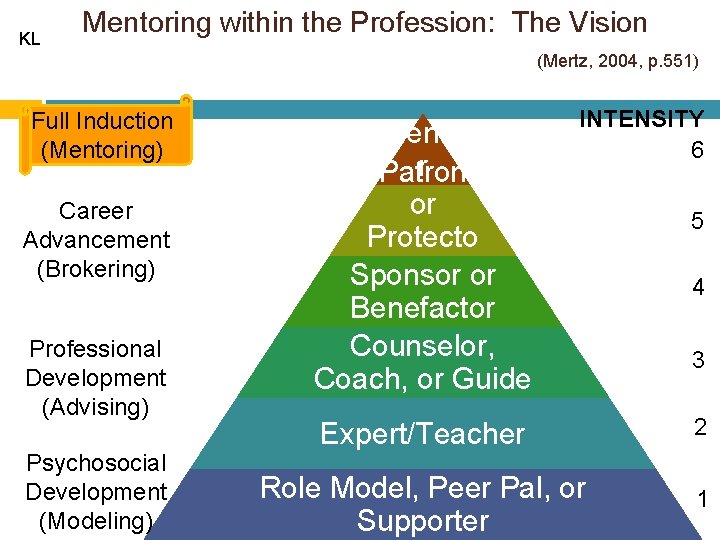
KL Mentoring within the Profession: The Vision (Mertz, 2004, p. 551) INTENT Full Induction (Mentoring) Career Advancement (Brokering) Professional Development (Advising) Psychosocial Development (Modeling) ROLE Mento r Patron or Protecto r or Sponsor Benefactor Counselor, Coach, or Guide LEVEL OF INTENSITY 6 5 4 3 Expert/Teacher 2 Role Model, Peer Pal, or Supporter 1
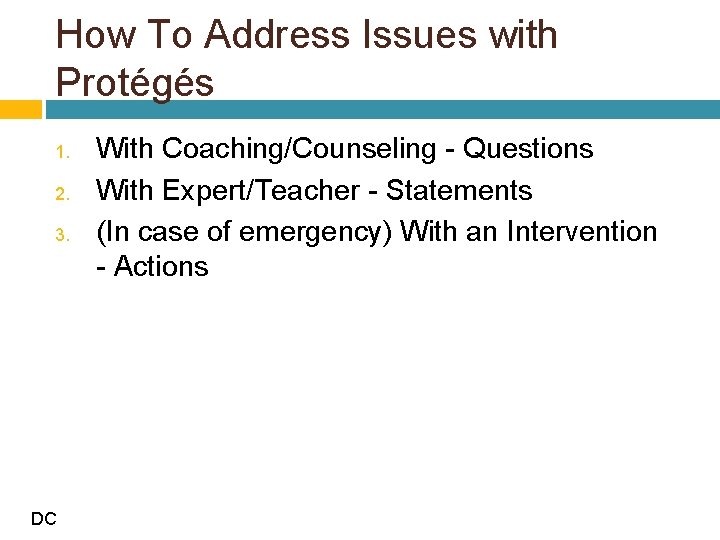
How To Address Issues with Protégés 1. 2. 3. DC With Coaching/Counseling - Questions With Expert/Teacher - Statements (In case of emergency) With an Intervention - Actions
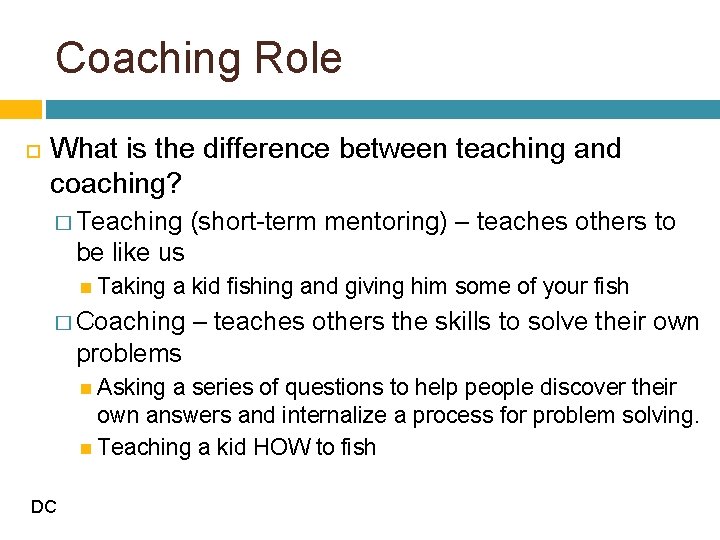
Coaching Role What is the difference between teaching and coaching? � Teaching (short-term mentoring) – teaches others to be like us Taking a kid fishing and giving him some of your fish � Coaching – teaches others the skills to solve their own problems Asking a series of questions to help people discover their own answers and internalize a process for problem solving. Teaching a kid HOW to fish DC
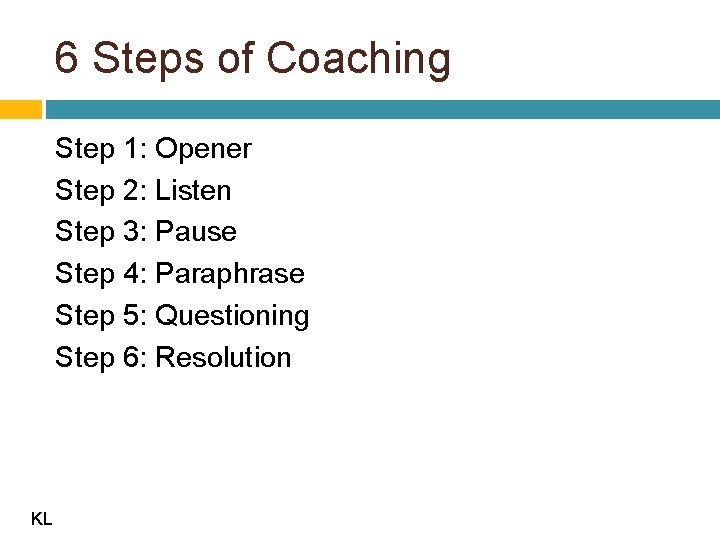
6 Steps of Coaching Step 1: Opener Step 2: Listen Step 3: Pause Step 4: Paraphrase Step 5: Questioning Step 6: Resolution KL
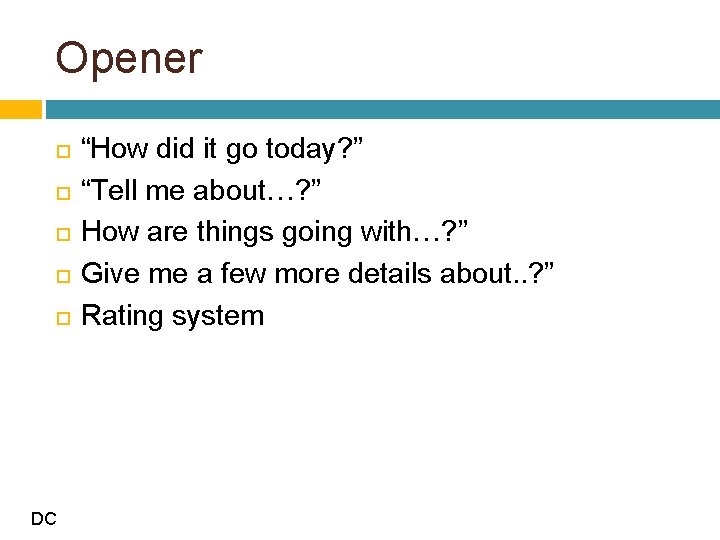
Opener DC “How did it go today? ” “Tell me about…? ” How are things going with…? ” Give me a few more details about. . ? ” Rating system
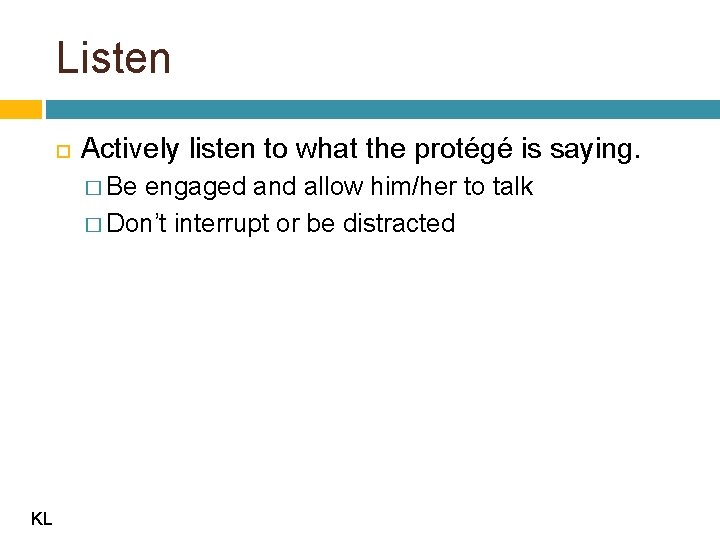
Listen Actively listen to what the protégé is saying. � Be engaged and allow him/her to talk � Don’t interrupt or be distracted KL

Pause KL Allow mentees to naturally finish their story. Gather your thoughts and show that you were listening for just a few seconds. Similar to wait time after asking a question in class.
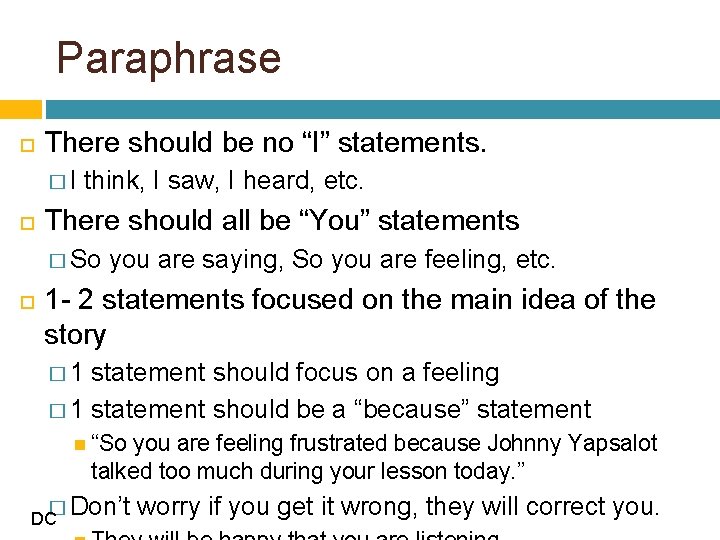
Paraphrase There should be no “I” statements. �I think, I saw, I heard, etc. There should all be “You” statements � So you are saying, So you are feeling, etc. 1 - 2 statements focused on the main idea of the story � 1 statement should focus on a feeling � 1 statement should be a “because” statement “So you are feeling frustrated because Johnny Yapsalot talked too much during your lesson today. ” � Don’t DC worry if you get it wrong, they will correct you.
Let’s Practice KL Partner A: Take 2 to 3 minutes to tell your partner about the most difficult class you have ever had to teach. Partner B: Listen, Pause, and Paraphrase Did they get it right? Now switch.
Questioning Once you’ve paraphrased and identified the problem, questions should be developed to help guide the protégé in finding resolution. Should all be “You” questions Should all be plural questions to allow potential for multiple solutions DC
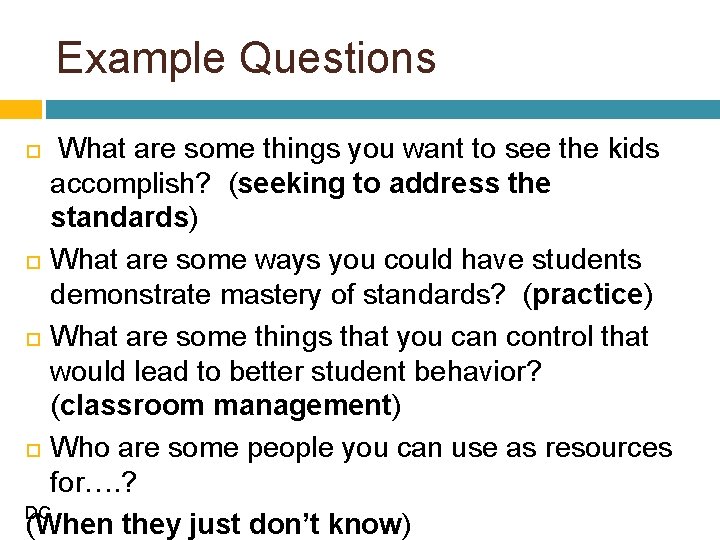
Example Questions What are some things you want to see the kids accomplish? (seeking to address the standards) What are some ways you could have students demonstrate mastery of standards? (practice) What are some things that you can control that would lead to better student behavior? (classroom management) Who are some people you can use as resources for…. ? DC (When they just don’t know)
Practice Questioning Partner B: Restate your previous paraphrase. Now, ask your partner a question that helps to guide them to resolution. This may take more than 1 question. How did that go? Partner A: Your turn KL
Resolution KL Based on the answers to questions, you and the protégé should develop a series of action steps with a timeline Have the protégé repeat the action steps to you Check in and make adjustments
Follow-up Questions KL What did you learn from this situation? What worked well? What did you do to make this a success? What barriers did you have to overcome? What were challenges to address? What are your next steps? When do you expect these results will occur? How will you know your plan is working? What will you do if your plans do not work?
Expert Role When you have to address an issue, then it’s time to switch hats from a coach to an expert. � The protégé is stuck. � They don’t know how to fix the issue. � They don’t see the problem. Most of your early experiences will be in this role Use the sandwich technique � Start with something the protégé did well � Get to the meat of the matter (issue/needs improvement) DC � End with a positive and a resolution with a timeline
Intervention Role As a last resort, with extreme issues only, you involve administrators, lead mentors, or department/grade-level chairs. � Temporary � MCT/Admin/UT get involved Not planning at all/ unprepared Serious classroom management issues – safety Inappropriate/unprofessional conduct in front of students Saying inappropriate things, dress, Facebook � Develop KL action plan and timeline for resolution
PROTÉGÉ/ MENTOR SCENARIOS What would you do?
Sections DC Lesson Planning Classroom Management Professionalism and General Concerns
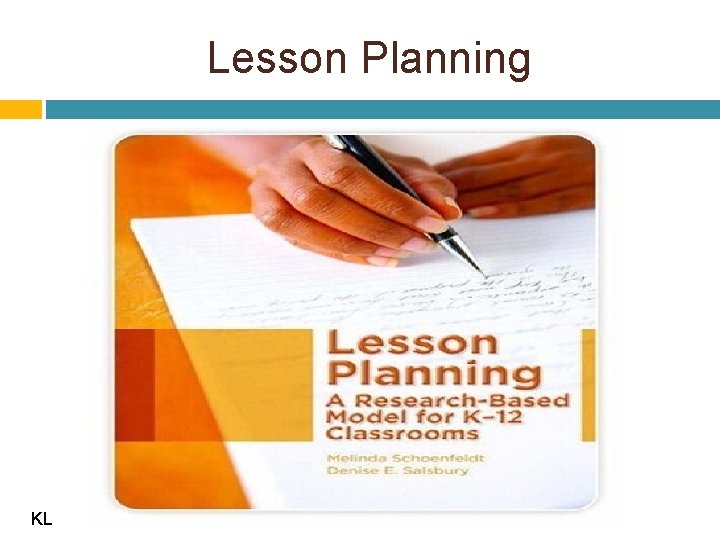
Lesson Planning KL
Scenario #2 “Game Planning” Your protégé has come to you seeking advice for lesson planning. They seem to be “stuck” with how to design a plan that is challenging, engaging, and transitions smoothly. You sit down to “game plan” with the protégé. � Which role(s) would you use? Coach, Expert, Intervention � How do you walk them through each portion of the lesson plan template? (the set, instructional strategies, activities/practice, KL
Scenario #3 “That’s Probably Not a Good Idea” Your protégé has brought to you a lesson plan that he has worked on diligently and is truly excited about. However, there are multiple aspects to lesson that you do not think will work well. � What KL role(s) would you use? � What questions would you raise about this lesson? � Do you let him go through with the lesson in its present state? � Is it ok to intervene and if so, when would you do so?
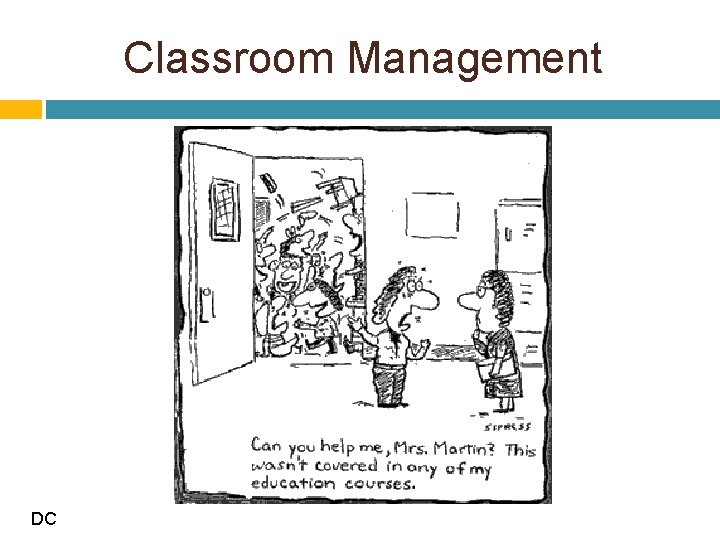
Classroom Management DC
Scenario #4 “Everybody’s Talking” Your protégé has taught a few lessons. You have noticed and reflected with him/her that classroom management is an issue. He/she is not addressing an excessive talking issue during the lessons. � Which role(s) would you use? � How would you begin this discussion? � What are some steps/strategies you would give your protégé? � What would you do if those strategies didn’t work? DC
Scenario #5 “Sinking Ship” Your protégé is being formally observed by a supervisor. According to him, the lesson he was teaching floundered. He informed you that he was nervous and lost control of not only the lesson, but classroom management as well. � Which role(s) would you use? � What should you do as well as not do in this case? � Is there anything you and the intern could have done to prevent this situation? � Is it appropriate to allow an intern to “fail” during an observation? DC
Professionalism DC
Scenario #6 “Philosophical Clash of the Titans” You and your protégé have distinct philosophical differences in teaching. Her philosophy is teacher centered teaching strategies, lax classroom management, and is the know-it-all type. � What are your first steps in this situation? � Should you include anyone else in the case? � What approach would work best in this situation? DC
Scenario #7 “I. E. P? ” Several students in your protégé’s class have I. E. P. s. Due to the hectic pace at the start of the year, the modifications have not been implemented up to this point. It is October; she comes to you for advice. � Which DC role(s) would you use? � To what resources might you direct them so they may have instruction/modification references? � What suggestions might you offer to reinforce how the intern can provide modifications to the students through instructional practices and activity planning?
Questions? Lee and Barnett (1994) have defined this process as follows: � “Reflective questioning is a technique in which one person prepares and asks questions that are designed to provide opportunities for the respondent to explore his or her knowledge, skills, experiences, attitudes, and values…Reflective questioning encourages the respondent to explore his or her own thinking; it is not intended to direct the respondent to a conclusion pre-determined by the questioner. For questioning to be truly effective, the questioner must respect the respondent’s statements, suspend judgment, and avoid attempts to manipulate his or her thinking. ” (p. 17) KL Go forth and mentor!
- Slides: 30