
Reflective Listening Active Listening What it does Used
- Slides: 6
Reflective Listening Active Listening
What it does • Used to help the speaker deal with a problem (rapport talk) • The capacity for self-insight, problemsolving resides in the speaker
Components Empathy Desire and effort to understand the recipient and their state of mind Acceptance Respect for the person, listener avoids agreement/disagreement Congruence Open, frank, candor, admits to feelings Concreteness Focus on specifics, not generalities. Ask about specific incidents.
Respond… To feelings, not just content; to negative, ambivalent feelings.
1. Repeating or rephrasing – listener repeats or substitutes synonyms or phrases; stays close to what the speaker has said 2. Paraphrasing – listener makes a major restatement in which the speaker’s meaning is inferred 3. Reflection of feeling – listener emphasizes emotional aspects of communication through feeling statements – deepest form of listening
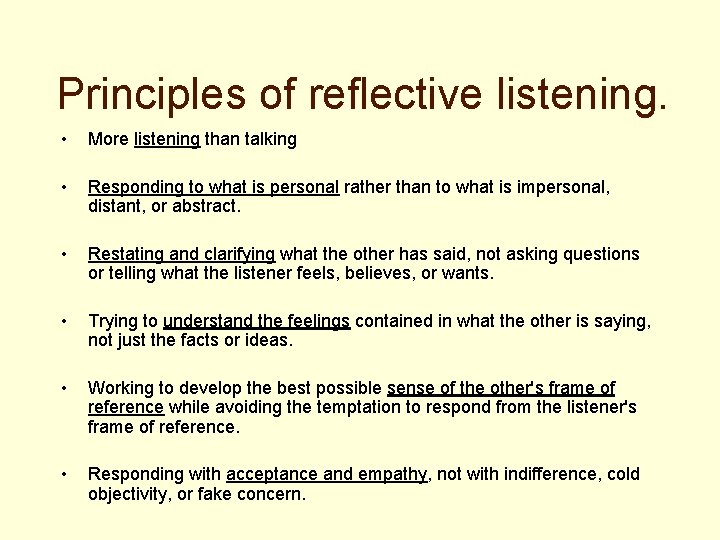
Principles of reflective listening. • More listening than talking • Responding to what is personal rather than to what is impersonal, distant, or abstract. • Restating and clarifying what the other has said, not asking questions or telling what the listener feels, believes, or wants. • Trying to understand the feelings contained in what the other is saying, not just the facts or ideas. • Working to develop the best possible sense of the other's frame of reference while avoiding the temptation to respond from the listener's frame of reference. • Responding with acceptance and empathy, not with indifference, cold objectivity, or fake concern.