
REFLECTIVE CLASSROOM TEACHING A P Thakur Principal DIET
- Slides: 18
“REFLECTIVE CLASSROOM TEACHING” A P Thakur Principal DIET, Sonpur
What is reflective teaching: Ample opportunities To observed and engage. Learn collaboretly in group. Professional opportunities. Own experience and Assumption. Class room Enquiry. Critical observation and Reflective Analysis.
Learning to Reflective teaching practice: Availability, Quality, Appropriateness, And Sufficient feedback GOAL: Reflective teaching in math class grade 2. Math. Is a core subject in elementary level. Leadership : - principal DIET. Participants : - Self interested 1 o math teacher of lab school. Supports ; - H. M. of each lab school. Active participants : - 04 Faculty members of DIET.
EXPECTATION FROM THE TEACHERS : 1. Component knowledge of math. 2. What the Need for children to learn math. 3. Why should children learn math. 4. The course should be known by teachers. 5. Who are the learner. What are their strength, Appreciate the experience, and their capacity to strength. 6. Understanding how math need to transacted. 7. Attitudes , Notions about math, the nature background Of learners, learning capacity and purpose of math education 8. Teachers need practice, responsible and ensuring for studen
Challenge : 1. The fear of math and halo of math. 2. Fixed mindset teacher. 3. Expectation of society. IMPORTNCE OF MATH. — 1. Basic core of elementary education. 2. Essential for national development. 3. Science and engineering depends on it. 4. Understanding of math demands day to day.
TOPIC – “ Reflective classroom teaching” Program objective : To implement of reflective math teaching in the lab school. Goal : Refective math teaching in grade 2. Short term objective : - To improve math in grade 2. Barrirrers : Fixed mindset, Traditional teaching, Lack of sources, etc.
Objective setting : 1. Identify the problems. 2. Develop teaching approach. 3. Demonstrate lesion. 4. Explain the benefits. Why reflective teaching is important ? 1, Identify the problems, 2. Look at the future. 3. To encourage students.
ACTIVITIES : Teachers Diary : -1. Easiest way, 2. Purely personnel, 3. Reaction and feeling, 4. Observe to learners, 5. Regular basis. Peer Observation : - 1. Invite RPs or expert teacher, 2. simple observation, 3. Student contribution, 4. To deal errors. Audio recording : - 1. More active 2. More effective 3. More sincere. Student feedback : - 1. Student opinion 2. simple questions 3. Learning desire. SOME INFORMATION RECORDED : THINK : - 1. Self observe 2. Feel surprise 3. Ideas for change, TALK /SHARE : - 1. Supportive Expert 2. Evidence based idea,
REFLECTIVE TEACHING CYCLE : START--- IMPLIMENT--- CHANGE--- REFLECTIVE-- EVALUATE--- START. SELF STUDY : -1. DIET LIBRARY 2. WEBSITE OBSERVATION. 2. 3. DISTRICT LIBRARY, 4. STATE LIBRARY
Proposed Programme: STEP 1. FIRST WEEK JANUARY 2014. PRE SESSION CONFERENCE : -LIDERSHIP: --- PRINCIPAL DIET. PARTICIPANTS: ---1. All Faculty members of DIET. 2. 10 interested math teachers of lab school. 3. 10 HM of lab school. For support in their school. Briefing and Discussion: -- Reform proposal, importance, areas, implementation, Role of MHRD, Outcomes and potential benefits, 1. Identify the problems. 2. How to student learn more. 3. What is the problems of math teaching processes. STEP 2. SECONED WEEK. 2014. Discussion and group presentation on the identified problems. -- Formation of common ideas, --- Math interesting teacher will also involve. ---- How to balance for students----Access opportunity of successful math. ----Method based teaching, Enhance learning, MAEMETICAL Thinking, ----Assessment of determine learning. ---- Small group formation, Discussion and common consensus on the Problem will be finalize on the weak areas recognize.
STEP– 3. THIRED WEEK JANUARY 2014. --- Orientation of pedagogy of mathematics refleting teaching. ---VIDEO CLIPS displaced regarding the solution of this problems. --- Component of mathematical reflective teaching will be discussion --- devide in to small group. GROUP ACTIVTY -----Teachers engage learner for active lerning. --- Teachers encourage students to their experience and construct meaning. ---Connect math in their life. --- Construct meaning of math. --- Creat positive learning environment that support critical And creative thinking. --- Constantly monitor and access student understanding and skills. --- RPs will lead the discussion, Introduce the pedagogical concept related to above ideas.
STEP 4. FORTH WEEK OF JANUARY 2014. ORIENTATION AND CONTENT OF PEDAGOGY. ORIENTATION TEACHING METHODS OF MATHEMATICS. --- Effective teaching related to learning. --- Understanding how to learn. Learning principle will be discuss like wise Activity based teaching, Presentation method, collaborative method, Analytical and synthesis method. STEP 5. FIRST WEEK FEBRUARY 2014. ORIENTATION OF TEACHING METHOD OF MATHEMATICS.
STEP 6. SECOND WEEK OF FEBRUARY. 2014. Orientation of recent development of mathematics. --- Recent trend of teaching , --- the need of attitude change, for solution of mathematical problems and mathematization a solution. The participants will develop their understanding on the basis of above topic THINK--- PAIR--SHARE method and discuss in group. STEP 7. SECOND WEEK. 2014. Classroom engagement of student teachers in mathematics of resource
STEP 8. FORTH WEEK. 2014. Evaluation and Assessment of both classroom practices and Teacher performance on the basis of --1. Mc. REL---Strategies and 2. TAP rubric --- Indicators. Participants will be assessed on rubric framed on scale 5. The rubric will be framed on the basis of 12 classroom observation, method Of teaching adopted by teachers, The communication of contents and student understanding, Teacher knowledge of children etc. For the evaluation of the students formal and Informal test (pre & post) will be tested weekly, and their skill will be weekly assessed. This will be done with continuous interaction between students and teachers during before
STEP 9. FIRST WEEK MARCH TO JUNE 2014. After continuous and comprehensive evaluation of assessment of Teacher performance and Teacher achievements. This outcome of small Project will be documented. If all goes believe the expected change will happen and then this will be implemented to all the school of the district for achieving Long term goal. The documentation and analysis will be doing by 2 Faculty members and 1. RP.
SCHOLARSHIP SUPPORT: --Resource materials: --- NCF-- 2005, BCF— 2008, NCFTE– 2009, RCFCE Act – 2009, (Right to education Act) –Education for all, School visit of ARIZONA.
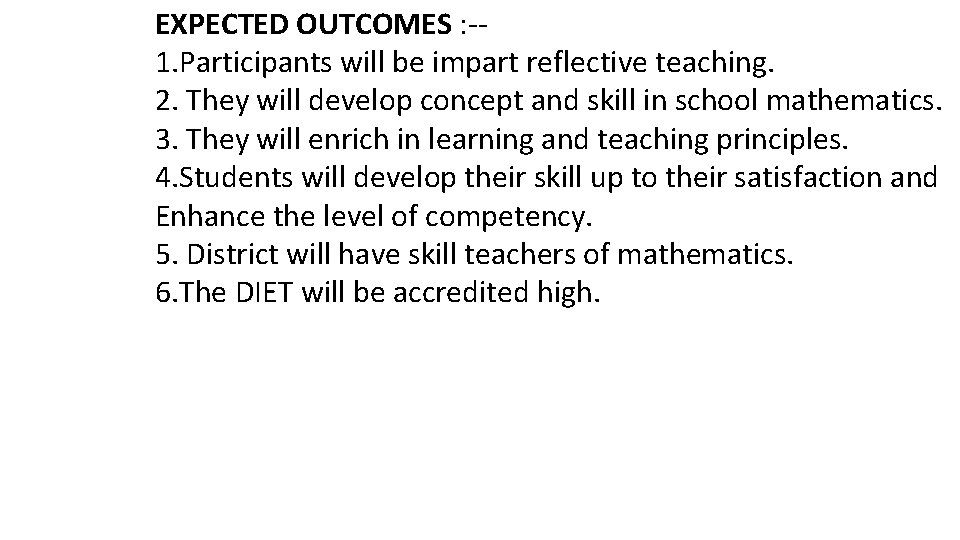
EXPECTED OUTCOMES : -1. Participants will be impart reflective teaching. 2. They will develop concept and skill in school mathematics. 3. They will enrich in learning and teaching principles. 4. Students will develop their skill up to their satisfaction and Enhance the level of competency. 5. District will have skill teachers of mathematics. 6. The DIET will be accredited high.
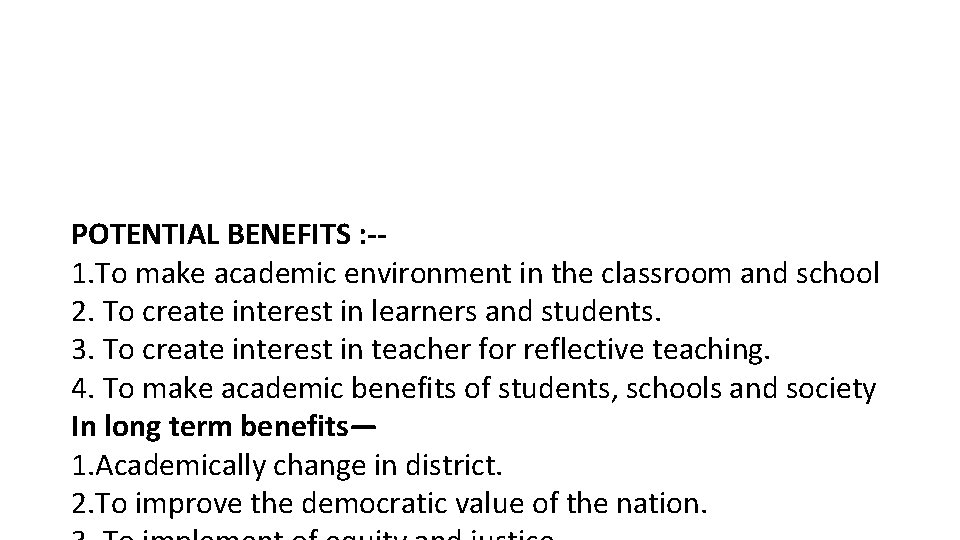
POTENTIAL BENEFITS : -1. To make academic environment in the classroom and school 2. To create interest in learners and students. 3. To create interest in teacher for reflective teaching. 4. To make academic benefits of students, schools and society In long term benefits— 1. Academically change in district. 2. To improve the democratic value of the nation.