
Reflections on the UN Fundamental Principles based on

Reflections on the UN Fundamental Principles based on EU experience UNSC High Level Forum New York, 21. Feb. 2011 Walter Radermacher, Eurostat
Changes since the Fundamental Principles were first adopted (1994) n The role of statistics and statistical offices has evolved e. g. the coordination role involving different data providers n Sources of official statistics have become more diverse, moving from statistical surveys to administrative data n Increasing demand for professional independence and accountability in the field of official statistics Walter Radermacher 2
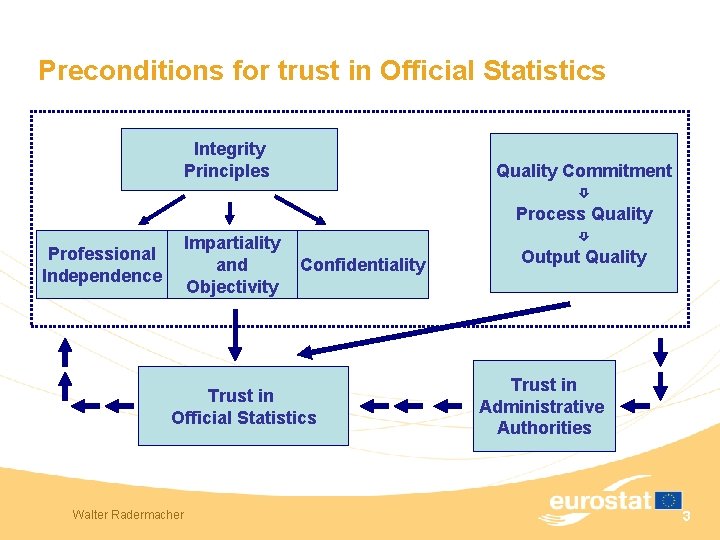
Preconditions for trust in Official Statistics Integrity Principles Impartiality and Objectivity Professional Independence Confidentiality Trust in Official Statistics Walter Radermacher Quality Commitment ⇩ Process Quality ⇩ Output Quality Trust in Administrative Authorities 3
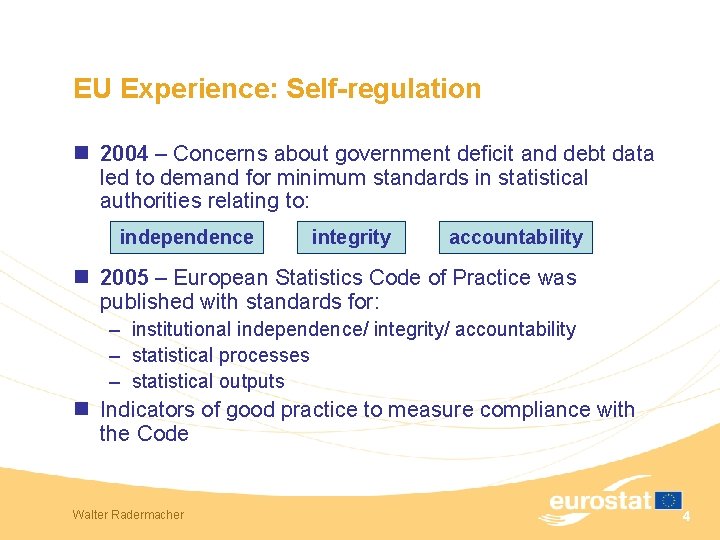
EU Experience: Self-regulation n 2004 – Concerns about government deficit and debt data led to demand for minimum standards in statistical authorities relating to: independence integrity accountability n 2005 – European Statistics Code of Practice was published with standards for: – institutional independence/ integrity/ accountability – statistical processes – statistical outputs n Indicators of good practice to measure compliance with the Code Walter Radermacher 4
EU Experience: Legal instruments n 2008 – European Statistical Governance Advisory Board was established to oversee implementation of the Code of Practice n 2009 – new Statistical Law reinforced the statistical principles and the independence, integrity and accountability of statistical authorities n 2010 – new law provided audit powers to Eurostat in the context of government finance statistics (Excessive Deficit Procedure) n 2010 – November ECOFIN Council requested the reinforcement of professional independence in official statistics Walter Radermacher 5
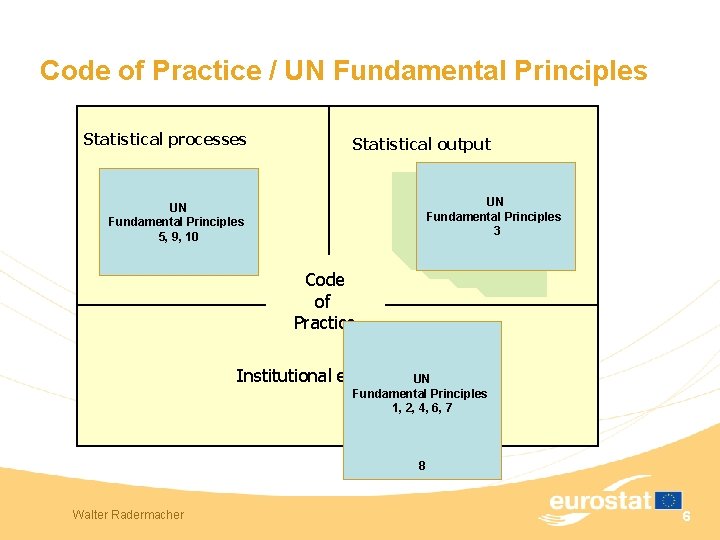
Code of Practice / UN Fundamental Principles Statistical processes Statistical output UN Fundamental Principles 3 UN Fundamental Principles 5, 9, 10 Code of Practice Institutional environment UN Fundamental Principles 1, 2, 4, 6, 7 8 Walter Radermacher 6
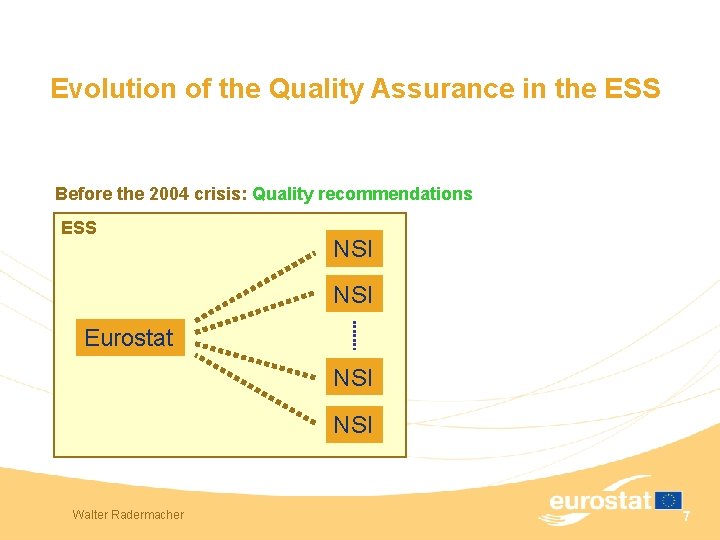
Evolution of the Quality Assurance in the ESS Before the 2004 crisis: Quality recommendations ESS NSI Eurostat NSI Walter Radermacher 7
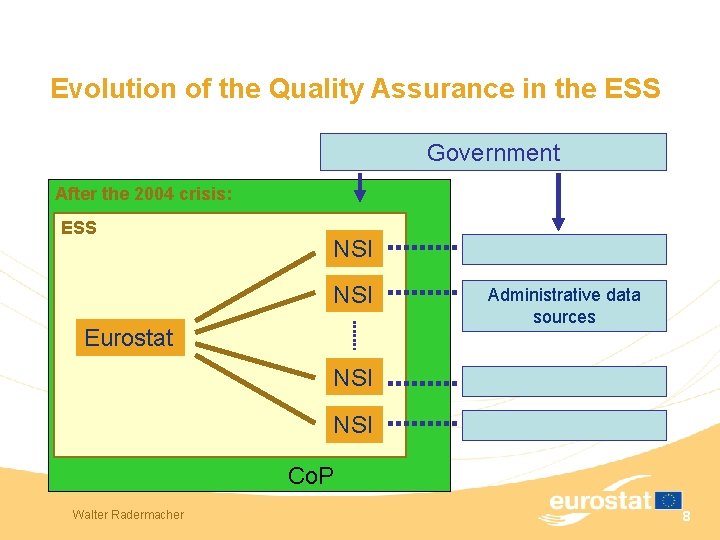
Evolution of the Quality Assurance in the ESS Government After the 2004 crisis: ESS NSI Eurostat Administrative data sources NSI Co. P Walter Radermacher 8
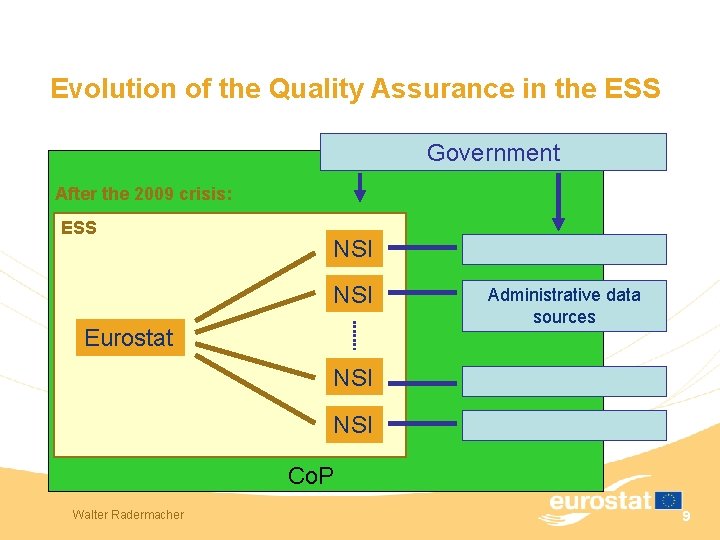
Evolution of the Quality Assurance in the ESS Government After the 2009 crisis: ESS NSI Eurostat Administrative data sources NSI Co. P Walter Radermacher 9
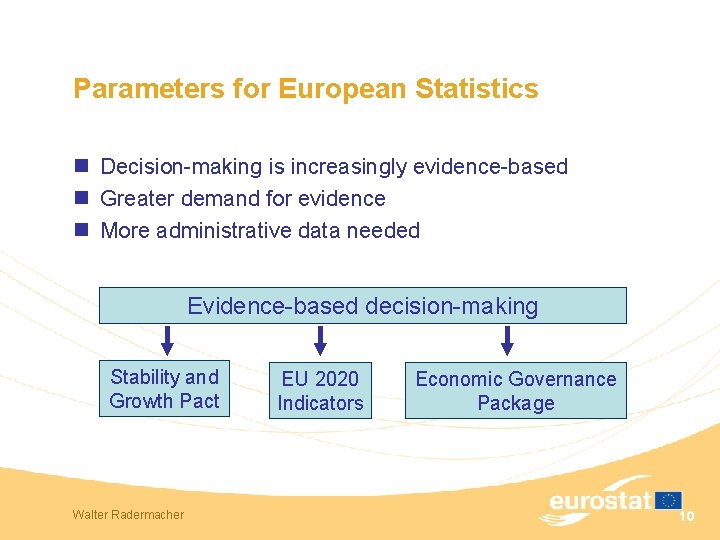
Parameters for European Statistics n Decision-making is increasingly evidence-based n Greater demand for evidence n More administrative data needed Evidence-based decision-making Stability and Growth Pact Walter Radermacher EU 2020 Indicators Economic Governance Package 10
New challenges identified for the ESS What is the appropriate degree of professional independence with regard to official statistics? – EU law sometimes includes elements of statistical methods decided by the European Parliament and Council – Statistical programmes and priorities are not fully in the hands of statistical authorities – Fixing standards for concepts may go beyond purely technical considerations (poverty levels, weights for composite indicators etc. ) Walter Radermacher 11
Recommendations for the revision of the UN Fundamental Principles (1) n Include in the preamble – The role of statistics and statistical offices has changed in the last 20 years with an increasing use of administrative data instead of survey data – The principles should apply to all official bodies producing statistics – Recognition of the role played by parliament in democratic societies regarding statistical methods and work programmes Walter Radermacher 12
Recommendations for the revision of the UN Fundamental Principles (2) n Reinforce the principles with good practice indicators as in the Code n Introduce a quality assurance framework to reinforce the good practice indicators (taking forward the current NQAF project) n Emphasize the importance of professional independence by recommending the inclusion of professional independence in statistical law n Consider the inclusion of the appointment and dismissal procedures for heads of national statistical offices Walter Radermacher 13
Recommendations for the revision of the UN Fundamental Principles (3) n Emphasize the principle of impartiality n Be more explicit about what is meant by statistical quality (for example the ESS Quality Declaration) n Ensure appropriate use of metadata, quality profiles and labelling to inform users about data reliability Walter Radermacher 14
Recommendations for the revision of the UN Fundamental Principles (4) n Introduce a system of regular assessment, monitoring and reporting to identify progress and areas for further improvement – self assessments based on a common questionnaire – peer reviews – annual monitoring Key message: Countries are responsible for putting in place robust statistical institutions that function independently Walter Radermacher 15
- Slides: 15